Wednesday, April 30, 2025
Knights of Labor

Hulton Archive/Getty Images
Published: October 29, 2009
Last Updated: February 27, 2025
Table of contents
1
Uriah Stevens, Knights of Labor Founder
2
Knights of Labor Expands Under Terrence Powderly
3
Joseph Buchanan Leads Strikes Against Railroad Companies
4
Ending Child Labor and Lobbying for a Graduated Income Tax
5
Attacks on Chinese Workers
6
Haymarket Square Riot
The Knights of Labor was founded as a secret society of tailors in Philadelphia in 1869. It grew in size and prominence in the early days of the American labor movement from the mid-to-late-1800s and played a key role in the Great Railroad Strike of 1877.
Uriah Stevens, Knights of Labor Founder
Uriah S. Stephens, a descendant of early Quaker settlers in New Jersey, founded the Knights of Labor on Thanksgiving Day 1869 in Philadelphia. When Stephens’ family lost everything during the economic panic and depression of the late 1830s, he became an indentured worker, obligated to work without pay in exchange for being trained as an apprentice mechanic.
Stephens’ experiences as a worker-led him to believe that massive changes in society were necessary. It wasn’t just enough for a group of workers at one company to strike for higher wages, he believed. Instead, all wage-earners had to be brought together into a single organization, which could then fight for the interests of them all.
When the local garment cutters union disbanded after failing to get better wages from local clothing companies, Stephens saw his chance. He called a meeting at his home, and six garment cutters showed up. Stephens explained to them his vision for an organization, “The Noble and Holy Order of the Knights of Labor,” whose members would be sworn to secrecy, and follow rituals comparable to Masonry.
Last Updated: February 27, 2025
Table of contents
1
Uriah Stevens, Knights of Labor Founder
2
Knights of Labor Expands Under Terrence Powderly
3
Joseph Buchanan Leads Strikes Against Railroad Companies
4
Ending Child Labor and Lobbying for a Graduated Income Tax
5
Attacks on Chinese Workers
6
Haymarket Square Riot
The Knights of Labor was founded as a secret society of tailors in Philadelphia in 1869. It grew in size and prominence in the early days of the American labor movement from the mid-to-late-1800s and played a key role in the Great Railroad Strike of 1877.
Uriah Stevens, Knights of Labor Founder
Uriah S. Stephens, a descendant of early Quaker settlers in New Jersey, founded the Knights of Labor on Thanksgiving Day 1869 in Philadelphia. When Stephens’ family lost everything during the economic panic and depression of the late 1830s, he became an indentured worker, obligated to work without pay in exchange for being trained as an apprentice mechanic.
Stephens’ experiences as a worker-led him to believe that massive changes in society were necessary. It wasn’t just enough for a group of workers at one company to strike for higher wages, he believed. Instead, all wage-earners had to be brought together into a single organization, which could then fight for the interests of them all.
When the local garment cutters union disbanded after failing to get better wages from local clothing companies, Stephens saw his chance. He called a meeting at his home, and six garment cutters showed up. Stephens explained to them his vision for an organization, “The Noble and Holy Order of the Knights of Labor,” whose members would be sworn to secrecy, and follow rituals comparable to Masonry.
DEATH OF POPE FRANCIS & THE NEXT POPE - 4.30.2025
NOISE OF THUNDER RADIO - 4.30.2025
Today's Show: DEATH OF POPE FRANCIS & THE NEXT POPE
Chris discusses the controversies surrounding the death of the first Jesuit pope, the prophecy of the Catholic "Saint Malachy" and who might be the next pontiff in Rome.

Wednesday, April 30, 2025 at 8:56AM
Today's Show: DEATH OF POPE FRANCIS & THE NEXT POPE - 4.30.2025
Chris discusses the stories surrounding the death of Pope Francis, the first official Jesuit pope in Rome. We consider his influence and legacy for the Catholic church in the next generation. Also discussed is the so-called prophecy of "St. Malachy" who is said to have predicted the number of popes all the way to the end of the world. Supposedly, the now-deceased pontiff was to be the final pope. Will there be a successor? And if so, will he take the name of Petrus Romanus? We review the history of the controversial prophecy of the popes and show what most modern historians and critics believe concerning it. We also consider whether the movie "Conclave" was somehow a foreshadowing of who or what the next pope might be.
Tuesday, April 29, 2025
Monday, April 28, 2025
Sunday, April 27, 2025
Saturday, April 26, 2025
All the President’s Pastors: Who’s Advising Trump?
HARVEST PRUDE
Donald Trump’s faith remains largely private, but his connections to Christian leaders are on full display this Easter.

President Donald Trump and faith advisor Paula White-Cain
CHRISTIANITY TODAYAPRIL 17, 2025
Win McNamee / Getty Images
After Franklin Graham offered a prayer at the White House Easter dinner on Wednesday, he introduced President Donald Trump to a group that already knew him quite well.
“It feels so dumb to have to introduce the president of the United States in his own house,” he said from the podium, sparking laughter around the room. “What a privilege, isn’t it? To have the president of the United States invite us here?”
The crowd was made up of faith leaders, mostly conservative evangelicals and Catholics, whose grassroots support was central to Trump winning his second term. For many, it wasn’t their first time gathering to pray with the president, whose administration has touted an open-door policy for pastors.
The president hasn’t publicly attended a church service since his inauguration day, he doesn’t hold membership in a particular congregation or denomination, he’s gone back and forth over whether he needs to ask for God’s forgiveness, and he avoids speaking in detail about his personal devotional life, so what we know about Trump’s faith comes largely from the pastors around him at the White House—starting with Paula White-Cain.
White-Cain, a prosperity-preaching televangelist and Trump’s longtime spiritual adviser, has been an unofficial guide in introducing him to other faith leaders, gathering his coterie of 25 evangelical advisers during his first term and now leading the White House Faith Office, based in the West Wing.
White-Cain told Fox & Friends during Holy Week that the office has hosted “almost 500 faith leaders” since February. By Wednesday’s dinner, the count had grown: “We’ve actually had over 1,000 faith leaders in through the White House in just this short time period,” she said.
Trump’s White House no longer releases visitor logs, but photos of evangelical supporters praying and worshiping in the Oval Office, dozens at a time, make their way to social media.
Participants regularly tout the “opportunity” and “honor” to be there and promote the administration’s Christian messaging to their followers.
5 "Sacred" Papal Symbols and Their Significance
The ancient office of the pope is rich in symbols and insignia.


VINCENZO PINTO/AFP via Getty Images
Published: April 23, 2025
Last Updated: April 23, 2025
In the Roman Catholic Church, the pope is the sucessor to St. Peter, who was given authority by Jesus to establish His church on Earth, according to the New Testament. The pope is the Bishop of Rome and the chief pastor of the Roman Catholic Church, which claims nearly 1.4 billion adherents worldwide.
The ancient office of the pope, also known as the Holy See, is rich in symbols and insignia. Here are some of the most visible and meaningful of the papal symbols.
1.
The Papal Tiara
Known as the papal tiara or the “Triple Crown,” this historic headdress is the most revered and sacred symbol of the papacy. In addition to appearing prominently on papal emblems and coats of arms, the tiara was also a physical crown worn by popes for more than 1,000 years.
The Latin name of the papal tiara is the triregnum or “triple reign.” It’s a cone-shaped headdress composed of three layers, giving the impression of an elaborate beehive adorned with gold and precious gems.
According to historians, the tiara didn’t always have three layers. The earliest versions, dating back to the fourth century, were inspired by a conical Greco-Roman headdress called a Phrygian cap, as well as a Byzantine hat known as a camelaucum.
The tiara got its first ringed “crown” in the 900s to represent the pope’s authority over the Papal States, large swaths of land in central Italy that included Rome. Even though they weren’t kings, popes in the Middle Ages enjoyed a certain level of earthly power, says Christopher Bellitto, a historian at Kean University.
The second crown debuted on the tiara of Pope Boniface VIII in 1298, who wanted to emphasize the spiritual dominion of the pope. A third crown was added a century later, perhaps to indicate the pope’s supreme spiritual and moral authority over earthly kings.
Over time, the papal tiara became more and more elaborate and bejeweled. Pope Julius II was crowned with a tiara in 1503 that was valued by a Milan jeweler at 200,000 ducats (each ducat was 3.5 grams of pure gold). Each new pope was crowned with a tiara at their coronation and wore it during special processions from St. Peter’s Basilica in Rome.
The physical tiara was removed as part of the pope’s official vestments as part of the Vatican II reforms of the 1960s.
“The last pope who had the tiara put on his head was Paul VI in 1963,” says Bellitto, author of 101 Questions & Answers on Popes and the Papacy. Paul VI’s stunning golden tiara is on display at the Basilica of the National Shrine of the Immaculate Conception in Washington, D.C.
As an emblem of the papacy, the tiara is depicted as three tiered crowns topped with an orb and a cross representing the dominion of Jesus over the world. The papal tiara figures prominently on the coat of arms of the Holy See.

The papal tiara of Pope Francis.
CLAUDIO ONORATI/AFP via Getty Images
‘Never turn people away’: In the spirit of Francis, Boston’s Catholic churches embrace immigrants

‘Never turn people away’: In the spirit of Francis, Boston’s Catholic churches embrace immigrants
Following the sexual-abuse crisis that badly damaged the Boston Archdiocese, a surge of committed, immigrant parishioners has given the...
Friday, April 25, 2025
President Trump endorses Cardinal Raymond Burke as potential successor to Pope Francis
April 21, 2025

Following the death of Pope Francis, attention has shifted to who will succeed him in the papal conclave. Cardinal Raymond Burke has emerged as a key conservative candidate. The 76-year-old American cleric from Wisconsin is known for his firm traditional views and past disagreements with the late pope.
Burke’s name is in the mix as 138 cardinals prepare to meet in secrecy to elect the next pope. While bookmakers currently place him sixth among the contenders, his visibility has increased due to support from U.S. President Donald Trump. Trump has hailed Burke as a champion of traditional Church values, especially during conflicts with Pope Francis.
Previously, Burke served as the Archbishop of St. Louis and was called to Rome by Pope Benedict XVI. However, tensions arose under Pope Francis, who removed Burke from key positions in the Vatican. Burke has often criticized the Vatican’s more inclusive approach on issues like LGBTQ rights and divorce.
As the conclave approaches, other candidates include moderates and progressives like Pietro Parolin and Luis Antonio Tagle. Burke’s candidacy—backed by political forces—raises questions about the future direction of the Church. It remains to be seen whether the next pope will continue Pope Francis’s progressive legacy or revert to traditionalist leadership.
Following the death of Pope Francis, attention has shifted to who will succeed him in the papal conclave. Cardinal Raymond Burke has emerged as a key conservative candidate. The 76-year-old American cleric from Wisconsin is known for his firm traditional views and past disagreements with the late pope.
Burke’s name is in the mix as 138 cardinals prepare to meet in secrecy to elect the next pope. While bookmakers currently place him sixth among the contenders, his visibility has increased due to support from U.S. President Donald Trump. Trump has hailed Burke as a champion of traditional Church values, especially during conflicts with Pope Francis.
Previously, Burke served as the Archbishop of St. Louis and was called to Rome by Pope Benedict XVI. However, tensions arose under Pope Francis, who removed Burke from key positions in the Vatican. Burke has often criticized the Vatican’s more inclusive approach on issues like LGBTQ rights and divorce.
As the conclave approaches, other candidates include moderates and progressives like Pietro Parolin and Luis Antonio Tagle. Burke’s candidacy—backed by political forces—raises questions about the future direction of the Church. It remains to be seen whether the next pope will continue Pope Francis’s progressive legacy or revert to traditionalist leadership.
Why Justice Amy Coney Barrett may be Haitian immigrants’ greatest ally, or foe, in the coming years
 President Donald J. Trump and First Lady Melania Trump pose for a photo with Judge Amy Coney Barrett, the President’s nominee for Associate Justice of the Supreme Court of the United States, her husband Jesse and their children Saturday, Sept. 26, 2020, in the Oval Office of the White House. Official White House Photo by Andrea Hanks.
Opinion
As legal challenges to the Trump administration’s immigration policies make their way to the courts, decisions made by Barrett, mother to two Haitian children, could shape the future of hundreds of thousands of Haitian migrants in the U.S.
 by Vania AndréMar. 07, 2025
Overview:
Justice Amy Coney Barrett, known for her conservative judicial philosophy, also has personal ties to Haiti through her two adopted children. As legal challenges to Trump’s rollback of Temporary Protected Status (TPS) and other immigration policies may reach the Supreme Court, the Haitian community should watch closely to see whether Barrett’s rulings will favor or restrict their legal pathways to stay in the U.S.
Justice Amy Coney Barrett rose to the national spotlight in 2020 during her confirmation to the U.S. Supreme Court, a lifetime appointment that grants her considerable influence over American law and policies.
Beyond her conservative judicial philosophy, Barrett drew additional attention for the makeup of her family, which consisted of seven children, two of whom were adopted from Haiti.
Now, five years later, her connection to Haiti has taken on new significance as key legal battles unfold over President Donald Trump’s immigration policies, which emphasize rolling back Temporary Protected Status (TPS) and other protections for hundreds of thousands of Haitians living in the United States.
Amy Coney Barrett Sides With Liberal Justice During Supreme Court Hearing
Published Apr 22, 2025 at 12:23 PM EDT
Updated Apr 24, 2025 at 1:18 PM EDT
Supreme Court Justice Amy Coney Barrett appeared to side with her liberal colleagues while hearing arguments in a case that will determine the future of no-cost preventive care under the Affordable Care Act.
Why It Matters
The case, Kennedy V. Braidwood challenges the legal authority of the U.S. Preventive Services Task Force (PSTF), created by the Affordable Care Act, known as Obamacare. The task force recommends services insurers must cover at no-cost measures including cancer screenings and HIV prevention drugs like PrEP. But the conservative Christian employers in Texas who brought the case, argue that the 16 members of the task force, who are appointed by the HHS secretary, are unconstitutionally appointed.
The case will be consequential for the future of American health care. If the justices uphold a New Orleans-based fifth U.S. Circuit Court of Appeals ruling in 2024, treatments that are now cost-free may become subject to payments.
Supreme Court Justice Amy Coney Barrett appeared to side with her liberal colleagues while hearing arguments in a case that will determine the future of no-cost preventive care under the Affordable Care Act.
Why It Matters
The case, Kennedy V. Braidwood challenges the legal authority of the U.S. Preventive Services Task Force (PSTF), created by the Affordable Care Act, known as Obamacare. The task force recommends services insurers must cover at no-cost measures including cancer screenings and HIV prevention drugs like PrEP. But the conservative Christian employers in Texas who brought the case, argue that the 16 members of the task force, who are appointed by the HHS secretary, are unconstitutionally appointed.
The case will be consequential for the future of American health care. If the justices uphold a New Orleans-based fifth U.S. Circuit Court of Appeals ruling in 2024, treatments that are now cost-free may become subject to payments.

Supreme Court nominee Amy Coney Barrett testifies during the third day of her confirmation hearings before the Senate Judiciary Committee on Capitol Hill in Washington, Wednesday, Oct. 14, 2020. Andrew Caballero-Reynolds/Pool via AP
Coney Barrett, who was nominated by Trump in 2020, has emerged as a centrist judge in Supreme Court cases and has been criticized by Trump supporters for voting against her conservative colleagues in the past.
Coney Barrett, who was nominated by Trump in 2020, has emerged as a centrist judge in Supreme Court cases and has been criticized by Trump supporters for voting against her conservative colleagues in the past.
What To Know
The Court's three liberal members, Justices Sonia Sotomayor, Elena Kagan and Ketanji Brown Jackson have all appeared to side with the task force while conservative justices Samuel Alito, Clarence Thomas and Neil Gorsuch appeared sympathetic to the challengers, with Thomas suggesting Congress had never designated authority to run the task force.
Conservative lawyer Jonathan Miller, who is representing the plaintiffs, argued that PSTF members are meant to be independent from political pressure. He said they could not simultaneously retain independence while being subject to supervision by the health secretary.
But Coney Barrett said Mitchell's interpretation of the word "independent" was "maximalist" and pointed to the doctrine of "constitutional avoidance" which argues that if a statute is open to interpretation, the Court should pick an interpretation that raises the least constitutional problems—i.e. the Court should not interpret the word "independent" in a way that renders the PSTF unconstitutional.
It is the latest in a string of decisions and comments by Coney Barrett which put her on a different path to her more conservative colleagues. In March, she expressed concerns about reviving the non delegation doctrine, as suggested by conservative judge Clarence Thomas. This doctrine, which hasn't been used since the 1930s, puts a cap on the amount of money federal agencies and other nonelected officials can raise through tax dollars. Coney Barrett said it would be ineffective and could weaken the power of government agencies.
In April, Coney Barrett joined liberals as the sole conservative in opposing the Court's majority decision to allow the administration to continue deporting alleged gang members under the Alien Enemies Act of 1798.
Thursday, April 24, 2025
Man Who Died In Trump Tower Fire Tried To Sell Apartment, Friend Says
April 9, 20183:24 AM ET
By
Scott Neuman

A firefighter looks out from the window of a damaged apartment in Trump Tower in New York on Saturday.Craig Ruttle/AP
Todd Brassner, a 67-year-old art dealer who died in a fire in Trump Tower over the weekend, had reportedly been trying to sell his 50th-floor apartment there since President Trump was elected, The New York Times reports.
The newspaper said Brassner — who records show purchased the apartment in 1996 — wanted to get out after Trump's 2016 election brought "increased security and scrutiny to the building" but that he could not sell the apartment for what he thought it was worth — $2.5 million in 2015.
Brassner told musician and music producer Stephen Dwire that the situation at Trump Tower was becoming "untenable," according to the Times.
"It was like living in an armed camp. But when people heard it was a Trump building, he couldn't give it away," Dwire, a friend of Brassner's said.
Brassner lived amid a collection that included artwork, such as a 1975 portrait of him painted by Andy Warhol and other pieces by Robert Indiana, Mati Klarwein and author Jack Kerouac, as well as "about 100 vintage electric guitars, 40 guitar amplifiers dating to the 1930s [and] 150 ukuleles," the Times said.
In recent years, Brassner was "plagued with debilitating medical problems" that made it "difficult for him to function," according to The Associated Press.
Firefighters were still investigating the cause of Saturday's blaze, which also injured four firefighters.
Before the death was reported, the president on Saturday tweeted that the fire was out at Trump Tower — a "well built building," he said — and thanked firefighters.
He has not tweeted about the fire again since Brassner died shortly after being taken to the hospital on Saturday.
Trump Tower was built in 1983 and did not have sprinklers, which were not required by building codes at the time. However, after two deadly high-rise apartment fires in 1999, New York City enacted a law requiring them in new construction, while exempting sprinklers in existing buildings until or unless they underwent extensive renovations.
According to the Times, "Real estate developers, including Mr. Trump, fought the sprinklers, arguing that they were unnecessary and would add $4 per square foot to the cost of an apartment."
However, the newspaper notes that Trump changed his views on the subject, concluding later that tenants felt safer with sprinklers and that he subsequently spent $3 million to install them in the Trump World Tower near the United Nations building in New York.
The AP reports: "The city's Department of Buildings on Sunday said Trump Tower did have working hard-wired smoke detectors, and that the fire department was first notified of the blaze by the detectors in the building's heating and ventilation system. A cause had not yet been determined."
CorrectionApril 9, 2018
A previous version of this story misspelled Robert Indiana's name as Indian.
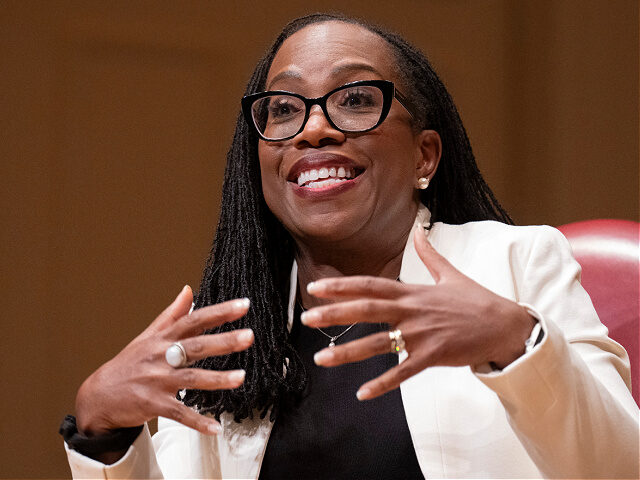
Justice Ketanji Brown Jackson on Mandatory LGBTQ+ Indoctrination: ‘You Don’t Have to Send Your Kid to That School’
23 Apr 2025
Liberal-leaning Supreme Court Justice Ketanji Brown Jackson — who was unable to define what a woman is in her confirmation hearing — appeared to side with a Maryland school district on Tuesday that is attempting to force young children to participate in LGBTQ+ curriculum, despite objections from parents.
In 2022, the Montgomery County Board of Education announced “inclusivity” books for K-5 students and took away parental notice and opt-outs for story books that discuss topics like “gender” transitions, pride parades, and preferred pronouns. In 2023, a federal court upheld a lower court decision siding with Maryland’s largest school district, and the mix of Christian, Muslim, and Jewish parents appealed to the Supreme Court. The Supreme Court agreed to take up the case in January.
In their petition, parents ultimately asked the Supreme Court to answer: “Do public schools burden parents’ religious exercise when they compel elementary school children to participate in instruction on gender and sexuality against their parents’ religious convictions and without notice or opportunity to opt out?”
Liberal-leaning Supreme Court Justice Ketanji Brown Jackson — who was unable to define what a woman is in her confirmation hearing — appeared to side with a Maryland school district on Tuesday that is attempting to force young children to participate in LGBTQ+ curriculum, despite objections from parents.
In 2022, the Montgomery County Board of Education announced “inclusivity” books for K-5 students and took away parental notice and opt-outs for story books that discuss topics like “gender” transitions, pride parades, and preferred pronouns. In 2023, a federal court upheld a lower court decision siding with Maryland’s largest school district, and the mix of Christian, Muslim, and Jewish parents appealed to the Supreme Court. The Supreme Court agreed to take up the case in January.
In their petition, parents ultimately asked the Supreme Court to answer: “Do public schools burden parents’ religious exercise when they compel elementary school children to participate in instruction on gender and sexuality against their parents’ religious convictions and without notice or opportunity to opt out?”
Conclave Viewership Shot Up 283 Percent Following Pope Francis’ Death
Angela Watercutter
Apr 22,2025 12:24 PM
Since Monday, viewers have watched nearly 7 million minutes of Conclave, a film about the process of choosing a new pope. The Two Popes saw its numbers go up 417 percent.
Since Monday, viewers have watched nearly 7 million minutes of Conclave, a film about the process of choosing a new pope. The Two Popes saw its numbers go up 417 percent.
.jpg)
Courtesy of Philippe Antonello/Focus Features
In the Roman Catholic Church, it was called the “Francis effect,” a feeling that the arrival of the more inclusive Pope Francis in 2013 would invigorate the faith and get people back in the pews.
On Monday, Francis’ passing at the age of 88 led to an effect of a different kind: a surge in viewership for Conclave, director Edward Berger’s Oscar-winning film about what happens in the Vatican when church leaders are locked in a room—or, well, the Sistine Chapel—to decide who will be the next pope.
Streaming viewership for Conclave increased 283 percent after Pope Francis’ death, jumping from 1.8 million minutes watched on April 20 to 6.9 million minutes watched on Monday, according to data from analytics firm Luminate. Netflix’s The Two Popes, meanwhile, saw a 417 percent increase in viewership over that same period, jumping from 290,000 minutes to 1.5 million minutes.
In some ways, these numbers are to be expected. Conclave’s arrival last year and eight Oscar nominations (it won for Best Adapted Screenplay) had already made it a popular film. The fact that the Vatican is about to start a real-life conclave in just a few days only increases the attention on the film. The Two Popes, meanwhile, is about Pope Francis himself, and the relationship he had with his predecessor, Pope Benedict XVI.
While the numbers are impressive, Luminate has seen similar boosts after other significant news events, according to spokesperson Jimmy Harney. When presidential candidate Donald Trump announced JD Vance as his running mate during the Republican National Convention last year, viewership for Netflix’s Hillbilly Elegy, based on Vance’s memoir, jumped 1,180 percent, according to Luminate. When news came out that Vice President Kamala Harris would likely be the Democrats’ candidate for president, US viewership for HBO’s Veep increased 353 percent.
Theoretically, Conclave’s viewership numbers could climb even higher in the coming days. On Monday, thanks to one of the many cumbersome deals that dictate the modern streaming landscape, viewers needed to rent or buy the movie in order to watch it. It cost between $6 and $20 on Amazon Prime Video. Early Tuesday, the movie became available to stream for Prime members.
Following Pope Francis’ death—an announcement that sent Catholics around the world into mourning—several news outlets (including this one) pointed to Conclave’s timeliness. The film, about a series of high-profile cardinals and their efforts to become the next pontiff, is a highly dramatized, and drama-filled, version of what the secretive conclave process looks like.
Francis’ funeral will be held in front of St. Peter’s Basilica in Rome on Saturday. Cardinals from around the world are headed to Italy to attend. After which, they will take part in the conclave, a name that’s derived from the Latin “with key,” meaning they will be locked in the historic church while they deliberate. No outside contact is permitted during the process; no phones, televisions, newspapers, or messages are allowed. Members of the College of Cardinals, the church’s most senior clergy, under the age of 80 get a vote, so about 135 of the 250-member body will be involved in the choosing.
According to Luminate data, other pope-centric films like Netflix’s Pope Francis biographic series Call Me Francis, haven’t seen the same huge spikes—yet. Maybe viewers just need to get back in the habit of watching Catholic content.
In the Roman Catholic Church, it was called the “Francis effect,” a feeling that the arrival of the more inclusive Pope Francis in 2013 would invigorate the faith and get people back in the pews.
On Monday, Francis’ passing at the age of 88 led to an effect of a different kind: a surge in viewership for Conclave, director Edward Berger’s Oscar-winning film about what happens in the Vatican when church leaders are locked in a room—or, well, the Sistine Chapel—to decide who will be the next pope.
Streaming viewership for Conclave increased 283 percent after Pope Francis’ death, jumping from 1.8 million minutes watched on April 20 to 6.9 million minutes watched on Monday, according to data from analytics firm Luminate. Netflix’s The Two Popes, meanwhile, saw a 417 percent increase in viewership over that same period, jumping from 290,000 minutes to 1.5 million minutes.
In some ways, these numbers are to be expected. Conclave’s arrival last year and eight Oscar nominations (it won for Best Adapted Screenplay) had already made it a popular film. The fact that the Vatican is about to start a real-life conclave in just a few days only increases the attention on the film. The Two Popes, meanwhile, is about Pope Francis himself, and the relationship he had with his predecessor, Pope Benedict XVI.
While the numbers are impressive, Luminate has seen similar boosts after other significant news events, according to spokesperson Jimmy Harney. When presidential candidate Donald Trump announced JD Vance as his running mate during the Republican National Convention last year, viewership for Netflix’s Hillbilly Elegy, based on Vance’s memoir, jumped 1,180 percent, according to Luminate. When news came out that Vice President Kamala Harris would likely be the Democrats’ candidate for president, US viewership for HBO’s Veep increased 353 percent.
Theoretically, Conclave’s viewership numbers could climb even higher in the coming days. On Monday, thanks to one of the many cumbersome deals that dictate the modern streaming landscape, viewers needed to rent or buy the movie in order to watch it. It cost between $6 and $20 on Amazon Prime Video. Early Tuesday, the movie became available to stream for Prime members.
Following Pope Francis’ death—an announcement that sent Catholics around the world into mourning—several news outlets (including this one) pointed to Conclave’s timeliness. The film, about a series of high-profile cardinals and their efforts to become the next pontiff, is a highly dramatized, and drama-filled, version of what the secretive conclave process looks like.
Francis’ funeral will be held in front of St. Peter’s Basilica in Rome on Saturday. Cardinals from around the world are headed to Italy to attend. After which, they will take part in the conclave, a name that’s derived from the Latin “with key,” meaning they will be locked in the historic church while they deliberate. No outside contact is permitted during the process; no phones, televisions, newspapers, or messages are allowed. Members of the College of Cardinals, the church’s most senior clergy, under the age of 80 get a vote, so about 135 of the 250-member body will be involved in the choosing.
According to Luminate data, other pope-centric films like Netflix’s Pope Francis biographic series Call Me Francis, haven’t seen the same huge spikes—yet. Maybe viewers just need to get back in the habit of watching Catholic content.
Wednesday, April 23, 2025
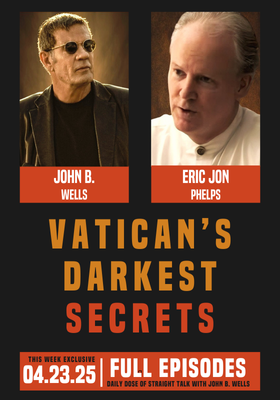
Vatican’s Darkest Secrets - John B Wells LIVE - w Eric Jon Phelps
Note:
The interview begins at 1:44:00 Mins. and ends at 4:10:00 Mins. of the podcast.
2502 - Vatican's Darkest Secrets
2502 - Vatican's Darkest Secrets
Release Date
23 April 2025
Tonight's Guest: Eric Jon Phelps
Website: https://vaticanassassins.org/
Episode Description: View Transcripts
In Episode 2502 of Caravan to Midnight, host John B. Wells welcomes first-time guest Eric Jon Phelps, the renowned author and historian known for his exhaustive research on the Jesuits and the Vatican's covert influence on global affairs. The episode, titled "The Vatican's Darkest Secrets," delves deep into the covert machinations of the Society of Jesus (Jesuits) and their alleged orchestration of global events, including wars and political assassinations, notably that of President John F. Kennedy.
Phelps, author of the 1,836-page exposé Vatican Assassins 3: Wounded in the House of My Friends, presents a compelling argument about the central role of the Vatican and Jesuit Order in global power dynamics. The conversation spans historical revelations, religious conspiracies, and a critical look at how these forces shape world events from the shadows. The episode also touches on controversial interpretations of AI, biblical prophecy, and the modern "beast system," linking contemporary technology to scriptural warnings.
Wells supports the discourse with current events and cultural observations, weaving in political critique, media distrust, and commentary on global socio-political movements. With its blend of theological insight, historical analysis, and provocative perspectives, this episode promises a thought-provoking journey into forbidden history and unseen powers.
Listeners intrigued by deep state theory, religious manipulation, and the intersections of prophecy and modern governance will find this installment both riveting and revelatory.
Relevant Topics:
Cast
John B. Wells
Host
2502 - Vatican's Darkest Secrets
Release Date
23 April 2025
Tonight's Guest: Eric Jon Phelps
Website: https://vaticanassassins.org/
Episode Description: View Transcripts
In Episode 2502 of Caravan to Midnight, host John B. Wells welcomes first-time guest Eric Jon Phelps, the renowned author and historian known for his exhaustive research on the Jesuits and the Vatican's covert influence on global affairs. The episode, titled "The Vatican's Darkest Secrets," delves deep into the covert machinations of the Society of Jesus (Jesuits) and their alleged orchestration of global events, including wars and political assassinations, notably that of President John F. Kennedy.
Phelps, author of the 1,836-page exposé Vatican Assassins 3: Wounded in the House of My Friends, presents a compelling argument about the central role of the Vatican and Jesuit Order in global power dynamics. The conversation spans historical revelations, religious conspiracies, and a critical look at how these forces shape world events from the shadows. The episode also touches on controversial interpretations of AI, biblical prophecy, and the modern "beast system," linking contemporary technology to scriptural warnings.
Wells supports the discourse with current events and cultural observations, weaving in political critique, media distrust, and commentary on global socio-political movements. With its blend of theological insight, historical analysis, and provocative perspectives, this episode promises a thought-provoking journey into forbidden history and unseen powers.
Listeners intrigued by deep state theory, religious manipulation, and the intersections of prophecy and modern governance will find this installment both riveting and revelatory.
Relevant Topics:
- Jesuit Order and Vatican Influence
- AI and Prophetic End-Times Warnings
- Assassination of President John F. Kennedy
- Media Censorship and Predictive Programming
- Deep State and Globalist Agendas
- Religious Symbolism and Scriptural Analysis
- South African Sociopolitical Crisis
- Historical Revisionism and Nazi Terminology Origins
- U.S. Immigration and Scientific Controversy
- Central Bank Digital Currencies and Surveillance
Cast
John B. Wells
Host
Description Courtesy of (zutalk) https://zutalk.com/2502-vaticans-darkest-secrets
As the first Latin American pope, Francis shifted the Catholic Church's center
(RNS) — Drawing on Latin American theology that emphasizes collaboration, developed in response to continued struggles with colonialism, Francis pushed for a Catholic Church with broader inclusion of people on the margins.
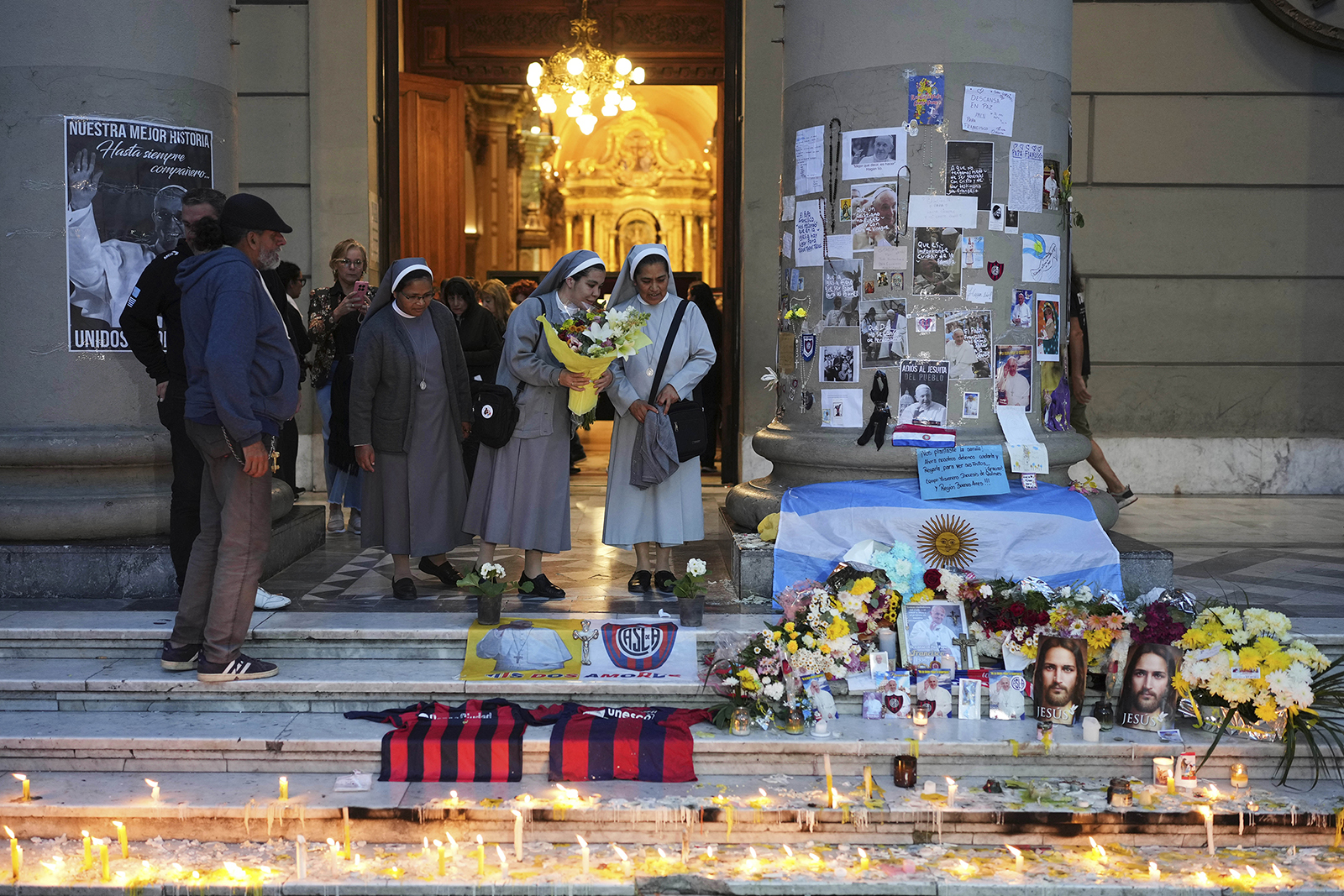
Nuns hold flowers and look at a memorial to the late Pope Francis outside the Metropolitan Cathedral in Buenos Aires, Argentina, Tuesday, April 22, 2025. (AP Photo/Rodrigo Abd)
Aleja Hertzler-McCain
April 22, 2025
(RNS) — When Pope Francis stepped onto the balcony of St. Peter’s Basilica for the first time back in 2013, he told the crowds below him that the College of Cardinals had gone “almost to the ends of the earth” to find the new bishop of Rome.
Over 500 years after papal bulls authorized the violent, colonial conquest of non-Christian peoples, paving the way for Catholicism to take root in the Americas, Francis was the first pope to emerge from those lands. Drawing on the region’s theology that emphasizes collaboration and developed in response to continued struggles with colonialism, Francis pushed for a Catholic Church with broader participation and inclusion of people on the margins, scholars told RNS before and after his death on Monday (April 21).
“We were, for several centuries, a church that reflected what they do in Europe — we repeated, copied Europe,” said Maria Clara Lucchetti Bingemer, a theology professor at the Pontifical Catholic University of Rio de Janeiro, in Spanish.
Latin American bishops began to implement the teachings of the modernizing Second Vatican Council right after the council in the early 1960s. And as a result, “we try to be a church that is a source, a church that generates its own content, that generates the way we celebrate our rituals, that generates our priorities,” Bingemer said. Francis made sure those efforts grew “in a strong and exponential way.”
As archbishop of Argentina, Cardinal Jorge Bergoglio, who would take the name Francis when he became pope in 2013, came up within the Latin American bishops’ conference, known as CELAM. That school of thought would become prominent during his papacy.
In 2007, he chaired the committee that drafted the final document for CELAM’s general conference in Aparecida, Brazil, which encouraged Catholics to be “missionary disciples” and described the church as the “home of the poor.” Both became key concepts six years later in Francis’ first apostolic exhortation, “Evangelii Gaudium,” in which the new pope encouraged the church to “go forth,” share “the joy of the Gospel” and understand “God’s heart has a special place for the poor.”
The Jesuits’ complicated past in Haiti: From owning plantations to serving the Black community


Benjamin E. Heidgerken
June 17, 2022
As the enslaved woman handed her newborn daughter to her master, she could not look him in the eye. It was hot (it was always hot), and she had to get back to the cane field that afternoon. But her manner had nothing to do with her duties.
The man took the girl, turned and walked to the baptismal font. He always moved confidently—his confidence was typical of the grand blancs in the Haitian colony. The enslaved persons he trusted were there, along with his wife and children. His family had begrudgingly accompanied him from France to the remote island. They all saw the colony the same way: just another step toward a lucrative return to the motherland and a château on the Loire.
The grand blanc held the child over the font, waiting for the Priest of the Blacks to start the ceremony. In his Roman collar, the Jesuit’s poise nearly matched the master’s. Having supplanted the Capuchins in northern Saint-Domingue in 1704, the Society of Jesus knew what it took to maintain its ecclesiastical rights and position in the colony. Despite many financial and civil obstacles, it had built a substantial missionary enterprise, preaching and teaching on an island where survival and profits were the order of the day. God had formed servants from the soil, but the Society had to get its hands dirtier to return humanity to God’s service. It had five plantations on the island with many enslaved Africans to fund its mission.
The priest smiled at the baby girl, then looked sternly at the supposed owner of this tiny image of God. Her skin was unlike that of her siblings—much lighter in tone. The Jesuit noted the downcast look on the mother’s face.
“I see,” said the Jesuit, searching for the next words. The grand blanc’s “confidence” was well known in Cap-Français, but before now its consequences had been confined to the mother’s downtrodden expression and the walls of the confessional. Gathering himself and glancing around quickly to see if any government officials were among those attending the baptism, he looked gravely at the master. “What is your relationship with this little girl?”
My research on the Society of Jesus in Saint-Domingue began about two years ago as I looked for stories that my seminary students could tell their congregations about Catholicism and slavery. In contrast to a narrative that reflects antebellum anxieties of white American Protestant slavers about the dangers of revolution, I wanted to find stories of Catholic agency—the good, the bad and the ugly. The writings of Médéric Louis Élie Moreau de Saint-Méry, from which I drew the story above, became my window into this history.
As the enslaved woman handed her newborn daughter to her master, she could not look him in the eye. It was hot (it was always hot), and she had to get back to the cane field that afternoon. But her manner had nothing to do with her duties.
The man took the girl, turned and walked to the baptismal font. He always moved confidently—his confidence was typical of the grand blancs in the Haitian colony. The enslaved persons he trusted were there, along with his wife and children. His family had begrudgingly accompanied him from France to the remote island. They all saw the colony the same way: just another step toward a lucrative return to the motherland and a château on the Loire.
The grand blanc held the child over the font, waiting for the Priest of the Blacks to start the ceremony. In his Roman collar, the Jesuit’s poise nearly matched the master’s. Having supplanted the Capuchins in northern Saint-Domingue in 1704, the Society of Jesus knew what it took to maintain its ecclesiastical rights and position in the colony. Despite many financial and civil obstacles, it had built a substantial missionary enterprise, preaching and teaching on an island where survival and profits were the order of the day. God had formed servants from the soil, but the Society had to get its hands dirtier to return humanity to God’s service. It had five plantations on the island with many enslaved Africans to fund its mission.
The priest smiled at the baby girl, then looked sternly at the supposed owner of this tiny image of God. Her skin was unlike that of her siblings—much lighter in tone. The Jesuit noted the downcast look on the mother’s face.
“I see,” said the Jesuit, searching for the next words. The grand blanc’s “confidence” was well known in Cap-Français, but before now its consequences had been confined to the mother’s downtrodden expression and the walls of the confessional. Gathering himself and glancing around quickly to see if any government officials were among those attending the baptism, he looked gravely at the master. “What is your relationship with this little girl?”
My research on the Society of Jesus in Saint-Domingue began about two years ago as I looked for stories that my seminary students could tell their congregations about Catholicism and slavery. In contrast to a narrative that reflects antebellum anxieties of white American Protestant slavers about the dangers of revolution, I wanted to find stories of Catholic agency—the good, the bad and the ugly. The writings of Médéric Louis Élie Moreau de Saint-Méry, from which I drew the story above, became my window into this history.
Tuesday, April 22, 2025
Monday, April 21, 2025
HONORING THE MEMORY OF HIS HOLINESS POPE FRANCIS
Presidential Actions
Proclamations
April 21, 2025
By the President of the United States of America
A Proclamation
As a mark of respect for the memory of His Holiness Pope Francis, by the authority vested in me as President of the United States by the Constitution and the laws of the United States of America, I hereby order that the flag of the United States shall be flown at half-staff at the White House and upon all public buildings and grounds, at all military posts and naval stations, and on all naval vessels of the Federal Government in the District of Columbia and throughout the United States and its Territories and possessions until sunset, on the day of interment. I also direct that the flag shall be flown at half-staff for the same length of time at all United States embassies, legations, consular offices, and other facilities abroad, including all military facilities and naval vessels and stations.
IN WITNESS WHEREOF, I have hereunto set my hand this twenty-first day of April, in the year of our Lord two thousand twenty-five, and of the Independence of the United States of America the two hundred and forty-ninth.
DONALD J. TRUMP
April 21, 2025
By the President of the United States of America
A Proclamation
As a mark of respect for the memory of His Holiness Pope Francis, by the authority vested in me as President of the United States by the Constitution and the laws of the United States of America, I hereby order that the flag of the United States shall be flown at half-staff at the White House and upon all public buildings and grounds, at all military posts and naval stations, and on all naval vessels of the Federal Government in the District of Columbia and throughout the United States and its Territories and possessions until sunset, on the day of interment. I also direct that the flag shall be flown at half-staff for the same length of time at all United States embassies, legations, consular offices, and other facilities abroad, including all military facilities and naval vessels and stations.
IN WITNESS WHEREOF, I have hereunto set my hand this twenty-first day of April, in the year of our Lord two thousand twenty-five, and of the Independence of the United States of America the two hundred and forty-ninth.
DONALD J. TRUMP
World Economic Forum chairman Klaus Schwab steps down
4 hours ago
Klaus Schwab has led the WEF — the organization behind the prestigious Davos conference — for over 50 years. But Schwab's life work has also been criticized as a symbol of the elites' detachment from ordinary people.
Klaus Schwab has led the WEF — the organization behind the prestigious Davos conference — for over 50 years. But Schwab's life work has also been criticized as a symbol of the elites' detachment from ordinary people.

Klaus Schwab founded the World Economic Forum in 1971Image: Michael Buholzer/KEYSTONE/picture alliance
The founder of the World Economic Forum (WEF), Klaus Schwab, resigned on Monday as chairman of the forum's board.
"Following my recent announcement, and as I enter my 88th year, I have decided to step down from the position of Chair and as a member of the Board of Trustees, with immediate effect," he said in a statement released by the WEF.
The German-born economist did not offer a reason for leaving the Geneva-based WEF, which organizes annual meeting of the international political and economic elite in the Swiss luxury ski resort of Davos.
Vice Chairman Peter Brabeck-Letmathe will serve as interim chairman, with the search for a new chair having begun after Schwab's resignation was accepted at an extraordinary meeting on April 20.
Schwab established the WEF in 1971 with the aim of creating a forum for policymakers and top corporate executives to tackle major global issues. The first conference was also held in Davos that year, with hundreds attending, including businesspeople, academics and politicians.
Full text of Pope Francis’ blessing ‘urbi et orbi’ for Easter 2025
Catholic News Agency / April 20, 2025
By Pope Francis
CNA Newsroom, Apr 20, 2025 / 06:48 am
On Easter Sunday 2025, Pope Francis did not deliver his speech in person, though he briefly greeted the faithful with a brief “Brothers and Sisters, Happy Easter”.
The pope’s traditio, “urbi et orbi,” was read by Archbishop Diego Ravelli, the Master of Pontifical Liturgical Celebrations, as the 88-year-old pontiff, still convalescing, was present but physically limited. Pope Francis briefly blessed the crowd after the message was read.
“Urbi et orbi” means “To the city [of Rome] and to the world.” It is a special apostolic blessing given by the pope every year on Easter Sunday, Christmas, and other special occasions.
Here is the full text of the pope’s message:
Christ is risen, alleluia!
Dear brothers and sisters, Happy Easter!
Sunday, April 20, 2025
France Killed the GOSPEL — and Paid the PRICE - The Great Controversy Ep...
@Approx. 37:00 Mins. -- Ellen G. White's well know depiction of the Order of Jesus, the JESUITS.
France, Denmark, Germany, and Ireland Join Canada in Urging Travelers to Use Burner Phones at US Borders Amid Digital Surveillance and Detention Fears: New Update You Need to Know Friday, April 18, 2025 France, denmark, germany, and ireland, canada, burner phones, us, In a major escalation of international travel precautions, France, Denmark, Germany, and Ireland have joined Canada in advising their citizens to use burner phones when entering the United States, citing growing fears of digital surveillance and arbitrary border detentions. The coordinated warnings reflect mounting concern over reports that U.S. border agents are inspecting personal devices, accessing private data, and detaining travelers based on digital content—prompting a wave of new travel protocols across Europe and North America. In a sweeping move that signals a new level of concern over data privacy, France, Denmark, Germany, and Ireland have joined Canada in updating their travel advisories for the United States. All five nations are now urging their citizens to travel with burner phones and take extra digital precautions when entering the U.S., citing increased incidents of invasive surveillance and border detentions. Advertisement This collective action marks a historic shift in diplomatic posture toward U.S. border procedures, traditionally seen as robust but predictable. Now, European nations are equating digital risk at U.S. borders with high-surveillance countries, recommending precautions once reserved for adversarial states. Why the Sudden Shift? Recent reports have revealed widespread inspections of travelers’ personal devices by U.S. Customs and Border Protection (CBP). These include unauthorized access to emails, social media accounts, photos, and private communications, even in the absence of a criminal warrant. Such scrutiny has led to an uptick in travelers being detained, questioned, or denied entry based on digital content found during inspection. In response, several European governments have updated their travel guidelines, warning citizens that bringing personal smartphones, laptops, or tablets across the U.S. border may put their privacy at risk. Burner Phones: Now a Recommended Travel Essential At the heart of the new advisories is the explicit recommendation to use burner phones or temporary devices. These low-cost, limited-function phones allow travelers to communicate and access essential services without exposing sensitive personal or professional data to border officials. Travelers are also being advised to: Wipe personal data from all devices before travel Avoid logging into personal email or social media accounts while in the U.S. Use encrypted cloud storage instead of local files Minimize device use at customs to reduce exposure Canada Leads, Europe Follows Canada was among the first to tighten its advisory, announcing a new registration requirement for Canadians staying in the U.S. longer than 30 days, starting April 11, 2025. Canadian legal experts have also begun recommending burner phones to avoid border complications linked to device searches. Shortly after, France, Germany, Denmark, and Ireland followed suit, each revising their official guidance and warning citizens about the increasing unpredictability of U.S. border enforcement. EU Deploys Burner Phones for Diplomats On the institutional side, the European Union has begun issuing burner phones and stripped-down laptops to its officials traveling to the U.S., a practice typically reserved for high-risk countries like Russia or China. The move underscores how seriously Europe now views digital surveillance risks in the U.S.—and marks the first time such protocols are being applied to an allied nation. According to updated internal protocols, EU officials are now barred from bringing personal devices and must use secure, pre-cleared hardware when traveling for official purposes to the United States. Border Incidents Driving Global Policy Changes The policy changes stem from a growing number of border incidents involving device inspections and detentions. In several cases, travelers were allegedly questioned or refused entry due to their online activity, political views, or even text message content. These incidents have triggered widespread concern about freedom of expression, data protection, and due process, leading to a ripple effect across Europe and North America. What Travelers Should Know Now If you’re a traveler from Canada, France, Germany, Ireland, or Denmark, or if you’re concerned about digital privacy at the U.S. border, consider these best practices: Use burner phones and basic laptops with minimal data Log out of all personal accounts and use incognito browsers if access is necessary Back up all data to the cloud and wipe devices before travel Avoid storing sensitive, political, or professional information on any hardware Comply strictly with all visa requirements and documentation Expect longer wait times if carrying multiple devices or if flagged by CBP France, Denmark, Germany, and Ireland have joined Canada in advising travelers to use burner phones at U.S. borders due to rising fears of digital surveillance, device inspections, and unexpected detentions. The move follows reports of border agents accessing personal data and denying entry based on digital content. A New Era of Caution in Transatlantic Travel The coordinated action by Canada and key EU countries reflects a broader transformation in global travel norms, where digital security is now considered as critical as physical safety. The normalization of burner phones and data hygiene practices may signal the beginning of a long-term shift in how personal technology is treated at borders, particularly as surveillance capabilities continue to expand and international trust continues to erode. What was once viewed as paranoia is quickly becoming protocol—and travelers around the world are being forced to weigh convenience against control in an increasingly monitored world...
France, Denmark, Germany, and Ireland Join Canada in Urging Travelers to Use Burner Phones at US Borders Amid Digital Surveillance and Detention Fears: New Update You Need to Know
Friday, April 18, 2025

In a major escalation of international travel precautions, France, Denmark, Germany, and Ireland have joined Canada in advising their citizens to use burner phones when entering the United States, citing growing fears of digital surveillance and arbitrary border detentions. The coordinated warnings reflect mounting concern over reports that U.S. border agents are inspecting personal devices, accessing private data, and detaining travelers based on digital content—prompting a wave of new travel protocols across Europe and North America.
In a sweeping move that signals a new level of concern over data privacy, France, Denmark, Germany, and Ireland have joined Canada in updating their travel advisories for the United States. All five nations are now urging their citizens to travel with burner phones and take extra digital precautions when entering the U.S., citing increased incidents of invasive surveillance and border detentions.
This collective action marks a historic shift in diplomatic posture toward U.S. border procedures, traditionally seen as robust but predictable. Now, European nations are equating digital risk at U.S. borders with high-surveillance countries, recommending precautions once reserved for adversarial states.
Friday, April 18, 2025
In a major escalation of international travel precautions, France, Denmark, Germany, and Ireland have joined Canada in advising their citizens to use burner phones when entering the United States, citing growing fears of digital surveillance and arbitrary border detentions. The coordinated warnings reflect mounting concern over reports that U.S. border agents are inspecting personal devices, accessing private data, and detaining travelers based on digital content—prompting a wave of new travel protocols across Europe and North America.
In a sweeping move that signals a new level of concern over data privacy, France, Denmark, Germany, and Ireland have joined Canada in updating their travel advisories for the United States. All five nations are now urging their citizens to travel with burner phones and take extra digital precautions when entering the U.S., citing increased incidents of invasive surveillance and border detentions.
This collective action marks a historic shift in diplomatic posture toward U.S. border procedures, traditionally seen as robust but predictable. Now, European nations are equating digital risk at U.S. borders with high-surveillance countries, recommending precautions once reserved for adversarial states.
Saturday, April 19, 2025
SEVEN UP 2025 FFJAN [Annual Adventist youth celebration 2025]
Rassemblement de jeunesse. fête annuelle de la jeunesse Adventiste. Session 2025
Translation:
Youth gathering. Annual Adventist youth celebration. 2025 Session
P.S.
The things you have described as taking place in Indiana, the Lord has shown me would take place just before the close of probation. Every uncouth thing will be demonstrated. There will be shouting, with drums, music, and dancing. The senses of rational beings will become so confused that they cannot be trusted to make right decisions. And this is called the moving of the Holy Spirit.The Holy Spirit never reveals itself in such methods, in such a bedlam of noise. This is an invention of Satan to cover up his ingenious methods for making of none effect the pure, sincere, elevating, ennobling, sanctifying truth for this time. Better never have the worship of God blended with music than to use musical instruments to do the work which last January was represented to me would be brought into our camp meetings. The truth for this time needs nothing of this kind in its work of converting souls. A bedlam of noise shocks the senses and perverts that which if conducted aright might be a blessing. The powers of satanic agencies blend with the din and noise, to have a carnival, and this is termed the Holy Spirit's working.
Selected Messages, Book 2, p.36.
"Everyone out, no photos": White House briefing ends abruptly, Trump's press conference cut short

Screenshot (Courtesy) The Economic Times
https://www.youtube.com/watch?v=c90UDwko4bk
"Everyone out, no photos": White House briefing ends abruptly, Trump's press conference cut short
ET Online Last Updated: 18 April, 2025 02:46 PM -4 GMT
Donald Trump's press conference in the Oval Office came to an abrupt end after a young girl in attendance suddenly fainted. He was answering questions from reporters on nuclear tensions with Iran and the deportation of Kilmar Abrego Garcia. After the girl fainted, White House aides to ran into action to disperse reporters and photographers.
Read more at:
https://economictimes.indiatimes.com//news/international/global-trends/everyone-out-no-photos-white-house-briefing-ends-abruptly-trumps-press-conference-cut-short/articleshow/120423266.cms?utm_source=contentofinterest&utm_medium=text&utm_campaign=cppst
Read more at:
https://economictimes.indiatimes.com//news/international/global-trends/everyone-out-no-photos-white-house-briefing-ends-abruptly-trumps-press-conference-cut-short/articleshow/120423266.cms?utm_source=contentofinterest&utm_medium=text&utm_campaign=cppst
Friday, April 18, 2025
“God Often Uses Migration to Spread the Message”
•16 Apr 2025
Refugee coordinator shares insights, ideas on how to better reach migrant populations.
Marcos Paseggi, Adventist Review

Terri Saelee, North American Division Refugee and Immigrant Ministries coordinator, discussed, during the Atlantic Union Conference SEEDS Festival of the Laity conference in Stamford, Connecticut, United States, how to better reach refugee populations across the region. [Photo: Marcos Paseggi, Adventist Review]
“God often uses migration to spread the message,” said Terri Saelee, North American Division Refugee and Immigrant Ministries coordinator, on March 30. Saelee’s words were part of a presentation entitled “Refugees and the New Pentecost,” given during the 2025 Atlantic Union Conference (AUC) SEEDS Festival of the Laity conference in Stamford, Connecticut, United States.
Saelee explained that even though “you won’t find the word ‘refugee’ in the Bible . . . , most of the Bible is about how God mentored, loved, used, and helped a group of refugees,” starting with Abraham. “When people come to our country, there’s a tendency . . . to push back on any new immigrant.
Just a Distraction?
Even though Saelee grew up on a Nebraska farm in the U.S. that had been part of her family for generations, she said that God led her to serve refugees in Thailand. It was a life-changing experience, she shared. There she was not only able to connect with refugees but also to see how it was not uncommon for locals to look down on newcomers, even though they contributed to their economy. “I think it’s human nature,” she said. “When we think of refugees overseas, it happens that if we can choose whom and when to help, we feel good about it. But when we come across refugees or asylum seekers and they don’t fit into our plan, it’s harder to have a proper attitude.”
Saelee said that against that background, she has come to appreciate the Bible story of the good Samaritan more. “I think that nowadays most would praise the priest and the Levite because they didn’t get distracted; they kept on track with their goals for the day. But the Samaritan came by and saw an opportunity in the distraction.” In that sense, she emphasized, “one key to be someone God can use to reach refugees and immigrants is to be prepared to see opportunities in distractions from our schedule.”
“God often uses migration to spread the message,” said Terri Saelee, North American Division Refugee and Immigrant Ministries coordinator, on March 30. Saelee’s words were part of a presentation entitled “Refugees and the New Pentecost,” given during the 2025 Atlantic Union Conference (AUC) SEEDS Festival of the Laity conference in Stamford, Connecticut, United States.
Saelee explained that even though “you won’t find the word ‘refugee’ in the Bible . . . , most of the Bible is about how God mentored, loved, used, and helped a group of refugees,” starting with Abraham. “When people come to our country, there’s a tendency . . . to push back on any new immigrant.
Just a Distraction?
Even though Saelee grew up on a Nebraska farm in the U.S. that had been part of her family for generations, she said that God led her to serve refugees in Thailand. It was a life-changing experience, she shared. There she was not only able to connect with refugees but also to see how it was not uncommon for locals to look down on newcomers, even though they contributed to their economy. “I think it’s human nature,” she said. “When we think of refugees overseas, it happens that if we can choose whom and when to help, we feel good about it. But when we come across refugees or asylum seekers and they don’t fit into our plan, it’s harder to have a proper attitude.”
Saelee said that against that background, she has come to appreciate the Bible story of the good Samaritan more. “I think that nowadays most would praise the priest and the Levite because they didn’t get distracted; they kept on track with their goals for the day. But the Samaritan came by and saw an opportunity in the distraction.” In that sense, she emphasized, “one key to be someone God can use to reach refugees and immigrants is to be prepared to see opportunities in distractions from our schedule.”
Thursday, April 17, 2025
Wednesday, April 16, 2025
Tuesday, April 15, 2025
Tuesdays with Ezekiel (Chapter 16)

on April 27, 2021by Rick and Linda
From the shortest chapter in Ezekiel (15), we move to the longest chapter. Dan Block points out that chapter 16 is longer than six of the minor prophets. But what makes chapter 16 so memorable is not primarily its length but its content. It is one of the most evocative, emotional, disturbing sections of Scripture. The Lord gives Ezekiel an extended word-picture of Jerusalem’s spiritual infidelity that is graphic and grisly. Jerusalem is compared to a wife who, after having been saved and served by her divine Husband, opts to become a foolish prostitute with other gods and surrounding nations. After brazenly playing the whore, she receives the “blood of wrath and jealousy” from the Lord (38). Although we would expect a complete and final divorce, the Lord astounds once again by promising to establish an “everlasting covenant” (60) with the very one who broke His covenant (59).
This chapter is difficult to read but not difficult to understand. The chapter reads like a movie script, starting with the birth of an unwanted girl to a mixed marriage (Amorite and Hittite—3). This daughter was cast into an open field to die, left wallowing in her own blood, completely uncared for (4-5). But the Lord saw this orphaned, helpless child and showed compassion by giving her life (“‘Live’ I said to you . . . ‘Live’”—6). He takes the girl in and, when she has grown up, takes her as His bride (“entered into a covenant with you”—8). He cleans her up (9) and then lavishes her with the finest of clothing, jewelry and food (10-12). She becomes a queen (crowned—12), stunning in the beauty and splendor given her by the Lord (14).
Then, instead of hearing they “lived happily ever after,” the story line takes a dark turn. The queen goes rogue. Over the course of the next 20 verses (15-34), we read a sexually-explicit account of her infidelities. She plays the whore with false gods and surrounding nations. And she does it all at her own expense, paying her other lovers with the very riches and children she received from her divine Husband. The translators of the Hebrew text had a difficult time bringing some of the phrases into English in a way that would be appropriate for all-ages. This is no longer a G or PG movie.
The Lord—the divine Husband—is both broken hearted and outraged. He sentences her (Jerusalem) to a just but gruesome punishment. Her so-called lovers will be brought to turn on her, strip her bare and cut her to pieces, and burn her houses (39-41). Thus the Lord says He will “satisfy my wrath on you, and my jealousy shall depart from you, I will be calm and will be no more be angry” (42). This woman (Jerusalem) has proven to be more wicked than her “sisters”—Samaria and Sodom (46-51).
Trump Issues Holy Week Declaration on 'the Living Son of God', Plans White House Easter Service

President Donald Trump prays as he holds his first Cabinet meeting at the White House in Washington, Wednesday, Feb. 26, 2025. (Pool via AP)
BENJAMIN GILL
04-14-2025
President Trump issued a faith-filled presidential message on Palm Sunday in honor of Holy Week as Christians around the world commemorate the holiest time of the year. And now there are reports that his administration is also planning a unique Easter staff worship ceremony at the White House with Rev. Franklin Graham as well as Pastors Greg Laurie and Jentezen Franklin.
Trump's Holy Week message wasn't a typical, obligatory, official government statement. Instead, it was filled with the type of language used by Christians, pointing to this week as being sacred to his personal faith, as his own post to Truth Social even declared, "HE IS RISEN!"
He declared, "This Holy Week, Melania and I join in prayer with Christians celebrating the crucifixion and resurrection of our Lord and Savior, Jesus Christ—the living Son of God who conquered death, freed us from sin, and unlocked the gates of Heaven for all of humanity."
The White House statement referred to the pivotal events that filled this Holy Week, including Jesus' "triumphal entry into Jerusalem," Holy Thursday when His Last Supper took place, Good Friday as the day Christ was crucified for our sins, and finally "His miraculous Resurrection from the dead" on Sunday.
"During this sacred week, we acknowledge that the glory of Easter Sunday cannot come without the sacrifice Jesus Christ made on the cross. In His final hours on Earth, Christ willingly endured excruciating pain, torture, and execution on the cross out of a deep and abiding love for all His creation. Through His suffering, we have redemption. Through His death, we are forgiven of our sins. Through His Resurrection, we have hope of eternal life. On Easter morning, the stone is rolled away, the tomb is empty, and light prevails over darkness—signaling that death does not have the final word," Trump's statement continues.
BENJAMIN GILL
04-14-2025
President Trump issued a faith-filled presidential message on Palm Sunday in honor of Holy Week as Christians around the world commemorate the holiest time of the year. And now there are reports that his administration is also planning a unique Easter staff worship ceremony at the White House with Rev. Franklin Graham as well as Pastors Greg Laurie and Jentezen Franklin.
Trump's Holy Week message wasn't a typical, obligatory, official government statement. Instead, it was filled with the type of language used by Christians, pointing to this week as being sacred to his personal faith, as his own post to Truth Social even declared, "HE IS RISEN!"
He declared, "This Holy Week, Melania and I join in prayer with Christians celebrating the crucifixion and resurrection of our Lord and Savior, Jesus Christ—the living Son of God who conquered death, freed us from sin, and unlocked the gates of Heaven for all of humanity."
The White House statement referred to the pivotal events that filled this Holy Week, including Jesus' "triumphal entry into Jerusalem," Holy Thursday when His Last Supper took place, Good Friday as the day Christ was crucified for our sins, and finally "His miraculous Resurrection from the dead" on Sunday.
"During this sacred week, we acknowledge that the glory of Easter Sunday cannot come without the sacrifice Jesus Christ made on the cross. In His final hours on Earth, Christ willingly endured excruciating pain, torture, and execution on the cross out of a deep and abiding love for all His creation. Through His suffering, we have redemption. Through His death, we are forgiven of our sins. Through His Resurrection, we have hope of eternal life. On Easter morning, the stone is rolled away, the tomb is empty, and light prevails over darkness—signaling that death does not have the final word," Trump's statement continues.
Monday, April 14, 2025
Sunday, April 13, 2025
Saturday, April 12, 2025
The Foundation of Our Faith

The Lord will put new, vital force into His work as human agencies obey the command to go forth and proclaim the truth. He who declared that His truth would shine forever will proclaim this truth through faithful messengers, who will give the trumpet a certain sound. The truth will be criticized, scorned, and derided; but the closer it is examined and tested, the brighter it will shine.
As a people, we are to stand firm on the platform of eternal truth that has withstood test and trial. We are to hold to the sure pillars of our faith. The principles of truth that God has revealed to us are our only true foundation. They have made us what we are. The lapse of time has not lessened their value. It is the constant effort of the enemy to remove these truths from their setting, and to put in their place spurious theories. He will bring in everything that he possibly can to carry out his deceptive designs. But the Lord will raise up men of keen perception, who will give these truths their proper place in the plan of God.
I have been instructed by the heavenly messenger that some of the reasoning in the book Living Temple is unsound, and that this reasoning would lead astray the minds of those who are not thoroughly established on the foundation principles of present truth. It introduces that which is nought but speculation in regard to the personality of God and where His presence is. No one on this earth has a right to speculate on this question. The more fanciful theories are discussed, the less men will know of God and of the truth that sanctifies the soul.
One and another come to me, asking me to explain the positions taken in Living Temple. I reply, “They are unexplainable.” The sentiments expressed do not give a true knowledge of God. All through the book are passages of Scripture. These scriptures are brought in in such a way that error is made to appear as truth. Erroneous theories are presented in so pleasing a way that unless care is taken, many will be misled.
We need not the mysticism that is in this book. Those who entertain these sophistries will soon find themselves in a position where the enemy can talk with them, and lead them away from God. It is represented to me that the writer of this book is on a false track. He has lost sight of the distinguishing truths for this time. He knows not whither his steps are tending. The track of truth lies close beside the track of error, and both tracks may seem to be one to minds which are not worked by the Holy Spirit, and which, therefore, are not quick to discern the difference between truth and error.
Americans Are Preparing for When All Hell Breaks Loose
Once thought of as a fringe mind-set, the prepared citizen movement is gaining traction in a world shaped by war, the pandemic and extreme weather.

Christopher Eric Roscher, an Air Force veteran, teaches a course called Full Contender Minuteman in Leesburg, Fla.Credit...Zack Wittman for The New York Times

By Thomas Gibbons-Neff
Thomas Gibbons-Neff reported from Leesburg and Orlando, Fla., and participated in the minuteman training described in the article. The New York Times paid to take the class.
April 9, 2025
Leer en español
Ten men, some wearing camouflage, others in vests loaded with ammunition for their AR-15 rifles, gathered under the morning shade of oak trees in Central Florida last month. They were there to learn marksmanship tactics common among Special Operation forces and elite law enforcement units.
Their instructor, Christopher Eric Roscher, an Air Force veteran, introduced himself and then led the group in prayer.
“Lord, you would use them as assets, to be protectors in this world, in a world that’s full of evil,” he prayed.
The men gathered around him were not soldiers, police officers or right-wing militia members. They were mostly civilians, including two pilots, a nurse and a construction company executive. The class’s title — Full Contender Minuteman — even referred to the civilians turned soldiers of the American Revolution.
By Thomas Gibbons-Neff
Thomas Gibbons-Neff reported from Leesburg and Orlando, Fla., and participated in the minuteman training described in the article. The New York Times paid to take the class.
April 9, 2025
Leer en español
Ten men, some wearing camouflage, others in vests loaded with ammunition for their AR-15 rifles, gathered under the morning shade of oak trees in Central Florida last month. They were there to learn marksmanship tactics common among Special Operation forces and elite law enforcement units.
Their instructor, Christopher Eric Roscher, an Air Force veteran, introduced himself and then led the group in prayer.
“Lord, you would use them as assets, to be protectors in this world, in a world that’s full of evil,” he prayed.
The men gathered around him were not soldiers, police officers or right-wing militia members. They were mostly civilians, including two pilots, a nurse and a construction company executive. The class’s title — Full Contender Minuteman — even referred to the civilians turned soldiers of the American Revolution.
Friday, April 11, 2025
Tuesday, April 08, 2025
As Denmark tears down homes in ‘non-Western’ areas to force assimilation, residents fight back in court
Denmark is taking a wrecking ball to people’s homes in neighborhoods where the government feels residents don’t share “Danish values.” A 2018 law allows the demolition of homes in communities designated as “parallel societies.” The underlying idea is “integration through dispersion” but this attempt at social engineering is raising hackles, and the country’s most vulnerable people seem to be left in the dust.
April 7, 2025
Updated on Apr 7, 2025By Joshua Coe
The remnants of a public housing block loom in the center of Gellerupparken in Aarhus, Denmark, on Dec. 14, 2024. The country is demolishing or repurposing public housing across the country in neighborhoods designated “parallel societies,” as part of a forced assimilation policy.Joshua Coe/The World
Muhammad Aslam, 57, pointed out his old apartment in Mjølnerparken, a well-known public housing complex in the Danish capital of Copenhagen.
The place was fenced off and monitored by security cameras, while the next-door lot — where neighboring apartments once stood — rumbled with the sounds of construction underway.
“This was our original home where we have lived since 1987, where the kids grew up, went to school and university,” Aslam said, gesturing toward a balcony on the third floor of an apartment building with a clean, red-brick facade.

April 7, 2025
Updated on Apr 7, 2025By Joshua Coe
The remnants of a public housing block loom in the center of Gellerupparken in Aarhus, Denmark, on Dec. 14, 2024. The country is demolishing or repurposing public housing across the country in neighborhoods designated “parallel societies,” as part of a forced assimilation policy.Joshua Coe/The World
Muhammad Aslam, 57, pointed out his old apartment in Mjølnerparken, a well-known public housing complex in the Danish capital of Copenhagen.
The place was fenced off and monitored by security cameras, while the next-door lot — where neighboring apartments once stood — rumbled with the sounds of construction underway.
“This was our original home where we have lived since 1987, where the kids grew up, went to school and university,” Aslam said, gesturing toward a balcony on the third floor of an apartment building with a clean, red-brick facade.
Muhammad Aslam stands outside the apartment building where he had lived since 1987, in the Mjølnerparken neighborhood of Copenhagen. While he got his Danish citizenship in the 1980s and has worked in Copenhagen’s taxi industry, Aslam was ordered to move out of his apartment under Denmark’s 2018 “ghetto package” policy.Joshua Coe/The World
The Catholic Church is breaking up with the U.S. government. Here’s why it matters
The Catholic Church is breaking up with the U.S. government. Here’s why it matters
Catholic refugee programs in the U.S. have been reeling since President Donald Trump froze federal funding after returning to office
Published: April 7, 2025, 12:25 p.m. MDT
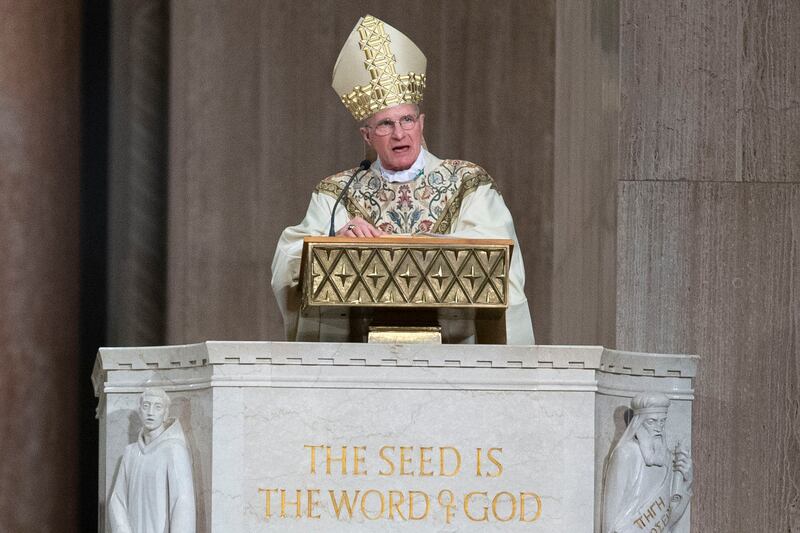

Kelsey is an assistant managing editor for the Deseret News. She covers religion, sports and the Supreme Court.
U.S. Catholic leaders are ending their church’s 50-year partnership with the federal government and seeking new ways to help refugees.
Archbishop Timothy P. Broglio, president of the U.S. Conference of Catholic Bishops, announced the change in a press release and Washington Post column on Monday, arguing that the Trump administration forced his denomination’s hand.
“The bishops’ decision came after the federal government suspended our cooperative agreements to resettle refugees. The drastic reduction of these programs forced us to reconsider the best way to serve the needs of our brothers and sisters seeking safe harbor from violence and persecution,” he wrote for The Washington Post.
Catholic refugee programs in the U.S. have been reeling since President Donald Trump froze federal funding after returning to office
Published: April 7, 2025, 12:25 p.m. MDT
Archbishop Timothy Broglio conducts an Easter Sunday Mass at Basilica of the National Shrine of the Immaculate Conception in Washington, Sunday, April 12, 2020. Archbishop Broglio has served as president of the U.S. Conference of Catholic Bishops since November 2022. Jose Luis Magana, Associated Press
Kelsey is an assistant managing editor for the Deseret News. She covers religion, sports and the Supreme Court.
U.S. Catholic leaders are ending their church’s 50-year partnership with the federal government and seeking new ways to help refugees.
Archbishop Timothy P. Broglio, president of the U.S. Conference of Catholic Bishops, announced the change in a press release and Washington Post column on Monday, arguing that the Trump administration forced his denomination’s hand.
“The bishops’ decision came after the federal government suspended our cooperative agreements to resettle refugees. The drastic reduction of these programs forced us to reconsider the best way to serve the needs of our brothers and sisters seeking safe harbor from violence and persecution,” he wrote for The Washington Post.
Monday, April 07, 2025
Is this the End of Globalism?
Signs of the Times
Signs of the Times #90

Apr 06, 2025

“To me, the most beautiful word in the dictionary is tariff.” Donald Trump, Bloomberg News Economic Club of Chicago,
Signs of the Times #90
Apr 06, 2025

“To me, the most beautiful word in the dictionary is tariff.” Donald Trump, Bloomberg News Economic Club of Chicago,
Original Source of NOVUS ORDO SECLORUM
Motto at the Foundation of the Unfinished Pyramid on the Great Seal
The motto Novus Ordo Seclorum was coined by Charles Thomson in June 1782. He adapted it from a line in Virgil's Eclogue IV, a pastoral poem written by the famed Roman writer in the first century B.C. that expresses the longing for a new era of peace and happiness.
The original Latin in Virgil's Eclogue IV (line 5) is: "Magnus ab integro seclorum nascitur ordo."
For a better sense of its meaning, below are two translations (by James Rhoades and by C. S. Calverley) of the passage at the beginning of Virgil's poem which refers to the Sibyl who prophesied the fate of the Roman empire.
Now the last age by Cumae's Sibyl sung
Has come and gone, and the majestic roll
Of circling centuries begins anew:
Justice returns, returns old Saturn's reign,
With a new breed of men sent down from heaven. Only do thou, at the boy's birth in whom The iron shall cease, the golden age arise. . .
Under thy guidance, whatso tracks remain
Of our old wickedness, once done away
Shall free the earth from never-ceasing fear.
He shall receive the life of gods, and see
Heroes with gods commingling, and himself
Be seen of them, and with his father's worth
Reign o'er a world at peace.
Come are those last days that the Sybil sang:
The ages' mighty march begins anew.
Now come the virgin, Saturn reigns again:
Now from high heaven descends a wondrous race. Thou on the newborn babe – who first shall end That age of iron, bid a golden dawn. . .
Thou, trampling out what prints our crimes have left, Shalt free the nations from perpetual fear. While he to bliss shall waken; with the Blest See the Brave mingling, and be seen of them, Ruling that world o'er which his father's arm shed peace.
That key phrase (bolded above) has also been translated as:
a "great series or mighty order of ages is born anew."
Charles Thomson was a former Latin teacher, and Virgil was one of his favorite poets. Inspired by the above passage, he coined the motto: "Novus Ordo Seclorum" and placed it beneath the unfinished pyramid, where he explained it signifies "the beginning of the new American Æra," which commences from the Declaration of Independence in 1776.
An accurate translation of Novus Ordo Seclorum is:
"A New Order of the Ages"
Note: Seclorum is a shortened form of seculorum, where the first "u" is deleted. In Latin poetry, it was very common to drop a letter in the middle of a word in order to preserve the meter of the poem – a device known as syncope.
Another proper spelling is "sæculorum." "æ" is an example of a ligature where two letters are combined into a single character.
Virgil's The Georgics inspired Annuit Coeptis, the motto above the eye of Providence. Also, his epic masterpiece, Aeneid, describes an ancient symbol of peace held by the American Bald Eagle, the olive branch.
Source
What are stablecoins?

Cryptocurrencies are extremely volatile assets, which is why they are primarily of interest to potential investors as exchange instruments for trading. However, it is legally challenging for exchanges to launch cryptocurrency trading pairs with fiat currencies because it requires obtaining an extended broker license in most countries. This is why there was a need to create cryptocurrencies whose value would be tied to the price of a specific asset. Thus, stablecoins emerged. Their main task is to simplify exchange trading.
Are stablecoins cryptocurrencies?
Technically, stablecoins are cryptocurrency tokens with a blockchain and a decentralized network. However, their value is pegged to a real asset, which can be:
specific currencies (dollar, euro);
securities (stocks of various companies);
non-financial assets (oil, gold, silver).It is important to understand that stablecoins are issued by a specific company. Its task is to conduct emission and ensure that the exchange rate of their token closely matches the value of the asset to which they are pegged. Dollar is often used for this purpose, thus simplifying exchange calculations. Launching stablecoins allows cryptocurrency exchanges to completely abandon the use of fiat currency pairs.
So, the fundamental differences are as follows:
for cryptocurrencies, the price is not tied to assets, it depends only on demand, supply, and total emission;
for stablecoins, the price is tied to a specific asset, and emission is possible only through its exchange by the issuer (the company that issues the coin).
Sunday, April 06, 2025
Saturday, April 05, 2025

Thursday, April 03, 2025
Catholic News Agency: “Muslims, Christians, Hindus, and Buddhists Gathered to Pray Together for the Holy Father’s Speedy Recovery”
March 28, 2025 by Andy Roman

Pope Francis has emerged as the most celebrated and universally revered figure in the world, as people of all faiths—Christians, Muslims, Hindus, Buddhists, and others—unite in prayer for his swift recovery. His message on interfaith unity and cooperation contained in Fratelli Tutti has inspired millions to see the Vatican as a symbol of peace and moral leadership in these last days. In an unprecedented show of global support, people of all faiths, including political leaders, have offered prayers and well-wishes for the ailing pontiff. This is proof that Bible prophecy is on track to its ultimate completion as more and more faith traditions recognize the Pope of Rome not just as the leader of the Catholic Church, but as the guiding light for a world yearning for unity and hope.
On March 12, 2025, Catholic News Agency published the following news about how the religious world is worried about the Pope’s health:
• “The Chaldean patriarch of Baghdad, Cardinal Louis Raphael Sako, said with emotion that most of the Iraqi population has been distressed by Pope Francis’ extended hospitalization and that even Muslims are praying for his recovery.” [1]
• “The cardinal emphasized that Muslims, too, have wanted to show their closeness to him. ‘Many Muslims contact me every day to find out how he is,’ he continued, adding that they hold dear the memory of the Holy Father’s visit to this country four years ago.” [1]
• “Everywhere there were pictures of the Holy Father and the Vatican flag,’ he added.” [1]
• “In addition, young Indonesians of different faiths have also wanted to join the prayers arriving from around the world to the 10th floor of Rome’s Gemelli Hospital, where the pontiff remains hospitalized with double pneumonia.” [1]
• “In a gesture of unity and hope, young people and leaders of different religions gathered at Hati Indonesia.” [1]
• “On this occasion, Muslims, Christians, Hindus, and Buddhists gathered to pray together for the Holy Father’s speedy recovery.” [1]