---
Wednesday, September 30, 2026
ADRA Helping to Fund Migrant Caravan Marching To United States Border
ADRA Helping to Fund Migrant Caravan Marching To United States Border
September 28, 2026 NewsHound

A migrant caravan is marching toward the US border ahead of the midterm elections. More than 400 aliens from the Honduras entered Mexico on Thursday en route to the United States, Reuters has confirmed. By now, the group has swelled to under 1,000 according to latest reports.
At least two NGOs are funding this caravan. ADRA and Proyecto Faro, according to independent reporter Anthony Aguero. Both NGO’s are ideologically aligned with the political, or progressive, left.
- Proyecto Faro, the immigrant support nonprofit out of Rockland County, New York, is funded by a mix of foundations, nonprofits, and government grants. Mainly funded by a Jewish Foundation, The Harry Donenfeld Foundation, named for the Jewish immigrant who co-founded DC Comics.
- ADRA stands for the Adventist Development and Relief Agency, its the humanitarian arm of the Seventh-day Adventist Church, a progressive denomination. Its biggest funder is the U.S. government, mainly USAID, which has given it roughly three hundred eighty-five million dollars. Their last report clarifies they were given at least 36 million US dollars by the end of 2025… more to come.
In January of last year, ADRA (which has championed climate change initiatives, mass immigration, and United Nations inclusions) was named on national television for helping to facilitate mass illegal immigration into the united states.
ADRA receives a large portion of its budget from the United States government and the United Nations, and thus is forbidden to proselytize. It has become just another NGO among hundreds, with post-Christian values and a program of uprooting patriarchy and traditional societies, promoting feminism, and of empowering all-pervasive totalitarian government. Ted Wilson took office in 2010 with the hope of reforming ADRA (and La Sierra), but failed at both. ADRA has its own value system and is, like our hospitals and medical school, only very loosely affiliated with the SDA Church and its message and value system.
Under the guise of being humanitarian, ADRA has supported these issues.
ADRA receives a large portion of its budget from the United States government and the United Nations, and thus is forbidden to proselytize. It has become just another NGO among hundreds, with post-Christian values and a program of uprooting patriarchy and traditional societies, promoting feminism, and of empowering all-pervasive totalitarian government. Ted Wilson took office in 2010 with the hope of reforming ADRA (and La Sierra), but failed at both. ADRA has its own value system and is, like our hospitals and medical school, only very loosely affiliated with the SDA Church and its message and value system.
Under the guise of being humanitarian, ADRA has supported these issues.
Decided Action to be Taken Now
Decided Action to be Taken Now
To our physicians and ministers,—
During the night the Spirit of God has been presenting many things to my mind. The experience that was given us at the General Conference held in Battle Creek early in 1901 was of God. Had Dr. Kellogg at that time done thorough work, the terrible experience through which we are now passing would never have been.
God has permitted the presentation of the combination of good and evil in Living Temple to be made to reveal the danger threatening us. The working that has been so ingeniously carried on He has permitted in order that certain developments might be made and that it might be seen what a man can do with human minds when he has obtained their confidence as a physician. God has permitted the present crisis to come to open the eyes of those who desire to know the truth. He would have His people understand to what lengths the sophistry and devising of the enemy would lead.
Men have given to our leading physician allegiance that is due to God alone; and he has been permitted to show what self-exaltation will lead men to do. Scientific, spiritualistic sentiments, representing the Creator as an essence pervading all nature, have been given to our people and have been received even by some who have had a long experience as teachers of the Word of God. The results of this insidious devising will break out again and again. There are many for whom special efforts will have to be put forth to free them from this specious deception.
I am now authorized to say that the time has come to take decided action. The development seen in the cause of God is similar to the development seen when Balaam caused Israel to sin just before they entered the promised land. How dangerous it is so to exalt any man that he becomes confused and confuses the minds of others in regard to the truths that for the last fifty years the Lord has been giving His people.
Few can see the meaning of the present apostasy. But the Lord has lifted the curtain and has shown me its meaning and the result that it will have if allowed to continue. We must now lift our voices in warning. Will our people acknowledge God as the supreme Ruler, or will they choose the misleading arguments and views that, when fully developed, make Him, in the minds of those who accept them, as nothingness?
These words were spoken to me in the night season. The sentiments in Living Temple regarding the personality of God have been received even by men who have had a long experience in the truth. When such men consent to eat of the fruit of the tree of the knowledge of good and evil, we are no longer to regard the subject as a matter to be treated with the greatest delicacy. That those whom we thought sound in the faith should have failed to discern the specious, deadly influence of this science of evil should alarm us as nothing else has alarmed us.
It is something that cannot be treated as a small matter, that men who have had so much light and such clear evidence as to the genuineness of the truth we hold should become unsettled and led to accept spiritualistic theories regarding the personality of God. These doctrines, followed to their logical conclusion, sweep away the whole Christian economy. They estimate as nothing the light that Christ came from heaven to give John to give to His people. They teach that the scenes just before us are not of sufficient importance to be given special attention. They make of no effect the truth of heavenly origin and rob the people of God of their past experience, giving them instead a false science.
Softly and Tenderly
Softly and Tenderly
SE Samonte
Nov 11, 2008
This is a special video made for Lois, mother of one of my subscribers, who is suffering from lung cancer. This Christian hymn is one of her favorites..To all Christians who would visit this channel and happen to read this, please pray for her, and her daughter Rebecca. God bless.
Please click to play all the featured Christian hymns:
To purchase music CD's of the Altar of Praise Chorale, click:
http://www.altarofpraise.com/Acapella...
Tuesday, September 29, 2026
The Secret Missions of History: What They DON'T Want You to Know About Secret Societies
The Secret Missions of History: What They DON'T Want You to Know About Secret Societies
End Times Productions
Sep 28, 2026
Historical patterns of global conflict often hide a darker, coordinated agenda. I sat down with Chris Pinto to examine the evidence behind these events.
From the strategic maps of imperial aggressions to the unsettling reality of the Jasenovac camp, history is rarely as random as we are taught. By analyzing the actions of key figures like Martin Luther alongside modern geopolitical shifts, I break down how past atrocities are being used to shape our current reality. This analysis connects these historical markers to the systemic forces working behind the scenes, offering a clear look at the agendas that many prefer to keep in the shadows.
We look past the standard textbook narrative to understand the true nature of these secret societies and the long-term goals they pursue. If you want to understand how historical patterns are being manipulated to influence the future, this breakdown provides the necessary context.
Subscribe for weekly prophecy and culture breakdowns, and tell me in the comments which historical event you think is the most misunderstood. for watching!
God Bless you all!!!!
This Video is a part of the End Time Productions catalog of original entertainment. End Times Productions is a trusted creator who has been active on YouTube since 2016. End Times Productions is dedicated to bringing high-quality and trustworthy entertainment to YouTube viewers worldwide.
If you like my content and wish to see me continue making videos, please consider supporting ETP, thanks everyone.
Patreon. / endtimesproductions
Paypal - endtimesproductions@protonmail.com
Something Is VERY WRONG With Times Square Right Now
Something Is VERY WRONG With Times Square Right Now
What Happened America?
Sep 20, 2026
Times Square is the most visited place in America and one of the few addresses on earth that needs no introduction. It is also a place almost nobody who lives in New York will willingly walk through.
This video traces how the "Crossroads of the World" became something New Yorkers actively route around: an eighteen-month Broadway shutdown that theaters are still recovering from, a retail corridor where independent businesses were replaced by chains and then by empty glass, a pedestrian plaza experiment that solved traffic and created a new problem, and an ongoing fight over costumed characters, ticket hustlers, and who the square actually belongs to.
The strange part is that the visitor numbers keep recovering while the experience keeps getting worse — and the people who run Times Square know it. This is what happened to the most famous intersection in the world, and why fixing it has proven harder than anyone expected.
Gaza Catholic school reopens, welcoming 1,000 students
The building sheltered more than 450 people displaced by bombardment. Now, the parish hopes the school can give children a sense of safety and routine amid the destruction.
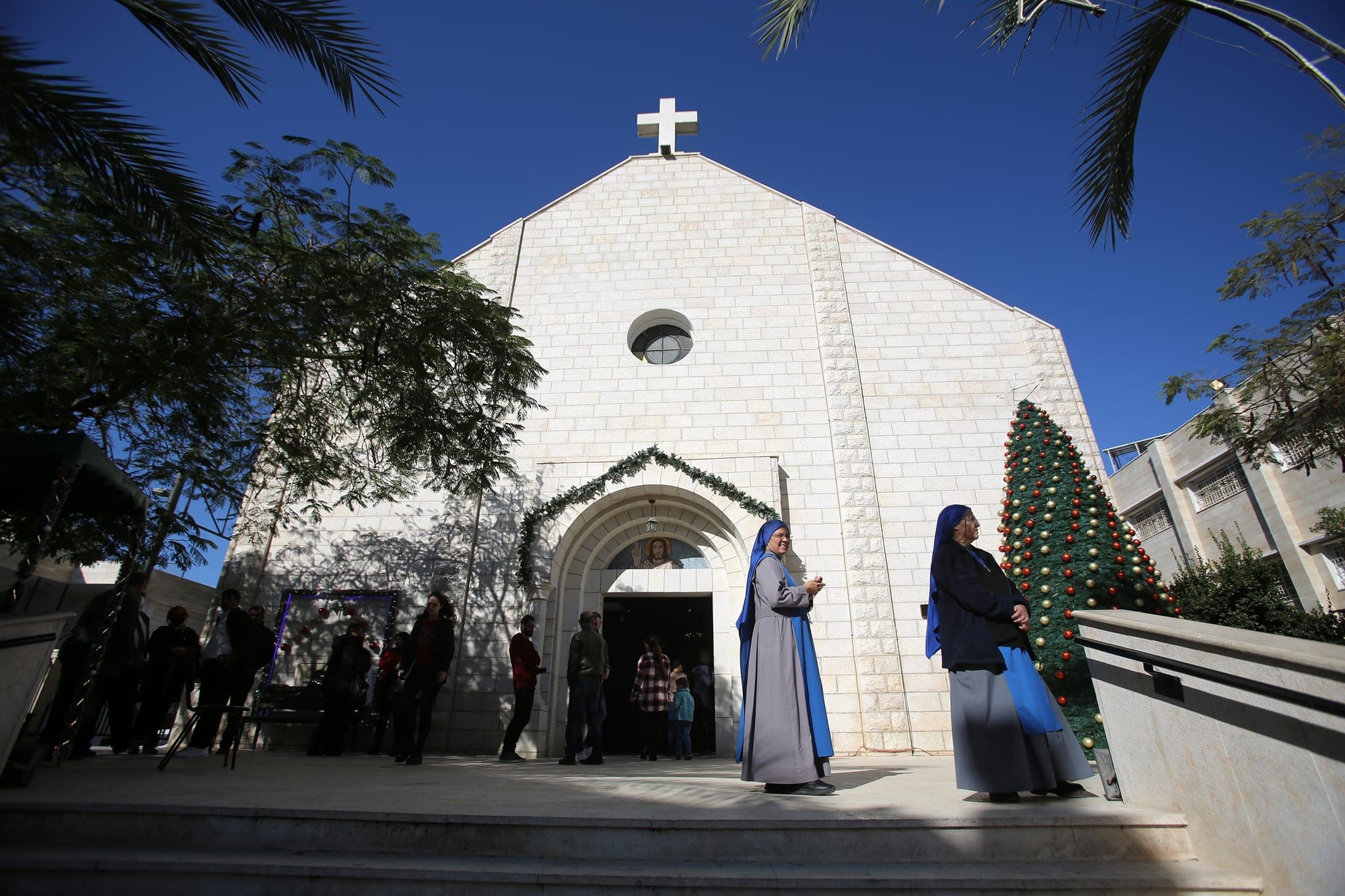
Holy Family School in Gaza City reopened Sept. 15 for about 1,000 students, serving families from Holy Family Catholic Parish and the wider community, according to Aid to the Church in Need (ACN).
Before the war, five Christian schools operated in Gaza — three Catholic, one Orthodox, and one Evangelical — and Christian pupils attended different schools across the territory.
George Akroush, director of the Latin Patriarchate of Jerusalem’s Project Development Office, told ACN that around 130 Christian pupils, about 13% of the student body, would attend Holy Family School. Most of the school’s students are Muslim.
“For the first time, all Christian students in Gaza will be studying together in one Christian school,” Akroush told an ACN delegation visiting the region. “This creates a strong sense of community and shows that the Church remains close to them, accompanying them in the midst of all they are going through.”
Before reopening, the school sheltered more than 450 people displaced by Israeli bombardment, according to ACN. Holy Family parish priest Father Gabriel Romanelli said staff worked to make the school a place where children could feel safe amid the destruction in Gaza.
“For the students and the families, reopening the school will bring some sense of normality. We have worked hard to ensure that it is a safe environment,” Father Romanelli told ACN. “There is almost nowhere in Gaza that has not been destroyed; destruction is all around. But we have worked hard to make the school a clean environment, where the children, who have been through so much, can feel safe.”
Father Romanelli said “the needs in Gaza are enormous.” The parish hopes to offer families some sense of normality, he said, “even though nothing is normal in Gaza.” After Sunday Mass, he takes parishioners to a beach in Gaza City for recreation, despite the rubble there.
The school will also provide support for children and teachers affected by the war.
“Many of the teachers are so traumatized, and it is almost as if they are not the same people who we knew before the start of the war,” Father Romanelli told ACN.
He said the school has added special psychosocial support to its program and plans to offer activities after classes. Children have asked him to keep the school open because they have nowhere else to go, he said.
“Everyone in Gaza is carrying so much trauma,” the parish priest told ACN, adding, “For me, the school is a light in the darkness. It means a lot to people. When they see the 1,000 students coming in their uniforms to the school, it shows them that there is a future.”
The Roman Catholic Holy Family Church in Gaza City, 2021. (Photo by Anas-Mohammed/Shutterstock)

Holy Family School in Gaza City reopened Sept. 15 for about 1,000 students, serving families from Holy Family Catholic Parish and the wider community, according to Aid to the Church in Need (ACN).
Before the war, five Christian schools operated in Gaza — three Catholic, one Orthodox, and one Evangelical — and Christian pupils attended different schools across the territory.
George Akroush, director of the Latin Patriarchate of Jerusalem’s Project Development Office, told ACN that around 130 Christian pupils, about 13% of the student body, would attend Holy Family School. Most of the school’s students are Muslim.
“For the first time, all Christian students in Gaza will be studying together in one Christian school,” Akroush told an ACN delegation visiting the region. “This creates a strong sense of community and shows that the Church remains close to them, accompanying them in the midst of all they are going through.”
Before reopening, the school sheltered more than 450 people displaced by Israeli bombardment, according to ACN. Holy Family parish priest Father Gabriel Romanelli said staff worked to make the school a place where children could feel safe amid the destruction in Gaza.
“For the students and the families, reopening the school will bring some sense of normality. We have worked hard to ensure that it is a safe environment,” Father Romanelli told ACN. “There is almost nowhere in Gaza that has not been destroyed; destruction is all around. But we have worked hard to make the school a clean environment, where the children, who have been through so much, can feel safe.”
Father Romanelli said “the needs in Gaza are enormous.” The parish hopes to offer families some sense of normality, he said, “even though nothing is normal in Gaza.” After Sunday Mass, he takes parishioners to a beach in Gaza City for recreation, despite the rubble there.
The school will also provide support for children and teachers affected by the war.
“Many of the teachers are so traumatized, and it is almost as if they are not the same people who we knew before the start of the war,” Father Romanelli told ACN.
He said the school has added special psychosocial support to its program and plans to offer activities after classes. Children have asked him to keep the school open because they have nowhere else to go, he said.
“Everyone in Gaza is carrying so much trauma,” the parish priest told ACN, adding, “For me, the school is a light in the darkness. It means a lot to people. When they see the 1,000 students coming in their uniforms to the school, it shows them that there is a future.”
5 men arrested near a US-run air base are bailed as UK police probe whether there’s a link to Iran
.webp)
United States Airforce B1 bombers are seen at RAF Fairford, a US Airbase, after an incident in Fairford, England, Sunday, Sept. 27, 2026. (AP Photo/Alastair Grant) License this photo
A B1 USAF bomber on the tarmac at RAF Fairford in Fairford, England, Monday, Sept. 28, 2026. (AP Photo/Alastair Grant)
BY ALASTAIR GRANT AND JILL LAWLESS
Updated 9:46 PM EDT, September 28, 2026
Leer en español
FAIRFORD, England (AP) — Five young British men arrested on explosives and terror charges near a U.S.-operated air force base in England were released on bail Monday, and counterterror detectives said they were investigating “multiple lines of inquiry,” including whether there is a link to Iran.
The men were detained early Sunday after three vans were spotted in the countryside near RAF Fairford, a U.K.-owned base that has been used by American bombers during decades of conflicts in the Middle East, including this year’s war with Iran.
Investigators haven’t concluded whether the incident was state-backed. They are investigating a possible link to Iran, Russia or non-state militant groups. RAF Fairford has also been the focus of protests by anti-war campaigners.
The five suspects, who haven’t been named, were initially held over suspected explosives offenses and later also arrested on suspicion of preparing an act of terrorism. Police said the men are all British nationals from London and in their 20s.
Britain’s national news agency, PA, reported without citing sources that police had not found viable explosives. Announcing that the suspects had been bailed, the head of U.K. Counter Terrorism Policing, Laurence Taylor, said that the suspects face stringent conditions and “absolutely remain under investigation.”
Taylor said lines of inquiry include that the suspected offenses were committed by “proxies or individuals, either knowingly or unknowingly, working on behalf of a foreign state.
Taxpayer-Funded Researchers Push Depopulation for “Sustainability”
Taxpayer-Funded Researchers Push Depopulation for “Sustainability”
The New American Video
Sep 28, 2026
A new taxpayer-funded “study” published in a UN-aligned journal argues that the human population must be slashed by 50 percent—to about 4 billion people by 2200—for “sustainable development.” Those who remain, the authors say, will have to accept a much lower standard of living, more restrictions on consumption, and even “resource quotas.”
On this episode of Behind The Deep State, The New American’s Alex Newman exposes the latest neo-Malthusian push for depopulation. He breaks down the paper in Sustainable Development, its ties to the UN’s Agenda 2030 Sustainable Development Goals, and the long history of this anti-human ideology—from Thomas Malthus and the Club of Rome to John Holdren and open calls at UN climate summits. Newman also notes what the study ignores: fertility rates have already collapsed below replacement in much of the world, and the real demographic crisis is coming from too few people, not too many.
Your tax dollars helped fund this. Don’t miss this must-see episode.
Human Rights in the Post-Pandemic Era

By Michael Tomlinson September 1, 2026
In 2020, governments around the world panicked in response to the declaration of a pandemic and imposed drastic interventions to impede the spread of Covid-19, interventions which crushed human rights on an unprecedented scale and without sufficient justification. Yet this was widely accepted, even by human rights organisations. How could this happen? And how could we amend human rights protections to ensure that it does not happen again?
In the aftermath of the Second World War, there was recognition that rights should be codified, leading to the United Nations’ Universal Declaration of Human Rights. These rights are taken to be universal and inalienable.
The Declaration includes declaration of the rights to ‘life, liberty and security of person,’ freedom from torture, equality before the law, freedom of movement, including ‘the right to leave any country including his own, and return to his country,’ freedom to own property, freedom of thought, opinion and expression, freedom of assembly, and the right to education.
These are a mix of fundamental rights and other categories. Fundamental rights are everyone’s birthrights originating in fundamental capabilities or states of being which we all have unless we are actively prevented from exercising them by others.
We do not need to apply for permission to exercise this type of right. The classic case of a fundamental right is freedom of expression. We all have this capability as soon as we can speak (or sign), and no one should take it away from us.
Freedom from torture is fundamental to health and well-being and again is the natural state of being unless torture is inflicted on us.
Freedom of education is in a different category, as education by its nature needs to be provided by someone, a government, or a private organisation, which costs money. There is no fundamental right to have education provided without contributing to the cost of it through fees or taxes, but where it is provided it should be accessible to all on an equal basis. So, this right is really about equity.
Commendably, the Declaration does not include any qualifications to fundamental rights, although it is understood elsewhere that:
They should not be taken away, except in specific situations and according to due process. For example, the right to liberty may be restricted if a person is found guilty of a crime by a court of law.
No one would dispute this exception: even the most libertarian of countries puts people in jail if they break the law (but authoritarian countries have laws that put people in jail for reasons that would never be acceptable in truly democratic counties, for example, insulting the President). Once the possibility of wider exceptions is recognised, however, abuses become possible.
The best justification for exceptions is where someone exercises their own right by contravening someone else’s right. Even in the case of free speech, one of the most fundamental of all rights, it is universally accepted that it is not permissible to advocate for or incite violence, especially against an ethnic or religious group. The most notorious examples of this over the last hundred years have been the Nazi campaign of vilification against the Jews, which led directly to their killing around six million Jewish people in the Holocaust, and the Hutu government incitement of the population against the Tutsi (‘cockroaches’), which led to at least 800,000 deaths. In these cases, a direct line can be drawn between incitement and genocide. In other cases, incitement is more coded and difficult to prove.
Monday, September 28, 2026
The Three Angels' Messages
The three angels' messages are a prophetic threefold warning and call to salvation found in the biblical book of Revelation (Revelation 14:6–12), which the Seventh-day Adventist Church views as a central mandate and final message to prepare the world for the Second Coming of Jesus Christ. [1, 2]
The First Angel's MessageThe Everlasting Gospel and Judgment (Rev. 14:6–7): Proclaims the eternal good news of salvation through Christ and declares that "the hour of His judgment has come." It calls all people to reverence ("fear") God, give Him glory, and worship Him as the Creator of heaven, earth, the sea, and springs of water. [1, 2, 3]
The Second Angel's MessageThe Fall of Babylon (Rev. 14:8): Proclaims that "Babylon is fallen, is fallen," a symbolic declaration representing the spiritual collapse and corruption of worldly religious systems and apostate churches that reject biblical truth and unite with worldly practices. [1, 2, 3]
The Third Angel's MessageWarning Against the Beast (Rev. 14:9–12): Issues a solemn warning against worshiping the beast and its image or receiving its mark on the forehead or hand, depicting the severe spiritual consequences of rebellion against God. It highlights the steadfast endurance of God's people—"those who keep the commandments of God and the faith of Jesus". [1, 2, 3]
Source: Google AI
Resistance to Christian Nationalism Could Help Decide Midterms | Opinion
Opinion
Resistance to Christian Nationalism Could Help Decide Midterms | Opinion
PUBLISHED
SEP 24, 2026 AT 05:00 AM EDT
By Melissa Deckman and Ruth Braunstein
Since the start of the second Trump administration, Christian nationalism—a political movement asserting that the U.S. was founded as, and should remain, a nation of, by and for Christians—has gained unprecedented influence in American politics, challenging long-established lines between church and state and promoting a policy agenda aligned with its right-wing vision of “Christian” values.
Several Trump cabinet officials have deep ties to the movement. Russell Vought was a primary architect of the Heritage Foundation’s Project 2025, widely considered a “Christian nationalist blueprint” for remaking the federal government. As head of the Office of Management and Budget, he has targeted programs the movement views as contrary to Christian values.
Defense Secretary Pete Hegseth has led Pentagon prayer sessions featuring Doug Wilson, an avowed Christian nationalist who supports repealing the 19th Amendment, outlawing all abortion and homosexuality, and has downplayed the horrors of Southern slavery. Under Hegseth's leadership, the Defense Department has also led a propaganda blitz that incorporates Christian nationalist symbolism and directly links American military actions to passages from Christian Scripture.

U.S. President Donald Trump bows his head in prayer during the National Prayer Breakfast on February 5, 2026, at the Washington Hilton in Washington, ...Read More | SAUL LOEB / AFP via Getty Images
Yet their worldview remains deeply unpopular. A new joint survey report from the Public Religion Research Institute (PRRI) and the Meanings of Democracy Lab of the SNF Agora Institute at Johns Hopkins University finds that nearly two-thirds of Americans reject this worldview. That could be important come November, when voters get their first chance to weigh in on Trump's second term performance, including the many overtures he's made to Christian nationalists while in office.
While 56 percent of Republicans support Christian nationalism, only 32 percent of Americans overall do. Majorities in all but four states reject Christian nationalism. In Iowa—where Trump won by 13 points in 2024—a strong majority (60 percent) oppose Christian nationalism, as do 57 percent of Texans and 56 percent of Alaskans.
Resistance to Christian Nationalism Could Help Decide Midterms | Opinion
PUBLISHED
SEP 24, 2026 AT 05:00 AM EDT
By Melissa Deckman and Ruth Braunstein
Since the start of the second Trump administration, Christian nationalism—a political movement asserting that the U.S. was founded as, and should remain, a nation of, by and for Christians—has gained unprecedented influence in American politics, challenging long-established lines between church and state and promoting a policy agenda aligned with its right-wing vision of “Christian” values.
Several Trump cabinet officials have deep ties to the movement. Russell Vought was a primary architect of the Heritage Foundation’s Project 2025, widely considered a “Christian nationalist blueprint” for remaking the federal government. As head of the Office of Management and Budget, he has targeted programs the movement views as contrary to Christian values.
Defense Secretary Pete Hegseth has led Pentagon prayer sessions featuring Doug Wilson, an avowed Christian nationalist who supports repealing the 19th Amendment, outlawing all abortion and homosexuality, and has downplayed the horrors of Southern slavery. Under Hegseth's leadership, the Defense Department has also led a propaganda blitz that incorporates Christian nationalist symbolism and directly links American military actions to passages from Christian Scripture.
U.S. President Donald Trump bows his head in prayer during the National Prayer Breakfast on February 5, 2026, at the Washington Hilton in Washington, ...Read More | SAUL LOEB / AFP via Getty Images
Yet their worldview remains deeply unpopular. A new joint survey report from the Public Religion Research Institute (PRRI) and the Meanings of Democracy Lab of the SNF Agora Institute at Johns Hopkins University finds that nearly two-thirds of Americans reject this worldview. That could be important come November, when voters get their first chance to weigh in on Trump's second term performance, including the many overtures he's made to Christian nationalists while in office.
While 56 percent of Republicans support Christian nationalism, only 32 percent of Americans overall do. Majorities in all but four states reject Christian nationalism. In Iowa—where Trump won by 13 points in 2024—a strong majority (60 percent) oppose Christian nationalism, as do 57 percent of Texans and 56 percent of Alaskans.
Parents Lose Religious Freedom Challenge to Connecticut School Vaccine Law
September 22, 2026 01:11 EDT

Photo credit: Unsplash/ CDC
A Connecticut judge has dismissed a lawsuit brought by parents challenging the state’s elimination of religious exemptions from school vaccine mandates.
Judge Edward Krumeich of the Connecticut Superior Court granted a motion to dismiss the case last Monday. The lawsuit was filed by parents Keira Spillane and Anna Kehle against Gov. Ned Lamont, state education and health officials, the Orange Board of Education and Whitby School.
The parents argued that vaccinating their children would violate “their closely held religious beliefs” about the sanctity of human life because some vaccines were developed using cell lines derived from aborted fetuses. They also claimed vaccines containing animal-derived components would “defile their children’s blood.”
Their lawsuit alleged violations of the Connecticut Religious Freedom Restoration Act, the Connecticut Constitution and the U.S. Constitution. It cited the state constitution’s declaration that “the Free Exercise of Religion shall forever be allowed in Connecticut,” along with federal protections for free exercise and equal protection.
It cited three constitutional protections: Article I, Section III of the Connecticut Constitution, which states that “the Free Exercise of Religion shall forever be allowed in Connecticut,” the Free Exercise Clause of the First Amendment, and the Equal Protection Clause of the Fourteenth Amendment to the U.S. Constitution.
State officials sought dismissal based on legislation enacted in 2021 and a law passed this year clarifying that religious exemptions to school vaccine requirements are not protected by the state RFRA.
The ruling concludes four years of litigation over Connecticut’s removal of the exemption. The Connecticut Supreme Court rejected the plaintiffs’ state and federal constitutional claims in 2024. Still, it returned the RFRA issue to the Superior Court, which has now ruled that eliminating the exemption does not violate the law.
Connecticut is among a small number of states that do not permit religious exemptions from school vaccine mandates, according to the National Conference of State Legislatures. California, Maine, Minnesota and New York are also listed among them.
A Connecticut judge has dismissed a lawsuit brought by parents challenging the state’s elimination of religious exemptions from school vaccine mandates.
Judge Edward Krumeich of the Connecticut Superior Court granted a motion to dismiss the case last Monday. The lawsuit was filed by parents Keira Spillane and Anna Kehle against Gov. Ned Lamont, state education and health officials, the Orange Board of Education and Whitby School.
The parents argued that vaccinating their children would violate “their closely held religious beliefs” about the sanctity of human life because some vaccines were developed using cell lines derived from aborted fetuses. They also claimed vaccines containing animal-derived components would “defile their children’s blood.”
Their lawsuit alleged violations of the Connecticut Religious Freedom Restoration Act, the Connecticut Constitution and the U.S. Constitution. It cited the state constitution’s declaration that “the Free Exercise of Religion shall forever be allowed in Connecticut,” along with federal protections for free exercise and equal protection.
It cited three constitutional protections: Article I, Section III of the Connecticut Constitution, which states that “the Free Exercise of Religion shall forever be allowed in Connecticut,” the Free Exercise Clause of the First Amendment, and the Equal Protection Clause of the Fourteenth Amendment to the U.S. Constitution.
State officials sought dismissal based on legislation enacted in 2021 and a law passed this year clarifying that religious exemptions to school vaccine requirements are not protected by the state RFRA.
The ruling concludes four years of litigation over Connecticut’s removal of the exemption. The Connecticut Supreme Court rejected the plaintiffs’ state and federal constitutional claims in 2024. Still, it returned the RFRA issue to the Superior Court, which has now ruled that eliminating the exemption does not violate the law.
Connecticut is among a small number of states that do not permit religious exemptions from school vaccine mandates, according to the National Conference of State Legislatures. California, Maine, Minnesota and New York are also listed among them.
On Pope Leo’s World Day of Migrants, Cardinal McElroy Indicts Trump’s War on Immigrants
Preaching on the Good Samaritan for World Day of Migrants, Washington’s archbishop named Minneapolis, a five-year-old used as bait, and a nation that “passed on by.” He told Catholics to fight every dimension of it.
Christopher Hale
Thank you for reading! Letters from Leo is a reader-supported publication and the fastest-growing Catholic community in the country. To receive new posts and support this movement, consider becoming a free or paid subscriber.
Subscribe
Make A One-Time Gift to Support My Work
Cardinal Robert McElroy stood at the ambo of the Cathedral of St. Matthew the Apostle on Sunday evening, less than a mile from the White House, and told Washington’s Catholics that their country has spent a year and a half walking past a man left bleeding by the road.
“For the last year and a half, the people of the United States have witnessed the suffering of the undocumented in our midst, purposely and strategically magnified by our government,” the archbishop of Washington said, “and for the most part, we have simply passed on by.”
The Mass marked the 112th World Day of Migrants and Refugees, which Pope Leo XIV devoted this year to children under the theme “Even Just One of These Children.” McElroy preached on the Good Samaritan. He borrowed a rule from one of his seminary scripture professors: in any parable, look for the character you most dislike, “and that is you.”
For Americans in 2026, he said, that character is the priest who crossed to the other side of the road (and the Levite who followed him).
The parable came second. McElroy opened with what he called the two great legacies that shape America’s duty to the stranger: the command in Deuteronomy that “you shall not violate the rights of the alien or the orphan,” and the words Emma Lazarus wrote for the Statue of Liberty. “There was a time when these words brought tears to every American,” he said of the poem. “Now they are shunned, riddled with conditions, or ignored altogether because they remind us of what we have become.”
Full text: Pope Leo XIV’s World Day of Migrants and Refugees message
written by Pope Leo XIV
6:30 AM September 27, 2026
Even Just One of These Children (cf. Mt 18:10)
Dear brothers and sisters,
Each year the World Day of Migrants and Refugees invites us to turn our attention to different aspects of the complex phenomenon of migration. For this 112th World Day, the theme, “Even just one of these children,” draws our attention to the minors directly involved in the experience of migration and flight, to the care owed to them, and to the Lord’s promise that “whoever receives one such child in my name receives me” (Mk 9:37).
Displaced minors: a complex reality of vulnerability
Minors are the most vulnerable group within the global movements of migration. They are concrete faces, who have unique stories, and call on our conscience. Every year, millions of children and adolescents are forced to leave their homeland because of war, poverty, violence, environmental disasters and other tragedies. Sadly, their number continues to grow. The economic, political and military consequences of this disaster are immense. The suffering of migrant children does not end with their relocation. There are very young children who have lost parents, brothers, sisters and friends, and who have witnessed unspeakable acts of violence. Others, separated from their families for long periods, try to reunite with them while enduring the anguish of separation. There are also minors who make the journey together with their parents, yet are exposed to extreme and traumatic conditions. Finally, we cannot forget the tragic situation of those separated from their parents because of repatriation.
To this already appalling situation are added further tragedies: deaths along migration routes, trafficking and exploitation, the recruitment of minors for use in armed conflicts, sexual violence, forced marriages, and the atrocities they have suffered or witnessed during their travels. Their dignity is trampled upon in countless ways.
In his Message for the 2017 World Day of Migrants and Refugees, dedicated to the theme “Child Migrants, the Vulnerable and the Voiceless”, Pope Francis recalled that migrant children “in a threefold way are defenseless: they are children, they are foreigners, and they have no means to protect themselves. I ask everyone to help those who, for various reasons, are forced to live far from their homeland and are separated from their families.”
Yet, amid so much darkness, the light of solidarity is not lacking. Individuals, families, civil institutions and ecclesial communities choose not to pass by on the other side (cf. Lk 10:29-37). We think of the families who open the doors of their homes in order to restore to these children the warmth of a family hearth; the educators who serve in reception centers; the volunteers and aid workers who each day devote themselves to healing the invisible wounds of these little ones along migration routes and in our cities. They bear witness through their commitment that love can overcome indifference.
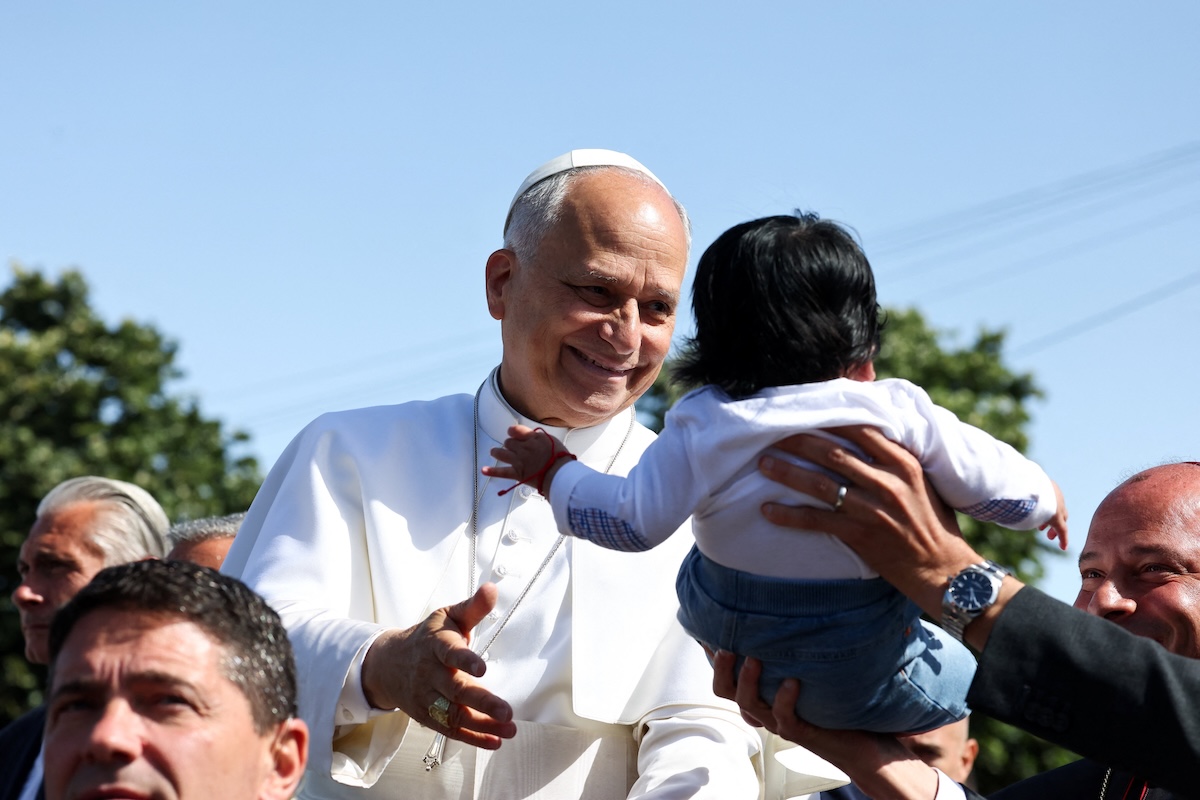
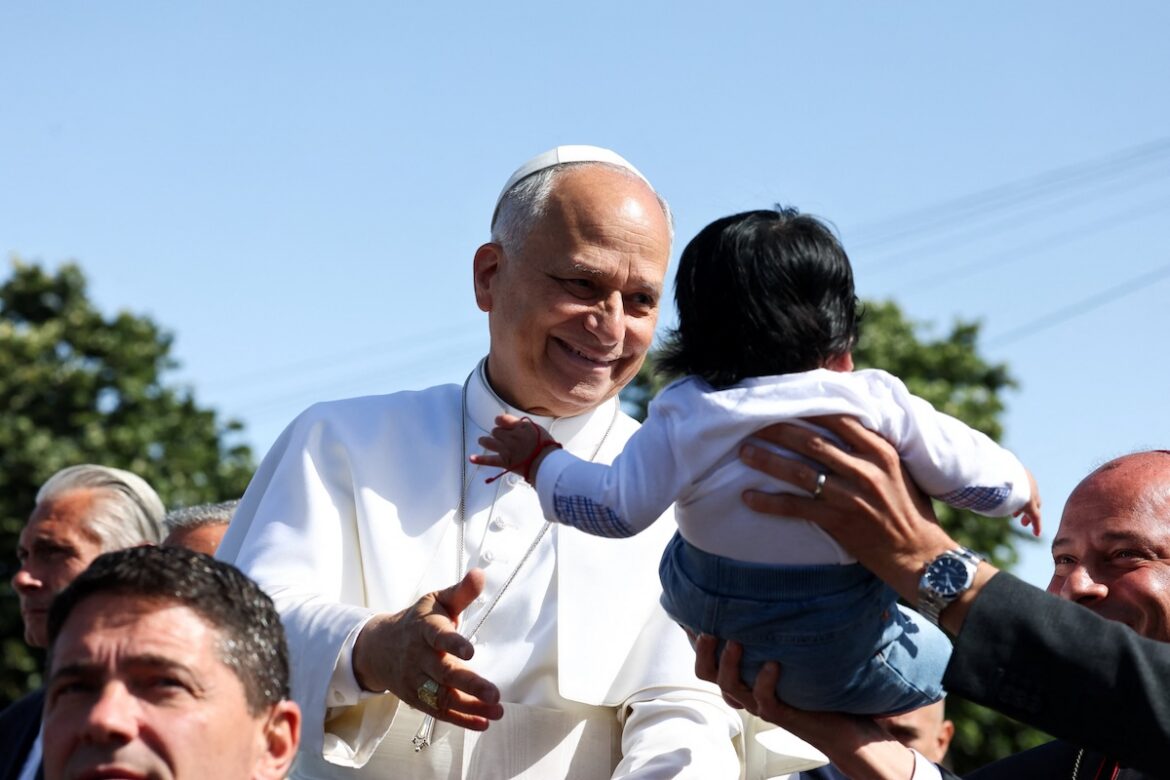
Pope Leo XIV smiles at a child at the Plaza del Cristo de La Laguna, Tenerife, Canary Islands, Spain, June 12, 2026, on the day he meets with migrants and humanitarian organizations. On Aug. 14, the Vatican published Pope Leo XIV's message for the World Day of Migrants and Refugees which reflects on the theme: "Even Just One of These Children." (OSV News photo/Yara Nardi, Reuters)
(OSV News) — The following is the full text of Pope Leo XIV’s 2026 message for the 112th World Day of Migrants and Refugees celebrated by the Church on Sept. 27.
(OSV News) — The following is the full text of Pope Leo XIV’s 2026 message for the 112th World Day of Migrants and Refugees celebrated by the Church on Sept. 27.
Even Just One of These Children (cf. Mt 18:10)
Dear brothers and sisters,
Each year the World Day of Migrants and Refugees invites us to turn our attention to different aspects of the complex phenomenon of migration. For this 112th World Day, the theme, “Even just one of these children,” draws our attention to the minors directly involved in the experience of migration and flight, to the care owed to them, and to the Lord’s promise that “whoever receives one such child in my name receives me” (Mk 9:37).
Displaced minors: a complex reality of vulnerability
Minors are the most vulnerable group within the global movements of migration. They are concrete faces, who have unique stories, and call on our conscience. Every year, millions of children and adolescents are forced to leave their homeland because of war, poverty, violence, environmental disasters and other tragedies. Sadly, their number continues to grow. The economic, political and military consequences of this disaster are immense. The suffering of migrant children does not end with their relocation. There are very young children who have lost parents, brothers, sisters and friends, and who have witnessed unspeakable acts of violence. Others, separated from their families for long periods, try to reunite with them while enduring the anguish of separation. There are also minors who make the journey together with their parents, yet are exposed to extreme and traumatic conditions. Finally, we cannot forget the tragic situation of those separated from their parents because of repatriation.
To this already appalling situation are added further tragedies: deaths along migration routes, trafficking and exploitation, the recruitment of minors for use in armed conflicts, sexual violence, forced marriages, and the atrocities they have suffered or witnessed during their travels. Their dignity is trampled upon in countless ways.
In his Message for the 2017 World Day of Migrants and Refugees, dedicated to the theme “Child Migrants, the Vulnerable and the Voiceless”, Pope Francis recalled that migrant children “in a threefold way are defenseless: they are children, they are foreigners, and they have no means to protect themselves. I ask everyone to help those who, for various reasons, are forced to live far from their homeland and are separated from their families.”
Yet, amid so much darkness, the light of solidarity is not lacking. Individuals, families, civil institutions and ecclesial communities choose not to pass by on the other side (cf. Lk 10:29-37). We think of the families who open the doors of their homes in order to restore to these children the warmth of a family hearth; the educators who serve in reception centers; the volunteers and aid workers who each day devote themselves to healing the invisible wounds of these little ones along migration routes and in our cities. They bear witness through their commitment that love can overcome indifference.
LIVE: Pope Leo visits Metz, France
LIVE: Pope Leo visits Metz, France
Reuters
Pope Leo finishes his four-day visit to France with meetings and a mass in the eastern city of Metz, before returning to Rome.
Sunday, September 27, 2026
United in debt: America has become a nation of fake rich people
by John Mac Ghlionn, opinion contributor - 09/26/26 1:00 PM ET

Phoenix-based content creator holds up a house margarita while filming content during the grand opening of Padeland, a venue for the racket sport padel in Chandler, Ariz., Thursday, Aug. 13, 2026. (AP Photo/Rebecca Noble)
The U.S. now functions as two distinct, fully realized nations occupying the same geographic coordinates. One exists in concrete and brick, where citizens drive 20-year-old sedans and buy generic eggs. The other exists within a six square-inch, forever-vibrating rectangle, where every third twenty-something is a lifestyle curator living a life built on reckless financial decisions.
A recent report by Empower, a major financial services company based in Colorado, found that 24 percent of Gen Zers experience intense pressure to display material wealth on social media, even as 41 percent of all Americans don’t consider themselves financially well-off. The math is simple, brutal and undeniable. Millions of broke people spend borrowed money to convince other broke people they live like oil barons.
Walk into a cafe in any major city on a Tuesday morning. The line stretches out the front door with men and women waiting to pay $7 for an oat milk latte. The transaction takes three seconds via a plastic card. The coffee is gone in ten minutes. The debt remains on the balance sheet for 30 days at a 28 percent annual percentage rate.
The person holding the cup takes four photos of the foam art before taking a single sip, uploading the image to an audience of 700 acquaintances doing the exact same thing three blocks away. It’s entirely absurd and slightly insane, but this is modern-day America, where a sandwich that costs more than most can reasonably afford becomes a status symbol for a sick, performative culture.
The physical economy relies on the illusion of endless prosperity. A $400 T-shirt made of standard cotton moves off the rack because it contains a small but highly visible logo. The owner wears it to a sit-down dinner, paid for with a buy-now-pay-later app that splits a $120 pasta bill into four easy installments due every two weeks.
Phoenix-based content creator holds up a house margarita while filming content during the grand opening of Padeland, a venue for the racket sport padel in Chandler, Ariz., Thursday, Aug. 13, 2026. (AP Photo/Rebecca Noble)
The U.S. now functions as two distinct, fully realized nations occupying the same geographic coordinates. One exists in concrete and brick, where citizens drive 20-year-old sedans and buy generic eggs. The other exists within a six square-inch, forever-vibrating rectangle, where every third twenty-something is a lifestyle curator living a life built on reckless financial decisions.
A recent report by Empower, a major financial services company based in Colorado, found that 24 percent of Gen Zers experience intense pressure to display material wealth on social media, even as 41 percent of all Americans don’t consider themselves financially well-off. The math is simple, brutal and undeniable. Millions of broke people spend borrowed money to convince other broke people they live like oil barons.
Walk into a cafe in any major city on a Tuesday morning. The line stretches out the front door with men and women waiting to pay $7 for an oat milk latte. The transaction takes three seconds via a plastic card. The coffee is gone in ten minutes. The debt remains on the balance sheet for 30 days at a 28 percent annual percentage rate.
The person holding the cup takes four photos of the foam art before taking a single sip, uploading the image to an audience of 700 acquaintances doing the exact same thing three blocks away. It’s entirely absurd and slightly insane, but this is modern-day America, where a sandwich that costs more than most can reasonably afford becomes a status symbol for a sick, performative culture.
The physical economy relies on the illusion of endless prosperity. A $400 T-shirt made of standard cotton moves off the rack because it contains a small but highly visible logo. The owner wears it to a sit-down dinner, paid for with a buy-now-pay-later app that splits a $120 pasta bill into four easy installments due every two weeks.
Prepping for a Cashless Control Grid: How Digital Currency Becomes Digital Control
Milan Adams
Cashless Society, Economy, Preppers
When Money Stops Being Money
Something fundamental is vanishing, and most people will not notice until it is already gone. Not with a declaration. Not with a law passed in the dead of night. Simply, gradually, the option to buy something without creating a permanent record will disappear. The ability to save purchasing power outside of a system that can freeze it, monitor it, or program it will become a memory that seems almost fictional to those who never experienced it.
I have watched this unfold over years of observing payment systems, reading central bank white papers that few citizens bother to examine, and noticing how my own transactions leave increasingly detailed trails. The pattern is consistent across nations: convenience precedes surveillance, and surveillance precedes control.
We are not approaching a cashless society. We are sleepwalking into it. And for anyone who values independence, privacy, or the basic human right to conduct commerce without surveillance, this represents not progress but regression toward a form of control that previous generations would have recognized immediately and resisted forcefully.
Central Bank Digital Currencies (CBDCs) are the mechanism of this transformation. The digital euro, the potential digital dollar, the digital yuan already operational in China—these are not simply modernizations of payment systems. They are structural changes to the relationship between the individual and the state, between commerce and surveillance, between freedom and permission. Once fully implemented, they would create a financial infrastructure where every transaction is visible, every purchase is logged, and every economic decision requires implicit or explicit approval from authorities.
This is not speculation. This is documented policy. The Bank for International Settlements, which coordinates central banking globally, has explicitly stated that CBDCs will enable “programmable money”—currency that can be restricted based on time, place, or purpose. The European Central Bank’s digital euro project includes provisions for offline payments only up to limited amounts, with all larger transactions requiring network connectivity and identity verification. The Federal Reserve’s FedNow system, launched in July 2023, created the technical infrastructure for instant digital payments that serves as the foundation for eventual CBDC implementation.
September 26, 2026
When Money Stops Being Money
Something fundamental is vanishing, and most people will not notice until it is already gone. Not with a declaration. Not with a law passed in the dead of night. Simply, gradually, the option to buy something without creating a permanent record will disappear. The ability to save purchasing power outside of a system that can freeze it, monitor it, or program it will become a memory that seems almost fictional to those who never experienced it.
I have watched this unfold over years of observing payment systems, reading central bank white papers that few citizens bother to examine, and noticing how my own transactions leave increasingly detailed trails. The pattern is consistent across nations: convenience precedes surveillance, and surveillance precedes control.
We are not approaching a cashless society. We are sleepwalking into it. And for anyone who values independence, privacy, or the basic human right to conduct commerce without surveillance, this represents not progress but regression toward a form of control that previous generations would have recognized immediately and resisted forcefully.
Central Bank Digital Currencies (CBDCs) are the mechanism of this transformation. The digital euro, the potential digital dollar, the digital yuan already operational in China—these are not simply modernizations of payment systems. They are structural changes to the relationship between the individual and the state, between commerce and surveillance, between freedom and permission. Once fully implemented, they would create a financial infrastructure where every transaction is visible, every purchase is logged, and every economic decision requires implicit or explicit approval from authorities.
This is not speculation. This is documented policy. The Bank for International Settlements, which coordinates central banking globally, has explicitly stated that CBDCs will enable “programmable money”—currency that can be restricted based on time, place, or purpose. The European Central Bank’s digital euro project includes provisions for offline payments only up to limited amounts, with all larger transactions requiring network connectivity and identity verification. The Federal Reserve’s FedNow system, launched in July 2023, created the technical infrastructure for instant digital payments that serves as the foundation for eventual CBDC implementation.
Michigan Church Demands Action Against LGBTQ Acceptance in California Churches

16 September 2026
The board of a small church in rural Michigan has prepared and submitted a detailed complaint against church entities in southern California who have shown acceptance toward LGBTQ people. The Coloma church asks the Michigan Conference Executive Committee to officially act on their complaint, and forward their request to discipline California’s leaders to the North American Division Executive Committee.
The document, which runs to 248 pages of obsessive detail, singles out Southern California Conference, particularly the Glendale City Church and its now-retired married gay pastor Leif Lind. It also complains about the Southeastern California Conference, location of La Sierra University and the La Sierra University Church, for LSU’s accommodation of LGBTQ students which includes a Kinship Sabbath School class and a private “Lavender Graduation” for LGBTQ students.
About 230 pages, many of them taken from Adventist Today and Spectrum, are appended as “evidentiary preservation… because live web links may not preserve the evidentiary record if source pages are later changed, moved, restricted, or removed.” It also includes annotations for “the purpose of helping the reader to quicker focus on relevant contents or to understand specific contexts.”
Support of LGBTQ people is condemned as a “long-term pattern,” with “current conference administration support,” and blasts the two conferences for allowing the “continuity of current conference officeholders.” Besides Leif Lind (who was paid by the Glendale City Church, not the conference) it singles out Southern California Conference president (formerly executive secretary) John Cress, current executive secretary Danny Chan, and Los Angeles regional director Brett Poynter. In Southeastern California Conference, it blames former LSU church pastor Chris Oberg.
“Taken together, this sustained, intentional, publicly documented pattern … conflicts with SDA biblical and voted standards, raises issues of institutional accountability, and affects member confidence and the Church’s public witness across the NAD, thus warranting submission to the NAD Executive Committee for formal consideration and action.”
Leif Lind writes,
“After the articles came out about my years of service at Glendale City Church, I was kind of holding my breath to see what happened next.… It’s almost uncanny the detail that this document has put together. Bulletins are included, with all relevant parts highlighted in red font, photos of me at the church that I never even knew existed, with my name highlighted in yellow boxes, page after page. It doesn’t make me feel worried, but it does leave me feeling disgusted as well as astounded that people can waste so much of their time on such trivial pursuits. Probably 60% of the document is about me, GCC and the Southern California Conference (as pertains to their interactions with me). The other 40% is about La Sierra University Church and SECC, with their Kinship Sabbath School class and “Lavender Graduation.”
Floyd Pönitz, president of Kinship, wrote this to Adventist Today:
“This document from the Coloma, Michigan church highlights a long‑standing challenge within Adventism: the difficulty some congregations have in opening their hearts to people whose lives or identities differ from their own. Many LGBTQ Adventists still long to feel at home in the church they grew up in—to belong without fear, without scrutiny, and without being treated as outsiders.
“Yet it’s important to recognize the hopeful movement happening in the church. Pastors Leif Lind and Chris Oberg and the leaders in their respective conferences have taken meaningful steps toward listening, learning, and creating space for LGBTQ Adventists. Their willingness to engage in grace stands in stark contrast to the Coloma church’s fixation on what happens thousands of miles away, rather than focusing on how the gospel of love and welcome might be lived out in their own community.”
You can read the whole document here.
God Burned Sodom and Gomorrah. I Found Evidence.
God Burned Sodom and Gomorrah. I Found Evidence.
Ear to Hear
Sep 26, 2026
Head to http://drinkag1.com/eartohear to save 20% on your first subscription orddeDer of AG1 Next Gen or AG1 Pro. Thanks to AG1 for sponsoring today's video!
AI-generated video summary
AI can make mistakes, so double-check it.
Ear to Hear explores the Dead Sea region, investigating geological evidence and ancient historical accounts related to the biblical narrative of Sodom and Gomorrah. This journey involves interviewing locals, examining unique landscape formations, and rappelling into subterranean salt caves to retrace the potential path of these lost cities.
NYC Episcopal priest Flourish Klink sparks outrage for claiming Jesus is trans and God is nonbinary in outlandish sermon
Story by Nicholas McEntyre
A New York City Episcopal priest sparked outrage by claiming that Jesus Christ was transgender and that God is nonbinary — a belief once shared by seminarian and Texas Democratic Senate candidate James Talarico.
Father Flourish Klink, who is nonbinary and transgender, made the outlandish assertions during a recent sermon at Christ & St. Stephen’s Episcopal Church on the Upper West Side.
“God is nonbinary,” Klink startlingly exclaimed, according to a livestream clip shared on X Wednesday. “But I’m going to go further than that, and I’m going to say God is actually also trans.”
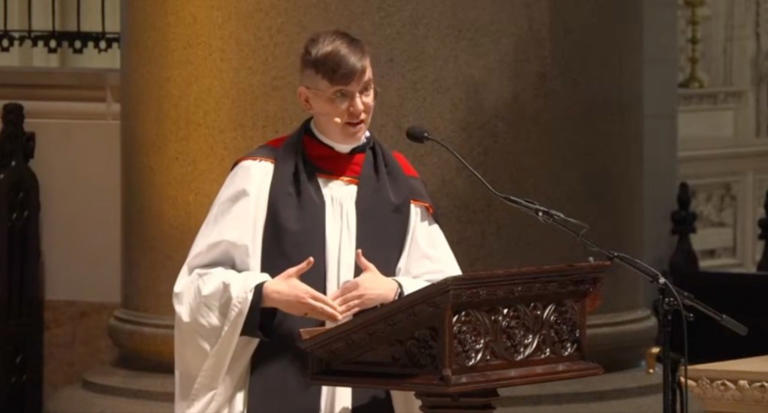
A New York City Episcopal priest sparked outrage by claiming that Jesus Christ was transgender and that God is nonbinary — a belief once shared by seminarian and Texas Democratic Senate candidate James Talarico.
Father Flourish Klink, who is nonbinary and transgender, made the outlandish assertions during a recent sermon at Christ & St. Stephen’s Episcopal Church on the Upper West Side.
“God is nonbinary,” Klink startlingly exclaimed, according to a livestream clip shared on X Wednesday. “But I’m going to go further than that, and I’m going to say God is actually also trans.”
Father Flourish Klink, a nonbinary and transgender priest with the Episcopal Church, Diocese of New York, claimed Jesus is transgender and God is nonbinary during a recent sermon on the Upper West Side. X/The Dissenter
Klink, who prefers “they/elle/hen” pronouns, went on to describe how transgender people are given a gender by “folks based on what they see” when they are born — and used it as grounds to why “God is trans.”
“When we’re old enough, we realize that wasn’t right and we’re not, in our deepest selves, the gender that everyone thought we were. Reasonable working definition of a trans person, right?” Klink asked the congregants.
“When God, who – as we have established is nonbinary – was born in human form as our Lord Jesus Christ, Mary said, ‘Oh look, a baby boy.'”
Klink, who has a spouse and daughter, paused for a second before claiming, “God isn’t a boy, we have established this. God is beyond boy and girl.
“God was assigned a gender at birth, and later on it became clear that that gender wasn’t right.
“So if you’re gonna deny that God is trans, I think you’re going to be denying the divinity of our Lord Jesus Christ and I have some notes about that,” Klink said.
Klink continued the sermon, alleging Jesus didn’t live the traditional life of a man from the first century by not getting married and instead chose to teach and engage with women in unusual ways — instead of the “traditionally masculine way.”
The priest used details from the Bible on how Jesus looked different after his resurrection as proof he was trans.
“There was something different about Jesus,” Klink said before admitting the Bible doesn’t directly say what was different.
“The Bible doesn’t tell us why it is that Jesus’ best friends, his disciples, the people who had walked with him to the end of his life, the people who had buried him in the tomb when it was politically difficult, who were committed to him still didn’t recognize Jesus for a good long time,” Klink added.
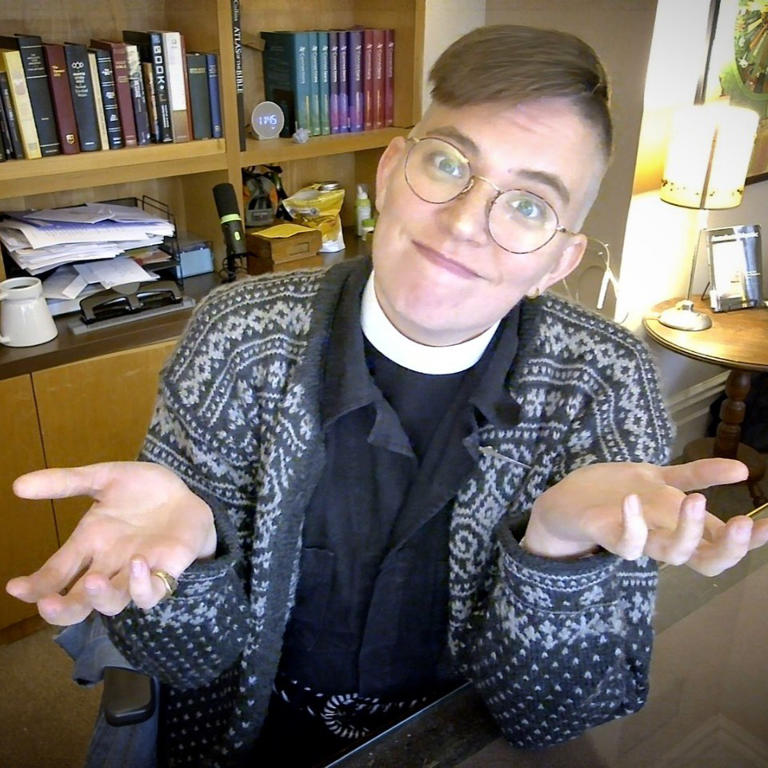
Klink, who prefers “they/elle/hen” pronouns, went on to describe how transgender people are given a gender by “folks based on what they see” when they are born — and used it as grounds to why “God is trans.”
“When we’re old enough, we realize that wasn’t right and we’re not, in our deepest selves, the gender that everyone thought we were. Reasonable working definition of a trans person, right?” Klink asked the congregants.
“When God, who – as we have established is nonbinary – was born in human form as our Lord Jesus Christ, Mary said, ‘Oh look, a baby boy.'”
Klink, who has a spouse and daughter, paused for a second before claiming, “God isn’t a boy, we have established this. God is beyond boy and girl.
“God was assigned a gender at birth, and later on it became clear that that gender wasn’t right.
“So if you’re gonna deny that God is trans, I think you’re going to be denying the divinity of our Lord Jesus Christ and I have some notes about that,” Klink said.
Klink continued the sermon, alleging Jesus didn’t live the traditional life of a man from the first century by not getting married and instead chose to teach and engage with women in unusual ways — instead of the “traditionally masculine way.”
The priest used details from the Bible on how Jesus looked different after his resurrection as proof he was trans.
“There was something different about Jesus,” Klink said before admitting the Bible doesn’t directly say what was different.
“The Bible doesn’t tell us why it is that Jesus’ best friends, his disciples, the people who had walked with him to the end of his life, the people who had buried him in the tomb when it was politically difficult, who were committed to him still didn’t recognize Jesus for a good long time,” Klink added.
Klink, who prefers “they/elle/hen” pronouns, described how transgender people are given a gender by “folks based on what they see” when they are born, as basis for the claim “God is trans.” Instagram/fatherflourish
Saturday, September 26, 2026
KTFLive: The Real Jeffery Epstein
KTFLive: The Real Jeffery Epstein

Keep the Faith Ministry
Apr 4, 2026 KTF Live
Make a Gift Now https://ktfnews.com/donate/
The Epstein scandal dominated the news cycle for months until the Iran war broke out. Since the Epstein files were released, while the public is still distracted by clamors for more salacious details, there is something that goes far deeper and broader and more sinister than the average Joe can imagine. And it will affect you. Join us today for a look under the wing of the bird. Hint: This is prophecy being fulfilled in real time.
Jesuit Influence From Hollywood To Higher Education SkyWatchTV
Note:
I do not promote the SkyWatchTV ads, or agree with the opinions expressed by the panel. But, I do concur with Chris Pinto's disclosure of facts about the Jesuit Order.
Jesuit Influence From Hollywood To Higher Education
SkyWatchTV
Sep 20, 2026
For centuries, the Jesuits have been associated with religion, education, politics, and some of the most powerful institutions in the world. But how far does that influence extend today?
In the third installment of this explosive SkyWatchTV series, Joe Horn sits down once again with award-winning filmmaker Chris Pinto, creator of American Jesuits: A History of Jesuitism in the United States.
After tracing Jesuit history and examining its connections to America's past in the first two episodes, this conversation brings the investigation into the modern world.
Healthcare. Politics. Intelligence. Immigration. China. Entertainment. Globalization.
Chris begins connecting historical threads to institutions and influential figures that millions of Americans encounter today—and argues that relationships most people would never think to look for have been hiding in plain sight.
But how much of this is documented history? How much is influence? And how far does the network actually reach?
Get Your "Chris Pinto American Jesuits Special Offer "Here!
https://www.skywatchtvstore.com/colle...
The Trail to Women’s Ordination in the NPUC Started in Oregon
Naomi Pepper
September 3, 2026

The historic vote on women’s ordination at the 2026 North Pacific Union Conference (NPUC) constituency session was driven by Adventists in Oregon. The motion was voted onto the agenda after delegates successfully navigated complex internal union bylaws to secure a direct vote. The efforts of these delegates resulted in a major victory for women in ministry and longtime advocates of ordination equality across the region.
Kessia Reyne Bennett, lead pastor of the Pleasant Valley Adventist Church in Oregon and a delegate at large, offered support that was characteristic of the careful way in which the Oregon Conference constituents presented the proposal. Noting that the move was not oppositional toward either the General Conference (GC) or “the establishment,” Bennett said, “I appreciate the motion for recognizing the authority of of the unions to administer ministerial credentials,” and added that the motion was careful not to compel conferences to put forward candidates who would not align with the conference’s “convictions or the qualifications of the candidate.” Kessia Reyne Bennett praised the motion for recognizing unions’ authority to approve ordinations. Video NPUC
But it wasn’t only Oregonians who spoke out in favor of ordination. José Haroldo Alomia, pastor of the Kirkland Adventist Church in the Washington Conference, said in support of the motion, “As a Hispanic man growing up in Latin America, I used to be of the opinion that women could not be ordained, nor lead in the church as I could.” He added that in over two decades of ministry, he changed his position because “Scripture doesn’t explicitly prohibit it,” and because his ministry “has been blessed and amplified by all the women that have worked with me,” including his current associate.José Haroldo Alomia noted that the Mid-America Union had already implemented the same measure proposed by the NPUC with no adverse effects to the Adventist Church or its mission. Video: NPUC
During more than an hour of discussion on the motion, of the 26 delegates who commented on the motion, seventeen spoke in favor, six in opposition, and three raised questions or declined to state a position. Nine of the seventeen delegates who voiced support are Oregon Conference pastors; one is an administrator in the conference.
The road to getting the motion to the floor was far from simple. Organizers had to navigate significant administrative hurdles to ensure the union leadership heard what a majority—62 percent—of delegates wanted for the women working in their churches.
The question of women’s ordination remains one of the most debated issues within the Adventist Church. Notably, the issue was brought to delegates at the 2015 GC Session in San Antonio, Texas. Out of 2,358 voters representing the world church, that motion fell just 203 votes short of allowing each world division to decide whether to permit the ordaining of women within their territory. There has not been a GC vote about whether unions can decide.
Increasingly, Adventists have pushed back against this stance, advocating more flexibility for unions and conferences to do what they believe is best for their congregations and pastors in their local contexts. With their awareness of how biblical values need to be communicated to increasingly diverse communities, they note how inviting people to join a church that officially discriminates on the basis of gender impedes Adventist mission. Walla Walla, Washington resident Jack Hoehn, author of Adventist Tomorrow: Fresh Ideas While Waiting for Jesus, stated in an interview, “‘Not now’ to female pastors is just another way of men saying ‘no!’”
In 2012, well before the 2015 GC vote, the Pacific Union and the Columbia Union successfully voted bylaw amendments approving “ordination to the gospel ministry without regard to gender” in their respective territories.
In 2021, the Mid-America Union followed, stating in their motion that it,“recognizes the right and responsibility of each local conference to prepare and recommend names for ordination, and will consider all recommended persons for ordination as submitted by the respective local conference executive committees.”
This was the exact language that members of the Oregon Conference executive committee used when submitting their proposed motion for the constituency session agenda. Though this does not compel conferences within the union to take any particular action, it gives each conference the flexibility to follow its own convictions on employment gender equality.