What in the World
Aug 19, 2025
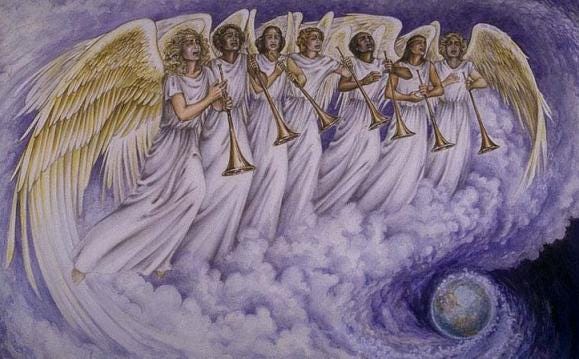
“Cry aloud, spare not, lift up thy voice like a trumpet, and shew my people their transgression, and the house of Jacob their sins” (Isa. 58:1).
Introduction
It is not always readily understood that the trumpets fall on the Roman Empire. However, if we review what the figure in Daniel 2, tells us, and if we start our analysis of the trumpets there, it becomes very clear that the trumpets are God’s judgements on the Roman Empire, firstly on the Western Empire, secondly on the Eastern Roman Empire and thirdly on the resurrected Roman Empire.
Daniel 2, tells us that the Roman Empire never disappeared into history, as the other empires did. In fact, the prophecy tells us that the Roman Empire will continue until the end of the world. It continues on in a metamorphosed form as the iron in the kingdom of iron and clay. This is why the correct name for the Catholic Church is the ROMAN Catholic Church because it is ROMAN and the inheritor of all things Roman and the continuation of all things Roman. This Roman heritage in the Catholic Church is something that has been recognized and commented on for hundreds of years:
If a man considers the origin of this great, ecclesiastical dominion he will easily perceive that the papacy is no other than the ghost of the deceased Roman Empire sitting crowned upon the grave thereof. Thomas Hobbs, Leviathan, p. 457.
Why does the prophecy in Daniel 2, only include five specific empires and leave out the myriad other empires that have historically existed? These empires are specifically included, because it is these empires that impact and intersect with the history of God’s people. But something changes when we come to the Roman Empire. It is only in the Roman Empire that we find God’s people merged with the empire. There was interaction with the other empires, but there but no merging. This is what makes the Roman Empire unique in the history of the world. The merging of the iron and the clay created the Christian Empire. But it is only Christian in name – it is ‘baptized paganism’ – paganism with Christian names. The church did not convert the Roman Empire, the Roman Empire converted the church.
This amalgamation is contrary to the will of God. Therefore, in order to save some of His people God sends judgments, so that His people will be jolted out of their deception – this is why the trumpets fall on the amalgamated Roman Empire – because God’s people are trapped in it and God was and still is, calling His people out of it. The trumpets have been calling His people out ever since the amalgamation began, and as time has gone by the trumpets grow exponentially in severity. Eventually there will be one last calling out which will go out to the whole world (see Rev. 18:4), after which the last trumpet will usher in the end of the world.
The Close of Probation
The sanctuary service given to the Israelites was the plan of salvation expressed in a manner by which the people could watch it and to a degree participate in it. The Book of Revelation follows the came pattern as that of the sanctuary. Briefly the sanctuary was made of three components: the courtyard, the holy place and the most holy place. Items found in these components represented the chief waymarks or essential events in the plan of salvation. For example, the altar in the courtyard represents the cross of Christ. The basin between the altar and the holy place represents baptism. The candlestick in the holy place represents the Holy Spirit. The table of showbread in the holy place represents the throne of God. The altar of incense represents the prayers of the saints. And the ark of the covenant in the most holy place represents God’s throne from which He delivers judgement.
When the Book of Revelation opens, we see Jesus walking among the candlesticks. We do not see Jesus in connection with the altar. The altar is not in focus because the plan of salvation is progressive and the sacrifice that Jesus made on the cross at this point in the plan is in the past. John is seeing what Jesus was doing at John’s present time. Jesus was walking among the candlesticks because according to the plan of salvation Jesus was now in the holy place, and He was sanctifying His people. Justification took place in the courtyard; the focus was now on sanctification, which is represented by the furniture in the Holy Place.
As John’s vision unfolds, he next sees Jesus on the table of showbread (chapters 4 & 5). And in the introductory scene to the seven trumpets, John sees Jesus standing before the altar of incense. The crucial point about this scene is the throwing down of the censor. Jesus takes fire from the altar, puts it in the censor and throws it down to the earth. This indicates that probation is over. The ministry that the incense represents is now over – there is no more mercy. This indicates that at some point in the sounding of the trumpets probation for the whole world will close:
I saw angels hurrying to and fro in heaven. An angel with a writer's inkhorn by his side returned from the earth and reported to Jesus that his work was done, and the saints were numbered and sealed. Then I saw Jesus, who had been ministering before the ark containing the ten commandments, throw down the censer. He raised His hands, and with a loud voice said, “It is done.” And all the angelic host laid off their crowns as Jesus made the solemn declaration, “He that is unjust, let him be unjust still: and he which is filthy, let him be filthy still: and he that is righteous, let him be righteous still: and he that is holy, let him be holy still.” EW 279
When Jesus throws down the censer, this indicates that the Day of Atonement ministry has come to its end. The purpose of the trumpets is to warn the world that that day is coming. Just as the trumpets were blown for seven months in the typical festival system, followed by a massive blowing of trumpets, blown to warn the people that it was just 10 days before the Day of Judgment – the history of the church and the world follows the same pattern. The trumpets are God’s warnings/judgments on the empire of iron and clay because God’s people have been trapped/ensnared in deception, and He wants them to awaken to their plight and rescue them and save them.
The First Trumpet
The first judgment falls on the earth. The earth is used in prophecy, to represent the refuge place for God’s people. The earth is a place of safety – a place that sustains and nourishes God’s people (see below). But these people have forfeited God’s protection – they have become apostate. Therefore, the place of safety, and the place of sustenance is taken away from them. Devastating attacks by barbarian tribes begin to reduce the Western Empire to ashes.
For many years, the empire in east and west had had been feeling the pressure, of the barbarian tribes, moving from east to west and from north to south. Various methods had been used to cope with this threat, from outright war, to bribery and even employment. But as the apostasy grew, so did the threat. First the Visigoths in the year 378 annihilated an entire Roman army. Then their cousins the Ostrogoths, under their leader Alaric, were the first to break through the Roman defenses, in the year 395, when they crossed the Danube River. They first ravaged those parts of the empire that we now call Greece, then France and Italy – and in the year 410, they did the unthinkable and sacked the city of Rome itself. The infamous ‘pax roma’ [peace of Rome] had come to an end. There was no peace and no security anywhere. Thus, there was much destruction, warfare and loss of life. The Roman world was virtually turned upside down, and was never the same again. This unprecedented period of history is considered to be the first trumpet – the first judgment against the apostasy. God was removing His protection and allowing a third part of the ‘earth’ with its ‘green trees’ and ‘green grass’ [the sustaining power of the earth] to be destroyed.
The Second Trumpet
Following close on the heals, of the Goths, came the Vandals [whose name is synonymous for wanton destruction]. After ‘vandalizing’ much of Europe from north to south, they established themselves in North Africa and became a powerful naval presence in the western Mediterranean. From this location, they launched devastating attacks against anything Roman, sacking the city of Rome itself, in the year 455. It is said that the question was asked of Gaiseric, the king of the Vandals, when an attack was being prepared, “Where shall we go this time?” To which he reputedly replied, “Against those whom God is angry.” When Nebuchadnezzar was the instrument, chosen by God to discipline His people, God called him “my servant” (Jer. 27:6). In other words, God was using a pagan king to punish and correct his apostate people. The Vanda’s were not pagans or heathens, they had converted to Christianity, (Arian theology) perhaps this is why Gaiseric had some insight into God’s methods, and he felt God’s directing hand upon his shoulder.
John describes the Vandal attacks as “a great mountain burning with fire” (Rev. 8:8), being cast into the sea. Undoubtedly, John has borrowed this imagery from Jeremiah, who also saw in vision the overpowering might of Nebuchadnezzar’s Babylon, in vision, described as a burning mountain (see Jer. 51:25). John sees this fiery mountain crashing into the sea. Water and the sea is a symbol for “peoples, and multitudes, and nations, and tongues” (Rev. 17:15). And it is on these ‘waters’ that the apostate religious power – the whore – is “sitting” (Rev. 17:1, 15). In other words, this water, that the woman is sitting on, is symbolic of more than just humanity in general – it is symbolic of the woman’s supporters [the woman is sitting on them, being supported by them – nourished by them. As the water of the Euphrates supported and nourished the literal city of Babylon, these people nourish and support the spiritual city of Babylon]. Therefore, the imagery of the fiery mountain crashing into the sea, is a particularly apt symbol, of the Vandal naval power crashing into the sea of apostate humanity, at this time in history.
This was the time period when the first steps towards the uniting of church and state took place. This unnatural union – this illegal union, symbolized by the blending of iron and clay and sexual immorality, was punished in the time of Elijah, and it is being punished again now. The purpose of this union of church and state, symbolized by the woman on the beast and the woman on the waters, is to persecute God’s people and “make war with the Lamb” (Rev. 17:14).
This same imagery of water overflowing against God’s people is employed when describing Satan’s attempt to destroy the remnant of God’s people:
And the serpent cast out of his mouth water as a flood after the woman, that he might cause her to be carried away of the flood. Rev. 12:15.
This imagery has been borrowed from the Old Testament, where it has been used to describe the attacks by God’s enemies, on His people like the overflowing of the river Euphrates. Thus, if the supporters of the enemy are described in terms of water and this water threatens to cover the earth and drown it – then the earth itself must represent the opposite of what water represents. The earth must therefore represent the support and refuge given to the people of God. Again, this is consistent with the imagery used to describe Satan’s attack on God’s people and the refuge that God provides for His people:
And the earth helped the woman, and the earth opened her mouth, and swallowed up the flood which the dragon cast out of his mouth. Rev. 12:16.
Once we know what the earth represents, we can also know what the damage done to the earth represents. When one third of the trees are burnt up and all the green grass is destroyed, this must have something to do with the earth’s ability to succor, support and sustain God’s people, being severely curtailed. The hail, the fire, and the blood indicate that this is accomplished because of war and bloodshed.
The falling of the mountain into the sea and the death and destruction that occurs in the sea – is symbolic of the destruction and loss of life of the people – because the water of the sea represents apostate people. Only nominally Christian, the people of the Roman Empire flocked to join the new church, which was not just a union of church and state, but also a union of nominal Christianity with paganism. It was an apostate church for an apostate people. And thus, the judgments came because, “when the judgments of the Lord are in the land the people will learn righteousness” (Isa. 26:9).
The Third Trumpet
The third trumpet introduces a change. There is no fire or burning or blood. Instead, there is poison. There is still death, but the deaths are no longer caused by warfare and bloodshed – the people are poisoned.
The poison is introduced by ‘a great star’ called ‘wormwood’ and the origin of this star is that it ‘fell’ from heaven (Rev. 8:10,11). This star can be none other than Satan. Angels are symbolized as stars (see Rev. 1:20), and ‘a great star’ that ‘fell’ could only be Satan. Jesus said to His disciples, “I beheld Satan as lightening fall from heaven” (Lu. 10:18). Who else but Satan, would be a poisonous influence? Satanic poisoning comes to us in both a physical form and a spiritual form:
…fatal errors, like a deadly poison, taint the morals and blight the hopes of a large part of the human race. AA 507.
If the moral atmosphere surrounding persons is not pure and sanctified, but is tainted with corruption, those who breathe this atmosphere will find that it operates almost insensibly upon the intellect and heart to poison and to ruin. AH 462.
The soul who loves Jesus, who appreciates the saving power of his grace, will feel such a drawing near to Christ that he will desire to work in his lines. He cannot, dare not, let Satan control his spirit and a poisonous miasma surround his soul. CE 148.
Satan is exercising his power. He sweeps away the ripening harvest, and famine and distress follow. He imparts to the air a deadly taint, and thousands perish by the pestilence. These visitations are to become more and more frequent and disastrous. Destruction will be upon both man and beast. CH 461.
The name ‘wormwood’ appears seven times in the Old Testament. All of these references to wormwood, are placed in a context of spiritual poisoning, that leads to apostasy, or it refers to the fact, that this poisoning has already taken place and the resultant apostasy has already happened. For example, the first time the word ‘wormwood’ is used is in Deuteronomy. The context, in which it appears, is the importance of each individual keeping the covenant, that they had just made with God. Moses exhorts them to remember, what it was like to live in Egypt, with its idols and abominations, and then he adds:
Lest there should be among you man, or woman, or family, or tribe, whose heart turneth away this day from the Lord our God to go and serve the gods of these nations; lest there should be among you a root that beareth gall and wormwood. Deut. 29:18.
A paraphrase of this verse reads thus, and helps us to understand the meaning of this verse:
So make sure that no man, woman, family or tribe serves any of the gods of other nations. Once this sort of thing gets started it will root itself in your consciousness and act like a poison in your system that will kill your love for the Lord. Deut. 29:18. The Clear Word.
This is the first-time wormwood appears in the Bible, and the principle of first mention tells us, that this is where we will find its definitive interpretation. We find that wormwood is associated with gall – a bitter substance. The scenario described by Moses takes the following path: if we turn from God and serve the gods of other nations, we will become a root of wormwood/poison, that will result in spiritual death. The Seventh-day Adventist Bible Commentary contains the following useful comments about gall and wormwood, in its analysis of verse 18:
The word translated “gall” appears as “venom” in ch. 32:33, “poison” in Job 20:16, and “hemlock” in Hosea 10:4. The word translated “wormwood” is similarly translated in all other texts except Amos 6:12, where it is given as “hemlock.” These terms are suggestive of the bitter consequences of idolatry. SDABC Vol. 1, page 1058.
This is what the third trumpet is about. It is about the “bitter consequences of idolatry.” The ‘great star’ that fell from heaven, has managed to poison the hearts of the people and turned them to serve other gods. This is the time period, when the doctrine of Balaam enters the church – and Balaam taught Balac “to cast a stumblingblock before the children of Israel, to eat things sacrificed unto idols, and to commit fornication” (Rev. 2:14). And the doctrine of Balaam pre-figures the arrival of the anti-typical Jezebel in the church:
Notwithstanding I have a few things against thee, because thou sufferest that woman Jezebel, which calleth herself a prophetess, to teach and to seduce my servants to commit fornication, and to eat things sacrificed unto idols. And I gave her space to repent of her fornication; and she repented not. Behold, I will cast her into a bed, and them that commit adultery with her into great tribulation, except they repent of their deeds. And I will kill her children with death; and all the churches shall know that I am he which searcheth the reins and hearts: and I will give unto every one of you according to your works. Rev. 2:20-23.
God indicates His opposition to Balaam and Jezebel, by allowing the people, to suffer the consequences of one of the principles of His kingdom, “for whatsoever a man soweth, that shall he also reap” (Gal. 6:7, 8).
Jesus said, “If any man thirst let him come unto me and drink” (Jn. 7:37). He added, “He that believeth on me, as the scripture hath said, out of his belly shall flow rivers of living water” (Jn. 7:38). But now, under the time of the third trumpet, a third part of all the water is polluted and poisoned. It was at this time that the results of uniting church and state were bearing fruit. The people became ‘Christian’ only in name – nominal Christians. They continued to worship their pagan gods and brought idol worship into the church. The only concession to Christianity was to change the names of the old gods to Christian names. As a result, many died, both physically and spiritually - “and many men died because of the waters, because they were bitter (poisoned)” (Rev. 8:11).
God does not always actively punish with judgments involving war, captivity and physical death. He also will withdraw His protection, allowing people to ‘reap what they sow.’ Scripture says, that God sometimes simply gives up on the ‘spiritually deaf and blind’ and leaves them to suffer the consequences of their actions:
Ephraim [the northern kingdom] is joined to idols: let him alone. Hosea 4:17.
I am the Lord thy God, which brought thee out of the land of Egypt: open thy mouth wide that I might fill it. But my people would not hearken to my voice; and Israel would none of me. So I gave them up unto their own hearts’ lusts; and they walked in their own counsels. Ps. 81:10-12. (see also Prov. 1:25-33; Rom. 1:20-32).
Paul has told us that God’s people would repeat the mistakes that God’s people made in the past (see 1 Cor. 1-15). Paul also tells us why he needs to remind us of what happened in the past, it is because we also need to beware of idolatry… “Wherefore, my dearly beloved, flee from idolatry” (1 Cor. 10:14). However, the people, at this time, are not ‘fleeing’ from idolatry, on the contrary they are ‘flocking’ to it. This is what has happened at this point in history. The people are committing the same mistake as those in the past (albeit in a disguised deceptive manner). The people have turned their backs on God, just as the men in the temple did in the days of Ezekiel (see Eze. 8:15-18). And just as the days of Ezekiel, saw a proliferation of idols and idol worship in sacred places, so too, did the same thing happen in the nominal Christian Church at this time. Therefore, God abandoned them, to walk “in their own counsels.”
The Fourth Trumpet
The downward spiral into spiritual darkness continues under the fourth trumpet. This period of history introduces, what has been aptly labeled ‘the Dark Ages.’ This is because, under the period of the fourth trumpet, we find the light of the world is being ‘darkened’:
And the fourth angel sounded, and the third part of the sun was smitten, and the third part of the moon, and the third part of the stars; so as the third part of them was darkened, and the day shone not for a third part of it, and the night likewise. Rev. 8:12.
The message of the fourth trumpet specifically mentions the light of the sun, moon and stars being diminished or withdrawn. What do the sun, moon and stars symbolically represent?
God told the prophet Malachi, that all the wicked would eventually be ‘burnt up.’ However, God, simultaneously assured His people, through Malachi that, His faithful people would not suffer the same fate: “But unto you that fear my name shall the Sun of righteousness arise with healing in his wings…” (Mal. 4:2). Here we are introduced, to yet again, one more title, that belongs to Jesus – ‘the Sun of Righteousness.’ Jesus claimed the right, to be known as the source of light, He said, “I am the light of the world” (Jn. 8:12). Even though the practice of sun worship, has obscured this fact, biblically, the sun and its light, is a symbol of Christ and His light. Therefore, we can safely conclude that the sun, is used biblically, as a symbol of Christ.
Because the moon, reflects the light of the sun, this must mean, that the moon is also used as a symbol connected to Christ. Lastly, the stars are biblically used, as symbols for the heavenly angels (see Rev. 1:20). It is for these reasons, that Jesus is represented as the sun, and that, His Church, is represented as the moon, supported by the angels, in Revelation:
And there appeared a great wonder in heaven; a woman clothed with the sun, and the moon under her feet, and upon her head a crown of twelve stars… Rev. 12:1.
Here we have the same light giving sources mentioned, as we find in the fourth trumpet – the sun, moon and stars. Biblically a woman, is a symbol of a church. This woman is clothed and reflecting the light of the Sun by standing on the moon. Therefore, this woman must be Christ’s Church, because the Sun is a symbol of Christ. In addition, the woman is crowned with a crown of twelve stars, indicating she is under the care of heavenly angels.
Therefore, the reason why the sun, moon and stars are ‘darkened’ in the period of the fourth trumpet, is because the light, which was originally shining upon the world, from Christ, the angels and reflected by His faithful people, is being obstructed and/or rejected by the world.
The period of the fourth trumpet corresponds with the period of the fourth seal and the period of the fourth church. This is the period of the 1260-year prophecy, mentioned seven times in prophecy – (twice in Daniel and five times in Revelation). This is the time of 1260 years of supremacy of the Roman power, in its papal form. It is the time of the Roman Catholic Church’s hegemony, over the political powers of the world. It is also the time when the ‘Light’ was at its lowest ebb, and when the ‘darkness’ was at its deepest. It was prophesied by Daniel that this would be the time when a ‘king’ would arise, “understanding dark sentences” (Dan. 8:23). Naturally, a ‘king’ who understood “dark sentences” would be in league with the “darkness.” In order to “understand” the “darkness” this ‘king’ would have to be close to the “darkness.” This ‘king’ would have had to been educated by the “darkness.” This ‘king’ would have wielded the “darkness” – spreading the “darkness.” This ‘king’ would be the greatest propagandist for the “darkness.”
This is why the light is diminished and rejected in the time of the fourth trumpet, because the ‘king’ who “understands dark sentences” and all his agents, were forcefully working against the ‘Light.’ This policy of working against the Light was carried out by the Roman Catholic Church, under the direction of its Papal Office (the office of the Pope). Anyone, who has studied history, if only briefly, knows about the strenuous efforts, put forth by the Roman Catholic Church to suppress all opposition to its rule. In so doing it was suppressing the ‘Light’ and promoting the ‘darkness.’ This is what the fourth trumpet is telling us.
Conclusion
The Bible tells the same stories in different ways - one way is to repeat and enlarge. The seven churches are a record of the spiritual history of the church from its beginning to its end. The third church and the fourth church cover the history of the spiritual decline – which is repeating and enlarging on the prophecy informing us about the establishing of the empire of iron and clay. The first four trumpets are taking this one step further. The first four trumpets are repeating and enlarging on the establishment of the empire of iron and clay but focusing on what God does to shake His people out of it, by allowing the people to reap what they have sown (see Gal. 6:7).
As history unfolds, the judgments become exponentially more severe. The church at this time is repeating the history of Israel and God is responding in the same manner that He responded to the apostasy of Israel. As the hearts of the Israelites grew hard and their necks grew stiff, so too did the judgments of God grow exponentially. However, the people had neither eyes to see or ears to hear. They preferred ‘fake news’ and ‘disinformation’ which allowed them to ignore the warnings and slumber on (see Isa. 28:14, 15). Eventually, there was ‘no remedy’ left – the people were in total rebellion (see 2 Chron. 36:11-17) - therefore the final judgment destroyed Jerusalem, the temple and the nation.
The same scenario is scheduled for the seven trumpets. The people of the world have already experienced trumpets one to six. The result has been an exponential hardening of hearts and stiffening of necks. Soon the seventh and last trumpet will blow, and it will sweep away the entire world.
Introduction
It is not always readily understood that the trumpets fall on the Roman Empire. However, if we review what the figure in Daniel 2, tells us, and if we start our analysis of the trumpets there, it becomes very clear that the trumpets are God’s judgements on the Roman Empire, firstly on the Western Empire, secondly on the Eastern Roman Empire and thirdly on the resurrected Roman Empire.
Daniel 2, tells us that the Roman Empire never disappeared into history, as the other empires did. In fact, the prophecy tells us that the Roman Empire will continue until the end of the world. It continues on in a metamorphosed form as the iron in the kingdom of iron and clay. This is why the correct name for the Catholic Church is the ROMAN Catholic Church because it is ROMAN and the inheritor of all things Roman and the continuation of all things Roman. This Roman heritage in the Catholic Church is something that has been recognized and commented on for hundreds of years:
Whatever Roman elements the barbarians and Arians left … [came] under the protection of the Bishop of Rome, who was the chief person there after the Emperor’s disappearance… The Roman Church in this way privily pushed itself into the place of the Roman World-Empire, of which it is the actual continuation… the Roman empire has not perished, but has only undergone a transformation That is no mere ‘clever remark,’ but the recognition of the true state of the matter historically, and the most appropriate and fruitful way of describing the character of this Church. It still governs the nations… It is a political creation, and as imposing as a World-Empire, because it is the continuation of the Roman Empire. The Pope, who calls himself ‘King’ and ‘Pontifex Maximus,’ is Caesar’s successor. Adolf Harnack, What Is Christianity? (2d ed., New York: Putnam, 1901), pp. 269, 270.
If a man considers the origin of this great, ecclesiastical dominion he will easily perceive that the papacy is no other than the ghost of the deceased Roman Empire sitting crowned upon the grave thereof. Thomas Hobbs, Leviathan, p. 457.
Why does the prophecy in Daniel 2, only include five specific empires and leave out the myriad other empires that have historically existed? These empires are specifically included, because it is these empires that impact and intersect with the history of God’s people. But something changes when we come to the Roman Empire. It is only in the Roman Empire that we find God’s people merged with the empire. There was interaction with the other empires, but there but no merging. This is what makes the Roman Empire unique in the history of the world. The merging of the iron and the clay created the Christian Empire. But it is only Christian in name – it is ‘baptized paganism’ – paganism with Christian names. The church did not convert the Roman Empire, the Roman Empire converted the church.
This amalgamation is contrary to the will of God. Therefore, in order to save some of His people God sends judgments, so that His people will be jolted out of their deception – this is why the trumpets fall on the amalgamated Roman Empire – because God’s people are trapped in it and God was and still is, calling His people out of it. The trumpets have been calling His people out ever since the amalgamation began, and as time has gone by the trumpets grow exponentially in severity. Eventually there will be one last calling out which will go out to the whole world (see Rev. 18:4), after which the last trumpet will usher in the end of the world.
The Close of Probation
The sanctuary service given to the Israelites was the plan of salvation expressed in a manner by which the people could watch it and to a degree participate in it. The Book of Revelation follows the came pattern as that of the sanctuary. Briefly the sanctuary was made of three components: the courtyard, the holy place and the most holy place. Items found in these components represented the chief waymarks or essential events in the plan of salvation. For example, the altar in the courtyard represents the cross of Christ. The basin between the altar and the holy place represents baptism. The candlestick in the holy place represents the Holy Spirit. The table of showbread in the holy place represents the throne of God. The altar of incense represents the prayers of the saints. And the ark of the covenant in the most holy place represents God’s throne from which He delivers judgement.
When the Book of Revelation opens, we see Jesus walking among the candlesticks. We do not see Jesus in connection with the altar. The altar is not in focus because the plan of salvation is progressive and the sacrifice that Jesus made on the cross at this point in the plan is in the past. John is seeing what Jesus was doing at John’s present time. Jesus was walking among the candlesticks because according to the plan of salvation Jesus was now in the holy place, and He was sanctifying His people. Justification took place in the courtyard; the focus was now on sanctification, which is represented by the furniture in the Holy Place.
As John’s vision unfolds, he next sees Jesus on the table of showbread (chapters 4 & 5). And in the introductory scene to the seven trumpets, John sees Jesus standing before the altar of incense. The crucial point about this scene is the throwing down of the censor. Jesus takes fire from the altar, puts it in the censor and throws it down to the earth. This indicates that probation is over. The ministry that the incense represents is now over – there is no more mercy. This indicates that at some point in the sounding of the trumpets probation for the whole world will close:
I saw angels hurrying to and fro in heaven. An angel with a writer's inkhorn by his side returned from the earth and reported to Jesus that his work was done, and the saints were numbered and sealed. Then I saw Jesus, who had been ministering before the ark containing the ten commandments, throw down the censer. He raised His hands, and with a loud voice said, “It is done.” And all the angelic host laid off their crowns as Jesus made the solemn declaration, “He that is unjust, let him be unjust still: and he which is filthy, let him be filthy still: and he that is righteous, let him be righteous still: and he that is holy, let him be holy still.” EW 279
When Jesus throws down the censer, this indicates that the Day of Atonement ministry has come to its end. The purpose of the trumpets is to warn the world that that day is coming. Just as the trumpets were blown for seven months in the typical festival system, followed by a massive blowing of trumpets, blown to warn the people that it was just 10 days before the Day of Judgment – the history of the church and the world follows the same pattern. The trumpets are God’s warnings/judgments on the empire of iron and clay because God’s people have been trapped/ensnared in deception, and He wants them to awaken to their plight and rescue them and save them.
The First Trumpet
The first judgment falls on the earth. The earth is used in prophecy, to represent the refuge place for God’s people. The earth is a place of safety – a place that sustains and nourishes God’s people (see below). But these people have forfeited God’s protection – they have become apostate. Therefore, the place of safety, and the place of sustenance is taken away from them. Devastating attacks by barbarian tribes begin to reduce the Western Empire to ashes.
For many years, the empire in east and west had had been feeling the pressure, of the barbarian tribes, moving from east to west and from north to south. Various methods had been used to cope with this threat, from outright war, to bribery and even employment. But as the apostasy grew, so did the threat. First the Visigoths in the year 378 annihilated an entire Roman army. Then their cousins the Ostrogoths, under their leader Alaric, were the first to break through the Roman defenses, in the year 395, when they crossed the Danube River. They first ravaged those parts of the empire that we now call Greece, then France and Italy – and in the year 410, they did the unthinkable and sacked the city of Rome itself. The infamous ‘pax roma’ [peace of Rome] had come to an end. There was no peace and no security anywhere. Thus, there was much destruction, warfare and loss of life. The Roman world was virtually turned upside down, and was never the same again. This unprecedented period of history is considered to be the first trumpet – the first judgment against the apostasy. God was removing His protection and allowing a third part of the ‘earth’ with its ‘green trees’ and ‘green grass’ [the sustaining power of the earth] to be destroyed.
The Second Trumpet
Following close on the heals, of the Goths, came the Vandals [whose name is synonymous for wanton destruction]. After ‘vandalizing’ much of Europe from north to south, they established themselves in North Africa and became a powerful naval presence in the western Mediterranean. From this location, they launched devastating attacks against anything Roman, sacking the city of Rome itself, in the year 455. It is said that the question was asked of Gaiseric, the king of the Vandals, when an attack was being prepared, “Where shall we go this time?” To which he reputedly replied, “Against those whom God is angry.” When Nebuchadnezzar was the instrument, chosen by God to discipline His people, God called him “my servant” (Jer. 27:6). In other words, God was using a pagan king to punish and correct his apostate people. The Vanda’s were not pagans or heathens, they had converted to Christianity, (Arian theology) perhaps this is why Gaiseric had some insight into God’s methods, and he felt God’s directing hand upon his shoulder.
John describes the Vandal attacks as “a great mountain burning with fire” (Rev. 8:8), being cast into the sea. Undoubtedly, John has borrowed this imagery from Jeremiah, who also saw in vision the overpowering might of Nebuchadnezzar’s Babylon, in vision, described as a burning mountain (see Jer. 51:25). John sees this fiery mountain crashing into the sea. Water and the sea is a symbol for “peoples, and multitudes, and nations, and tongues” (Rev. 17:15). And it is on these ‘waters’ that the apostate religious power – the whore – is “sitting” (Rev. 17:1, 15). In other words, this water, that the woman is sitting on, is symbolic of more than just humanity in general – it is symbolic of the woman’s supporters [the woman is sitting on them, being supported by them – nourished by them. As the water of the Euphrates supported and nourished the literal city of Babylon, these people nourish and support the spiritual city of Babylon]. Therefore, the imagery of the fiery mountain crashing into the sea, is a particularly apt symbol, of the Vandal naval power crashing into the sea of apostate humanity, at this time in history.
This was the time period when the first steps towards the uniting of church and state took place. This unnatural union – this illegal union, symbolized by the blending of iron and clay and sexual immorality, was punished in the time of Elijah, and it is being punished again now. The purpose of this union of church and state, symbolized by the woman on the beast and the woman on the waters, is to persecute God’s people and “make war with the Lamb” (Rev. 17:14).
This same imagery of water overflowing against God’s people is employed when describing Satan’s attempt to destroy the remnant of God’s people:
And the serpent cast out of his mouth water as a flood after the woman, that he might cause her to be carried away of the flood. Rev. 12:15.
This imagery has been borrowed from the Old Testament, where it has been used to describe the attacks by God’s enemies, on His people like the overflowing of the river Euphrates. Thus, if the supporters of the enemy are described in terms of water and this water threatens to cover the earth and drown it – then the earth itself must represent the opposite of what water represents. The earth must therefore represent the support and refuge given to the people of God. Again, this is consistent with the imagery used to describe Satan’s attack on God’s people and the refuge that God provides for His people:
And the earth helped the woman, and the earth opened her mouth, and swallowed up the flood which the dragon cast out of his mouth. Rev. 12:16.
Once we know what the earth represents, we can also know what the damage done to the earth represents. When one third of the trees are burnt up and all the green grass is destroyed, this must have something to do with the earth’s ability to succor, support and sustain God’s people, being severely curtailed. The hail, the fire, and the blood indicate that this is accomplished because of war and bloodshed.
The falling of the mountain into the sea and the death and destruction that occurs in the sea – is symbolic of the destruction and loss of life of the people – because the water of the sea represents apostate people. Only nominally Christian, the people of the Roman Empire flocked to join the new church, which was not just a union of church and state, but also a union of nominal Christianity with paganism. It was an apostate church for an apostate people. And thus, the judgments came because, “when the judgments of the Lord are in the land the people will learn righteousness” (Isa. 26:9).
The Third Trumpet
The third trumpet introduces a change. There is no fire or burning or blood. Instead, there is poison. There is still death, but the deaths are no longer caused by warfare and bloodshed – the people are poisoned.
The poison is introduced by ‘a great star’ called ‘wormwood’ and the origin of this star is that it ‘fell’ from heaven (Rev. 8:10,11). This star can be none other than Satan. Angels are symbolized as stars (see Rev. 1:20), and ‘a great star’ that ‘fell’ could only be Satan. Jesus said to His disciples, “I beheld Satan as lightening fall from heaven” (Lu. 10:18). Who else but Satan, would be a poisonous influence? Satanic poisoning comes to us in both a physical form and a spiritual form:
…fatal errors, like a deadly poison, taint the morals and blight the hopes of a large part of the human race. AA 507.
If the moral atmosphere surrounding persons is not pure and sanctified, but is tainted with corruption, those who breathe this atmosphere will find that it operates almost insensibly upon the intellect and heart to poison and to ruin. AH 462.
The soul who loves Jesus, who appreciates the saving power of his grace, will feel such a drawing near to Christ that he will desire to work in his lines. He cannot, dare not, let Satan control his spirit and a poisonous miasma surround his soul. CE 148.
Satan is exercising his power. He sweeps away the ripening harvest, and famine and distress follow. He imparts to the air a deadly taint, and thousands perish by the pestilence. These visitations are to become more and more frequent and disastrous. Destruction will be upon both man and beast. CH 461.
The name ‘wormwood’ appears seven times in the Old Testament. All of these references to wormwood, are placed in a context of spiritual poisoning, that leads to apostasy, or it refers to the fact, that this poisoning has already taken place and the resultant apostasy has already happened. For example, the first time the word ‘wormwood’ is used is in Deuteronomy. The context, in which it appears, is the importance of each individual keeping the covenant, that they had just made with God. Moses exhorts them to remember, what it was like to live in Egypt, with its idols and abominations, and then he adds:
Lest there should be among you man, or woman, or family, or tribe, whose heart turneth away this day from the Lord our God to go and serve the gods of these nations; lest there should be among you a root that beareth gall and wormwood. Deut. 29:18.
A paraphrase of this verse reads thus, and helps us to understand the meaning of this verse:
So make sure that no man, woman, family or tribe serves any of the gods of other nations. Once this sort of thing gets started it will root itself in your consciousness and act like a poison in your system that will kill your love for the Lord. Deut. 29:18. The Clear Word.
This is the first-time wormwood appears in the Bible, and the principle of first mention tells us, that this is where we will find its definitive interpretation. We find that wormwood is associated with gall – a bitter substance. The scenario described by Moses takes the following path: if we turn from God and serve the gods of other nations, we will become a root of wormwood/poison, that will result in spiritual death. The Seventh-day Adventist Bible Commentary contains the following useful comments about gall and wormwood, in its analysis of verse 18:
The word translated “gall” appears as “venom” in ch. 32:33, “poison” in Job 20:16, and “hemlock” in Hosea 10:4. The word translated “wormwood” is similarly translated in all other texts except Amos 6:12, where it is given as “hemlock.” These terms are suggestive of the bitter consequences of idolatry. SDABC Vol. 1, page 1058.
This is what the third trumpet is about. It is about the “bitter consequences of idolatry.” The ‘great star’ that fell from heaven, has managed to poison the hearts of the people and turned them to serve other gods. This is the time period, when the doctrine of Balaam enters the church – and Balaam taught Balac “to cast a stumblingblock before the children of Israel, to eat things sacrificed unto idols, and to commit fornication” (Rev. 2:14). And the doctrine of Balaam pre-figures the arrival of the anti-typical Jezebel in the church:
Notwithstanding I have a few things against thee, because thou sufferest that woman Jezebel, which calleth herself a prophetess, to teach and to seduce my servants to commit fornication, and to eat things sacrificed unto idols. And I gave her space to repent of her fornication; and she repented not. Behold, I will cast her into a bed, and them that commit adultery with her into great tribulation, except they repent of their deeds. And I will kill her children with death; and all the churches shall know that I am he which searcheth the reins and hearts: and I will give unto every one of you according to your works. Rev. 2:20-23.
God indicates His opposition to Balaam and Jezebel, by allowing the people, to suffer the consequences of one of the principles of His kingdom, “for whatsoever a man soweth, that shall he also reap” (Gal. 6:7, 8).
Jesus said, “If any man thirst let him come unto me and drink” (Jn. 7:37). He added, “He that believeth on me, as the scripture hath said, out of his belly shall flow rivers of living water” (Jn. 7:38). But now, under the time of the third trumpet, a third part of all the water is polluted and poisoned. It was at this time that the results of uniting church and state were bearing fruit. The people became ‘Christian’ only in name – nominal Christians. They continued to worship their pagan gods and brought idol worship into the church. The only concession to Christianity was to change the names of the old gods to Christian names. As a result, many died, both physically and spiritually - “and many men died because of the waters, because they were bitter (poisoned)” (Rev. 8:11).
God does not always actively punish with judgments involving war, captivity and physical death. He also will withdraw His protection, allowing people to ‘reap what they sow.’ Scripture says, that God sometimes simply gives up on the ‘spiritually deaf and blind’ and leaves them to suffer the consequences of their actions:
Ephraim [the northern kingdom] is joined to idols: let him alone. Hosea 4:17.
I am the Lord thy God, which brought thee out of the land of Egypt: open thy mouth wide that I might fill it. But my people would not hearken to my voice; and Israel would none of me. So I gave them up unto their own hearts’ lusts; and they walked in their own counsels. Ps. 81:10-12. (see also Prov. 1:25-33; Rom. 1:20-32).
Paul has told us that God’s people would repeat the mistakes that God’s people made in the past (see 1 Cor. 1-15). Paul also tells us why he needs to remind us of what happened in the past, it is because we also need to beware of idolatry… “Wherefore, my dearly beloved, flee from idolatry” (1 Cor. 10:14). However, the people, at this time, are not ‘fleeing’ from idolatry, on the contrary they are ‘flocking’ to it. This is what has happened at this point in history. The people are committing the same mistake as those in the past (albeit in a disguised deceptive manner). The people have turned their backs on God, just as the men in the temple did in the days of Ezekiel (see Eze. 8:15-18). And just as the days of Ezekiel, saw a proliferation of idols and idol worship in sacred places, so too, did the same thing happen in the nominal Christian Church at this time. Therefore, God abandoned them, to walk “in their own counsels.”
The Fourth Trumpet
The downward spiral into spiritual darkness continues under the fourth trumpet. This period of history introduces, what has been aptly labeled ‘the Dark Ages.’ This is because, under the period of the fourth trumpet, we find the light of the world is being ‘darkened’:
And the fourth angel sounded, and the third part of the sun was smitten, and the third part of the moon, and the third part of the stars; so as the third part of them was darkened, and the day shone not for a third part of it, and the night likewise. Rev. 8:12.
The message of the fourth trumpet specifically mentions the light of the sun, moon and stars being diminished or withdrawn. What do the sun, moon and stars symbolically represent?
God told the prophet Malachi, that all the wicked would eventually be ‘burnt up.’ However, God, simultaneously assured His people, through Malachi that, His faithful people would not suffer the same fate: “But unto you that fear my name shall the Sun of righteousness arise with healing in his wings…” (Mal. 4:2). Here we are introduced, to yet again, one more title, that belongs to Jesus – ‘the Sun of Righteousness.’ Jesus claimed the right, to be known as the source of light, He said, “I am the light of the world” (Jn. 8:12). Even though the practice of sun worship, has obscured this fact, biblically, the sun and its light, is a symbol of Christ and His light. Therefore, we can safely conclude that the sun, is used biblically, as a symbol of Christ.
Because the moon, reflects the light of the sun, this must mean, that the moon is also used as a symbol connected to Christ. Lastly, the stars are biblically used, as symbols for the heavenly angels (see Rev. 1:20). It is for these reasons, that Jesus is represented as the sun, and that, His Church, is represented as the moon, supported by the angels, in Revelation:
And there appeared a great wonder in heaven; a woman clothed with the sun, and the moon under her feet, and upon her head a crown of twelve stars… Rev. 12:1.
Here we have the same light giving sources mentioned, as we find in the fourth trumpet – the sun, moon and stars. Biblically a woman, is a symbol of a church. This woman is clothed and reflecting the light of the Sun by standing on the moon. Therefore, this woman must be Christ’s Church, because the Sun is a symbol of Christ. In addition, the woman is crowned with a crown of twelve stars, indicating she is under the care of heavenly angels.
Therefore, the reason why the sun, moon and stars are ‘darkened’ in the period of the fourth trumpet, is because the light, which was originally shining upon the world, from Christ, the angels and reflected by His faithful people, is being obstructed and/or rejected by the world.
The period of the fourth trumpet corresponds with the period of the fourth seal and the period of the fourth church. This is the period of the 1260-year prophecy, mentioned seven times in prophecy – (twice in Daniel and five times in Revelation). This is the time of 1260 years of supremacy of the Roman power, in its papal form. It is the time of the Roman Catholic Church’s hegemony, over the political powers of the world. It is also the time when the ‘Light’ was at its lowest ebb, and when the ‘darkness’ was at its deepest. It was prophesied by Daniel that this would be the time when a ‘king’ would arise, “understanding dark sentences” (Dan. 8:23). Naturally, a ‘king’ who understood “dark sentences” would be in league with the “darkness.” In order to “understand” the “darkness” this ‘king’ would have to be close to the “darkness.” This ‘king’ would have had to been educated by the “darkness.” This ‘king’ would have wielded the “darkness” – spreading the “darkness.” This ‘king’ would be the greatest propagandist for the “darkness.”
This is why the light is diminished and rejected in the time of the fourth trumpet, because the ‘king’ who “understands dark sentences” and all his agents, were forcefully working against the ‘Light.’ This policy of working against the Light was carried out by the Roman Catholic Church, under the direction of its Papal Office (the office of the Pope). Anyone, who has studied history, if only briefly, knows about the strenuous efforts, put forth by the Roman Catholic Church to suppress all opposition to its rule. In so doing it was suppressing the ‘Light’ and promoting the ‘darkness.’ This is what the fourth trumpet is telling us.
Conclusion
The Bible tells the same stories in different ways - one way is to repeat and enlarge. The seven churches are a record of the spiritual history of the church from its beginning to its end. The third church and the fourth church cover the history of the spiritual decline – which is repeating and enlarging on the prophecy informing us about the establishing of the empire of iron and clay. The first four trumpets are taking this one step further. The first four trumpets are repeating and enlarging on the establishment of the empire of iron and clay but focusing on what God does to shake His people out of it, by allowing the people to reap what they have sown (see Gal. 6:7).
As history unfolds, the judgments become exponentially more severe. The church at this time is repeating the history of Israel and God is responding in the same manner that He responded to the apostasy of Israel. As the hearts of the Israelites grew hard and their necks grew stiff, so too did the judgments of God grow exponentially. However, the people had neither eyes to see or ears to hear. They preferred ‘fake news’ and ‘disinformation’ which allowed them to ignore the warnings and slumber on (see Isa. 28:14, 15). Eventually, there was ‘no remedy’ left – the people were in total rebellion (see 2 Chron. 36:11-17) - therefore the final judgment destroyed Jerusalem, the temple and the nation.
The same scenario is scheduled for the seven trumpets. The people of the world have already experienced trumpets one to six. The result has been an exponential hardening of hearts and stiffening of necks. Soon the seventh and last trumpet will blow, and it will sweep away the entire world.
No comments:
Post a Comment