Saturday, February 28, 2026

Something BIBLICAL Is Happening in Iran — And the World Doesn't See It
Something BIBLICAL Is Happening in Iran — And the World Doesn't See It

🚨 The United States just assembled its largest military force in the Middle East since the 2003 invasion of Iraq
Friday, February 27, 2026
Thursday, February 26, 2026
Sunday Rest Proposal Raises Troubling Religious Liberty Concerns
January 18, 2026
Columbia, Maryland.

A proposal by a Washington, D.C.-based advocacy organization to legally recognize and enforce a “uniform day of rest” represents a disturbing disregard for the religious freedom of all Americans. The Heritage Foundation’s document, “Saving America by Saving the Family,” calls for states and local municipalities to restrict commercial activities on Sunday as a way to promote spiritual engagement and provide a regular day of relaxation for American workers.
Seventh-day Adventists believe all people have been created in God’s image with the freedom to worship according to the dictates of their conscience. For more than 160 years, the Church has forcefully advocated against any form of Sunday law. Adventists have always understood these laws — whether at a local, state, or federal level — as attempts to compel conscience, even when they are defended on pretextual secular grounds such as promoting the health of communities and families.
This new proposal for a “uniform day of rest” is irreconcilable with America’s rich heritage of protecting the religious freedom of all its citizens, regardless of their religious beliefs or nonbelief. It represents a dangerous desire to use state power to advance religious objectives. Restricting commercial activities on Sunday also raises serious practical concerns for members of those faiths that do not worship on Sunday, including Seventh-day Adventists and Orthodox Jews.
Sunday laws run counter to the First Amendment to the U.S. Constitution, which preserves religious freedom for all Americans by requiring the government to remain neutral between different religious faiths. Our church leaders in the North American Division and the union conferences will continue to uphold the banner of truth and religious liberty, firmly opposing this proposal and any similar measures.

Wednesday, February 25, 2026
'Personal Visit': U.S on Ilhan Omar's Pakistan-occupied Kashmir visit after strong condemnation by India
- Omar's visit to PoK was unofficial and personal. It did not represent any policy change.
- Omar's meeting with former Pakistani Prime Minister Imran Khan was part of her personal visit.
- Omar expressed admiration for Khan's work.
- Khan has claimed that the US conspired to remove him from office.
- India condemned Omar's visit as reflecting her "narrow-minded" politics.
- India stated that the visit violated its sovereignty and territorial integrity.
Tuesday, February 24, 2026
Monday, February 23, 2026
No Respecter of Persons, February 23
God’s Character and Providences
Then Peter opened his mouth, and said, Of a truth I perceive that God is no respecter of persons: but in every nation he that feareth him, and worketh righteousness, is accepted with him. Acts 10:34, 35.
God is no respecter of persons.... Those who have the light and do not follow it, but disregard the requirements of God, will find that their blessings will be changed into curses and their mercies into judgments.
God does not regard all sins as of equal magnitude; there are degrees of guilt in His estimation, as well as in that of man; but however trifling this or that wrong act may seem in the eyes of men, no sin is small in the sight of God. Man’s judgment is partial, imperfect; but God estimates all things as they really are. The drunkard is despised, and is told that his sin will exclude him from heaven; while pride, selfishness, and covetousness too often go unrebuked. But these are sins that are especially offensive to God; for they are contrary to the benevolence of His character, to that unselfish love which is the very atmosphere of the unfallen universe.111Steps to Christ, 30.
The exceeding sinfulness of sin can be estimated only in the light of the cross. When men urge that God is too good to cast off the sinner, let them look to Calvary. It was because there was no other way in which man could be saved, because without this sacrifice it was impossible for the human race to escape from the defiling power of sin, and be restored to communion with holy beings—impossible for them again to become partakers of spiritual life—it was because of this that Christ took upon Himself the guilt of the disobedient, and suffered in the sinner’s stead. The love and suffering and death of the Son of God all testify to the terrible enormity of sin, and declare that there is no escape from its power, no hope of the higher life, but through the submission of the soul to Christ.112Steps to Christ, 31, 32.
Let the soul be uplifted from the lowlands of sin to contemplate the God of all goodness, mercy, and love, but who will in no wise clear the guilty.113The Review and Herald, March 19, 1889.
The Faith I Live By, p.60.
Sunday, February 22, 2026
Saturday, February 21, 2026
Friday, February 20, 2026
Thursday, February 19, 2026
Wednesday, February 18, 2026
PM Shehbaz leaves for Washington to attend Trump's 'Board of Peace' meeting on Gaza
Sources say premier is expected to hold one-on-one meeting with Trump during his stay in US
By
Web Desk
February 18, 2026

Prime Minister Shehbaz Sharif (left) speaks with US President Donald Trump at the “Board of Peace” meeting during the World Economic Forum (WEF) 2026 in Davos on January 22, 2026. — AFP
Prime Minister Shehbaz Sharif departed for the United States on Wednesday to attend the inaugural global summit of the Board of Peace (BoP), hosted by US President Donald Trump in Washington on February 19.
The prime minister left for Washington from London, where he had arrived on Tuesday for a brief two-day stay following the conclusion of his official visit to Austria.
The sources said PM Shehbaz would have a one-on-one meeting with host President Donald Trump during his stay in Washington, The News reported last week.
They said that one of the key goals of the Washington meeting was to mobilise funding for Gaza’s reconstruction. More than 20 countries, including Pakistan, Saudi Arabia, Turkey, Qatar, the United Arab Emirates (UAE), Indonesia, Argentina and Hungary, are members of the board.
Last month, Foreign Office Spokesperson Tahir Andrabi said that Pakistan would continue to engage with international efforts aimed at peace and security in Gaza.
“Pakistan will remain engaged with international efforts for peace and security in Gaza, leading to a lasting solution to the Palestine issue in accordance with United Nations resolutions,” he said.
Best Bug Out Locations in America: Safest Areas To Be After Society Collapses
Oct 15, 2022
What are the best places in the United States to bug out to or safest place to live? I explain in this article and on my youtube channel. Video below.

Legend
RED shaded areas are the BEST bug out areas or safest areas to live
ORANGE areas are the second best areas to bug out to or live in
YELLOW areas are the best areas to get to or live in if you cannot reach the orange or red areas
Strait Showdown: Iran Launches "Smart Control" Exercise At Oil Transit Point

by Tyler Durden
Monday, Feb 16, 2026 - 01:00 PM
Iran's elite Islamic Revolutionary Guard Corps (IRGC) kicked off naval drills Monday in the strategically vital Strait of Hormuz, according to state media.
The exercise, dubbed "Smart Control of Hormuz Strait," is being carried out by IRGC naval forces under the direct supervision of the Guards' top command, state television reported, with semi-official Tasnim news agency describing the drills as testing combat readiness against "possible security and military threats." Energy markets are watching closely.

Under the supervision of IRGC Commander-in-Chief Major General Mohammad Pakpour, a state media press release described the exercise further as "A rapid, decisive, and comprehensive response to maritime security threats form the core focus of the intelligence and operational components of the units deployed during the exercise."
Indirect nuclear talks between the US and Iran have lately resumed after collapsing when Israel launched strikes on Iran in June 2025, igniting a 12-day conflict that included US attacks on three Iranian nuclear facilities - with another round of negotiations scheduled for Tuesday in Geneva, with Oman serving as mediator.
The timing is no coincidence, given that late last week President Trump announced he was dispatching a second aircraft carrier to the Middle East, while continuing to warn that military action against Iran remains on the table.
The IRGC has been conducing sporadic and in some cases unannounced drills in regional waters in order to demonstrate to Washington the Islamic Republic's military readiness.
Two weeks ago, when some of the first drills kicked off, US Central Command (CENTCOM) warned the IRGC it better be careful in the vicinity of US naval assets.
"We will not tolerate unsafe IRGC (Islamic Revolutionary Guard Corps) actions including overflight of U.S. military vessels engaged in flight operations, low-altitude or armed overflight of U.S. military assets when intentions are unclear, highspeed boat approaches on a collision course with U.S. military vessels, or weapons trained at U.S. forces," CENTCOM said at the time.
Tuesday, February 17, 2026
Sec. Hegseth’s "Spiritual Readiness" Push Sparks Constitutional Debate

The Story: Today's Pentagon Prayer Service Today's event—scheduled for 12:00 PM EST in the Pentagon Auditorium—is the latest in a series of monthly "Christian prayer and worship services" instituted by Secretary of War Pete Hegseth.
Monday, February 16, 2026
Sunday, February 15, 2026
Infiltration of Marxist Thought into Adventist Institutions
February 13, 2026 Dr. Adami A. Gabriel

When the Church Speaks the Language of Babylon:
A Prophetic Warning Against the Subtle Infiltration of Marxist Thought into Adventist Institutions
By: Dr. Adami A. Gabriel, PsyD
1. Introduction – The Language of the Age and the Church of Prophecy
Every generation faces the challenge of communicating the gospel in a changing world. Language, however, is never neutral. Words carry worldviews. Whoever defines the terms defines the debate, and whoever shapes the debate shapes belief. As the American linguist Edward Sapir stated, "Human beings... are very much at the mercy of the particular language which has become the medium of expression for their society". He further elaborated that "We see and hear and otherwise experience very largely as we do because the language habits of our community predispose certain choices of interpretation" (1929). This strongly suggests that language is inherently biased by cultural assumptions and worldviews. Philosopher Ludwig Wittgenstein (1922) famously articulated the deep connection between language and our perception of reality, stating "The limits of my language mean the limits of my world". The Marxist philosopher and linguist V.N. Voloshinov (often associated with Mikhail Bakhtin) argued that "Every word is a microcosm of the world, every word is a philosophy." (1973). The French philosopher Michel Foucault (1978) extensively explored how "discourse” is inseparable from power relations. He argued that the power to define "what can be said" and "who can speak" fundamentally shapes societal knowledge and belief. Finally, in modern cognitive linguistics, authors like George Lakoff (2004) emphasize how political "framing" through language heavily influences public opinion and belief systems. He argues that political discourse relies on specific, culturally embedded frames, and controlling the frame, or defining the terms, is essential to winning a debate and shaping public understanding.
Secular scholars and academics understand these principles on how influencing, shaping and reengineering culture and worldviews through language work and operate. In recent decades, secular society has produced a new moral vocabulary—equity, systemic oppression, inclusion, diversity, allyship, and social justice. These terms, born out of Marxist and postmodern theories (Mor Barak, 2005), often embed values that differ from biblical anthropology and morality.
In official statements and institutional materials, the Seventh-day Adventist Church increasingly employs this same vocabulary in its attempts to address racism, poverty, and human suffering. While these causes may appear righteous, the uncritical adoption of the world’s terminology risks compromising the distinct prophetic mission entrusted to the remnant church. Scripture warns,
“Do not be conformed to this world, but be transformed by the renewing of your mind” (Romans 12:2, NKJV).
When the church begins to think and speak in the categories of the world, its transformation becomes reversal.
This paper offers a public apologetic and prophetic warning: that the borrowing of secular ideological language—especially language rooted in Marxist social theory—inevitably shapes thought, theology, and practice (Wittgenstein, 1922; Foucault, 1978; Lakoff, 2004). It will demonstrate, through examples from official SDA sources, how such language has become normalized, and then will analyze, through Scripture and the writings of Ellen G. White, why this blending of sacred and profane language is spiritually dangerous, even when pursued for a “good cause.”
Action Trump's Intent: Does it Matter if the President is Racist?
by Miguel A. De La Torre | Jan 12, 2026 | Opinion

I have heard many dismiss President Donald Trump as a racist. In response, he has claimed, “I don’t have a racist bone in my body!”
Why shouldn’t I take him at his word? After all, I do not know what is in his heart. Only God does.
Hence, I lack the hubris to ascertain with any certainty if he is, indeed, a racist. Still, I wonder, can a tree ever be known by its fruit? Is racism what racism does?
Trump’s versatility, his hollow patriotism, and the genuine power of simplistic, nonsensical words invigorate those who are mostly deficient in basic qualities associated with morality and decency.
Although lacking an ethical compass, his skillful simoniacal trading of political influence, posts and pardons to enrich himself, and the teflonic ease with which he dispenses verifiable seditious accusations, establish the foundation of his appeal. His obstinate usage of appointed sycophants to bring the full weight of the government against those who contest his self-serving trajectory, along with his total lack of scruples to even hide his public shame, deepens that pull. Together, these forces conspire to lure cultish MAGA followers to forgive him of all guilt, seeing in this self-exultant political sinner their atonement for their own unrestrained odium for all that falls short of the white ideal.
In this country, where minoritized communities have always been familiar with the aggression of white supremacy, Trump callously pursues people of color as if on steroids. He does so without the façade of charity, heartlessly dismantling with implacable passion any governmental design established to provide the minimum relief and protection from the onslaught of normalized and legitimized white affirmative action. His abnormal, aggressive temperament dazzles followers while seducing foes to the futility of resistance.
He may very well not be a racist, but instead a political animal playing to the worst impulses of the U.S. psyche. Nevertheless, there is no denying he has done and said racist things.
In fact, his political success is dependent on racism and ethnic discrimination. It flows like an everlasting stream, dooming any domestic hope of fostering a more perfect union, even while spouting high-sounding, empty patriotic rhetoric.
Saturday, February 14, 2026
RAW VIDEO: Woman sets Kansas City warehouse, former potential ICE detention center site, on fire
Woman sought after setting fire to Kansas City, MO, warehouse once considered for use as ICE detention center

Photo by: KSHB
By: KSHB 41 News Staff
Posted 11:02 PM, Feb 12, 2026
and last updated 2:42 PM, Feb 13, 2026
KANSAS CITY, Mo. — The Kansas City, Missouri, Police Department is looking for a woman who allegedly set fire to a south KCMO warehouse that had been considered for use as an ICE detention center.
Buddhist monks conclude 2,300-mile 'Walk for Peace' at the Lincoln Memorial in Washington, DC
Friday, February 13, 2026
Updates to OpenAI's Privacy Policy

Hello,
We wanted to let you know that we're updating our Privacy Policy to give you more information about what data we collect, how we use it, and how you can control it.
Here's what's changing:
Finding friends on OpenAI services
You can now choose to sync your contacts to see who else is using our services. This is completely optional.
Ads
Ads may appear on Free and Go plans.
Plus, Pro, Enterprise, Business and Education plans do not have ads.
Ads do not influence the answers ChatGPT gives you. When you see an ad, they are always clearly labeled as sponsored and visually separated from the organic answer.
You'll get relevant and personalized ads using information that stays only on ChatGPT, such as ads you've interacted with, or context from your chats. You can manage personalization anytime in settings.
Your personal details and conversations with ChatGPT are private and are not shared with advertisers. Advertisers do not have access to your chats, chat history, memories, or personal details. Advertisers only receive overall information about how their ads perform such as total views or clicks. Learn more about ads in ChatGPT.
What we've clarified:
Age prediction & safeguards for teens
We use age prediction across our services to help provide safer, more age-appropriate experiences for teens. Learn more.
New tools and features
We've added details about Atlas, Sora 2, parental controls for teen accounts, and other features.
More transparency around data
We explain how long we keep data, your controls, and the legal bases we rely on when processing your personal data.
You can review and manage your data preferences anytime in your account settings. Learn more about our privacy controls and how we protect your data.
Thanks,
The OpenAI Team
Thursday, February 12, 2026
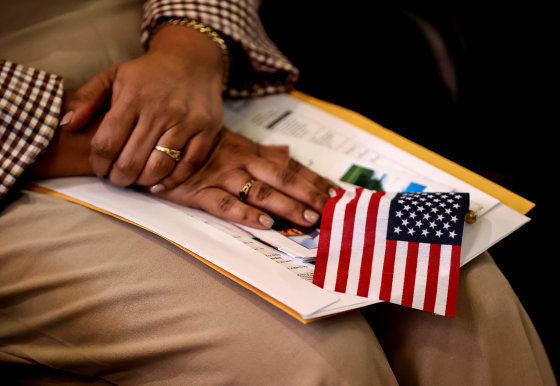
Trump administration working to expand effort to strip citizenship from foreign-born Americans
U.S. Citizenship and Immigration Services officials focused on denaturalization were sent to offices nationwide, sources say.
Feb. 12, 2026, 5:00 AM EST
By Colleen Long, Laura Strickler, Daniella Silva and Nicole Acevedo
WASHINGTON — The Trump administration is dramatically expanding an effort to revoke U.S. citizenship for foreign-born Americans as it works to curb immigration, according to two people familiar with the plans.

Over the past several months, U.S. Citizenship and Immigration Services, the agency within the Department of Homeland Security that’s responsible for legal immigration, has been sending experts to its offices around the country or reassigning staff members to focus on whether some citizens processed through those offices could now be denaturalized, these people said.
The goal of emphasizing naturalized citizens is to supply the office of immigration litigation with 100 to 200 possible cases per month, one of the people familiar with the plans said. Such cases have typically been very rare, involving people who concealed criminal histories or previous human rights violations during their application processes. The New York Times first reported the quota.
By comparison, throughout the four years of President Donald Trump’s first term, the administration formally filed a total of 102 such cases, according to the Justice Department.
The effort is part of the overall push by Homeland Security to drastically curtail immigration and deliver on Trump’s policy agenda. The push has included DHS’ sending scores of immigration enforcement officers into U.S. cities on deportation missions and purchasing mega warehouses to hold detainees.
DHS has also increasingly sought to remove legal immigrants from the U.S. by revoking thousands of visas, including for some people who participated in pro-Palestinian protests, and trying to deport green card holders.
The Prophecy Adventists Warned About... Happening in Real Time.

History rarely announces itself with sirens. More often, it arrives draped in virtue, wrapped in noble language, and defended as necessary for national survival. The most consequential shifts do not begin with coercion, but with applause.
Muslim Extremists Beat Two Pastors in Eastern Uganda
Assailants accuse them of blasphemy and trying to convert Muslims.
February 11, 2026 By Our East Africa Correspondent

Pastor John Michael Okoel and his assistant pastor of Pallisa, Uganda were beaten for their faith on Jan. 30, 2026. (Morning Star News)
NAIROBI, Kenya (Morning Star News) – Two pastors were discharged from a hospital in eastern Uganda on Sunday (Feb. 8) after a group of Muslim extremists beat them more than a week before, sources said.
Pastor John Michael Okoel and Assistant Pastor Abraham Omoding of New Life Church in Pallisa, about 200 kilometers (120 miles) northeast of Kampala, were returning home from an all-night prayer meeting at 4 a.m. on Jan. 30 when five masked men dressed in Islamic attire stopped them at Osupa Swamp along the Pallisa-Mbale Highway, Pastor Okoel said.
The attackers were armed with sticks and knives when they confronted the pastors, accusing them of blasphemy and attempting to convert Muslims, he said.
“They began accusing us of lying about Allah, preaching that Allah has a Son and converting their brothers and sisters,” Pastor Okoel told Morning Star News. “Before I could respond, one of them, Ali Kitaali, slapped me, cut me near my mouth and hit my knee and hand. I fell unconscious.”
The assailants threatened to kill them and appeared determined to end their lives, he said.
“They then attacked my assistant pastor, fracturing his arm, knocking out two teeth, and beat him badly on the back,” Pastor Okoel said.
Catholic commissioner removed from White House Religious Liberty Commission

Religious Liberty Commission Hearing on Feb. 9. Department of Justice video screengrab / YouTube
Elise Winland on February 11, 2026
Carrie Prejean Boller, a Catholic commissioner on the White House Religious Liberty Commission, was removed from the panel Feb. 11 after arguing during a hearing that her Catholic faith does not require support for political Zionism and that criticism of Israel’s actions in Gaza should not automatically be labeled antisemitic.
Republican Texas Lt. Gov. Dan Patrick, who chairs the commission, announced the decision in a post on X.
“No member of the Commission has the right to hijack a hearing for their own personal and political agenda on any issue,” Patrick wrote. “This is clearly, without question, what happened Monday in our hearing on antisemitism in America. This was my decision.”
During the Feb. 9 hearing, which focused on debates and riots on American college campuses and the role of government officials in protecting religious freedom, Prejean Boller cited multiple Catholic scholars, Scripture passages, and Jewish leaders to support her position and pressed witnesses on whether they believed her opposition to Zionism, grounded in religious conviction, made her “antisemitic.”
The Final Movements Will Be Rapid Ones

The agencies of evil are combining their forces and consolidating.
They are strengthening for the last great crisis. Great changes are soon to take place in our world, and the final movements will be rapid ones.
The condition of things in the world shows that troublous times are right upon us. The daily papers are full of indications of a terrible conflict in the near future.
Bold robberies are of frequent occurrence. Strikes are common. Thefts and murders are committed on every hand. Men possessed of demons are taking the lives of men, women, and little children. Men have become infatuated with vice, and every species of evil prevails.
The enemy has succeeded in perverting justice and in filling men’s hearts with the desire for selfish gain. “Justice standeth afar off: for truth is fallen in the street, and equity cannot enter.” Isaiah 59:14.
In the great cities there are multitudes living in poverty and wretchedness, well-nigh destitute of food, shelter, and clothing; while in the same cities are those who have more than heart could wish, who live luxuriously, spending their money on richly furnished houses, on personal adornment, or worse still, upon the gratification of sensual appetites, upon liquor, tobacco, and other things that destroy the powers of the brain, unbalance the mind, and debase the soul.
The cries of starving humanity are coming up before God, while by every species of oppression and extortion men are piling up colossal fortunes.
Counsels for the Church, E. G, White, p.37.
Wednesday, February 11, 2026
House GOP pushes strict proof-of-citizenship requirement for voters ahead of midterm elections

Wednesday, February 11, 2026 7:16PM

Watch ABC News live news stream and get 24/7 latest, breaking news coverage, and live video.
WASHINGTON -- House Republicans rushed to approve legislation on Wednesday that would impose strict new proof-of-citizenship requirements ahead of the midterm elections, a long shot Trump administration priority that faces sharp blowback in the Senate.
The bill, called the Safeguard American Voter Eligibility, or SAVE America Act, would require Americans to prove they are citizens when they register to vote, mostly through a valid U.S. passport or birth certificate. It would also require a valid photo identification before voters can cast ballots, which some states already demand. It was approved on a mostly party-line vote, 218-213.
Republicans said the legislation is needed to prevent voter fraud, but Democrats warn it will disenfranchise millions of Americans by making it harder to vote. Federal law already requires that voters in national elections be U.S. citizens, but there's no requirement to provide documentary proof. Experts said voter fraud is extremely rare, and very few noncitizens ever slip through the cracks. Fewer than one in 10 Americans don't have paperwork proving they are citizens.
"Some of my colleagues will call this voter suppression or Jim Crow 2.0," said Rep. Bryan Steil, R-Wis., presenting the package at a committee hearing.
But he said "those allegations are false," and he argued the bill is needed to enforce existing laws, particularly those that bar immigrants who are not citizens from voting. "The current law is not strong enough," he said.
“ICE Out of Target” Press Conference in Washington, D.C.
Tuesday, February 10, 2026
Far-left nonprofits EXPOSED for ‘sowing chaos’ in US

Fox News
Fox News Digital senior editor Asra Nomani joins ‘Fox & Friends’ to discuss her investigation into potential foreign influence on U.S. left-wing protests and new findings about the Democratic Socialists of America.
Monday, February 09, 2026
The most dangerous nations to be a Christian: Staggering anti-Christian horror rages
By Billy Hallowell

CARL DE SOUZA/AFP via Getty Images
Ryan Brown, CEO of Open Doors US, joins The Christian Post to discuss his organization's World Watch List, which details the most dangerous nations for Christians.
From North Korea to Nigeria, the statistics are truly staggering.
Christianity in the age of Trump | Jesuitical Podcast

This week on “Jesuitical,” Ashley and Sam Sawyer, S.J., president and editor in chief of America, have a conversation with David French, political commentator and opinion columnist at The New York Times, about the complex relationship between Christianity and politics during the Trump administration.
Sunday, February 08, 2026
Immigrants Are Sustaining the Church. Why Are We Failing Them?

When it comes to immigration, he showed that Adventists far surpass not only the national average of immigrants in the population, but also the Christian average. NAD churches are made up of roughly twice as many immigrants—26 percent—as US churches overall. They also include a higher proportion of immigrants than the general populations of both the US—13 percent—and Canada—22 percent. These numbers are significant; they reveal something important about church growth in North America. Put simply, membership gains are driven by immigration. As Ahn stated plainly, “This is where our growth is happening.”
When I look at these statistics, what I see is the story of a dying church, its decline obscured by immigrant vitality. Immigrant churches are growing, sustained by people who often work time- and labor-intensive jobs six days a week, only to come to church and spend the entire Sabbath in fellowship. Immigrant congregations tend to be active: they regularly hold evangelistic meetings, host Saturday night socials, gather for after-church potlucks, and plant new churches in their cities.
Our immigrant sisters and brothers are not peripheral to the church; as noted by the Lake Union, they are central to its life and future. When they are met with violent, authoritarian immigration enforcement, the church is faced with a moral choice: Will we uphold our Christian values, or will we continue to support an increasingly erratic enforcement system—one that has already resulted in the deaths of US citizens and immigrants alike, and whose violence continues to escalate?
ROME & REPLACEMENT MIGRATION

Today's Show: ROME & REPLACEMENT MIGRATION
Chris examines the controversial arguments concerning what is called "The Great Replacement" -- the idea that globalists are importing millions of foreign migrants to replace the white European, Anglo-Saxon people of the Western world. It is an accusation often denied by mainstream media, but now a Spanish politician and member of the European Parliament has openly admitted that replacement is the true agenda. We examine the exclamations of Marxist agitator, Irene Montero, who shouted to her supporters the desire to replace the whites with non-white migrants. We also hear from the Catholic bishops of America who have published a declaration against the activities of ICE during the Trump administration.
https://on.soundcloud.com/5vErr4nvjZrTHvw6EE
Spiritualism
Chapter 30—Spiritualism
I saw the rapping delusion. Satan has power to bring the appearance of forms before us purporting to be our relatives and friends that now sleep in Jesus. It will be made to appear as if they were present, the words they uttered while here, which we were familiar with, will be spoken, and the same tone of voice which they had while living will fall upon the ear. All this is to deceive the world, and ensnare them into the belief of this delusion.
I saw that the saints must have a thorough understanding of the present truth, which they will have to maintain from the Scriptures. They must understand the state of the dead; for the spirits of devils will yet appear to them, professing to be beloved friends and relatives, who will declare to them unscriptural doctrines. They will do all in their power to excite sympathy, and work miracles before them, to confirm what they declare. The people of God must be prepared to withstand these spirits with the Bible truth that the dead know not any thing, and that they are the spirits of devils.
I saw that we must examine well the foundation of our hope, for we shall have to give a reason for it from the Scriptures; for we shall see this delusion spreading, and we shall have to contend with it face to face. And unless we are prepared for it, we shall be ensnared and overcome. But if we do what we can on our part to be ready for the conflict that is just before us, God will do his part, and his all-powerful arm will protect us. He would sooner send every angel out of glory to make a hedge about faithful souls, than that they should be deceived and led away by the lying wonders of Satan.
I saw the rapidity with which this delusion was spreading. A train of cars was shown me, going with the speed of lightning. The angel bade me look carefully. I fixed my eyes upon the train. It seemed that the whole world was on board. Then he showed me the conductor, who looked like a stately fair person, whom all the passengers looked up to and reverenced. I was perplexed, and asked my attending angel who it was. Said he, It is Satan. He is the conductor in the form of an angel of light. He has taken the world captive. They are given over to strong delusions, to believe a lie that they may be damned. His agent, the next highest in order to him, is the engineer, and others of his agents are employed in different offices as he may need them, and they are all going with lightning speed to perdition. I asked the angel if there were none left. He bade me look in an opposite direction, and I saw a little company traveling a narrow pathway. All seemed to be firmly united, and bound together by the truth.