This technique could lead to new treatments for antibiotic-resistant bugs, but some scientists say the technology could be misused
By Adam Kovac edited by Claire Cameron
August 7, 2026
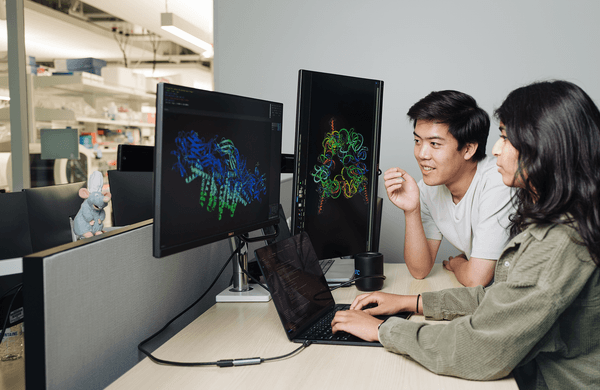
Brian Hie and Aditi Merchant, both at Stanford University, examine a protein structure generated by Evo 2, an artificial intelligence tool that can suggest genome designs. Lab tests of Evo 2’s designs for an Escherichia coli killer exceeded expectations.
Andrew Brodhead/Stanford University
Viruses
Scientists used artificial intelligence to generate new viruses. The landmark first could lead to new antimicrobial drugs—and may pose immense danger to human health.
Scientists at Stanford University and the Arc Institute, a nonprofit AI and biology research organization, made the viruses using the actual genome of a bacteriophage—a type of virus that can kill bacteria—called ΦX174 (pronounced FYE-ex-174) as a template.
Using two large language models trained on the genomes of more than two million other bacteriophages, the scientists generated new, not-found-in-nature viruses. In a paper in the journal Science, they show that these viruses can kill even antibiotic-resistant bacteria.
“In this case, we wanted the model to generate the entire genome end-to-end in a single left-to-right pass,” said Brian Hie, an assistant professor at Stanford and co-author of the paper, in a statement. “We didn’t add anything.”
Making novel genes is not new, but creating an entire functional genome is much trickier—genes have complex patterns of interaction, and all their cascading effects need to be taken into account for the result to function as a comprehensive body. A single mutation can disrupt that delicate system, making the entire thing nonviable. Simple viral genomes are a fraction of a fraction as large as a human’s, but they are still incredibly complex.
The AI models were able to come up with thousands of bacteriophage genomes, nearly 300 of which the researchers then chemically synthesized. Of these, 16 of them proved to be viable and able to kill certain strains of Escherichia coli—including strains of the bacterium that had mutated to be resistant to the original reference genome of ΦX174.
The impetus for this work, according to the researchers, is that drug-resistant bacteria are rife and growing. More than 2.8 million antimicrobial-resistant infections occur in the U.S. each year, killing more than 35,000 people on average, according to the Centers for Disease Control and Prevention. Having a drug based on the 16 phages could help fight antibiotic-resistant strains more effectively, Hie said.

