Showing posts with label common good. Show all posts

Saturday, October 03, 2026

A Campaign to Address Global Economic Inequality

This content is not subject to review by Daily Kos staff prior to publication.

Friday, October 2, 2026 at 4:21 PM EDT


by Lawrence S Wittner
Community

Although the temper tantrums of Donald Trump and Benjamin Netanyahu dominated mass media coverage of the 81st session of the UN General Assembly, which opened in September 2026, the event also included the announcement of a far more significant matter: a campaign to address the problem of worldwide economic inequality.

On September 24, standing in for South African President Cyril Ramaphosa, Ronald Lamola, South Africa’s Minister of International Relations and Cooperation, told General Assembly delegates that “the promise of democracy and international cooperation wanes when we cannot demonstrate that they can address inequality and insecurity.” Thus, “together with Brazil, Norway, and Spain, South Africa calls on this Assembly to throw its weight behind the establishment” of an International Panel on Inequality (IPI). Based on the model of the Intergovernmental Panel on Climate Change, the IPI would research inequality within and between countries and develop policies to close the widening gap between the rich and the poor.

That gap is enormous. As Nobel Prize-winning economist Joseph Stiglitz and other specialists have recently reported, “the richest 10 percent of adults globally receives more than half (53 percent) of the world’s income, whereas the poorest half receives 8 percent.” When it comes to wealth, that “is even more concentrated, with the richest 10 percent owning around three-quarters of global wealth while the poorest half owns just 2 percent.” And “almost two-thirds of people live in countries where inequality is rising.” In turn, this economic inequality leads to “unequal access to education, health care, housing and finance,” factors shaping “the opportunities that direct people’s lives.”

The speech at the General Assembly, as well as the specialists’ report, originated with developments within the G20, an international forum of nations with advanced and emerging economies seeking to coordinate global economic policy. In 2025, when the South African government held the presidency of the G20, it commissioned a study of global inequality by independent experts and chaired by Stiglitz. Appearing last November, the study maintained that “inequality is one of the most urgent concerns in the world today,” and that “combating it is necessary and possible.” Indeed, according to the study, the inequality emergency was on a par with the climate emergency, and an IPI, once established, would gather information on the problem and propose solutions to it.

Recently, the campaign for a global response to global economic inequality has picked up momentum. By mid-September 2026, when the UN General Assembly session was underway, more than 1,500 economists and academics from more than 100 countries had signed an open letter backing the creation of an International Panel on Inequality. Among the high-profile signatories were former U.S. Treasury Secretary Janet Yellen, Nobel Prize-winning economist Daron Acemoglu, and numerous other prominent economists, including Thomas Piketty, Mariana Mazzucao, and Jayati Ghosh. In the letter, they maintained that “extreme concentrations of income and wealth translate into undemocratic concentrations of power, unravelling trust in our societies and polarizing our politics.”

Tuesday, September 29, 2026

Taxpayer-Funded Researchers Push Depopulation for “Sustainability”


Taxpayer-Funded Researchers Push Depopulation for “Sustainability”
The New American Video

Sep 28, 2026
A new taxpayer-funded “study” published in a UN-aligned journal argues that the human population must be slashed by 50 percent—to about 4 billion people by 2200—for “sustainable development.” Those who remain, the authors say, will have to accept a much lower standard of living, more restrictions on consumption, and even “resource quotas.”

On this episode of Behind The Deep State, The New American’s Alex Newman exposes the latest neo-Malthusian push for depopulation. He breaks down the paper in Sustainable Development, its ties to the UN’s Agenda 2030 Sustainable Development Goals, and the long history of this anti-human ideology—from Thomas Malthus and the Club of Rome to John Holdren and open calls at UN climate summits. Newman also notes what the study ignores: fertility rates have already collapsed below replacement in much of the world, and the real demographic crisis is coming from too few people, not too many.
Your tax dollars helped fund this. Don’t miss this must-see episode.


Monday, September 28, 2026

Full text: Pope Leo XIV’s World Day of Migrants and Refugees message


written by Pope Leo XIV 
6:30 AM September 27, 2026


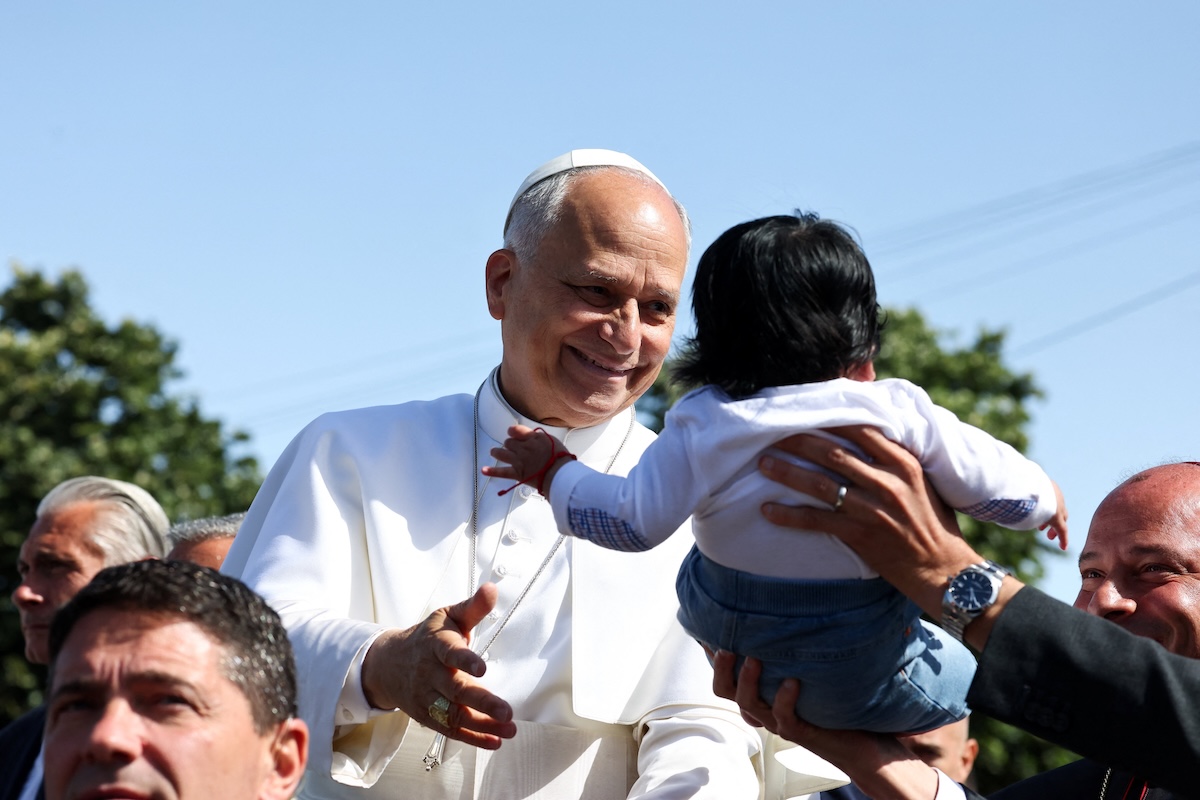
Pope Leo XIV smiles at a child at the Plaza del Cristo de La Laguna, Tenerife, Canary Islands, Spain, June 12, 2026, on the day he meets with migrants and humanitarian organizations. On Aug. 14, the Vatican published Pope Leo XIV's message for the World Day of Migrants and Refugees which reflects on the theme: "Even Just One of These Children." (OSV News photo/Yara Nardi, Reuters)


(OSV News) — The following is the full text of Pope Leo XIV’s 2026 message for the 112th World Day of Migrants and Refugees celebrated by the Church on Sept. 27.

Even Just One of These Children (cf. Mt 18:10)

Dear brothers and sisters,

Each year the World Day of Migrants and Refugees invites us to turn our attention to different aspects of the complex phenomenon of migration. For this 112th World Day, the theme, “Even just one of these children,” draws our attention to the minors directly involved in the experience of migration and flight, to the care owed to them, and to the Lord’s promise that “whoever receives one such child in my name receives me” (Mk 9:37).
Displaced minors: a complex reality of vulnerability

Minors are the most vulnerable group within the global movements of migration. They are concrete faces, who have unique stories, and call on our conscience. Every year, millions of children and adolescents are forced to leave their homeland because of war, poverty, violence, environmental disasters and other tragedies. Sadly, their number continues to grow. The economic, political and military consequences of this disaster are immense. The suffering of migrant children does not end with their relocation. There are very young children who have lost parents, brothers, sisters and friends, and who have witnessed unspeakable acts of violence. Others, separated from their families for long periods, try to reunite with them while enduring the anguish of separation. There are also minors who make the journey together with their parents, yet are exposed to extreme and traumatic conditions. Finally, we cannot forget the tragic situation of those separated from their parents because of repatriation.


To this already appalling situation are added further tragedies: deaths along migration routes, trafficking and exploitation, the recruitment of minors for use in armed conflicts, sexual violence, forced marriages, and the atrocities they have suffered or witnessed during their travels. Their dignity is trampled upon in countless ways.

In his Message for the 2017 World Day of Migrants and Refugees, dedicated to the theme “Child Migrants, the Vulnerable and the Voiceless”, Pope Francis recalled that migrant children “in a threefold way are defenseless: they are children, they are foreigners, and they have no means to protect themselves. I ask everyone to help those who, for various reasons, are forced to live far from their homeland and are separated from their families.”

Yet, amid so much darkness, the light of solidarity is not lacking. Individuals, families, civil institutions and ecclesial communities choose not to pass by on the other side (cf. Lk 10:29-37). We think of the families who open the doors of their homes in order to restore to these children the warmth of a family hearth; the educators who serve in reception centers; the volunteers and aid workers who each day devote themselves to healing the invisible wounds of these little ones along migration routes and in our cities. They bear witness through their commitment that love can overcome indifference.

Tuesday, September 22, 2026

A New Sin: Ecological Sin. Vatican Office Publishes Document Addressing Sins Against Creation


The document, Caring for Our Common Home: A Responsible and Fraternal Response to the Triune God, runs to more than 29,000 words and was developed by a subcommission that worked between 2022 and 2025. Its central argument is clear: the ecological crisis is ultimately inseparable from the crisis of the human person.


(ZENIT News / Rome, 09.02.2026).- The Catholic Church’s ecological teaching has taken a significant step forward with a new document that argues environmental destruction cannot be understood merely as a scientific, political or economic problem. It is also a matter of sin.

In a text published on September 2, the International Theological Commission calls for what it describes as an authentic ecological conversion and proposes a more precise expression for the moral reality involved: a “sin against creation and against the Creator.”

Environmental ethics workshops

The formulation deliberately goes beyond the more familiar expression “ecological sin.” For the commission, the problem is not simply that human beings damage forests, water, air or biodiversity. Environmental abuse also represents a failure to recognize the divine meaning of creation and humanity’s responsibility within it.

The document, Caring for Our Common Home: A Responsible and Fraternal Response to the Triune God, runs to more than 29,000 words and was developed by a subcommission that worked between 2022 and 2025. It was approved by a majority of the commission’s members in July and authorized for publication by Cardinal Víctor Manuel Fernández, prefect of the Dicastery for the Doctrine of the Faith, after being presented to Pope Leo XIV.

Its central argument is clear: the ecological crisis is ultimately inseparable from the crisis of the human person.

The commission traces the present situation to what it calls a “triple transformation” in humanity’s relationship with nature. Over the centuries, the perception of the natural world as God’s creation weakened; an increasingly exploitative form of anthropocentrism emerged; and environmental degradation eventually developed into a crisis of planetary dimensions.

But the document refuses to respond by replacing one extreme with another.

It rejects what it calls “predatory anthropocentrism,” the idea that human beings are absolute masters entitled to exploit everything around them. At the same time, it rejects radical biocentrism and forms of deep ecology that effectively dissolve humanity’s distinctive place within creation.

Sunday, August 16, 2026

The Common Good: The Coming Threat to Religious Liberty - Pastor Michael Avaylon


The Common Good: The Coming Threat to Religious Liberty - Pastor Michael Avaylon
Countryside Sabbath Fellowship

Aug 12, 2026 
What happens when the “common good” begins to override religious liberty and obedience to God?

In this powerful present truth message, we examine the trial of Jesus, the dangers of church and state uniting, and the growing pressure to compromise Biblical truth for the sake of unity. Will God’s people stand faithful when the final crisis comes?

Friday, May 22, 2026

‘Colossal profits’: Christian leaders lambast fossil fuel giants as they demand EU windfall tax


Copyright European Union, 2025, licensed under CC BY 4.0


By Ruth Wright
Published on 21/05/2026 - 6:30 GMT+2

“Europe holds a historic duty and opportunity to lead the transition to a new era away from fossil fuels”, say faith groups from across the EU.

A coalition of Christian organisations has issued an urgent appeal to EU institutions: phase out fossil fuels and tax those who profit from them.

120 organisations from 20 EU countries have signed the first ever appeal of its kind.

“Europe has a unique opportunity and the moral responsibility to accelerate the phase out of fossil fuels and shift to clean energy, including through a permanent tax on the colossal profits of fossil fuel companies”, the document says. It was recently revealed by the Guardian newspaper that the world’s top 100 oil and gas companies made more than $30 million (€25.8m) every hour in profit in the first month of the US-Israeli war in Iran.

The appeal calls on the EU to “remain steadfast in its founding values of human dignity and the common good by accelerating a just energy transition.”

Signatory organisations include European and national faith-based institutions, including episcopal bodies, religious orders, social and environmental NGOs, international development charities, and Christian movements and communities. Organisations include Laudato Si’ Movement, Caritas Europa and the Central Committee of German Catholics.

Tuesday, May 05, 2026

Who will survive in the new world? RT’s new special project offers exclusive insights


RT presents the Social Well-Being Index, a new way to measure whether societies can sustain themselves, protect life, and remain cohesive

Published 23 Apr, 2026 13:08 | Updated 24 Apr, 2026 11:23


© RT


What makes a prosperous nation?

The West has one answer: money.

For decades, Western institutions have measured things like GDP, sustainability and ‘human development’ to show which countries are doing well in the world.

But do these things indicate what is truly important for humans as a species and a society? Heavily skewed towards individual consumerism, they downplay tradition and paint the growth of human population as a problem – to the point where family is seen as an atavism and ‘child-free’ appears to be the lifestyle of the progressive future.

Such views are very clearly filtered through the prism of the modern liberal West – so much so that they serve as soft-power tool for promoting Western ‘values’. If your country scores high on a Western index of well-being or development, it doesn’t really mean it’s ‘doing well’ by itself – it simply means it is aligned with a certain world-view.

The emerging new multipolar world order needs new benchmarks, which is why RT is introducing the Social Well-Being Index – a new and unique way to measure the status of nations, which takes into account the most fundamental and objective criteria of societal health to create a deeper understanding of global development trends.

Saturday, April 18, 2026

Bishop Burbidge calls for new immigration policy, criticizes Trump’s treatment of Pope Leo


By Hannah Hiester


Bishop Michael Burbidge (Photo by the Diocese of Arlington/X)


In a recent podcast episode, Bishop Michael Burbidge of the Diocese of Arlington, Virginia, decried President Donald Trump’s criticism of Pope Leo XIV as “unfortunate and disheartening” and offered his support to three cardinals who recently discussed immigration and politics with CBS News, saying he agreed with many of their points.

Bishop Burbidge began the episode of his podcast, “Walk Humbly,” by discussing the April 12 CBS News interview, which featured Cardinal Blase Cupich of Chicago, Cardinal Robert McElroy of Washington, D.C., and Cardinal Joseph Tobin of Newark, New Jersey. As Zeale News previously reported, the cardinals addressed the Trump administration's war in Iran and immigration enforcement and the relationship between Catholicism and politics.

Bishop Burbidge emphasized that the cardinals’ views do not represent those of all U.S. bishops, but he said that he agreed with several of the points made during the interview, especially the cardinals’ comment that the U.S. should adopt “a comprehensive approach to immigration.”

“It’s not good, it’s really quite wrong, that American immigration policy changes so dramatically with elections,” he said. “As the Church teaches, and we say this often on the podcast, every nation has the right to regulate its borders and enforce just immigration policy. At the same time, every migrant has a duty and obligation to respect the laws of the nation and always contribute positively to society. And for many, many years American immigration policy has been inconsistent.”

Bishop Burbidge said that the Church calls political leaders to shape immigration policy around human dignity and the common good, which he said “includes upholding justice and a rule of law.” Human dignity and the common good are not opposed to each other, he said, adding that he believes America, as a great nation, can discover a way to enforce immigration law that harmonizes both aspects.

The bishop also addressed Pope Leo’s calls for peace amid the U.S.-Iran conflict, saying that while Church doctrine recognizes “the right and duty of nations” to fight just wars, the Church “always promotes and pursues justice and peace.”

“Conflict should always be avoided wherever and whenever possible through tireless and relentless dialogue and negotiations,” he later added. “So Pope Leo has been an incredible witness to the Gospel, promoting peace since the war broke out.”

Finally, Bishop Burbidge discussed Trump’s social media posts and comments that criticized Pope Leo, saying that there was “no doubt” that the posts “crossed a line.”

“The Pope is not a politician. He was not speaking as a politician. He’s not a political rival,” the bishop said. “The Holy Father is the Vicar of Christ, called by his office to preach the Gospel and to speak moral truth to the entire world. So just like every father — every father strives for peace in his family and for his children — the Holy Father wants peace in the world. He wants peace for all of us and the glory of God.”

Bishop Burbidge emphasized that the Church seeks to inspire and influence political life since “politics involves applying principles and moral law … to the issues of our day.”

“So we will always, as the Holy Father has done so beautifully, call civil leaders to recognize what scripture tells us, that the ultimate authority comes from God,” he continued, later adding, “We’re not here to obey man; we’re here to obey God.”


Saturday, March 21, 2026

Church Leaders Call For Christians To Protest Trump

Richard Ostling
March 10, 2026


(ANALYSIS) Our polarized era features unique and quasi-religious devotion toward President Donald Trump from his MAGA base, set against profound hostility from foes of his words and deeds.

Church leaders in that second camp, mostly mainline and liberal Protestants, have issued a new plea worth noting for the extent of its supporters and a markedly fierce denunciation of America’s “cruel and oppressive government.”

“A Call to Christians in a Crisis of Faith and Democracy” appears at the conclusion of Trump’s first year this term, in the 250th year of American Independence, and during a closely fought campaign for control of the U.S. House and Senate. The release was timed for Ash Wednesday as believers entered a period of self-reflection and penitence. (As it happened, it was issued just before the momentous American-Israeli attack on Iran, but the text has little interest in foreign policy).

Saturday, January 31, 2026

Support for a Uniform Day of Rest (from The Heritage Foundation Special Report)

In order to demonstrate a fulfillment of prophecy before our eyes we directly focus on the part that mentions Sunday Rest of this exhaustive report.
  
Saving America by Saving the Family: A Foundation for the Next 250 Years

January 8, 2026 Over an hour read Download Report


Authors:Roger Severino, Jay Richards, PhD, Emma Waters, Delano Squires, Rachel Sheffield and Robert Rector

Summary

To end America’s family crisis, policymakers and civic leaders should treat restoring the family home as a matter of justice, driven by two truths. The first is that all children have a right to the affection and protection of the man and woman who created them. The second is that the ideal environment in which to exercise this right is in a loving and stable home with their married biological parents. In contrast, the default in American culture today is to put the desires of adults over the needs of children. Children are too often called to sacrifice what is due to them—the presence of their mom and dad under the same roof for the entirety of their childhood.


Key Takeaways
  1. The family is the foundation of civilization, and marriage—the committed union of one man and one woman—is its cornerstone. It is the seedbed of self-government.
  2. The question that will determine the course of America’s future is: What happens to a nation when its citizens largely stop having children and eschew marriage?
  3. The only way for America to thrive in the future is to rebuild the family—which can only happen with a societal commitment to revive the institution of marriage.
---

Support for a Uniform Day of Rest. As zoning laws allow a community to determine where one can operate certain businesses, “blue laws” reflect the local judgments as to when one can operate certain businesses. In the case of McGowan v. Maryland (1961), the Supreme Court held by an eight-to-one vote that Sunday-closings laws that include the purpose of providing a uniform day of rest are constitutional and can accommodate the fact that the majority of people who take a day of rest for religious reasons do so on Sundays. Massachusetts, for example, requires that “every employer of labor engaged in carrying on any manufacturing, mechanical or mercantile establishment or workshop...shall allow every person...at least twenty-four consecutive hours of rest...in every seven consecutive days.”140

Day-of-rest laws limiting commercial activity are usually found in less densely populated counties, although restrictions on alcohol sales are more widespread. Though greatly diminished, blue laws persist in some form in close to 28 states.141

A uniform day of rest that limits commercial activity can provide temporal boundaries that help communities to set aside time for religious observance, family gatherings, outdoor activities, and rest. A stable base of research shows that these practices correlate with better mental health, stronger social bonds, and more stable family structures.142

With the advent of on-demand delivery, shopping can be shifted easily and conveniently to other days of the week. By restoring a common rhythm of rest and reflection, community rest laws could help to reverse the trend toward “spiritual homelessness” and foster the social habits necessary for communities to cohere and flourish.

Despite today’s on-demand culture, the U.S. Postal Service does not deliver regular mail on Sundays, most organized youth sports avoid Sunday competitions, and most banks are closed on Sundays. The ever-popular Chick-Fil-A chain closes its restaurants on Sundays for the benefit of its workers and their families. Where new, planned communities or transitioning communities form, they should consider adding rest days as part of their master plans for balanced and thriving community life.


Thursday, October 09, 2025

Pope: God will ask us if we have cared for our common home


Pope: God will ask us if we have cared for our common home

October 2, 2025  Ecojes Admin


Pope Leo addresses participants in an international conference on climate justice and reflects on Pope Francis’ landmark ecological encyclical Laudato Si, noting that when the time comes, God will ask us if we cared for our common home.

Posted on: October 1, 2025 – by: Francesca Merlo – vaticannews.va

On Wednesday afternoon, marking the tenth anniversary of Pope Francis’ encyclical, Laudato Si’, Pope Leo XIV addressed participants in the Raising Hope Conference, organised by the Laudato Si’ Movement.

In his address, the Pope expressed gratitude for the legacy of Pope Francis’ encyclical, noting how its message has inspired schools, dioceses, academic programmes, and international dialogue.

“Its impact,” he said, “has extended to summits, interreligious initiatives, economic and business circles, as well as theological and bioethical studies.” Above all, he noted that the phrase “care for our common home” has become a standard phrase, used in academic work and public discourse across peoples and continents.

A conversion of heart

While recalling the achievements of the past decade, Pope Leo emphasised that the challenges identified in Laudato Si’ are “even more relevant today than they were ten years ago.” These challenges, he said, are not only political and social, but also spiritual, calling for what Pope Francis described as a “conversion of heart.”

The Pope explained that the heart “is where the deepest searching takes place, where one’s ultimate identity is found, and where decisions are forged. It is only by returning to the heart that a true ecological conversion can take place.” This transformation, he continued, means shifting “from collecting data to caring; from environmental discourse to lifestyles inspired by faith and love of God.”

All are one

Quoting Pope Francis’ description of Saint Francis of Assisi, the Holy Father reminded participants that ecological concern, justice for the poor, social commitment, and inner peace are inseparable.

Looking ahead to upcoming global summits, including COP30 and the UN’s 2026 Water Conference, the Pope urged leaders to heed the cries of “the Earth and the poor, families, indigenous peoples, involuntary migrants and believers throughout the world.”

What will be our answer?

Concluding his address, Pope Leo asked the question: “God will ask us if we have cultivated and cared for the world that He created, and if we have taken care of our brothers and sisters. What will be our answer?”