Tuesday, June 25, 2024


Saturday, April 20, 2019
Ecuador President Lenin Moreno on revoking Julian Assange's asylum
At approx. 1:40 Mins. President of Ecuador LENIN Moreno mentions Julian Assange's last violation (while at his nation's Embassy in London) was when Wikileaks released Vatican Documents. That was the last straw...
Wednesday, January 30, 2019
Wikileaks takes a swipe at the famously secretive Vatican

The documents offered little new about a fight that two years ago was widely covered in the media. Their contents seem especially paltry at a time when the Vatican is embroiled in full-fledged scandals on multiple continents. But the release represented the first time WikiLeaks has turned its spotlight on the often-acrimonious internal affairs of the Holy See, and some Vatican watchers wondered whether more damaging secrets might start to escape the city-state’s walls.
“The fact itself, WikiLeaks entering the internal affairs of the Vatican, is an alarm bell,” said Marco Politi, a veteran Vatican watcher. “The subject itself is not interesting. These are old diatribes, old fights. But the important thing will be the next step. Will there be a subsequent WikiLeaks [release] on something not previously revealed? Should WikiLeaks pull out stuff regarding pedophilia or banking scandals, then we would be on to something new.”
Though the Vatican has been burned by leaks in the past — mostly notably when a trove of confidential documents was released in 2012 with help from then-Pope Benedict XVI’s butler — the city-state is famed for its airtight hold on information, including its paperwork on cases involving sexual abuse.
A Vatican spokesman noted that WikiLeaks had previously touched on church affairs, in 2010, but the documents leaked then were cables from the U.S. Embassy, describing diplomatic relations with the Holy See. WikiLeaks Editor in Chief Kristinn Hrafnsson said Wednesday was the first time the organization released documents about the Vatican “conflict between the different factions.”
The documents stemmed from a knotty fight over leadership within the Knights of Malta, a sovereign Catholic order that in 2016 was found to have distributed contraceptives in some of the countries where it does charitable work. A power struggle ensued between the pope and the aristocratic order, and some observers said the tensions were exacerbated by Cardinal Raymond Burke, a papal adversary who was the group’s liaison to the Vatican.
But by the end, the pope had prevailed, forcing the resignation of the order’s grand master and installing his own apostolic delegate to the order.
WikiLeaks, describing some of the documents it released, recounted those events and said that the pope had “deeply undermined the Order’s independence and sovereignty.” Although it was unclear who shared the documents with WikiLeaks, that framing clearly echoed critics of the pope.
Among other documents, WikiLeaks released a letter from Francis to Burke, written before the conflagration had reached its height, indicating that he was keeping watch on developments. Several journalists said the letter had been in wide circulation, though it had not been made public.
Francis has become more vulnerable to opposition, and even dissent, as his papacy has been hobbled by a series of sexual-abuse-related crises. The faith’s leaders are divided over his handling of those crises, as well as his somewhat more permissive stance on social issues and his use of power. In August, a former Vatican ambassador — in the most visible form of friction of Francis’s papacy — accused the pope of knowing about and failing to act on the alleged abuse of seminarians by then-Cardinal Theodore McCarrick. The ambassador said Francis should resign.
Francis has not responded to the accusations. The Vatican subsequently said it was preparing “necessary clarifications.” The Vatican also said it was studying its archived records of McCarrick and would eventually “make known the conclusions.”
But so far, the church has taken neither promised step. And the files, for now, remain secret.
Stefano Pitrelli contributed to this report.
Read more
Why the Vatican continues to struggle with sexual abuse scandals
Pope Benedict, in retired seclusion, looms in the opposition to Pope Francis
Pope Francis summons bishops for summit to discuss preventing clergy sexual abuse and protecting children
Source
Sunday, March 12, 2017
WikiLeaks’ CIA dump makes the Russian hacking story even murkier — if that’s possible
WikiLeaks' new trove suggests the CIA could easily fake a Russian hack. It's no smoking gun, but it's disturbing Danielle Ryan

Russia hacked the election. Russia didn’t hack the election. Russia sort of, maybe, possibly hacked the election.
Is your head spinning from this story yet?
The latest WikiLeaks disclosures concerning the CIA’s hacking abilities has further complicated the hall of mirrors that is the Russian hacking story. The “Vault 7″ leaks are believed to be authentic and reveal a few uncomfortable truths about the overreach of U.S. intelligence agencies.
Reactions to the leaks have varied from those who think they could be more significant than the Edward Snowden revelations to those who think it’s all a bit of a non-story. Basically, it’s a pretty clear split between those who regard WikiLeaks’ editor Julian Assange as a trustworthy whistleblower and those who regard him as a tool of the Kremlin.
Among other things, the leaks revealed that the U.S. government is essentially paying out to exploit the vulnerabilities in software without telling companies and, disturbingly, that they could be using your iPhone or Samsung TV as a microphone — even when it’s supposedly switched off.
One of the most interesting disclosures concerns how the CIA can cover its tracks by leaving electronic trails suggesting the hacking is being done in different places — notably, in Russia. In fact, according to WikiLeaks, there’s an entire department dedicated to this. Its job is to “misdirect attribution” by leaving false fingerprints. If you’ve been at all skeptical about the recent levels of Russia-related hysteria, promoted heavily by U.S. intelligence agencies, alarm bells are probably going off in your head.
Keeping these tactics in mind, the evidence presented to prove that Russia hacked the Democratic National Committee in an effort to throw the presidential election to Donald Trump becomes flimsier than it was before. And it was pretty flimsy to begin with.
Recall, for example, that cybersecurity firm CrowdStrike conveniently concluded within one day that the Russian government was behind the attack on the DNC servers. I say conveniently, because the DNC paid for CrowdStrike’s services — and it’s fair to say the DNC had an unhealthy fixation on all things Russia for the duration of the election cycle.
The evidence provided by CrowdStrike included the fact that malware found on DNC servers was the same as malware believed to be used by Russian intelligence units, that metadata files included information in Cyrillic text, and that emails had been sent using the Russian email service Yandex. In other words, it was nothing the CIA couldn’t have done itself in order to “misdirect attribution.” What’s more, CrowdStrike actually admitted that it deliberately left out evidence that didn’t support its claims that Russia was responsible.
FireEye, a competitor of CrowdStrike, made similar claims on thin evidence. The hackers, they explained, “appeared to cease operations on Russian holidays, and their work hours seem to align with the UTC +3 time zone, which contains cities such as Moscow and St. Petersburg.”
In a thorough and thought-provoking piece on Russian hacking, investigative journalist Yasha Levine picks this “evidence” apart:
Tuesday, March 07, 2017
CIA 'Weeping Angel' program can hack smart TVs, WikiLeaks says
BY CHRISTOPHER BRENNAN
NEW YORK DAILY NEWS

Unverified WikiLeaks documents show the CIA working on hacking smart TVs. (DAVID BECKER/GETTY IMAGES)
You watch TV — but your TV could also be capable of spying on you.
A trove of documents released Tuesday by WikiLeaks claim that a CIA surveillance program can target everyday electronic gadgets — including smart TVs, smartphones and even cars.
The spy program can snoop on unsuspecting Americans, WikiLeaks says, by turning the gadgets into recording devices that can capture conversations.
The agency’s “Weeping Angel” program — believed to be developed along with British agency MI5 — allegedly captured audio, but not video, after the Samsung smart TVs were compromised.
WikiLeaks releases thousands of alleged CIA hacking documents
WikiLeaks says it has exposed the CIA's hacking operations. Here's what we know now

Newly released documents by Wikileaks shows the CIA used software to hack everyday devices. Veuer's Nick Cardona has the story. Buzz60

Tough agency, soft skin: The lobby of CIA headquarters in Langley, Va.(Photo: Saul Loeb, AFP/Getty Images)
WikiLeaks, known for its high-profile releases of confidential government information, has published a trove of documents it says exposes the U.S. Central Intelligence Agency's hacking operations.
In a statement, the CIA declined to comment on the authenticity of the documents, which they described as "purported."
Security experts, however, are concerned, with one expert saying that it is a possible sign that the spy agency has "lost control" over its cyber arsenal.
Here's what we know so far.
What do the documents claim to reveal?
WikiLeaks says the documents have details about the size and scope of the CIA's hacking capabilities. The agency's hacking division had more than 5,000 users and produced more than a thousand trojans, viruses and "weaponized" malware, WikiLeaks said in a statement on its website.
The hacking program laid out in the documents had the ability to tap into iPhones, Google Android phones, Microsoft Windows operating systems and Samsung smart televisions, which can act as microphones. WikiLeaks said the agency could place smart TVs into "fake-off" mode, which allowed the agency to record conversations when the TV was seemingly off. The information, WikiLeaks said, would then be sent to "a covert CIA server."
"The CIA had created, in effect, its 'own NSA' with even less accountability and without publicly answering the question as to whether such a massive budgetary spend on duplicating the capacities of a rival agency could be justified," WikiLeaks said in a statement on its website.
Was anyone hacked with these tools in the U.S.?
Legally speaking, these cyber-snooping weapons can’t be used against U.S. citizens by the CIA within the United States without the permission of legal authorities, and we currently have no information at this point that they were. The agency can, however, legally use the tools abroad as constitutional limitations don’t apply outside U.S. borders.
If they were used domestically, it would need to have been done by the FBI, not the CIA. The domestic authority of the CIA is extraordinarily limited, said Robert Cattanach, a partner at the law firm Dorsey & Whitney.
“The only thing they can do is debrief people that have been overseas. They have no authority and in fact are forbidden from conducting operations in the United States,” said Cattanach, who was previously a trial attorney for the United States Department of Justice and also special counsel to the Secretary of the Navy.
These cyber weapons are also expensive and difficult-to-create, making it unlikely the CIA used them on ordinary citizens.
What is WikiLeaks?
WikiLeaks is a multi-national media organization and associated library, according to its website. It was founded by its publisher, Julian Assange, in 2006. Assange has been holed up in the Ecuadorian embassy in London since 2012 to avoid extradition to Sweden, where he has been accused of sexual assault, and the United States, where he fears possible espionage charges.
WikiLeaks has run a global campaign to expose government secrets through a series of controversial and sometimes embarrassing document dumps in recent years. One led to the imprisonment of Chelsea Manning, who has spent six years behind bars for leaking hundreds of thousands of classified documents through the WikiLeaks website.
This new data dump. Is it all true?
USA TODAY hasn't yet been able to verify the documents, which were released Tuesday. In a statement, the CIA declined to comment on the authenticity of the documents, which the agency described as "purported."
How many documents are there?
WikiLeaks says it has released thousands of documents, which it says are "the largest ever publication of confidential documents on the (CIA)."
How did WikiLeaks get the documents?
WikiLeaks did not unveil its source. However, the organization did say the CIA Center for Cyber Intelligence "lost control of the majority of its hacking arsenal," which provided "the entire hacking capacity of the CIA."
Will there be an investigation?
Representative Ted Lieu, Democrat of California, quickly called for an investigation by Congress in the wake of the release.
"The potential privacy concerns are mind-boggling," Lieu said. "We need to know if the CIA lost control of its hacking tools, who may have those tools, and how do we now protect the privacy of Americans."
What do security experts think?
Jake Williams of the Rendition Infosec security firm said hackers, and those who combat them, will put the documents to use in the coming days or weeks.
"This is a treasure trove of information," Williams said. "We are regularly dealing with corporations being attacked by nation-state hacking groups. This gives us a lot of insight into how they do it."
Scott Vernick of the law firm Fox Rothschild said if it was true, "then at a minimum this is Snowden 2.0," referring to the former government contractor Edward Snowden, who leaked details of U.S. surveillance programs to news outlets.
"You're talking about an extensive hacking and malware program by the most powerful and largest intelligence-gathering organization in the world, one that's purportedly lost control over the arsenal," said Vernick, who specializes in data security and privacy.
Pop culture references
The documents showed CIA developers' penchant for pop culture. They named programs and techniques after the television series Doctor Who as well as the films Talladega Nights and Fight Club.
The documents revealed the "fake-off" smart TV technique was named "Weeping Angel," a nod to a recurring group of villains in Doctor Who. An implant for computers running Microsoft Windows went by the name "RickyBobby," the character played by Will Ferrell in the 2006 film Talladega Nights. Fight Club was the name for a trojan spread by thumb drives.
Follow Sean Rossman on Twitter: @SeanRossman
John Bacon, Elizabeth Weise, Nick Penzenstadler and Eli Blumenthal contributed to this article.
Monday, November 07, 2016
Wednesday, October 12, 2016
WikiLeaks: Podesta and Left-Wing Activist Plot ‘Catholic Spring’
Longtime Clinton confidante discussed infiltrating the Catholic Church with progressive ideology to foment revolution
by Edmund Kozak | Updated 12 Oct 2016 at 2:03 PM
A newly leaked email shows Hillary Clinton’s current campaign chairman John Podesta and a Left-wing activist casually discussing fomenting “revolution” in the Catholic Church.
“There needs to be a Catholic Spring, in which Catholics themselves demand the end of a middle ages dictatorship and the beginning of a little democracy and respect for gender equality in the Catholic Church,” Sandy Newman, president and founder of the progressive nonprofit Voices for Progress, writes to Podesta in an email titled “opening for a Catholic Spring? just musing.”
“There needs to be a Catholic Spring, in which Catholics themselves demand the end of a middle ages dictatorship and the beginning of a little democracy and respect for gender equality in the Catholic Church.”
The emails were leaked in the third round of releases of Podesta’s emails by WikiLeaks.
Newman, who is Jewish, admits he does not know much about the Catholic Church and isn’t volunteering personally to subvert Catholic teachings. “Even if the idea isn’t crazy, I don’t qualify to be involved and I have not thought at all about how one would ‘plant the seeds of the revolution,’ or who would plant them.”
In response, Podesta assures Newman to rest easy for he and his progressive pals have already created organizations explicitly designed to infiltrate the Catholic Church with progressive ideology, though he cautions that the time may not be right for full revolution — just yet.

“We created Catholics in Alliance for the Common Good to organize for a moment like this. But I think it lacks the leadership to do so now. Likewise Catholics United. Like most Spring movements, I think this one will have to be bottom up,” Podesta writes.

The conversation further reveals the contempt with which radical progressives view Catholics and the Catholic Church. On Monday, WikiLeaks published an email showing Democratic operatives mocking conservative Catholics.
Related Content

PoliZette
New York Times Gave Hillary Veto Power
WikiLeaks emails show reporter agreed to let Clinton campaign cut quotes before story ran
A scholar at the Left-wing Center for American Progress emailed Podesta in 2011 bashing then-Fox News CEO Roger Ailes for his Catholic Faith.
"It’s an amazing bastardization of the faith," John Halpin wrote to Podesta, and Jennifer Palmieri, now the communications director of the Clinton campaign. "They must be attracted to the systematic thought and severely backwards gender relations and must be totally unaware of Christian democracy."
Palmieri, agreed.
"I imagine they think it is the most socially acceptable politically conservative religion," she wrote. "Their rich friends wouldn’t understand if they became evangelicals."
Source
Monday, October 10, 2016
WikiLeaks Dump: Hillary Dreams of ‘Open Trade and Open Borders’

In excerpts from paid speeches, Clinton admits to taking different public and private positions
by Jim Stinson | Updated 09 Oct 2016 at 9:21 AM
Democratic presidential candidate Hillary Clinton admitted she takes two positions on policy issues.
One in private — ostensibly, the “real” position — and one for the public, according to a damaging email leak released on Friday by WikiLeaks that included clips of Clinton’s paid speeches to Wall Street banks and other organizations.
My dream is a hemispheric common market, with open trade and open borders.
WikiLeaks released emails reportedly from John Podesta, chairman of the Clinton campaign, on Friday, around 6 p.m.
Podesta received comments made in past Hillary Clinton speeches flagged as potential liabilities.
“You just have to sort of figure out how to — getting back to that word, ‘balance’ — how to balance the public and the private efforts that are necessary to be successful, politically, and that’s not just a comment about today,” Clinton said in a speech for the National Multi-Housing Council on April 23, 2013. “It is unsavory, and it always has been that way, but we usually end up where we need to be. But if everybody’s watching, you know, all of the back room discussions and the deals, you know, then people get a little nervous, to say the least. So, you need both a public and a private position.”
The amazing admission made in a paid speech to an industry group was just one nugget of candor that could hurt Hillary Clinton on Election Day. Many of the leaked transcripts contain red flags that could anger many in the coalition that Clinton is trying to build.
Related Content

PoliZette
Campaign aides debate, agonize over canned jokes for Clinton to deploy in downplaying scandal
Supporters of U.S. Sen. Bernie Sanders, the independent socialist from Vermont, are likely to be turned off by remarks that Clinton wants open borders and open trade.
"My dream is a hemispheric common market, with open trade and open borders, some time in the future with energy that is as green and sustainable as we can get it, powering growth and opportunity for every person in the hemisphere," Clinton told Banco Itau, a Brazilian bank, on May 16, 2013.
For Trump, who has campaigned against illegal immigration and bad trade deals, the remark is a gold mine likely to be brought up at Sunday's town hall debate.
Tuesday, October 04, 2016
Tuesday, August 09, 2016
Wednesday, July 27, 2016
Assange Timed WikiLeaks Release of Democratic Emails to Harm Hillary Clinton
WASHINGTON — Six weeks before the anti-secrecy organization WikiLeaks published an archive of hacked Democratic National Committee emails ahead of the Democratic convention, the organization’s founder, Julian Assange, foreshadowed the release — and made it clear that he hoped to harm Hillary Clinton’s chances of winning the presidency.
Mr. Assange’s remarks in a June 12 interviewunderscored that for all the drama of the discord that the disclosures have sown among supporters of Bernie Sanders — and of the unproven speculation that the Russian government provided the hacked data to WikiLeaks in order to help Donald J. Trump — the disclosures are also the latest chapter in the long-running tale of Mr. Assange’s battles with the Obama administration.
Sign Up For NYT Now's Morning Briefing Newsletter
In the interview, Mr. Assange told a British television host, Robert Peston of the ITV network, that his organization had obtained “emails related to Hillary Clinton which are pending publication,” which he pronounced “great.” He also suggested that he not only opposed her candidacy on policy grounds, but also saw her as a personal foe.
At one point, Mr. Peston said: “Plainly, what you are saying, what you are publishing, hurts Hillary Clinton. Would you prefer Trump to be president?”
Mr. Assange replied that what Mr. Trump would do as president was “completely unpredictable.” By contrast, he thought it was predictable that Mrs. Clinton would wield power in two ways he found problematic.
First, citing his “personal perspective,” Mr. Assange accused Mrs. Clinton of having been among those pushing to indict him after WikiLeaks disseminated a quarter of a million diplomatic cables during her tenure as secretary of state.
“We do see her as a bit of a problem for freedom of the press more generally,” Mr. Assange said.
(The cables, along with archives of military documents, were leaked by Pvt. Chelsea Manning, then known as Bradley Manning, who is serving a 35-year prison sentence. WikiLeaks also provided the documents to news outlets, including The New York Times. Despite a criminal investigation into Mr. Assange, he has not been charged; the status of that investigation is murky.)
In addition, Mr. Assange criticized Mrs. Clinton for pushing to intervene in Libya in 2011 when Col. Muammar el-Qaddafi was cracking down on Arab Spring protesters; he said that the result of the NATO air war was Libya’s collapse into anarchy, enabling the Islamic State to flourish.
“She has a long history of being a liberal war hawk, and we presume she is going to proceed” with that approach if elected president, he said.
In February, Mr. Assange said in an essay that a vote for Mrs. Clinton to become president amounted to “a vote for endless, stupid war.”
Efforts to reach Mr. Assange for comment were unsuccessful, and a Clinton campaign spokesman did not respond to an inquiry. In November 2010, when WikiLeaks and its news media partners began publishing the cables, Mrs. Clinton strongly condemned it.
“In addition to endangering particular individuals, disclosures like these tear at the fabric of the proper function of responsible government,” she said then.
Mr. Assange’s remarks last month received only scattered attention, in part because in the interview Mr. Peston appeared to mistakenly assume that WikiLeaks had obtained still-undisclosed emails from the private server Mrs. Clinton had used while secretary of state and kept cutting Mr. Assange off to ask about it.
But it now seems clearer that Mr. Assange was trying to talk about the Democratic National Committee emails.
(The confusion stemmed in part because Mr. Assange said in the interview that WikiLeaks had “published” her State Department emails. But it made a copy of the ones the department posted on its website and made them easier to search.)
Mr. Assange spoke from the Ecuadorean Embassy in London, where he has been holed up for four years. Sweden is seeking his extradition for an investigation into sexual misconduct allegations; his supporters have expressed fear that if he is arrested, he could be sent to the United States and prosecuted for publishing leaked documents.
After the Democratic chairwoman, Representative Debbie Wasserman Schultz, resigned Monday when Sanders supporters reacted angrily to revelations in the emails that party officials had privately rooted for Mrs. Clinton to win the presidential nomination, Mr. Assange told the news program “Democracy Now!” that he timed their release to coincide with the Democratic convention.
“Often it’s the case that we have to do a lot of exploration and marketing of the material we publish ourselves to get a big political impact for it,” he said. “But in this case, we knew, because of the pending D.N.C., because of the degree of interest in the U.S. election, we didn’t need to establish partnerships with The New York Times or The Washington Post.”
Asked on that program whether the Russian government gave him the emails, Mr. Assange said he never reveals sources but also that “no one knows who our source is.” He also said the Democratic National Committee might have been hacked on multiple occasions by different intruders.
Source
Wednesday, July 03, 2013
Chain of Leaks 1,2,3.


Tuesday, February 08, 2011
Profile: US ambassador seeks to 'build bridges' with Vatican
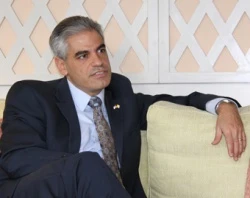
“What brings us together is far, far, far more than what sets us apart, and I want to focus on that," Ambassador Miguel H. Diaz told CNA in a wide-ranging interview at his hilltop residence in Rome Jan. 19.
Ambassador Diaz said that during his 16 months in Rome he has seen “significant signs that show the ongoing commitment of this President, the White House, and our government in general to fostering and deepening this relationship.”
He said the scandal of the alleged U.S. diplomatic cables, released on the website WikiLeaks has not affected the Vatican-U.S. working relationship.
According to an analysis by CNA, more than 700 cables from the U.S. embassy to the Vatican were among the 250,000 State Department cables obtained by WikiLeaks.
To date, only a handful of them has been released. But some of those have proven embarrassing, including one in which a U.S. embassy staffer poked fun at the “poor communications culture” in the Vatican and another in which Vatican Secretary of State Tarcisio Bertone was described as “yes man.”
The WikiLeaks affair has been a bump in the road in an otherwise easy and low-key relationship between the Vatican and the administration of U.S. President Barack Obama, during his first two years in office.
Ambassador Diaz is credited with running a smooth diplomatic operation — especially considering that prior to this he has had no previous diplomatic experience.
The 47-year old Cuban-American was a professor of theology at the College of Saint Benedict and Saint John's University in Minnesota when the call came from the White House in May 2009, five months after President Obama was inaugurated.
Reportedly, he was not first on the list for the position. However, the president’s top choices had to be rejected because they favored abortion or embryonic stem cell research — positions that would have made their appointment appear to be a snub to the Vatican.
The U.S. Senate confirmed Ambassador Diaz in August 2009, and since then he and his wife, also a theology professor, have been living with their four children in the ambassador's residence atop Rome’s Janiculum Hill.
When Pope Benedict XVI received Ambassador Diaz for the first time to accept his credentials, he did so warmly. But he made a point of emphasizing the Church’s differences with the U.S. administration.
“I think particularly of the need for a clear discernment with regard to issues touching the protection of human dignity and respect for the inalienable right to life from the moment of conception to natural death, as well as the protection of the right to conscientious objection on the part of health care workers, and indeed all citizens,” the Pope told the new ambassador.
Despite broad disagreements on basic policies, Ambassador Diaz said he is focusing on the values and the interests the two sides share.
"I think it's important to recognize that there are differences,” he said. “But I think it's important not to be paralyzed by those differences. The things that we have in common far exceed the things that divide us," said Ambassador Diaz.
As the ninth U.S. ambassador, Diaz said he is really "standing on the shoulders" of the "giants" that have gone before him.
Unofficial relations between the two states go back to the birth of America, when President George Washington assured Pope Pius VI that the Pope would have full freedom to appoint bishops in the new land.
It would take until President Ronald Reagan in 1984 for the U.S. to establish its first official embassy here. At that time, it was widely perceived that the U.S. president saw the Vatican and then-Pope John Paul II as an important ally in the fight against communism.
The embassy recently celebrated its 27th anniversary. Ambassador Diaz has as a staff of 19 — a formidable presence for promoting U.S. foreign policy at the world's smallest state.
"The size is really inversely proportional to the scope of influence," said Ambassador Diaz. “You can't just think of the Holy See as boxed with the Vatican City walls. We have to think of it as this vast network."
Since his Senate confirmation hearings, Ambassador Diaz has spoken of his vision for the embassy as one of “building bridges.”
And he has pursued that strategy during his 16-month tenure. He has worked diligently to build relationships not only with Vatican officials, but also with the wider institutions of the universal Church — pontifical universities, religious communities, even hospitals, non-profits and humanitarian agencies.
The embassy has sponsored several high-profile meetings to highlight areas of mutual interest.
An embassy-sponsored conference in 2009 brought professionals to the city to raise awareness of the need to stop mother-child transmission of AIDS. The embassy co-sponsored a concert with the Church aid agency Caritas to raise money for Haitian earthquake victims.
An embassy-sponsored conference at the Pontifical Gregorian University last October encouraged members of different faith traditions to come together in "building bridges." At the event, the director of the White House's Office of Faith-Based and Neighborhood Partnerships, Joshua DuBois, gave the keynote address.
But Ambassador Diaz said much of his diplomatic work is done in one-on-one conversations — what he called "diplomacy at the table" during luncheons and dinners, and "targeted diplomacy" with Vatican contacts through more formal channels.
The issues of concern to the U.S. and the Vatican are broad and far-reaching.
"One of the greatest challenges,” he said, was how the “human family” is going to “reconcile” its “incredible diversity” of religions and cultures. This diversity, he said, “increasingly threatens to tear us apart.”
On that note, Ambassador Diaz called Pope Benedict’s annual speech to diplomats Jan. 10 “ambitious.”
The Pope used strong language to condemn religious discrimination and persecution around globe, especially in the Middle East, North Africa and China.
"The task of building bridges is essential if we are to bring about reconciliation and peace, and if we are going to tackle ongoing problems such as the trafficking of persons and basic violations of human dignity — including violations for persons to exercise a right to religious freedom," Ambassador Diaz said.
He sees a "bridge-building" opportunity in Pope Benedict's call for world religious leaders to gather in Assisi next October to pray for peace. It is fitting that such an encounter should take place in the birthplace of St. Francis, whose name is associated with peace and reconciliation.
In an "interconnected" world, St. Francis’ message that all things are tied together is important, Ambassador Diaz said. The day of prayer called by the Pope has the potential to "do what religion is intended to do — bring people together and not drive them apart."
"In this interdependent world, civic leaders cannot act alone, no nation can act alone, and the contribution of religious leaders is essential in the building of peace, the defending of human dignity, the fight against any type of abuse. And certainly the religious leaders have a central role to play in that outgoing, noble task," Ambassador Diaz said.
He identified ending human trafficking and promoting education and migration issues as the embassy's top priorities.
"There are so many different areas that wherever the dignity of the human person is violated, that persons … and organizations associated with the Church can help," he explained.
"I think that's where the effective work of building those bridges and defending that dignity would come in, the day-to-day exercise of this relationship."
He does not downplay the continued differences between the U.S. and the Holy See on issues such as abortion, embryonic stem cell research, the homosexual lifestyle, and the promotion of condoms for AIDS prevention.
No diplomatic relationship finds both sides seeing eye-to-eye on every issue, Ambassador Diaz noted. "That's the ideal, the ideal will never be there."
He prefers to concentrate on his responsibility as President Obama's personal representative to the Holy See.
"As a person of integrity, I would not be sitting here if I did not believe that there was a significant convergence in my ability to carry out this duty here at the Holy See,” he said. “I'm defending the dignity of human persons in different ways. I am building bridges. And these are fundamental tenets of this administration and fundamental tenets of who I am as a person.”
He would like his time as ambassador to be remembered as one in which U.S. foreign policy and the common interests of the Holy See were united "to advance the common good of the human family."
"If I can do that, even if it's just in little ways, during my tenure here, then I'll call it a success,” he said. “I'll be happy that I did my job, which is to answer the call — certainly of President Obama and of my country, to serve it — and also the call of the human family and the Church to advance the common good."
Friday, December 10, 2010
Architect John Young: WikiLeaks Fog of Infowar and its Ties to The Elite
TheAlexJonesChannel December 09, 2010
Alex talks with architect John Young, who runs the website Cryptome. The site is a repository for information about freedom of speech, cryptography, spying, and surveillance. In February 2010, Cryptome was briefly shut down by Network Solutions for alleged DMCA violations after it posted a "Microsoft legal spy manual."
http://cryptome.org/
http://www.infowars.com/
http://www.prisonplanet.tv/
.
Thursday, December 09, 2010
Wikileaks are for-hire mercenaries – Cryptome
http://www.youtube.com/watch?v=70pmhZHy6eQ&feature=player_embedded
http://www.youtube.com/watch?v=p3XE448dfXA&feature=player_embedded
COLONEL SIXX: WIKILEAKS IS ABOUT TO DROP INFORMATION ON THE VATICAN. THE VATICAN IS THE MODEL FOR ALL INTELLIGENCE AGENCIES IN THE WORLD.
THEN BANK OF AMERICA RECORDS THAT ARE GOING TO BREAK THE BANKING INDUSTRY DOWN.
Source
.
SHOCKING NEWS – DIPLOMACY BEING PRACTICED HERE
December 7, 2010
NewsWithViews.com
"The fact is governments deal with the United States because it's in their interest, not because they like us, not because they trust us and not because they think we can keep secrets. -Robert Gates, U.S. Secretary of Defense
WikiLeaks, a website operated by Julian Assange that publishes leaked material provided by insider informants, is in the process of releasing a quarter of a million documents from the U.S. Department of State. These documents were diplomatic cables, or dispatches, sent from U.S. diplomats worldwide to the Department of State, or vice-versa.
These dispatches were allegedly retrieved and passed on to WikiLeaks by Bradley Manning, a low-ranking Army intelligence analyst stationed in Baghdad.
How on earth was a person of his status able to get ahold of such a big batch of material? The military had better find out and correct that situation, as soon as possible.
As for the international fallout from the leaks, that is still continuing. But since they´re out there, we might as well discuss them, right?
Reportedly, none of these diplomatic documents were classified as “top secret”, though many were classified as “secret” or “confidential” or “unclassified.”
It’s fair to point out that any organization, be it public or private, including WikiLeaks itself, has its institutional secrets it doesn’t want revealed. That certainly goes for the U.S State Department. Cables from U.S. diplomats from throughout the world are sent to the State Department to provide observations for analysis back in the State department, to help guide our foreign policy.
I´m reminded of that famous scene from the movie Casablanca, in which Captain Renault declares that “I´m shocked – shocked to find that gambling is going on in here."
By the same token, people are shocked that diplomacy is going on here. Information gathering is part of diplomacy and there is a thin line between information gathering and spying.
Don’t all governments with a diplomatic corps engage in similar activity?
Indeed, a lot of the material I have seen from the WikiLeaks document dump is not that shocking. Much of it was already in the public domain and known to people who follow the news on the internet.
Even the personal descriptions don’t seem too far off the mark. Cables describe French president Nicolas Sarkozy as “thin-skinned” and “authoritarian”, German chancellor Angela Merkel as “risk averse and rarely creative” and Italian Prime Minister Silvio Berlusconi as “vain.” How entertaining!
I’d like to read foreign diplomats’ descriptions of our leaders!
There is a lot of material from the Middle East, indicating, among other things, that it’s not only the U.S. and Israel who are concerned about Iranian nuclear ambitions. Saudi Arabia and other Gulf Arabs are quite concerned as well. Once again, though, no big surprise.
What about Mexico? What do the WikiLeaks reveal about the ongoing drug cartel violence south of the border?
First the disclaimers. The Mexican foreign ministry has condemned the release of the documents, because the content of the memos is “incomplete and inaccurate.”
Carlos Pascual, American ambassador to Mexico says that the dispatches relating to Mexico (some that he himself authored) “do not represent U.S. policy.”
Yes, well, both governments would feel compelled to say that, now wouldn’t they?
The real question is, though, now that the information is leaked, is it accurate or not?
Katherine Corcoran, of the Associated Press, summed up the information this way:
“Mexico’s 4-year-old assault on drug cartels lacks a clear strategy and a modernized military, and suffers from infighting among security agencies, according to U.S. State Department cables leaked to WikiLeaks.”
According to the diplomatic cables, the Mexican Army is behind the times, it’s slow, avoids risks and ignores intelligence offered it by the U.S.
Secretary of State Hillary Clinton is concerned with how the stress of it all affects Mexican president Calderon’s “personality and management style.” Pascual says that in meetings, the Mexican president seems “down.”
Secretary Clinton also wants to know if Calderon’s advisors challenge him, asking “Does he like to get into debates with people who disagree with him?”
Ambassador Pascual, in a dispatch sent in November of 2009, wrote that “Mexico’s use of strategic and tactical intelligence is often fractured, ad hoc, and heavily reliant on the United States for leads and operations.” Pascual also complained about turf wars between Mexican security agencies, and that these agencies “would rather hoard intelligence than allow a rival agency to succeed.”
Mexico’s corruption and low prosecution rate are discussed. That’s not exactly a shock.
A memo reports that “Calderon has aggressively attacked Mexico’s drug-trafficking organizations but has struggled with an unwieldy and uncoordinated interagency and spiraling rates of violence that have made him vulnerable to criticism that his anti-crime strategy has failed.”
Shortly before the leak release began, Calderon criticized;
“the spying of the Americans, who have always been very interfering in this sense.” On the other hand, the cables reveal that Calderon has urged the U.S. to increase its political engagement with Latin America.
Geronimo Gutierrez, Mexico’s Undersecretary of the Interior, was a fertile source of quotes
In October of 2009, Gutierrez “expressed a real concern with ‘losing’ certain regions” of the country to the drug cartels. Looking at the big picture, the official said that “It is damaging Mexico’s international reputation, hurting foreign investment, and leading to a sense of government impotence.” And, Gutierrez looked ahead:
“If we do not produce a tangible success that is recognizable to the Mexican people, it will be difficult to sustain the confrontation into the next administration.” (The official has since resigned).
Sometimes a social event like a dinner can be revealing. One dispatch reports a dinner hosted by Mexico’s Attorney General for officials from the U.S Justice Department. There, Gutierrez said that the Merida Initiative (the U.S. aid program for Mexico’s drug war) was cobbled together too quickly to be effective.
A diplomat reports that “In retrospect [Gutierrez] and other GOM (government of Mexico) officials realize that not enough strategic thought went into Merida in the early phase. There was too much emphasis in the initial planning on equipment, which they now know is slow to arrive and even slower to be of direct utility in the fight against the DTOs (drug-trafficking organizations).”
Gutierrez and Jorge Tello (National Security System Coordinator) described the pressure on Calderon to resolve the situation in Ciudad Juarez, Mexico’s most violent city: “Politically…Calderon has staked so much of his reputation there, with a major show of force that, to date, has not panned out.”
Another part of the problem is Mexico’s low prosecution rates. According to a diplomatic cable “Prosecution rates for organized crime-related offenses are dismal, 2 percent of those detained are brought to trial. Only 2 percent of those arrested in Ciudad Juarez have even been charged with a crime.”
It’s not that the U.S. isn’t willing to help Mexico, reveal the dispatches, but that requires “the development of strong trust through proper vetting”. This cable seems to be referring to the problem of corruption within the security forces. “It would also be excellent to get to the point where there is no longer impunity for Chapo Guzman” the cables say of Mexico’s most wanted man and Forbes magazine billionaire.
It’s despressing, that’s for sure. So is there anything positive to note here?
Well, according to the diplomatic cables, the Mexican Navy receives high marks in its performance. Pascual has reported that the U.S. had information on the whereabouts of drug kingpin Arturo Beltran Leyva (chief of the Beltran Leyva cartel) and provided it to the Mexican Army. The Army however, didn’t move fast enough. The Mexican Navy, however, moved faster and sent in the Marines who killed the notorious drug baron. During the struggle for power within the Beltran Leyva cartel after his death, the Marines took out Sergio Villarreal. They also killed “Tony Tormenta” of the Gulf cartel.
But, as an example of that inter-agency competition, there is friction between the Mexican Army and Mexican Marines, according to the cables. The diplomatic dispatches give higher marks to the Navy than the Army, reporting that Mexico’s Navy “has shown itself capable of responding quickly to actionable intelligence. Its success puts the army…in the difficult position of explaining why it has been reluctant to act on good intelligence and conduct operations against high-level targets.”
There is still plenty of WikiLeaks material on the way, which may provide more insight. But given the information leaked thus far, who can honestly say that it’s wrong? It does seem to fit with what we knew about the situation already.
© 2010 Allan Wall - All Rights Reserved
Wednesday, December 08, 2010
WikiLeaks Reveals U.S. & EU Climate Bullying, Bribery, Espionage
Monday, 06 December 2010 00:00

Only a fraction of the more than 250,000 cables have been released so far, and just a few of those were related to the “climate” negotiations last year. But even what little has come out thus far — analysts are calling it the “tip of the iceberg” — is raising eyebrows and generating more anti-U.S. sentiment around the globe. And the revelations certainly won’t help the COP16 “climate change” negotiations in Cancun right now, either.
It turns out that, at the behest of the Central Intelligence Agency and the American “intelligence” apparatus, the U.S. State Department sent out secret diplomatic cables seeking intelligence on United Nations bosses, foreign officials, and others. News reports claimed such an operation — basically using diplomats with immunity as spies — could be considered a violation of international law.
The State Department, while conceding that its staff does gather information around the world, was insistent that American diplomats should not be considered spies. But among the information they were collecting was data such as credit card numbers, frequent flyer numbers, telephone records, internet passwords, biometrics data, "vulnerabilities," and other “biographical” information. It was also looking for dirt on other governments and officials.
In terms of the climate shenanigans revealed in the cables, the U.K. Guardian reported: “Hidden behind the save-the-world rhetoric of the global climate change negotiations lies the mucky realpolitik: money and threats buy political support; spying and cyberwarfare are used to seek out leverage.”
The newspaper described some of the revelations in the diplomatic cables, saying they show “how the US seeks dirt on nations opposed to its approach to tackling global warming; how financial and other aid is used by countries to gain political backing; how distrust, broken promises and creative accounting dog negotiations; and how the US mounted a secret global diplomatic offensive to overwhelm opposition to the controversial ‘Copenhagen accord.’”
Some of the comments in the cables reviewed by The New American would seem to indicate that, for the U.S. goverment, this sort of “negotiating” is simply business as usual. Discussing the Dutch government’s ploy to “solicit support” for the climate “Accord” by sending messages to countries receiving “development assistance,” a cable signed by ambassador Fay Levin at the American embassy in the Netherlands to the U.S. State Department in D.C. is very revealing. “This is an unprecedented move for the Dutch government, which traditionally recoils at any suggestion to use aid money as political leverage,” it said.
At a meeting of Dutch negotiators, ambassadors were apparently “clamoring” for guidance on how to sign poor countries up to the agreement, the cable reported. “However, [Dutch Foreign Ministry climate negotiator Sanne] Kaasjager said the Netherlands would find it difficult to make association with the Accord a condition to receive climate financing.” In other words, using so-called “climate financing” as a bribe to third-world regimes — even if it meant they would agree to the climate deal — was not something Dutch climate bosses were too excited about.
Judging from the cable, some developing-country governments were still not totally on board with the so-called “accord.” Mainly this was because they weren’t getting enough say in where the loot would be spent, and because some of the climate plunder was apparently coming out of existing foreign-aid budgets. So, the Dutch government thought of a possible solution — meet with the “recipients (sic) countries to address these issues head-on rather than wait for them to surface as a PR disaster later,” the cable explained.
Of course, U.S. Ambassador to the Netherlands Fay Levin was not happy about the leak. “I cannot vouch for the authenticity of any one of these documents. But I can say that the United States deeply regrets the disclosure of any information that was intended to be confidential. And we condemn it,” she said in a statement posted online. “Diplomats must engage in frank discussions with their colleagues, and they must be assured that these discussions will remain private.”
Levin strongly condemned WikiLeaks and said the U.S. regime was moving “aggressively” to prevent a similar mishap. “Honest dialogue — within governments and between them — is part of the basic bargain of international relations,” she claimed. “In the United States, [diplomats’ internal reports] are one element out of many that shape our policies, which are ultimately set by the President and the Secretary of State.” Congress, apparently, gets no say.
Then there was a cable from Riyadh, Saudi Arabia, a country that generally mocked the warmists in Copenhagen. “Saudi officials are very eager to obtain investment credits for Carbon Capture and Storage (CCS) and other technology transfer projects that will only become available once an agreement has been reached,” the embassy cable boasted. The document also discussed more technology transfers, more foreign investment, and “a U.S. commitment to help Saudi Arabia with its economic diversification efforts” as goodies that might make the Islamic regime come onboard with the “climate” agreement.
Cables dealing with “climate change” and the island-nation of the Maldives basically show the Maldivian regime promising to support the “Copenhagen Accord” in exchange for U.S. taxpayer money. The “tangible assistance,” as the regime referred to it, would allegedly be used to finance various pet projects such as a deeper harbor.
Why a nation supposedly on the brink of disappearing under the waves needed a deeper harbor was not explained. How the depth of a harbor is related to “climate change” was not mentioned either. But either way, once the money started to flow, other nations would realize "the advantages to be gained by compliance" with the climate agreement, a Maldivian official promised U.S. climate negotiator Jonathan Pershing.
When Maldivian President Mohamed Nasheed spoke to The New American magazine at the Copenhagen summit last year, he was asked about his alarmist claims regarding the disappearance of his nation due to alleged warming and rising seas. However, one of the world’s foremost experts on sea levels, Swedish oceanographer and Stockholm University Professor Niklas Morner, had recently been in Copenhagen to discuss his findings from a trip to the Maldives. He had been measuring the sea levels there for decades. And he reported no unusual or dangerous rise in ocean levels.
President Nasheed’s response to Morner’s studies consisted mostly of inaccurate statements about a Pope killing Galileo, an attack on the Swedish expert’s methodology, and a reference to the moon landing. Finally, at a loss for words, Nasheed simply said: "[Morner’s] attacks are not even worthy of a response." But “climate funds” in exchange for supporting the U.S. position on “global warming,” evidently, are worthy of a response.
In a cable about a conversation with European Union climate boss Connie Hedegaard, the prospect of bribing nations to support the agenda was revealed even more clearly, though this time, it was the EU making suggestions. Hedegaard wanted to know, first of all, if the United States would need to engage in "creative accounting" to meet its climate-financing pledges.
Next, EU climate chief Hedegaard “suggested the AOSIS (Alliance of Small Island States) countries ‘could be our best allies’ given their need for financing,” according to the cable. And indeed, given the AOSIS’ vocal and aggressive demands for more money, the analysis is probably correct. But the deal really would work both ways: The island regimes agree to the deal based on bribes offered, and the “rich” countries’ regimes get to impose all sorts of economy — killing taxes and regulations on their populations. A win-win situation for everyone — except, of course, for the people.
If a private American company (that wasn’t well connected) was caught discussing espionage, bribery, and extortion so candidly in an effort to further its agenda, the firm and responsible individuals would almost certainly be prosecuted under the Foreign Corrupt Practices Act. But for governments, including those ruling from D.C. and Brussels, such practices seem to be normal and acceptable. To add just a little more irony, government apologists and officials are now calling for the prosecution of WikiLeaks for exposing the scandals. So much for the purported “consensus,” anyway.
Thursday, December 02, 2010
Media Ignore Gay Source for WikiLeaks

The issue is not just WikiLeaks and its strange founder Julian Assange but Bradley Manning and those in the Army who turned a blind eye to his alleged insubordination and treason.
As the Senate returns to Washington to debate such matters as the Pentagon’s homosexual exclusion policy, major media coverage of the disclosure of thousands of sensitive U.S. Government cables by WikiLeaks has curiously and conveniently ignored the homosexual orientation and anti-American motivation of the alleged leaker, Pfc. Bradley Manning, now in prison.
The New York Times reported, “The possibility that a large number of diplomatic cables might become public has been discussed in government and media circles since May. That was when, in an online chat, an Army intelligence analyst, Pfc. Bradley Manning, described having downloaded from a military computer system many classified documents, including ‘260,000 State Department cables from embassies and consulates all over the world.’ In an online discussion with Adrian Lamo, a computer hacker, Private Manning said he had delivered the cables and other documents to WikiLeaks.”
This is all true. But what the Times left out of its coverage was that Manning was an open homosexual who flaunted the Pentagon’s homosexual exclusion policy without being punished for his behavior and conduct.
Similarly, The Washington Post ignored the controversial issue of Manning’s sexual orientation. It reported, “Although WikiLeaks has not disclosed the source of the materials, suspicion has centered on Pfc. Bradley Manning, 23, an Army intelligence analyst now in military custody. The military arrested Manning this year, charging him with the downloading and transfer of classified material.” This was it.
Some honest coverage came from International Business Times, which reported, “Manning is openly gay and has been active in gay rights movements.”
But how was this possible if the Pentagon had a policy against gay soldiers?
Jonah Knox, the pseudonym for a noncommissioned officer and analyst in the United States Army Reserves, pointed out in an AIM column that, rather than repeal the Pentagon’s homosexual exclusion policy, the WikiLeaks scandal demonstrates that the policy and regulations need to be tightened up.
Knox wrote that the regulations implementing the policy seemed to be designed to cause confusion. Despite Manning’s flaunting of the law, Knox wrote, “it does not surprise me that the Army may never have investigated Manning for his support of the homosexual agenda, for his frequenting of homosexual events and/or establishments because Department of Defense policy does not seem to allow it. However, Department of Defense and Army regulations did allow the Army to investigate Manning based on his declarations of being a homosexual who despised the Army for not fully embracing the homosexual agenda and not acting quickly enough to repeal DADT.”
So the issue is not just WikiLeaks and its strange founder Julian Assange but Bradley Manning and those in the Army who turned a blind eye to his alleged insubordination and treason.
--------------------------------------------------------------------------------
Cliff Kincaid is the Editor of the AIM Report and can be reached at cliff.kincaid@aim.org
Source
.
Monday, November 29, 2010
A Superpower's View of the World
The US Diplomatic Leaks
A Superpower's View of the World
By SPIEGEL Staff

US Secretary of State Hillary Clinton and US President Barack Obama: Never before in history has a superpower lost control of such vast amounts of such sensitive information.
251,000 State Department documents, many of them secret embassy reports from around the world, show how the US seeks to safeguard its influence around the world. It is nothing short of a political meltdown for US foreign policy.
What does the United States really think of German Chancellor Angela Merkel? Is she a reliable ally? Did she really make an effort to patch up relations with Washington that had been so damaged by her predecessor? At most, it was a half-hearted one.
The tone of trans-Atlantic relations may have improved, former US Ambassador to Germany William Timken wrote in a cable to the State Department at the end of 2006, but the chancellor "has not taken bold steps yet to improve the substantive content of the relationship." That is not exactly high praise.
And the verdict on German Foreign Minister Guido Westerwelle? His thoughts "were short on substance," wrote the current US ambassador in Berlin, Philip Murphy, in a cable. The reason, Murphy suggested, was that "Westerwelle's command of complex foreign and security policy issues still requires deepening."
Such comments are hardly friendly. But in the eyes of the American diplomatic corps, every actor is quickly categorized as a friend or foe. King Abdullah of Saudi Arabia? A friend: Abdullah can't stand his neighbors in Iran and, expressing his disdain for the mullah regime, said, "there is no doubt something unstable about them." And his ally, Sheikh bin Zayed of Abu Dhabi? Also a friend. He believes "a near term conventional war with Iran is clearly preferable to the long term consequences of a nuclear armed Iran."
Secretary of State Hillary Clinton's emissaries also learn of a special "Iran observer" in the Azerbaijani capital of Baku who reports on a dispute that played out during a meeting of Iran's Supreme National Security Council. An enraged Revolutionary Guard Chief of Staff Mohammed Ali Jafari allegedly got into a heated argument with Mahmoud Ahmadinejad and slapped him in the face because the generally conservative president had, surprisingly, advocated freedom of the press.
A Political Meltdown
Such surprises from the annals of US diplomacy will dominate the headlines in the coming days when the New York Times, London's Guardian, Paris' Le Monde, Madrid's El Pais and SPIEGEL begin shedding light on the treasure trove of secret documents from the State Department. Included are 243,270 diplomatic cables filed by US embassies to the State Department and 8,017 directives that the State Department sent to its diplomatic outposts around the world. In the coming days, the participating media will show in a series of investigative stories how America seeks to steer the world. The development is no less than a political meltdown for American foreign policy.
Never before in history has a superpower lost control of such vast amounts of such sensitive information -- data that can help paint a picture of the foundation upon which US foreign policy is built. Never before has the trust America's partners have in the country been as badly shaken. Now, their own personal views and policy recommendations have been made public -- as have America's true views of them.

America's ambassadors can be merciless in their assessments of the countries in which they are stationed. That's their job. Kenya? A swamp of flourishing corruption extending across the country. Fifteen high-ranking Kenyan officials are already banned from traveling to the United States, and almost every single sentence in the embassy reports speaks with disdain of the government of President Mwai Kibaki and Prime Minister Raila Odinga.
Weighing Public Interest against Confidentiality
Turkey hardly comes away any less scathed in the cables. Prime Minister Recep Tayyip Erdogan, the cables allege, governs with the help of a cabal of incompetent advisors. Ankara Embassy officials depict a country on a path to an Islamist future -- a future that likely won't include European Union membership.
As with the close to 92,000 documents on the war in Afghanistan at the end of July and the almost 400,000 documents on the Iraq war recently released, the State Department cables have also been leaked to the WikiLeaks whistleblower platform -- and they presumably came from the same source. As before, WikiLeaks has provided the material to media partners to review and analyze.
With a team of more than 50 reporters and researchers, SPIEGEL has viewed, analyzed and vetted the mass of documents. In most cases, the magazine has sought to protect the identities of the Americans' informants, unless the person who served as the informant was senior enough to be politically relevant. In some cases, the US government expressed security concerns and SPIEGEL accepted a number of such objections. In other cases, however, SPIEGEL felt the public interest in reporting the news was greater than the threat to security. Throughout our research, SPIEGEL reporters and editors weighed the public interest against the justified interest of countries in security and confidentiality.
In a statement, a spokesperson for the White House condemned the impending publication of the documents by WikiLeaks as "reckless and dangerous." The cables, which contain "candid and often incomplete information," are not an expression of policy and do not always shape final policy decisions, the statement reads. "Such disclosures put at risk our diplomats, intelligence professionals, and people around the world," the spokesperson said. The fact that "private conversations" are now being made public "can deeply impact not only US foreign policy interests, but those of our allies and friends around the world."
It is now possible to view many political developments around the world through the lens of those who participated in those events. As such, our understanding of those events is deeply enriched. That alone is often enough to place transparency ahead of national regulations regarding confidentiality.
Following the leaks of military secrets from Afghanistan and Iraq, these leaks now put US diplomats on the hot seat. It is the third coup for WikiLeaks within six months, and it is one that is likely to leave Washington feeling more than a bit exposed. Around half of the cables that have been obtained aren't classified and slightly less, 40.5 percent, as classified as "confidential." Six percent of the reports, or 16,652 cables, are labelled as "secret" and of those, 4,330 are so explosive that they are labelled "NOFORN," meaning access should not be made available to non-US nationals. Taken together, the cables provide enough raw text to fill 66 years' worth of weekly SPIEGEL magazines.
Gossip and the Unvarnished Truth
Much in the material was noted and sent because those compiling the reports or their dialogue partners believed, with some certainty, that their transcripts would not be made public for the next 25 years. That may also explain why the ambassadors and emissaries from Washington were so willing to report gossip and hearsay back to State Department headquarters. One cable from the Moscow Embassy on Russian first lady Svetlana Medvedeva, for example, states that she is "generating tensions between the camps and remains the subject of avid gossip." It then goes on to report that President Medvedev's wife had already drawn up a list of officials who should be made to "suffer" in their careers because they had been disloyal to Medvedev. Another reports that the wife of Azerbaijan leader Ilham Aliyev has had so much plastic surgery that it is possible to confuse her for one of her daughters from a distance, but that she can barely still move her face.
What makes the documents particularly appealing, though, is that many politicians speak the unvarnished truth, confident as they are that their musings will never be made public.
What, though, do the thousands of documents prove? Do they really show a US which has the world on a leash? Are Washington's embassies still self-contained power centers in their host countries?
In sum, probably not. In the major crisis regions, an image emerges of a superpower that can no longer truly be certain of its allies -- like in Pakistan, where the Americans are consumed by fear that the unstable nuclear power could become precisely the place where terrorists obtain dangerous nuclear material.
There are similar fears in Yemen, where the US, against its better judgement, allows itself to be instrumentalized by an unscrupulous leader. With American military aid that was intended for the fight against al-Qaida, Ali Abdullah Saleh is now able to wage his battle against enemy tribes in the northern part of the country.
Insult to Injury
Even after the fall of Saddam Hussein, it still remained a challenge for the victorious power to assert its will on Iraq. In Baghdad, which has seen a series of powerful US ambassadors -- men the international press often like to refer to as American viceroys -- it is now up to Vice President Joe Biden to make repeated visits to allied Iraqi politicians in an effort to get them to finally establish a respectable democracy. But the embassy cables make it very clear that Obama's deputy has made little headway.
Instead, the Americans are forced to endure the endless tirades of Egyptian President Hosni Mubarek, who claims to have always known that the Iraq war was the "biggest mistake ever committed" and who advised the Americans to "forget about democracy in Iraq." Once the US forces depart, Mubarak said, the best way to ensure a peaceful transition is for there to be a military coup. They are statements that add insult to injury.
On the whole, the cables from the Middle East expose the superpower's weaknesses. Washington has always viewed it as vital to its survival to secure its share of energy reserves, but the world power is often quickly reduced to becoming a plaything of diverse interests. And it is drawn into the animosities between Arabs and Israelis, Shiites and Sunnis, between Islamists and secularists, between despots and kings. Often enough, the lesson of the documents that have now been obtained, is that the Arab leaders use their friends in Washington to expand their own positions of power.
Editor's note: DER SPIEGEL's full reporting on the WikiLeaks US diplomatic cables will be published first in the German-language edition of the magazine, which will be available on Monday to subscribers and at newsstands in Germany and Europe. SPIEGEL ONLINE International will publish extended excerpts of SPIEGEL's reporting in English in a series that will launch on Monday.
.