Showing posts with label Cold War. Show all posts

Friday, October 16, 2026

The Shadow Pact: CIA, Vatican & the Mafia in the Cold War

Navroop Singh and Himja Parekh

Apr 19, 2025


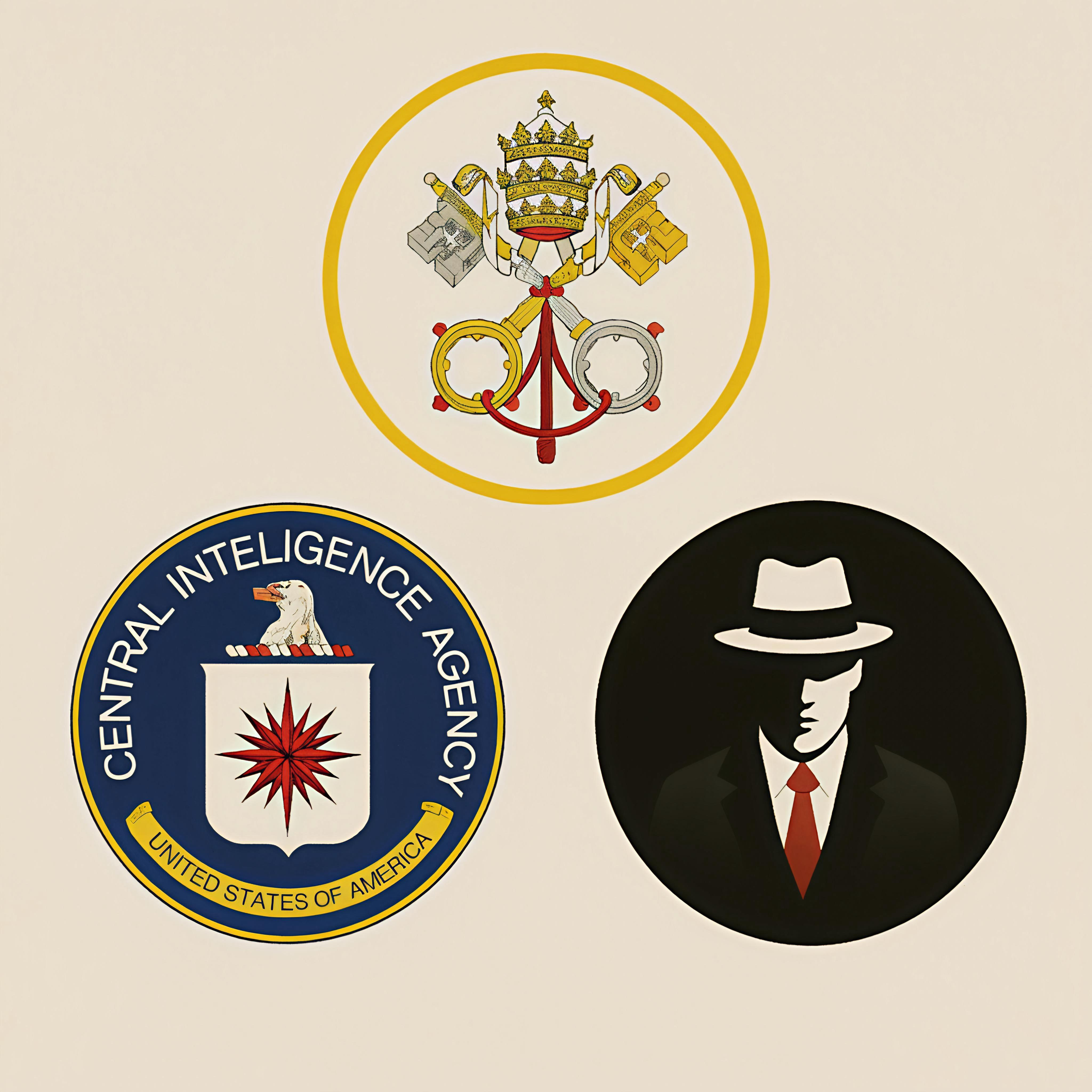
The end of World War II in 1945 didn’t usher in peace so much as it ignited a new, frigid conflict i.e. the Cold War. The United States and the Soviet Union squared off in a global chess match, each seeking to outmanoeuvre the other through ideology, espionage, and proxy wars. In this shadowy arena, an alleged alliance emerged one so improbable yet chillingly plausible that it has fueled decades of debate. According to some historians and theorists, the Vatican, the CIA (born from the wartime OSS), the Sicilian Mafia, and even former Nazis joined forces to combat the Soviet threat. This covert network, they argue, orchestrated everything from bombings and coups to drug trafficking and assassinations, leaving a trail of intrigue that stretches from Europe to Latin America. While parts of this narrative rest on declassified documents and firsthand accounts, others teeter on the edge of conspiracy, blurred by the secrecy that defined the era. What follows is an exploration of this supposed pact, delving into its origins, its operations like Italy’s Operation Gladio and Latin America’s Operation Condor and its murky ties to organized crime.

The Postwar Crucible: A Convergence of Interests


The seeds of this alliance were sown in the chaotic aftermath of World War II. As Nazi Germany collapsed, the United States, through the Office of Strategic Services (OSS), sought to repurpose the Third Reich’s remnants against a new foe: the Soviet Union. Allen Dulles, a Swiss-based OSS operative who later became CIA director, was a pivotal figure. In 1945, he negotiated Operation Sunrise with SS General Karl Wolff in Bern, securing a partial German surrender in Italy. Some claim this was more than a pragmatic deal that ex-Nazis, via Vatican intermediaries, pitched a broader alliance to the U.S., offering peace in exchange for a joint fight against communism. The Vatican, fiercely anti-communist under Pope Pius XII, had its own postwar role i.e. the "Ratlines," escape routes that funneled Nazi officials like Adolf Eichmann to safety in South America. While often framed as humanitarian aid gone awry, these channels hint at deeper collaboration, aligning the Holy See with Western intelligence goals.

Meanwhile, the U.S. turned to an unlikely partner, the Sicilian Mafia. During the 1943 invasion of Sicily, the OSS enlisted Charles "Lucky" Luciano, a jailed mobster, to secure the island and protect New York docks from sabotage. His reward came in 1946 early release and deportation to Italy sparking speculation of a quid pro quo that outlasted the war. Paul Helliwell, another OSS officer, added a financial twist. Operating in China, he allegedly tapped opium networks to fund anti-communist forces, a model some say foreshadowed later CIA-Mafia ties. This convergence of ex-Nazis with intelligence, the Vatican with moral cover, and the Mafia with street-level muscle set the stage for a Cold War partnership that, operated in the shadows of official policy.

Why would such disparate groups unite? For the U.S., the Soviet Union posed an existential threat, justifying any means however unsavory to counter it. Operation Paperclip, which recruited Nazi scientists, exemplified this pragmatism; extending it to spies or soldiers wasn’t a stretch. The Vatican saw communism as a godless scourge, a view Pope Pius XII articulated in his 1949 decree excommunicating Catholics who joined communist parties. The Mafia, reborn in postwar Italy, sought profit and protection, leveraging wartime favors into a lasting arrangement. Ex-Nazis, desperate for redemption or survival, offered skills honed in Europe’s darkest hours. Together, they formed a coalition of convenience, each bringing something the others lacked: ideology, resources, networks, and ruthlessness.

Thursday, October 15, 2026

God’s Spooks: Religion, Spying, and the Cold War


by Matthew Avery Sutton

January 15, 2026


And ye shall know the truth, and the truth shall set you free.
—John 8:32, inscribed on the wall at CIA headquarters, Langley, VA

In the early years of World War II, the U.S. State Department asked all American personnel living near enemy lines in China to return home. Baptist missionary John Birch refused to leave. God, he believed, wanted him in Asia. For years Birch had worked with local Chinese communities. He knew their language, their customs, and the layout of their land. He soon put this knowledge to work—not just for God but for Uncle Sam. In 1942 his life took a dramatic turn when a squadron of bombers led by Lieutenant Colonel James Doolittle crashed in the Chinese countryside. The American airmen had taken off from a carrier in the Pacific, dropped bombs on Tokyo, and then flown toward safety in China, where they parachuted from their planes as their fuel supplies ran out. When Birch received word of the raid and subsequent crash, he rendezvoused with the soldiers and helped them navigate through enemy lines and to freedom.

Birch’s performance impressed the Army and the Office of Strategic Services (OSS), the precursor to the Central Intelligence Agency (CIA). They saw in Birch a loyal foot soldier who knew the Chinese language and understood the geography and politics of the region. They put him to work, baptizing him in the waters of covert operations. During and immediately after the war Birch provided the OSS with intelligence on Chinese communism while still fronting as a missionary. He was eventually captured by communists and killed, becoming the first “martyr” of the Cold War. He later became the inspiration for Robert Welch’s extreme right-wing, anti-communist John Birch Society. Birch’s work for the government revealed that religious activists could make extremely valuable contributions to American intelligence services. But his death also demonstrated the potential consequences of mixing faith with work for the U.S. government.

What follows investigates the complicated relationship between the CIA and religion. Since its inception, the CIA has used missionaries and other religious activists for intelligence and espionage work; it has used religion as an effective propaganda tool, and its agents have even posed as clergy. CIA agents and religious activists managed to keep their partnerships mostly hidden until the 1970s. But in the wake of Vietnam and Watergate, numerous journalists and then Congress began scrutinizing the agency more closely. They revealed to the world that the CIA had been employing missionaries to further its agenda and that some religious activists were receiving substantial rewards for their work on the government’s behalf. In fact, the CIA and religious activists have long collaborated to achieve numerous policy goals.

In recent years, historians of religion have worked to better embed their narratives in the rich and complex historical contexts in which their subjects acted, linking issues of faith and belief to the ebbs and flows of particular environments. Historians Jon Butler, Paul Harvey, and Kevin Schultz have called for better integration of religion into more “mainstream” American history. The case of missionary-CIA collaboration answers that call by demonstrating how important it is for scholars to understand the many ways that religion functions in ostensibly nonreligious spheres. In the specific case of intelligence and espionage, religion had tangible impacts on American covert activities abroad. CIA-missionary relationships highlight underexplored intersections between religion and foreign policy; they expose in new ways the complicated nature of church-state collaboration; and they offer fresh insights into the many ways in which religion functions in nontraditional spheres.

At the same time, historians have much to learn by probing how and in what ways individuals and religious groups have benefited from their cooperation with the government. The State Department has often helped missionary groups expedite visas and gain entry into new regions of the world in return for their collaboration. Some government agencies have also provided humanitarian ministries with cash, food, and other supplies, subsidizing and supporting their work. Missionaries have received equally valuable, even if less tangible, benefits as well: many have found satisfaction in the conviction that in serving Uncle Sam, they were serving God. Despite the official disestablishment of religion, these partnerships illustrate how the state can serve as a historical actor, substantially aiding, or substantially undermining, a wide variety of missionary ventures.

Thursday, October 27, 2016

US-Russian war tensions mount over Eastern Europe and Syria - World Socialist Web Site


By Bill Van Auken 

27 October 2016

NATO defense ministers convened a two-day meeting in Brussels Wednesday to thrash out final plans for the deployment of some 4,000 combat troops organized in four battle groups within striking distance of Russia’s border.

These front-line forces are to be backed by a 40,000-strong rapid reaction force capable of going into battle within days.

The plan represents the largest military escalation in the region since the height of the Cold War between the US and the former Soviet Union and carries with it the heightened threat of an armed confrontation between Washington and Moscow, the world’s two largest nuclear powers.

At the end of Wednesday’s session, NATO Secretary General Jens Stoltenberg confirmed that the United States, Britain, Germany and Canada had agreed to provide the leading elements of the battle groups to be deployed respectively in Poland and the three former Soviet Baltic republics: Estonia, Lithuania and Latvia.

Stoltenberg added that other NATO member states would contribute soldiers and armaments to the buildup. Describing the deployment as “multinational,” he stressed that it underscored that “[a]n attack on any ally will be considered an attack on us all.”

US Defense Secretary Ashton Carter said that Washington would send a “battle-ready battalion task force” of approximately 900 solders into eastern Poland. The troops are to be drawn from the 2nd Stryker Cavalry Regiment, named for the Stryker armored fighting vehicle. The unit was sent repeatedly into the wars in Afghanistan and Iraq.

In addition, the Pentagon is sending the 3rd Armored Brigade Combat Team of the 4th Infantry Division, replete with battle tanks and heavy artillery, which will be based in Poland, but operate in the general periphery of ex-Soviet republics and former Warsaw Pact nations on Russia’s western flank. Also being sent is the 10th Combat Aviation Brigade, equipped with Black Hawk attack helicopters.

Washington has also announced it is dispatching 330 Marines to a base in Norway after the Norwegian government approved the deployment Monday. “We expect a sustained challenge from the East, from Russia, by way of its military activity,” Douglas Lute, the US ambassador to NATO, said in explaining the move.

Britain, meanwhile, spelled out its plans to deploy 800 troops to Estonia, equipped with battle tanks, armored infantry fighting vehicles and drones. It is to be joined by units from France and Denmark. British warplanes are also being sent to Romania.

Germany will deploy a battalion of between 400 and 600 troops to Lithuania, marking the first entry of the German military into the country since its occupation by the Nazis, who carried out the murder of close to a quarter of a million Jews there. The German deployment will be backed by units from Netherlands, Norway, Belgium, Croatia and Luxembourg.

Canada is reportedly sending 450 troops to Latvia, to be joined by 140 Italian military personnel.

Defending the deployments in an interview with the German broadcaster, Deutsche Welle, the outgoing American deputy secretary general of NATO, Alexander Vershbow, claimed the US-led alliance “had no choice.”

“Russia changed the whole paradigm in 2014 with its aggression against Ukraine, its illegal annexation of Crimea,” said Vershbow.

This is a barefaced lie. The crisis in Ukraine was triggered not by “aggression” on the part of the Kremlin oligarchy, but rather the conspiracy of Washington and Berlin to overthrow the elected government in Kiev through the mobilization of violent fascist and right-wing nationalist forces. The US openly associated itself with this coup, with Assistant Secretary of State Victoria Nuland bragging that the US had spent $5 billion to further Ukrainian regime change.

The reintegration of Crimea into Russia--it was only placed under Ukrainian administration in 1956, when both Russia and Ukraine were part of the Soviet Union--was overwhelmingly supported by the territory’s population in a popular referendum. From Moscow’s standpoint, this was a defensive measure taken to safeguard the historic base of Russia’s Black Sea fleet.

The coup in Ukraine was the culmination of the relentless military encirclement of Russia, which has seen NATO shift its borders 800 miles eastward. Now, the deployments announced Wednesday have turned into a dead letter the agreement negotiated between NATO and Moscow not to send “substantial” numbers of Western troops into these areas.

In the wake of the Ukrainian coup, US President Barack Obama flew to Estonia to declare Washington’s “eternal” commitment to defend it and the other two Baltic states with “American boots on the ground,” thereby committing the US to war in defense of three tiny territories ruled by right-wing and fanatically anti-Russian governments eager for confrontation.

Further justifying the current NATO buildup, Stoltenberg declared Wednesday, “Close to our borders, Russia continues its assertive military posturing.” Given that NATO has expanded its reach to Russia’s own borders, this effectively means that Russia is a threat because it maintains armed forces on its own soil.

Tensions with Russia, as well as within the NATO alliance itself, have been further ratcheted up over Moscow’s dispatch of an eight-vessel flotilla led by the aircraft carrier Admiral Kuznetsov to the eastern Mediterranean to support Russian operations in support of the Syrian government.

After reports that this Russian flotilla would stop in Ceuta, the Spanish-ruled port city on the north coast of Africa, for refueling, the NATO powers exerted immense pressure on the Spanish government to refuse to allow the Russian warships to dock there.

British Defense Secretary Michel Fallon declared that his government “would be extremely concerned if a NATO member should consider assisting a Russian carrier group that might end up bombing Syria.”

Spain has reportedly allowed nearly 60 Russian warships to take on fuel and supplies in Ceuta since 2011. The practice led to denunciations in the US Congress and an amendment being attached last May to the US military spending bill requiring the Pentagon to report to Congress on countries hosting Russian vessels.

The Russian media reported Wednesday that Moscow rescinded its request to refuel at the port, while Russian government sources said the ships had adequate fuel and supplies to reach their destination.

The controversy reflects the widening divisions that have opened up within the NATO alliance under the pressure of the escalating confrontation with Russia. The countries of southern Europe, particularly Spain, Italy and Greece, have grown increasingly hostile to the regime of sanctions against Russia that has only deepened their own economic crises. Meanwhile, Germany and France have floated plans for turning the European Union into an independent military alliance, reflecting the growing conflict between US and European interests.

NATO officials have couched the issue of the Russian flotilla in alleged “humanitarian” concerns over the situation in Syria, with warnings that the fighter jets onboard the Kuznetsov will join in air strikes against eastern Aleppo and other areas controlled by the Al Qaeda-linked Islamist militias supported by Washington and its allies.

Undoubtedly a more fundamental concern is that the Russian naval buildup in the eastern Mediterranean, coupled with Russia’s deployment of fighter jets and advanced mobile S-400 and S-300 missile defense systems in Syria itself, is challenging the control of the area historically exercised by the US Sixth Fleet, which has been sorely depleted by the US “pivot” to Asia.

The Russian firepower in and around Syria has also effectively precluded the imposition of a “no-fly zone,” a policy promoted by Democratic presidential candidate Hillary Clinton and much of the US foreign policy establishment, outside of a direct military confrontation with Russia.

This was acknowledged Tuesday by US Director of National Intelligence James Clapper in remarks to the Council on Foreign Relations. “I wouldn’t put it past them to shoot down an American aircraft if they felt that was threatening to their forces on the ground,” Clapper said of the Russian military during a talk at the Council of Foreign Relations. “The system they have there is very advanced, very capable, and I don’t think they’d do it--deploy it--if they didn’t have some intention to use it.”

Whether the flashpoint emerges in Eastern Europe or in Syria, the drive by US imperialism to achieve global hegemony is steadily escalating the threat of world war.


Monday, October 10, 2016

Gorbachev warns of 'dangerous point' as US-Russia ties sour


October 10, 2016


Former Soviet leader Mikhail Gorbachev is warning the world has reached a "dangerous point" as tensions between Russia and the United States spike over the Syria conflict (AFP Photo/Joseph Eid)


Moscow (AFP) - Former Soviet leader Mikhail Gorbachev warned on Monday that the world has reached a "dangerous point" as tensions between Russia and the United States spike over the Syria conflict.

Relations between Moscow and Washington -- already at their lowest since the Cold War over the Ukraine conflict -- have soured further in recent days as the United States pulled the plug on Syria talks and accused Russia of hacking attacks.

The Kremlin has suspended a series of nuclear pacts, including a symbolic cooperation deal to cut stocks of weapons-grade plutonium.

"I think the world has reached a dangerous point," Gorbachev, 85, told state news agency RIA Novosti.

"I don't want to give any concrete prescriptions but I do want to say that this needs to stop. We need to renew dialogue. Stopping it was the biggest mistake."

As the last leader of the Soviet Union, Gorbachev oversaw an easing of decades of tensions with the West that helped to end the Cold War.

He signed several landmark nuclear disarmament deals with Washington aimed at defusing the standoff between the two superpowers.

"It is necessary to return to the main priorities. These are nuclear disarmament, the fight against terrorism, the prevention of an environmental disaster," he said.

"Compared to these challenges, all the rest slips into the background."


Wednesday, April 13, 2016

Russian Jets Make Aggressive Maneuver Near U.S. Ship In Baltic Sea


The incident came as NATO plans to build up its presence in eastern Europe in an attempt to counter an increasingly aggressive Russia.

 04/13/2016 04:06 pm ET | Updated 9 minutes ago


Phil Stewart


WASHINGTON, April 13 (Reuters) - Two Russian warplanes with no visible weaponry flew simulated attack passes near a U.S. guided missile destroyer in the Baltic Sea on Tuesday, a U.S. official said, describing it as one of the most aggressive interactions in recent memory.

The repeated flights by the Sukhoi SU-24 warplanes, which also flew near the ship a day earlier, were so close they created wake in the water, with 11 passes, the official said.

A Russian KA-27 Helix helicopter also made seven passes around the USS Donald Cook, taking pictures. The nearest Russian territory was about 70 nautical miles away in its enclave of Kaliningrad, which sits between Lithuania and Poland.

“They tried to raise them (the Russian aircraft) on the radio but they did not answer,” the official said, speaking on condition of anonymity, adding the U.S. ship was in international waters.


Matej Divizna via Getty Images The incident comes as NATO plans its biggest build-up in eastern Europe to counter an increasingly aggressive Russia. Paratroopers from U.S. and Italian airborne brigades train near Grafenwoehr, Germany.


The incident came as NATO plans its biggest build-up in eastern Europe since the Cold War to counter what the alliance, and in particular the Baltic states and Poland, consider to be a more aggressive Russia.

The three Baltic states, which joined both NATO and the European Union in 2004, have asked NATO for a permanent presence of battalion-sized deployments of allied troops in each of their territories. A NATO battalion typically consists of 300 to 800 troops.

Moscow denies any intention to attack the Baltic states.

The USS Donald Cook had just wrapped up a port visit in the Polish city of Gdynia on April 11 and then proceeded out to sea with a Polish helicopter on board.

The first incident took place on April 11, when two SU-24 jets flew about 20 passes near the Donald Cook, coming within 1,000 yards (meters) of the ship, at about 100 feet (30 meters) in altitude.

That was followed by even closer passes by the SU-24s the following day and the passes by the Russian helicopter.

The U.S. defense official said the commanding officer of the Donald Cook believed that Tuesday’s incident was “unsafe and unprofessional,” but cautioned that a formal U.S. military review of the matter was underway.

(Reporting by Phil Stewart; Editing by James Dalgleish)


Source
.

Tuesday, June 16, 2015

Putin says Russian military will receive 40 new intercontinental ballistic missiles this year


Russian President Vladimir Putin, center, and Defense Minister Sergei Shoigu, right, arrive for the opening of the Army-2015 international military show in Kubinka, outside Moscow, on Tuesday, June 16, 2015. The show features the latest Russian weapons. Putin said Tuesday the Russian military will receive 40 new intercontinental ballistic missiles this year capable of piercing any missile defenses, a blunt reminder of the nation's nuclear might amid tensions with the West over Ukraine. (Vasily Maximov/ pool photo via AP)


Associated PressJune 16, 2015 | 2:39 p.m. EDT


By VLADIMIR ISACHENKOV, Associated Press

MOSCOW (AP) — Russia's military will receive over 40 new intercontinental ballistic missiles this year alone that are capable of piercing any missile defenses, President Vladimir Putin said Tuesday in a blunt reminder of the nation's nuclear might amid tensions with the West over Ukraine.

Putin spoke at the opening of an arms show at a shooting range in Alabino just west of Moscow, a huge display intended to showcase Russia's resurgent military.

NATO Secretary-General Jens Stoltenberg accused the Russians of "nuclear saber-rattling," and said that was one of the reasons the western military alliance has been beefing up its ability to defend its members.

U.S. Secretary of State John Kerry, briefing reporters via teleconference from Boston, where he is recovering from surgery on a broken leg, called Putin's announcement concerning.

"We're trying to move in the opposite direction," Kerry said. "We have had enormous cooperation from the 1990s forward with respect to the structure of nuclear weapons in the former territories of the Soviet Union. And no one wants to see us step backwards."

He said Putin could be posturing.

"It's really hard to tell," Kerry said. "But nobody should hear that kind of an announcement from the leader of a powerful country and not be concerned about the implications."

Russia-West relations have plunged to their lowest point since Cold War times over Moscow's annexation of Ukraine's Crimean Peninsula and support for a pro-Russia separatist insurgency in eastern Ukraine. The U.S. and the EU have slapped Russia with economic sanctions, and Washington and its NATO allies have pondered an array of measures in response to Russia's moves.

The three Baltic members of the alliance, Estonia, Latvia and Lithuania, have asked NATO to permanently deploy ground troops to their nations as a deterrent against an increasingly assertive Russia. And Polish Defense Minister Tomasz Siemoniak says he and U.S. Defense Secretary Ash Carter have held talks about placing U.S. heavy army equipment in Poland.

The NATO chief said he expected Carter to brief other alliance members on the proposal to stockpile tanks and other weapons and supplies in Eastern Europe during a NATO defense ministers meeting next week.

"I welcome all efforts to defend and protect allies," Stoltenberg said in Brussels.

Moscow bristled at the plans, warning Washington that the deployment of new U.S. weapons near Russian borders would foment dangerous instability in Europe.

"The United States is inciting tensions and carefully nurturing their European allies' anti-Russian phobias in order to use the current difficult situation for further expanding its military presence and influence in Europe," the Russian Foreign Ministry said.

"We hope that reason will prevail and it will be possible to save the situation in Europe from sliding toward a military standoff, which could entail dangerous consequences," the ministry added.

The NATO chief said the alliance had to respond to Russia's actions by "increasing the readiness and the preparedness of our forces."

"We are responding by making sure that NATO also in the future is an alliance which provides deterrence and protection for all allies against any threat," Stoltenberg said.

In his speech at the arms show, Putin vowed to continue a big arms modernization program despite the nation's economic downturn. He specifically mentioned the Armata tanks and other new armored vehicles, which were first shown to the public during a Red Square military parade last month.

The Russian leader also noted the military was to start testing its new long-range early warning radar intended to monitor the western border and later will deploy another one in the east.


Source
.

Monday, June 15, 2015

U.S. Is Poised to Put Heavy Weaponry in Eastern Europe


Stryker vehicles from the Army’s 2nd Cavalry Regiment took part in a military exercise in Riga, Latvia.
OKSANA DZADAN / ASSOCIATED PRESS


By ERIC SCHMITT and STEVEN LEE MYERS
JUNE 13, 2015


RIGA, Latvia — In a significant move to deter possible Russian aggression in Europe, the Pentagon is poised to store battle tanks, infantry fighting vehicles and other heavy weapons for as many as 5,000 American troops in several Baltic and Eastern European countries, American and allied officials say.

The proposal, if approved, would represent the first time since the end of the Cold War that the United States has stationed heavy military equipment in the newerNATO member nations in Eastern Europe that had once been part of the Soviet sphere of influence. Russia’s annexation of Crimea and the war in eastern Ukraine have caused alarm and prompted new military planning in NATO capitals.

It would be the most prominent of a series of moves the United States and NATO have taken to bolster forces in the region and send a clear message of resolve to allies and to Russia’s president, Vladimir V. Putin, that the United States would defend the alliance’s members closest to the Russian frontier.

After the expansion of NATO to include the Baltic nations in 2004, the United States and its allies avoided the permanent stationing of equipment or troops in the east as they sought varying forms of partnership with Russia.


United States Army soldiers met with residents in Bialystok, Poland.
ARTUR RESZKO / AGENCE FRANCE-PRESSE — GETTY IMAGES


“This is a very meaningful shift in policy,” said James G. Stavridis, a retired admiral and the former supreme allied commander of NATO, who is now dean of the Fletcher School of Law and Diplomacy at Tufts University. “It provides a reasonable level of reassurance to jittery allies, although nothing is as good as troops stationed full-time on the ground, of course.”


The amount of equipment included in the planning is small compared with what Russia could bring to bear against the NATO nations on or near its borders, but it would serve as a credible sign of American commitment, acting as a deterrent the way that the Berlin Brigade did after the Berlin Wall crisis in 1961.

“It’s like taking NATO back to the future,” said Julianne Smith, a former defense and White House official who is now a senior fellow at the Center for a New American Security and a vice president at the consulting firm Beacon Global Strategies.

The “prepositioned” stocks — to be stored on allied bases and enough to equip a brigade of 3,000 to 5,000 soldiers — also would be similar to what the United States maintained in Kuwait for more than a decade after Iraq invaded it in 1990 and was expelled by American and allied forces early the next year.

The Pentagon’s proposal still requires approval by Defense Secretary Ashton B. Carter and the White House. And political hurdles remain, as the significance of the potential step has stirred concern among some NATO allies about Russia’s reaction to a buildup of equipment.

“The U.S. military continues to review the best location to store these materials in consultation with our allies,” said Col. Steven H. Warren, a Pentagon spokesman. “At this time, we have made no decision about if or when to move to this equipment.”

Senior officials briefed on the proposals, who described the internal military planning on the condition of anonymity, said that they expected approval to come before the NATO defense ministers’ meeting in Brussels this month.

The current proposal falls short of permanently assigning United States troops to the Baltics — something that senior officials of those countries recently requested in a letter to NATO. Even so, officials in those countries say they welcome the proposal to ship at least the equipment forward.

“We need the prepositioned equipment because if something happens, we’ll need additional armaments, equipment and ammunition,” Raimonds Vejonis, Latvia’s minister of defense, said in an interview at his office here last week.

“If something happens, we can’t wait days or weeks for more equipment,” said Mr. Vejonis, who will become Latvia’s president in July. “We need to react immediately.”

Mark Galeotti, a professor at New York University who has written extensively on Russia’s military and security services, noted, “Tanks on the ground, even if they haven’t people in them, make for a significant marker.”

As the proposal stands now, a company’s worth of equipment — enough for about 150 soldiers — would be stored in each of the three Baltic nations: Lithuania, Latvia and Estonia. Enough for a company or possibly a battalion — about 750 soldiers — would be located in Poland, Romania, Bulgaria and possibly Hungary, they said.

American military specialists have conducted site surveys in the countries under consideration, and the Pentagon is working on estimates about the costs to upgrade railways, build new warehouses and equipment-cleaning facilities, and to replace other Soviet-era facilities to accommodate the heavy American weaponry. The weapons warehouses would be guarded by local or security contractors, and not by American military personnel, officials said.

Positioning the equipment forward saves the United States Army time, money and resources, and avoids having to ship the equipment back and forth to the United States each time an Army unit travels to Europe to train. A full brigade’s worth of equipment — formally called the European Activity Set — would include about 1,200 vehicles, including some 250 M1-A2 tanks, Bradley fighting vehicles, and armored howitzers, according to a senior military official.

The Army previously said after the invasion of Crimea last year that it would expand the amount of equipment it stored at the Grafenwöhr training range in southeastern Germany and at other sites to a brigade from a battalion. An interim step would be prepositioning the additional weapons and vehicles in Germany ahead of decisions to move them farther east.

Army units — currently a battalion from the Third Infantry Division — now fly into the range on regular rotations, using the same equipment left in place. They train with the equipment there or take it to exercises elsewhere in Europe.

That, along with stepped-up air patrolling and training exercises on NATO’s eastern flank, was among the initial measures approved by NATO’s leaders at their summit meeting in Wales last year. The Pentagon’s proposal reflects a realization that the tensions with Russia are unlikely to diminish soon.

“We have to transition from what was a series of temporary decisions made last year,” said Heather A. Conley, director of the Europe Program at the Center for Strategic and International Studies in Washington.

The idea of moving prepositioned weapons and materials to the Baltics and Eastern Europe has been discussed before, but never carried out because it would be viewed by the Kremlin as a violation of the spirit of the 1997 agreement between NATO and Russia that laid the foundation for cooperation.

In that agreement, NATO pledged that, “in the current and foreseeable security environment,” it would not seek “additional permanent stationing of substantial ground combat forces” in the nations closer to Russia.

The agreement also says that “NATO and Russia do not consider each other as adversaries.” Many in the alliance argue that Russia’s increasingly aggressive actions around NATO’s borders have made that pact effectively moot.

The Pentagon’s proposal has gained new support because of fears among the eastern NATO allies that they could face a Russian threat.

“This is essentially about politics,” Professor Galeotti said. “This is about telling Russia that you’re getting closer to a real red line.”

In an interview before a visit to Italy this week, Mr. Putin dismissed fears of any Russian attack on NATO.

“I think that only an insane person and only in a dream can imagine that Russia would suddenly attack NATO,” he told the newspaper Corriere Della Sera. “I think some countries are simply taking advantage of people’s fears with regard to Russia.”


Eric Schmitt reported from Riga, Latvia, and Vilnius, Lithuania, and Steven Lee Myers from Washington.


Source
.
.

Tuesday, May 06, 2014

Infiltration of the U.S. Government, Part Two


By Cliff Kincaid — May 5, 2014

Vladimir Putin’s aggression in Ukraine has apparently surprised a lot of people who thought the Cold War was over, and that Russia had been integrated into the “community of nations.” In 2012, President Obama pushed through Permanent Normal Trade Relations for Russia, giving Putin access to billions of dollars of Western capital. Continue reading here... 

Source

A long, long time ago

"Hillary Clinton and Russian Foreign Minister Sergey Lavrov press a red button symbolizing the intention to "reset" US-Russian relations March, 2009." 


Photos (Courtesy):

Thursday, August 08, 2013

Obama Snubs, Russia Laughs, Putin Wins


Vladimir Putin was this close to caring that Barack Obama decided not to meet with him. Photographer: Jochen Eckel/Bloomberg
 
By Leonid Bershidsky Aug 7, 2013 12:53 PM ET


In the U.S., President Barack Obama's decision to cancel a summit with Russian President Vladimir Putin for harboring fugitive Edward Snowden is seen as an important diplomatic demarche.

From the Russian perspective, it's a bit of a joke.

One freshly minted Russian witticism, picked up by the news site Gazeta.ru, portrayed the U.S. president as a jilted suitor: "Obama won't see Putin because Putin is already seeing Snowden."
The White House issued a statement saying Obama "looked forward to" the September G-20 summit in St. Petersburg, but that he had decided against a one-on-one meeting with Putin "given our lack of progress on issues such as missile defense and arms control, trade and commercial relations, global security issues, and human rights and civil society in the last 12 months." As regards the man wanted in the U.S. for leaking information on government surveillance, the White House said: "Russia’s disappointing decision to grant Edward Snowden temporary asylum was also a factor that we considered in assessing the current state of our bilateral relationship."

The fact that Obama stopped short of skipping the entire G-20 meeting was seen in the Putin camp as a sign of weakness. The dominant theory is that the U.S. president did not really want to make hostile moves against Russia, but domestic interests forced him to make a show of chastising Putin.

"Obama is under powerful pressure from the cold war lobby," political analyst Sergei Markov told the news agency Interfax.

"This is clearly a political defeat for Obama," pro-Putin newspaper editor Vitaly Tretyakov wrote on the social network Vkontakte. In an eerie echo of the White House statement, Tretyakov added: "Russia, strictly speaking, does not care. What could we expect from Obama's visit? A second reset? But the first one failed. A second detente? Who even remembers the first one?"

Putin's liberal opponents, for their part, could not sympathize with Obama's move. They saw better reasons than Snowden's asylum to chastise Putin.

"It's sad that Obama did not refuse to meet with Putin because of human rights violations in Russia but rather because of rights violations in the U.S.," blogger Oleg Kozyrev wrote on Twitter.

The two leaders did not have much to discuss, anyway.

Russia and the United States do not see eye to eye on most issues, from gay rights to the civil war in Syria. The differences have been starkly evident for at least a year, since Putin returned to the Kremlin after a four-year hiatus. Now a man wanted in the U.S. for espionage has found an apartment in Moscow, is looking for a job and sending out invitations to family in the U.S. If a meeting would not have changed anything, neither does its cancellation.

"Obama canceled his meeting with Putin," Russia's most popular anti-Putin politician Alexei Navalny, who is now running for mayor of Moscow, wrote on Twitter. "As for me, I held my meeting with the residents of Zyablikovo neighborhood as planned."

(Leonid Bershidsky, an editor and novelist, is a Bloomberg View contributor. Follow him on Twitter.)
 
 
.

Tuesday, August 21, 2012

Russia, China warn US against military intervention in Syria

ELECTIONS 2012
AUGUST 21, 2012

Russian Foreign Minister Sergei Lavrov warned the US on Tuesday against any unilateral military action in Syria

Credits:
Pravda

President Obama told the White House press corp on Monday he had refrained "at this point" from ordering military action against the Assad regime in Syria, but that could change if he felt there was a need to secure Syrian chemical and biological weapons. This was some of the strongest language yet from Obama regarding Syria, and both Russia and China responded to his remarks on Tuesday.

Russian Foreign Minister Sergei Lavrov warned the U.S. and it's Western allies on Tuesday against any unilateral action in Syria after Obama said U.S. forces may act if Syrian President Assad uses chemical weapons against his adversaries.

Lavrov, speaking at a meeting with in Russia with Chinese State Councillor Dai Bingguo, said that Russia and China understand "the need to strictly adhere to the norms of international law and the principles contained in the U.N. Charter, and not to allow their violation."

In July Lavrov said "the US position on Syria directly endorses terrorism."

Lavrov said on Monday that only the UN Security Council could legally authorize the use of external force against Syria, and warned Obama and the West against imposing "democracy by bombs".

Russian leaders have said in recent days that they will not stand aside as they did in Libya last year, when Moscow let NATO military operations go forward by abstaining from the UN Security Council resolution that authorized air operations.

Russian warships and marines have been seen in Syrian ports in recent weeks, although Russia says the warships were only delivering supplies, and were returning to Russia. There have been conflicting reports as to whether the Russian marines may have stayed behind in Syria.

Dai said he had come to Russia for "consultations on strategic security" and also had a "very good, friendly and important meeting" with Russian President Vladimir Putin.

Putin has publicly stated his opposition to what he calls "foreign intervention in sovereign states."

A recent report on the Pravda website quoted Putin as saying to Obama, "We know your plans, where your military and agents are located. World War 3 will be on your head and legacy," during their last face to face meeting.

Many Middle east experts are concerned that a strike on Iran's nuclear facilities by Israel, which some reports say could come before U.S. elections in November, combined with U.S. military intervention in Syria could ignite a larger war in the region, and some warn that it could mark the beginning of a global conflict.


Source


P.S.

What a difference a daze makes?

Remember this photo-op?


Sergei Lavrov and Hillary R. Clinton in happier (goofier) times.

What a riot, what a stunt?

.

Monday, June 18, 2012

Obama to press Putin on Syria at G20 amid skepticism

Mon, 18 Jun 2012 04:59 GMT

Source: Reuters // Reuters

* First Obama-Putin meeting since 2009

* Syria conflict stirs Cold War-style recriminations

* Suspension of U.N. monitoring steps up pressure to act

By Matt Spetalnick and Gleb Bryanski

LOS CABOS, Mexico, June 18 (Reuters) - U.S. President Barack Obama will press Vladimir Putin over Russia's role in the Syrian crisis when they meet on Monday but appears to have little chance of persuading him to budge on Moscow's resistance to tougher U.N. action against Damascus.

After a week of Cold War-style recriminations between U.S. and Russian diplomats, the talks at a Group of 20 summit in Mexico will test whether the two leaders can forge a working relationship and find common ground on Syria and other festering disputes.

Suspension of the U.N. monitoring mission in Syria over the weekend has put added pressure on Obama and Putin, meeting for the first time since the Russian president's re-election, to act decisively to keep the conflict from spiraling into civil war.

But with relations frayed and expectations low on both sides for progress on breaking the deadlock, the stage is set for an uncomfortable meeting in the Pacific resort of Los Cabos.

Diplomatic efforts will be further complicated by Obama's re-election battle against Republican Mitt Romney - who has called Russia "our number one geopolitical foe" - as well as questions on how far Putin might go in translating his anti-Western rhetoric into actual policy.

The hardened tone appears to mark the endpoint of Obama's "reset" of ties with Moscow, pursued with Putin predecessor Dmitry Medvedev and touted by the White House as a signature foreign policy accomplishment.

With Syrian President Bashar al-Assad continuing his bloody, 15-month crackdown on the opposition, Obama and Western allies want veto-wielding Moscow to stop shielding him from further U.N. Security Council sanctions aimed at forcing him from power.

But Putin, a former KGB spymaster, is suspicious of U.S. motives especially after the NATO-assisted ouster of Libyan leader Muammar Gaddafi last year, and has offered little sign of softening his stance on Syria.

Though Washington has shown no appetite for a new Libya-style intervention, Russia is reluctant to abandon its Syrian ally, a longtime arms customer, and risk losing its last firm foothold in the Middle East, including access to a warm-water navy base.

Obama's aides say they are counting on other G20 leaders such as British Prime Minister David Cameron also to exert pressure on Putin. But Putin can expect solidarity from China, which has joined in blocking anti-Assad moves at the United Nations.

ANGRY RETORT

The seriousness of the rift between Washington and Moscow was underscored last week when Secretary of State Hillary Clinton accused Russia of supplying Assad with attack helicopters. This drew an angry retort from the Kremlin.

"Some people are trying to spoil the atmosphere of these talks," said Yuri Ushakov, Putin's adviser on foreign policy.

He cited not only the arms sale accusation but also a proposed new bill in the U.S. Congress, the so-called "Magnitsky" law, that would target Russian human rights violators, legislation he called "anti-Russian."

Putin focused on another irritant in relations on Thursday, warning ominously of an "appropriate reaction" to U.S.-backed missile defense plans for Europe that Moscow vehemently opposes.

Obama may seek to lower the temperature, but he also wants to be assertive enough to avoid giving Republicans an opening to accuse him of being soft on Moscow at a time when he is already struggling to defend his record on the economy. At the same time, he faces criticism for not providing stronger leadership on Syria.

For his part, Putin will be in no mood for concessions that could be seen as weakness as he seeks to quell dissent at home with tactics that are drawing U.S. criticism. He also will be wary of making commitments to an American president whose future remains uncertain beyond the Nov. 6 election.

On a personal level, there is reason to doubt whether "No-Drama" Obama and tough-talking Putin will click. Their body language will be dissected by the media for any hint of where the relationship is heading.

Their first meeting, nearly three years ago at Putin's dacha when he was prime minister, was by most accounts an awkward one, with Obama subjected to a long monologue of Russian grievances.

But Obama aides say the initial improvement in relations, which came after ties soured near the end of President George W. Bush's tenure, would not have been possible without Putin's behind-the-scenes support.

Los Cabos, where the broader summit will focus on the euro zone crisis threatening the world economy, will be a chance for both leaders to make their case. But no new ideas are expected.

Obama will urge Putin to use his influence with Assad to accept a transition modeled on Yemen's, in which an autocratic president was pushed out, U.S. officials say. Moscow has signaled its opposition to making Assad's exit a pre-condition.

The White House also hopes to placate a key Russian concern. "It's not our goal in Syria to eliminate Russian influence," U.S. deputy national security adviser Ben Rhodes told reporters.

Putin is likely to push for an international "contact group" that would include Iran, which counts Syria as its only real ally in the region. The United States opposes any Iranian role.

Still, Obama will tread carefully with Putin on Iran. Russia is hosting the next round of talks between Iran and world powers this week, and Washington wants Moscow to do more to help pressure Tehran to curb its nuclear program. (Additional reporting By Steve Gutterman; editing by Mohammad Zargham)


Source


Wednesday, June 13, 2012

Syria Crisis and Putin’s Return Chill U.S. Ties With Russia

By PETER BAKER
Published: June 13, 2012 51


WASHINGTON — Sitting beside President Obama this spring, the president of Russia gushed that “these were perhaps the best three years of relations between Russia and the United States over the last decade.” Two and a half months later, those halcyon days of friendship look like a distant memory.

Gone is Dmitri A. Medvedev, the optimistic president who collaborated with Mr. Obama and celebrated their partnership in March. In his place is Vladimir V. Putin, the grim former K.G.B. colonel whose return to the Kremlin has ushered in a frostier relationship freighted by an impasse over Syria and complicated by fractious domestic politics in both countries.

The tension over Syria has been exacerbated by an accusation by Secretary of State Hillary Rodham Clinton on Tuesday that Russia is supplying attack helicopters to the government of President Bashar al-Assad as it tries to crush an uprising. Russia’s foreign minister, Sergey V. Lavrov, rejected the assertions on Wednesday, saying that Moscow was supplying only defensive weapons and countering that the United States was arming the region.

The back-and-forth underscored the limits of Mr. Obama’s ability to “reset” ties between the two countries, as he resolved to do when he arrived in office. He has signed an arms control treaty, expanded supply lines to Afghanistan through Russian territory, secured Moscow’s support for sanctions on Iran and helped bring Russia into the World Trade Organization. But officials in both capitals noted this week that the two countries still operated on fundamentally different sets of values and interests.

The souring relations come as Mr. Obama and Mr. Putin are preparing to meet for the first time as presidents next week on the sidelines of a summit meeting in Mexico. With Mr. Obama being accused by Mitt Romney, his Republican presidential opponent, of going soft on Russia and Mr. Putin turning to anti-American statements in response to street protests in Moscow, the Mexico meeting is being seen as a test of whether the reset has run its course.

“We were already at a place with the Russians where we were about to move to a new phase,” said Benjamin J. Rhodes, a deputy national security adviser to Mr. Obama. “A lot of this is can we continue to build on the initial steps we’ve taken with the Russians even as we’ve had differences emerge, most notably on Syria.”

Others see relations between the two countries more pessimistically. “There is a crisis in the Russian-American relationship,” said Aleksei K. Pushkov, the hawkish head of Russia’s parliamentary foreign affairs committee. “It is a crisis when the sides have to balance their interests but they cannot do so because their interests diverge. It is developing into some kind of long-term mistrust.”

The signs of that divergence have been there for a while but have seemed increasingly pronounced in recent months. Michael A. McFaul, a former Russia adviser to Mr. Obama, has been subjected to an unusual campaign of public harassment since arriving in Moscow as ambassador. A Russian general last month threatened pre-emptive strikes against American missile defense sites in Poland in the event of a crisis.

Reclaiming the presidency after a four-year interregnum wielding power as prime minister, Mr. Putin has responded to sustained demonstrations with a crackdown and accusations of American perfidy, singling out Mrs. Clinton. He snubbed Mr. Obama by skipping the annual Group of 8 summit meeting, hosted by the president at Camp David last month.

“The reset failed to change the underlying suspicion and distrust of America shared by a majority of Russians as well as Putin himself,” said Masha Lipman, an analyst at the Carnegie Moscow Center. “America is seen as a threat, an agent seeking to undermine Russia, to weaken it, to do harm to it. Russia always has to be on the alert, on the defensive.”

Adding to the tension have been moves in Congress to impose visa and banking restrictions on Russian officials implicated in human rights abuses. The bipartisan legislation, named for Sergei L. Magnitsky, a lawyer whose corruption investigation led to his death in prison, passed a House committee last week and will be taken up by a Senate panel next week.

“I see this as part of an effort to make clear the expected international conduct as it relates to human rights,” said Senator Benjamin L. Cardin, a Maryland Democrat who has pushed the legislation. “This is what friends do. We point out when you need to do better.”

The Obama administration, seeking to avoid a rupture, opposes the legislation on the grounds that the State Department has already banned visas for Russians implicated in Mr. Magnitsky’s death.

Instead, the administration is highlighting separate legislation introduced on Tuesday by a bipartisan group, including Senators John McCain, Republican of Arizona, and John Kerry, Democrat of Massachusetts, that would repeal decades-old trade restrictions on Russia.

Hours after Mrs. Clinton lodged her helicopter allegations on Tuesday, she sent an under secretary of state, Wendy Sherman, to a Russia Day reception at the Russian Embassy in Washington, where she pointed to the proposed repeal of the Jackson-Vanik restrictions and talked about treating Moscow “with respect.”

The complication for Mr. Obama is that lawmakers like Mr. Cardin and Mr. McCain want to link the Jackson-Vanik repeal to the Magnitsky legislation, seeing it as the only way to win enough votes. Mr. Cardin said he agreed with an administration push to broaden the Magnitsky bill to cover all countries, not singling out Russia, but others in Congress oppose such a move.

Mr. Obama is focusing on enlisting Russia’s help on issues like stopping Iran from building nuclear weapons. The next round of talks between Iran and international powers open in Moscow next week, and the administration hopes that Russia’s role as host will prompt it to use its influence with Tehran to extract more concessions.

One of the biggest successes of the reset, however, has also made the United States more dependent on Russia. With Pakistan cutting off supply lines to Afghanistan, the so-called northern distribution network through Russia is the primary reinforcement route for America’s war on the Taliban.

“We need more from them than they need from us at the moment,” said Angela E. Stent, a former national intelligence officer on Russian affairs who now directs Russian studies at Georgetown University. The Russians are less invested than Mr. Obama in the notion of a reset. “They look at that as an American course correction. But it’s not their policy, it’s an American policy,” Dr. Stent said.

Publicly, the administration rejects any connection between Syria and the Afghan supply route. “We’re not linking the two,” said Capt. John Kirby, a Pentagon spokesman. But, privately, officials worry that Russia will try to use the leverage provided by the supply route.

So far, Russian officials have reassured their American counterparts that they will not link the issues. If anything, Moscow worries that the United States is pulling out of Afghanistan too soon, recognizing that a collapse in security there would pose problems for Russia’s southern flank.

For Mr. Obama, who considers improved ties with Russia one of his signature accomplishments, the question is whether the current friction is temporary or is a sign that the reset has accomplished what it can. At some point, administration officials said, it was inevitable that the two countries would settle into a situation in which they cooperate in some areas and clash in others.

The coming meeting in Los Cabos, Mexico, on the sidelines of a Group of 20 gathering, could prove uncomfortable for Mr. Obama. The first time the two men met, in July 2009, when Mr. Putin was prime minister, Mr. Putin delivered an hourlong harangue about the United States.

Los Cabos may be no more congenial. “This should be an awkward meeting, because otherwise the president runs a risk of palling around with a guy who’s cracking down on the opposition, who’s selling attack helicopters to a murderous regime in Syria and is just going in the wrong direction,” said David J. Kramer, a Bush official who is now executive director of Freedom House, an advocacy organization.

“The president’s going to be yearning for the days of meetings with Dima,” Mr. Kramer added, using Mr. Medvedev’s nickname. “It probably won’t be a pretty meeting. And it shouldn’t be a pretty meeting.”


Ellen Barry contributed reporting from Moscow, and Thom Shanker from Washington.


US accuses Russia but needs its help in Syria


06-13) 13:47 PDT WASHINGTON, (AP) --

Tensions between the U.S. and Russia flared Wednesday as the former Cold War foes traded blame for the violence in Syria just days before a planned meeting between President Barack Obama and Russian President Vladimir Putin.

Secretary of State Hillary Rodham Clinton held to her explosive accusation that the "latest information" in U.S. hands is that Russia is sending attack helicopters to Syrian President Bashar Assad's regime at the risk of fomenting a dangerous civil war. Russian Foreign Minister Sergey Lavrov fired back by alleging that the U.S. has sent military support to the region with the same result.

The public U.S.-Russian rift is occurring at a time that Obama administration had hoped to court Moscow's support for a transition plan to end the Assad regime. If nothing else, the dispute underlines the American government's continued difficulty in finding a strategy to pacify Syria after 15 months of brutal government crackdowns and armed rebellion.

A day after blasting Moscow for purportedly sending new helicopter gunships to Syria, Clinton lamented on Wednesday that repeated U.S. requests to the Russian government to suspend its military ties with Damascus had fallen on deaf ears.

"We have repeatedly urged the Russian government to cut these military ties completely and to suspend all further support and deliveries," Clinton told reporters. "We know, because they confirm, that they continue to deliver and we believe that the situation is spiraling toward civil war. It is now time for everyone in the international community, including Russia ... to speak to Assad in unified voice and insist that the violence stop."

Clinton questioned Russia's insistence that "it wants peace and stability restored" and that it is not wedded to Assad's remaining in power. "It also claims to have vital interests in the region and relationships that it wants to continue to keep," she said. "They put all of that at risk if they do not move more constructively right now."

In Tehran, Lavrov rejected the helicopter charge and blamed Washington for fueling the conflict. He said his government was completing earlier weapons contracts with Syria exclusively for air defense systems, which generally refers to surface-to-air missiles, radar and other such materiel. He didn't speak specifically about helicopters but insisted that nothing being delivered could be used against peaceful demonstrators.

Lavrov was widely quoted as accusing the U.S. of providing Syrian dissidents with weapons, but he only said the U.S. was supplying "special means" to the region, not the rebels.

"We are not supplying to Syria or anywhere else things that are used in fighting with peaceful demonstrators, in contrast to the United States, which is regularly sending such special means to countries in the region," he said. "For some reason, the Americans consider this to be in order. We are not delivering such means and are delivering only that which Syria requires in the event of an armed attack on it from outside."

Nevertheless, Clinton said Wednesday: "The United States has provided no military support to the opposition. None."

The U.S. has helped other countries vet potential recipients of military aid in the hope that none of the weapons heading into the region end up with al-Qaida or other terrorist groups.

Responding to Lavrov's dismissal of the U.S. helicopter claims, State Department spokeswoman Victoria Nuland said: "I would encourage him to check with his own authorities."

"Russian and Soviet-made helicopters form the base of the Syrian helicopter fleet," Nuland told reporters. "We are seeing these helicopters used all over Syria now against civilians. We are seeing gun mounts on these being used to fire on populations in Homs, in Hama, in Lattakia, in Idlib. We have seen the Russians resupply weapons they have sold to the Syrians as recently as January."

In making the initial charge on Tuesday, Clinton cited what she called the "latest information" the U.S. had about helicopters on the way from Russia to Syria. The remark appeared to catch many in the Obama administration unprepared, but two U.S. officials said that Clinton was repeating information contained in a classified intelligence briefing circulated Tuesday morning.

The officials spoke on condition of anonymity to discuss the classified material. Another official said the Syrians use both Mi-8/17 HIP and Mi-24/25 HIND helicopters. The HIP is a multi-purpose helicopter used primarily for transport but can be modified to carry hull-mounted weapons for air-to-ground strike missions. The HIND is an attack helicopter specifically designed for air-to-ground strikes using missiles, rockets and heavy machine guns.

At the White House, press secretary Jay Carney softened Clinton's accusation against Russia, calling it one element of a larger argument the U.S. is making that Russia should do more to spur political change in Syria. He would not say whether Obama and Putin would discuss arms sales on the sidelines of the meeting of the Group of 20 industrial and emerging market nations in Mexico next week.

"Our argument has been, to the Russians and others who have supported that regime in the past, that that it is the wrong thing to do to continue that support," Carney said.

Despite their disagreement, diplomatic hopes rest with Washington and Moscow agreeing on a transition plan that might end the four-decade Assad regime. Russia, along with China, has twice blocked the U.N. Security Council from setting world sanctions on Assad's regime, and Moscow has consistently rejected the use of outside forces to end the conflict or any international plan to force regime change in Damascus.

More than 13,000 people have died since March 2011, according to opposition groups, and the view of many in the international community is that the conflict could get worse still. Hoping for a plan that wins international unity and avoids the need for another U.S. military intervention in the Muslim world, the Obama administration has been trying to get Russia to join a widened diplomatic strategy for a structured end to the four-decade Assad dynasty.

One concession to Moscow is that Assad would be allowed to remain in power for the start of the transition. But Russia has up to now steadfastly backed its closest Middle East partner. Moscow and Damascus maintain long-standing military relations and the Arab country hosts Russia's only naval base in the Mediterranean Sea.

Nevertheless, U.N. mediator Kofi Annan is also banking on a Russian-American understanding on Syria, inviting both powers to a conference aimed at mapping out a transition planned for later this month in Geneva.

Carney expressed the administration's frustration.

"The window of opportunity to bring about a transition to a democratic future for Syria is closing and will close," he said. "And if it does, the chance for a broader and sectarian civil war will be enhanced greatly."

___

Associated Press writers Edith M. Lederer at the United Nations, Anne Gearan in Washington, James Heintz in Moscow and Ali Akbar Dareini in Tehran contributed to this report.


Source: http://www.sfgate.com/cgi-bin/article.cgi?f=/n/a/2012/06/13/national/w134703D32.DTL&ao=all#ixzz1xiJUb1Pn


Tuesday, May 01, 2012

PsyWar: A Short History of the Battle for the Mind

March 15, 2012 By davidjones


March 15, 2012 By
By ADRIAN SALBUCHI—


As with all totalitarian regimes, the black/white or the good/bad Baby Bush “You’re either with us or you’re with the Terrorists” – binary rhetoric lies at the heart of the Global Power Elite’s PsyWar technology.


In 2004, Denis Boneau, a French journalist writing for the Voltaire Network, published an article called “The Science of World Domination” (www.voltairenet.org/The-Science-of-World-Domination), making an excellent summary of key milestones in the development of the United States’ post-World War II Global Psychological Warfare Strategy.


He starts by describing the Truman Doctrine of “Containment” of the former Soviet Union that was based on the so-called “long telegram” sent to the State Department in 1946 by an advisor in the US embassy in Moscow – and key Council on Foreign Relations (CFR) scholar – George S. Kennan.


Shortly afterwards, Kennan was called back to the US to brief his superiors more fully and his recommendations were finally published in the July 1947 issue of Foreign Affairs, the official journal of the CFR, as “The Sources of Soviet Conduct.” This became known as the “X” article because that’s how Kennan signed it, as there was still heated debated as to whether it would become official US foreign policy.


It did. With his highly influential article, Kennan gave birth to the US policy of “Containment” of the Soviet Union which consisted in blocking the expansion of communism through the control of national emancipationist movements that could lead to greater power to pro-socialist or nationalist leaders.


As official policy, “Containment” required the collaboration of experts capable of providing geographical, economic, cultural, psychological and sociological data useful to the US Armed Forces and the intelligence community, working very closely with key think tanks like the CFR.
Thus began the Cold War which Kennan and the US Government believed would give the United States a historic opportunity to assume leadership over what they would eventually describe as the “Free World.” With time, as the Global Power Elite became more deeply embedded inside the US and British public and private power structures (and that of their key allies), that “leadership” would end up encompassing practically the whole planet.


In a way, one can say that the CFR in conjunction with other think-tank and university scholars – George Kennan, Henry Kissinger, Leo Strauss, Zbigniew Brzezinski included – single-handedly started and macro-managed last century’s forty-five year long Cold War.


As part of that global strategy, 1947 also saw the Truman Administration sanction the National Security Act which, amongst other things, created the Central Intelligence Agency (CIA) tasked with designing, planning and executing “propaganda, economic war, direct preventive action, sabotage, anti-sabotage, destruction, subversion against hostile States, assistance to clandestine liberation movements, guerrilla, murders, assistance to indigenous groups opposed to the enemy countries of the ‘free world’…”


What is Psychological Warfare?

Boneau defines Psychological Warfare (PsyWar) as a number of actions ranging from radio propaganda to torture, that require comprehensive information on targeted populations. In a document written in 1948, American ground forces defined “psychological warfare” as follows:
“It is based on moral and physical means different from those upon which orthodox military techniques are based on. Its purpose is: (a) To destroy the will and the fighting spirit of the enemy and avoid its allies’ support and, (b) To encourage our troops and our allies’ will of being victorious.”


PsyWar uses every possible weapon and tool to influence and impact the will of the enemy. Such “weapons” are labelled “psychological” because of their effect and not because of their own nature. This is the reason why, open propaganda (“white”), secret (“black”) or “grey” propaganda – subversion, sabotage, murders, special operations, guerrilla, espionage, political, economic and racial and ethnic pressures – are all considered useful PsyWar weapons.
To implement such programs, the intelligence services recruited specialists on behavioural sciences capable of inventing the “simple, clear and repetitive” white propaganda and black propaganda aimed at provoking “disorder, confusion and… terror” within the enemy forces.
We thus begin to fathom that the so-called “Arab Spring” of today did not just suddenly and spontaneously explode in 2011, but was rather hatched from an “egg” laid decades ago and brooded by the secret intelligence agencies.


“White” Propaganda


This began in the 40’s and 50’s with Project Troy that mobilised top scholars to identify available means of transmitting the “truth” (i.e., US propaganda) behind the Iron Curtain through powerful radio transmitters like the Voice of America, the broadcasting network created by the International Information Service (IIS), another PsyWar institution created under the Truman Administration.

Voice of America was used to promote US “values” of so-called “democracy,” the “American Way of Life,” “freedom” and Corporate Capitalism. A key leader of Project Troy was James Webb, adviser to Secretary of State Dean Acheson and a “psychological warfare” operative who recommended university experts and the government to work closer.

They soon realised, however, that Voice of America was not enough to penetrate the Iron Curtain and supported by the US Navy and the CIA, they suggested other channels to implement “white” propaganda: university exchanges, publications of books, information through the mail, professional journals, commerce and industrial publications.


Truman also created the Psychological Strategy Board encouraging studies of “Soviet society” through a program of recruiting dissidents called Project CENIS – Centre for International Studies – at MIT (Massachusetts Institute of Technology) directed by CFR operative Max Millikan.


This worked so well that in 1950 the US Air Force commissioned and funded similar research on the Korean population. Wilbur Schramm, the founding father of the mass communication paradigm, John Ridley and Fredericks Williams were given the mission of interviewing anti-communist refugees to draw up a suitable propaganda strategy on Korea. The study also resulted in the establishment of the “Public Opinion Quarterly” (POQ), the official magazine of “psychological warfare” community.


In the 1963 Project Camelot was created that defined process models leading to national revolutions in Third World countries to facilitate counter-insurgence operations. Camelot is a good example of the strengthening ties between behavioural scholars and the US Intelligence community (i.e., intel services, universities, major corporations, think-tanks and the Military). It facilitated interventions in Yemen, Cuba and the Congo, and helped foresee and prevent the risk of revolution.


In Chile, operating through the Special Operations Research Office (SORO), Project Camelot supported CIA plans to overthrow the democratically elected government of Salvador Allende imposing General Augusto Pinochet’s military junta on Chile on 11 September 1973.


Psychological Warfare Strategy development also counted on key universities dealing in Communication Sciences to develop the “mass communication” paradigm financed by the US Military, the CIA and the State Department. This led to effective propaganda used to penetrate the Iron Curtain through different means, including leaflets and broadcasting. The discipline’s field of study was wide: persuasion techniques, opinion polls, interviews, military and political mobilisations, ideological dissemination…


They have now come a long way thanks to dramatic breakthroughs in communications and information technologies, where propaganda and PsyWar have to a great extent been outsourced and privatised. Today, their main PsyWar weapons include TV, radio, press and internet outlets such as Fox, CNN, MSNBC, ABC, CBS, PBS, New York Times, Newsweek, BBC, RTVE, RAI, Time, Daily Telegraph, Sun, Mirror, Daily News, Reuters, Jerusalem Post and their global subsidiaries and dependants.


Most importantly, this process also encompasses that key arm of social engineering and thought deformation known as the “entertainment industry” with Hollywood as its main hub and flagship.


Dirty Tricks Departments


From the very beginning, torture was considered a research field in social sciences. During the Korean War, the BSSR (main “black” propaganda research centre) was charged with carrying out studies for the Army to identify Eastern Europe population’s “vulnerability targets and factors” while defining different “aspects of psychological violence.” BSSR reported on the effects of traditional interrogation techniques – electric shocks, blows, drugs – all funded in part by the CIA, especially on the populations of Viet Nam and Africa, geared at improving torture effectiveness.


The paradigm of mass communication was inserted in a broader intellectual plan consisting in the division of the world map based on the American strategists’ logic. The patriarch of this discipline, Wilbur Schramm (as did Leo Strauss), offered a perspective of this reductionist dimension of communication sciences based on the “good guys/bad guys” antagonism, where communism symbolised “Evil” and America symbolised “Good.” This was shared by the majority of the intellectuals and scientists supporting the US government in its fight against Soviet expansionism where neutrality was considered treason.


In 2001, the Bush Administration reactivated these Cold War mechanisms, not to fight the Soviet Union but to impose a “New World Order.” Since 11 September 2001, the excuse for this reactivation is “The War on Terror.” Once again the intelligence community turned to universities: the CIA’s director of scientific research, John Philips, took control of the Rochester Institute of Technology; Michael Crawl, deputy director of the CIA’s joint economic association in the computer sector was appointed dean of the University of Arizona, and Robert Gates (former CIA director under Bush Senior) before becoming Bush/Obama’s Pentagon Chief was president of Texas A&M University.


Alas! Nothing new under the sun…


ADRIAN SALBUCHI is a political analyst, author, speaker and radio talk-show host in Argentina. He has published several books on geopolitics and economics in Spanish, and recently published his first eBook in English: The Coming World Government: Tragedy & Hope? which can be ordered through his web site http://www.asalbuchi.com.ar/, or details can be requested by E-mail to arsalbuchi@gmail.com. Salbuchi is 58 years of age, married, with four adult children, and works as strategic consultant for domestic and international companies. He is also founder of the Second Republic Project in Argentina, which is expanding internationally (visit: http://www.secondrepublicproject.com/).


.