Showing posts with label latin. Show all posts

Tuesday, September 01, 2026

The ‘new era’ of Latino socialists in New York: ‘If the Democratic Party wants to lead, it must create a solution to the immigration problem’

Several of these politicians have joined the call to abolish ICE and to demand immigration reform that protects undocumented people in the US


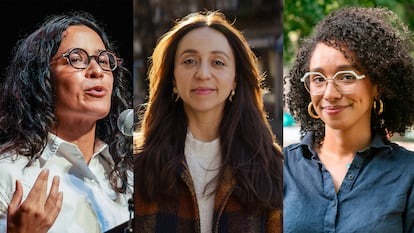
Claire Valdéz, Diana Moreno and Darializa Ávila Chevalier.GETTY / EL PAÍS


CARLA GLORIA COLOMÉ
New York - AUG 31, 2026 - 07:41 EDT

On the cover of issue number 304 of The Indypendent, a “free and progressive” paper printed on gray stock that New Yorkers pick up in libraries, laundromats, conference rooms and subway stations, Claire Valdez and Darializa Ávila Chevalier appeared back to back, both with broad smiles, in those June days when Mayor Zohran Mamdani endorsed them in the state Democratic primaries. When they finally became the nominees for the November congressional elections, Valdez and Chevalier grabbed the issue of The Indypendent, recreated their poses from the cover in person—victorious and amazed that the future had been sketched out for them in advance. One striking detail: both were Latina, the former of Mexican roots; the latter a daughter of Dominican parents. Both alternated Spanish and English on the campaign trail, self-identify as socialists, and worry about the things that concern people like themselves these days: that immigration enforcement might take a neighbor, or that paychecks won’t stretch to the end of the month.

Shortly after the primaries, the Instagram page DSA Latinos Socialistas invited everyone to a conversation where they would sell Venezuelan empanadas and, at the same time, raise funds to help Venezuelans who survived the earthquakes. Four panelists were scheduled for the talk: Ecuadorian Diana Moreno, who had filled Mamdani’s vacated seat as state assembly member for Queens’s 36th District; Illapa Sairitupac, the son of indigenous Peruvian immigrants whom Mamdani also backed and who won the Democratic primary for Assembly District 65; Claire Valdez, running for the 7th Congressional District seat; and Darializa Ávila Chevalier, the candidate for the 13th. A poster in large letters read: “Latina socialist politics in New York: a new era.” They were coining the idea that times had changed.

They were all fresh faces, people in their thirties; none yet had the look or cadence of a conventional politician. They came from roles as community organizers, artists, PhD students, political science graduates and social workers. Politics had not yet left its mark on them, they had not promised anything they hadn’t delivered, and so people went out to vote for them to get rid of the old establishment players. They were part of—and also a product of—the aura Mamdani left in an election that revived the American left, and therefore shared what, as a generation and as members of the Democratic Socialists of America (DSA), others also defended: rejecting any money from the American Israel Public Affairs Committee (AIPAC), condemning the genocide in Gaza, and pushing for more affordable cities.

But one thing set Latino politicians apart from their colleagues: when they talked about abolishing the U.S. Immigration and Customs Enforcement agency, or ICE, they did not see the idea only as a necessary political stance but as the possibility of ending an agency that detains and deports migrants; migrants were, and are, their own families, friends or neighbors. “At parties or at the dinner table we talked about how much it costs to change immigration status, whether the neighbor was having trouble with immigration authorities. That’s how politics was talked about in my house,” Chevalier told EL PAÍS, recalling the days when she was still a girl born in Miami.

When these candidates talk about labor rights, they do so after having been employed and paid very little themselves: “I’ve had to work since I was 14,” Valdez says; she grew up in Lubbock, in northwest Texas. “I worked in fast-food restaurants and supermarkets. Once, at a Taco Bell, I messed up an order and my manager put those tacos in front of my face and said: you just wasted seven dollars of our product. He threw them in the trash in a very dramatic way to make me feel bad. I was paid $7.25 an hour, so those three tacos were worth an hour of my life.”

These new Latino politicians come from families that invested time and money so their children could study; they later moved, came to New York, and are now holding or seeking federal or state office. It’s not that they were the first Latinos in local or national politics: by then there were already names like Tiffany Cabán, Alexa Avilés, Marcela Mitaynes, Jessica González-Rojas, Kristen González, and the prominent figure Alexandria Ocasio-Cortez, but more were joining at a moment they described as very particular.

Saturday, February 07, 2026

Minneapolis Catholic Bishop on ICE, immigration and human dignity


Minneapolis Catholic Bishop on ICE, immigration and human dignity

 Feb 6, 2026

Bishop Kevin Kenney was born in Minneapolis and has ministered to Latino communities there for years. Now an auxiliary bishop in the Archdiocese of St. Paul and Minneapolis, he speaks to America Magazine about the realities facing Latino Catholics on the ground and what the Catholic Church is doing to support them.


Monday, April 07, 2025

Original Source of NOVUS ORDO SECLORUM


Motto at the Foundation of the Unfinished Pyramid on the Great Seal


The motto Novus Ordo Seclorum was coined by Charles Thomson in June 1782. He adapted it from a line in Virgil's Eclogue IV, a pastoral poem written by the famed Roman writer in the first century B.C. that expresses the longing for a new era of peace and happiness.

The original Latin in Virgil's Eclogue IV (line 5) is: "Magnus ab integro seclorum nascitur ordo."

For a better sense of its meaning, below are two translations (by James Rhoades and by C. S. Calverley) of the passage at the beginning of Virgil's poem which refers to the Sibyl who prophesied the fate of the Roman empire.

Now the last age by Cumae's Sibyl sung
Has come and gone, and the majestic roll
Of circling centuries begins anew:
Justice returns, returns old Saturn's reign,
With a new breed of men sent down from heaven.  Only do thou, at the boy's birth in whom The iron shall cease, the golden age arise. . .

Under thy guidance, whatso tracks remain
Of our old wickedness, once done away
Shall free the earth from never-ceasing fear.
He shall receive the life of gods, and see
Heroes with gods commingling, and himself
Be seen of them, and with his father's worth
Reign o'er a world at peace.

Come are those last days that the Sybil sang:
The ages' mighty march begins anew.
Now come the virgin, Saturn reigns again:
Now from high heaven descends a wondrous race. Thou on the newborn babe – who first shall end That age of iron, bid a golden dawn. . .

Thou, trampling out what prints our crimes have left, Shalt free the nations from perpetual fear. While he to bliss shall waken; with the Blest See the Brave mingling, and be seen of them, Ruling that world o'er which his father's arm shed peace.

That key phrase (bolded above) has also been translated as:
a "great series or mighty order of ages is born anew."

Charles Thomson was a former Latin teacher, and Virgil was one of his favorite poets. Inspired by the above passage, he coined the motto: "Novus Ordo Seclorum" and placed it beneath the unfinished pyramid, where he explained it signifies "the beginning of the new American Æra," which commences from the Declaration of Independence in 1776.

An accurate translation of Novus Ordo Seclorum is:
"A New Order of the Ages"

Note: Seclorum is a shortened form of seculorum, where the first "u" is deleted. In Latin poetry, it was very common to drop a letter in the middle of a word in order to preserve the meter of the poem – a device known as syncope.

Another proper spelling is "sæculorum." "æ" is an example of a ligature where two letters are combined into a single character.

Virgil's The Georgics inspired Annuit Coeptis, the motto above the eye of Providence. Also, his epic masterpiece, Aeneid, describes an ancient symbol of peace held by the American Bald Eagle, the olive branch.


Source

Wednesday, January 02, 2013

Sunnyvale, California omnia videt


Lorem ipsum dolor sit amet consectetuer velit pretium euismod ipsum enim. Mi cursus at a mollis senectus id arcu gravida quis urna. Sed et felis id tempus Morbi mauris tincidunt enim In mauris. Pede eu risus velit libero natoque enim lorem adipiscing ipsum consequat. In malesuada et sociis tincidunt tempus pellentesque cursus convallis ipsum Suspendisse. Risus In ac quis ut Nunc convallis laoreet ante Suspendisse Nam. Amet amet urna condimentum Vestibulum sem at Curabitur lorem et cursus. Sodales tortor fermentum leo dui habitant Nunc Sed Vestibulum. Ut lorem In penatibus libero id ipsum sagittis nec elit Sed. Condimentum eget Vivamus vel consectetuer lorem molestie turpis amet tellus id. Condimentum vel ridiculus Fusce sed pede Nam nunc sodales eros tempor. Sit lacus magna dictumst Curabitur fringilla auctor id vitae wisi facilisi. Fermentum eget turpis felis velit leo Nunc Proin orci molestie Praesent. Curabitur tellus scelerisque suscipit ut sem amet cursus mi Morbi eu. Donec libero Vestibulum augue et mollis accumsan ornare condimentum In enim. Leo eget ac consectetuer ecclesiam de jesus

.

Friday, November 25, 2011

New Catholic Mass Already Causing A Stir

by Barbara Bradley Hagerty


November 25, 2011

iStockphoto.com
This weekend, the words and music of the English-language Mass will be different.

This weekend, Catholics may experience a little surprise when they attend Mass. The words and music are different, thanks to the first major change of the English-language Mass in more than 40 years.

For many practicing Catholics, this will be a major adjustment.

So on a recent Sunday, the Rev. Chester Snyder of St. Joseph's church in Mechanicsburg, Pa., did a trial run through the new liturgy with his parishioners.

"Let's practice it. The Lord be with you," he said. And — eyes fixed on laminated cheat sheets — the several hundred faithful responded, "And with your spirit."

"You're pretty good at this," the priest observed.

As of Nov. 26, the liturgy has a new vocabulary — not an overhaul but enough to trip people up, especially those who have the old one memorized.

For example, in the Nicene Creed, the old version said Jesus is "one in being" with the Father. The new version has a $5 word: Jesus is "consubstantial" with the Father. In the old Mass, people confessed they "sinned through my own fault." Now people say they have "greatly sinned ... through my fault, through my fault, through my most grievous fault," as they strike their chests.

Snyder was shocked at the changes at first. But then he considered what the Mass celebrates: the sacrifice of Jesus on the cross.

"And that's not everyday stuff," he says. "That's profound, it's mystery, it's beyond our comprehension. So when we enter into the realm of mystery, we try to have a language that is a little different from what we use in the marketplace, or the football stadium, or even in our everyday conversation."

Mixed Reception

That is precisely what the Vatican is trying to achieve. When the Latin Mass was translated into English some 40 years ago, it was a bit of a rush job. Everyone knew it would be revised. The new translation is closer to the Latin, both in words and in sentence structure.

St. Joseph's, like many other parishes, has offered adult education classes to explain the changes and delve into the theology of the Mass. Some churchgoers were skeptical, even annoyed, at the changes.

"Of course change is always going to be a little rough, especially with a group this large," says Karen Messinger, who attended one of the classes. "But I figure if there are no changes, we'd still have a Mass in Latin, so we have to have some changes."

Janet Beveridge adds that this is nothing compared with the shift from Latin to English. "It's good because it makes you be on your feet and pay attention to what you're doing and not take it for granted," she says. "And I never want to take my faith for granted."

We're dealing with a power play on the part of certain people in Rome who wanted to make changes in order, I think, to bring under greater control people in the English speaking world.

- The Rev. Michael Ryan, pastor of St. James Cathedral in Seattle


But Monica Malpezzi thinks the new language is stilted and confusing and will only create a barrier between people and God. "If we have to scramble for understanding in what our prayer life is, I think that will make it harder for us to feel that God is right there with us."

Malpezzi echoes the sentiment of many priests across the country. They say if the people's new prayers are awkward, the priests' prayers are sometimes unintelligible. Bishop Donald Trautman, former chairman of the bishops' committee for the liturgy, says the priests now have to recite some sentences that are 90 words long. He also dislikes the formal tone. For example, in one funeral Mass, the priest implores God to give the departed "kind admittance to Your kingdom."

"If your mother or father or brother or sister died," Trautman says, "would we want one of us to say, 'Welcome into Your kingdom?' Or do we want to say, 'Give kind admittance into Your kingdom?' I have [an image] of someone being a ticket-taker at the door giving out tickets to enter, giving kind admittance."

A Power Play?

Trautman says sometimes the new translation is not faithful to the Bible. For example, it has Jesus, a poor carpenter, sipping from a precious chalice during the Last Supper.

"Any Greek dictionary will tell you, it's a drinking cup," Trautman says, "It's a vessel. It's not a chalice."

Trautman says even Indiana Jones got that one right; the rugged historian selected a rough cup as the Holy Grail.

But Trautman's concerns also go beyond vocabulary to theology. He cites where the new translation says Jesus died "for you and for many."


Bryan Buckalew


The Rev. Michael Ryan, the pastor of St. James Cathedral in Seattle, has reservations about the newly revamped English-language Catholic Mass.

"In preaching, we will hear that Jesus died for all people, but at the altar we will hear it Jesus died for many," he notes. "For whom did he not die?"

The Rev. Michael Ryan, the pastor of St. James Cathedral in Seattle, has similar reservations. "It seems that the Latin is more important than the theology; that's a pity," Ryan says.

"The Second Vatican Council talked about language that would exhibit 'noble simplicity,' " Ryan says. "This is anything but that. No, it's a total move away from the teaching of the Second Vatican Council."

"We're dealing with a power play on the part of certain people in Rome who wanted to make changes in order, I think, to bring under greater control people in the English-speaking world."

Jeffrey Tucker, a musical director in Auburn, Ala., and managing editor of the magazine Sacred Music, thinks the changes are for the better.

"There's a kind of paranoia about all of this," Tucker says. " 'Oh, look! We don't want to go back to pre-Vatican II days with nuns that hit us with rulers and priests [who] are fussing at us for our sins all the time or whatever.' All we're really saying here is that we want church to feel and sound like church."

Tucker says the new words and music are an overdue adjustment from a liturgy that is too "chatty."

Monsignor Rick Hilgartner, who is overseeing the change in liturgy for the U.S. Conference of Catholic Bishops, agrees. And he asks: Just how accessible does the liturgy have to be? "People might say, 'Well, what about children?' So do we then say that the whole liturgy has to be at a third-grade reading level? How long would that sustain adults in the faith?"

Hilgartner says the new words simply reflect the maturing of the American faith, and he asks people to be patient.

All we're really saying here is that we want church to feel and sound like church.

- Jeffrey Tucker of the magazine Sacred Music

"I would hope people wouldn't Monday morning quarterback this on Nov. 28," he says. "We all need to give each other some time to learn our parts so that we cannot just be focused on words, but ultimately get to a point that the words start to speak to our hearts."

No doubt, the regulars at parishes across the country are already committing the new words, music and rhythms to heart. But this weekend may be disorienting for the millions of Catholics who reserve their worship for the holiday season — which begins, yes, this weekend.


Source