Showing posts with label COMECE. Show all posts

Tuesday, October 13, 2026

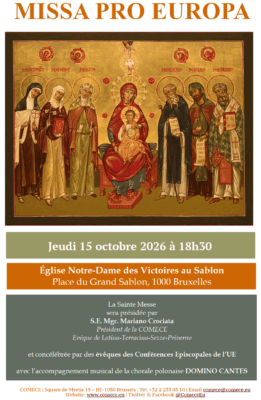
‘Mass for Europe’ to be celebrated in Brussels on 15 October

12 October 2026

Invitation


EVENT | ‘Mass for Europe’ to be celebrated in Brussels on 15 October


The public is warmly invited to join the bishops of the European Union for the Mass for Europe, to be celebrated on Thursday, 15 October 2026, at 18:30 at the Église Notre-Dame des Victoires au Sablon, Place du Grand Sablon, 1000 Brussels. The celebration is open to everyone and no registration is required. Download Poster

The Mass will take place in the context of the autumn 2026 Assembly of the Commission of the Bishops’ Conferences of the European Union (COMECE), to be held in Brussels from 14 to 16 October. The Assembly will bring together the bishops who compose COMECE and represent the episcopal conferences of the EU Member States.

The Mass will be presided over by H.E. Mgr Mariano Crociata, President of COMECE, and concelebrated by the bishops participating in the Assembly. Musical accompaniment will be provided by the Polish choir Domino Cantus.


Source

Tuesday, June 09, 2026

COMECE outlines a vision for Europe’s future against populism and wars


Pope Leo XIV meets with the Presidency of COMECE (@VATICAN MEDIA)
Church

Speaking at a press conference at Vatican Radio headquarters, the presidency of the Commission of the Bishops’ Conferences of the European Union (COMECE) reflected on their meeting with Pope Leo XIV on Thursday morning and on presenting him with a proposal for a new edition of “Rethinking Europe” for fall 2027.

By Davide Dionisi

“Today’s audience was particularly cordial, direct, and open regarding the issues discussed. The underlying note was a strong harmony between our work and what the Pope teaches and bears witness to through his magisterium, his positions, and his initiatives.”

These were the words of Bishop Mariano Crociata, the President of the Commission of the Bishops’ Conferences of the European Union (COMECE), during a press conference held in Sala Marconi of the Vatican Radio headquarters following the audience that the presidency of COMECE had with Pope Leo XIV this morning.

Weakening of the EU’s mission

“The European Union,” Bishop Crociata stated, “was born as a project of peace, and peace lies at its roots and in its identity. It is therefore called to foster dialogue among countries and international institutions, while at the same time promoting multilateralism, as the Pope explicitly recalled.”

At the same time, the President of COMECE noted that the EU’s mission, in a world marked by strong polarization, “is weakened by the lack of unity, also as a result of populism.”

Promoting values

For Bishop Crociata, “the words of the Gospel and the Church’s social teaching, applied to the issues that concern us today,” remain fundamental.

This, the COMECE President insisted, is the central point, and “on this we cannot retreat out of fear, convenience, or worse, because of possible political preferences. Our task goes beyond divisions, majorities, and minorities: it is to promote values at the service of humanity and of today’s Europe.”

Bishop Crociata also emphasized that the Bishops presented to the Pope the proposal to organize, in the autumn of 2027, a new edition of “Rethinking Europe.”
Tuesday, November 18, 2025

COMECE urges stronger action to tackle religious discrimination and protect freedom of religion in the EU

17 November 2025

Annual Article 17 TFEU EU-Churches meeting: COMECE urges stronger action to tackle religious discrimination and protect freedom of religion in the EU

COMECE participated in the Article 17 TFEU Annual High-Level Meeting between the European Commission and religious leaders on the theme “Living together in increasingly polarised societies” on Monday, 17 November 2024. During the meeting, COMECE Vice-President, Mgr Czeslaw Kozon, called for stronger institutional action, including “the appointment of an EU Coordinator on combating anti-Christian hatred and the urgent need for improved religious literacy”. Read the COMECE contribution | Photo Gallery

The meeting was hosted by Magnus Brunner, EU Commissioner for Home Affairs and Migration and the Commissioner responsible for the implementation of the Article 17 TFEU Dialogue. COMECE was represented by its Vice-President, Mgr Czeslaw Kozon, Bishop of Copenhagen.

Friday, November 07, 2025

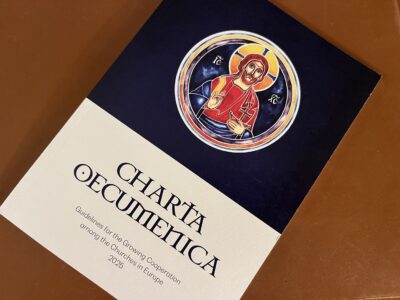
Updated Charta Œcumenica marks a milestone towards Christian unity in Europe


6 November 2025

News

🔴 DOCUMENT | Updated Charta Œcumenica marks a milestone towards Christian unity in Europe

With a historic step towards Christian unity, the Council of European Bishops’ Conferences (CCEE) and the Conference of European Churches (CEC) launched the Updated Charta Œcumenica on Wednesday 5 November 2025 in Rome. This joint document marks a milestone in the ecumenical journey of European Churches, renewing their commitment to walk together in dialogue, mutual understanding, and shared witness in response to the challenges of our time. On this historic day, COMECE was represented by its General Secretary, Fr. Manuel Barrios Prieto, who was a member of the joint CCEE-CEC committee. Today, Thursday 8 November, the CCEE-CEC group will meet in Vatican City with Pope Leo XIV. Download the updated Charta Œcumenica


H.E. Msgr. Gintaras GRUŠAS, Archbishop of Vilnius and President of CCEE (left) and H. Em. Archbishop NIKITAS of Thyateira and Great Britain, President of CEC (right). Rome, 5 November 2025. (Photo: CCEE-CEC)

The updated Charta was officially signed by H. Em. Archbishop NIKITAS of Thyateira and Great Britain, President of CEC, and H.E. Msgr. Gintaras GRUŠAS, Archbishop of Vilnius and President of CCEE. Together, they affirmed the renewed dedication to continue building bridges between churches in Europe.


"This Charta Œcumenica is a call to conscience and cooperation,” said Archbishop Nikitas. “Our commitment to one another as Churches is not abstract—it is grounded in shared faith, lived out amid pain, division, and hope. In a fragmented and secular Europe, the Charta urges us to rediscover the strength of our communion and the urgency of our mission. We must proclaim the Gospel together, uphold human dignity, and work side by side for justice, peace, and care for Creation. This is our ecumenical vocation—not just to speak of unity, but to live it.”

Saturday, July 12, 2025

Conference: ‘Religious Education – Fit for the Present and Future?’


Conference: ‘Religious Education – Fit for the Present and Future?’


Secretariat COMECE

Jun 16, 2025

The conference “Religious Education: Fit for Present and Future? The Role of Religion in the Formation of Young Generations at the European Schools” was held at the Chapel for Europe, Brussels, on Wednesday, 4 June 2025. Amid ongoing discussions on educational reform, this event aimed to spark dialogue on the role of Religious Education within the unique setting of the European Schools, underlining its significance for today’s youth. The event featured contribution from members of the entire educational community: learners, teachers, parents and experts. It was organised by COMECE, the religious authorities responsible for Religion at the European Schools and the Chapel for Europe.

Saturday, June 04, 2022

EU Military Bishops in Brussels discuss perspectives for peace


As part of its mission of dialogue with the EU institutions, COMECE gathered EU Military Bishops and experts of the Military Ordinariates on Wednesday 1 June 2022 to exchange on the current and emerging security challenges in Europe.


COMECE General Secretary, Fr. Barrios Prieto, together with Lt. Gen. Bart Laurent, Director of Operations, EU Military Staff. (Credit: COMECE)

Following the first meeting held in 2019, Military Ordinaries from EU Member States gathered at the COMECE Secretariat to meet with EU officials and national representatives to the EU Military Committee and discuss the challenges for the Common Security and Defence Policy.

In light of the current international context, they highlighted the EU’s specific role in promoting human security and peace. Fr. Manuel Barrios Prieto, General Secretary of COMECE, stated that “the Russian invasion of Ukraine did not only bring war to the country, but it has also questioned the entire security order in Europe and the world”.

“Inspired by Pope Francis’ Encyclical Letter ‘Fratelli tutti’ – Fr. Barrios Prieto continued – COMECE promotes the vision of a new architecture of peace based on a global ethic of solidarity and cooperation in the service of a future shaped by interdependence and shared responsibility in the whole human family”.

The EU and its Member States should engage responsibly and collaboratively on security in line with the principles of international law and ethical standards. These efforts, according to COMECE, should be embedded in an integral approach, especially in the context of the implementation of the recently adopted EU Strategic Compass.

“Since peace goes beyond security – stated the General Secretary of COMECE – a comprehensive European peace strategy should equally promote integral human development, justice and care of Creation”.

The meeting also identified ways in which Military Ordinariates can contribute to the peace-building process. Thanks to their specific mission, they remain in the field during all stages of a conflict cycle, accompanying the members of the armed forces, while being close to the needs of civilians, and fostering intercultural and interreligious ties.


Wednesday, March 02, 2022

Ash Wednesday and prayer for Peace for Ukraine


28 FEBRUARY 2022

INVITATION

Ash Wednesday and prayer for Peace for Ukraine


Following Pope Francis’s appeal “to everyone, believers and non-believers alike”, to make March 2 – Ash Wednesday – “a day of prayer and fasting for peace in Ukraine”, COMECE, CEC, the Finnish Seamen’s Mission and the Chapel for Europe invite you to join one Ash Wednesday celebration in solidarity with the people of Ukraine.

The event will take place at the Chapel for Europe, Rue Van Maerlantstraat 22-24, Brussels.

For more info, visit www.chapelforeurope.eu

Programme

13:15 (CET)
Catholic Eucharist with the rite of the imposition of ashes
Celebrant: Fr Krystian Sowa sj

18:00 (CET)
Ecumenical Liturgy with the rite of the imposition of ashes
Celebrants: Rev. Tuomas Meurman from the Finnish Seamen’s Mission (Lutheran Church) and Fr Krystian Sowa sj (Catholic Church)

Face mask is mandatory.


Sunday, July 05, 2020

"let’s work all together for a recovery that leaves no one behind"


LATEST PRESS RELEASES
Content:
Press Release, 04/06/2020

COMECE-CCEE Presidencies: "let’s work all together for a recovery that leaves no one behind"


The annual COMECE-CCEE Presidencies meeting was held on Wednesday, 3 June 2020 with a special focus on the impact of the Covid-19 pandemic on the day-to-day life in the Church and European societies, as well as on the Catholic Church's contribution to "a just recovery that leaves no-one behind".


At the centre of the debate was the situation of the Church in Europe, together with future prospects in the critical context of the pandemic caused by the SARS-CoV-19 virus.

The COMECE and CCEE Presidencies analysed the effects of the pandemic on our civil and ecclesial communities, and identified possibilities for cooperation for the future Church life in Europe.

Renewing the Catholic Church's closeness to all those struggling against the pandemic - the victims, their families and all health workers, volunteers and the faithful who have been and are in the front line, caring for those affected and bringing them relief - the prelates expressed their concern "about the economic crisis and the consequent loss of a large number of jobs", and the hope that in Europe "we will all work together for a recovery that leaves no one behind".

In this time of crisis, which showed the great limits of individualism, the two Presidencies stressed the central role played by the family, "the true cell of solidarity and sharing, but also a place to pray together. Investing in the family - they continued - is the first step towards a just social, economic and ecclesial recovery".

Thanking the many priests for their crucial and generous service during this period, some also sacrificing their own lives, the participants of the meeting analysed the role played by social media in prayer and streaming celebrations.

These new forms of religious practice, relationships, presence and sharing of faith invite us not only to evaluate the possibility of giving a new meaning to faith and the Church, but also to work to make many faithful rediscover the element of full sacramentality of religious celebrations in places of worship, which the use of new technologies cannot ensure.

The two Presidencies also dwelt on the strong limitation imposed on freedom of religion in the context of the closure of places of worship and the prohibition of liturgies, calling for the re-establishment of normal State-Church relations based on dialogue and respect for fundamental rights.

Because of the precautionary social-distancing measures, the meeting was held via video conference. The meeting was attended by Presidents Card. Jean-Claude Hollerich SJ (COMECE) and Card. Angelo Bagnasco (CCEE), by all the members of the two presidencies - the bishops Mariano Crociata (Latina), Noel Treanor (Down and Connor), Jan Vokal (Hradec Králové) and Franz-Josef Overbeck (Essen) for COMECE and Card. Vincent Nichols (Westminster) and Bishop Stanisław Gądecki (Poznan) for CCEE – and by the Apostolic Nuncio to the European Union, H.E. Mgr Alain Lebeaupin.


Sunday, February 16, 2020

Catholic NGOs and COMECE on human rights violations in a globalised economy


LATEST PRESS RELEASE

Webnews, 13/02/2020


In the follow up of the Future of Work Reflection, on 27-28 January 2020 COMECE hosted a 2-day capacity-building seminar gathering Catholic-inspired organisations to discuss possible ways to improve people’s working conditions in the global value chain.


The event comes after two years of work in which Catholic grassroot organisations and Christian social movements collected cases of human rights violations in the globalized economy.

Based on their experience, these organisations, active at the international and EU levels, contributed to the COMECE Reflection on the Future of Work, published in November 2018 and calling the EU “to play a constructive role in the ongoing negotiations for a binding UN treaty on business and human rights”.

During the meeting, COMECE and Catholic inspired organisations engaged in a dialogue with representatives of the EU Commission, of the International Labour Organisations (ILO) and of the International Trade Union Confederation (ITUC), highlighting the importance of promoting an international legal framework that protects workers, families and communities across the value chain in light of the challenges posed by the new forms of work on online platforms.

In the context of the ongoing review of the EU Action Plan on Human Rights and Democracy, the COMECE Assembly called the EU to take ambitious steps to ensure policy coherence between its trade, development, climate and human rights policies in line with the Sustainable Development Goals (DDGs). In particular they highlighted the importance of adopting binding and effective human rights legislation for EU-based transnational companies to ensure compliance of their actions throughout the entire supply chain with legal, social and environmental standards.

COMECE will continue supporting the initiatives of Catholic inspired NGOs, facilitating their exchange with the EU institutions.

Media

Photo Gallery


Saturday, August 24, 2019

Laudato Si‘: good practices of a spiritual and ecological conversion

LATEST PRESS RELEASES

Webnews, 20/08/2019


In Spring 2019 COMECE and its partners organised the Second European Laudato Si’ Reflection Day to sharpen the view on what is necessary and possible to do in order to facilitate the ecological conversion described in Pope Francis’ Encyclical Letter “Laudato Si’”.


The required conversion is key to maintain «our common home, the Earth», and goes beyond the «spiritual change», also including a change of our lifestyle which is often negatively connoted because it is seen as a «loss of the existing» and not as an «opportunity for something new».

In order to foster this transformation, the discussion held on the reflection day suggested less emphasis on safeguarding the existing wealth in our societies and presented initiatives and projects committing to make this necessary change a reality.

Archbishop Jean-Claude Hollerich SJ, President of COMECE, restated: «We need deep and lasting change towards sustainable lifestyles and bold policy choices that could support these efforts […] A simple "greening" of current economic and production conditions, the productivity gains of digitalization alone will not be enough to meet the challenge of a long- term sustainability policy».

Monday, April 15, 2019

Military Bishops in dialogue with the EU on human security


Webnews, 09/04/2019


Military Bishops in dialogue with the EU on human security


In the context of an increased attention to security concerns of European citizens, COMECE organised on Monday 8 April 2019 a first meeting between Military Bishops from across the European Union and EU military officials to enhance the cooperation towards a shared strategic culture across Europe.


This meeting allowed them to exchange on their respective military realities and on the EU’s response to current geopolitical and security challenges.

Witnessing a loss of trust in multilateral mechanisms and an expansion of conflict environments, accompanied by an omnipresence of digital technologies, Church representatives encourage the EU to strategically focus its policies on longstanding human security and sustainable peace.

In dialogue with General Claudio Graziano, Chairman of the EU Military Committee, EU Military Bishops highlighted the need for pursuing an integrated approach by better articulating military measures with civilian peace-building instruments promoting human, socio-economic and ecological development. As worldwide networks deeply rooted in local realities, religious actors can provide an important contribution in this regard.

The event included a visit to the EU Military Staff, where Bishops were received by Major General Giovanni Manione to exchange on EU military missions and operations.

In the Church’s understanding, security is essential because it protects human life and dignity. True security can only exist through sustainable peace. As stated in the COMECE reflection “Whose security? Whose defence?”, if not focusing on the security of persons, families and communities - including the respect for human rights and the rule of law - merely technical security measures may allow or even lead to a new conflict.


Media

Photos


Saturday, March 16, 2019

EC President Juncker in dialogue with EU Bishops

latest press releases
Press Release, 14/03/2019


2019 COMECE Spring Assembly

EC President Juncker in dialogue with EU Bishops

On the occasion of the 2019 COMECE Spring Assembly, EU Bishops received today, Thursday 14 March, Jean-Claude Juncker, President of the European Commission. Together they urged all citizens to engage into the European political debate and vote with responsibility to protect and promote the common good.


The dialogue with the President of the European Commission was an opportunity for Bishops to exchange on the main achievements and remaining priorities of Juncker’s Presidency.

In his contribution, President Juncker stated: "I am a fervent advocate of the social doctrine of the Church. It is one of the most noble teachings of our Church. All of this is part of a doctrine that Europe does not apply often enough. I would like us to rediscover the values and guiding principles of the social teaching of the Church".

European Bishops reaffirmed the Church’s commitment to address the challenges that our continent and our people have to face: digitalisation and technological development, demography, global warming and migration.

They highlighted the need to combine efforts of all people of good will to better serving the common good, placing the human person at the heart of EU public policies.

Days before a possible Brexit and two months ahead of the EU 2019 parliament elections, Bishops recalled EU citizens’ responsibility to exercise their right and fulfil their duty to vote, giving new impulse to the European construction. The electoral results will condition the political decisions impacting on our day to day lives during the next 5 years.

Bishops expressed the need to promote a European context of dialogue in order to discover opportunities behind challenges, proposing effective solutions for the wellbeing of all those living in the European Union.

The meeting between the EU Bishops and President Juncker is a concrete expression of the open, transparent and regular dialogue between EU institutions and Churches in accordance with Article 17 TFEU.


Media

Photo Gallery


Photo: © EU, Etienne Ansotte


Saturday, October 27, 2018

Church worldwide calls for ambitious and urgent climate action


Content: Press Release, 26/10/2018


In the context of a recent UN report on the urgent need to develop policies that limit global warming to 1.5 degrees, Mgr. Jean-Claude Hollerich SJ, President of COMECE, together with all the other presidents of continental Bishops’ Conferences, calls politicians to work towards an ambitious implementation of the Paris Agreement. They ask for COP24 to prove a milestone in the path set out in 2015 in Paris.


Promoting the messages carried out by the Encyclical Letter Laudato Si’, Church leaders from all around the world call for ambitious and immediate actions to be taken to tackle and overcome the devastating effects of the climate crisis.

In their statement, Bishops’ Conferences from all continents urge world leaders to resist the temptation to look for short-term solutions without addressing the root causes and the long-term consequences.

The call is based on the principles of urgency, intergenerational justice, human dignity and human rights, ands demands policies that include the following elements: 

  • keeping global warming below 1.5°C;
  • shifting towards sustainable lifestyles;
  • respecting the knowledge of indigenous communities;
  • implementing a financial paradigm shift in line with global climate accords;
  • transforming the energy sector by putting an end to the fossil fuel era and transitioning to renewable energy;
  • and rethinking the agriculture sector to ensure it provides healthy and accessible food for everyone, with a special emphasis on promoting agroecology. 


The appeal was presented today in Rome and signed by Mgr. Jean-Claude Hollerich (President, COMECE), Card. Angelo Cardinal Bagnasco (President of CCEE), Card. Oswald Gracias (President of FABC), Mgr. Peter Loy Chong (President of FCBCO), Mgr. Gabriel Mbilingi (President of SECAM), and Card. Rubén Salazar Gómez (President of CELAM).


Media

Statement

Photo Gallery


Monday, October 15, 2018

Migration, addressing its root causes while protecting migrants

RSS-Feed
LATEST PRESS RELEASES
Content:
Webnews, 09/10/2018


During the international conference on “Religious freedom and development cooperation to reduce the causes for migration” on 17 September 2018, COMECE stressed the primary right of every human person to live in dignity in his home country without being forced to move.


Participants debated the ways to address the root causes of migration through the European development cooperation, which, emphasised COMECE, “should neither be based on ideological approaches, nor instrumentalising peoples and countries but benefitting persons in all their aspects, including spiritual and moral welfare”.

COMECE also highlighted the importance of a greater access to education to enhance the human integral development of persons, families and peoples in their home countries.

Article 13.2 of the Universal Declaration of Human Rights recognises the right of everyone to leave any country, including his own. As stated by Pope Francis in his last message for the World Day of Migrants and Refugees, when people migrate, they should be welcomed, protected, promoted and integrated in a responsible manner, according to the hosting society’s capacity.

This message was conveyed by COMECE during the Seminar “Three years after the migration and security agendas - Where does the public sector stand?”, together with the principle that security should aim at protecting persons, families and communities including migrants and refugees.

COMECE also reaffirmed that the asylum legislation grants international protection in case of religious persecution as discussed in a recent joint COMECE-CEC meeting on religious conversion in asylum procedures. Migration current developments will be at the agenda of the next COMECE Working Group on Migration and Asylum next 22 November 2018.

Media

Photo Gallery

Photo: Reuters/Marko Djurica


Saturday, March 10, 2018

COMECE holds meeting at the Parliament on the role of common free time for social, religious and civic engagement

RSS-Feed


latest press releases

Content:

Webnews, 23/02/2018

COMECE holds meeting at the Parliament on the role of common free time for social, religious and civic engagement


COMECE, together with its partners of the European Sunday Alliance, organised at the European Parliament a panel debate on the role of common free time for social, religious and civic engagement and volunteering. The event, hosted by MEPs Evelyn Regner and Thomas Mann, highlighted the challenge of reconciling social commitment with increasingly flexibilised working schedules.


Participants exchanged ideas, experiences and statistics, shaping a dialogue on the effects of the changing world of work on European society, whose social, religious and civic engagement is declining due to lack of common free time and free Sundays. The issue of synchronized free time for all citizens in Europe is important at a personal level to ensure an adequate time of rest and for social, cultural or sports activities, but also at a spiritual level as a day of rest and religious edification.

As Pope Francis said, “Sunday is a holy day for Christians, sanctified by the Eucharistic celebration, the living presence of the Lord among us and for us. it is necessary to revive this awareness, to recover the meaning of the celebration, the meaning of the joy, of the parish community, of solidarity, of the rest which restores body and soul”.

During the event at the European Parliament, Agnieszka Piasna (European Trade Union Institute), showed that collective free time is closely related to well-being and civic engagement. “It helps EU citizens to spend more time in activities that promote personal growth and community involvement”, she said.

“Common free time is scarcer, but new digital ways of activism cannot replace ‘traditional’ ways for social and civic engagement - said Chris Droogenbroeck (LBC-NVK), who also acknowledged the decline of engagement in the trade union sector due to more flexible working schedules and increased pressure while at work. The results of the recent survey among ESA members on Sunday rest and overtime hours have shown a similar picture.

The panel debate was the 6th meeting of the Interest Group on Work-life Balance, launched in 2015 by the European Sunday Alliance in order to raise awareness of the need of EU actions aimed at a better articulation of private, family and work life.


Media
See the photos of the event
Outcome report on the ESA questionnaire on work-life balance and Sunday rest


Saturday, February 10, 2018

COMECE Conference on "Promoting the Christian Heritage of Europe"


Alessandro Di Maio

Communications Officer

E-mail Contact - Tel. +32 (0) 2 235 05 15


latest press releases

Content:

Press Release, 01/02/2018

COMECE organised a conference on 31 of January in Brussels on the theme of “Promoting the Christian Heritage of Europe” as a contribution to the European Year of Cultural Heritage 2018.


“The Church has a spiritual dimension but it is also a key actor in developing culture – said Fr. Poquillon op, COMECE General Secretary. It is the oldest structure still existing in Europe based on a faith expressing itself in different ways. It is a clear example of unity in diversity, like the EU wishes to be, and exactly like all of you arrived here from every corner of Europe in order to reflect about EU’s cultural diversities”.

He particularly referred to Pope Francis addressing the participants of the (Re)Thinking Europe Dialogue in Rome last October, when he diagnosed that “Europe has a kind of memory deficit” and that “to become once more a solidary community means rediscovering the value of our own past, in order to enrich the present and to pass on a future of hope to future generations.”

In his address, H.E. Mons Paul Tighe, Secretary of the Pontifical Council for Culture, exposed the challenges of developing culture in a context of religious illiteracy, highlighting the risk to lose keys of interpretation of our own culture. He praised the European Year as an opportunity for encounter and invited Catholic bishops in Europe to promote it as a tool for Evangelisation.

Monday, January 22, 2018

World Day of Peace: Migration as an opportunity to build peace

latest press releases


Content:


Webnews, 01/01/2018


In his Message for the World Day of Peace, Pope Francis encouraged to offer «refugees, migrants and victims of human trafficking an opportunity to find the peace they seek».


The Holy Father also underlined that political leaders should «by practising the virtue of prudence, […] take practical measures to welcome, promote, protect and integrate» men and women, children, young and elderly people searching for peace.

According to Pope Francis, this spirit should guide the process leading to the adoption of the two UN Global Compacts for Migration and Refugees in the coming year. The twenty action points recently published by the Migrants & Refugees Section of the Dicastery for Promoting Integral Human Development provide some concrete recommendations in this regard.

While deploring the spread of rhetoric undermining the human dignity of migrants and refugees, Pope Francis highlighted their enriching contributions to host societies by bringing «their courage, skills, energy and aspirations, as well as the treasures of their own cultures».

COMECE supports the protection of persons in mobility, either migrants or refugees, at all stages of their journey, the fight against trafficking in human beings and tackling the root causes of forced migration.

Recently, COMECE, together with other Christian organisations, contributed to the European Commission’s public consultation on legal migration of non-EU citizens.


Saturday, December 16, 2017

Pope Francis in dialogue with Europe

#210 - December 2017


Content:

Pope Francis in dialogue with Europe


For Pope Francis the future of Europe is of crucial importance.
For the fifth time, he delivered a speech on the topic of the continent where his family’s roots lie.


The high point of the “Rethinking Europe” dialogue in Rome was the eagerly anticipated closing address by Pope Francis. With sober realism he took as a starting point the plurality of cultures and religions in Europe, observing that “for many people Christianity is regarded as a thing of the past, both alien and irrelevant”. The audience sat up and took notice when he criticised secularist prejudice that “is incapable of seeing the positive value of religion’s public and objective role in society, preferring to relegate it to the realm of the merely private and sentimental”.

Focus on people

Although he may make fewer references than his predecessors to Europe’s Christian roots, Pope Francis is in no doubt that the countries of Europe have, over centuries, been shaped by the Christian faith. As already stated in his speech on accepting the Charlemagne Prize, he believes that the most important contribution made by Christians to today’s Europe is to ensure that the focus is on people. He clearly stated how today’s issues are so often reduced to discussions revolving around statistics – “There are no citizens, only votes. There are no migrants, only quotas. There are no workers, only economic markers. There are no poor, only thresholds of poverty. The concrete reality of the human person is thus reduced to an abstract principle, thereby rendering it more comfortable and reassuring.”

By contrast he valued giving people their human face, people who commit to responsibility that is genuine, personal and effective. There is an interesting resonance here to the opening address by Frans Timmermans, European Commission first vice-president. Timmermans pointed to one of the specific aspects of Christianity: the ability of a Christian to see the world through the eyes of others, “even if it is an African refugee drifting in a boat on the Mediterranean.”

Rediscovering a sense of community

The Pope declared that the second contribution made by Christians to the future of Europe “is to help recover the sense of belonging to a community”. He drew attention to this word “community” as the very word used by the founding fathers of the European project. A sense of community is the greatest antidote to the spread of individualism which leads to an uprooted society that lacks any sense of belonging or heritage.