Showing posts with label ORTHODOX. Show all posts
Showing posts with label ORTHODOX. Show all posts
Wednesday, October 14, 2026


Friday, September 11, 2026
Zohran Mamdani speaks at a 9/11 memorial service
Audio volume is extremely low.
Fox Business Streamed live New York City
P.S.
St. Nicholas Greek Orthodox Church
130 Liberty Street,
Manhattan, New York City, New York
Zohran Mamdani speaks at a 9/11 memorial service
Fox Business Streamed live New York City
Mayor Zohran Mamdani delivers remarks at St. Nicholas Greek Orthodox Church; National Shrine’s Interfaith 9/11 Memorial Service. (Credit: St. Nicholas Greek Orthodox Church).
-----
St. Nicholas Greek Orthodox Church
130 Liberty Street,
Manhattan, New York City, New York
Saturday, August 29, 2026
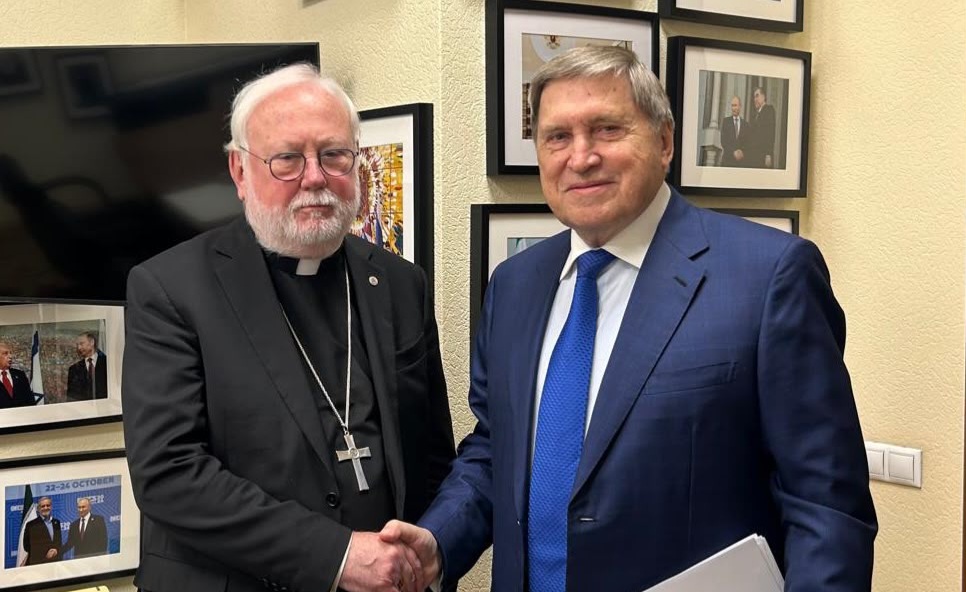
Gallagher meets with Putin's advisor and strengthens his contacts with the Moscow Patriarchate
by INFOVATICANA | August 27, 2026
The representative of the Holy See discussed with Yuri Ushakov “current issues on the international agenda” and visited the Cathedral of Christ the Savior, where he prayed before the icon of Our Lady of Vladimir. This Thursday, the visit focuses on the Catholic community in Russia.
The visit of Mons. Paul Richard Gallagher to Russia has included in recent hours a meeting with Yuri Ushakov, advisor to Vladimir Putin on foreign policy, and a visit to the Cathedral of Christ the Savior in Moscow, the main church of the Russian Orthodox Church.
The Secretariat of State confirmed this Thursday Gallagher’s meeting with Ushakov, scheduled for Wednesday the 26th, and reported that both addressed “current issues on the international agenda”. No further details on the content of the conversation have been provided so far.
The meeting with one of Putin’s top advisors represents the closest contact to the Kremlin within Gallagher’s agenda during his stay in the Russian capital.
It took place after the meeting that the head of Vatican diplomacy held on Tuesday with the Russian Minister of Foreign Affairs, Sergey Lavrov.
Read also: Gallagher to Lavrov in Moscow: “This war must end”
Gallagher visits the Cathedral of Christ the Savior
The agenda also included a new approach to the Patriarchate of Moscow, following the meeting Gallagher previously held with Metropolitan Anthony of Volokolamsk, head of external relations for the Russian Orthodox Church.
Gallagher visited the Cathedral of Christ the Savior in Moscow, seat of Patriarch Kirill, accompanied by the Apostolic Nuncio to Russia, Mons. Giovanni d’Aniello.
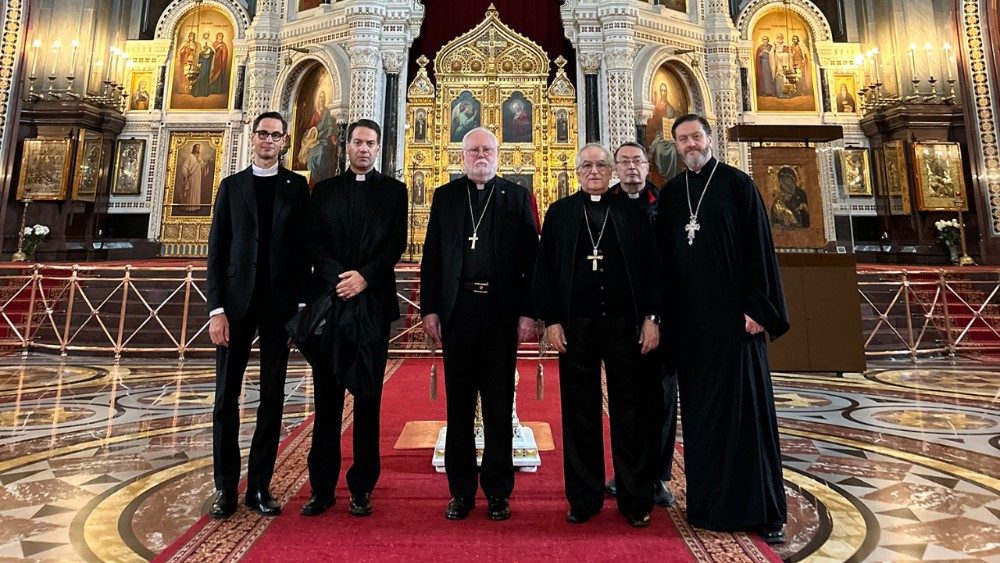
The representative of the Holy See was received by Archpriest Igor Yakimchuk, Vice-Chairman of the Department for External Church Relations of the Patriarchate of Moscow.
During a visit lasting more than an hour, Gallagher toured the church and stopped to pray before the icon of Our Lady of Vladimir, one of the Marian images most venerated by Russian Orthodox faithful.
The visit to the cathedral continued the contacts maintained in recent days between the Vatican delegation and the Patriarchate of Moscow.
This Thursday, the agenda focuses on the Catholic community
After the meetings with Russian authorities and contacts with the Patriarchate, Gallagher is dedicating this Thursday, August 27, the final part of his agenda in Moscow to the Catholic community.
The program includes a meeting with priests, religious brothers and sisters, and the celebration of Mass at the Cathedral of the Immaculate Conception of the Blessed Virgin Mary in Moscow.
Afterwards, the Secretary for Relations with States and International Organizations is scheduled to meet with the Catholic bishops of Russia.
Gallagher’s visit, the first he has made to Russia since 2021, will conclude this Friday, August 28 with his return to Rome.
Saturday, November 29, 2025
Saturday, November 15, 2025
Pope Leo's first papal trip signals desire to bridge Catholic-Orthodox divides
ISTANBUL (RNS) — An upcoming visit between two of Christianity's most prominent figures is a welcome sign that reflects what's already happening in many churches in Turkey.

David I. Klein
November 14, 2025
ISTANBUL (RNS) — Pope Leo XIV is set to touch down in Istanbul at the end of November before visiting Lebanon for his first international trip since his papal election in May. The pontiff will visit eight cities from Nov. 27 to Dec. 2, sitting down with both political and faith leaders and leading Masses for Catholic locals and pilgrims.
Though Leo will first meet with Turkish President Recep Tayyip Erdoğan and various religious leaders, one of the most significant aspects of his visit will be joint ceremonies with Bartholomew I, ecumenical patriarch of Constantinople and one of Eastern Orthodox Christianity’s chief spiritual leaders.
The two together are slated to visit the Turkish city of İznik, once Greek-speaking Nicaea that 1,700 years ago played host to the first ecumenical council. There, early church fathers determined some of Christianity’s most basic doctrines, such as setting the date of Easter, explaining the trinity and clarifying the divinity of Jesus. It was agreed that Jesus was “God from God, light from light, true God from true God, begotten not made, of one s ubstance with the Father,” as reads the Nicene Creed, which many churches hold to be the fundamental declaration of Christian faith.
The anniversary of Nicaea isn’t just a historical moment. It’s a symbol around which ecumenically minded leaders in both Orthodox and Catholic churches have continued to work on bridging the centuries-old divisions between the churches.
RELATED: On anniversary of the first Council of Nicaea, Christian leaders seek to return to ecumenism
The pope and patriarch standing together at Nicaea has been in the works for some time. Luca Refatti, an Istanbul-based Catholic priest, told RNS the trip was planned by Pope Francis but delayed by his sickness and canceled by his death earlier this year. That it was chosen for Pope Leo’s first apostolic international trip is a signal he will follow in Francis’ footsteps in bridging relations with other churches, Refatti said.
“To celebrate this moment is important because it is reminding us of our unity,” said Refatti, who stressed that the First Council of Nicaea — which occurred only a few years after Christianity was legalized in the Roman Empire — predates divisions of most modern churches. “Nicaea is important because it is basically the symbol, the creed, where every Christian is united. Now, Orthodox, Catholics, Syriacs, Armenians, everybody recognizes and accepts the creed of Nicaea.”
French pilgrims look at archaeological excavations of the ancient Byzantine-era Christian Saint Neophytos Basilica, in İznik, also known by its ancient name Nicaea, northwestern Turkey, Thursday, Nov. 13, 2025, ahead of the visit of Pope Leo XIV to mark the 1,700th anniversary of the First Council of Nicaea. (AP Photo/Francisco Seco)
David I. Klein
November 14, 2025
ISTANBUL (RNS) — Pope Leo XIV is set to touch down in Istanbul at the end of November before visiting Lebanon for his first international trip since his papal election in May. The pontiff will visit eight cities from Nov. 27 to Dec. 2, sitting down with both political and faith leaders and leading Masses for Catholic locals and pilgrims.
Though Leo will first meet with Turkish President Recep Tayyip Erdoğan and various religious leaders, one of the most significant aspects of his visit will be joint ceremonies with Bartholomew I, ecumenical patriarch of Constantinople and one of Eastern Orthodox Christianity’s chief spiritual leaders.
The two together are slated to visit the Turkish city of İznik, once Greek-speaking Nicaea that 1,700 years ago played host to the first ecumenical council. There, early church fathers determined some of Christianity’s most basic doctrines, such as setting the date of Easter, explaining the trinity and clarifying the divinity of Jesus. It was agreed that Jesus was “God from God, light from light, true God from true God, begotten not made, of one s ubstance with the Father,” as reads the Nicene Creed, which many churches hold to be the fundamental declaration of Christian faith.
The anniversary of Nicaea isn’t just a historical moment. It’s a symbol around which ecumenically minded leaders in both Orthodox and Catholic churches have continued to work on bridging the centuries-old divisions between the churches.
RELATED: On anniversary of the first Council of Nicaea, Christian leaders seek to return to ecumenism
The pope and patriarch standing together at Nicaea has been in the works for some time. Luca Refatti, an Istanbul-based Catholic priest, told RNS the trip was planned by Pope Francis but delayed by his sickness and canceled by his death earlier this year. That it was chosen for Pope Leo’s first apostolic international trip is a signal he will follow in Francis’ footsteps in bridging relations with other churches, Refatti said.
“To celebrate this moment is important because it is reminding us of our unity,” said Refatti, who stressed that the First Council of Nicaea — which occurred only a few years after Christianity was legalized in the Roman Empire — predates divisions of most modern churches. “Nicaea is important because it is basically the symbol, the creed, where every Christian is united. Now, Orthodox, Catholics, Syriacs, Armenians, everybody recognizes and accepts the creed of Nicaea.”
Friday, November 07, 2025
Updated Charta Œcumenica marks a milestone towards Christian unity in Europe
6 November 2025
🔴 DOCUMENT | Updated Charta Œcumenica marks a milestone towards Christian unity in Europe
With a historic step towards Christian unity, the Council of European Bishops’ Conferences (CCEE) and the Conference of European Churches (CEC) launched the Updated Charta Œcumenica on Wednesday 5 November 2025 in Rome. This joint document marks a milestone in the ecumenical journey of European Churches, renewing their commitment to walk together in dialogue, mutual understanding, and shared witness in response to the challenges of our time. On this historic day, COMECE was represented by its General Secretary, Fr. Manuel Barrios Prieto, who was a member of the joint CCEE-CEC committee. Today, Thursday 8 November, the CCEE-CEC group will meet in Vatican City with Pope Leo XIV. Download the updated Charta Œcumenica

H.E. Msgr. Gintaras GRUŠAS, Archbishop of Vilnius and President of CCEE (left) and H. Em. Archbishop NIKITAS of Thyateira and Great Britain, President of CEC (right). Rome, 5 November 2025. (Photo: CCEE-CEC)
The updated Charta was officially signed by H. Em. Archbishop NIKITAS of Thyateira and Great Britain, President of CEC, and H.E. Msgr. Gintaras GRUŠAS, Archbishop of Vilnius and President of CCEE. Together, they affirmed the renewed dedication to continue building bridges between churches in Europe.
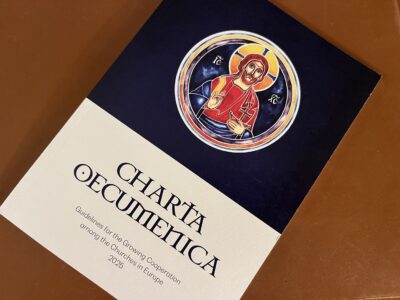
"This Charta Œcumenica is a call to conscience and cooperation,” said Archbishop Nikitas. “Our commitment to one another as Churches is not abstract—it is grounded in shared faith, lived out amid pain, division, and hope. In a fragmented and secular Europe, the Charta urges us to rediscover the strength of our communion and the urgency of our mission. We must proclaim the Gospel together, uphold human dignity, and work side by side for justice, peace, and care for Creation. This is our ecumenical vocation—not just to speak of unity, but to live it.”
Sunday, May 18, 2025
Temptation and The Spirit of The Grand Inquisitor
What Can Dostoevsky Teach Us About Catholicism?

Jul 19, 2024
Thank you to those who subscribed in the past couple of weeks. I am so grateful! As I am balancing my marriage, day job, and the needs of a young infant, these essays will never be as long as I might wish. I appreciate the chance to discuss great books with all of you.
In my previous post, I discussed Dostoevsky’s perceptions of Catholicism in the context of his novel The Brothers Karamazov, and specifically The Grand Inquisitor, a story-within-a-story and a chapter in that book.
Thanks for reading Dostoevsky's Grand Inquisitor! Subscribe for free to receive new posts and support my work.
Subscribe
As I noted, Dostoevsky suggests that the Catholic Church and its leaders embrace the Devil instead of Christ, promising material security and rules that create moral certainty instead of accepting God’s gift of free will (and its derivatives, freedom of conscience and moral responsibility) . Dostoevsky reserves particular contempt for Jesuits1, a Catholic religious order of priests, who even Alyosha, the kindest and wisest of the three Karamazov brothers, despises.
Some might say that Dostoevsky’s critique sounds Protestant in nature, but Dostoevsky rejected Protestantism, too—he viewed it as fundamentally void and believed it would eventually collapse.2
Dostoevsky’s religious views are rooted in Russian Orthodoxy—and very emphatically Russian Orthodoxy, not Orthodoxy in general. I will discuss Dostoevsky’s Russian Orthodoxy at length in a moment, but first I want to address Dostoevsky’s view of Catholicism in more detail.
Dostoevsky’s view of Catholicism was shaped by the time he spent in a Siberian labor camp as a young man. There, Dostoevsky “observed the machinations of Polish prisoners, many of whom were revolutionaries hoping to throw off the Russian yoke.”3 Dostoevsky was also disturbed by intra-Catholic loyalty, especially the Polish loyalty to the Jesuits.4
Later, Dostoevsky came to view France as the paradigm of Catholicism—and the best example of its inherent errors. As he argued in his essay “Three Ideas”:
“Catholicism has sought but failed to organize society in the name of Christ; that same France with her revolutionists of the Convention, with her atheists, with her socialists and with her present-day communards,—is, continues to be, in the highest degree, fully and altogether, a Catholic nation, completely contaminated with the spirit and letter of Catholicism.”5
Dostoevsky believed that socialism and Catholicism shared the same core ideas, those expressed by the Grand Inquisitor. To Dostoevsky, both socialism and Catholicism seek to liberate men from the “burden” of their free will and its attendant responsibility, which requires individuals to make the difficult choice to choose God’s will on a daily basis. As John Moran argues,
“At its core, socialism promises a society that allows for the blossoming of human happiness. Once the material conditions of man’s existence are corrected through the elimination of private property, man can be expected to attain his highest state of happiness.”6
Monday, August 26, 2024
Saturday, August 12, 2023
Tuesday, January 08, 2019
Smartphone users warned to be careful of the Antichrist
By Anastasia Clark and Chris Bell
BBC Monitoring and BBC News
BBC Monitoring and BBC News
08 January 2019
GETTY IMAGES
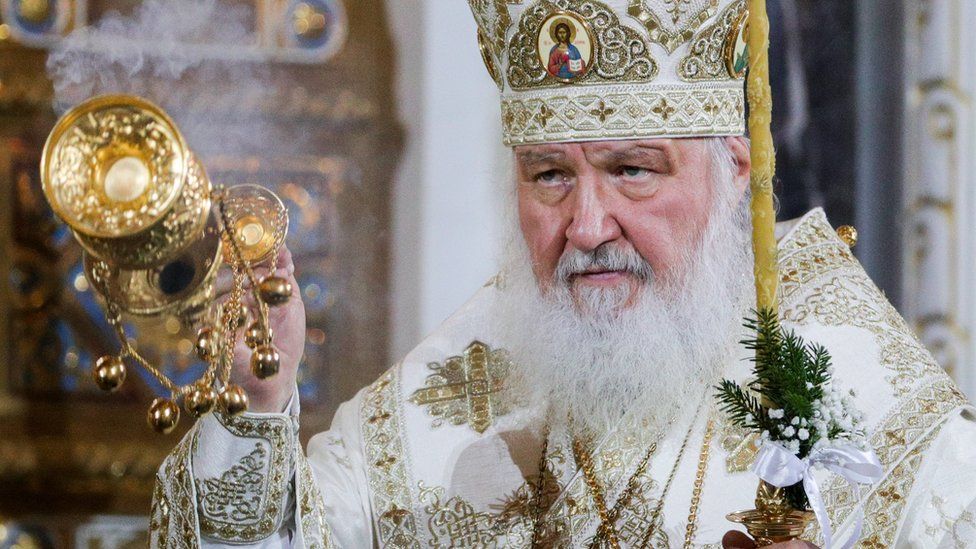
Patriarch Kirill conducting a Christmas liturgy
People's dependence on smartphones and modern technology could bring about the coming of the Antichrist, the leader of the Russian Orthodox Church has warned.
Russian social media users largely responded with humour and scepticism, while some accused the Church of "serving the regime" .
Speaking to Russian state TV, Patriarch Kirill said smartphone users should be careful when using the "worldwide web of gadgets" because it represented "an opportunity to gain global control over mankind".
"The Antichrist is the person who will be at the head of the worldwide web, controlling all of humankind," he said.
"Every time you use your gadget, whether you like it or not, whether you turn on your location or not, somebody can find out exactly where you are, exactly what your interests are and exactly what you are scared of," Patriarch Kirill told Rossiya 1.
"If not today, then tomorrow methods and technology could appear that will not just provide access to all information but will also allow the use of this information.
"Do you imagine what power will be concentrated in the hands of those who gain knowledge about what is going on in the world?
"Such control from one place forebodes the coming of the Antichrist."
Friday, December 14, 2018
Russian Orthodox church calls on Pope Francis, UN for help in Ukraine
Nataliya Vasilyeva
Dec 14, 2018
ASSOCIATED PRESS

In this file photo from Nov. 4, 2018, Russian President Vladimir Putin and Russian Orthodox Church Patriarch Kirill, left, walk to lay flowers at the monument of Minin and Pozharsky at Red Square in Moscow, during National Unity Day. The Russian Church said on Friday, Dec. 14, 2018, that Patriarch Kirill has sent a letter to the U.N. secretary-general, German Chancellor Angela Merkel, French President Emmanuel Macron, Pope Francis, the Archbishop of Canterbury and other spiritual leaders, urging them to help protect the clerics, believers and their faith in Ukraine. (Credit: Alexander Nemenov/Pool Photo via AP.)
MOSCOW, Russia - The Russian Orthodox church on Friday called on Pope Francis, the United Nations, the leaders of Germany and France, and other spiritual leaders to protect believers in Ukraine in the face of pressure on Moscow-affiliated clerics.
Ukraine’s Orthodox clerics will gather for a meeting Saturday that is expected to form a new, independent Ukrainian church, and Ukrainian authorities have ramped up pressure on priests to support the move. The Ukrainian church has been part of the Russian church for centuries, while enjoying broad autonomy, but Ukrainian President Petro Poroshenko has pushed for the creation of an independent church.
The newly formed community would then be expected to receive independence from the Ecumenical Patriarchate of Constantinople, the Istanbul-based institution considered the so-called “first among equals” of leaders of the world’s Orthodox Churches that has already drafted a charter for an independent Ukrainian church.
The Russian church said on Friday that its Patriarch Kirill has sent a letter to Francis, the U.N. secretary-general, German Chancellor Angela Merkel, French President Emmanuel Macron, the Archbishop of Canterbury and other spiritual leaders, urging them to help protect the clerics, believers and their faith in Ukraine.
Merkel’s spokeswoman and the German foreign ministry spokesman said they didn’t immediately have any information on the letter.
As church tensions have grown, Ukraine’s Security Service has searched Russian Orthodox churches and the homes of Russian Orthodox priests in several cities. The agency also has summoned dozens of priests for questioning.
Ukrainian authorities have sought to portray Russian Orthodox priests in Ukraine as supporting Russian-backed separatists in eastern Ukraine, claims that the clerics have rejected.
Kirill’s letter accused the Ukrainian government of hate speech and pressuring the clerics to take part in the Saturday gathering.
“The numerous instances of discrimination against the Ukrainian church (of the Moscow Patriarchate) give us the reason to fear far worse infringements of the rights and legitimate interests of Orthodox believers,” the letter said.
In Kiev, about 100 people led by a Moscow-affiliated cleric were holding prayers near the Ukrainian parliament Friday morning to protest the creation of a new church.
Some voiced fears that authorities will seize churches from the communities under the Moscow patriarchate and give them to the new church.
Geir Moulson in Berlin contributed to this report.
Sunday, May 27, 2018
Pope, patriarch call for ethical intervention in economy

Pope Francis embraces Ecumenical Patriarch Bartholomew of Constantinople at the conclusion of a meeting in the Apostolic Palace at the Vatican May 26. (Credit: CNS photo/Paul Haring.)
VATICAN CITY - Pope Francis and Ecumenical Patriarch Bartholomew of Constantinople called on Christians to work together to build a culture of solidarity in the face of growing economic inequality and a lack of respect for the human dignity of the poor and of migrants.
The two leaders met privately May 26 before addressing an international conference sponsored by the Centesimus Annus Pro Pontifice Foundation, which seeks to promote the teaching of St. John Paul II’s 1991 encyclical on social and economic justice.
“The current difficulties and crises within the global economic system have an undeniable ethical dimension,” Francis told some 500 business leaders, theologians and proponents of Catholic social teaching.
The crises clearly “are related to a mentality of egoism and exclusion that has effectively created a culture of waste blind to the human dignity of the most vulnerable,” the pope said.
A “growing ‘globalization of indifference'” is seen in the uneven pace of development, “not only in materially poorer countries but increasingly amid the opulence of the developed world,” he said. It also is obvious in people’s reactions to migrants and refugees.
In his speech to the gathering, Bartholomew insisted that Christianity is “essentially social. Faith is not limited only to the ‘soul’ without any interest for the social dimension, but rather, it also plays a pivotal role at the level of society.”
The Orthodox and Catholic churches, he said, promote spiritual values and charitable activity, but they also teach “the principles of the respect of the person, solidarity, subsidiarity and the common good.”
But, he said, the world today - as seen in the global economic system and the continued destruction of the environment - is experiencing a “crisis of solidarity” that threatens humanity’s very existence.
Bartholomew condemned what he described as the “‘fundamentalism of the market,’ the deification of profit, the association of dignity with property, the reduction of the human being to ‘homo oeconomicus’ and the subordination of the human person to the tyranny of needs.”
In addition, he said, “we worship technology and its highest symbol - the computer - as our god,” thinking that it will solve all of people’s problems. But the world’s deepest problems cannot be fixed with technology alone, he said, citing “social injustice, divorces, violence, crimes, loneliness, fanaticism and the clash of civilizations.”
“Never before have we possessed so much scientific knowledge and acted so violently and destructively against nature and our fellow human beings,” Bartholomew said.
For Christians, he said, two things are clear: the “crisis of solidarity” cannot be ignored because the problems directly impact human dignity; and, “nobody can face these problems alone.”
“The contribution of our churches remains crucial,” he said, because “they have preserved high values, precious spiritual and moral heritage and deep anthropological knowledge.”
“For Pope Francis and us, the identity and value of a culture or a society cannot be judged by the level of its economic growth, its technological development or its organization,” he said. “A civilization is judged by whether or not its final point of reference is the human person, in relation to his true divine destiny and the protection of his world.”
Saturday, October 08, 2016
Thursday, February 11, 2016
Russian patriarch in Cuba before pope meeting

By Carlos Batista
1 hour ago

.
View gallery
.
View gallery

.

.
Havana (AFP) - Russian Orthodox Patriarch Kirill arrived on Thursday in Cuba, where he will sit down with Pope Francis in the first meeting of its kind since the historic 11th-century church schism.
Related Stories
Pope and Patriarch to bridge 1,000-year split in Cuba AFP
Historic step: Pope, Russia patriarch meet in Cuba Feb. 12 Associated Press
Pope To Hold Historic Meeting With Russian Orthodox Church LeaderHuffington Post
[$] Pope Francis Plans Historic Meeting With Russian Orthodox Leader in CubaThe Wall Street Journal
Pope, Russian Orthodox leader bridge schism to fight Christian persecutionChristian Science Monitor
3 ways to get the freshest home on the block. Febreze Sponsored
The 69-year-old Kirill, in black robes and white headdress, was greeted by Cuba's communist President Raul Castro at Havana airport, where the Russian church leader was due to meet with Francis on Friday.
That meeting, set for Friday afternoon, will be the first of its kind since Christianity split into Western and Eastern branches in 1054.
It is Kirill's fourth visit to Russia's Cold War Latin American ally Cuba, but his first as patriarch, overall head of the powerful Russian Orthodox church.
"I am visiting Cuba for the fourth time with very warm feelings. I have come here on a visit of friendship," the white-bearded patriarch said in a short speech after arriving on a Russian government plane.
"The Russian and Cuban people are united by many years of collaboration, cooperation and friendship," he added.
"I wish the Cuban people well."
Francis makes a short stopover in Havana on Friday on his way to Mexico for an official visit.

Pope Francis on February 10, 2016 at the Vatican (AFP Photo/Alberto Pizzoli)
Kirill's 11-day trip will also take him to Paraguay and Brazil.
"This will be a long and difficult journey," the patriarch said in Moscow before leaving. "It requires spiritual and physical strength."
- Historic Orthodox-Catholic meeting -
The Russian church said their meeting would focus on the persecution of Christians around the world and that a joint declaration would be issued.
"This historic meeting clearly marks a new stage in our relations," the Orthodox Church's spokesman Alexander Volkov said Tuesday.
He said it was not political and could open "new prospects" for cooperation between the two branches of the church.
A meeting between the two religious leaders has been on the cards for some time, with Francis saying in 2014 he was willing to meet Kirill "wherever you want. You call me and I'll come."

Cuban president Raul Castro (L) welcomes Patriarch Kirill (C), upon his arrival at Jose Marti Intern …
Relations between the two churches have been frosty for centuries because of the legacy of the Great Schism of 1054 and the recriminations and mutual excommunications that followed.
The Orthodox Church's refusal to accept the primacy of the Roman pontiff has long been the primary barrier to a rapprochement. But more recently, relations have been strained by the fallout from the conflict in Ukraine.
A close ally of President Vladimir Putin, the patriarch has fervently backed Moscow's military action abroad.
The patriarch denounced the "anti-Russian" policies of the Ukrainian Greek Catholic Church, an Eastern rite church that recognizes the pope and is a source of friction between Moscow and the Vatican.
- Meeting Fidel Castro -
Kirill was due to meet on Friday morning with Cuba's atheist president before the pope's arrival in the afternoon.
On Sunday, Kirill will hold a mass in the Our Lady of Kazan Orthodox cathedral, which he consecrated in 2008.
He was expected to meet with Cuba's former president Fidel Castro, 89, the revolutionary leader who handed the presidency to his brother Raul, 84, in 2008 due to ailing health.
The patriarch was also due to visit a school for children with disabilities, attend a concert and lay flowers at a Soviet memorial in Havana.
Cuba hosted Russian personnel during the Cold War and is currently home to some 3,000 Orthodox worshippers.
They are outnumbered in the former Spanish colony by Roman Catholics, Protestants and practitioners of African-rooted cults.
The Cuban state is officially secular.
Fidel Castro has said that Kirill "is not the enemy of socialism. He does not condemn to eternal fire those of us who use Leninist Marxism as a basis to fight for a just world."
.
Thursday, July 30, 2015
At least 6 stabbed at Jerusalem Gay Pride Parade
Suspect was convicted of attempted murder after stabbing three during 2005 Gay Pride Parade; he was recently released from prison.

Israeli security forces reach for an ultra-Orthodox Jew attacking people with a knife during a Gay Pride parade Thursday, July 30, 2015 in central Jerusalem. Photo by AP

Yishai Schlissel's arrest at the Gay Pride Parade on July 30, 2015 (left), and his arrest in 2005.Photo by Emil Salman, Uri Lantz

A stabbing victim at the Jerusalem Gay Pride Parade, July 30, 2015. Photo by Emil Salman

Ultra-Orthodox Jew Yishai Schlissel walks through a Gay Pride parade and is just about to pull a knife from under his coat and start stabbing people in Jerusalem, Thursday, July 30, 2015. Photo by AP

Plainclothes Israeli police detain an-ultra Orthodox Jew after he attacked people with a knife during a Gay Pride parade Thursday, July 30, 2015 in central Jerusalem. Photo by AP
At least six people were stabbed at Jerusalem's annual Gay Pride Parade on Thursday. The suspected attacker was identified as the same man behind the attack on the 2005 parade, recently released from prison.
One woman was critically wounded, Magen David Adom emergency services reported, adding that two men were moderately wounded, and another two men and a woman suffered light wounds. Magen David Adom emergency services treated the victims on the scene, and then rushed them to three different hospitals in Jerusalem.
Police confirmed that the suspected stabber is Yishai Schlissel, a Haredi man from Modiin Ilit who stabbed three participants in the 2005 Gay Pride march. He was recently released from prison after serving a 10-year sentence.
Thousands of people took part in the march, which was heavily secured by police. In the Keren Hayesod Street, a haredi man broke into the crowd and stabbed several of the marchers. He was quickly wrestled down by police and arrested. Minutes after the stabbing, organizers and police agreed the march will go on and terminate in the agreed upon location in Liberty Bell Park.
Schlissel was sentenced for 12 years in prison for the 2005 attack after his conviction on charges of attempted murder and aggravated assault. However, in 2007, following an appeal, the Supreme Court mitigated his sentence to 10 years.
After his release, Schlissel returned to his hometown, where residents said that he distributed hand-written pamphlets in which he called on "all Jews faithful to God" to risk "beatings and imprisonment" for the sake of preventing the parade.
.
.
Monday, November 18, 2013
Christians for a new world vision

The first day of the assembly of the World Council of Churches in Busan
Busan, 31.
Leaving space for stories, experiences, hopes, prayers but above all a vision for the world. This is one of the main themes of the Assembly of the World Council of Churches (WCC), in course in Busan, South Korea until 8 November. Yesterday Pope Francis' message to the Assembly was read by Cardinal Kurt Koch, President of the Pontifical Council for the Promoting Christian Unity, present at the meeting. The Ecumenical Patriarch Bartholomew I also sent his best wishes to the assembly with a video message, calling Christians “to pray for the peace of the whole world and for the unity of all”. He added that “we cannot remain idle spectators in a world pervaded by social injustice and plagued by suffering and oppression”.
The Patriarch also addressed the search for unity. “May your encounter in Busan”, he said, “be the source of renewal for our churches and our ‘life together in faith, hope and love’.” He added that the Patriarchate is also dedicated to this goal within the WCC.
November 1, 2013
.
Friday, December 07, 2012
Ecumenists Celebrate “50 Years of Ecumenical Progress”
Published on Nov 26, 2012
Secretaries of the North American Orthodox-Catholic Theological Consultation look at progress in the 50 years since Vatican II.
*
Posted on November 29, 2012 by HmkEnoch
The Catholic News Services reported on November 26, 2012, on “50 Years of Ecumenical Progress” with a video report. The World Orthodox and Roman Catholic participants in the North American Orthodox-Catholic Theological Consultation, especially the two co-secretaries, laud the coming reconciliation between the Patriarchates and the Vatican.
In the interview Jesuit Father Brian Daley and World Orthodox Father Thomas FitzGerald praised the ecumenical endeavours. From a traditional Orthodox perspective, however, both men are heretical in their theology and teachings, and the coming planned official union between the Vatican and the Patriarchates (something that has been planned by the Jesuits since the 60s, at the very least, in terms of modern planning), will be the culmination of the heresy of Ecumenism (which teaches that the Church is divided into bodies that hold mutually contradictory formulations of dogmas).
The video montage contains images of Roman Popes Paul VI, John Paul II, and Benedict XVI along with an assortment of World Patriarchate and Monophysite leaders.
Source
.
Monday, January 02, 2012
Jews alarmed by Messianic movement boom

12/27/2011
SOS fake Messiah
In an interview with Catholic magazine 30 Giorni, Riccardo Di Segni, Chief Rabbi of Rome speaks out against the rise in Messianic movements
IACOMO GALEAZZI
ROME
SOS fake Messiah. Alarm bells have been raised within the Jewish population, in light of the boom in Messianic movements. The “Messiah” is different from the prophet, in that contrary to the latter, he does not proclaim himself to be a simple intermediary, but a direct incarnation of the divinity or of another divine principle. However, the difference between the two is not always clear. Indeed, it is not unusual for some prophets, who have gained a certain notoriety, to declare that they are of divine descent or considered by the followers as the Messiah.
Among those who condemn the risk posed by these Messianic movements, is Riccardo Di Segni, Chief Rabbi of the Jewish Community of Rome (the oldest Jewish Diaspora) who aired his opinions in an interview with Italian Catholic magazine 30 Giorni. “These Messianic movements present themselves to the Jewish world as something new; their mission is aimed solely at Judaism – Chief Rabbi Di Segni said. Judaism does not carry out any missions outside the Jewish community and our traditions are conserved through experimental and ancient mechanisms: schools, synagogues and the family.” One element which is new - Di Segni said - is that “outreach” movements, as they are called in America have been widely promoted and are trying to export the religious message. Judaism - he added - is full of cases of pseudo-Messianism, which history has proven to be false, but which nevertheless still have secret followers. “History is constantly presenting the Jewish population with fatal challenges, and people try to understand these by asking questions – Di Segni explained. This has occurred on many occasions; important answers have been given to important questions and vice versa; there have been great escapes from reality, great illusions, reinterpretations and movements.”
These Messianic movements “take a rigid approach to tradition, in the sense that whatever the master says can never be questioned.” Whereas in other Orthodox Jewish denominations of the Jewish faith, there is still a certain pluralism, certain dynamics and there is a contrasting between possible solutions. “Here, however, there is a sort of doctrinal toughness – Di Segni underlined. Charisma is personal in that it belongs to the chief. This also applies to Messianic movements. What is most shocking is that in some of these movements, the waiting for the Messiah does not involve waiting for a person but for a principle. There is a great deal of debate over this. Orthodox Judaism tends to favour the idea of waiting for a person over waiting for a principle. The debate is not over yet. But to say that Messianism is an era rather than a person, is an idea that is foreign to Orthodoxy.”
It was also a form of rationalisation, Messianism not as a person but as an era, a concept which Italian Judaism also dabbled in: the most significant Messianism comes from within Christianity. Christians say that Christ is the Messiah, that Christianity is Messianism by definition. Judaism sees the Messianic idea as one of many ideas. It is characterised by a tension, a waiting and Judaism could theoretically exist without the Messianic prophesy being fulfilled. “But one of the ways in which Judaism is seen and lived, there are groups in which the Messianic waiting becomes stronger and stronger. And this can either translate into an intense religiosity or into intense politics,” Di Segni explained. And there is a great risk in this. Messianism pushes humanity vigorously through history, but without any idea of where this leads to. Marxism and the movements that grew out of it are also political experiences that have a religious, Messianic undercurrent. “If Messianism gives religion impetus, its impact is positive, but if it becomes an interpretative key, with some people even being conscious of a fulfilled Messianic prophesy, then we are faced with a dangerous situation,” Di Segni warned.
The Hasidic tradition represents a very strong undercurrent in these movements. Hasidism was born in the mid 18th Century as a movement composed of one charismatic leader, who rediscovered the emotive and spiritual dimension of Judaism; this was in contrast, or at least in addition to the intellectual component which had come to dominate throughout the centuries. This movement has a great popular impact and is organised through leaders, who become dynastic leaders of groups that are tied to their master, the Rebbe. But – Di Segni pointed out – even over time, these groups, who also had a significant impact on people, continued to remain closed, they only diffused spirituality within the group. One of the latest ideas was to use the strong influence of this charismatic and authoritative movement, to send people across the world to spread Judaism. “It is a type of mission that was rare in past centuries: perhaps there was no need for such missions because Jews had other ways of organising themselves, whilst today, they feel the need for organisation in order to deal with the dispersion of the Jewish faith,” Di Segni said in conclusion.
Source
Wednesday, November 30, 2011
Relic to promote motherhood in Russia
Uploaded by AlJazeeraEnglish on Nov 12, 2011
A sacred relic, believed by some Orthodox Christians to be the belt of the Virgin Mary, is drawing thousands of Russian pilgrims in search of a cure for a myriad of ailments including infertility. But the treasure -- a 2,000 year old cincture woven from camel fur - is also having political resonance.Russian leaders have called the country's shrinking population a matter of national security and now the influential Orthodox church has joined the fight.It wants to take the relic to pregnancy centres to discourage women from having abortions and save mother Russia by promoting motherhood.Al Jazeera's Neave Barker reports from Samara.
Subscribe to:
Posts (Atom)