Showing posts with label global warming. Show all posts

Friday, August 07, 2026

The Stunning Collapse of the Climate Scam, Documented


The Corbett Report
Jul 18, 2026


by James Corbett
corbettreport.com
July 19, 2026

For those who have been paying attention, the stunning collapse of the climate scam over the past year has been something to behold.

First there was the COP Flop.

Then the US withdrew from the Intergovernmental Panel on Climate Change (IPCC).

Then Judith Curry retired her blog, opining that “It’s time to declare victory against climate stupidity and move on.”

Then The Guardian published an article lamenting that less than 5% of UK media outlets have used the recent European heat wave as an excuse to promote Net Zero propaganda.

And now even The New York Times is waving the white flag on the climate Armageddon story...well, kind of.

So, what on earth is happening? How did we go from a world where the climate apocalypse was touted as an existential threat to life on earth and trumpeted on the news every single day to a world where climate change isn’t even on the radar anymore?

Let’s find out.

Un-Settled Science: The death of RCP 8.5


Students of the climate scam will know by now the laundry list of scientific frauds, fallacies and fudgery that have undergirded the supposedly “settled science” of catastrophic anthropogenic global warming.

Sunday, December 07, 2025

End of Climate Catastrophism Is Good for Prosperity


By Josh Hammer  December 05, 2025


Fré Sonneveld


Is the American Left finally waking up from its decadeslong climate catastrophism stupor? For years, climate alarmism has reigned as political catechism: The planet is burning, and only drastic action -- deindustrialization, draconian regulation, even ceasing childbearing -- could forestall certain apocalypse. Now, at least some signs are emerging that both the broader public and leading liberal voices may be recoiling from the doom and gloom.

First, recent polling shows that the intensity of climate dread is weakening. According to a July 2025 report from the Yale Program on Climate Change Communication, while a majority (69%) of Americans still say global warming is happening, only 60% say it's "mostly human-caused"; 28% attribute it mostly to natural environmental changes. A similar October 2025 study from the University of Chicago's Energy Policy Institute found that "belief in human-driven climate change declined overall" since 2017. Interestingly, Democrats and political independents, not Republicans, were primarily responsible for the decline.

Moreover, public willingness to countenance personal sacrifice in the name of saving the planet seems to be plummeting: An earlier October 2024 poll from the Pew Research Center found that only 45% said human activity contributes "a great deal" to climate change. Another 29% said it contributes "some" -- while a quarter said human influence was minimal or nonexistent.

The moral panic is slowly evaporating. Millions of Americans may still believe warming exists, but far fewer view it as an imminent existential threat -- let alone embrace sweeping upheavals in energy policy and personal lifestyle.

Sunday, September 17, 2023

California's lawsuit says oil giants downplayed climate change. Here's what to know


CLIMATE

Updated September 17, 20236:08 PM ET
Heard on Weekend Edition Sunday

By Juliana Kim,
Michael Copley


In this aerial picture taken on Aug. 21, a vehicle drives through floodwaters following heavy rains from Tropical Storm Hilary in Thousand Palms, Calif.Josh Edelson/AFP via Getty Images


The state of California has filed a sweeping climate lawsuit against Exxon Mobil, Shell, BP, ConocoPhillips, and Chevron, as well as the domestic oil industry's biggest lobby, the American Petroleum Institute.

The suit, filed on Friday in San Francisco Superior Court, claims that the companies misled the public for decades about climate change and the dangers of fossil fuels. It demands the companies help fund recovery efforts related to California's extreme weather events, from rising sea levels to drought and wildfires, that have been supercharged by human-caused climate change.

"Oil and gas companies have privately known the truth for decades — that the burning of fossil fuels leads to climate change — but have fed us lies and mistruths to further their record-breaking profits at the expense of our environment. Enough is enough," Rob Bonta, California's attorney general, said Saturday in a statement.


CLIMATE
Why California's floods may be 'only a taste' of what's to come in a warmer world

Oil giants are already facing dozens of lawsuits from states and localities over their role in causing climate change. California's case adds to the legal threats facing America's oil and gas industry, forcing fossil fuel companies to defend themselves against the largest economy in the U.S. and a major oil-producing state.

On Sunday, California Gov. Gavin Newsom said the damage caused by oil and gas companies' deceit was "incalculable" and his state is prepared to enforce accountability.

"The scale and scope of what the state of California can do, we think can move the needle," Newsom said at a discussion organized by Climate Week NYC.

Why now?

The lawsuit comes after years of extreme weather events have battered California's economy and killed its residents. In just the past year, California has been inundated with record heat, explosive wildfires, unusual bouts of severe rain and snow, and a rising sea level that's threatened the state's shorelines — disasters that studies say were made more likely or more intense due to climate change.

California filed its lawsuit against Exxon and other oil and gas companies just a day after The Wall Street Journal reported that executives at Exxon continued in recent years to raise doubts internally about the dangers of climate change and the need to cut back on oil and gas use, even as the company publicly conceded that burning fossil fuels contributes to global warming.


CLIMATE
Exxon minimized climate change internally after conceding that fossil fuels cause it

Those efforts inside of Exxon, which continued until 2016, according to the Journal, were happening at the same time that scientists at the company were modeling troubling increases in carbon dioxide emissions without big reductions in fossil fuel consumption. The Journal cited internal company documents that were part of a New York state lawsuit and interviews with former executives.

In response to the Journal article, an Exxon spokesperson told NPR that the company has repeatedly acknowledged that "climate change is real, and we have an entire business dedicated to reducing emissions — both our own and others."

Wiles said in a statement this week that the documents the Journal uncovered will probably be used against Exxon in court.

What are the allegations?

In the 135-page California complaint, the state claims that oil and gas executives knew at least since the 1960s that greenhouse gasses produced by fossil fuels would warm the planet and change the climate. According to the suit, industry-funded reports themselves directly linked fossil fuel consumption to rising global temperatures, as well as damages to the air, land and water.

Despite this, oil companies intentionally suppressed the information from the public and policymakers, even investing billions to cast doubt and spread disinformation on climate change, the state alleges.

"Their deception caused a delayed societal response to global warming," the complaint said. "And their misconduct has resulted in tremendous costs to people, property, and natural resources, which continue to unfold each day."

The state further charges that the oil companies continue to deceive the public today about the science and reality of climate change, adding that the industry's investments in clean fuels and renewable energy are "nonexistent or miniscule" in comparison to the resources devoted to expanding their fossil fuel production.

How are companies responding?

Ryan Meyers, general counsel of the American Petroleum Institute, defended oil and gas companies and their commitment to reducing their environmental footprint, adding that climate policy should be for Congress "to debate and decide, not the court system."

"This ongoing, coordinated campaign to wage meritless, politicized lawsuits against a foundational American industry and its workers is nothing more than a distraction from important national conversations and an enormous waste of California taxpayer resources," Meyers said.


CLIMATE
Shell plans to increase fossil fuel production despite its net-zero pledge

Similarly, Shell spokesperson Anna Arata said that the company agrees climate change needs to be addressed, but it should be done collaboratively not by legal action.

"We do not believe the courtroom is the right venue to address climate change, but that smart policy from government and action from all sectors is the appropriate way to reach solutions and drive progress," she said in a statement.

Chevron agreed that climate change policy requires coordination. The company also accused California of being "a leading promoter of oil and gas development."

"Its local courts have no constructive or constitutionally permissible role in crafting global energy policy," the company said in a statement.

Exxon, BP and ConocoPhillips did not immediately respond to NPR's request for comment.

Why Exxon?

Earlier investigations found Exxon worked for decades to create confusion about climate change, even though its own scientists had begun warning executives as early as 1977 that carbon emissions from burning fossil fuels were warming the planet, posing dire risks to human beings.

A study early this year in the journal Nature found that Exxon's scientists had modeled global warming trends with "shocking levels of skill and accuracy," according to the lead author.

Despite the warning from its own scientists, Exxon spearheaded and funded a highly effective campaign for more than 30 years that cast doubt on human-driven climate change and the science underpinning it.


CLIMATE
Exxon climate predictions were accurate decades ago. Still it sowed doubt

Scientists with the United Nations say the world is running out of time to prevent global warming that would cause more dangerous impacts, like storms and heat waves. Climate scientists say people need to limit warming to 1.5 degrees Celsius (2.7 degrees Fahrenheit). The world is currently heading for about 2.5 degrees Celsius of warming.

Climate change is making California wildfires more explosive. Over the past two years, the threat of wildfires has led several big insurance companies to scale back their home insurance business in the state or to stop selling new policies altogether in order to avoid paying billions in damages.


Saturday, September 28, 2019

New Statement from Young Catholics


Young Catholics worldwide will raise their voices for change during the climate strikes on September 20 and 27. And as upcoming leaders of the Laudato Si’ Generation, they’re calling the Church to stand with them:

“We’re the young Catholics of the Laudato Si’ Generation, and we’ll inherit the Earth older generations leave us. This Earth could offer a rich heritage, bright with promise, but it has not been protected. We’re scared, and we are motivated by a sense of urgency, and we need your help. We call on all those in the Church to stand with us for the global climate strikes on September 20. March to your town’s park or government center, or set aside time for public prayer. However you take action, make sure you carry signs and banners so others know that Catholics stand together for a clean, safe future. We’re counting on you.”

Learn more and register your event here.


Friday, November 30, 2018

A Call for Climate Justice


A Call for Climate Justice - Release 7


“The Lord God placed the man in the Garden of Eden to tend and watch over it.”
-Genesis 2:15-

“The spirit of the Lord is upon me, because I have been anointed to give good news to the poor; He has sent me to heal the broken heart; to preach freedom to the captives, and bring sight to the blind; to release the oppressed.”
-Luke 14:18- 


What Does the Lord Require of You?

The call to climate justice is deeply rooted in biblically based Christian convictions. The scriptures provide a wealth of reasons why Christ followers simply cannot ignore this crisis. The following points are drawn from the Evangelical Climate Initiative, a group of senior evangelical leaders in the United States who are convinced it is time to seriously address the problem of global warming.

This is Our Father’s World
. Christians must care about climate change because we love God the Creator and Jesus our Lord, through whom and for whom the creation was made. This is God’s world, and any damage that we do to God’s world is an offense against God Himself (Gen. 1; Ps. 24; Col. 1:16).

Do Unto the Least of These
. Christians must care about climate change because we are called to love our neighbors, to do unto others as we would have them do unto us, and to protect and care for the least of these as though each was Jesus Christ himself (Mt. 22:34-40; Mt. 7:12; Mt. 25:31-46).

Steward the Earth. When God made humanity he commissioned us to exercise stewardship over the earth and its creatures. Climate change is the latest evidence of our failure to exercise proper stewardship, and constitutes a critical opportunity for us to do better (Gen. 1:26-28). We are reminded in Luke 12:48 that, to whom much is given, much will be required.

Seek Justice. We must acknowledge that climate change is a huge and still growing factor in many issues of social injustice: Poverty, food and water security, nutrition, child health, women’s empowerment etc. Followers of Christ are called to do his justice in the world. That means facing climate change. (Zechariah 7:9-10, Romans 12:15-18, Jeremiah 22:3, Isaiah 1:17).


Saturday, October 27, 2018

Church worldwide calls for ambitious and urgent climate action


Content: Press Release, 26/10/2018


In the context of a recent UN report on the urgent need to develop policies that limit global warming to 1.5 degrees, Mgr. Jean-Claude Hollerich SJ, President of COMECE, together with all the other presidents of continental Bishops’ Conferences, calls politicians to work towards an ambitious implementation of the Paris Agreement. They ask for COP24 to prove a milestone in the path set out in 2015 in Paris.


Promoting the messages carried out by the Encyclical Letter Laudato Si’, Church leaders from all around the world call for ambitious and immediate actions to be taken to tackle and overcome the devastating effects of the climate crisis.

In their statement, Bishops’ Conferences from all continents urge world leaders to resist the temptation to look for short-term solutions without addressing the root causes and the long-term consequences.

The call is based on the principles of urgency, intergenerational justice, human dignity and human rights, ands demands policies that include the following elements: 

  • keeping global warming below 1.5°C;
  • shifting towards sustainable lifestyles;
  • respecting the knowledge of indigenous communities;
  • implementing a financial paradigm shift in line with global climate accords;
  • transforming the energy sector by putting an end to the fossil fuel era and transitioning to renewable energy;
  • and rethinking the agriculture sector to ensure it provides healthy and accessible food for everyone, with a special emphasis on promoting agroecology. 


The appeal was presented today in Rome and signed by Mgr. Jean-Claude Hollerich (President, COMECE), Card. Angelo Cardinal Bagnasco (President of CCEE), Card. Oswald Gracias (President of FABC), Mgr. Peter Loy Chong (President of FCBCO), Mgr. Gabriel Mbilingi (President of SECAM), and Card. Rubén Salazar Gómez (President of CELAM).


Media

Statement

Photo Gallery


Sunday, October 14, 2018

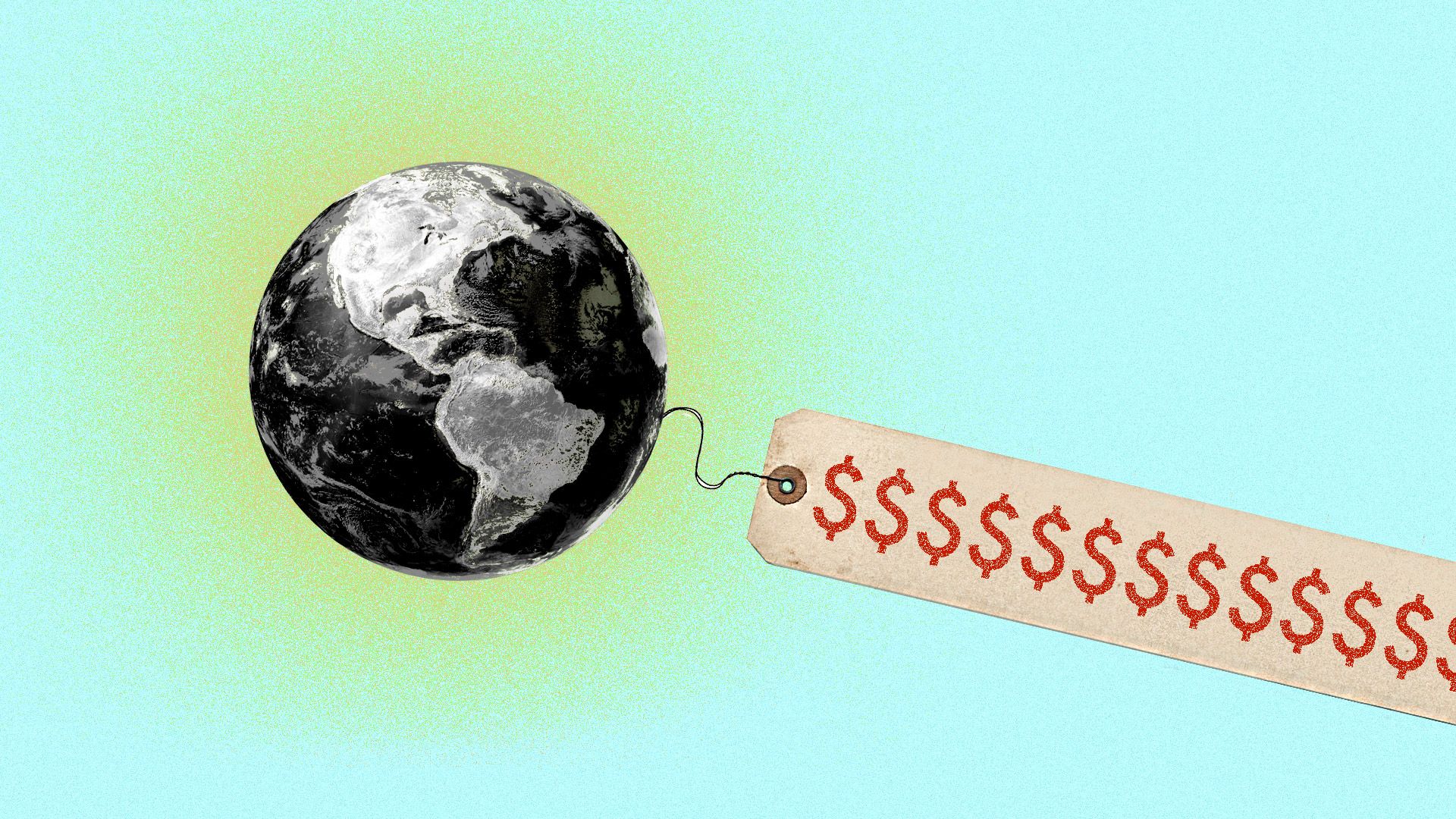
The cost of climate change


Illustration: Lazaro Gamio/Axios


There's $500 trillion of wealth on planet Earth, give or take: Maybe $230 trillion in land and property, $200 trillion in debt and $70 trillion in equity.

The big picture: All of that wealth comes, ultimately, from the planet, and the climate. Specifically, it has come from a stable climate. William Nordhaus points out in his 2013 book "The Climate Casino" that “the last 7,000 years have been the most stable climatic period in more than 100,000 years.” The last 7,000 years have also seen the rise of civilization and the creation of that $500 trillion in wealth. This is not a coincidence.


Nordhaus won the Nobel Prize this week, in an announcement that coincided with the release of a hugely important UN Intergovernmental Panel on Climate Change report on what will happen to the world when it gets 1.5°C, or 2.7°F, warmer than preindustrial levels.

The report puts the cost of a 1.5°C increase at $54 trillion, in today's money.
  • You think $54 trillion is a lot? That number comes from research that also says that a 2.0°C increase will cause $69 trillion of damage, and a 3.7°C increase will cause a stunning $551 trillion in damage.
  • $551 trillion is more than all the wealth currently existing in the world, which gives an indication of just how much richer humanity could become if we don't first destroy our planet.
We'll be environmentally richer, too. While it's hard to put a dollar value on that, the value of environmental benefits has been rising steadily over time and will continue to do so. Already, we regret environmental destruction in the past and would happily give up a small fraction of our current wealth to undo it.

Where things stand: Human civilization has reached the very end of reaping the dividends from a stable climate. Compared to recent decades, the world in 2100 will have a 13% reduction in crop yields (and those crops will also be less nutritious); it will also have 2.8 billion more people at risk from drought in any given month.

Preventing extreme global warming will be neither cheap nor easy. Just for starters, we will need to spend about $2.4 trillion per year on energy investment between now and 2035, overwhelmingly targeted at renewables.
  • Looking forward to 2050, the required average annual investment rises to $3.5 trillion, including massive new investment in electricity transmission, distribution and storage.
  • That's more than double our current energy investment, most of which is still focused on fossil fuels.
  • Such investment pays noncash dividends. Improved air quality on the 1.5°C pathway, for instance, would lead to more than 100 million avoided premature deaths over the 21st century, over and above the number of lives saved by keeping global warming to 2°C, according to the IPCC report.

The bottom line: Both Nordhaus and the IPCC report make clear that we will have to tax carbon. That incentivizes investment in alternatives, while deliberately making our current carbon-heavy lives less sustainable.
  • It's hard to get to 1.5°C with a carbon tax alone. The lowest figure for doing that in the IPCC report is $135 per ton in 2030, rising to $690 in 2100; the highest estimate is $5,500 per ton in 2030 and $27,000 per ton in 2100.
  • More realistically, a carbon tax of about $25 per ton in 2030 could be combined with tough regulation of energy usage and efficiency, including a ban on new coal-fired power plants.

Go deeper: 


Saturday, June 09, 2018

Climate change: Pope urges action on clean energy


1 hour ago


Reuters 
The Pope has taken the business world to task on issues ranging from poverty to tax haven 


Pope Francis has said climate change is a challenge of "epochal proportions" and that the world must convert to clean fuel.

"Civilisation requires energy, but energy use must not destroy civilisation," he said.

He was speaking to a group of oil company executives at the end of a two-day conference in the Vatican.

Firms present included ExxonMobil, BP, Royal Dutch Shell, Norway's Equinor and Pemex of Mexico. 


'Dodgy' greenhouse gas data threatens Paris accord
Hurricane Irma: Pope Francis condemns climate change sceptics


Modern society with its "massive movement of information, persons and things requires an immense supply of energy", he told the gathering.

"But that energy should also be clean, by a reduction in the systematic use of fossil fuels," he said.

"Our desire to ensure energy for all must not lead to the undesired effect of a spiral of extreme climate changes due to a catastrophic rise in global temperatures, harsher environments and increased levels of poverty."

The world needed to come up with an energy mix that combated pollution, eliminated poverty and promoted social justice, he added.

As many as one billion people still lack electricity, he said.

Under Pope Francis' leadership, the church has moved to confront the business world on a range of subjects from poverty to tax havens and complex financial securities.

Pope Francis on climate change

2017

"You can see the effects of climate change with your own eyes and scientists tell us clearly the way forward.

"All of us have a responsibility. All of us. Some small, some big. A moral responsibility, to accept opinions, or make decisions. I think it is not something to joke about."

Quoting from the Old Testament, he then said: "Man is stupid, a stubborn, blind man.

"Those who deny it [climate change] should go to the scientists and ask them. They are very clear, very precise."

2015

"We have come to see ourselves as her lords and masters, entitled to plunder her [the Earth] at will.

"The violence present in our hearts, wounded by sin, is also reflected in the symptoms of sickness evident in the soil, in the water, in the air and in all forms of life.

"We need only take a frank look at the facts to see that our common home is falling into serious disrepair.

"I urgently appeal, then, for a new dialogue about how we are shaping the future of our planet."

The unprecedented conference brought together oil executives, investors and Vatican experts who, like the Pope, back scientific opinion that climate change is caused by human activity and that global warming must be curbed, Reuters reports.

It is being held behind closed doors at the Pontifical Academy of Sciences, in a secluded 16th-Century villa in the Vatican gardens.

Called Energy Transition and Care for Our Common Home, it has been organised by the Catholic University of Notre Dame in South Bend, Indiana.
Growing energy demands

Consumption of oil and gas is expected to grow, according to analysts, remaining the world's largest sources of energy for the foreseeable future.

ExxonMobil alone has announced plans to increase oil production in the US and start more than two dozen projects worldwide, adding more than one million oil-equivalent barrels per day.

The firm says it has taken steps to reduce emissions in its own operations, spending $9bn on the effort since 2000.

But it maintains that growing demand for energy cannot be met by alternatives like wind and solar power alone.

Renewable sources provided about 18% of energy consumed in 2015, with forms like solar, wind and hydropower representing less than 10%, according to the International Energy Agency.

That share is expected to grow to just 15% by 2030, it said.


Saturday, June 02, 2018

Pope to address oil majors in Vatican climate conference


FRI JUN 1, 2018 / 12:56 PM EDT

Philip Pullella


FILE PHOTO: Pope Francis arrives to lead the Wednesday general audience in Saint Peter's square at the Vatican, May 23, 2018.
REUTERS/STEFANO RELLANDINI/FILE PHOTO


(Reuters) - The Vatican will host executives of the world's top oil companies for a conference next week on climate change and the transition away from fossil fuels, a Vatican source said on Friday.

Pope Francis, who wrote a major document on protection of the environment from global warming in 2015, is expected to address the group on the last day of the June 8-9 conference.

The conference, organized by the University of Notre Dame in the United States, is expected to be attended by the heads or senior executives of companies including Exxon Mobil, Eni, BP, Royal Dutch Shell and Pemex, the source said.

The chief executive officers of Exxon, BP and Norway's Equinor will attend the event, the companies confirmed. Shell declined to comment.

The oil and gas industry has come under increasing pressure from investors and activists to play a bigger role in reducing the emission of greenhouse gases in order to meet goals set out in a 2015 climate agreement signed in Paris.

Companies are betting on increased demand for gas, the least polluting fossil fuel, and to a lesser extent on renewable power such as wind and solar, to meet global targets of net zero emissions by the end of the century.


Saturday, September 19, 2015

Do Adventists Have a Beef With Pope Francis?


Do Adventists Have a Beef With Pope Francis?

BY JARED THURMON

Excitement has been mounting for months in anticipation of Pope Francis’ first visit to the United States. Even though this is the tenth papal visit to the U.S. since 1965, many are saying, “This one is different.” Why? Perhaps because Pope Francis will be speaking at the UN to the largest assembly of heads of state in world history and addressing the U.S. Congress for the first time. Or maybe because he’s being described as “a pontiff like no other,” venerated by the right and the left, by Jews and Muslims, by the gay community and the religious right. His name flashes repeatedly across television news screens and makes headlines in national and international newspapers. He appears to be “the pope for the people,” receiving accolades from men and women across a wide spectrum of society.

One issue in particular that is drawing both applause and criticism is the pope’s strong stance on climate change and human responsibility to care for the environment, touted as the big agenda item for this trip across the pond. Pope Francis plans to give a certain sound to the trumpet call regarding climate change, otherwise known as global warming. And with this issue, Adventists can resonate.


An Uphill Battle

As the Washington Post recently noted, Pope Francis is facing an uphill battle with many Christians who deny that climate change is real. But Francis isn’t alone in his beliefs. Nearly half of Americans say that climate change is a sign of “the last days.”Businessman Jay Faison is contributing $175 million to help persuade the naysayers that climate change is the real deal. And Muslim leaders from 20 countries are sounding their own trumpet that climate change is real and a force to be reckoned with.

So this isn’t an isolated event or one that will likely go away anytime soon. In fact, experts are declaring that climate change is to blame for everything from 400,000 deaths per year to the rapid increase in diabetes to the 500 percent rise in natural disasters since the 1970s—a trend the World Bank expects to see continue.


No Surprise Here


The apostle John, sitting on an island in the Mediterranean under a beautiful, smog-free blue sky and pristine azure waters, wrote that one day in the distant future God would “destroy those who destroy the earth” (Rev. 11:18). So today’s devastation of the environment should come as no surprise to Bible-believing Christians.

Whether we want to call it global warming, climate change, or natural disasters, there is a strong case that this is more than a mundane environmental issue; rather, as Jeff Nesbit of US News stated, many are considering it “the moral issue of our time.” Just ask farmers and other folk in California lamenting their dying crops and brown lawns whether they think climate change is real. Ask the citizens of Boston who had snow on the ground in June this year if they think something is changing. The debate often centers around who is responsible?

We don’t yet know all the solutions that Francis is going to propose. Some have suggested a “Slow Sunday,” and about such proposals, Adventists must stand by their historic Biblically-based opposition to any legislation that would infringe on a person’s freedom of conscience and right to practice the Biblical Sabbath. As the Summer of Trump has cooled down, the topic of climate change is heating up as Francis takes center stage on an issue many Americans are not quite sure affects them—at least not yet.


The Burden of Proof

Evidence rests heavily on the side of climate change, evidence that thinking individuals, including Adventist Protestants, can support. We’ve been sitting on a “secret”—knowledge that we’ve been given by both the Bible and the Spirit of Prophecy—for too long. This isn’t an issue or an event for which Adventists should be resting on the sidelines. Instead, “perhaps we have come to the kingdom for such a time as this!”

“Our people have been regarded as too insignificant to be worthy of notice; but a change will come,” 1 wrote Ellen White. Who knows? Maybe that time is now.


The Tide of Change


Votes and laws won’t stop the tide of climate change. “The earth dries up and withers” because “they have disobeyed the laws, violated the statutes and broken the everlasting covenant,” Isaiah writes (24:4, 5). But let us not be among the “they.” God expects more from us.

In the book Education, Ellen White wrote:

“ ‘As the whole creation groaneth and travaileth in pain together’ (Romans 8:26, 22), the heart of the infinite Father is pained in sympathy. Our world is a vast lazar house, a scene of misery that we dare not allow even our thoughts to dwell upon. Did we realize it as it is, the burden would be too terrible. Yet God feels it all. In order to destroy sin and its results He gave His best Beloved, and He has put it in our power, through co-operation with Him, to bring this scene of misery to an end” (emphasis supplied).

What Can We Do?

So, how can we cooperate with the God of nature, the God of the climate, to do our honest part in bringing this scene of misery to an end?

It’s simple: let’s take better care of His creation. This includes our body temple as well as the sanctuary of nature in which we live. The sad reality is that the creation is dying. According toYaleNews, animals are dying in increasing numbers, and for reasons few people understand. And the toll being taken is not just on the environment and animals, but on humans and their health as well.

After succumbing to Satan’s temptation in the Garden of Eden, Eve said, “The serpent deceived me, and I ate” (Gen. 3:13). Humanity has been deceived, and it seems we may have eaten our way into this mess—at least according to the United Nations FAO report “Livestock’s Long Shadow.”This eye-opening report cites the livestock sector as “a major stressor on many ecosystems and on the planet as a whole. Globally it is one of the largest sources of greenhouse gasses and one of the leading causal factors in the loss of biodiversity.” It adds that in developed and emerging countries, “it is perhaps the leading source of water pollution.”

More Articles and Books to Read

  • Berry, Wendell. The Unsettling of America: Culture and Agriculture. 2nd ed. New York: Avon Books, 1996. 
  • Blackmer, Sandra. “What Are We Really Doing to God’s Creatures?”Adventist Review, March 18, 2010, pp. 16-20.http://archives.adventistreview.org/issue.php?issue=2010-1508&page=16
  • Davidson, Jo Ann, “And It Was Good,” Adventist Review, August 21, 2008, pp. 8-11.http://archives.adventistreview.org/issue.php?id=2030&action=print
  • Davidson, Jo Ann, “Who Cares: Bioethics and the Christian,”Adventist Review, June 25, 2009, pp. 51-54.http://archives.adventistreview.org/issue.php?issue=2009-1518&page=51
  • Davis, Ellen F. Scripture, Culture, and Agriculture: An Agrarian Reading of the Bible. Cambridge: Cambridge University Press, 2009.
  • Dunbar, Stephen; Gibson, L. James; and Rasi, Humberto M., eds.Entrusted: Christians and Environmental Care, Adventus International University Publishers, 2013.
  • Habel, Norman. The Land Is Mine: Six Biblical Land Ideologies. Minneapolis: Fortress Press, 1995.
  • Imhoff, Daniel. CAFO: The Tragedy of Industrial Animal Factories, Earth Aware Editions, 2010.
  • Scully, Matthew. Dominion: The Power of Man, the Suffering of Animals, and the Call to Mercy. New York: St. Martin’s Press, 2002.
  • Sinclair, Upton. The Jungle, Dover Publications, 2001.
  • Tonstad, Sigve K. The Lost Meaning of the Seventh Day. Berrien Springs, MI: Andrews University Press, 2009. 
  • Tonstad, Sigve, K., “Ecology, Ethics, and Ecumenism: Taking the health message to a new level,” Adventist Review online.http://www.adventistreview.org/141519-62

According to the Environmental Working Group and USDA report titled Meat Eater’s Guide to Climate Change + Health, “the takeaway . . . is that eating meat and dairy is expensive, and in a whole lot of ways. . . . It’s not just the carbon emissions that hurt; it’s also the pesticides, fertilizers, fuel, and water needed to produce the feed for all those cows and pigs. And once that damage is done, there are still the health consequences we all face from eating too much meat, particularly red meat.”

Rob Bailey, the report’s lead author, nailed the reason the problem isn’t abating when he added, “Preventing catastrophic warming is dependent on tackling meat and dairy consumption, but the world is doing very little.”

“Curbing the world’s huge and increasing appetite for meat is essential to avoid devastating climate change,” says think-tank Chatham House. The problem is that few people want to make that change.
What Ellen White learned from a Catholic

Each one of us individually, including Adventists, holds in our hands the power to make a significant difference regarding the environment and to help end much of this misery. The world is clear-cutting rainforests, growing GMO monocrops, saturating rivers and soil with pesticides—all to raise ( often inhumanely) more than 56 billion animals every year for human consumption. It is the inhumane and unsustainable methods of raising of animals that I take issue with. We make the choice at every meal whether to eat for life or eat what once lived, to eat plant-based foods or animals.

Adam and Eve did not eat animals, which were in their care, nor will we eat animals in heaven (see Isa. 65:25). Our culture mourns the loss of Cecil the lion, 2 but consumes Bessie the cow, millions of times a day.

Health is a journey. It took Ellen White 33 years after she shared her health-message vision in 1863 to completely stop eating meat herself. 3 And when she finally made that decision, the reason she identified was not because of her health, but because of mercy and animal compassion:

“When the selfishness of taking the lives of animals to gratify a perverted appetite, was presented to me by a Catholic woman, kneeling at my feet, I felt ashamed and distressed; I saw it in a new light, and I said, ‘I will no longer patronize the butchers; I will not have the flesh of corpses on my table.’” 4


The Adventist Perspective

Ellen White’s well-known statement—“We have nothing to fear for the future, except as we shall forget the way the Lord has led us, and His teaching in our past history” 5—is often used in the context of theology, but could it also refer to health?

In the April 2015 issue of Adventist Review, startling data revealed that more than 73 percent of Seventh-day Adventist Millennials are not vegetarians! So, what does this mean?

Gary Fraser, principal investigator of the Adventist Health Studies, shared that the reality is that “the evidence that Adventist vegetarians do better than Adventist non-vegetarians with respect to risk of diabetes, hypertension, overweight, blood cholesterol, risk of several cancers, heart disease, and that they live longer lives, is overwhelming.” In light of the evidence-based research and current trends with younger Adventists, it seems likely that the results of the health studies could likely change as well. It was these studies that led National Geographic to identify Loma Linda, California, as a Blue Zone, and that Adventists are often the longest living and most healthy Americans.6 One of the key characteristics of the longevity and optimal health of the California Adventists noted in the National Geographic report was Adventists’ adherence to a plant-based diet. What will happen if this dynamic is no longer in play?


Look Upon the Earth

Isaiah declared, “Lift up your eyes to the heavens, look upon the earth beneath; the heavens will vanish like smoke, the earth will wear out like a garment and its inhabitants die like flies. But my salvation will last forever, my righteousness will never fail” (Isa. 51:6).

Isaiah was undoubtedly describing our day. The earth is wearing out, and thinking minds realize that something decisive is about to take place, that the world is on the verge of a stupendous crisis.7 So much so that people such as Tony-Stark-wannabe Elon Musk and other billionaire friends such as Richard Branson are putting all their eggs into the basket of colonizing another planet.People are realizing that something has to give, and many are turning to extreme measures in response.

When Pope Francis comes to the U.S. and shares his passion and strong encouragement for decided change regarding the environment, Adventists—and all others who see the validity of responsibly caring for the planet, the rainforests, the soil, the rivers, the air, the animals—should consider the now-scientifically proven words of that dear Catholic woman who convinced Ellen White in 1893 that it is selfishness to continue to take the lives of animals just to gratify appetite. We then need to look at what each of us personally can do to make a difference as well.

On the issue of climate change, thoughtful Adventists won’t have a beef with Pope Francis.

Jared Thurmon is the Strategic Partnerships Liaison
for Adventist Review.


  1. Ellen G. White, Testimonies to the Church, vol. 5, p. 546.
  2. http://www.cnn.com/2015/07/31/world/zimbabwe-cecil-lion-dentist/
  3. Ellen G. White, Letter 73, 1896.
  4. Ellen G. White, Testimony Studies on Diet and Foods, p. 67.
  5. Ellen G. White, Christian Experience and Teachings, p. 204.
  6. http://travel.nationalgeographic.com/travel/happiest-places/blue-zones-california-photos/#/swim-lomo-linda_41552_600x450.jpg
  7. Ellen G. White, Prophets and Kings, p. 537.


.

P.S.
When I read dubious articles as these it reminds of Samuelle Bacchiocchi, and this warning from the Spirit of Prophecy:
We have far more to fear from within than from without.
Selected Message Book 1, p.122.
 

Tuesday, June 16, 2015

Jeb Bush: Pope Francis should steer clear of climate issue


© Joe Skipper / Reuters


BY STEVE HOLLAND AND
AMANDA BECKER,Reuters


June 16, 2015


DERRY, N.H./WASHINGTON (Reuters) - In his first official day on the presidential campaign trail on Tuesday, Republican Jeb Bush, a Catholic, had sharp words on Pope Francis’ decision to leap into the climate change debate, saying the pontiff should steer clear of political issues.

Bush, at a town hall event in New Hampshire a day after formally announcing his candidacy for the 2016 presidential election, said he was eager to read an encyclical the Vatican is set to release Thursday on climate change, but will take it with a grain of salt, even as he called Francis an extraordinary leader.

"I hope I’m not going to get castigated for saying this by my priest back home,” Bush said. “But I don’t get my economic policy from my bishops or my cardinals or my pope."

Bush, a former Florida governor who converted to Catholicism 25 years ago, said religion "ought to be about making us better as people and less about things that end up getting into the political realm."

Francis, according to a leaked draft version of his encyclical, or a letter to bishops, says the world could see destruction of entire ecosystems this century without urgent action on climate change.

In the Italian version of the 192-page document, posted on Monday by the weekly magazine l'Espresso, the pope again backs scientists who say global warming is mostly man-made and says that developed countries have a particular responsibility to stem a trend that will hurt the poor the most.

In an appearance in New Hampshire last month, Bush said it was arrogant for people to insist that science on climate change is clear.

In Derry on Tuesday, Bush said he did not think the science on climate change was "complete."

But Vice President Joseph Biden, a practicing Catholic, invoked the pope's encyclical at clean energy conference at the White House on Tuesday. "Usually encyclicals are only issued on what the church thinks are incredibly important initiatives," Biden said.

He cited a growing consensus about the need to fight climate change, adding, "This doesn't only have a moral component to it, it has a security component to it, as well as it has an economic component to it."

Bush is not the only Republican presidential candidate to differ publicly with Pope Francis.

In January, after the pope said there was no need to procreate "like rabbits" in order to be a faithful Catholic, Rick Santorum, a former U.S. senator and also a Catholic who announced his bid for the Republican nomination in May, said that it was "sometimes very difficult to listen to the pope and some of the things he says off the cuff."

More than 70 percent of U.S. Catholics believe the planet is getting warmer, though only 47 percent attribute that warming to human causes, according to the Pew Research Center. The views of Catholics on the issue are similar to those of Americans overall.


(Additional reporting by Timothy Gardner in Washington; Editing by Leslie Adler)


.

Monday, June 08, 2015

Catholics organize to promote pope's climate change message


USA TODAY NETWORK AP 10:06 a.m. EDT  May 25, 2015


(Photo: Wally Santana, AP)


NEW YORK (AP) — When Pope Francis releases his much-anticipated teaching document on the environment and climate change in the coming weeks, a network of Roman Catholics will be ready.

There will be prayer vigils and pilgrimages, policy briefings and seminars, and sermons in parishes from the U.S. to the Philippines.

These environmental advocates — who work with bishops, religious orders, Catholic universities and lay movements — have been preparing for months to help maximize the effect of the statement, hoping for a transformative impact in the fight against global warming.

"This is such a powerful moment," said Patrick Carolan, executive director of Franciscan Action Network, a Washington-based advocacy group formed by Franciscan religious orders. "We're asking ourselves, 'What would be the best way for us to support the faith community in getting this out and using it as a call to action?'"

Francis is issuing the encyclical by the end of June with an eye toward the end-of-year U.N. climate change conference in Paris. While previous popes have made strong moral and theological arguments in favor of environmental protection, Francis will be the first to address global warming in such a high-level teaching document.

The pope, who will address the U.N. General Assembly Sept. 25 when he visits the U.S., has said he wants the encyclical to be released in time to be read and absorbed before the Paris talks.  Advocates are pressing for a binding, comprehensive agreement among nations to curb rising global temperatures, which scientists say are largely driven by carbon emissions.

"People are really putting a lot of weight on this," said Nancy Tuchman, director of the Institute of Environmental Sustainability at Loyola University Chicago. "I think the real hope is that he says it like it is and tells us there has to be a call to action and it has to be immediate."

The institute, which has been working to unite 28 U.S. Jesuit colleges and universities as a common voice on climate change, plans to collect papers from students, faculty and staff with their reflections on the document and how they can be "one of its champions," Tuchman said. A school colloquium on the papers is planned for Sept. 9.

Carolan was among about 40 Catholic leaders who gathered in Rome this month for a strategy meeting organized by the Global Catholic Climate Movement, a network he co-founded which includes organizations representing religious orders, church aid agencies, Catholic social justice advocates and others. The movement started a petition that urges political leaders to take action to curb global warming and plans a prayer vigil in Washington the night before Francis' Sept. 24 address to Congress, where he is likely to touch on environmental protection.

His audience at the Capitol will include skeptics on climate change, and like-minded groups are preparing a response to the encyclical.

The Heartland Institute, a conservative Chicago-based think-tank that sent a team to Rome last month to warn the pope against the U.N.'s climate change agenda, says it is building relationships with Catholic leaders and planning to distribute reports on sustainable development and challenges to climate science to a Catholic audience.

Jim Lakely, a Heartland spokesman, said since the Rome event, the institute has heard from Catholic groups, bloggers and others "who share our concern that the pope is being misadvised by the United Nations on this complicated scientific issue."

At the same time, however, other Catholics worldwide are mobilizing to echo the pope's words among the faithful.

Catholic Earthcare Australia, the ecology agency of the Australian Catholic Bishops' Conference, plans an event on the encyclical at the Australian Parliament and will publish a book on the encyclical for use in parishes.

In the Philippines, the Archdiocese of Manila's decade-old ecology ministry is asking bishops to encourage all parishes to ring their church bells when the encyclical is released, among other efforts to highlight the pope's statement, ministry director Lou Arsenio said. Each September, the Manila ecology ministry holds a month of liturgies and church activities on environmental protection called a "Season of Creation."

"The big issue here is that environmental issues are not just about science but about ethics and moral values," said Pablo Canziani, an atmospheric physicist who works with the Argentine bishops' conference.

Canziani, who worked with then-Cardinal Jorge Mario Bergoglio of Buenos Aires before he became Pope Francis, recently led a two-day environmental seminar organized for Argentine diocesan priests. Canziani said he and others also hope to incorporate prayers related to the encyclical in the many upcoming Argentine pilgrimages to shrines dedicated to the Virgin Mary.

In the U.S., Dan Misleh, director of the Catholic Climate Covenant, an education and advocacy network that works with the U.S. bishops, is preparing model sermons on the expected themes of the encyclical.

Over the last 15 years or so, Catholic and other faith traditions have been increasingly taking up environmental protection, or what they call creation care, as a moral issue, emphasizing the impact not only on nature but also on poor people who struggle for access to clean water and farmable land and are often the most vulnerable in natural disasters.

However, theologians and secular environmental activists say this stunningly popular pope, who has captured the world's attention, can bring into focus the human toll from climate change in a way few other leaders can.

"The social justice aspect, and the way climate change is going to affect the poor and underprivileged and less privileged — that's not the first thing people think about when they think about climate change," said Lou Leonard, a World Wildlife Fund vice president who specializes in climate change issues. "For those who see this primarily as an issue of polar bears or other impact on species — which is all really important — this is an opportunity to say this is as much a human issue as anything else."

The church, given its reach and structure, also provides an unparalleled network for amplifying calls to reduce global warming.


Bishops' conferences in many countries, including in the U.S., have social justice programs that focus on the environment. Archbishop Thomas Wenski of Miami, head of the U.S. bishops' domestic justice and human development committee, speaks frequently about Catholic teaching on preserving creation and the impact of climate change on the poor.

Global warming has also emerged as an issue for Caritas International, a confederation of Catholic charitable groups who play a major role in development and disaster relief in more than 160 countries. Caritas leaders worldwide said in a survey released this month that climate change was a top contributor to food insecurity.
Major environmental organizations are also abuzz about the encyclical and have been contacting Catholic groups for guidance. In webinars for them, Carolan has been explaining what an encyclical is. Misleh has cautioned the groups that the pope will be making a theological statement and speaking "as a Catholic, not a member of the Sierra Club."


.
.

Monday, May 11, 2015

Scientists Fear CIA Funding Geoengineering to Control ‘Weaponized Weather’


TRUTHER

FEBRUARY 24, 2015


It is no secret to anyone paying attention that controlling the weather has not only been going on for decades, but now, under the pretext of containing global warming, it is coming out of the lab and going mainstream, but that doesn’t mean the efforts to geoengineer that planet are accountable, transparent or under control.


In fact, a NASA Jet Propulsion Lab scientist warned that a rogue geoengineer could even hold the power to blackmail the planet.

The issue at hand is who is steering the weather… not whether it is being steered. While the masses are debating that the chemtrail phenomenon daily vandalizing our skies is conspiracy make-believe, others are watching for clues to what has been dubbed, a ‘New Manhattan Project’ – evidently ongoing for decades now, pursued by scientific and military entities, but executed under silence and ignorance in the public.Peter A. Kirby detailed much of this recent history of secret chemtrail experimentation:

Controlling Earth’s weather would necessarily require a gigantic scientific effort. Oddly enough, when one looks for a National effort in weather modification, one finds a lot. Specifically, if one looks, one can find a history of weather control programs involving electromagnetic energy and atmospheric particles; all in a coherent chronological order.

This paper is the result of thousands of dollars and countless hours spent researching many thousands ofpages of source, organizational and Government documents related to weather modification and the atmospheric sciences. This article serves as the foundation for a series of shortly forthcoming articles detailing the history and current state of this Project. May this work help end the spraying. For the fact that these environmental modifications have been done without our informed consent, may this work contribute to the largest class-action lawsuit in history.

This paper examines the origins and development of this; the first planetary level scientific endeavor. Now is our opportunity to gain a deeper understanding of the New Manhattan Project.

After detailing several key projects by military scientists and academic researchers in the 20th and 21st Century, Kirby concludes:

So there you have an evolutionary history of a project employing sprayed particles and the electrification of clouds for the purpose of weather modification. Is this a coincidence? Are all these examples simply isolated, one-off events not a part of a larger overall plan? What are the odds of these data points evolving in a chronological order such as they have without being part of a coordinated effort? One may be looking at something like a quadrillion to one; and that is conservative.

James Corbett of The Corbett Report discusses how a scientist has “accuse[d] CIA of funding climate research to develop weather weapons.” Indeed the CIA has.


Spy Agencies Fund Climate Research in Hunt for Weather Weapon

http://ur1.ca/jrbx6

CIA Funding Geoengineering to Weaponize Weather

http://ur1.ca/jrbxd

Chemtrails Exposed: A History of the New Manhattan Project

http://ur1.ca/jrbxi

CIA Accuses Russia Of “Manipulating The World’s Weather”

http://ur1.ca/jrbxk

Flashback: Operation Popeye – Weaponized Weather During Vietnam War

http://ur1.ca/jrbxp

The London Guardian just reported on concerns from a senior scientist about how methods of modifying weather ostensibly to offset climate change are indeed becoming ‘weaponized weather’… but at the hands of who? For certain, the CIA has been involved for several years now:

A senior US scientist has expressed concern that the intelligence services are funding climate changeresearch to learn if new technologies could be used as potential weapons.

Alan Robock, a climate scientist at Rutgers University in New Jersey, has called on secretive government agencies to be open about their interest in radical work that explores how to alter the world’s climate.

“The CIA was a major funder of the National Academies report so that makes me really worried who is going to be in control,” he said. Other funders included Nasa, the US Department of Energy, and the National Oceanic and Atmospheric Administration.

Robock said he became suspicious about the intelligence agencies’ involvement in climate changescience after receiving a call from two men who claimed to be CIA consultants three years ago. “They said: ‘We are working for the CIA and we’d like to know if some other country was controlling our climate, would we be able to detect it?’ I think they were also thinking in the back of their minds: ‘If we wanted to control somebody else’s climate could they detect it?’”

He replied that if a country wanted to create a stratospheric cloud large enough to change the climate, it would be visible with satellites and ground-based instruments. The use of the weather as a weapon was banned in 1978 under the Environmental Modification Convention (Enmod).

What we see, in terms of this largely undisclosed weather modification program is an effort to create a public “cover story” under “geoengineering as a solution to climate change” in order to keep the true nature of this massive secret program under wraps.

Keep in mind that even after the Atomic Bomb was revealed to the world, many other aspect of the Manhattan Project remained secret, and research continued in secret under other project names.

In 1998, the Stanford Environmental Law Journal published a paper calling for a “Climate Change Manhattan Project,” to accomplish what the Kyoto agreement, Al Gore and an assorted cast of greenies have not been able to:


“In the post-Kyoto world, we need more than promises of emissions cuts and tradeable permits. We need a Climate Change Manhattan Project.”


.

Wednesday, April 29, 2015

California Governor Orders New Target for Emissions Cuts


U.S.


By ADAM NAGOURNEY

APRIL 29, 2015


Gov. Jerry Brown at a news conference with California mayors on Tuesday. On Wednesday, he issued an executive order aimed at curbing greenhouse gas emissions.CreditMax Whittaker/European Pressphoto Agency


LOS ANGELES — Gov. Jerry Brown issued an executive order Wednesday sharply ramping up this state’s already ambitious program aimed at curbing greenhouse gas emissions, saying it was critical to address “an ever-growing threat” posed by global warming to the state’s economy and well-being.

Under Mr. Brown’s order, by 2030, emission levels will have to be reduced by 40 percent compared with 1990. Under existing state law, emissions are supposed to be cut 80 percent from what they were in 1990 by 2050, and Mr. Brown said this tough new interim target was essential to helping the state make investment and regulatory decisions that would assure that goal was reached.

Mr. Brown faulted Republicans in Congress for “pooh-poohing” the threat of global warming. He said that he wanted California to set an example for the rest of the country and the world on the urgency of responding to what he described as a slow-moving crisis.

The Parched West: Drought Frames Economic Divide of Californians APRIL 26, 2015


California Releases Revised Water Consumption Rules APRIL 18, 2015


How to Save Water: The California Way APRIL 2, 2015


“It’s a real test,” Mr. Brown, a Democrat, said in a speech at an environmental conference in downtown Los Angeles. “Not just for California, not just for America, but for the world. Can we rise above the parochialisms, the ethno-centric perspectives, the immediacy of I-want-I-need, to a vision, a way of life, that is sustainable?”

The Parched West

Articles in this series will explore the impact of the drought that has hit states from the Pacific Coast to the Great Plains.

Mr. Brown’s order marks an aggressive turn in what already was one of the toughest programs in the nation aimed at reducing greenhouse gas emissions. Under the law put into place by Mr. Brown’s predecessor, Arnold Schwarzenegger, the state was required to reduce greenhouse gas emissions to 1990 levels by 2020 on the way to reach the 2050 target; California is already well on its way to meeting the 2020 goal, and may exceed it, officials said Thursday.

“With this order, California sets a very high bar for itself and other states and nations, but it’s one that must be reached – for this generation and generations to come,” Mr. Brown said.

The order marks the latest effort by Mr. Brown to position California as a leading force in the world’s effort to address climate change – and himself as a leader of that campaign effort as he faces his final years in public office. In his State of the State address in January, the governor called for reducing gas consumption by cars and trucks by up to 50 percent over the next 15 years.

These efforts come as this state has been struggling with a drought that Mr. Brown has said is, at least in part, exacerbated by global warming. “Climate change poses an ever-growing threat to the well-being, public health, natural resources, economy, and the environment of California, including loss of snowpack, drought, sea level rise, more frequent and intense wildfires, heat waves, more severe smog, and harm to natural and working lands, and these effects are already being felt in the state,” Mr. Brown said in his executive order.

The governor’s speech, coming at a time when he has been trying to rally the state behind tough water conservation measures, was a reminder of the often conflicting demands of these twin challenges. Some of the central efforts proposed to alleviate the drought – including the building of desalinization plants to make ocean water potable – are highly energy intensive.

main story


Interactive Graphic: How Water Cuts Could Affect Every Community in California


The governor’s order did not give details of how the state would reach the new goals, though Mr. Brown in his speech here noted the success of the auto and energy industry so far in meeting the emission targets that the state has set over the years. He disputed the argument — voiced by Republicans in recent years — that such efforts would increase the cost of doing business in California.

“We’re sending the signals to the private economy to create, to innovate, and to make the kind of response that will enable Californians to live in compatibility with the environment,” he said. “We can do it.”

Lawmakers in Sacramento have been pushing through legislation intended to help achieve long-term cuts in emissions. Kevin de Leon, the Democratic leader of the State Senate, said Mr. Brown’s order exemplified “California’s global leadership on climate change.”

“We see the framework of a new economy for tomorrow,” Mr. de Leon said in an interview. “And that’s why it’s critical that we move forward with these far-reaching and progressive policies. That is why the world is watching what we are doing here in California.”

California’s target reflects those set by other governments — including the European Union — ahead of the United Nations conference on climate change in Paris this year. Christiana Figueres, the executive secretary of the conference, issued a statement praising Mr. Brown’s order.

“California’s announcement is a realization and a determination that will gladly resonate with other inspiring actions within the United States and around the globe,” she said. “It is yet another reason for optimism in advance of the U.N. climate conference in Paris in December.”


Source
.
. 

Monday, March 09, 2015

Florida Bans State Environmental Workers From Using the Term Climate Change


By Daniel Politi


Florida Gov. Rick Scott on Oct. 28, 2013, in Miami.

Photo by Joe Raedle/Getty Images


Florida is largely seen as the U.S. state that is most vulnerable to the effects of global warming. But even uttering the term global warming in official communications can get employees at the state’s Department of Environmental Protection in trouble. TheFlorida Center for Investigative Reporting talks to four former DEP officials who say they were ordered to not use the terms global warming or climate change in any emails, reports, or official communications. “We were told not to use the terms climate change, global warming, or sustainability,” said Christopher Byrd, who worked at the DEP from 2008 to 2013.

The unwritten policy apparently first went into effect after Gov. Rick Scott took office in 2011. Scott has long expressed skepticism that human activity causes climate change. The DEP’s press secretary, however, said the reports weren’t accurate. “DEP does not have a policy on this,” she said before declining to answer more questions. Yet even if there was no written policy, one former employee said staffers had been warned that just using the banned terms would bring them unwanted attention. “The policy goes beyond semantics and has affected reports, educational efforts and public policy in a department that has about 3,200 employees and $1.4 billion budget,” writes Tristram Korten.

Daniel Politi has been contributing to Slate since 2004 and wrote the "Today's Papers" column from 2006 to 2009. You can follow him on Twitter @dpoliti.


.

Sunday, January 04, 2015

Climate Change in 2015 Could be Bigger Than Religion – or Selfie


By Don Jergler | December 31, 2014


The phrase “climate change” yields roughly 108 million results in a Google search – in the ballpark in terms of numbers of results with “Jesus Christ,” “Mohamed” and “selfie” – and you can expect the phrase to become an even more popular topic in the coming year.

Climate change is now on Pope Francis’ agenda. It’s certain to be a topic pressed hard by the president of the United States and many national leaders, who are unlikely to take their foot off the gas pedal in their push to reduce carbon emissions and adapt to a changing climate.

In fact the year that is now passing will itself likely bolster the climate change topic in 2015. According to the National Oceanic and Atmospheric Administration, 2014 is on track to be the warmest year on record.15

This was also a year of progress on climate change for President Obama, including what some call a “landmark deal” with China to reduce carbon emissions.

With Obama entering his final two years in office he seems poised to push this agenda further to see how much he can get done before he exits the White House .

If there was any uncertainty over whether
Obama will go all-in on climate change over the next two years it was eliminated in the last few months. Shortly after the China deal he announced in November the U.S. will contribute $3 billion to an international fund to help the world’s poorest countries address the impacts of climate change.

“The two announcements, both unveiled at prominent global meetings with world leaders, highlight Mr. Obama’s intention to use the last two years of his administration to push forward on climate change policy, which he sees as a cornerstone of his legacy,” states an article in the New York Times.


Just about every nation on the planet will be involved in some way on a new global climate change agreement set to unfold in late 2015 in Paris at the United Nations Climate Change Conference, referred to as COP21 or CMP11 – COP21 stands for Conference of the Parties to the 1992 United Nations Framework Convention on Climate Change; CMP11 refers to the 11th Meeting of the Parties to the 1997 Kyoto Protocol.

  • The year is full of meetings and events to tackle or address climate change. Here are a few big meetings to keep an eye on next year as listed by the Climate Action Network.
  • World Economic Forum Annual Meeting 2015 in Davos-Klosters, Switzerland from Jan. 21-24. Titled “The New Global Context,” the meeting is a stage for “strategic dialogues which map the key transformations reshaping the world.”
  • United Nations Framework Convention on Climate Change intercessional meeting in Geneva, Switzerland from Feb. 8-13. This is a continuation of the Ad Hoc Working Group on the Durban Platform for Enhanced Action.
  • Intergovernmental Panel on Climate Change in Nairobi, Kenya from Feb. 24-27. The panel is working on the ongoing Fifth Assessment Report, which provides an up-to-date view of the state of scientific knowledge relative to climate change.
  • World Conference on Disaster Reduction 2015 in Sendai, Japan from March 14-18. This United Nations Office for Disaster Risk Reduction event will work on the Hyogo Framework for Action, a 10-year plan to make the world safer from natural hazards.
  • 2nd Annual Sustainable Energy for All (SE4ALL) Forum in New York, N.Y. from May 18-22. This is the Second United Nations Sustainable Energy For All Forum at the U.N. headquarters.
  • 2015 Annual Meetings of the World Bank Group and the International Monetary Fund in Lima, Peru on Oct. 1. Climate change and green bonds will likely take center stage.

This list is far from conclusive, and of course, more events are being planned.


.

Pope Francis May Tip the Balance in Climate Change Debate: Should Skeptics Worry?


By Rhodi Lee, Tech Times | January 4, 9:16 AM


In a bid to influence how the world deals with the issue of climate change, Pope Francis will issue an encyclical that will urge Catholics worldwide to take action on global warming.
(Photo : Jeffrey Bruno)


Pope Francis is again taking a bold stance on a sensitive issue. This time, it involves something that had representatives of nations from all over the world convening in Lima, Peru last month.

Word is out that the head of the Roman Catholic Church will soon urge its 1.2 billion members worldwide to act on climate change, with the Pope anticipated to issue an encyclical this year that will tackle the issue of global warming and human ecology.

In January, the Pope is scheduled to visit Tacloban City, Philippines, which was devastated by typhoon Haiyan in 2013, and will likely take the chance to publish the encyclical.

The document, which will be given to 5,000 bishops and 400,000 priests for distribution to their parishioners, will direct Catholics to take action on climate change on scientific and moral grounds.

Pope Francis will also meet with other religious leaders and politicians at a general assembly in New York later this year when countries will commit to new antipoverty and environmental goals.

Bishop Marcelo Sorondo, the Pontifical Academy of Sciences chancellor of the Vatican, said that the reason behind these activities is that the Pope wanted to directly influence the UN climate meeting, which will be held in Paris, France this year. The summit aims to achieve a universal commitment among countries to reduce emissions of greenhouse gas in order to limit the increase in global temperature to no more than 2 degrees Celsius above pre-industrial levels.

"Our academics supported the Pope's initiative to influence next year's crucial decisions," Sorondo said. "The idea is to convene a meeting with leaders of the main religions to make all people aware of the state of our climate and the tragedy of social exclusion."

While the Pope's call for environmental action may not change the mind of skeptics, including Catholic politicians who have been resisting government efforts to reduce the emission of carbon, the Pope's call to action on a warming world could have a significant impact worldwide, given the church's influence and because it is known to be one of the biggest consumers of energy.

With its network of hospitals, schools, parish centers, seminaries and other institutions, the Church spends billions for its energy use. The Pope's position on climate change could lead to installations of renewable energy sources, such as solar systems in establishments and institutions that the Church has stakes in.


.