Showing posts with label green revolution. Show all posts
Showing posts with label green revolution. Show all posts
Thursday, March 22, 2018
Thursday, September 08, 2016
CLIMATE ACTION: A CAMPAIGN MANUAL FOR GREENHOUSE SOLUTIONS

BY: MARK DIESENDORF
Publisher: UNSW Press, Sydney, NSW
ISBN Number: 978 1 74223 018
Publish Date: 2014
Number of Pages:
“The word academic is synonymous for irrelevant”, declared Saul Alinsky, the influential Chicago activist-educator. A notable exception to Alinsky’s rule is Mark Diesendorf, author of ‘Climate Action: A campaign manual for greenhouse solutions’. Diesendorf is Deputy Director of the Institute of Environmental Studies at the University of New South Wales.
Alinsky would admire Diesendorf’s academic activism. He’s an outspoken critic of the Rudd Government’s proposed Carbon Pollution Reduction Scheme and the Australian bargaining stance in Copenhagen. He accuses the Australian Government of ‘posing as an active proponent of climate action’. In recent months, Mark has gone head to head with Tony Abbott over the Liberal leader’s support for nuclear power as a remedy to climate change, arguing that, ‘The two biggest threats facing human civilisation in the 21st century are climate change and nuclear war. It would be absurd to respond to one by increasing the risks of the other.’ He has also challenged the powerful Australian Coal Association, asserting that in just 20 years, Australia could entirely replace coal with less polluting energy sources.
In mid-2009, Diesendorf added Climate Action to his impressive list of almost 80 publications including the popular, Greenhouse Solutions with Sustainable Energy (2007). The new book has been well received.
Thursday, August 18, 2011
The Green Agenda

"Effective execution of Agenda 21 will require a profound reorientation of all human society, unlike anything the world has ever experienced a major shift in the priorities of both governments and individuals and an unprecedented redeployment of human and financial resources. This shift will demand that a concern for the environmental consequences of every human action be integrated into individual and collective decision-making at every level."
- excerpt, UN Agenda 21
Agenda 21 – The UN Blueprint for the 21st Century
As described in my previous article on Sustainable Development, Agenda 21 was the main outcome of the United Nation's Earth Summit held in Rio de Janeiro in 1992. Agenda 21 outlines, in detail, the UN's vision for a centrally managed global society. This contract binds governments around the world to the United Nation's plan for controlling the way we live, eat, learn, move and communicate - all under the noble banner of saving the earth. If fully implemented, Agenda 21 would have the government involved in every aspect of life of every human on earth.
Agenda 21 spreads it tentacles from Governments, to federal and local authorities, and right down to community groups. Chapter 28 of Agenda 21 specifically calls for each community to formulate its own Local Agenda 21: ”Each local authority should enter into a dialogue with its citizens, local organizations, and private enterprises to formulate 'a Local Agenda 21.' Through consultation and consensus-building, local authorities would learn from citizens and from local, civic, community, business and industrial organizations and acquire the information needed for formulating the best strategies.” - Agenda 21, Chapter 28, sec 1.3
Interestingly, in April 1991, fourteen months before Earth Summit, Prince Charles held a private two day international conference aboard the royal yacht Britannia, moored off the coast of Brazil. His goal was to bring together key international figures in an attempt to achieve a degree of harmony between the various countries that would gather at the Summit. Al Gore was present, along with senior officials from the United Nations and the World Bank.
At the summit 179 nations officially signed Agenda 21 and many more have followed since. Nearly 12,000 local and federal authorities have legally committed themselves to the Agenda. In practice this means that all their plans and policies must begin with an assessment of how the plan or policy meets the requirements of Agenda 21, and no plans or policies are allowed to contradict any part of the Agenda. Local authorities are audited by UN inspectors and the results of the audits are placed on the UN website. You can see how many local authorities in your country were bound by Agenda 21 in 2001 here. The number has increased significantly since then.
The official opening ceremony was conducted by the Dalai Lama and centered around a Viking long-ship that was constructed to celebrate the summit and sailed to Rio from Norway. The ship was appropriately named Gaia. A huge mural of a beauiful woman holding the earth within her hands adorned the entrance to the summit. Al Gore lead the US delegation where he was joined by 110 Heads of State, and representatives of more than 800 NGO’s.
Maurice Strong, Club of Rome member, devout Bahai, founder and first Secretary General of UNEP, has been the driving force behind the birth and imposition of Agenda 21. While he chaired the Earth Summit, outside his wife Hanne and 300 followers called the Wisdom-Keepers, continuously beat drums, chanted prayers to Gaia, and trended scared flames in order to “establish and hold the energy field” for the duration of the summit. You can view actual footage of these ceremonies on YouTube. During the opening speech Maurice Strong made the following statements:
"The concept of national sovereignty has been an immutable, indeed sacred, principle of international relations. It is a principle which will yield only slowly and reluctantly to the new imperatives of global environmental cooperation. It is simply not feasible for sovereignty to be exercised unilaterally by individual nation states, however powerful. The global community must be assured of environmental security." - Link
"It is the responsibility of each human being today to choose between the force of darkness and the force of light. We must therefore transform our attitudes, and adopt a renewed respect for the superior laws of Divine Nature." - Link
"Current lifestyles and consumption patterns of the affluent middle class - involving high meat intake, use of fossil fuels, appliances, air-conditioning, and suburban housing - are not sustainable. A shift is necessary which will require a vast strengthening of the multilateral system, including the United Nations." - Link
Among other things, the agenda called for a Global Biodiversity Assessment of the State of the Earth. Prepared by the UN Environmental Programme (UNEP), this 1140 page document armed UN leaders with the "ecological basis, and moral authority" they needed to validate their global management system. The GBA concludes on page 863 that "the root causes of the loss of biodiversity are embedded in the way societies use resources. This world view is characteristic of large scale societies, heavily dependent on resources brought from considerable distances. It is a world view that is characterized by the denial of sacred attributes in nature, a characteristic that became firmly established about 2000 years ago with the Judeo-Christian-Islamic religious traditions. Eastern cultures with religious traditions such as Buddhism, Jainism and Hinduism did not depart as drastically from the perspective of humans as members of a community of beings including other living and non-living elements." In other words Christians and Moslems are to blame for the sorry state of the world because their religions do not involve worshipping “sacred nature.”
Following the Earth Summit Maurice Strong was named Assistant Secretary General of the United Nations, and was appointed to the position of Chief Policy Advisor by Kofi Annan. He was also a member of the UN's Commission on Global Governance, and the key architect of the Kyoto Protocol. Strong and his wife have also established the Manitou Foundation, providing land in the Colorado to an eclectic mix of religious groups, including the Crestone Mountain Zen Center, the Spiritual Life Institute (a Catholic Carmelite monastery), the Haidakhandi Universal Ashram, the Sri Aurobindo Learning Center, Mangala Shri Bhuti (Tibetan Buddhists), and Karma Thegsum Tashi Gomang (Indian mystics). The Strongs have located their spiritual centre in the Colorado mountains because:"The Strongs learned that since antiquity indigenous peoples had revered this pristine wilderness as a place for conducting their vision quests and receiving shamanic trainings. It is prophesied that the world's religious traditions would gather here and help move theworld toward globally conscious co-existence and co-creation."
So what exactly does Agenda 21 contain? It consists of 115 different and very specific programs designed to facilitate, or to force, the transition to Sustainable Development. The objective, clearly enunciated by the leaders of the Earth Summit, is to bring about a change in the present system of independent nations. The agenda is broken up into 8 ‘programme areas for action’:
>> Agriculture
>> Biodiversity and Ecosystem Management
>> Education
>> Energy and Housing
>> Population
>> Public Health
>> Resources and recycling
>> Transportation, Sustainable Economic Development
As you can see Agenda 21 addresses nearly every aspect of modern life. If you have a spare few days the entire document can be read here. I encourage the reader to at least read the Table of Contents in order to understand the true scope of this ‘blueprint for the 21st century.’ I won’t torture the reader by going into the document in too much depth but I will provide the first six paragraphs so that you can understand the true intent of Agenda 21:
1.1. Humanity stands at a defining moment in history. We are confronted with a perpetuation of disparities between and within nations, a worsening of poverty, hunger, ill health and illiteracy, and the continuing deterioration of the ecosystems on which we depend for our well-being. However, integration of environment and development concerns and greater attention to them will lead to the fulfilment of basic needs, improved living standards for all, better protected and managed ecosystems and a safer, more prosperous future. No nation can achieve this on its own; but together we can - in a global partnership for sustainable development.
1.2. This global partnership must build on the premises of General Assembly resolution 44/228 of 22 December 1989, which was adopted when the nations of the world called for the United Nations Conference on Environment and Development, and on the acceptance of the need to take a balanced and integrated approach to environment and development questions.
1.3. Agenda 21 addresses the pressing problems of today and also aims at preparing the world for the challenges of the next century. It reflects a global consensus and political commitment at the highest level on development and environment cooperation. Its successful implementation is first and foremost the responsibility of Governments. National strategies, plans, policies and processes are crucial in achieving this. International cooperation should support and supplement such national efforts. In this context, the United Nations system has a key role to play. Other international, regional and subregional organizations are also called upon to contribute to this effort. The broadest public participation and the active involvement of the non-governmental organizations and other groups should also be encouraged.
1.4. The developmental and environmental objectives of Agenda 21 will require a substantial flow of new and additional financial resources to developing countries, in order to cover the incremental costs for the actions they have to undertake to deal with global environmental problems and to accelerate sustainable development. Financial resources are also required for strengthening the capacity of international institutions for the implementation of Agenda 21.
1.5. In the implementation of the relevant programme areas identified in Agenda 21, special attention should be given to the particular circumstances facing the economies in transition. It must also be recognized that these countries are facing unprecedented challenges in transforming their economies, in some cases in the midst of considerable social and political tension.
1.6. The programme areas that constitute Agenda 21 are described in terms of the basis for action, objectives, activities and means of implementation. Agenda 21 is a dynamic programme. It will be carried out by the various actors according to the different situations, capacities and priorities of countries and regions in full respect of all the principles contained in the Rio Declaration on Environment and Development. It could evolve over time in the light of changing needs and circumstances. This process marks the beginning of a new global partnership for sustainable development.
Like many ‘green movement initiatives’ Agenda 21 is a ‘wolf in sheep's clothing’. As explained in my brief biography I have been actively involved in preparing Agenda 21 action plans and monitoring compliance with environmental permits. All the policies and plans we developed were required to begin with a description of how they met the objectives of Agenda 21 and various other UN agreements, and were audited too determine how they complied with UN requirements. It was these experiences that lead to my research into what was 'behind it all' and the subsequent publication of this website.
Agenda 21 is not an environmental management policy, but an attempt to impose a global centrally planned quasi-government administered by the United Nations. Under Agenda 21 all central government and local authority signatories are required to conform strictly to a common prescribed standard and hence this is just communism resurrected in a new guise. Now that Agenda 21 has gained a stranglehold on global regulatory and planning processes Maurice Strong and his Club of Rome colleagues have moved on to the next phase of the Global Green Agenda.
In association with fellow CoR member Mikhail Gorbachev, Strong co-chaired the committee responsible for drafting the Earth Charter. Compared to the 2500 pages that make up Agenda 21 and the BGA it is a tiny document – only 4 pages long. But it is of far more significance to the Global Green Agenda. The Earth Charter is a “declaration of fundamental principles for building a just, sustainable, and peaceful global society in the 21st century”. It is the constitution for a New Green Order. You can read about it here.
.
Tuesday, August 17, 2010
Wednesday, March 31, 2010
James Lovelock: Humans are too stupid to prevent climate change
In his first in-depth interview since the theft of UEA emails, the scientist blames inertia and democracy for lack of action
• Read the full transcript of James Lovelock's G2 interview with Leo Hickman
• The G2 interview
Leo Hickman
guardian.co.uk, Monday 29 March 2010 13.15 BST
Article history

Humans are too stupid to prevent climate change, according to the British scientist James Lovelock. Illustration: Murdo Macleod
Humans are too stupid to prevent climate change from radically impacting on our lives over the coming decades. This is the stark conclusion of James Lovelock, the globally respected environmental thinker and independent scientist who developed the Gaia theory.
It follows a tumultuous few months in which public opinion on efforts to tackle climate change has been undermined by events such as the climate scientists' emails leaked from the University of East Anglia (UEA) and the failure of the Copenhagen climate summit.
"I don't think we're yet evolved to the point where we're clever enough to handle a complex a situation as climate change," said Lovelock in his first in-depth interview since the theft of the UEA emails last November. "The inertia of humans is so huge that you can't really do anything meaningful."
One of the main obstructions to meaningful action is "modern democracy", he added. "Even the best democracies agree that when a major war approaches, democracy must be put on hold for the time being. I have a feeling that climate change may be an issue as severe as a war. It may be necessary to put democracy on hold for a while."
Lovelock, 90, believes the world's best hope is to invest in adaptation measures, such as building sea defences around the cities that are most vulnerable to sea-level rises. He thinks only a catastrophic event would now persuade humanity to take the threat of climate change seriously enough, such as the collapse of a giant glacier in Antarctica, such as the Pine Island glacier, which would immediately push up sea level.
"That would be the sort of event that would change public opinion," he said. "Or a return of the dust bowl in the mid-west. Another Intergovernmental Panel on Climate Change (IPCC) report won't be enough. We'll just argue over it like now." The IPCC's 2007 report concluded that there was a 90% chance that greenhouse gas emissions from human activities are causing global warming, but the panel has been criticised over a mistaken claim that all Himalayan glaciers could melt by 2030.
Lovelock says the events of the recent months have seen him warming to the efforts of the "good" climate sceptics: "What I like about sceptics is that in good science you need critics that make you think: 'Crumbs, have I made a mistake here?' If you don't have that continuously, you really are up the creek. The good sceptics have done a good service, but some of the mad ones I think have not done anyone any favours. You need sceptics, especially when the science gets very big and monolithic."
Lovelock, who 40 years ago originated the idea that the planet is a giant, self-regulating organism – the so-called Gaia theory – added that he has little sympathy for the climate scientists caught up in the UEA email scandal. He said he had not read the original emails – "I felt reluctant to pry" – but that their reported content had left him feeling "utterly disgusted".
"Fudging the data in any way whatsoever is quite literally a sin against the holy ghost of science," he said. "I'm not religious, but I put it that way because I feel so strongly. It's the one thing you do not ever do. You've got to have standards."
• Read the full transcript of the interview
Source: http://www.guardian.co.uk/science/2010/mar/29/james-lovelock-climate-change
.
• Read the full transcript of James Lovelock's G2 interview with Leo Hickman
• The G2 interview
Leo Hickman
guardian.co.uk, Monday 29 March 2010 13.15 BST
Article history
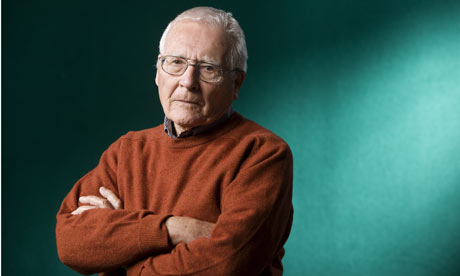
Humans are too stupid to prevent climate change, according to the British scientist James Lovelock. Illustration: Murdo Macleod
Humans are too stupid to prevent climate change from radically impacting on our lives over the coming decades. This is the stark conclusion of James Lovelock, the globally respected environmental thinker and independent scientist who developed the Gaia theory.
It follows a tumultuous few months in which public opinion on efforts to tackle climate change has been undermined by events such as the climate scientists' emails leaked from the University of East Anglia (UEA) and the failure of the Copenhagen climate summit.
"I don't think we're yet evolved to the point where we're clever enough to handle a complex a situation as climate change," said Lovelock in his first in-depth interview since the theft of the UEA emails last November. "The inertia of humans is so huge that you can't really do anything meaningful."
One of the main obstructions to meaningful action is "modern democracy", he added. "Even the best democracies agree that when a major war approaches, democracy must be put on hold for the time being. I have a feeling that climate change may be an issue as severe as a war. It may be necessary to put democracy on hold for a while."
Lovelock, 90, believes the world's best hope is to invest in adaptation measures, such as building sea defences around the cities that are most vulnerable to sea-level rises. He thinks only a catastrophic event would now persuade humanity to take the threat of climate change seriously enough, such as the collapse of a giant glacier in Antarctica, such as the Pine Island glacier, which would immediately push up sea level.
"That would be the sort of event that would change public opinion," he said. "Or a return of the dust bowl in the mid-west. Another Intergovernmental Panel on Climate Change (IPCC) report won't be enough. We'll just argue over it like now." The IPCC's 2007 report concluded that there was a 90% chance that greenhouse gas emissions from human activities are causing global warming, but the panel has been criticised over a mistaken claim that all Himalayan glaciers could melt by 2030.
Lovelock says the events of the recent months have seen him warming to the efforts of the "good" climate sceptics: "What I like about sceptics is that in good science you need critics that make you think: 'Crumbs, have I made a mistake here?' If you don't have that continuously, you really are up the creek. The good sceptics have done a good service, but some of the mad ones I think have not done anyone any favours. You need sceptics, especially when the science gets very big and monolithic."
Lovelock, who 40 years ago originated the idea that the planet is a giant, self-regulating organism – the so-called Gaia theory – added that he has little sympathy for the climate scientists caught up in the UEA email scandal. He said he had not read the original emails – "I felt reluctant to pry" – but that their reported content had left him feeling "utterly disgusted".
"Fudging the data in any way whatsoever is quite literally a sin against the holy ghost of science," he said. "I'm not religious, but I put it that way because I feel so strongly. It's the one thing you do not ever do. You've got to have standards."
• Read the full transcript of the interview
Source: http://www.guardian.co.uk/science/2010/mar/29/james-lovelock-climate-change
.
Sunday, March 21, 2010
Agenda 21 – The UN Blueprint for the 21st Century *
The Green Agenda
20.08.2008
">http://
Agenda 21 Enforcement
“Effective execution of Agenda 21 will require a profound reorientation of all human society, unlike anything the world has ever experienced a major shift in the priorities of both governments and individuals and an unprecedented redeployment of human and financial resources. This shift will demand that a concern for the environmental consequences of every human action be integrated into individual and collective decision-making at every level.”-
[Excerpt from attorney Dan Sitarz’s book about the United Nations’ Agenda 21, the blueprint for the 21st century (Agenda 21: The Earth Summit Strategy), written with the cooperation of the United Nations Conference on Environment and Development. Listed as one of the top books for the 21st century by the International Center for Environment and Public Policy of the California Institute of Public Affairs.]
Agenda 21 – The UN Blueprint for the 21st Century
As described in my previous article on Sustainable Development, Agenda 21 was the main outcome of the United Nation’s Earth Summit held in Rio de Janeiro in 1992. Agenda 21 outlines, in detail, the UN’s vision for a centrally managed global society. This contract binds governments around the world to the United Nation’s plan for controlling the way we live, eat, learn, move and communicate - all under the noble banner of saving the earth. If fully implemented, Agenda 21 would have the government involved in every aspect of life of every human on earth.
Agenda 21 spreads it tentacles from Governments, to federal and local authorities, and right down to community groups. Chapter 28 of Agenda 21 specifically calls for each community to formulate its own Local Agenda 21: ”Each local authority should enter into a dialogue with its citizens, local organizations, and private enterprises and formulate ‘a Local Agenda 21.’ Through consultation and consensus-building, local authorities would learn from citizens and from local, civic, community, business and industrial organizations and acquire the information needed for formulating the best strategies.” - Agenda 21, Chapter 28, sec 1.3
Interestingly, in April 1991, fourteen months before Earth Summit, Prince Charles held a private two day international conference aboard the royal yacht Britannia, moored off the coast of Brazil. His goal was to bring together key international figures in an attempt to achieve a degree of harmony between the various countries that would gather at the Summit. Al Gore was present, along with senior officials from the United Nations and the World Bank.
At the summit 179 nations officially signed Agenda 21 and many more have followed since. Nearly 12,000 local and federal authorities have legally committed themselves to the Agenda. In practice this means that all their plans and policies must begin with an assessment of how the plan or policy meets the requirements of Agenda 21, and no plans or policies are allowed to contradict any part of the Agenda. Local authorities are audited by UN inspectors and the results of the audits are placed on the UN website. You can see how many local authorities in your country were bound by Agenda 21 in 2001 here. The number has increased significantly since then.
The official opening ceremony was conducted by the Dalai Lama and centered around a Viking long-ship that was constructed to celebrate the summit and sailed to Rio from Norway. The ship was appropriately named Gaia. A huge mural of a beauiful woman holding the earth within her hands adorned the entrance to the summit. Al Gore lead the US delegation where he was joined by 110 Heads of State, and representatives of more than 800 NGO’s.
Maurice Strong, Club of Rome member, devout Bahai, founder and first Secretary General of UNEP, has been the driving force behind the birth and imposition of Agenda 21. While he chaired the Earth Summit, outside his wife Hanne and 300 followers called the Wisdom-Keepers, continuously beat drums, chanted prayers to Gaia, and trended scared flames in order to “establish and hold the energy field” for the duration of the summit. You can view actual footage of these ceremonies on YouTube. During the opening speech Maurice Strong made the following statements:
“The concept of national sovereignty has been an immutable, indeed sacred, principle of international relations. It is a principle which will yield only slowly and reluctantly to the new imperatives of global environmental cooperation. It is simply not feasible for sovereignty to be exercised unilaterally by individual nation states, however powerful. The global community must be assured of environmental security.” - Link
“It is the responsibility of each human being today to choose between the force of darkness and the force of light. We must therefore transform our attitudes, and adopt a renewed respect for the superior laws of Divine Nature.” - Link
“Current lifestyles and consumption patterns of the affluent middle class - involving high meat intake, use of fossil fuels, appliances, air-conditioning, and suburban housing - are not sustainable. A shift is necessary which will require a vast strengthening of the multilateral system, including the United Nations.” - Link
Among other things, the agenda called for a Global Biodiversity Assessment of the State of the Earth. Prepared by the UN Environmental Programme (UNEP), this 1140 page document armed UN leaders with the “ecological basis, and moral authority” they needed to validate their global management system. The GBA concludes on page 863 that “the root causes of the loss of biodiversity are embedded in the way societies use resources. This world view is characteristic of large scale societies, heavily dependent on resources brought from considerable distances. It is a world view that is characterized by the denial of sacred attributes in nature, a characteristic that became firmly established about 2000 years ago with the Judeo-Christian-Islamic religious traditions. Eastern cultures with religious traditions such as Buddhism, Jainism and Hinduism did not depart as drastically from the perspective of humans as members of a community of beings including other living and non-living elements.” In other words Christians and Moslems are to blame for the sorry state of the world because their religions do not involve worshipping “sacred nature.”
Following the Earth Summit Maurice Strong was named Assistant Secretary General of the United Nations, and was appointed to the position of Chief Policy Advisor by Kofi Annan. He was also a member of the UN’s Commission on Global Governance, and the key architect of the Kyoto Protocol. Strong and his wife have also established the Manitou Foundation, providing land in the Colorado to an eclectic mix of religious groups, including the Crestone Mountain Zen Center, the Spiritual Life Institute (a Catholic Carmelite monastery), the Haidakhandi Universal Ashram, the Sri Aurobindo Learning Center, Mangala Shri Bhuti (Tibetan Buddhists), and Karma Thegsum Tashi Gomang (Indian mystics). The Strongs have located their spiritual centre in the Colorado mountains because:”The Strongs learned that since antiquity indigenous peoples had revered this pristine wilderness as a place for conducting their vision quests and receiving shamanic trainings. It is prophesied that the world’s religious traditions would gather here and help move theworld toward globally conscious co-existence and co-creation.”
So what exactly does Agenda 21 contain? It consists of 115 different and very specific programs designed to facilitate, or to force, the transition to Sustainable Development. The objective, clearly enunciated by the leaders of the Earth Summit, is to bring about a change in the present system of independent nations. The agenda is broken up into 8 ‘programme areas for action’:
>> Agriculture
>> Biodiversity and Ecosystem Management
>> Education
>> Energy and Housing
>> Population
>> Public Health
>> Resources and recycling
>> Transportation, Sustainable Economic Development
As you can see Agenda 21 addresses nearly every aspect of modern life. If you have a spare few days the entire document can be read here. I encourage the reader to at least read the Table of Contents in order to understand the true scope of this ‘blueprint for the 21st century.’ I won’t torture the reader by going into the document in too much depth but I will provide the first six paragraphs so that you can understand the true intent of Agenda 21:
1.1. Humanity stands at a defining moment in history. We are confronted with a perpetuation of disparities between and within nations, a worsening of poverty, hunger, ill health and illiteracy, and the continuing deterioration of the ecosystems on which we depend for our well-being. However, integration of environment and development concerns and greater attention to them will lead to the fulfilment of basic needs, improved living standards for all, better protected and managed ecosystems and a safer, more prosperous future. No nation can achieve this on its own; but together we can - in a global partnership for sustainable development.
1.2. This global partnership must build on the premises of General Assembly resolution 44/228 of 22 December 1989, which was adopted when the nations of the world called for the United Nations Conference on Environment and Development, and on the acceptance of the need to take a balanced and integrated approach to environment and development questions.
1.3. Agenda 21 addresses the pressing problems of today and also aims at preparing the world for the challenges of the next century. It reflects a global consensus and political commitment at the highest level on development and environment cooperation. Its successful implementation is first and foremost the responsibility of Governments. National strategies, plans, policies and processes are crucial in achieving this. International cooperation should support and supplement such national efforts. In this context, the United Nations system has a key role to play. Other international, regional and subregional organizations are also called upon to contribute to this effort. The broadest public participation and the active involvement of the non-governmental organizations and other groups should also be encouraged.
1.4. The developmental and environmental objectives of Agenda 21 will require a substantial flow of new and additional financial resources to developing countries, in order to cover the incremental costs for the actions they have to undertake to deal with global environmental problems and to accelerate sustainable development. Financial resources are also required for strengthening the capacity of international institutions for the implementation of Agenda 21.
1.5. In the implementation of the relevant programme areas identified in Agenda 21, special attention should be given to the particular circumstances facing the economies in transition. It must also be recognized that these countries are facing unprecedented challenges in transforming their economies, in some cases in the midst of considerable social and political tension.
1.6. The programme areas that constitute Agenda 21 are described in terms of the basis for action, objectives, activities and means of implementation. Agenda 21 is a dynamic programme. It will be carried out by the various actors according to the different situations, capacities and priorities of countries and regions in full respect of all the principles contained in the Rio Declaration on Environment and Development. It could evolve over time in the light of changing needs and circumstances. This process marks the beginning of a new global partnership for sustainable development.
Like many ‘green movement initiatives’ Agenda 21 is a ‘wolf in sheep’s clothing’. As explained in my brief biography I have been actively involved in preparing Agenda 21 action plans and monitoring compliance with environmental permits. All the policies and plans we developed were required to begin with a description of how they met the objectives of Agenda 21 and various other UN agreements, and were audited too determine how they complied with UN requirements. It was these experiences that lead to my research into what was ‘behind it all’ and the subsequent publication of this website.
Agenda 21 is not an environmental management policy, but an attempt to impose a global centrally planned quasi-government administered by the United Nations. Under Agenda 21 all central government and local authority signatories are required to conform strictly to a common prescribed standard and hence this is just communism resurrected in a new guise. Now that Agenda 21 has gained a stranglehold on global regulatory and planning processes Maurice Strong and his Club of Rome colleagues have moved on to the next phase of the Global Green Agenda.

In association with fellow CoR member Mikhail Gorbachev, Strong co-chaired the committee responsible for drafting the Earth Charter. Compared to the 2500 pages that make up Agenda 21 and the BGA it is a tiny document – only 4 pages long. But it is of far more significance to the Global Green Agenda. The Earth Charter is a “declaration of fundamental principles for building a just, sustainable, and peaceful global society in the 21st century”. It is the constitution for a New Green Order. You can read about it
here.
.
.
Source: http://www.wiseupjournal.com/?p=475
.
Friday, January 15, 2010
AIM Column on Pope Sparks Controversy
Press Release January 13, 2010
AIM editor Cliff Kincaid's column, "Pope Continues Global "Green" Crusade for World Government," has generated a lot of reaction. Cliff discussed the column during an appearance on G. Gordon Liddy's national radio program. Cliff and Gordon are both Catholics and discussed the roles being played by the Vatican and the U.S. Catholic Bishops in such matters as climate change legislation, health care, and amnesty for illegal aliens. You can listen to the interview here. These are some of the comments we received in response to Cliff's column:
AIM editor Cliff Kincaid's column, "Pope Continues Global "Green" Crusade for World Government," has generated a lot of reaction. Cliff discussed the column during an appearance on G. Gordon Liddy's national radio program. Cliff and Gordon are both Catholics and discussed the roles being played by the Vatican and the U.S. Catholic Bishops in such matters as climate change legislation, health care, and amnesty for illegal aliens. You can listen to the interview here. These are some of the comments we received in response to Cliff's column:
- You have been writing some great articles on the Vatican's socialist and environmentalist agenda. The papacy wields so much power that it is sheer suicide for those who truly care about liberty to ignore the influence and agenda of the Vatican. I suppose you also know the role the Catholic Bishops have been playing in promoting illegal immigration across our southern borderas well aslobbying for amnesty, drivers licenses, scholarships etc.for illegals. But again, thank you for being bold to tell the truth about the pope's political agenda.
- Thank you Cliff, another good article. I wonder if anyone else will enter the subject.
- Please take me off your distribution list. The treatment of the Holy Father in the article is demeaning and offensive to traditional, conservative Catholics, like me. I am not troubled nor embarrassed by my church but am very proud of it and this Pope.
- I am a 'traditional' Catholic and attend Mass at an SSPX chapel. It's scandalous that so-called Popes, who have deliberately undermined Catholicism as well as liberty for decades, now feel no compunction about ushering in the age of the anti-Christ, as described in Revelation. Nominally, the Pope is the leader of the Catholic Church. In reality, he is becoming irrelevant to the majority of Catholics. It is a predictable result of meddling in politics and refusing to exercise any moral guidance, his only legitimate function.
- The pope does exactly what scripture says; namely reviving the 3rd Roman Empire. It will be the last one; and if you continue to read scripture, you will see that once again, the Roman Catholic Church and Europe will attack Israel. I was wondering when this would come about; I guess I don't have to wait anymore. Surely, the resurrected Roman Empire will be part of the UN, which is called 'the beast' in the Bible. Nothing surprises me anymore."
- Being a Catholic, I believe the Pope looks at the world not through a political eye. He sees United Nations as the way the world should be, united and at peace with each other, protecting each other. He sees man's faults (and sinfulness) and how man can destroy himself and the creation around him. You and I know that the United Nations is corrupt and not to be trusted and that global warming is a hoax. I think we have to examine the lens we look through.
- As a traditional Catholic it is my opinion that the pope should be calling for the investigation and prosecution of all who are responsible for the fraud called 'global warming.' All who are indicted for this fraud should be tried for 'CRIMES AGAINST HUMANITY.'Population control, confiscation and redistribution of wealth, destruction of sovereignties around the world, oppressive laws established to control humanity and out and out tyranny against ALL OF MANKIND. They have squandered billions of dollars in their fraud on research in global warming -- money that could have been well spent in feeding the poor. These people need to be brought to justice, exposed and convicted for their crimes against mankind. In my opinion the pope must be sipping too much of the altar wine or he is now favorable to the teachings of Freemasonry, which the REAL Roman Catholic Church and its popes always opposed.
- Someone needs to clue in the pope that man-made global warming is a hoax and conspiracy as proven by the whistleblower email scandal.Climate is mostly due to sunspot activity (i.e., God).The Pope would be better off by railing against corrupt governments and money wasted on global warming and not used to help the needy, hungry, etc.
- I don't believe this; as if those of us who are "foot soldiers in the anti-New World Order army" don't have a big enough challenge as it is, now we have to deal with this same neo-Marxist, anti-civilization, anti-progress twaddle coming from the Church of all places!! This to me sounds like Ratzinger is using his Papacy to shill for eco-fascist, globalist, and international leftist pet causes when he should be concerning himself with Church matters. When he speaks of the "cultural and moral problems" that exist in the world, as the leader of the Catholic Church he of all people should know perfectly well that those problems exist because of the fallen nature of the imperfect human race, and the solution to those issues is not to be found in the empowerment of any kind of global tyranny, whether it be the Dis-United Nations or anything else.
- Ever since Constantine, the church has been political.Why are we surprised that the pope would support a globalist scam?Of course, there is always the possibility that he thinks AGW [anthropogenic global warming] is true.
Source:http://www.aim.org/press-release/aim-column-on-pope-sparks-controversy/
.


Saturday, December 19, 2009
Ellen White Visionary for Kids #11 Focuses on Being Green!

Ellen WhiteVisionary for Kids#11 Focuses on Being Green!
Focus on Being Green
From the Pen
You've Got Issues
Ask Cindy
Jesus - His Story
Give a Bible Study
Your Corner
Eco-Craft
Did you Know?
Puzzle Page
About Ellen White
Videos
From the Pen
You've Got Issues
Ask Cindy
Jesus - His Story
Give a Bible Study
Your Corner
Eco-Craft
Did you Know?
Puzzle Page
About Ellen White
Videos
Focus on Being a Green Christian
This issue of Ellen White Visionary for Kids (Ve.Z) focuses on Being Green Christians. Why is it important to take care of the earth? What can you do to make a difference? What does the Bible have to say about taking care of creation? There are so many questions you want answered! Take a peek inside and find answers to some of your questions. Next time in Ve.Z we will focus on God's Amazing Creation.
e-Mail us your questions, stories, pictures or drawings and receive $25 for your published pictures or stories. Click here if you would like to: Subscribe to Ve.Z
Source: http://www.whiteestate.org/vez/
.
Wednesday, December 16, 2009
Hope in Copenhagen
Tuesday, December 15, 2009
By Megan Sweas

But now that I'm on the other side of the ocean from the talks, it's hard to keep that optimism up. I admit that I am not following the talks too closely, though the "news" from the Daily Show was distressing--both that limos are being brought in to cart around dignitaries and that some loud people (on FOX News, of course) are denying climate change.
But I can't help worrying that nothing or little will happen.
This statement discounts the fact that not everyone in the United States can afford to live in McMansions in the suburbs and drive around SUVs. And most Catholics know that de-emphasizing the material in favor of the spiritual will actually give you a higher quality of life.
By Megan Sweas

Having spent part of my Thanksgiving vacation in Hopenhagen, as the locals are calling it, I have been optimistic that this round of climate change talks would achieve something.
But now that I'm on the other side of the ocean from the talks, it's hard to keep that optimism up. I admit that I am not following the talks too closely, though the "news" from the Daily Show was distressing--both that limos are being brought in to cart around dignitaries and that some loud people (on FOX News, of course) are denying climate change.
.
.
I’m glad for Catholic News Service’s update on the talks, in which we get the view from the developing world.
.
I feel that I am represented well by the Catholic Church at least, and I’m thankful that the pope released his World Peace Day message about climate change now (the official day is January 1).
While angry protesters have caused some problems, there are a number of peaceful protesters as well. I thought this idea of ringing church bells 350 times to signify 350 ppm of carbon dioxide, the safe upper limit according to the latest science, was unique. And more than 11 million have signed this petition. I am inspired by the women religious/ecotheologians that Meghan writes about in her blog post.
While angry protesters have caused some problems, there are a number of peaceful protesters as well. I thought this idea of ringing church bells 350 times to signify 350 ppm of carbon dioxide, the safe upper limit according to the latest science, was unique. And more than 11 million have signed this petition. I am inspired by the women religious/ecotheologians that Meghan writes about in her blog post.
But I can't help worrying that nothing or little will happen.
.
This photo is of a new statue placed in the water near Copenhagen's famous Little Mermaid. A fat woman, representing rich, Western countries, rides on the back of a skinny African man, representing the poor. I was distressed by a comment on FOX (see the Daily Show) that said the rest of the world just wants to bring the U.S. standard of living in the down.
This statement discounts the fact that not everyone in the United States can afford to live in McMansions in the suburbs and drive around SUVs. And most Catholics know that de-emphasizing the material in favor of the spiritual will actually give you a higher quality of life.
“Live simply so that others may simply live” is a good prescription for happiness. God’s love is unlimited, but Earth's bounty is limited. Especially at this time of year when waste is so high (read my post on having a green Christmas from last year), we should try to live by our values and remember that the poor suffer because of the way we treat the Earth.
.
.
ClimateGate, the Green Dragon, and the End of Christianity - Special Report

AIM Column By Cliff Kincaid December 9, 2009
What is the real agenda behind the fraudulent “science?
With the ClimateGate revelations of flimsy "science" behind the man-made global warming theory, the role of the religious left in promoting this fraudulent scheme now deserves serious media scrutiny. Walter Grazer, who served as the Director of the Environmental Justice Program for the United States Catholic Conference of Bishops from 1993 to 2007 and is now interim executive director of the National Religious Partnership for the Environment (NRPE), was asked for a comment on ClimateGate and replied, "I am really not up on that issue at all."
Ignoring the growing scandal, the National Religious Coalition on Creation Care issued a press release on the occasion of the opening of the Copenhagen climate change conference declaring that "climate change is a moral and ethical issue because it deals with lifestyle issues and choices that all people must face." Cardinal Theodore McCarrick was quoted as saying that Catholic bishops will be promoting a new "Climate Covenant" and "take the message on the seriousness of climate change to every Catholic parish in America."
But what is the real agenda behind the fraudulent "science?" Is it something more than political and economic control over people's lives?
Dr. James Wanliss, Associate Professor of Physics at Presbyterian College, has written The Green Dragon, a book about how environmentalism is actually committed to "the reconstruction of a pagan world order" and "rejection of Christian spirituality." Wanliss argues that the environmental movement "is a religion with a vision of sin and repentance, heaven and hell. It even has a special vocabulary, with words like 'sustainability' and 'carbon neutral.' Its communion is organic food. Its sacraments are sex, abortion, and when all else fails, sterilization. Its saints are Al Gore and the InterGovernmental Panel on Climate Change."
"Both professing Protestants and Roman Catholics bear a burden of guilt for the current political mess we are in with the global warming and other hysterias," he argues. "If the church had not turned from the gospel of Jesus Christ it is unlikely the Green Dragon would have been able to so deeply sink its fangs into our lives."
Green Religion
Major U.S. religious groups involved in the "climate change" campaign include the National Religious Partnership for the Environment, the Catholic Campaign on Climate Change, the Evangelical Environmental Network and the Evangelical Climate Initiative.
Dr. E. Calvin Beisner, national spokesman for the Cornwall Alliance for the Stewardship of Creation, identifies evangelical leftist Ron Sider as a key figure behind the Evangelical Environmental Network and the Evangelical Climate Initiative. "He's been pressing for wealth redistribution for over thirty years, and the global treaty being touted to fight global warming is nothing if it isn't an exercise in wealth redistribution," says Beisner.
Sider, who is also founder and president of Evangelicals for Social Action, is the author of Rich Christians in an Age of Hunger.
Richard Cizik, who served for ten years as vice president for governmental affairs of the National Association of Evangelicals, was instrumental in creating the Evangelical Climate Initiative. He now serves as a fellow of the George Soros-funded Open Society Institute, where his current job is to "organize and host gatherings of evangelical faith leaders, policy-makers and academics" on climate change.
Beisner says it's a shame that evangelicals are being asked to jump on the global warming bandwagon right when the wheels are falling off because of the ClimateGate scandal.
Big Liberal Money
Wanliss identifies the National Council of Churches (NCC) as playing a major role. He says massive infusions of "green"--money, that is--for the NCC come from left-leaning philanthropies including Pew Charitable Trusts, Tides Foundation, Rockefeller Brothers Fund, Turner Foundation, W. Alton Jones Foundation, V. Kann Rasmussen Foundation, and New World Foundation.
As a result, "There has been, in past decades, a cosmic shift towards a social climate that begins to favor the environment--polar bears, trees, and bugs--over human beings."
Another major player, the National Religious Partnership for the Environment (NRPE), "has an awesome army of organizational links and is itself something of a matryoshka, the Russian nested doll, which is never what it appears at first sight. For it is also not grassroots but launched with funding from left-leaning foundations, primarily the Pew Charitable Trust," he says.
NRPE describes itself as "an association of independent faith groups" that includes the U.S. Conference of Catholic Bishops, the National Council of Churches, the Coalition on the Environment and Jewish Life, and the Evangelical Environmental Network.
"When it began in 1993," Wanliss says, "NRPE had over $5 million in grants to accomplish the goal, according to executive director Paul Gorman, of utilizing churches to produce a 'distinctly religious response to the crisis of environmental sustainability and social justice.' The Partnership has been able to spread environmentalist propaganda and teaching aids to almost every Jewish, and to several hundred thousand Protestant congregations in America."
Through another entity, the Au Sable Institute, Wanliss says that these forces "have infiltrated Christian higher education by careful placement of teachers and teaching materials on environmental activism in schools associated with the Council for Christian Colleges and Universities (CCCU). Many of these schools are conservative in politics or theology. What they teach there under the Au Sable banner, will surprise their supporters. Not surprisingly, the Au Sable Institute and the NRPE share a subset of the same donor pool. Little by little wolves try to douse Christian resistance and lead sheep by troubled waters to accept the inevitability of a divine environmental movement."
The Catholic Coalition on Climate Change was launched in 2006 as a vehicle of the U.S. Conference of Catholic Bishops. This group says that "Because we are not experts on climate change and its consequences, we rely on a scientific consensus (best represented by the Intergovernmental Panel on Climate Change) to guide our activities." Of course, it is the IPCC that is embroiled in the ClimateGate scandal.
In addition to the United States Conference of Catholic Bishops, the Catholic Coalition on Climate Change enjoys the active support of the Association of Catholic Colleges and Universities, Carmelite NGO, Catholic Charities USA; the Catholic Health Association of the United States, Catholic Relief Services, the Conference of Major Superiors of Men, the Franciscan Action Network, the Leadership Conference of Women Religious, the National Catholic Rural Life Conference, and the National Council of Catholic Women.
A related organization is the Catholic Climate Covenant, which claims that the poor are suffering because of the "carbon footprints" of people in the United States and other "rich" nations.
Wanliss says such notions are essential to the "alternative religion" of environmentalism.
.
Wanliss says such notions are essential to the "alternative religion" of environmentalism.
.
Penance for New "Sin"
He explains that, "people with money to burn can buy indulgences just like in the medieval Roman Catholic Church. In that religion priests sold indulgences to souls burdened with guilt over their sins. Even today, when Roman indulgences are not generally for sale--at least not for money--forgiveness is only assured to those who complete the required tasks that earn the indulgence. The green movement has absorbed these faux religious elements, and for each one has its own ersatz affectation. Whatever it may mean, raping the earth is not ecologically sound or morally attractive. But if you must rape Mother Earth, then be sure to visit the Green Dragon and pay a sum of money to cleanse your guilt, until next time. Forgiveness for sins is only a carbon offset away."
"It is possible to calculate the extent of one's sins online," Wanliss points out. "According to TerraPass, over the past three years my weekly driving has resulted in about 5,224 pounds of CO2 a year, and for a mere $29.95 I can buy an indulgence that will offset the environmental impact of my reckless, indeed sacrilegious, lifestyle. These 'carbon offsets' will do as little for the salvation of the world as papal indulgences would for my soul. But for people with a desperate spiritual hunger it is a panacea and penance they are eager to embrace, and an incredible gift to give-it promises guilt free living and a purpose driven life. If only it were true. Go ahead, say the Gore-like business barons, pay the toll at our gate, and this year 'Give the gift of green.'"
Meanwhile, America Magazine, the national Catholic weekly published by the Jesuits, is complaining that Congress did not pass legislation on greenhouse gas emissions before the current United Nations Copenhagen meeting. "The United States will thus remain the only developed nation with no established target for carbon reduction," it says.
The magazine praises the National Religious Partnership for the Environment and the Catholic Campaign on Climate Change for being "vigorous advocates for integrating the world's poor in a climate covenant with funding for both adapting infrastructure to meet the hardships of changing climate and for transferring green technology."
It goes on, "If the planet is to survive, as Pope Benedict XVI concluded in Caritas in Veritate, all nations must accept binding reductions in carbon emissions and construct an equitable structure for energy consumption and for sharing the development of green technology among rich and poor nations--for the sake of this generation and generations to come."
.
Pope Endorses Green Religion
.
.
As AIM has reported, in the encyclical, the Pope says that there is a need for a "a worldwide redistribution of energy resources" and that, "The technologically advanced societies can and must lower their domestic energy consumption, either through an evolution in manufacturing methods or through greater ecological sensitivity among their citizens."
At the same time, he warned that "it is contrary to authentic development to view nature as something more important than the human person" and that this position "leads to attitudes of neo-paganism or a new pantheism."
Indeed, the U.N. Environmental Program, which is now promoting a "Global Green New Deal," has celebrated the idea of an "Environmental Sabbath," in which children hold hands around a tree and meditate.
Wanliss notes that George Orwell's book Animal Farm tells of the visionary pig Old Major who had a dream that soon proved disastrous: "And now, comrades, I will tell you about my dream of last night. I cannot describe that dream to you. It was a dream of the earth as it will be when Man is forgotten."
Wanliss cautions that attempts by Church leaders and Christian organizations to synthesize a Christian environmentalism can succeed "only by exorcising truth, and ultimately, by expelling Christianity..."
But he adds, "Will it not be ironic if the Green Dragon they so adore ends up destroying them?"
.
.
Cliff Kincaid is the Editor of the AIM Report and can be reached at cliff.kincaid@aim.org
Sunday, December 06, 2009
Top UN climate official confident that new pact will be reached in Copenhagen

6 December 2009 – On the eve of the historic United Nations climate change gathering in Copenhagen, Denmark, a top official with the world body today expressed confidence that the event will deliver a comprehensive and ambitious new deal.
The two-week talks are set to kick off tomorrow in the Danish capital, and by the end of the summit, Governments must adequately respond to the urgent challenge posed by climate change, said Yvo de Boer, Executive Secretary of the UN Framework Convention on Climate Change (UNFCCC).
“Negotiators now have the clearest signal ever from world leaders to craft solid proposals to implement rapid action,” he noted.
Mr. de Boer acknowledged the many pledges to slash reductions made by nations – both developed and developing – and underscored that there is an unprecedented political momentum to “seal the deal” on a new deal in Copenhagen, which will be the scene of the world's largest meeting on climate change ever, with over 100 Heads of State expected to attend.
“Never in 17 years of climate negotiations have so many different nations made so many firm pledges together,” he said. “So whilst there will be more steps on the road to a safe climate future, Copenhagen is already a turning point in the international response to climate change.”
There are three layers of action, the official emphasized, that nations must agree on during the gathering: swift implementation of action on climate change ambitious commitments to curb emissions and a long-term shared vision of a low-emissions future for all.
Developed countries, he said, must provide at least $10 billion annually from next year through 2012 to help their developing counterparts plan and launch low emission growth and adaptation strategies, as well as to build internal capacity. Simultaneously, wealthier nations must also indicate how they will raise predictable and sustainable financing for the long term, as well as what their future commitments will be.
According to the Nobel Peace Prize-winning Intergovernmental Panel on Climate Change (IPCC), an aggregate emission reduction by industrialized nations of between -25 and 40 per cent over 1990 levels is necessary by 2020 in order to avert the worst effects of climate change, with global emissions falling by at least 50 per cent by 2050.
A new report backed by the UN Environment Programme (http://www.unep.org/UNEP) has found that countries taking part in the Copenhagen summit, expected to draw over 15,000 people, may be closer than some might realize to agreeing to emissions cuts required to allow the world to prevent a global temperature rise of more than 2 degrees centigrade.
The publication released today notes that the gap between countries' strongest proposed cuts and what is needed could only be a few billion tonnes of greenhouse gases.
The study was compiled by Lord Stern of Brentford, chair of the Grantham Research Institute on Climate Change and the Environment at London School of Economics and Political Science, in collaboration with UNEP analysts.
To ward off a more than 2 degree temperature rise, it said that annual emissions in 2020 must not exceed more than 44 billion tonnes of carbon dioxide-equivalent. The new analysis shows that the gap between this target and the most ambitious cuts suggested by nations in recent months is some 2 billon tonnes of carbon dioxide-equivalent.
The gap could be bridged in the Danish capital, the report suggests, by actions including additional reductions from deforestation and other sources slashing emissions from the aviation and shipping industries and key developing countries offering more than their current proposals.
“What we are presenting here is underpinned by numerous provisons – not least that serious and sustained funding is provided to assist countries like Brazil and Indonesia to achieve the high end of their new proposals, and that all nations deliver on their pledges and promises,” said Achim Steiner, UNEP's Executive Director.
The “central message,” he stressed, is that limiting global temperature rise to no more than 2 degrees can be achieved in a cost-effective way with clearly-designed policies consistently applied across countries and industries and “can also set the stage for a low-carbon, resource-efficient 21st century Green Economy.”
.
.
Monday, November 30, 2009
Document Reveals U.N.'s Goal of Becoming Rule-Maker in Global Environmental Talks

Monday, November 30, 2009 By George Russell
Environmentalism should be regarded on the same level with religion "as the only compelling, value-based narrative available to humanity," according to a paper written two years ago to influence the future strategy of the United Nations Environmental Program (UNEP), the world's would-be environmental watchdog.
The purpose of the paper, put together after an unpublicized day-long session in Switzerland by some of the world's top environmental bureaucrats: to argue for a new and unprecedented effort to move environmental concerns to "the center of political and economic decision-making" around the world — and perhaps not coincidentally, expand the influence and reach of UNEP at the tables of world power, as a rule-maker and potential supervisor of the New Environmental Order.
The positions argued in that paper now appear to be much closer at hand; many of them are embedded in a four-year strategy document for UNEP taking effect next year, in the immediate wake of the much-touted, 11-day Copenhagen conference on "climate change," which starts on Dec. 7, and which is intended to push environmental concerns to a new crescendo.
The major difference is that the four-year UNEP plan expresses its aims in the carefully soporific language that U.N. organizations customarily use to swaddle their objectives. The Swiss document makes its case passionately — and more important, plainly — than any U.N. official document ever would.
The ambitious paper, entitled "The UNEP That We Want," was the product of a select group of 20 top environmental bureaucrats and thinkers, including UNEP's current No. 2 official, Angela Cropper. The document was later delivered to UNEP Executive Director Achim Steiner.
Other participants included Janos Pasztor, currently head of the team pushing U.N. Secretary General Ban Ki-moon's unprecedented Seal the Deal lobbying campaign to pressure U.N. member governments into signing a new environmental agreement at Copenhagen; Julia Marton-Lefevre, head of the World Conservation Union; Dominic Waughray, currently head of environmental initiatives at the World Economic Forum; and Maria Ivanova, a Bulgarian academic who is director of the Global Economic Governance Project at the Yale Center for Environmental Law and Policy.
Another important attendee was John Scanlon, listed on UNEP's website as principal advisor to UNEP's Steiner. Among other things, Scanlon is credited in his UNEP biography with being the leader in developing UNEP's new medium-term strategy, "Environment for Development," covering the period from 2010 to 2013. The draft version of the strategy was presented to a UNEP's Governing Council and a meeting of the world's environmental minister's in February 2008, and subsequently approved.
The Swiss paper was written not by Scanlon but by Mark Halle, the Europe-based director of trade and investment for an influential environmental think-tank, the International Institute for Sustainable Development (IISD), which originated in Canada and now operates in some 30 countries. IISD, which still has heavy Canadian government support, bills itself as a research institute promoting policies that are "simultaneously beneficial to the global economy, the global environment and to social well-being."
Even though all of the Swiss participants took part in the brainstorming, the responsibility for the ideas in the paper are his own, Halle emphasized to Fox News, after he was contacted last week about the document. The paper itself says it offers "elements," not a "complete offering," of what UNEP should consider for its role in the years ahead.
Despite those limitations, the report was "very well received" by UNEP's hierarchy, according to Halle, and "it has had a great impact internally." He added, "I have participated in several discussions and presentations of the ideas."
In fact, there is a high degree of overlap between the ideas pulled together at the small Swiss meeting of experts and the ideas that also appear in the new strategic plan for UNEP, a copy of which has been obtained by Fox News.
Those ideas are being espoused at a highly charged time. Both environmentalists and the entire United Nations, led by Secretary-General Ban Ki-moon, are still fervently pressuring governments around the world to sign a legally binding and more global successor to the Kyoto Protocol on greenhouse gas suppression, which expires in 2012. At the moment, that deal appears likely to be delayed, at least until next spring, as some wealthy countries, including the U.S., balk at the high cost and potentially crippling economic impact of targets to reduce carbon emissions into the earth's atmosphere, even though President Barack Obama supports an ambitious Copenhagen deal.
But UNEP's strategic plan, as well as the IISD document that grew out of the Swiss gathering, look well beyond the horizon of Copenhagen in suggesting the outlines of the world's environment-centered future, to what the strategic plan calls "the next phase in the evolution of UNEP."
Among other things, both documents argue for:
—a "new and central position for environmentalism in the world's thinking," as the Swiss paper puts it. "The current environmental challenges and opportunities will cause the environment to move from often being considered as a marginal issue at the intergovernmental and national levels to the centre of political and economic decision-making," says the medium-term plan.
—a new position in the international power game for UNEP, reaching far beyond the member governments that currently finance its core budget and make up its normal supervisors. "It will have to make itself relevant well beyond the world of those already concerned with the environment, including very prominently its own formal constituency," as the Swiss paper puts it.
UNEP will "actively reach out to Governments, other United Nations entities, international institutions, multilateral environmental agreement secretariats, civil society, the private sector and other relevant partners to implement the Medium-term Strategy," says the UNEP document.
—a major restructuring of international institutions to merge environmental issues with economics as the central priority. "We require an Environmental Bretton Woods for the 21st Century," Halle argues — a reference to the meeting that laid the foundations of Western international finance and economic regulation after World War II. "The linkages between environmental sustainability and the economy will emerge as a key focus for public policymaking and a determinant of future markets opportunities," according to the UNEP strategic plan.
—new environmental rules, regulations and standards, and the linking of existing environmental agreements, in a stronger global lattice-work of environmental law, with stronger authority to command national governments. The Swiss paper calls it a series of "ambitious yet incremental adjustments" to international environmental governance. Indeed, the document says, UNEP's "role is to 'tee up' the next generation of such rules."
The UNEP four-year strategy puts it more obliquely, and only in a footnote on page 7 of the document: "UNEP will actively participate in the continuing international environmental governance discussions both within and outside the United Nations system, noting the repeated calls to strengthen UNEP, including its financial base, and the 'evolutionary nature of strengthening international environmental governance.'"
—an extensive propagandizing role for UNEP that reaches beyond its member governments and traditional environmental institutions to "children and youth" as well as business and political groups, to support UNEP strategic objectives.
As the Swiss paper puts it, UNEP "should pioneer a new style of work. This requires going beyond a narrow interpretation of UNEP's stakeholders as comprising its member states — or even the world's governments — and recruiting a far wider community of support, in civil society, the academic world and the private sector." At the same time the paper warns that these groups need to be "harnessed to the UNEP mission without appearing to make an end-run around the member governments."
The official four-year plan uses more restrained language in declaring that "civil society, including children and youth, and the private sector will be reached through tailor-made outreach products and campaigns.... Civil society will also be engaged to assist with UNEP outreach efforts." (The term "civil society," as used by the U.N., usually refers to organizations and associations that have received formal recognition from one branch or another of the sprawling world organization.)
—along with increased political leverage for UNEP, bringing increased financial leverage to its cause, once again by reaching beyond the national environmental ministries that traditionally are the organization's financial base to more powerful sectors of government as well as business and other interest groups that will see profit and advantage in the new, environment centered approach.
Says the Swiss paper: "UNEP must focus on priorities that meet two characteristics: they should appeal to the more powerful [government] ministers responsible for economic policy; and they should empower environmental ministers at the cabinet table. UNEP's message is not for environment ministers — the already converted.... It must aim higher."
As UNEP's four-year strategy more circumspectly puts it: "Mobilizing sufficient finance to meet environmental challenges, including climate change, extends well beyond global mechanisms negotiated under conventions. It will require efforts at local, national and global levels to engage with Governments and the private sector to achieve the necessary additional investment and financial flows."
As far as UNEP itself is concerned, the document says, the organization "will raise contributions from the private sector, foundations and non-environmental funding windows…Funds will also be drawn from humanitarian, crisis and peacebuilding instruments, where appropriate."
—Perhaps the most important function both documents see for the newly enhanced UNEP is to seek influence as the world's guiding arbiter of a new measurement of human development. "We believe the environmental argument should be recast in terms of its importance for and potential contribution to prosperity, stability and equity," the Swiss paper argues.
Or, more discreetly, as the strategy document puts it: "Integrated environmental assessments that highlight the state of the environment and trends will be used to inform decision-makers and ensure UNEP plays its lead environmental role in the United Nations system and strengthens its capacity to respond better to the global, regional and national needs of Governments."
According to Halle, however, in an e-mail exchange with Fox News, there are signs that the hugely ambitious role he and his fellow-thinkers sketched for UNEP as religion's main competitor are "beginning to happen." Halle pointed to UNEP's espousal this year of a so-called Green Economy Initiative, a proposal to radically redesign the global economy and transfer trillions of dollars in investment to the world's poorest developing countries, but one that is couched in terms of providing new green jobs, an end to old, unfair carbon-based energy subsidies, and greater global fairness and opportunity. Halle called the development "quite exciting."
The Green Economy Initiative, also called the Global Green New Deal, is a major counterpart to the new treaty on greenhouse gas suppression that all branches of the United Nations, and a horde of environmental organizations, are lobbying loudly to bring to agreement at the environmental summit in Copenhagen.
It is certain to remain a UNEP rallying cry long after the Copenhagen meeting is over — and while the other brainstorming ideas that went into the new four-year strategy, not to mention the strategy itself, go into effect.
George Russell is executive editor of Fox News.
.
Sunday, October 18, 2009
Biggest economies try again to strike climate deal

By ROBERT BARR (AP) – 5 hours ago
LONDON — Representatives of the world's 17 biggest and most polluting nations were holding talks Sunday to search for a breakthrough on financing efforts to contain climate change and reduce gas emissions causing global warming.
Pressure has been mounting for the United States to finalize its position before a decisive December conference in Denmark meant to cap two years of negotiations on a global climate change treaty.
"With only 50 more days to go before the final talks at Copenhagen, we have to up our game. Britain is determined to throw everything at this because the stakes are so high," British Environment Minister Ed Miliband said in a statement released Sunday.
Earlier Miliband had said it was "important that the U.S. makes as much progress as possible" at the two-day meeting of the Major Economies Forum.
The Obama administration said it was tied to action by U.S. Congress, where climate bills were making their slow way toward legislation — an argument which cut little ice with other negotiators.
"The rich countries of the Major Economies Forum must urgently put new money on the table to ensure the developing world can grow cleanly and adapt to the effects of climate change, which are already putting millions of lives at risk," said Asad Rehman of Friends of the Earth.
Miliband said there had been some progress, pointing to recent commitments by Japan and China aimed at reducing emissions.
"There are some good straws in the wind, but there are also some big obstacles to overcome," Miliband told the BBC, speaking ahead of the talks opening.
He insisted that the meeting in London could tackle differences between developed and developing nations outside the formal U.N. negotiating process.
"The truth is if this is left to the negotiators ... I think we'll fail," Miliband said. "If we can get a way forward, narrow some of the differences between the countries which represent the lion's share of the problem, then it might make those U.N. talks a bit easier."
Sweden's environment minister Andreas Carlgren, representing the European Union, will hold separate talks with representatives from China and India during the meeting, his spokesman Lennart Boden said.
"All the important components that need solving ahead of Copenhagen will be up for discussion here," Boden said. "By tomorrow afternoon we should know if there have been any changes to positions."
One further negotiating session is set for November in Barcelona, Spain.
But pessimism was mounting that a deal can be struck without policy changes at the highest level.
"In recent months, the prospects that states will actually agree to anything in Copenhagen are starting to look worse and worse," Rajendra Pachauri, head of the U.N. scientific panel studying climate change, wrote in a Friday post on the Newsweek Web site.
President Barack Obama initiated the Major Economies Forum earlier this year as an informal caucus to quietly deal with the toughest problems. Participants agree to keep the talks confidential.
A key issue is helping poor countries adapt to changes in the earth's climate that threaten to flood coastal regions, make farming unpredictable and spread diseases. They also need funds and technologies to develop their economies without overly increasing pollution.
Estimates range in the hundreds of billions of dollars needed every year, but a formula for raising, administering and distributing the funds has proved elusive.
Rapidly growing nations like India, China, Brazil and Mexico have agreed to draw up national strategies for slowing the growth of greenhouse gas emissions, but resist making those limits binding and subject to international monitoring in a treaty.
Industrial countries agree to reduce their own emissions, but not to the levels scientists say are required to avert climate catastrophes.
Associated Press Writer Malin Rising in Stockholm, Sweden, contributed to this report
.
Subscribe to:
Posts (Atom)