Showing posts with label 2016. Show all posts
Showing posts with label 2016. Show all posts
Thursday, July 23, 2026


Wednesday, May 06, 2026
Panama Papers: 10 years on, the promises and the failures
The Panama Papers exposed the systems and mechanisms that enable corruption worldwide. A decade later, Transparency International assesses what has changed and what hasn't

- The Panama Papers exposed how hidden company ownership and corporate service providers helped move and conceal wealth linked to corruption and crime.
- A decade on, some progress has been made: more countries now require beneficial ownership registers, anti-money laundering rules have tightened, and Mossack Fonseca shut down.
- Major loopholes still remain and the core system has survived: corruption still thrives through a parallel financial world built to keep dirty money safe.
- Transparency International is pushing for accessible ownership data, tougher enforcement, stronger regulation and supervision of gatekeeper professions, better asset recovery and real cross-border cooperation.
In 2016, the Panama Papers pulled back the curtain on a financial system designed to operate in secrecy. The International Consortium of Investigative Journalists, working with Süddeutsche Zeitung and more than 100 media partners, analysed a cache of 11.5 million leaked documents from the Panamanian law firm Mossack Fonseca. The investigation revealed how anonymous shell companies and offshore accounts were used to conceal wealth, obscure ownership and, in many cases, facilitate corruption and crime.
The level of global exposure, the vast sums moved through the system and its sheer geographic reach were unprecedented – and the first consequences followed swiftly.
Icelandic prime minister Sigmundur Davíð Gunnlaugsson resigned within days of being linked to an offshore company. Pakistan’s prime minister Nawaz Sharif was later disqualified from office following investigations triggered by the leak. Vast hidden financial networks were uncovered, reportedly connected to associates of Russian president Vladimir Putin, while figures close to power in China, Ukraine and across Latin America were also named.
What shocked the world was not only who was named and involved, but how routine it all appeared. Anonymous shell companies, nominee directors and complex offshore structures were not fringe tools – they were standard practice in a parallel financial system operating with minimal scrutiny.
Thursday, November 27, 2025
Thursday, May 30, 2024
Thursday, March 28, 2024
Monday, November 13, 2023
Wednesday, August 16, 2023
Monday, May 08, 2023
Saturday, August 31, 2019
Sunday, May 12, 2019
Saturday, December 29, 2018
Saturday, October 27, 2018
2300 versus 2520

Saturday, August 04, 2018
Saturday, July 28, 2018
Catholic and Conservative: A Conversation with Ramesh Ponnuru
25 May 2016

Ramesh Ponnuru is a senior editor for National Review, the venerable magazine of conservative politics founded by William F. Buckley, Jr., in 1955.
Ponnuru grew up in Kansas City and graduated summa cum laude from Princeton’s history department. He has published articles in numerous newspapers including the New York Times, the Washington Post, the Wall Street Journal, the Financial Times, Newsday, and the New York Post. He has also written for First Things, Policy Review, The Weekly Standard, The New Republic, Reason, and other publications.
He is a regular guest on television programs, including CNN’s "Inside Politics," NBC’s "The McLaughlin Group," MSNBC’s "Buchanan & Press" and "Donahue," CNBC’s "Kudlow & Cramer," PBS’s "The NewsHour with Jim Lehrer," CSPAN’s "Washington Journal," Comedy Central’s "Politically Incorrect," Fox News, and NPR’s "Morning Edition."
Ponnuru lives in Washington D.C. with his wife April, a policy adviser to the Majority Whip in the U.S. House of Representatives.
IgnatiusInsight.com spoke with Ponnuru about his recent conversion to Catholicism, the current state of politics in the United States, and the upcoming presidential election.
IgnatiusInsight.com: You recently entered the Catholic Church. What was your religious background and what led you to become Catholic? Were you surprised by anything as you journeyed toward becoming Catholic?
Ponnuru: My father is Hindu, my mother Lutheran. I was raised without much religious instruction, except that of example. The process by which the Church drew me to her was long. It would be presumptuous for me to say that I myself entirely understood how the Holy Spirit worked here. To summarize the intellectual aspect of the process: I first came to see that many of the virtues the Church inculcates were good for people, and then to see that they were good for people because this was the way we were meant to live--and so forth until I saw that I now believed the Church’s claims for itself to be true.
Saturday, June 16, 2018
Saturday, May 26, 2018
Vatican Walls Originally Designed to Repel Muslims…
Posted on February 20, 2016 by Jan Sobieski III
Pope Francis’ statement this week Christians should not think of “building walls” had one major problem.
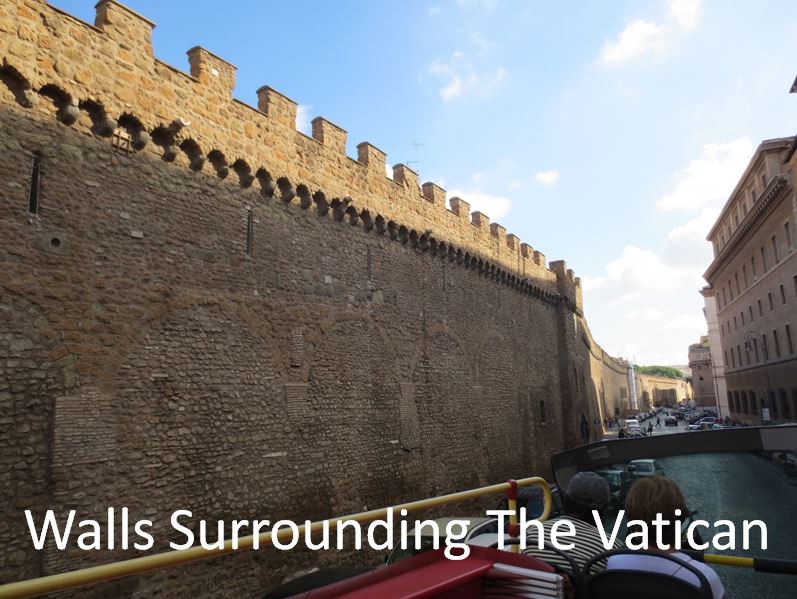
The pope’s sovereign city-state, Vatican City, is surrounded by giant walls.
Online Portfolio Websites
Artists - Photographers - Musicians Add Photo Galleries, Music & Videos
www.talkspot.com/Free_Websites
What’s more, the walls were specifically built by a prior pope to repel Muslims.
History shows back in 846, Muslim raiders known as the Saracens looted Old St. Peter’s Basilica and the Papal Basilica of St. Paul outside the walls. The pirates took priceless treasures from the shrines.
Shocked by the sack of some of the most sacred sites in Christendom, Pope Leo IV created the Leonine Wall, completely surrounding the Vatican Hill. Additional defenses were added in the 15th and 16th centuries.
Commenters on social networking, including GOP president frontrunner Donald Trump’s social media director Dan Scavino, mocked Pope Francis’ attack on Trump by posting pictures of the large walls surrounding Vatican City. But some critics saw a more sinister design at work.
Pamela Geller, a world-famous activist against Islamization and a WND columnist, slammed the pope for his advocacy of open borders policies in both Europe and the United States.
“He’s a hypocrite,” she charged. “If he is sincere, let him tear down the Vatican walls and admit Muslim migrants in unlimited numbers. Some can stay in his luxurious apartments. Until he does that, he is exposed as a self-righteous leftist hypocrite.”
Geller, the author of “Stop the Islamization of America,” called the pope’s actions “unconscionable as well as one-sided.”
“When has he ever called out Hillary or Bernie Sanders for their un-Christian support for abortion?” she asked rhetorically. “The church supposedly opposes that and has opposed it for longer than it has been in favor of absolutely open borders and the suicide of the West. It appears as if the pope has abandoned all pretense of being a spiritual leader and has become instead an eager advocate for the far left’s political agenda.”
The Vatican attempted to walk back the pope’s attack, which came against Trump, on Friday, with a spokesperson saying, “In no way was this a personal attack, nor an indication of how to vote.”
However, Dr. G.M. Davis, the author of “House of War: Islam’s Jihad Against the World,” argues the pope’s reputation has already been damaged.
Saturday, May 05, 2018
Saturday, April 21, 2018
Evangelicals and Catholics Together
Articles
Isaiah 28:9–13; Romans 3:28; Romans 4:5; Romans 9:31–32; Romans 10:3; 1 Corinthians 2:13; 2 Corinthians 6:14–17; 2 Corinthians 11:4; Galatians 1:6-9; Galatians 2:16-21; Ephesians 2:8-9; 1 Timothy 2:5; Hebrews 10:10-12
Aug 18, 2016
Adapted from: Master's Seminary Journal Volume 6 (6:7-37).
A recent document entitled “Evangelicals and Catholics Together: The Christian Mission in the Third Millennium,” signed by a number of prominent evangelicals, has neglected the wide doctrinal breach that separates evangelicalism and Roman Catholicism. It declares the unity of the two participating groups, emphasizes their common faith, allows for doctrinal differences, but states that the two nevertheless have a common mission. A fatal flaw in the document is its assumption that a common mission is possible in spite of the doctrinal differences. The alleged common mission is in effect a contradiction of the truths treasured among evangelicals. Reasons given by evangelical signers of the agreement are hollow and unconvincing. The statement in effect reverses what the Protestant Reformation advocated regarding sola Scriptura and sola fide. The position of the Reformers regarding justification, which was quite biblical, was pronounced as anathema by the Roman Catholic Council of Trent in 1547. Other essential biblical doctrines have been denied by Roman Catholic pronouncements, even recent ones. Unity with Roman Catholicism is not a worthy goal if it means sacrificing the truth.
March 29, 1994 saw a development that some have touted as the most significant development in Protestant-Catholic relations since the dawn of the Reformation. A document titled “Evangelicals and Catholics Together: The Christian Mission in the Third Millennium” was published with a list of more than thirty signatories—including well-known evangelicals Pat Robertson, J. I. Packer, Os Guinness, and Bill Bright. They were joined by leading Catholics such as John Cardinal O’Connor, Bishop Carlos A. Sevilla, and Catholic scholar Peter Kreeft.
A team of fifteen participants led by Richard John Neuhaus and Charles Colson drafted the twenty-five-page document. Neuhaus is a former Lutheran minister who converted to Catholicism in 1990 and has since been ordained to the priesthood. Like Colson, he is an influential author and speaker.
Colson explained that “Evangelicals and Catholics Together” resulted from a series of meetings sponsored by Neuhaus a few years ago in New York. The original purpose of the meetings was to discuss tensions in Latin America between Protestant missionaries and Catholic officials. “In some countries the Catholic Church was using political power to suppress Protestant evangelistic efforts; Protestant missionaries were being persecuted for their faith,” Colson said. “On the other side, some evangelicals were promoting the gospel by calling the Catholic Church the ‘whore of Babylon;’ the Pope, the ‘antichrist,’ and the like.” 2
Colson says he and others at the meetings “were moved by the words of our Lord, calling us to be one with one another as He is one with us and with the Father, in order that the world might know, as Jesus prayed, that ‘Thou didst send me.’“ Colson added, “We were agreed that the Scripture makes the unity of true Christians an essential—a prerequisite for Christian evangelism.” 3
The lengthy statement of accord that resulted has been praised in both the secular and Christian press as a landmark ecumenical agreement. Especially notable is the fact that the Catholics who signed are not from the liberal wing of Catholicism. Signatories on both sides are conservatives, many of whom are active in the pro-life movement and other right-wing political causes. Historically, evangelicals and conservative Catholics have opposed ecumenical efforts.
An article in Christianity Today praised the accord for bringing conservatives into the ecumenical movement: “For too long, ecumenism has been left to Left-leaning Catholics and mainline Protestants. For that reason alone, evangelicals should applaud this effort and rejoice in the progress it represents.” 4
But does this new accord really represent progress, or are the essentials of the gospel being relegated to secondary status? Is the spirit of the Reformation quite dead? Should we now rejoice to see conservative evangelicals pursuing ecumenical union with Roman Catholicism?
The list of Protestant signatories to the document is certainly impressive. Some of these are men who have given their lives to proclaiming and defending Reformation theology. J. I. Packer’s work is well known through his many valuable books. His book Evangelism and the Sovereignty of God, in print for several decades, has introduced multiplied thousands to the Reformed emphasis on divine sovereignty. He has capably defended the key Reformation doctrine of justification by faith in several of his books. His book Fundamentalism and the Word of God is an able defense of the authority of Scripture. Few in our generation have been more effective advocates of Reformation theology than Packer.
Sunday, April 08, 2018
Tuesday, March 20, 2018
Subscribe to:
Posts (Atom)