Showing posts with label Indiana. Show all posts

Saturday, June 22, 2019

Jesuits defy order from Indianapolis archbishop to fire a veteran teacher in same-sex marriage


The archdiocese said it would no longer recognize Brebeuf Jesuit Preparatory School as a Catholic institution because it refused to fire the teacher.


Brebeuf Jesuit Preparatory School in Indianapolis is defying a demand by the local archbishop that they fire a veteran teacher who is gay. 
Sean824 / Getty Images


June 20, 2019, 5:01 PM ET
By Corky Siemaszko


A Jesuit-run prep school in Indianapolis is defying a demand by the local archbishop that it fire a veteran teacher who is in a same-sex marriage, prompting the archdiocese to revoke recognition for the school as a Catholic institution.

In a letter to parents, the leaders of the Brebeuf Jesuit Preparatory School said Archbishop Charles Thompson’s “direct insertion into an employment matter of a school governed by a religious order is unprecedented.”

“
After long and prayerful consideration, we determined that following the Archdiocese’s directive would not only violate our informed conscience on this particular matter, but also set a concerning precedent for future interference in the school’s operations,” school officials said.

The letter was signed by the school president, the Rev. William Verbryke, and the heads of the board of trustees, W. Patrick Bruen and Daniel M. Lechleiter.

They wrote that for 57 years, school leaders have decided who gets hired.

“Brebeuf Jesuit has respectfully declined the Archdiocese’s insistence and directive that we dismiss a highly capable and qualified teacher due to the teacher being a spouse within a civilly-recognized same-sex marriage,” they said in the letter.

Sunday, April 01, 2018

Sunday laws aren't about Christianity — they're about economics

By Brian Alberts Special to The Washington Post


Last month, Indiana residents gained the ability to buy packaged alcohol on a Sunday for the first time in more than two centuries. Idiosyncratic Sunday laws regulating alcohol, commerce and personal behavior have peppered American history since the nation’s founding and are commonly viewed as relics of bygone religious Puritanism or hypersensitive moral codes. After all, Indiana’s laws began in 1787 (before Indiana even became a state), with the direction that “the Christian world” should abstain from any work, except that of “necessity and charity,” to honor the Sabbath. But it didn’t take long for Sunday laws to become tools for various political interests, which may or may not harbor any religious conviction on the matter.

In fact, those most committed to Indiana’s Sunday ban were not religious groups but the state’s powerful liquor store lobby. It long safeguarded its members’ ability to remain closed on Sundays while their competitors (grocery and convenience stores) remained open without being able to sell booze on those days. Lifting the ban required striking a deal with big-box retailers to protect liquor stores’ virtual legal monopoly on selling cold beer.

The prominence of economic concerns regarding such laws should come as no surprise. In Indiana and other states, Sunday advocacy (or Sabbatarianism) began as a tool to root out vice and immorality but wound up serving economic and political purposes above all else. While the Christian origins of the laws remain apparent — they apply only on the Christian Sabbath, after all — over the past two centuries the laws have largely lost their overt spirituality.

Early Sunday laws throughout the country invoked religious values to control the behavior of ordinary citizens, who, lawmakers feared, tended toward drunkenness and greed. Using the government to ban business transactions, recreation or alcohol consumption on the Sabbath encouraged church attendance and responsible commerce, they believed. According to a 1797 Massachusetts law, the prohibition gave workers a necessary day of rest from the burdens of labor. Blocking alcohol consumption further curbed drunkenness and criminal behavior.

Saturday, April 11, 2015

Arkansas legislature passes religious freedom bill


THIS JUST IN

March 31, 2015


Win McNamee/Getty Images


Arkansas on Tuesday passed a religious freedom bill largely similar to the one in Indiana that has sparked an intense public backlash and boycott threats. The state's Republican governor, Asa Hutchinson, has signaled he will sign the bill when it reaches his desk.

Like Indiana's law, the Arkansas version goes further than a federal iteration and those elsewhere around the country in that it protects against "burdens" on religious freedom even when the state is not a party in the litigation. Amid unrelenting criticism, Indiana Gov. Mike Pence (R) on Tuesday said his state would "fix" its law to ban discrimination based on sexual orientation. Jon Terbush


.
.

Thursday, March 26, 2015

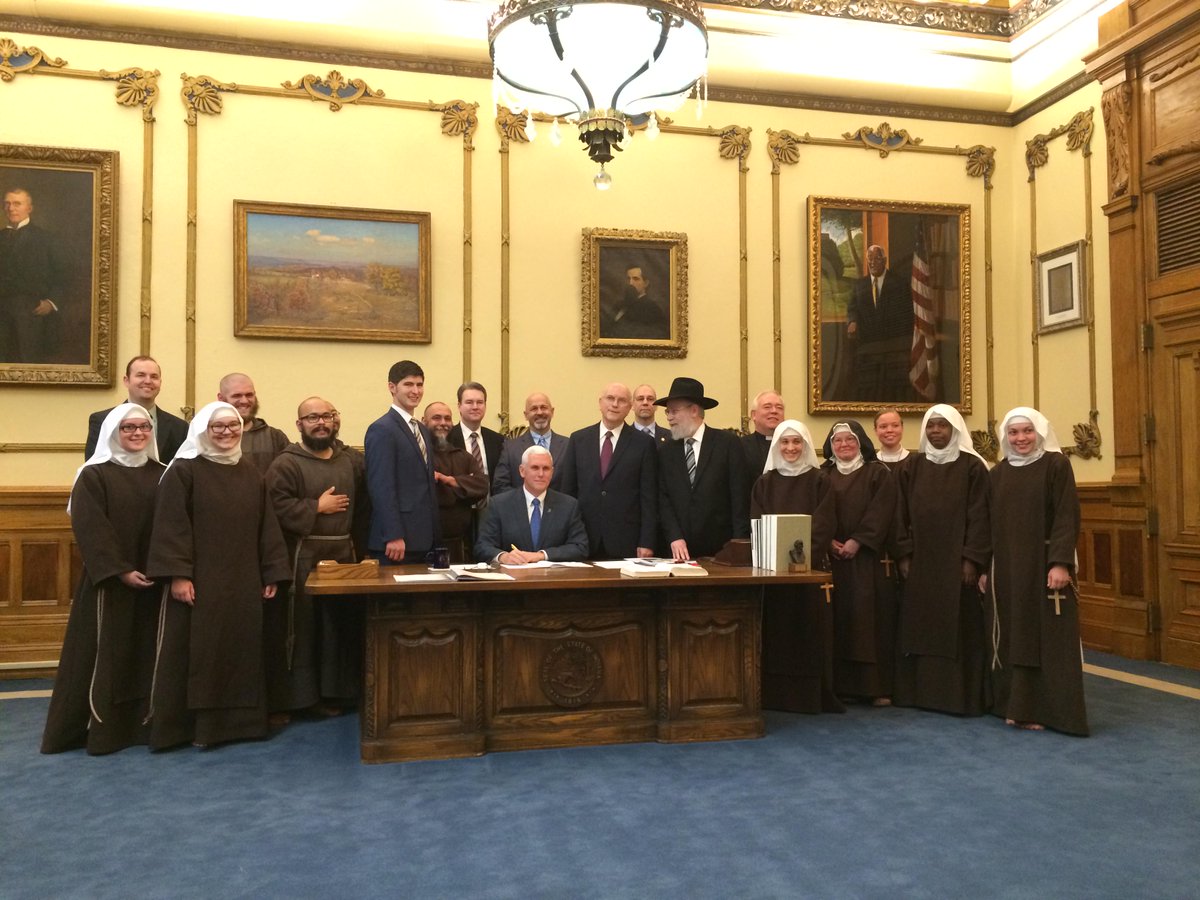
Indiana governor signs state’s Religious Freedom Restoration Act


BY NICOLE HENSLEY 

NEW YORK DAILY NEWS 

Published: Thursday, March 26, 2015, 10:52 AM

Updated: Thursday, March 26, 2015, 2:20 PM


DARRON CUMMINGS/AP
Indiana Gov. Mike Pence, pictured Wednesday, signed the state’s Religious Freedom Restoration Act into law to prohibit the government from impeding on a person’s religious rights.


Indiana Gov. Mike Pence went behind closed doors to sign a controversial measure that would effectively legalize discrimination against same-sex couples by those who object on religious grounds.

Senate Bill 101 was passed by the state House and Senate despite pleas from LGBT activists, Indiana businesses, the Republican mayor of Indianapolis and even leaders of the Disciples of Christ church.

The measure bars the government from impinging on a person’s religious convictions without a “compelling” justification.

Opponents fear the legislation is broad enough to justify an array of discriminatory treatment to residents based on sexual orientation.

Pence, a Republican who assumed office in 2013, promised Monday to sign it into law, and he took the action during a private ceremony Thursday, according to a statement released by his office.

“Today I signed the religious Freedom Restoration Act, because I support the freedom of religious for every Hoosier of every faith,” Pence said.

The legislation garnered an array of criticism by those willing to take their business elsewhere instead of facing the state’s possibly discriminatory law.

It’s believed the bill would provide a valid defense to caterers, photographers or bakers to deny goods and services to same-sex couples.

Seattle-based convention group Gen Con, whose organizers threatened to leave Indianapolis, flaunted its $50 million economic impact that would be at stake over the legislation.


That statement prompted Indianapolis Mayor Greg Ballard to voice his own concerns about the initiative, saying he fears it would send the “wrong signal” about Indiana and deter commerce.

“Indianapolis strives to be a welcoming place that attracts businesses, conventions, visitors and residents,” Ballard, a Republican, said in a statement Wednesday. “We are a diverse city, and I want everyone who visits and lives in Indy to feel comfortable here."

The measure's approval elicited concern from leaders of the Christian Church (Disciples of Christ), who are considering taking their General Assembly, which gathers about 6,000 attendees, out of Indianapolis when it next meets in 2017.

The state’s capital is set to host the NCAA Final Four next week and though the basketball organizers based in Indianapolis did not openly criticize the legislation, they acknowledged it could prove troublesome.

"We are examining the details of this bill, however, the NCAA national office is committed to an inclusive environment where all individuals enjoy equal access to events," the college sports governing association said in a statement.

The state’s new policy is the first bill of its kind to be signed into law this session; coinciding with similar bills in Wyoming, Oklahoma, West Virginia and Utah that were quickly defeated.

Another wave of religious freedom measures were introduced in Montana and North Carolina legislatures during the past two weeks, just weeks before the Supreme Court is expected to hear arguments on marriage equality.

American Civil Liberties Union attorneys have taken note of the legislation’s timing and warned it could have implications for required vaccinations and child welfare cases.


A state-by-state break down of controversial legislation.

“The bill was introduced as backlash reaction to achieving marriage equality for same-sex couples in Indiana,” director of ACLU’s Indiana office said in a statement. “We are deeply disappointed that the governor and state lawmakers have been tone-deaf to the cries of legions of Hoosiers.”


Supporters of the bill, including Pence, have repeatedly said the act was intended to protect religious rights, not to codify prejudice.

The state law is patterned after the federal measure enacted by former President Bill Clinton in the early 1990s, but it is most directly inspired by last year’s religious freedom bill in Arizona that fail with Gov. Jan Brewer’s veto.

The federal measure counteracted a Supreme Court decision that upheld the firing and denial of benefits to two Washington state employees whose religious rituals violated state law.

“This bill is not about discrimination, and if I thought it legalized discrimination in any way in Indiana, I would have vetoed it,” Pence wrote. “For more than 20 years, the federal Religious Freedom Restoration Act has never undermined our nation’s anti-discrimination laws, and it will not in Indiana.”

With News Wire Services.

nhensley@nydailynews.com


.

Tuesday, March 10, 2015

Two states, Puerto Rico join N.Y. in diet supplement probe


By Christie Smythe and Chris Dolmetsch, Bloomberg News
Bloomberg


NEW YORK — Dietary supplements are facing more scrutiny from U.S. regulators as two states and Puerto Rico joined New York in a probe of the $33 billion industry after testing showed some products didn't appear to contain key ingredients advertised.

Attorneys general in Connecticut and Indiana and the Puerto Rico Department of Consumer Affairs will investigate industry business practices and whether claims of authenticity and purity are valid, Attorney General Eric Schneiderman said Tuesday in a statement.


Pittsburgh-based GNC Holdings Inc.'s stock price fell as much as 7 percent Tuesday following news of the expanded probe. Herbal supplements make up about 8 percent of the nutritional retailer's sales, according to analysts from Jefferies.

The real $61 billion per year question is whether or not the entire supplement business is one big criminal fraud that steals by deception $61 billion a year of consumer payments. Anyone who has been spending money buying supplements needs to take this case very seriously. It is after all not...

Earlier, a researcher hired by New York found evidence that store-brand products from GNC, Wal-Mart Stores, Walgreens and Target labeled as containing supplements such as echinacea and ginkgo biloba lacked those signature ingredients or contained substances not on the label. GNC has disputed Schneiderman's findings and called his testing methods "incomplete and unreliable."

GNC "fully complied" with inquiries about products from Schneiderman and "took the additional step of commissioning independent, third-party tests to verify the quality of our products," Ellen Davis, a spokeswoman for GNC with Sard Verbinnen & Co., said in a statement Tuesday. The additional tests and the company's own procedures "confirm in no uncertain terms that our products are safe, pure, properly labeled and in full compliance with all regulatory requirements."

Based on work at Ontario's University of Guelph, the DNA barcoding testing method in Schneiderman's probe identifies organisms using a small amount of genetic material.

Minneapolis-based Target and Deerfield, Illinois-based Walgreens Boots Alliance have pulled products flagged by Schneiderman's results from store shelves nationwide. GNC and Wal-Mart have said they would remove some of their supplements from stores in New York.

"We take these issues very seriously," Emily Hartwig, a spokeswoman for Walgreens, said in a statement Tuesday. "We continue to review this matter and also intend to continue cooperating."

Evan Lapiska, a spokesman for Target, declined to comment on the states' actions. Brian Nick, a spokesman for Bentonville, Arkansas-based Wal-Mart, didn't immediately respond to phone and e-mailed requests for comment.

The Food and Drug Administration requires supplement sellers to verify that products are safe and properly labeled. Supplements don't undergo the same strict evaluation process as drugs.

One problem for the industry as the probe expands is "consumer perception" of supplements, Jefferies analysts Mark Wiltamuth, Christopher Mandeville and Clayton Meyers said in a note to investors Tuesday. The timing of the probe is "unfortunate" as companies begin to shake off the effects of scrutiny of products such as fish oil and multivitamins, they said.

Ted Craig, a Miami lawyer who has defended companies in regulatory disputes and class actions, said other states may see Schneiderman's investigation as "low-hanging fruit" and seek to "jump on this bandwagon" by joining it.

Schneiderman said in his release that the industry "contributes" $61 billion to the U.S. economy. According to the Nutrition Business Journal, a trade publication, supplement companies had 2012 sales of $32.5 billion.


.

Saturday, August 13, 2011

Four Killed, Dozens Injured as Stage Collapses at Indiana State Fair

Published August 13, 2011

NewsCore


INDIANAPOLIS -- At least four people were killed and a dozen others injured in Indianapolis Saturday night when a stage collapsed during a storm at the Indiana State Fair, The Indianapolis Star reported.

Emergency crews were dispatched to the scene, where a command center was being set up to manage injured and trapped music fans.

Thousands of people, who were attending the Sugarland concert, were reportedly being evacuated when the rigging for the stage fell onto an area where some people were seated.

A reporter at the scene said the stage collapsed, between the opening and main acts, when a wind gust hit at about 9:00pm local time.

Another witness said there were still people trapped under the collapsed rigging at 9:30pm, WTHR-TV reported.

Preparations were underway at 10:00pm to inflate large air bags to lift the stage rigging, The Star reported.

Indiana Homeland Security declared the incident a Level 1 emergency.

Those injured were being taken to Methodist Hospital, police said. No details have been released on the seriousness of the injuries, nor the number of people still trapped.


Source: http://www.foxnews.com/us/2011/08/13/four-killed-dozens-injured-as-stage-collapses-at-indiana-state-fair/#ixzz1Uy79vL4T

Monday, April 13, 2009

Midwest auto industry: Tough times ahead for towns across region


Automakers restructuring and business contracting

By Tim Jones Tribune correspondent
April 12, 2009


In tattered and gray industrial towns across the Midwest, no one knows exactly where the ax will swing next. But there is no doubt the forced downsizing of General Motors and Chrysler, which will begin to take shape in the coming weeks, will fundamentally change the quality of life in communities and the region for years to come.

Even if both automakers survive, economists say, they will be smaller and will pay lower wages and benefits. More communities will lose production and parts plants, and the states that have relied heavily on those manufacturing jobs—especially Michigan, Indiana and Ohio — will take a big hit that, economists warn, will take years and perhaps decades to overcome.

"If you go back to 1980 to 1982, with the upheavals in the steel, rubber, glass and auto industries, that really was the end of an economic era that started in the 1890s," said Ned Hill, an economist at Cleveland State University. "This is the last movement in the symphony."

While the American auto industry played a large role in creating the modern Midwest a century ago, its unraveling has exposed the region's economic over-reliance on vehicle manufacturing. In recent decades, the demise of specialized manufacturing—shoes in Missouri, TV picture tubes in Indiana and Ohio, glass in Toledo and rubber in Akron—sent many towns and cities reeling from the loss of jobs. On a larger scale, Chicago, northwest Indiana and northeast Ohio suffered from Big Steel's slide more than 25 years ago.


But the auto industry has a much broader footprint in the region, with about two dozen assembly plants of General Motors, Chrysler and Ford in the Midwest and many hundreds of parts suppliers peppered about, according to the Federal Reserve Bank of Chicago.

"Every job in the auto industry usually can be responsible for five to six jobs in general throughout the entire economy," said Jerry Conover, director of the Indiana Business Research Center at Indiana University. "The direct and indirect effect of all of this means a lot less money circulating through the cash registers in these states."

The details of the downsizing are being discussed as GM faces a deadline at the end of May to satisfy the government's requirements for federal assistance. Chrysler has until the end of April to work out a merger deal with Italian carmaker Fiat. Those private discussions have fed rumors of plant closings around the Midwest and across the nation. Bankruptcy is an option for both automakers.

How bad would it be if one or more of the Detroit automakers failed? In perhaps the most dire forecast, the Center for Automotive Research in Ann Arbor, Mich., said the 2009 job loss would be nearly 2.5 million if there were a 50 percent cut in operations at the Big Three. Personal income would drop by $276 billion, the report forecast.

That, Hill noted, assumes the lost auto production would not be picked up by other automakers, including Honda and Toyota, which have production facilities in the Midwest. Still, even under less pessimistic projections, pain will be spread around the region as jobs are slashed and pay, health-care and retirement benefits are scaled back, Hill predicted.

"The unfortunate thing is you've got a large number of small- to mid-size communities dependent on this income," Hill said. "What's happening now will put the industrial Midwest at a bigger disadvantage."

The domestic auto industry has been shrinking since the 1980s, and some of the cities affected by that decline provide a bleak view of what may be in store for others as the industry continues to contract. For generations, Anderson, Ind., was a major parts supplier for GM, but most of those operations have been gradually shut down over the past 25 years. Anderson, which has struggled to regain its economic footing, is defined by a disproportionate number of senior residents, steady job losses and wages at less than 75 percent of the U.S. average, according to a report from STATS Indiana.

In nearby Muncie, Ind., another city that supplied GM, the last of the major suppliers is scheduled to complete its shutdown later this year. The average wage has dropped in Muncie, which is making a painful transition from a well-paying manufacturing economy to one dominated by health care and Ball State University.

"It takes decades to make the adjustment," said Roy Budd, executive director of Energize-East Central Indiana, a non-profit economic development group. "I think we've trough-ed out and are on the upswing. But it takes a lot of time. We didn't get into it overnight and won't get out of it overnight."

The economic crisis has made Michigan, once one of the more prosperous states, a net population loser, with 109,000 more people moving out last year than moved in, according to census data. Among the obstacles for the region to recover, Conover said, is the relatively low percentage of college graduates in these states. The national average of people with a bachelor's degree or more is 27.5 percent, according to the Census Bureau. The percentages in Michigan, Ohio and Indiana are 24.7, 24.1 and 22.1, respectively.

The questions of how, and indeed whether, GM and Chrysler survive will begin to be answered in a few weeks, and then any affected communities will begin the adjustment to life without their biggest breadwinner.

"This is pretty devastating stuff," Hill said. "It takes almost 20 years to rebuild your economy, and usually you waste five to six years because of denial."

tmjones@tribune.com


.