Thursday, November 21, 2024
Tuesday, July 28, 2015
The Bankrutpcy of the Planet Accelerates


There has been so much attention on Greece in recent weeks, but the truth is that Greece represents only a very tiny fraction of an unprecedented global debt bomb which threatens to explode at any moment.
As you are about to see, there are 24 nations that are currently facing a full-blown debt crisis, and there are 14 more that are rapidly heading toward one.
Right now, the debt to GDP ratio for the entire planet is up to an all-time record high of 286 percent, and globally there is approximately 200 TRILLION dollars of debt on the books.
That breaks down to about $28,000 of debt for every man, woman and child on the entire planet.
And since close to half of the population of the world lives on less than 10 dollars a day, there is no way that all of this debt can ever be repaid. The only "solution" under our current system is to kick the can down the road for as long as we can until this colossal debt pyramid finally collapses in upon itself.
As we are seeing in Greece, you can eventually accumulate so much debt that there is literally no way out.
The other European nations are attempting to find a way to give Greece a third bailout, but that is like paying one credit card with another credit card because virtually everyone in Europe is absolutely drowning in debt.
Even if some "permanent solution" could be crafted for Greece, that would only solve a very small fraction of the overall problem that we are facing. The nations of the world have never been in this much debt before, and it gets worse with each passing day.
According to a new report from the Jubilee Debt Campaign, there are currently 24 countries in the world that are facing a full-blown debt crisis…
- Armenia
- Belize
- Costa Rica
- Croatia
- Cyprus
- Dominican Republic
- El Salvador
- The Gambia
- Greece
- Grenada
- Ireland
- Jamaica
- Lebanon
- Macedonia
- Marshall Islands
- Montenegro
- Portugal
- Spain
- Sri Lanka
- St Vincent and the Grenadines
- Tunisia
- Ukraine
- Sudan
- Zimbabwe
So what should be done about this? Should we have the "wealthy" countries bail all of them out?
- Bhutan
- Cape Verde
- Dominica
- Ethiopia
- Ghana
- Laos
- Mauritania
- Mongolia
- Mozambique
- Samoa
- Sao Tome e Principe
- Senegal
- Tanzania
- Uganda
Well, the truth is that the "wealthy" countries are some of the biggest debt offenders of all. Just consider the United States. Our national debt has more than doubled since 2007, and at this point it has gotten so large that it is mathematically impossible to pay it off.
Europe is in similar shape.
Members of the Eurozone are trying to cobble together a "bailout package" for Greece, but the truth is that most of them will soon need bailouts too…
All of those countries will come knocking asking for help at some point. The fact is that their Debt to GDP levels have soared since the EU nearly collapsed in 2012.
- Spain's Debt to GDP has risen from 69% to 98%
- Italy's Debt to GDP has risen from 116% to 132%
- France's has risen from 85% to 95%
- Belgium (106 percent debt to GDP)
- Ireland (109 debt to GDP)
- Portugal (130 debt to GDP)
Spain has over $1.0 trillion in debt outstanding… and Italy has €2.6 trillion.
These bonds are backstopping tens of trillions of Euros' worth of derivatives trades. A haircut or debt forgiveness for them would trigger systemic failure in Europe.
EU banks as a whole are leveraged at 26-to-1. At these leverage levels, even a 4% drop in asset prices wipes out ALL of your capital. And any haircut of Greek, Spanish, Italian and French debt would be a lot more than 4%.
Things in Asia look quite ominous as well.
According to Bloomberg, debt levels in China have risen to levels never recorded before…
While China's economic expansion beat analysts' forecasts in the second quarter, the country's debt levels increased at an even faster pace.
Outstanding loans for companies and households stood at a record 207 percent of gross domestic product at the end of June, up from 125 percent in 2008, data compiled by Bloomberg show.
And remember, that doesn't even include government debt. When you throw all forms of debt into the mix, the overall debt to GDP number for China is rapidly approaching 300 percent.
In Japan, things are even worse.
The government debt to GDP ratio in Japan is now up to an astounding 230 percent. That number has gotten so high that it is hard to believe that it could possibly be true. At some point an implosion is coming in Japan which is going to shock the world.
Of course the same thing could be said about the entire planet. Yes, national governments and central banks have been attempting to kick the can down the road for as long as possible, but everyone knows that this is not going to end well.
And when things do really start falling apart, it will be unlike anything that we have ever seen before.
Just consider what Egon von Greyerz recently told King World News…
Eric, there are now more problem areas in the world, rather than stable situations. No major nation in the West can repay its debts.
The same is true for Japan and most of the emerging markets. Europe is a failed experiment for socialism and deficit spending. China is a massive bubble, in terms of its stock markets, property markets and shadow banking system.
Japan is also a basket case and the U.S. is the most indebted country in the world and has lived above its means for over 50 years.
So we will see twin $200 trillion debt and $1.5 quadrillion derivatives implosions. That will lead to the most historic wealth destruction ever in global stock, with bond and property markets declining at least 75-95 percent.
World trade will also contract dramatically and we will see massive hardship across the globe.
Monday, August 27, 2012
U.S. Debt On Track to Hit $16 Trillion Within Week

(CNSNews.com) - The federal government’s debt could hit an unprecedented $16 trillion this week while the Republican Party is holding its national convention in Tampa, Fla.
On Monday afternoon, at the opening of the convention. the Republicans will try to draw attention to the mounting debt by unveiling a debt clock in the Tampa Bay Times Forum, where the convention will be held.
At an event in Waterloo, Iowa, earlier this month President Obama highlighted his own efforts to deal with the debt.
"I'll make sure government does its part to reduce our debt and our deficits," the president said. "We've cut out already a trillion dollars' worth of spending we don't need. And we can do more. I want to make government efficient. We've got to make sure that your tax dollars are being well spent. But we can't bring down our deficit and our debt just by asking us to get rid of things that open up opportunity to Americans.
"So instead," said Obama, "we're asking folks like me to go back to the rates we paid under Bill Clinton--which, by the way, was a time when we created 23 million new jobs, went from deficit to surplus, and we created a whole lot of millionaires to boot."
At the close of business on Thursday, Aug. 23, according to the U.S. Treasury, the federal government’s debt stood at $15,976,519,029,144.14. That left it $23,480,970,855.86 short of the $16 trillion mark.
So far in this fiscal year (from Oct. 1 through Aug. 23), the debt has grown by an average of $3,616,398,477.40 per calendar day ($1,186,178,700,586.99 divided by 328 days). Were the debt to grow at that pace in the week following last Thursday’s close of $15.976 trillion, it would hit $16 trillion this Thursday--the day Mitt Romney is scheduled to give his speech accepting the Republican presidential nomination.
However, the debt does not grow in a steady, unbroken daily pace. Instead, it expands and retracts from day to day during the business week depending on the value of the bonds the U.S. Treasury sells and redeems. On a day that the Treasury derives more revenue from selling bonds than it pays out to redeem bonds, the debt increases.
Last Wednesday, for example, the debt actually declined by almost $9.7 billion--from $15,970,134,937,605.00 to $15,960,468,522,111.20—as the Treasury redeemed bonds of greater value than it sold. However, on Thursday, the debt increased by slightly more than $16 billion, ending that day at $15,976,519,029,144.14.
Also, the Treasury does not report the value of the debt reached at the close of any business day until 4:00 pm on the following business day. For example, the value of the government’s debt as of the close of business on Friday will not be officially reported by the Treasury until 4:00 pm on Monday—and the value of the debt as of the close of business this Thursday will not be reported until 4:00 pm this Friday.

President George W. Bush met with President-elect Barack Obama and former Presidents George H.W. Bush, Bill Clinton and Jimmy Carter in the Oval Office on Jan. 7, 2009. (AP Photo/File Photo)
Thus, under Obama, the debt has increased more than under all presidents from George Washington through George H.W. Bush combined.
During President George W. Bush’s two terms in office, the debt increased $4,899,100,310,608.44. That is also more than all the debt accumulated by all previous presidents from George Washington through George H.W. Bush combined.
Nonetheless, the $5,349,641,980,231.06 in new debt accumulated in less than four years under Obama is more than the $4,899,100,310,608.44 in new debt accumulated in eight full years under George W. Bush.
According to data reported by the IRS earlier this year, there were 81,890,189 tax returns filed for 2009 that showed taxable income. That means the total debt of the United States now equals $195,096.86 for each 2009 federal taxpayer.
The $5,349,641,980,231.06 in new debt accumulated just during Obama's time in office equals about $65,327 per taxpayer.

House Speaker John Boehner speaks at the Peter G. Peterson Foundation’s 2012 fiscal summit in Washingon on Tuesday, May 15, 2012 (AP Photo)
The Republicans won a majority in the House of Representatives in the November 2010 election. However, the Republican-controlled House did not gain a veto over federal spending until March 4, 2011, when a continuing resolution passed by a lame-duck Congress in December 2010 expired. Since March 4, 2011, the government has been funded by a series of spending deals made between House Speaker John Boehner, Senate Majority Leader Harry Reid and President Barack Obama.
Since the first Boehner-Obama spending deal, which took effect on March 4, 2011, the debt has increased by $1,793,891,844,263.11. That equals about $21,906.07 per taxpayer.
President Obama proposed a fiscal 2013 budget that, according to the Congressional Budget Office, called for $6.39 trillion in deficit spending in the ten years from fiscal 2013 through fiscal 2022. During those ten years, according to CBO’s analysis, the annual deficit would never drop below $488 billion, a level it would hit in 2017. Under Obama’s budget proposal, according to CBO, annual deficits would start to grow again after 2017, hitting $510 billion in 2018, $602 billion in 2019, $638 billion in 2020, $678 billion in 2021, and $728 billion in 2022.
In fiscal 2008, according to the White House Office of Management and Budget, the federal government spent $2.982 trillion. In fiscal 2012, it will spend an estimated $3.795 trillion
Source
Thursday, August 16, 2012
U.S. Government's Foreign Debt Hits Record $5.29 Trillion

U.S. flags fly with Chinese flag outside the White House. (AP Photo/Carolyn Kaster)
(CNSNews.com) - The money the U.S. government owes to foreign entities rose to a record $5.2923 trillion in June, according to data released by the U.S. TreasuryWednesday afternoon.
In May, the U.S. Treasury had owed $5.2581 trillion to foreign entities. On net, in June, the U.S. government borrowed an additional $34.2 billion from foreign entities in order to fund U.S. government operations.
The U.S. government’s indebtedness to foreign interests has grown by 72.3 percent during President Barack Obama’s term in office. In January 2009, when Obama was inaugurated, the U.S. government owed $3.0717 trillion to foreign entities, according to the Treasury Department. That has increased by $2.2206 trillion—or 72.3 percent—to the record $5.2923 trillion reported for yesterday.
Entities in the People’s Republic of China remain the largest holders of U.S. government debt. Entities in Japan, however, are on track to eclipse the Chinese as the top holders of U.S. government debt.
In June, the Chinese held $1.1643 trillion in U.S. government debt, up slightly from the $1.1640 trillion in U.S. government debt the Chinese held in May. However, Chinese ownership of U.S. government debt hit an historical peaked of $1.3149 trillion in July 2011 and has been on a generally downward trend since then.
Entities in Japan, by contrast, have been consistently increasing their ownership of U.S. government debt. In June, the Japanese owned $1.1193 trillion in U.S. debt. In May, they owned $1.1089 trillion in U.S. debt. A year ago, in June 2011, the Japanese owned only $881.5 in U.S. government debt.
Although the Chinese maintained their place as the top foreign owners of U.S. debt in June, they are not the top owners of U.S. debt in the world. That distinction belongs to the U.S. Federal Reserve, which according to its July monthly report, owned $1.667 trillion in U.S. government debt in June.
As of the end of June, the total debt of the federal government was $15,856,367,214,324.44. However, of that debt, $4,812,182,369,712.78 was money the federal government owed to itself (i.e. money the Treasury had borrowed from federal trust funds such as the Social Security Trust Fund, etc.). The Treasury calls this type of debt “intragovernmental” debt. The remaining $11,044,184,844,611.66 the federal government owed as of the end of June was debt held by the “public.” This is debt in the form of Treasury securities the government is obligated to pay off in cash.
The combined $6.9593 trillion that U.S. Treasury owed both to foreign entities ($5.2923 trillion) and the Federal Reserve ($1.667 trillion) at the end of June, equaled about 63 percent of the federal government’s debt held by the public.
Source
Wednesday, November 30, 2011
Report: Federal Reserve lent banks nearly $8 trillion during 2007-2009 crises
11/30/2011
Catholic Online (www.catholic.org)
Loan allowed banks to keep paying executives millions of dollars
Throughout the 2007 - 2009 financial crises, major American banks assured the public that everything was fine - while at the same time approaching the Federal Reserve to borrow $7.77 trillion. That mount was many more times higher than the TARP bailout. The loan allowed the banks to continue to pay out exorbitant fees - and many fear yet another crisis is on the way.

The Fed contends that the biggest financial institutions in the country were too big to fail. That phrase has become a bone of contention among lawmakers. They argue that a 'too big to fail' bank is one that's too big to exist.
LOS ANGELES, CA (Catholic Online) - A report in Bloomberg Markets says that the magnitude of the government's assistance to struggling banks allowed them to grow even bigger and continue paying executives billions in compensation.
A win in court against a group representing the banks and a FOIA request filed by Bloomberg revealed the extent of the central bank's largesse - as well as the $13 billion in profits banks earned from those bailouts.
JPMorgan, Bank of America, Citigroup, Wells Fargo, Goldman Sachs and Morgan Stanley, also known as "the big six," accounted for $4.8 billion of that total, nearly a quarter of their net income during that time.
Saved by the bailout, bankers lobbied against government regulations, a job made easier by the Fed, which never disclosed the details of the rescue to lawmakers even as Congress doled out more money and debated new rules aimed at preventing the next collapse.
The narrative of the financial crisis of 2007 to 2009 emerges from 29,000 pages of Fed documents obtained under the Freedom of Information Act and central bank records of more than 21,000 transactions. While Fed officials say that almost all of the loans were repaid and there have been no losses, details suggest taxpayers paid a price beyond dollars as the secret funding helped preserve a broken status quo and enabled the biggest banks to grow even bigger.
Until recently, those trillions were a deeply-buried secret. The highest-ranking Fed officials didn't know about the enormity of the handouts. Then-president of the Federal Reserve Bank of Minneapolis Gary H. Stern "wasn't aware of the magnitude." Unnamed sources say that even top aides to Treasury Department head Henry Paulson were denied information.
The "big six" received a total $160 billion in TARP funds. As much as $460 billion was lent from the Fed, raising the question as to how and why this nearly $8 trillion in loans, guarantees and limits remained under wraps for so long.
According to the reserve, the massive scale of banks' borrowing had to be kept secret to avoid spooking investors. They feared that if the magnitude of the borrowed funds would create a panic, or bank runs that would have had even more devastating consequences on the already battered economy.
The Fed contends that the biggest financial institutions in the country were too big to fail. That phrase has become a bone of contention among lawmakers. They argue that a "too big to fail" bank is one that's too big to exist.
Ohio Senator Sherrod Brown sponsored a bill last year that would cap a bank's non-deposit liabilities at 2 percent of gross domestic product, and crack down on workarounds banks currently use to bypass a 1994 law that prohibits any one bank from holding more than 10 percent of all deposits in the country.
Friday, August 05, 2011
Strategists Still See 17% S&P 500 Rally on Earnings
Please read the details below:
Strategists Still See 17% S&P 500 Rally on Earnings
By Whitney Kisling, Inyoung Hwang and Lynn Thomasson - Aug 5, 2011 5:24 AM ET .
 Wall Street has never been more sure that the Standard & Poor’s 500 Index will rally in 2011, even after speculation the U.S. economy is heading for a recession prompted the biggest plunge since the bull market began. Photographer: Jin Lee/Bloomberg
Wall Street has never been more sure that the Standard & Poor’s 500 Index will rally in 2011, even after speculation the U.S. economy is heading for a recession prompted the biggest plunge since the bull market began.
Chief strategists at 13 banks from Barclays Plc (BARC) to UBS AG (UBSN) see the benchmark measure of American equity surging 17 percent through Dec. 31, the average estimate in a Bloomberg survey. Their projection that the index will reach 1,401 hasn’t budged in four weeks, while mounting concern U.S. growth is slowing drove the S&P 500 down 11 percent since July 22, including yesterday’s 4.8 percent tumble.
About $1.8 trillion has been erased from American equities as reports on manufacturing and consumer spending showed the world’s largest economy is slowing. Forecasters at UBS and Deutsche Bank AG (DBK) say rising profits mean the S&P 500 deserves a higher price-earnings ratio than the 28-month low reached yesterday. A year ago, strategists also remained bullish after a 14 percent drop, and proved prescient as the S&P 500 rallied 20 percent from its August low.
“I’m reluctant to overreact to some shorter-term weakness, no matter how real it is, because the market has proven to be unbelievably resilient,” Jonathan Golub, the chief U.S. market strategist at UBS in New York, said in an Aug. 3 phone interview. “If you would have been acting that way for the last two years, you would have gotten killed by this market. Companies have done an absurdly good job of managing through this environment.”
Most Since 2009
Golub says the S&P 500 will end the year at 1,425. It fell yesterday to an eight-month low of 1,200.07 amid a global rout, extending a nine-day retreat to 11 percent. That was the biggest loss over the same amount of time since March 9, 2009, when the gauge ended a 17-month bear market. The MSCI All-Country World Index slid 4.1 percent yesterday, the most since March 2009. The Stoxx Europe 600 Index fell to the lowest level since July 2010, while Brazil’s index sank the most since 2008, as commodities producers dropped.
Europe’s Stoxx 600 retreated 2 percent to 238.38 at 10:17 a.m. in London, headed for a weekly drop of 10 percent. Hong Kong’s Hang Seng Index (HSI) lost 4.3 percent today, the most since November 2009, and equity benchmarks in Japan, Australia and Korea fell more than 3.7 percent.
A year ago, stocks also fell as investors speculated the U.S. economy would contract. Equities plunged until Federal Reserve Chairman Ben S. Bernanke foreshadowed $600 billion in bond purchases meant to prevent deflation and stimulate growth at a Aug. 27, 2010, meeting in Jackson Hole, Wyoming.
More Stimulus?
Bill Gross, who runs the world’s biggest bond fund at Pacific Investment Management Co., told Bloomberg Television on Aug. 2 that another asset-purchase program may be announced by the Fed, even after President Barack Obama signed a deficit reduction plan that demands less government spending.
Should a plan materialize, it won’t have the same impact as last year, said Mark Luschini of Janney Montgomery Scott LLC, which manages about $54 billion.
“The macroeconomic issues are trumping the good earnings picture,” Luschini, the chief investment strategist at the Philadelphia-based firm, said in a phone interview on Aug. 3. For valuations to rise, “we’d have to have better economic conditions than we do at the moment, and that’s not evident,” he said.
Credit Suisse, HSBC
Strategists say earnings growth will fuel gains. S&P 500 profit will rise 18 percent in 2011 and 14 percent in 2012, according to the average per-share analyst estimates in a Bloomberg survey. More than 75 percent of corporations in the index have exceeded earnings estimates for the second quarter, with total income topping projections by 5.2 percent.
Credit Suisse Group AG and HSBC Holdings Plc advised investors to buy equities today. Andrew Garthwaite, London-based strategist at Credit Suisse, reiterated an “overweight” recommendation on stocks even as he cut his 2011-end forecast for the S&P 500 by 7 percent to 1,350.
“Our economists are not forecasting a recession and, indeed, are looking for U.S. growth to accelerate in the second half,” Garry Evans, global head of equity strategy at HSBC in Hong Kong, wrote in a note today. “Investors should look to raise equity risk gradually over the summer.”
‘Better Shape’
Marc Faber, publisher of the Gloom, Boom & Doom report, said in a Bloomberg Television interview that he expects the S&P 500 to rally about 40-to-50 points. Templeton Asset Management’s Mark Mobius said emerging economies are in “better shape” than developed nations amid turmoil roiling global markets.
“We’re looking at equities all the time and equities are looking better and better with all this turmoil,” Mobius, who oversees about $50 billion as executive chairman of Templeton’s emerging markets group, said in a Bloomberg Television interview today. “If you look at the gross domestic product levels, foreign exchange reserves, emerging markets are in a very, very sweet spot.”
Even as companies from Ford Motor Co. (F) to Boeing Co. beat forecasts, the S&P 500 has plunged as investors turned their attention to reports showing slower economic growth. Consumer spending fell 0.2 percent in June, personal incomes grew at the slowest pace since November and an index of American manufacturing sank to a two-year low.
The Labor Department may say at 8:30 a.m. in New York today that U.S. employers added 85,000 jobs in July, the median forecast in a Bloomberg survey of economists. The unemployment rate rose for a third straight month in June, climbing to a 2011 high of 9.2 percent.
‘Reactive Trader Mindset’
“It’s unlikely I will change my view because we had a bad week or get really excited because we had a good week,” Tobias Levkovich, Citigroup Inc. (C)’s chief U.S. equity strategist in New York, said in an Aug. 3 phone interview. “That’s not a well- reasoned market outlook,” said Levkovich, who forecasts the S&P 500 will end the year at 1,400. “That’s a reactive trader mindset, but that’s not what I’m supposed to be doing.”
The combination of falling prices and rising profits has driven the S&P 500’s price-earnings ratio down 17 percent since Feb. 18, data compiled by Bloomberg show. At 13.2 times profit, the valuation is 20 percent below the average since 1954.
Following the drop in valuations, “our view is growth picks up, and like last summer/fall as the data turn up, they will take the equity market up with it,” Binky Chadha, Deutsche Bank’s chief U.S. equity strategist in New York, said in an Aug. 2 e-mail. He said the index will reach 1,550, the highest projection in the Bloomberg survey.
Bond Purchases
The S&P 500 bottomed in 2010 at 1,022.58 on July 2. Gross domestic product expanded at an annual rate of 2.5 percent and 2.3 percent in the third and fourth quarters. The stock index rallied 10 percent to 1,127.79 through Aug. 9, before slipping 7.1 percent to 1,047.22 by Aug. 26.
At the time, strategists said the index would rise to 1,234 through the end of 2010, according to the average estimate. Three days later, Bernanke said the central bank would “do all that it can” to sustain growth, foreshadowing the bond-purchase program revealed two months later. The August announcement helped catapult the S&P 500 to 1,257.64 as of Dec. 31 and 1,343.01 by Feb. 18, a 28 percent advance.
Laszlo Birinyi, one of the first investors to recommend buying stocks when the bull market began in March 2009, said this week that stocks shouldn’t be abandoned.
More Scotch
“It’s like all these times when you second-guess yourself, and you probably wake up a little earlier than you’re used to, and maybe you put an extra finger of scotch in the glass,” Birinyi said in an Aug. 2 telephone interview. “It’s probably a good idea to have a gut check once in a while, because it makes you review and rethink your process. Our view is that this is still a market of some duration.”
The S&P 500 had the second-best performance in 2011 among the world’s 10 biggest stock markets through yesterday, even after the 12 percent slump since April 29 brought the year-to- date decline to 4.6 percent. China’s Shanghai Stock Exchange Composite Index did best with a 4.4 percent drop. Japan’s Topix lost 8.1 percent, while the FTSE 100 Index (UKX) of U.K. stocks dropped 8.6 percent.
Clean Slate
“Doing this 22 years, to me this has to be the type of bottoming that the U.S. needed to just clean the slate,” Brian Belski, the New York-based chief investment strategist at Oppenheimer & Co., said in a telephone interview yesterday. “A year ago, we were only a couple quarters into the rebound, now we’re further in. There was less belief a year ago because nobody really believed forward earnings growth. Now they’ve proven themselves.” He estimates the S&P 500 will reach 1,325.
Barry Knapp, the New York-based chief U.S. equity strategist at Barclays, said that it’s unlikely the economy will contract even though data show a slowdown. The Citigroup Economic Surprise Index has averaged negative 95.05 since sinking on June 3 to negative 117.20, meaning reports were missing the median estimate in Bloomberg surveys by the most since January 2009.
“If you sell stocks at 1,250, that’s a bet we’re going back to a recession, and we don’t buy that,” Knapp said in a telephone interview yesterday. His year-end projection is 1,450. “The probability of the U.S. going back into a recession is low. These things have a way of running their course.”
To contact the reporters on this story: Whitney Kisling in New York at wkisling@bloomberg.net; Inyoung Hwang in New York at ihwang7@bloomberg.net; Lynn Thomasson in Hong Kong at lthomasson@bloomberg.net
To contact the editors responsible for this story: Nick Baker at nbaker7@bloomberg.net; Nick Gentle at ngentle2@bloomberg.net
Source.
Wednesday, June 23, 2010
Orszag Leaves, Red Ink Remains
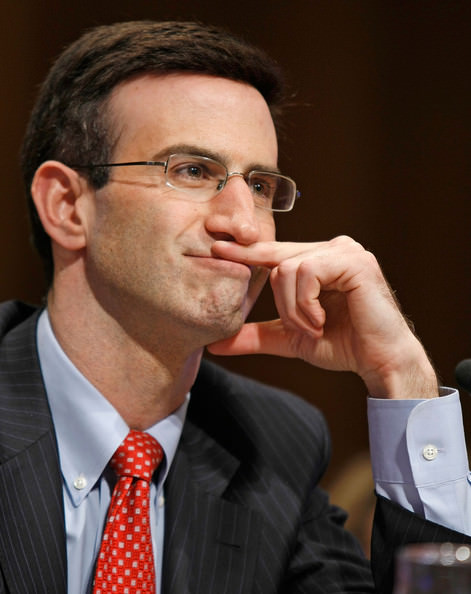
. . . Orszag made the case to the president that reducing healthcare costs was an important element to slashing the long-term budget deficit. More importantly, he persuaded Obama the U.S. healthcare system was so inefficient, overall spending could be restrained while also providing near-universal health insurance coverage. In effect, “bending the curve” was a free lunch. Or at least close enough for government work.
Speaking of intellectual dishonesty, in what parallel universe is it acceptable to introduce a budget that neglects to mention a whopping $3.6 trillion in liabilities? Again, this would be trillion. With a T. Any business that pulled such a stunt would have found itself answering to people called “prosecutors,” and “class action attorneys.” One doesn’t wish Peter Orszag legal trouble–despite the manifest policy failings he is responsible for, he certainly seems like a nice guy–but it is worth noting that after leaving the Office of Management and Budget, Orszag will land some cushy, remunerative position in a think tank, or a private sector company, or both. Is this the price one pays for perpetrating budgetary fraud and chicanery upon the United States of America?
Is it possible that we will get competence? Possibly; Orszag has set the bar so low, that his successor will have to work extra hard to fail to clear it. Of course, the setting of that low bar is the source of many of our problems, now isn’t it?
Monday, February 01, 2010
Obama budget: Record spending, record deficit
2010 United States federal budget - $3.55 trillion (submitted 2009 by President Obama)
2009 United States federal budget - $3.10 trillion (submitted 2008 by President Bush)
2008 United States federal budget - $2.90 trillion (submitted 2007 by President Bush)
2007 United States federal budget - $2.77 trillion (submitted 2006 by President Bush)
2006 United States federal budget - $2.7 trillion (submitted 2005 by President Bush)
2005 United States federal budget - $2.4 trillion (submitted 2004 by President Bush)
2004 United States federal budget - $2.3 trillion (submitted 2003 by President Bush)
2003 United States federal budget - $2.2 trillion (submitted 2002 by President Bush)
2002 United States federal budget - $2.0 trillion (submitted 2001 by President Bush)
2001 United States federal budget - $1.9 trillion (submitted 2000 by President Clinton)
2000 United States federal budget - $1.8 trillion (submitted 1999 by President Clinton)
1999 United States federal budget - $1.7 trillion (submitted 1998 by President Clinton)
1998 United States federal budget - $1.7 trillion (submitted 1997 by President Clinton)
1997 United States federal budget - $1.63 trillion (submitted 1996 by President Clinton)
1996 United States federal budget - $1.6 trillion (submitted 1995 by President Clinton)
Wednesday, January 27, 2010
A Plan to Fix the Budget Process

A Plan to Fix the Budget Process
The current process doesn't work. Here's a plan to fix it.
By Richard Sammon, Senior Associate Editor, The Kiplinger Letter
Release of the budget is the start of the federal budget process, probably the easiest step in a long, byzantine and largely busted routine that consumes months of Congress’ time each year, with most of the work conducted outside of the public view. The annual budget tends to be in the news only when some examples of outrageous pork projects bubble up to the surface. And annual earmarked funding for pet projects is barely newsworthy as all of the pork combined amounts to less than a half of one percent of the budget. Truly a smidgen.
This year will be no different. The modern budget process began with the Budget Reform Act of 1974, which was aimed at bringing some sense and light to a then very secretive annual budget operation that had almost no brakes on spending. It didn’t work. Instead, the process has gotten steadily worse, especially in recent years. Congress almost never finishes its budget work on time, having to rely to Band-Aid measures each year to keep the government from shutting down.
Maybe the strangest thing is how the budget process creates multilayered and duplicative debates. Many of the same budget issues are fought over at great lengths. The first time is in the annual congressional budget resolution that serves as a general spending blueprint. Many of the same budget issues return in full force in authorization bills that essentially say it’s OK for money to be spent by all the various federal agencies, sub-agencies and programs. Then the very same debates are rejoined a third time in the annual appropriations bills and supplemental budget bills that unleash the real money.
The budget resolution -- the spending guide -- is supposed to pass by April 15, a deadline so routinely missed it might as well be removed from the books altogether. Sometimes a budget resolution is not even agreed to at all because of partisan showdowns or because the votes are not there to pass it. It’s nonbinding anyhow -- no power of law. It has limited ultimate affect, except in proposing spending limits in general areas, such as defense, science research and social welfare.
The 12 regular spending bills covering the entire federal bureaucracy and federal programs in every state are all supposed to be signed into law by Oct. 1, just weeks after Congress’ monthlong August recess. Usually only a handful of appropriation bills -- often the easies ones -- make it past the finish line on time.
Other stuck spending bills are then rolled into giant omnibus or catchall measures, often several thousand pages and containing hundreds of billions of dollars’ worth of spending. No one really reads omnibuses before they vote on them. They check for a few provisions they care about and then vote without knowing the vast majority of details. Sometimes the omnibuses are not approved until four, five and even six months into the very same fiscal year they are supposed to apply. That leaves federal agencies in limbo, not knowing how much they have to spend. Invariably they spend less the first half of the year, then rush more money out the door in haste to catch up.
Here’s two simple changes to the budget process that could do a world of good. One would be to change the date of the fiscal year, making it the same as the calendar year. Instead of Oct. 1, it would be Jan. 1. Three months of additional time could give members a little more opportunity to understand the trillions of dollars they are approving. But couple this with an ban on the stop-gap measures used to keep the government going when Congress misses the deadline. Require that the government be shut down unless all the bills are passed before Congress goes home for Christmas.
A second would be to change the whole authorization and appropriation process. Congress could easily agree to make most authorization bills multiyear bills and to make the appropriations bills cover more years than only the next fiscal year. That would free up congressional committees to do more pressing work before the nation. If special circumstances require more money after a two-year spending bill is passed, Congress could pass an addendum or a supplemental. No big deal.
Retired Sen. Pete V. Domenici, R-N.M., a longtime Budget Committee chairman respected for his knowledge of all types of budget arcana, once urged Congress to adopt biennial budgets to help unclog the budget process and allow committees to tackle other work.
He was almost laughed at by his colleagues.
A two year system would mean less leverage, power and influence for chairmen and members of the powerful appropriations committee – the people who hold the purse strings. They rather like hauling agency heads and others before their panels each and every year to let them know who’s boss.
The same is found in the truly bizarre way Congress goes about authorizing funding for the Homeland Security Department, which was created by merging nearly two dozen distinct federal programs and offices. A mind-boggling 88 committees and subcommittees have jurisdiction over some part or other of the department that was created after the 2001 terrorist attacks.
There was an early effort by House and Senate leaders to have just one panel in charge of overseeing the department. That went over in lead balloon fashion. It made eminent sense to have one committee handle the new department, but that would have meant all those other panel chairmen and panel members would be stripped of some of their power. That’s a good way to put a chairman in a foul mood.
It’s too bad Domenici’s idea for two-year budgets went nowhere. It would have eased the entire process and given federal agencies some time to plan and execute programs, no doubt improving performance. It seems a bit selfish and self-important and overly territorial for lawmakers to have to hang on to every bit of power they have, even if it is on a small subcommittee. Then again, this is Washington. Clear, logical and straightforward solutions to vexing problems can quickly be killed off in Congress if it means power would be taken away from someone. .


Wednesday, January 20, 2010
Fannie Mae and Freddie Mac shares soar

But exactly how the government's move makes a payoff for Fannie and Freddie shareholders more likely in the long run, rather than less likely, ought to puzzle most investors.
The stock market's reaction mystifies veteran banking analyst Bert Ely at Ely & Co. in Alexandria, Va.
"They're not going to get anything back," he says of any investors who have long-term faith in the mortgage giants' shares.
Of course, "long term" for most people trading these two stocks probably means an hour or so.
Freddie's shares jumped 34 cents, or 27%, to $1.60; Fannie's stock gained 22 cents, or 21%, to $1.27. Trading volume for both was the highest since late October.
The day's action was reminiscent of the speculative frenzy that erupted late last summer, when shares of Freddie Mac and Fannie Mae nearly quadrupled from the end of July to Aug. 28. During that four-week period, Freddie's stock rocketed from 62 cents to $2.40, while Fannie's shares soared from 58 cents to $2.04.
The Treasury on Christmas Eve announced that it was removing previously set limits on federal financial aid for the companies, which were seized by the U.S. in September 2008 amid mounting mortgage losses. The restrictions had capped aid at $200 billion for each firm. Freddie so far has tapped $51 billion and Fannie has used $60 billion.
The administration said it was removing the caps to "leave no uncertainty about the Treasury's commitment to support these firms as they continue to play a vital role in the housing market during this current crisis."
But whatever additional federal money flows into Fannie and Freddie would almost certainly come at the expense of shareholders' remaining stake. The government now owns 80% of both firms.
The administration is supposed to announce its long-term strategy for Fannie and Freddie in February. The companies' losses could continue to balloon if, as some analysts expect, the White House were to seek to use the companies to support new mortgage-forgiveness programs that would help struggling homeowners.
Ely points out another reason to doubt that the stocks have any real value: The pay packages the Treasury announced Thursday for the companies' chief executives consisted exclusively of cash compensation; no shares were offered.
In contrast, the Treasury has been requiring top executives of other large-scale recipients of federal aid to accept pay packages made up largely of stock and relatively little cash.
tom.petruno@latimes.com
Monday, January 18, 2010
Bernanke will you tell American people to whom Fed Res lent $2.2 trillion of their dollars?
VoiceofAmericans2008
March 3, 2009
Senate Budget Committee Sanders (I-VT) Bernanke Chairman Federal Reserve
In a testy exchange at a hearing before the Senate Budget Committee, Vermont Sen. Bernie Sanders, an independent who usually votes with the Democrats, said he found it "unacceptable" that the central bank risked taxpayer money without detailing where the funds went."My question to you is, will you tell the American people to whom you lent $2.2 trillion of their dollars?" Sanders asked, referring to the size of the Fed's balance sheet.Bernanke responded that the Fed explains the various lending programs on its website, and details the terms and collateral requirements.When Sanders pressed on whether he would name the firms that borrowed from the Fed, the central bank chairman replied, "No," and started to say that doing so risked stigmatizing banks and discouraging them from borrowing from the central bank."Isn't that too bad," Sanders interrupted, cutting off Bernanke's answer. "They took the money but they don't want to be public about the fact that they received it."He said businesses in his state were in trouble and needed loans, but were not permitted to borrow from the Fed."Do you have to be a large, greedy, reckless financial institution to apply for this money?" he asked.Bernanke said the Fed's lending programs were not gifts or subsidies but rather over-collateralized loans. He said the law restricted the types of firms to which the central bank can lend."We have never lost a penny doing it," he said.Sanders responded: "Let me just say this, Mr. Chairman. I have a hard time understanding how you have put $2.2 trillion at risk without making those names available, those institutions public.""We are going to introduce legislation today, by the way, to demand that you do that. It is unacceptable to me that that this goes on," he added. (Reporting by Emily Kaiser, Editing by Chizu Nomiyama)
.
P.S. Notice the swastika design directly behind the left side of Mr. sanders head. Carving symbol with complex swastika motif. ................. Arsenio.
.
Wednesday, December 02, 2009
Bank Of America Exceeds $1 Billion In Lending And Investing To Community Lenders

"Bank of America is investing more in community-based institutions because small businesses, nonprofit organizations and other local efforts are the engine for job growth and economic activity in our cities and towns," said Andrew D. Plepler, Bank of America's global corporate social responsibility and consumer policy executive. "CDFIs are one of the best channels to reach these organizations."
According to Opportunity Finance Network, the leading network for CDFIs, these institutions provide more than $30 billion in capital to underserved communities with positive results every year. This funding goes to more than 9,000 small businesses, 57,000 affordable housing units, and almost 700 new community facilities, including schools, child care centers and health care facilities, and helps create more than 34,000 jobs.
"Bank of America is the single largest investor in CDFIs. They understand the important role these institutions play in delivering capital for housing, businesses and nonprofits in underserved markets," said Mark Pinsky, president and chief executive officer of Opportunity Finance Network . "We are excited but not surprised to hear Bank of America has lent more than $1 billion to our organizations."
Bank of America's work with CDFIs is part of its 10-year, $1.5 trillion lending and investing goal, which demonstrates its ongoing commitment to addressing the critical needs of local communities.
Bank of America and Community Development
Bank of America is a longtime leader of community development and homeownership preservation efforts as noted through six consecutive "outstanding" Community Reinvestment Act (CRA) ratings. In 2009, the company commenced its 10-year, $1.5 trillion community development lending and investing goal – the largest ever established by a U.S. financial institution – focused on affordable housing, small business/farm lending, consumer lending and economic development. Bank of America has provided more than $35 million through its Neighborhood Preservation Initiative to aid distressed homeowners and stabilize communities, increasing capacity of nonprofits for foreclosure prevention counseling and the acquisition, rehabilitation and resale of foreclosed properties. The company also created new streamlined guidelines for government agencies using federal Neighborhood Stabilization Program (NSP) grants to more efficiently acquire foreclosed properties. Key to these efforts is Bank of America's commitment to offer loan modifications to as many as 630,000 borrowers over a three-year period, representing more than $100 billion in mortgages.
SOURCE Bank of America