Showing posts with label Navy. Show all posts

Monday, August 24, 2026

The Cynical Coverage of Conditions on the USS Abraham Lincoln


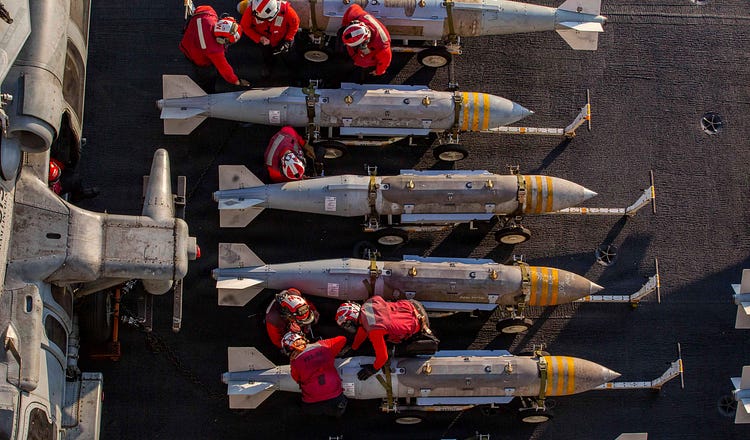
Navy sailors working with ordnance on the flight deck of the USS Abraham Lincoln in support of Operation Epic Fury, on February 28, 2026. (U.S. Navy via AP)
The media covers military suicides when it’s politically useful.

08.17.26 —International


Elliot Ackerman is a decorated veteran of the Marine Corps and CIA special operations. He is a CBS contributor, and Free Press columnist.

Produced by ElevenLabs using AI narration


In 2006, I was deployed aboard the USS Iwo Jima as a Marine. Israel invaded Lebanon that summer and we were diverted off the coast of Beirut, where we stayed underway for weeks, without port calls or a break, while we evacuated U.S. citizens. The pace of operations was relentless; it put a strain on all of us. After several months, we returned home. Days before we pulled into our home port, word spread through the ship that a member of the crew had been found dead in his rack—a suicide. Days later, when we flew off the ship to be reunited with our families, his body was loaded onto one of those flights, to be reunited with his.

I thought of this reading the extensive recent coverage of the USS Abraham Lincoln, a Nimitz-class aircraft carrier, currently deployed in the Persian Gulf. It has been at sea for more than 260 days, a record for the ship. Roughly 40 of those days underway have been during sustained combat operations, which places an additional strain on the crew. And earlier this month, a sailor leapt off the flight deck and into the water. Fortunately, the sailor was recovered and evacuated after what appears to be a suicide attempt, with several other attempts now reported.

This incident has become a cause célèbre in the media, which appear happy to leave readers with the misperception that long deployments and psychically strained sailors in the U.S. Navy represent a situation unique to Trump’s war in Iran. “Conditions on U.S. Aircraft Carrier at Sea for More Than 250 Days Raise Alarms” blared a BBC headline. “Concerns Grow Over Conditions on Navy Carrier,” reported The New York Times. Dozens of similar headlines appeared alongside, and the story led more than a day of television news coverage. The story about the conditions on the Lincoln has gotten so out of control in its virality over the past few days that U.S. Central Command took the unusual step of debunking certain specific online rumors directly on X, and CentCom commander Admiral Brad Cooper made a stop onto the Lincoln over the weekend. Democratic Senators such as Richard Blumenthal and Ruben Gallego have publicly asked the Navy, and Defense Secretary Pete Hegseth, to account for conditions aboard the Lincoln.

Wednesday, February 18, 2026

Strait Showdown: Iran Launches "Smart Control" Exercise At Oil Transit Point


by Tyler Durden

Monday, Feb 16, 2026 - 01:00 PM


Iran's elite Islamic Revolutionary Guard Corps (IRGC) kicked off naval drills Monday in the strategically vital Strait of Hormuz, according to state media.

The exercise, dubbed "Smart Control of Hormuz Strait," is being carried out by IRGC naval forces under the direct supervision of the Guards' top command, state television reported, with semi-official Tasnim news agency describing the drills as testing combat readiness against "possible security and military threats." Energy markets are watching closely.


IRNA: IRGC Navy conducts a hybrid, live exercise dubbed "Smart Control of the Strait of Hormuz."

Under the supervision of IRGC Commander-in-Chief Major General Mohammad Pakpour, a state media press release described the exercise further as "A rapid, decisive, and comprehensive response to maritime security threats form the core focus of the intelligence and operational components of the units deployed during the exercise."

Indirect nuclear talks between the US and Iran have lately resumed after collapsing when Israel launched strikes on Iran in June 2025, igniting a 12-day conflict that included US attacks on three Iranian nuclear facilities - with another round of negotiations scheduled for Tuesday in Geneva, with Oman serving as mediator.

The timing is no coincidence, given that late last week President Trump announced he was dispatching a second aircraft carrier to the Middle East, while continuing to warn that military action against Iran remains on the table.

The IRGC has been conducing sporadic and in some cases unannounced drills in regional waters in order to demonstrate to Washington the Islamic Republic's military readiness.

Two weeks ago, when some of the first drills kicked off, US Central Command (CENTCOM) warned the IRGC it better be careful in the vicinity of US naval assets.

"We will not tolerate unsafe IRGC (Islamic Revolutionary Guard Corps) actions including overflight of U.S. military vessels engaged in flight operations, low-altitude or armed overflight of U.S. military assets when intentions are unclear, highspeed boat approaches on a collision course with U.S. military vessels, or weapons trained at U.S. forces," CENTCOM said at the time.

Thursday, April 05, 2018

Navy chaplain fired after being caught on film having sex at New Orleans bar


| April 04, 2018 05:30 PM


Capt. Loften Thornton, a chaplain at the Marine Reserve in New Orleans, was fired on March 20 due to a "lost of trust and confidence."
(Image via Marine Corps)


A Navy chaplain was fired from his post last month after being caught on video having sex with a woman at a New Orleans pub, according to a report Wednesday.

A Marine spokesman, Lt. Col. Ted Wong, told USA Today that Capt. Loften Thornton was fired on March 20 due to a "lost of trust and confidence."

Two defense officials confirmed to the outlet that authorities were evaluating a video which showed Thornton engaging in sex with a woman at the Crown & Anchor Pub, which is reportedly only a five minute drive from the Marine Reserve where he served in New Orleans.

Thornton had been a chaplain since 1986 and previously served on the destroyer Cole, according to the Navy Times.

The Navy supplies chaplains to the the Marine Corps and they “are embedded within commands operating at sea and ashore to ensure 24/7 availability,” the Navy’s strategic plan for religious ministry reads.

Implicit in the professional Naval chaplaincy role is also "the expectation that chaplains will be faithful representatives of their religious organizations."


Friday, July 15, 2016

Ousted Navy Chaplain Looks to High Court to Overturn 2006 Separation


Daily News


Colorado State Rep. Gordon Klingenschmitt talks with fellow legislator Rep. Joe Salazar on the closing day of the 2015 Colorado legislative session, at the Capitol, in Denver, Wednesday May 6, 2015. (AP Photo/Brennan Linsley)13 JUL 2016Military.com | by Bryant Jordan


A former Navy chaplain removed from the service after disobeying an order not to wear his uniform during a protest in front of the White House 10 years ago is hoping to present his case for reinstatement to the U.S. Supreme Court when it reconvenes in the fall.

Gordon Klingenschmitt, a minister who has served as a representative for the past two years in the Colorado state legislature, said he hopes to show the high court that he did not violate a lawful order or Navy regulations with his appearance at the White House demonstration.

"Because I only said a prayer while in my uniform, and I declined to make any political speeches, and declined any interviews with the media until I changed into civilian clothes, I contend that my prayer in Jesus' name was a religious observance," Klingenschmitt said Tuesday.

In September 2006, a Navy court found then-Lt. Klingenschmitt guilty of disobeying an order by appearing in uniform at a political protest and subsequently separated him from the Navy. He said the Navy had offered to discipline him quietly with a letter of reprimand, but he insisted on a court- martial.

Klingenschmitt, through his attorneys, filed a writ of certiorari with the Supreme Court in May. It's now up to the court to review the petition and decide whether it will hear the appeal.

He said he wants the Navy's ruling overturned and, if it is, to be returned to the chaplaincy and awarded back pay.

Klingenschmitt was elected to the Colorado House of Representatives in 2014 but last month lost the Republican Party primary race to Bob Gardner, who previously served from 2007 to 2013 in the state legislature.

Since being separated from the Navy a decade ago, Klingenschmitt has continued to press the case that military chaplains should be allowed to use Jesus Christ's name in prayer at any time.

Additionally, his Pray In Jesus Name Project claims to have delivered five million faxed petitions to Congress in support of legislation opposing abortion, defending traditional marriage and other causes.

-- Bryant Jordan can be reached atBryant.jordan@military.com. Follow him on Twitter at@BryantJordan.


Source


Wednesday, April 13, 2016

Russian Jets Make Aggressive Maneuver Near U.S. Ship In Baltic Sea


The incident came as NATO plans to build up its presence in eastern Europe in an attempt to counter an increasingly aggressive Russia.

 04/13/2016 04:06 pm ET | Updated 9 minutes ago


Phil Stewart


WASHINGTON, April 13 (Reuters) - Two Russian warplanes with no visible weaponry flew simulated attack passes near a U.S. guided missile destroyer in the Baltic Sea on Tuesday, a U.S. official said, describing it as one of the most aggressive interactions in recent memory.

The repeated flights by the Sukhoi SU-24 warplanes, which also flew near the ship a day earlier, were so close they created wake in the water, with 11 passes, the official said.

A Russian KA-27 Helix helicopter also made seven passes around the USS Donald Cook, taking pictures. The nearest Russian territory was about 70 nautical miles away in its enclave of Kaliningrad, which sits between Lithuania and Poland.

“They tried to raise them (the Russian aircraft) on the radio but they did not answer,” the official said, speaking on condition of anonymity, adding the U.S. ship was in international waters.


Matej Divizna via Getty Images The incident comes as NATO plans its biggest build-up in eastern Europe to counter an increasingly aggressive Russia. Paratroopers from U.S. and Italian airborne brigades train near Grafenwoehr, Germany.


The incident came as NATO plans its biggest build-up in eastern Europe since the Cold War to counter what the alliance, and in particular the Baltic states and Poland, consider to be a more aggressive Russia.

The three Baltic states, which joined both NATO and the European Union in 2004, have asked NATO for a permanent presence of battalion-sized deployments of allied troops in each of their territories. A NATO battalion typically consists of 300 to 800 troops.

Moscow denies any intention to attack the Baltic states.

The USS Donald Cook had just wrapped up a port visit in the Polish city of Gdynia on April 11 and then proceeded out to sea with a Polish helicopter on board.

The first incident took place on April 11, when two SU-24 jets flew about 20 passes near the Donald Cook, coming within 1,000 yards (meters) of the ship, at about 100 feet (30 meters) in altitude.

That was followed by even closer passes by the SU-24s the following day and the passes by the Russian helicopter.

The U.S. defense official said the commanding officer of the Donald Cook believed that Tuesday’s incident was “unsafe and unprofessional,” but cautioned that a formal U.S. military review of the matter was underway.

(Reporting by Phil Stewart; Editing by James Dalgleish)


Source
.

Tuesday, August 19, 2014

Almost 8,000 Navy chiefs face ax


Navy Times12:05 p.m. EDT August 18, 2014


(Photo: Navy Times)


WASHINGTON — Almost 8,000 senior enlisted personnel must go before a continuation board later this year to determine whether they can continue to serve or must retire.

The board — the first since early 2013 — will convene Oct. 27, according to a Navy document released Aug. 14.

At risk are between 7,500 and 8,000 retirement-eligible active and reserve E-7s, E-8s and E-9s with at least at least three years' time in rate.

But there is a big upside to the process: Clearing out senior enlisted who have engaged in misconduct or whose performance has slipped noticeably makes way for hot running sailors to move up.

The board has no exceptions; even the most senior sailors — up to and including Master Chief Petty Officer of the Navy Mike Stevens — will have their records reviewed.

"It's an opportunity for us, as chief petty officers, to police ourselves," said Fleet Master Chief April Beldo, senior enlisted adviser to the chief of naval personnel, in a July 30 interview.

"Expectations for continued service depend on maintaining performance," she said. "As chief petty officers, we're accountable to the Navy, our sailors and ourselves for our actions — and that is really what this is all about."

The board has no quotas, meaning no mandatory cuts to make. It's the board members' job simply to review records and decide who gets to stay in and who must retire — what officials call a "pure quality cut."

The Navy has held such boards — every year but one since fiscal 2010, the last in February of 2013. To date, 30,850 records have been reviewed, with a total of 1,381 chiefs being told to retire — an overall 4.48 percent chance of being sent home.

The fiscal 2014 board was skipped because of a decision made in 2013 by Vice Adm. Scott Van Buskirk, then chief of naval personnel. Scheduling conflicts had caused the fiscal 2013 board to slip into early calendar year 2013. Officials realized that a fiscal 2014 board would have to be come almost immediately after the 2013 non-selects were required to retire.

"We decided (that) to do another one right on the heels of the last one wasn't a good idea," Beldo said. "Based on everything that was going on — sequestration, manning at sea issues — CNP made the decision, supported by the CNO and MCPON, not to do one for fiscal year 2014."

Who's eligible

Retirement-eligible active and reserve chief petty officers — E-7 through E-9 — will be reviewed by the board.

More specifically, active-duty chiefs will be looked at only if they had at least 19 years of active service as of Feb. 28, and three years' time in their current paygrade on June 30.

For drilling reservists, the only difference is that they won't get looked at unless they had 20 qualifying years of service as of Feb. 28. The time-in-paygrade cutoff is the same.

"The board will look at those who are not only retirement-eligible, but also retirement-eligible in their current pay grade," Beldo said.

For example, if a chief is selected for and pins on senior chief, but decides to retire a year later, Beldo said, he or she would retire as an E-7 unless there were extenuating circumstances.

"This guarantees that anyone selected not to continue can retire in their current grade," she said. "We don't want this in any way to be punitive or even to be perceived as punitive."

There are two exceptions to eligibility for consideration by the board: Anyone with an approved retirement request or who has been selected for warrant officer by the most recent selection board won't get a look.

Aside from that, not even the most senior fleet and force master chiefs will escape review. Enlisted board members, too, will be reviewed before being cleared to sit the board.

This wasn't always the case; the first board exempted those in special warfare, nuclear power and the command master chief programs. But the scope of the review has gradually expanded each year, and the fiscal 2013 board included everyone for the first time.

Although personnel officials estimate the review will include 7,500 to 8,000 chiefs, the the exact number won't be known until the end of August.

Naval Personnel Command will post the initial list of eligible chiefs to the Bupers Online Portal. Fleet commands will have until Aug. 29 to add someone or to make the case that a particular chief should not be considered.

The watch list

The 2015 board will be looking at the same types of issues as previous boards, according to the NavAdmin.

"This board's purpose is to evaluate the performance of our chief petty officers and determine whether they should continue on in active service," Beldo said. "It has absolutely nothing to do with force-shaping, or downsizing, if you will — it's simply a performance check."

Every record gets an initial look, as with promotion boards. If the board finds nothing adverse, the sailor is selected for continuation.

If certain negative indicators are found, the board is required to deliberate further on whether that chief stays or goes.

Even those chiefs with one or more black marks on their record won't necessarily be asked to retire; that will only happen if a majority of the board members gives them a thumbs-down.

That's why, officials say, this is a board and not simply a scrub to bounce those with hiccups in their records.

"We're not a zero-defect outfit," then-Capt. Leo Falardeau, who is now retired, told Navy Times after the 2011 board. As head of enlisted progression, Falardeau was in charge of overseeing the board and reviewing its findings.

"There were people who had performance indicators in their record, and their futures were debated in the tank, but they were ultimately retained," he said.

Creating room to advance

Because the Navy's advancements are based on vacancy at the next level, no openings means no advancements.

The solution was to create an enlisted continuation board — similar to the early retirement boards held for officers.

The chief of naval personnel at the time, now Adm. Mark Ferguson, wanted to set a quota of 2,500 chiefs to be cut, but his senior enlisted advisers recommended a pure quality cut instead.

Though it might take longer, the advisers said, the quality cut would serve the same purpose: creating opportunities for advancement in ensuing years.

"This is at the heart of why we've started the continuation board process," said then-Master Chief Petty Officer of the Navy (SS/SW) Rick West, who has since retired. "Yes, it's about performance, but if we do it right, it will also create opportunity for our best young sailors to move up."

Now, nearly six years and almost five boards later, the chance to make chief has again risen.

"This is an opportunity for leadership to show junior sailors coming up — who want to be chief petty officers and who might have the perception that chiefs get away with anything — that we police ourselves," Beldo said. But she re-emphasized that the board's decisions aren't punitive in nature and won't impact any retirements, other than to speed them up for those not continued.


.

Monday, August 18, 2014

Navy Caves In to Atheists, Removes Bibles From Guest Rooms


Wednesday, 13 August 2014 15:42
Written by Dave Bohon


The U.S. Navy has caved in to the demands of an atheist group that it remove Bibles from guests rooms on naval bases.

In March, attorneys from the atheist group Freedom From Religion Foundation (FFRF) sent a letter to the Navy Exchange Service Command (NEXCOM) claiming that two “concerned service members” had independently contacted FFRF to complain that “every Navy lodging room that they have stayed in during decades of service has contained a Bible” — most of them provided by the Christian group Gideons International, which appears to be a particular target of the FFRF.

The FFRF was deeply worried, as noted in the letter, that materials from other faiths were “rarely” seen in the Navy guest rooms. “One complainant noted that he 'never saw a Book of Mormon or Koran' in any Navy-run lodge and that he had 'been in varied Navy Bachelor Officer Quarters (BOQs) with Bibles,” wrote troubled FFRF staff attorney Andrew Seidel with a note of righteous concern.

Insisting that under the Establishment Clause of the First Amendment, “a government entity cannot in any way promote, advance, or otherwise endorse religion,” Seidel charged that the Navy's longtime tradition of allowing Bibles in its guest rooms “amounts to a government endorsement of that religious text. Including Bibles sends the message to non-Christian ... guests that they should read the Bible.... The military should not promote certain religious beliefs by placing Bibles in guest rooms.”

Arguing that “government-run entities have a constitutional obligation to remain neutral toward religion,” Seidel and the FFRF demanded that the Navy remove the offensive Bibles from its guest rooms, and “provide us with a written response outlining the actions that your office is taking to remedy this constitutional violation.”

In June, NEXCOM responded to the demand with a directive that Bibles were to be removed from all Navy guest rooms until further review of Navy policy on religious materials. “The Navy Lodge General Manager should advise the Installation Commanding Officer of our intention to work through the chaplain’s office to determine what [the] installation policy is,” read the directive, “and the method to remove religious material currently in the guest rooms.” According to the order, all Bibles currently in Navy guest rooms were to be removed by September 1.

The directive does not say that Bibles will be prohibited from rooms in the future, but that in the future the commanding officer of a naval base will determine, “in accordance with personnel readiness and military regulations, whether [religious materials] will be accepted and how they will be handled and distributed.”

Addressing the FFRF's issue, NEXCOM spokeswoman Kathleen Martin told reporters that “we looked at our policy and realized there wasn’t a consistent policy regarding Navy Lodges. We decided we needed to have some consistency.”

According to a report by the American Family Association (AFA), a Navy lodging housekeeper wrote in an e-mail to the AFA: “We were told today, June 23, 2014, that due to a new policy by the CEO of NEXCOM, Rear Admiral Robert J. Bianchi, we were to remove the Bibles from the rooms. They told us to put them in boxes, where they would be taken to a donation center somewhere.”

The AFA reported that a NEXCOM directive ordered the removal of Bibles from 34 Navy Lodge locations and 24,000 Navy Gateway Inns and Suites guest rooms on Navy bases around the world. Lodge managers were ordered to contact base commanders and chaplains and facilitate removing the Bibles and other 'religious material currently in the guest rooms.'”

While it is probable, based on the published directive, that Bibles may again be available in some Navy guest rooms in the future, the FFRF trumpeted the NEXCOM action as a victory for atheists, with FFRF spokesman Sam Grover announcing, “We’re pleased that NEXCOM has taken seriously its constitutional obligation to remain neutral toward religion as a representative of our federal government.... By removing Bibles from Navy-run lodges, the Navy has taken a step to ensure that it is not sending the impermissible message that Christians are favored over guests with other religious beliefs or over those guests with no religion.”

Among the conservative Christian leaders sounding off against the Navy's preliminary cave-in to the atheist attack was Ron Crews, a retired military chaplain and head of the Chaplain Alliance for Religious Liberty. “A Bible in a hotel room is no more illegal than a chaplain in the military,” said Crews of the FFRF's charge that the presence of the Bibles in Navy guest rooms was somehow unconstitutional. “They are there for those who want them.”

He added that “there is nothing wrong with allowing the Gideons to place Bibles in Navy lodges, which it has done for decades at no cost to the Navy. Our service men and women are often away from home, sometimes for long periods of time. It’s perfectly constitutional and legal to allow the Gideons to provide, at their own expense, this source of comfort for service men and women of faith.”

As for the ease with which Navy superiors surrendered to the atheist advance, Crews said that “it’s tiresome to see senior military leaders needlessly cave in to activist groups offended by anything Christian. We sincerely hope that the Navy will reverse its decision as the Air Force did in 2012 after the public spoke loudly and clearly against this sort of censorship.”

Crews was referring to the decision in 2012 by Air Force higher-ups to reverse their cave-in to the demands of another atheist group, the Military Association of Atheists and Freethinkers (MAAF). As reported at the time by The New American, following demands from MAAF, the Air Force dropped a policy that directed housekeepers to make certain there were Bibles in guest rooms on Air Force bases. “While the atheist group had wanted the Air Force to ban the Bibles, placed there for free by the Gideons, from the room altogether,” reported The New American, after deliberation the Air Force Services Agency decided instead to simply remove the question, 'Is a Bible provided?' from the lodging check list housekeepers go through in making up the rooms.”

An Air Force spokesman, Mike Dickerson, said at the time that while the checklist was being dropped, the Air Force was not prepared to sanitize Scripture from rooms entirely, as the atheist group had desired. “The Air Force has not directed the removal of Bibles from Air Force Inns lodging rooms at this time,” Dickerson said. “We continue to review the situation and weigh our multiple First Amendment responsibilities and obligations.”

Speaking of the present Navy actions, Mike Berry, director of military affairs at Liberty Institute, noted that “many of our military's religious traditions and observances pre-date America's founding, but groups like the Freedom From Religion Foundation want to erase that history. We've seen Bibles temporarily banned from military hospitals, demands that veterans' memorials be torn down, and crosses removed from military chapels. This is just the latest in a well-documented pattern of hostility against religion in our military.”

Thursday, November 14, 2013

Two Navy admirals suspended amid mushrooming bribery, prostitution scandal


VIRGINIA BEACH, Va. (July 02, 2012) Rear Adm. Ted Branch, commander of Naval Air Force Atlantic, addresses the public regarding the results of its Judge Advocate General Manual (JAGMAN) investigation of the F/A-18D Hornet that crashed into an apartment complex in Virginia Beach on April 6. The aircraft, assigned to Strike Fighter Squadron (VFA) 106 and based at Naval Air Station Oceana, was conducting a scheduled training exercise when it suffered a catastrophic mechanical failure shortly after takeoff and crashed into the Mayfair Mews Apartment Complex. (U.S. Navy photo by Mass Communication Specialist 2nd Class Ernest R. Scott/Released)


By Kristina Wong


The Washington Times

Sunday, November 10, 2013


The Navy has suspended two admirals in a broadening bribery scandal that already has ensnared three senior naval officials.

Involving charges of prostitution and payoffs, the scandal is the U.S. military’s highest-profile case of officer misconduct this year — part of a trend that has caused deep concern among Pentagon officials. The number of substantiated cases of misconduct has increased steadily since 2008, according to statistics by the Defense Department’s inspector general.

The Navy is investigating Vice Adm. Ted Branch, director of naval intelligence, and Rear Adm. Bruce Loveless, director of intelligence operations, on accusations of “illegal and improper relations” with a defense contractor who scammed the Navy of millions of dollars and bribed naval officials with hookers and gifts over several years.

Neither admiral has been charged with a crime or violation, but the Navy said the accusations against them involve “inappropriate conduct prior to their current assignments and flag officer rank.”

So far, three Navy officials have been arrested and charged with giving classified information to Malaysian defense contractor Leonard Glenn Francis in exchange for concert tickets, prostitutes and other illicit gifts.

The contractor’s company, Glenn Defense Marine Asia Ltd., serviced naval ships in Southeast Asia, and the classified information helped him win Navy contracts worth hundreds of millions of dollars. The information included ship movements and scheduled port visits, and data about internal Navy investigations of the company.

The three Navy officials are Cmdrs. Jose Luis Sanchez and Michael Vannak Khem Misiewicz, and naval criminal investigator John Bertrand Beliveau II. Mr. Francis also has been arrested, along with company executive Alex Wisidagama, of Singapore.

Cmdr. Misiewicz, Mr. Francis and Mr. Beliveau’s attorney appeared for a routine hearing Friday in U.S. District Court in Southern California. The next court date is scheduled for Feb. 28.

The bribery scandal is unfolding amid a Pentagon effort to instill and enforce high standards of conduct among senior officers — and to hold them accountable for violating those standards. The effort’s success is debatable.

According to the Pentagon inspector general, 294 cases of officer misconduct were investigated and 40 were verified in 2008 — a substantiation rate of 14 percent. In 2012, 83 of 321 investigated cases were verified — a substantiation rate of 26 percent.

So far this year, 277 cases have been investigated and 95 verified — a substantiation rate of 34 percent.

Criminal convictions under the military justice system increased from 615 in 2008 to 731 in 2011, and dipped to 656 in 2012. The statistics do not include convictions in civilian courts or cases in which non-judicial punishment was administered.

The military’s handling of misconduct has been under fire amid an increase in reports of sexual assaults in the ranks. Reports of sexual assaults rose by 46 percent last fiscal year, the Pentagon announced last week.

Restoring the military’s ethics and professionalism has been a top goal of Army Gen. Martin E. Dempsey, chairman of the Joint Chiefs of Staff.

But no major initiatives have been announced since a review of ethics training for senior officers last November that found such training should begin earlier in an officer’s career.

“It remains a priority for the chairman, and we’ll continue to work this issue very hard,” Pentagon press secretary George Little said. “We’re troubled by the allegations surrounding what’s been reported with respect to Navy officers, and we need to continue to grapple with this issue [of misconduct].”

Martin L. Cook, professor of leadership and ethics at the Naval War College, said he thinks the growing number of ethical violations stems from Bathsheba syndrome, in which senior officers begin to abuse the privileges that come with their success.

“Senior officers have been successful for so long, they take it for granted and develop inflated senses of ego,” he said.

Steven Olson, an ethics professor at Georgia State University and co-founder of the Center for Ethics and Corporate Responsibility, said the type of unethical behavior exhibited in the bribery case usually happens when spending goes unchecked.

“In big buildups, the audit function tends to weaken and there becomes more tendency to engage in those [initial] behaviors that eventually end up in major fraud,” said Mr. Olson, who leads business executives through a military ethics class at the Marine Corps base at Quantico, Va.

“You see this in business when things are really booming,” he said. “When there’s a lot of money flowing through, it’s hard to keep track of it all, and that’s when people typically engage in fraud. They know the level that will be checked, and they do things just below that level.”

Mr. Cook said the problem could worsen as the military curtails training because of budget cuts.

A course that includes ethics training for new one-star generals has been canceled or curtailed twice this year because of budget cuts and the partial government shutdown in October. The Joint Chiefs’ capstone course, which requires senior officers from across the country to spend five consecutive weeks training together, is mandated by the 1986 Goldwater-Nichols Act, but the shutdown forced all of those who were traveling to return home.

“You need to constantly re-prime the importance of ethics, of standards, and the brain will remember what’s been most recently taught,” Mr. Olson said.


Source: http://www.washingtontimes.com/news/2013/nov/10/two-navy-admirals-suspended-as-military-cracks-dow/#ixzz2ke4YXwhv
.
.

Friday, October 11, 2013

Vice Adm. Tim Giardina Fired as No. 2 Nuclear Commander


Oct. 9, 2013
By LUIS MARTINEZ


Navy Vice Adm. Tim Giardina is shown in a Nov. 11, 2011, photo. U.S. Navy


The No. 2 officer at U.S. Strategic Command has been relieved of command by President Obama because of a "loss of confidence" in his abilities to carry out his post.

Vice Adm. Tim Giardina has been the focus of a criminal investigation looking into his suspected use of counterfeit gambling chips in a poker game at a western Iowa casino.

StratCom commander Gen. Robert Kehler suspended Giardina from his duties as deputy commander on Sept. 3 and recommended to Defense Secretary Chuck Hagel that he be relieved from his post. Kehler's moves were guided by preliminary information he had received from investigations of Giardina's alleged activities.

A defense official said Wednesday that "based upon a recommendation from the Secretary of Defense Chuck Hagel, the president determined Oct. 3 that Vice Adm. Timothy M. Giardina, former Deputy Commander, U.S. Strategic Command (O-9), should be relieved."

President Obama became involved in the case because only the president can relieve a three- and four-star officer from his post.

Giardina has been reassigned to an undetermined position within the Navy.

The vice admiral remains under investigation by the Navy Criminal Investigative Service (NCIS) which launched its own probe of Giardina after being contacted by Iowa authorities in mid-July.

David Dales, a special agent in charge with the Iowa Division of Criminal Investigation (DCI), told ABC News in late September that his agency began an investigation this past June centered on the introduction of counterfeit poker chips in a poker game at the Horseshoe Council Bluffs Casino in Council Bluffs, Iowa. That city is located across the Missouri River from Omaha, Neb., which is near StratCom's headquarters.

Dales said the use of counterfeit chips is "pretty rare" and constituted "a Class D felony in the state of Iowa." Dale would not characterize the amount of chips used in the game, but described it as "a significant monetary amount."

He said his agency contacted StratCom "when we discovered the subject of the investigation that we had developed, and who that person was."

A source familiar with the case said Giardina was the subject of DCI's investigation.

Dale said the investigation is still open and no charges have been brought in the case, though DCI's investigation is pretty much complete. The county attorney has decided to hold off on charges for the moment and DCI is fully cooperating with the investigation being conducted by NCIS, he said.

Council Bluffs is home to three casinos that do the most gambling business in the state of Iowa. Horseshoe Council Bluffs Casino, run by Harrah's, is home to a greyhound race track and has table games and slot games inside a casino area.

A defense official said there is nothing to indicate there's been any compromise of StratCom's mission or classified material in the matter involving Giardina.

StratCom, based at Offutt Air Force Base in Bellevue, Neb., oversees the military's nuclear units and weapons.

Giardina was scheduled to leave StratCom later this year and his successor, Lt. Gen. James Kowalski, had already been nominated by the White House.


Source
.

Monday, September 30, 2013

Navy Yard Shooter- Mind Control False Flag or Plain Insanity?


kytekutter

Published on Sep 25, 2013


(September 26, 2013) The Navy Yard shooter thought he was being controlled by low-frequency radio waves. Does this have any credibility or just fall into the realm of conspiracy theories.

.

Wednesday, August 21, 2013

Asylum-seekers made it less than half-way from Indonesia when boat began to sink


by: Paige Taylor
From: The Australian
August 21, 2013 12:00AM


TRAUMATISED survivors of another fatal asylum boat journey will be delivered to Christmas Island this morning after being rescued by the Australian navy in the third tragedy at sea in five weeks.

The 106 survivors are due to be taken off HMAS Parramatta, the frigate that rescued them from their sunken vessel about 120 nautical miles north of the Australian territory. Up to five people are feared drowned.

The asylum-seekers had made it less than half-way from Indonesia when their boat began to sink. A search for five people the asylum-seekers said were unaccounted was called off last night. Navy officers in rigid inflatable boats rescued the 106 people from the sinking asylum vessel after somebody onboard phoned for help early yesterday saying two passengers were injured.

The Parramatta was more than six hours from the asylum vessel shortly after 5.30am (AEST) when the Australian Maritime Safety Authority received the phone call asking for help. At that time, there was no indication the vessel was stricken. The person who contacted AMSA indicated only that two people on board were injured and needed help, an AMSA spokeswoman said.

When the Customs and Border Protection Dash 8 aircraft arrived on the scene at 12:20pm, it sighted a "foundered vessel".

"The vessel was upright, but partially submerged. A number of people were sighted in the water," an AMSA statement said.

At 12:25pm, the Parramatta arrived and began pulling people out of the water. A merchant vessel was on the scene as well.

"After an extensive search of the area for further survivors or bodies, none have been sighted; it is therefore believed any people unaccounted for have gone down with part of the vessel," AMSA and Border Protection Command said in a joint media release at 6.38pm.

In two asylum boat tragedies north of Christmas Island last month, the vessels tipped over in rough conditions. Those two capsizes - one overnight on July 12-13 and another on July 16 - were also fatal.

In the first, officers from Customs Vessel Triton rescued 88 people with help from a merchant vessel. Rescuers also recovered the body of 10-week-old baby boy Abul Jafari from Afghanistan.

The July 16 capsize was closer to Christmas Island. The bodies of two men and two women were recovered. In that incident, officers from HMAS Warramunga and HMAS Albany rescued 144 people, including an eight-month-old baby Afghan girl found floating face down in the ocean and not breathing.

Her mother is missing presumably drowned. In that incident, the navy has confirmed an officer from the Warramunga spotted the girl, pulled her into a inflatable boat and revived her.

Those rescued yesterday are from the 40th boat to either arrive, be intercepted or rescued since Kevin Rudd announced his PNG Solution on July 19.


Source
.

Monday, February 11, 2013

SEAL sniper Chris Kyle gets public farewell at Cowboys Stadium

Chris Kyle's widow, Taya, speaks at his memorial at Cowboys Stadium.
By Matt Pearce

February 11, 2013, 2:43 p.m.


Thousands of well-wishers, including dozens of Navy SEALS, descended on Cowboys Stadium in Arlington, Texas, on Monday to remember the life of a famed Navy SEAL sniper killed at a nearby gun range on Feb. 2.

The body of Chris Kyle, author of "American Sniper: The Autobiography of the Most Lethal Sniper in U.S. Military History" -- an account of Kyle's four tours in Iraq, where he said he killed at least 160 enemy combatants -- lay in state on the Cowboys' silver and blue star logo at the 50-yard line, with an American flag draped over his coffin.

The stadium, designed for the fidgety loudness of an NFL game day, instead swallowed the echoes of tributes, scripture readings and country songs dedicated to Kyle, as well as the mournful silences between.

An estimated 7,000 people attended, and Texas Gov. Rick Perry issued a statement that said, in part, “Chris Kyle was the public face of an anonymous breed of American warrior who are handed the hardest missions and assume the largest risks. Chris was among the very best at what he did, and he saved countless American lives in the process. Our state and our nation suffered a profound loss with his passing."

Although no politician spoke at the service, former Alaska Gov. Sarah Palin was in Dallas on Monday and posted on her Facebook page that she would attend the memorial. "I find it sad to see that flags aren't flying at half staff for this American hero," Palin wrote on the page.

According to police, Kyle, 38, and a friend, Chad Littlefield, 35, were shot to death by a fellow Iraq veteran who had been struggling with mental health problems and who they had taken to the gun range for a kind of shooting therapy.

Eddie Ray Routh, a 25-year-old Marine reservist, had been diagnosed with post-traumatic stress disorder, or PTSD, and had been hospitalized multiple times, his family said.

Kyle left behind a wife, Taya, and attendees tweeted photos of the goodbye notes from his two children that were printed on the back of the service's program: "I love you Dad. You are the best dad ever. I never wanted you to die. I will miss your heart. I will love you even if you died. Love you forever, Baby Girl." The other, signed "Bubba," said, "Dad, I miss you a lot. One of the best things that has happened to me is you. I love you Dad. I always will."

The service blended the unusual mix of the public and the clandestine that swirled through the final years of Kyle's life; whether friends or comrades in arms, speakers rarely gave their names when remembering the highly decorated veteran who ascended out of the anonymity of service and into the public spotlight.

Country music stars, including Randy Travis and Joe Nichols, didn't announce themselves before performing the music Kyle liked, nor did the Navy SEAL officials who spoke of Kyle's service in some of the most fevered encounters of the Iraq war theater over the past decade.

One SEAL official related an account of Kyle staying on his scope after his position came under heavy fire in Ramadi, and another of rescuing a stranded Marine in Fallujah.

But far more commonly throughout the memorial service, friends and co-workers recalled an ornery Texas boy who liked to "choke out" friends and celebrities alike with his forceful brand of horseplay, who was a slob at camp in contrast to the neatness of his shooting, and who loved his fallen comrades so much that he could hardly bear their deaths.

Debbie Lee -- the mother of Marc Allen Lee, the first SEAL to die in Iraq -- recalled that Kyle "adopted" her after her son died and earmarked earnings from his book sales for her family.

"Chris didn’t publish that book for an income or to be famous," Lee said. "He hated the spotlight. Chris did that for his teammates" and to show the country what his experience had been like. She added that he didn't take a salary from the nonprofit foundation he helped start for veterans.

"He didn’t give out of abundance.… He trusted that God would provide for him and his family," she said.

The service largely skirted the darker portions of Kyle's life after war, which he had detailed in his book -- problems with drinking and depression and a likely case of PTSD. His marriage too had fallen under strain.

Kyle's wife, Taya, however, in an emotional and frank recollection of her husband, credited Littlefield with helping Kyle get back in shape after he returned home from duty. She said Littlefield -- who has received much less attention in the aftermath of the shooting -- was the anchor that helped Kyle right himself.

Speaking only a few yards from her husband's coffin, Taya recalled a man she fought with and loved endlessly.

“You taught me innocent, reckless love without abandon," she said. "You taught me how to turn a life full of fear into a life full of faith. You taught me that I could be more independent than I ever wanted to be. You taught me how to raise children with love and softness and proved it could be done with a high standard of respect and old-fashioned values.”

Before the trumpeter began to play taps for her husband, she said, “I love you, Chris. I love you.”


Source
.

Sunday, September 16, 2012

On the Brink of War: Armada of U.S. and British Naval Power is Missing in the Gulf

SUNDAY, SEPTEMBER 16, 2012


Sean Rayment is reporting for the UK's Telegraph:

Battleships, aircraft carriers, minesweepers and submarines from 25 nations are converging on the strategically important Strait of Hormuz in an unprecedented show of force as Israel and Iran move towards the brink of war.

Western leaders are convinced that Iran will retaliate to any attack by attempting to mine or blockade the shipping lane through which passes around 18 million barrels of oil every day, approximately 35 per cent of the world’s petroleum traded by sea.

A blockade would have a catastrophic effect on the fragile economies of Britain, Europe the United States and Japan, all of which rely heavily on oil and gas supplies from the Gulf.
The Strait of Hormuz is one of the world’s most congested international waterways. It is only 21 miles wide at its narrowest point and is bordered by the Iranian coast to the north and the United Arab Emirates to the south.

Can Iran close the Strait of Hormuz?

This is what I reported in the EPJ Daily Alert in November 2010:
This afternoon I attended a meeting where the speaker was Capitan Jeffrey Kline. Kline is the Program Director, Maritime Defense and Security Research Programs, Naval Postgraduate School. He is an Adjunct Professor at the Naval War College where he teaches, "Joint Analysis for the Warfare Commander".

While his speech was about piracy on the high seas, I took the opportunity after his speech to ask him about the Strait of Hormuz. The strait is a very strategically important waterway between the Gulf of Oman in the southeast and the Persian Gulf. A lot of oil passes through the straight, 20% of all world oil trade. You can't spend more than 5 minutes with an oil trader after bringing up the possibility of war with Iran before talk turns to the closure of the Strait.

There are many, many opinions as to the whether the strait can be closed. I even heard Boone Pickens (Who knows more about oil than any other man I have met) say at a Michael Milken Conference that he couldn't imagine that the strait could be closed, given that at its narrowest point, the traffic lanes are 6 miles wide.

I thought I would ask Kline, who might have a pretty damn good idea if the Straight could be closed by Iran. His answer was it could. When I asked him how long it would take, he said 3 or 4 days for Iran to position ships and lay mines. He did say that the blockade could eventually be broken, but it would depend upon international co-operation and that it would take "some time". He said that Iran has missiles onshore aimed at the strait that would have to be taken out, and that Iran had other sophisticated equipment in the area including drones that could listen in on ship communications. He said ship mine sweeping can also get "very tricky".


I am not sure how much of Kline's analysis holds up if there is already a major joint U.S.-U.K. presence in the area. My guess this would make the operation more difficult, but notice Kline did mention that Iran has drones that can listen to ship communications. Thus, if Iran is capable of knowing where U.S. and U.K. ships are presumably they will have limited ability to place some mines.


Source

Wednesday, August 29, 2012

Bin Laden Raid Became Re-Election Mission, SEAL Book Says


President Obama and his national security team watch the bin Laden raid unfold. Photo: Wikimedia

The mission was twofold: first and foremost, kill Osama bin Laden. Then, once the deed was done and the troops were back safe, help re-elect the president of the United States by promoting the death of the world’s most wanted terrorist.

That’s the accusation in “No Easy Day,” the firsthand account of the bin Laden raid from Matt Bissonette, a former member of SEAL Team 6. Copies of the book, due out next week, were obtained by the Huffington Post and by the Associated Press’ Kim Dozier.

In the excerpts they present, Bissonette praises President Obama for giving the green light to attack bin Laden’s compound in Abbottabad. But even before the mission began, Bissonette and his fellow SEALs knew that the raid would be played up by the White House for political purposes.

“We’ll get Obama re-elected for sure. I can see him now, talking about how he killed bin Laden,” one SEAL said, according to Bissonette.

Bissonette adds: “We all knew the deal. We were tools in the toolbox, and when things go well they promote it. They inflate their roles. But we should have done it. It was the right call to make. Regardless of the politics that would come along with it, the end result was what we all wanted.”

The degree to which the White House took credit for — and leaked information about — the bin Laden raid has already become a contentious campaign issue. “No Easy Day,” written by Bissonette under a pseudonym and co-authored by the journalist Kevin Maurer, won’t exactly relieve that strain. A political action committee backed by right-wing activists and claiming to represent former special operations forces has gone after the “countless leaks, interviews and decisions by the Obama administration” that have “put future missions and personnel at risk.” Republicans have teased Obama for playing up his role in the mission. “He pats himself on the back every night for continuing the aggressive search for bin Laden started by George Bush,” said one surrogate for Mitt Romney’s presidential campaign.

Obama administration internal messages, released yesterday by Judicial Watch, provide fresh details about the promotional push that followed the bin Laden raid. The CIA, for example, helped a pair of White House-friendly filmmakers, Mark Boal and Kathryn Bigelow, arrange interviews with two of the men who accompanied Bissonette on the mission to Abbottabad. “I know we don’t pick favorites but it makes sense to get behind a winning horse,” agency spokesperson Marie Harf wrote. “Mark and Kathryn’s movie is going to be the first and the biggest. It’s got the most money behind it, and two Oscar winners on board.”

Bissonette writes that the initial accounts of the raid, leaked by administration officials, were bordering on Tinseltown, as well. A claimed 40-minute gunfight between the SEALs and al-Qaida operatives never happened. Nor was bin Laden shot while reaching for a gun, as officials originally claimed. In fact, the terrorist was unarmed and didn’t even bother to defend himself. ”The raid was being reported like a bad action movie,” Bissonette says. “At first, it was funny because it was so wrong.”

Later, Bissonette and his fellow SEALs met the president. At the end of the meeting, Obama invited the troops to the White House for a beer at a later date. A few weeks later, Bissonette asked a teammate if he heard anything about the beer. The reply, according to the author: “You believed that xxxx. I bet you voted for change too, sucker.”


Source

.

Wednesday, March 14, 2012

Sunday: A day of 'rest' at sea


By Jennifer McDermott

Publication: The Day

Published 03/13/2012 12:00 AM
Updated 03/13/2012 04:47 PM
Jennifer McDermott/The Day
Lt. j.g. Ryan Sullivan, center, receives Communion from the Rev. Thomas Hoar, Catholic priest for the Naval Submarine Base in Groton, in the wardroom of the submarine USS Missouri on Sunday. Waiting at right is Lt. Anthony Roa.


Editor's Note: Jennifer McDermott is on a special assignment aboard the USS Missouri, one of the newest Virginia-class submarines to join the fleet. She will provide updates during her four-day transit with the crew of this advanced submarine.

Under way on the USS Missouri - At the Catholic Mass on board the USS Missouri Sunday, Lt. Anthony Roa said he wanted to pray that the families of the crew stayed safe while the submarine was at sea.

Sunday is the one day that the tempo slows on the Missouri (SSN 780) so the crew can relax and recharge.

Many were thinking about their families.

"That one hour in the ward room together, we can set aside the military aspect of our lives and be able to pray together," said Roa, 27, of Maryland.

The service was the first Mass held on a submarine at sea in more than a decade and was most likely the first on a Virginia-class boat. Roa usually leads the Catholic members of the crew in a few readings each Sunday, but this week the Rev. Thomas Hoar, Catholic chaplain for the Naval Submarine Base in Groton and president of St. Edmund's Retreat in Mystic, was riding as a guest.

Joseph Cefaratti, a first-class machinist's mate, carried his wife's sonogram photo in his pocket. Chief Joseph Johns, a logistics specialist, kept a picture he took with his wife as a screensaver on his iPod.

It helps a little, Chief Brian Paugh said, to watch the videos of his seven kids on his cell phone.

These men said that what drives them to leave their families, sunlight and the comforts of home for months at a time is their love for the job and the camaraderie on board their sub.

"I know whoever earned these has the ability to save my life," said Cefaratti, 31, of Texas, pointing to the dolphins on his chest that signify he's qualified in submarines. "It makes it more of a brotherhood. We're like a family out to sea.

"I love what I do. It's hard, it's strenuous and it's a lot of long hours. But in the long run, I really do love what I do."

There was still plenty of work to be done. Chief Nicholas Harr, the assistant navigator, gathered about 20 people together to go over the plans for pulling into Naval Submarine Base Kings Bay in Georgia the next day.

Entering or leaving a port is risky because submarines are built to be submerged and don't maneuver as well on the surface. Kings Bay has challenging currents and a narrow channel, said Harr, who worked on the plans for two weeks.

"My sole purpose in life is the safe navigation of the ship," Harr said after the meeting. "A lot of people call me strange. I enjoy my job. I thrive on the stress of it. It'll probably make me an old man very fast, but I enjoy what I do."

Walking by, Chief Jay Carson teased Harr good-naturedly.

"You're turning 19 today, right?" Carson quipped.

"I know, I know, you could be my father," Harr joked back. "'Just For Men' really worked for you."

Harr, of Ohio, celebrated his 29th birthday Sunday. He gets teased about his age because he has risen through the ranks quickly and is young for his position.

The sailors are sarcastic, Harr said, because it helps relieve stress. Many are also Type A personalities - analytical, resourceful and flexible.

"After you've been a submariner for a certain period of time, you become a specific person," said Senior Chief Ronald Clark, the chief of the boat. "You still have unique qualities and things like that, but I can walk into a room and pick out a submariner quickly."

A sudden shift

"Emergency deep!"

The announcement rang out over the PA system shortly before dinner, and the Missouri dove deep. It was part of the training for a junior officer who was conning, or driving, the submarine.

The shower is one of the worst places to be when this happens. Shampoo bottles go flying and the water on the floor rushes to one side. The stall is built like a metal telephone booth, and hitting the side of it hurts.

The Missouri had been at varying angles all day because the crew was testing the submarine's rudder and control planes. When it was angled down, some sailors leaned back and took baby steps to walk forward. Others stood still and held on to pipes overhead.

Dinner and dolphins

Sunday's dinner, the best of the week because the culinary specialists can splurge a little, was prime rib and scampi.

After dinner, Cmdr. Timothy Rexrode, the commanding officer, held a special ceremony to pin dolphins on five crew members and commend others for various accomplishments. Earning dolphins is a major milestone and signifies that the men have Rexrode's full confidence to operate the submarine.

"It's a really big day for me," said Lt. j.g. Joe Innerst, 24, of Pennsylvania, who was pinned. "Receiving them means a whole lot, but we need to earn them every day."

The mood shifted after the ceremony as the crew began getting ready for the final push to get the Missouri into port.

They set up the equipment in the sail they would need the next day and took the submarine nearly to the surface. The Missouri rocked back and forth with the waves all night. When the submarine is deeper, only the ship's movements can be felt.

No one was sleeping when the Missouri headed into Kings Bay; all had assignments. The torpedo room was filled with sailors and their firefighting equipment, just in case. The control room was tense.

The Missouri and its crew arrived safely.

The sailors, especially those with Irish roots, were looking forward to St. Patrick's Day. Others wanted to celebrate their birthdays and promotions on shore. But it wouldn't be long before they were back at work. There was maintenance to be done before returning to Groton and there were more trials planned.

When the Missouri arrives at the Groton base in April, the testing phase that all new submarines have to go through will be over. The seventh member of the Virginia class, the sub was commissioned in 2010.

Rexrode said the submarine has performed "superbly" so far. This summer it will begin the yearlong preparation process for its first six-month deployment.

The Missouri is so "awesome and impressive," Rexrode said, "it makes you want to do nothing more than go to sea."

j.mcdermott@theday.com


Source
Saturday, February 04, 2012

Iran Begins Naval Exercises Near Gulf Strait

By ALI AKBAR DAREINI Associated Press

TEHRAN, Iran February 4, 2012 (AP)

Iran's powerful Revolutionary Guard began naval maneuvers Saturday in the latest show of force near the strategic Strait of Hormuz, the critical Gulf oil tanker route that Tehran has threatened to close in retaliation for tougher Western sanctions.

Plans for new Iranian war games in the Gulf have been in the works for weeks. But they got under way following stern warnings by Iran's Supreme Leader, Ayatollah Ali Khamenei, about any possible U.S. or Israeli attacks against Tehran's nuclear facilities.

The month-long maneuvers also come after Western forces boosted their naval presence in the Gulf led by the American aircraft carrier USS Abraham Lincoln.

Ali Khamenei
AP
In this photo released by an official website of the Iranian supreme leader's office, Iranian supreme leader Ayatollah Ali Khamenei, delivers Friday prayers sermon, at the Tehran University campus, Iran, Friday, Feb. 3, 2012. Iran will help any nation or group that confronts the "cancer" Israel, Ayatollah Ali Khamenei said Friday. He also said in remarks delivered to worshippers at Friday prayers in Tehran and broadcast on state TV that the country would continue its controversial nuclear program, and warned that any military strike by the U.S. would only make Iran stronger. (AP Photo/Office of the Supreme Leader)

Iran has so far made no attempts to disrupt shipping through the strait, the route for one-fifth the world's crude oil. The U.S. and allies have said they would respond swiftly to any attempts at a blockade.

Last month, Iran's navy wrapped up 10 days of exercises in the Gulf, but the Revolutionary Guard — which is directly under control of the supreme leader — represents a significantly stronger military force and controls key programs such as missile development. Iranian state media announced the new maneuvers, but gave no further details.

Khamenei, in a speech nationally broadcast on Friday, staked out a hard line after suggestions by Israel that military strikes are an increasing possibility if sanctions fail to rein in the Islamic Republic's nuclear program.

He pledged to aid any nation or group that challenges Israel and said any military strikes would damage U.S. interests in the Middle East "10 times" more than they would hurt Iran. The comments also may signal that Tehran's proxy forces — led by Lebanon's Islamic militant group Hezbollah — could be given the green light to revive attacks on Israel as the showdown between the archfoes intensifies.

The West and its allies fear Iran could use its uranium enrichment labs — which make nuclear fuel — to eventually produce weapons-grade material. Iran insists it only seeks reactors for energy and medical research.

Israel has so far publicly backed the efforts by the U.S. and European Union for tougher sanctions that target Iran's crucial oil exports. But Israeli leaders have urged even harsher measures and warn that military action remains a clear option despite Western appeals to allow time for the economic pressures and isolation to bear down on Iran.

Although Israel has raised the strongest hints over a military campaign, Khamenei reserved some of his strongest comments for Israel's key U.S. ally.

"A war itself will damage the U.S. 10 times" more in the region, said Khamenei.

Khamenei claimed Iran would only emerge stronger from a conflict. "Iran will not withdraw. Then what happens?" asked Khamenei. "In conclusion, the West's hegemony and threats will be discredited" in the Middle East. "The hegemony of Iran will be promoted. In fact, this will be in our service."

On Thursday, Israel's defense minister, Ehud Barak, suggested the world is increasingly ready to consider a military strike if sanctions fail. The head of the country's strategic affairs ministry, Vice Premier Moshe Yaalon, also suggested Iran's main military installations are still vulnerable to airstrikes — even as Iran starts up a new uranium enrichment facility deep in a mountainside bunker south of Tehran.

Yaalon's comments appear to reinforce earlier suggestions by other Israel officials that the window for a possible attack is closing and Israel would need to strike by summer to inflict significant setbacks on Iran's nuclear facilities. The officials spoke on condition of anonymity under standing guidelines.

At Ramstein Air Base in Germany, U.S. Defense Secretary Leon Panetta said sanctions remain the best approach to pressure Iran. But he told U.S. airmen Friday that Washington keeps "all options on the table and would be prepared to respond if we have to."

Khamenei answered by repeating Iran's declarations that it will never roll back its nuclear program, which he had earlier said was now part of the country's "identity" and a cornerstone of its technological endeavors. On Friday, Iran said it successfully sent a small satellite into orbit in the third such launch in recent years, state media reported.

Khamenei affirmed that Iran had assisted groups such as Hezbollah and the Palestinian Hamas — a well-known policy rarely stated explicitly by Iranian leaders — and said that Tehran would assist anyone else who challenges Israel.

"From now on, in any place, if any nation or any group confronts the Zionist regime, we will endorse and we will help. We have no fear expressing this," said Khamenei, using the phrase widely used by Iran's leader to describe Israel.

.