Showing posts with label IMF. Show all posts

Saturday, October 17, 2026

IMF, World Bank Leaders Address Global Economy at 2026 Annual Meetings Plenary

IMF, World Bank Leaders Address Global Economy at 2026 Annual Meetings Plenary

NTD News

International Monetary Fund (IMF) Managing Director Kristalina Georgieva, World Bank Group President Ajay Banga, and Annual Meetings Chair Carlos Carvallo Spalding deliver remarks on the global economy during the 2026 Annual Meetings Plenary on Oct. 16.


Wednesday, October 14, 2026

IMF warns global economy nearing "limits of resilience"


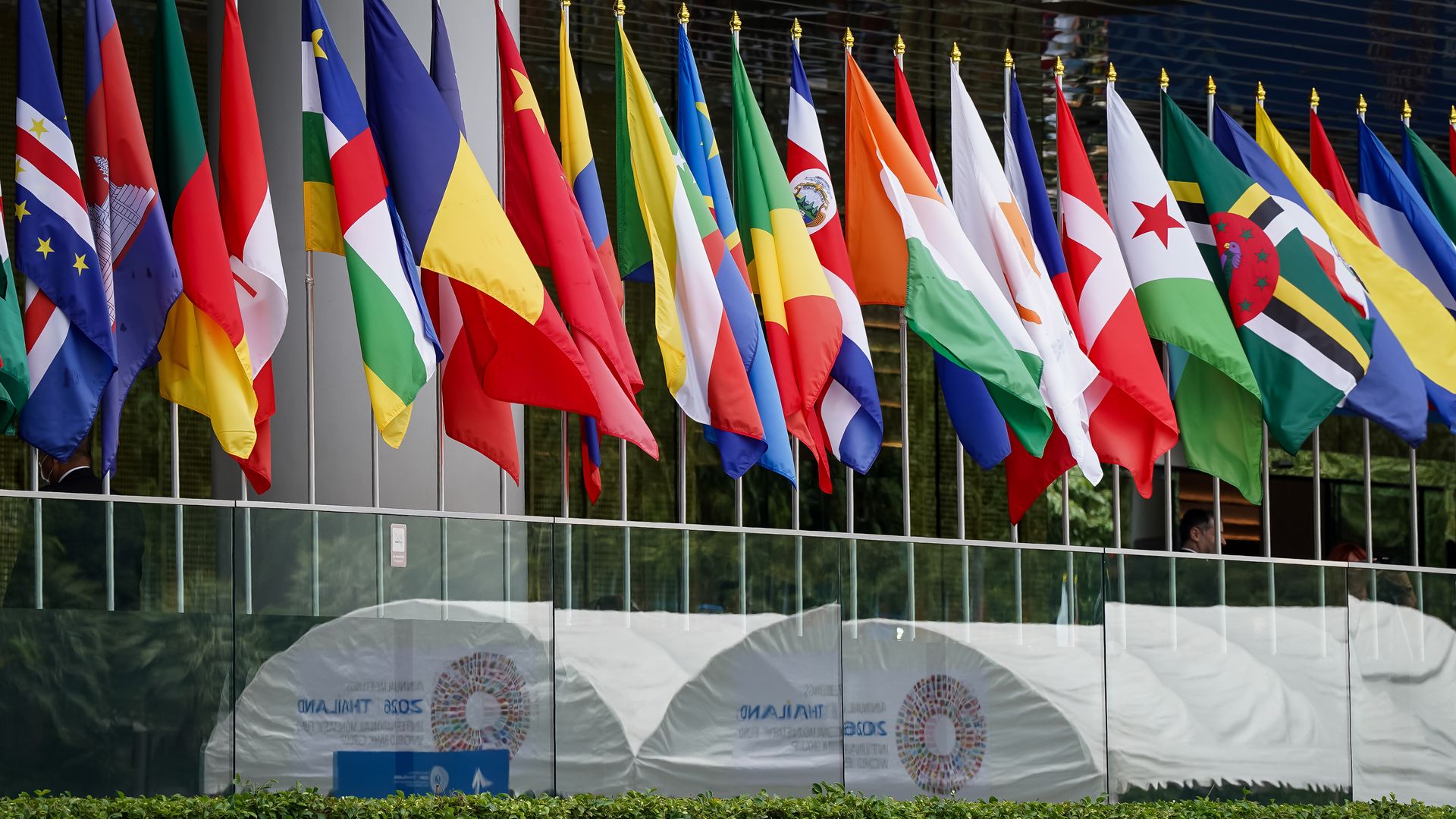
The IMF and World Bank annual meetings in Bangkok, Thailand, on Monday. 
Photo: Matt Hunt/Anadolu via Getty Images

Oct 12, 2026 


The global economy's ability to withstand new shocks is coming under strain, the International Monetary Fund warned Monday night in its latest economic forecast.

Why it matters: Worldwide growth has defied expectations, holding up despite the Middle East war and soaring oil prices. But some policymakers fear that dwindling energy reserves, mounting debt and growing reliance on the AI boom leave the world increasingly vulnerable.

What they're saying: "Without shoring up supply capacity and replenishing policy buffers, the global economy could soon test the limits of resilience," IMF economic counselor Silvana Tenreyro wrote in a blog post.
"Technology-related investment, while an important boon against the energy shock, is concentrating risks — making the global expansion heavily reliant on a small number of firms, sectors, and economies," she added.
The intrigue: The AI boom has helped offset the war's economic toll, but a sharp reversal could leave global GDP 1.1% below the IMF's baseline forecast by 2028, with a bigger hit of 1.8% to U.S. GDP.
That scenario assumes AI's promised productivity gains fail to materialize, triggering a pullback in investment and a financial market correction.

Continued AI investment could also fuel inflation, potentially prompting further interest rate hikes.

But a stronger AI investment boom — paired with faster productivity gains — could lift global GDP 0.6% above its baseline forecast by 2029.

Tuesday, October 13, 2026

Major economies approach their largest budget deficits since the COVID-19 pandemic

12:00, 13 October 2026
Source: LB.ua


The International Monetary Fund (IMF) has warned of deteriorating public finances in the world’s major economies. In 2026, budget deficits in China and the United States are expected to reach or exceed 8% of GDP, while net borrowing across advanced economies is projected to total 5.2% of GDP. This would be the highest level since 2021.

According to the IMF, net borrowing by the US general government sector will reach 8.5% of GDP in 2026, up from 7.1% in 2025 and 5.8% before the COVID-19 pandemic. The fiscal outlook has deteriorated compared with the IMF’s April projections amid turmoil in global debt markets.

At the same time, government borrowing costs are rising. Investors are concerned about growing public debt, inflation and large-scale investment in artificial intelligence. In September, a bond sell-off put additional pressure on government budgets as debt-servicing costs increased.

According to the IMF, global public debt is expected to approach 100% of world GDP by the end of the decade. The fund identified prolonged wars, cyberattacks and extreme weather events as factors increasing fiscal risks and exacerbating the global energy shock.

Meanwhile, the IMF slightly upgraded its forecast for global economic growth in 2026 by 0.1 percentage points to 3.1%. The global economy is projected to grow by 3.4% in 2027. The US economy is expected to expand by 2.3% in both years, while China’s growth is forecast at 4.5% in 2026 and 4% in 2027. India’s economy is projected to grow by 7% annually.


Sunday, December 08, 2024

MSNBC star reveals he is 'conflicted' over openly gay Trump Treasury pick Scott Bessent


By GERMANIA RODRIGUEZ POLEO, CHIEF U.S. REPORTER
15:10 25 Nov 2024, updated 17:21 25 Nov 2024

MSNBC star Jonathan Capehart has confessed that he feels conflicted that Donald Trump chose an openly-gay man as his pick to lead the Treasury Department.

Capehart, who is also gay, said he feels torn about Scott Bessent's nomination because a Republican president has selected the highest ranking gay government official ever, not a Democrat.

'You know if confirmed, he would be the highest ranking out LGBT person ever to serve — to be appointed and confirmed by the United States Senate,' Capehart


'And I said, you know, kind of conflicted about it.'

Guest Jon Reinish, a Democratic strategist, then stepped in, saying: 'In that case, credit where it's due...

'It is very interesting, yes, that is Trump and not one of our team that made that historic nomination.'

President-elect Trump announced the money manager as his pick to run the Treasury on Friday.

Bessent is a past supporter of Democrats who has become an enthusiastic supporter of Trump. He’s an advocate of cutting spending while extending the tax cuts approved by Congress in Trump’s first term.


Saturday, June 24, 2023

Rich nations pledge to unlock hundreds of billions of dollars for climate fight


By John Irish and Leigh Thomas

June 23, 20238:15 AM EDT
Updated 19 hours ago


Summary
  • World leaders and global organisations meet in Paris
  • Agreement for development banks to boost lending
  • Rich nations close in on $100 bln climate finance pledge
  • U.S., China adopt conciliatory tone on debt relief

PARIS, June 23 (Reuters) - Multilateral development banks like the World Bank are expected to find $200 billion in extra firepower for low-income economies by taking on more risk, a move that may require wealthy nations to inject more cash, world leaders said on Friday.

The leaders, gathered at a summit in Paris to thrash out funding for the climate transition and post-COVID debt burdens of poor countries, said their plans would secure billions of dollars of matching investment from the private sector.

An overdue pledge of $100 billion in climate finance for developing nations was also now in sight, they said.

Many in attendance, however, said over the two-day summit that the World Bank and the International Monetary Fund were increasingly ill-suited for tackling the most pressing challenges and needed a broad revamp.

Tuesday, April 11, 2023

The Digital Currency Monetary Authority (DCMA) Launches an International Central Bank Digital Currency (CBDC)


NEWS PROVIDED BY
Digital Currency Monetary Authority

Apr 10, 2023, 09:27 ET


WASHINGTON, April 10, 2023 /PRNewswire/ -- Today, at the International Monetary Fund (IMF) Spring Meetings 2023, the Digital Currency Monetary Authority (DCMA) announced their official launch of an international central bank digital currency (CBDC) that strengthens the monetary sovereignty of participating central banks and complies with the recent crypto assets policy recommendations proposed by the IMF.


International Monetary Fund Spring Meetings 2023


Universal Monetary Unit (UMU), symbolized as ANSI Character, Ü, is legally a money commodity, can transact in any legal tender settlement currency, and functions like a CBDC to enforce banking regulations and to protect the financial integrity of the international banking system.

Banks can attach SWIFT Codes and bank accounts to a UMU digital currency wallet and transaction SWIFT-like cross-border payments over digital currency rails completely bypassing the correspondent banking system at best-priced wholesale FX rates and with instantaneous real-time settlement.

In an IMF interview with Tobias Adrian, Financial Counsellor at the International Monetary Fund, he states "Cross-border payments can be slow, expensive, and risky. In today's world of payments, counterparties in different jurisdictions rely on costly trusted relationships to offset the lack of a common settlement asset together with common rules and governance. But imagine if a multilateral platform existed that could improve cross-border payments—at the same time transforming foreign exchange transactions, risk sharing, and more generally, financial contracting."

According to Darrell Hubbard, the Executive Director of the DCMA, and the chief architect of UMU, "This vision expressed by the IMF is the exact solution the DCMA is delivering to central banks worldwide."

Adopting a global localization public monetary system architecture, UMU can be configured to operate according to the central banking regulations of each participating jurisdiction.

George Walker, a Partner at Practus, LLP, specializing in international law, facilitated meetings between the DMCA and the IMF, states "Although the IMF has not officially endorsed Universal Monetary Unit, in reviewing the DCMA's Whitepaper and in weekly team discussions, the IMF has yet to state any objections to UMU's FX premium rates and its monetary sovereignty approach."

According to Darrell, "UMU is not attempting to disrupt the international monetary system. If fact, it strengthens it by helping the IMF achieve its stated mandate to provide economic and financial stability to its member states. UMU is a game-changer in how cross-border payments are transacted and mitigates against seasonal and systemic local currency depreciation."

Universal Monetary Unit Model Law legislation has been drafted in collaboration with several sovereign states. In this proposed legislation, UMU should not be enacted as legal tender for negotiating domestic prices or international trade agreements. Instead, the legislation proposes UMU to be enacted as a complementary money commodity for the store of value, mitigating against potential seasonal and systemic local currency depreciation, and tendered as a payment currency at the time of settlement.

Merchants and trading partners could accept UMU for the equivalent market value for their good and services priced in any national legal tender. UMU has premium exchange rates built into its wallet and can convert any settlement currency amount to the equivalent UMU amount.

Universal Monetary Unit is cryptocurrency reimagined from the ground up to support central banking and regulated financial institutions. It features a trusted consensus protocol, Staked Proof of Trust (SPOT) Protocol, and a multi-dimensional DLT (mDLT) capable of supporting any asset or liability ledger enabling full-service digital banking and international trade payments.

The DCMA introduces Universal Monetary Unit as Crypto 2.0 because it innovates a new wave of cryptographic technologies for realizing a digital currency public monetary system with a widespread adoption framework encompassing use cases for all constituencies in a global economy.

About the Digital Currency Monetary Authority (DCMA) –

The DCMA is a world leader in the advocacy of digital currency and monetary policy innovations for governments and central banks. Membership within the DCMA consists of sovereign states, central banks, commercial and retail banks, and other financial institutions.
https://dcma.io

About Universal Monetary Unit (UMU) –
Universal Monetary Unit (UMU), also known as Unicoin, is an innovation in store of value cryptography powered by artificial intelligence (AI). It adopts a central banking monetary policy framework to ensure it has continuous purchasing demand, minimal price volatility, and annual asset pricing targets.
A copy of the UMU Whitepaper is available on its website.
https://umu.cash

Contact:
Ruth Marshall
7043035359
356933@email4pr.com

SOURCE Digital Currency Monetary Authority

Source


Sunday, July 11, 2021

IMF, World Bank and BIS champion central bank digital currencies at G20


MARIE HUILLET

JUL 09, 2021


A new report released by the triumvirate of global finance argues that central bank digital currencies will benefit worldwide development.


NEWS

In a joint report, the International Monetary Fund (IMF), the World Bank and the Bank of International Settlements (BIS) have proposed to the G20 that a cross-border network of central bank digital currencies (CBDC), underpinned by efficient technological integration and proactive international cooperation, could be of significant benefit to the world economy.

The report focuses on broadening the horizon beyond central banks’ individual studies of CBDCs for domestic needs, emphasizing that it is crucial to coordinate work at a global scale and to find common ground between various national efforts to reap the full benefits of digital currency.

If tackled astutely, the IMF, the World Bank and the BIS believe that the creation of CBDCs could offer a “clean slate” that would enable the global financial system to significantly enhance the efficiency of cross-border payments.

The report paints a bleak picture of the current system for cross-border payments, which is beset by long transaction delays and high costs due to an excessive number of intermediaries operating across different time zones across the correspondent banking process.

Moreover, cross-border flows are often opaque and difficult to trace, presenting a problem for Anti-Money Laundering (AML) and combating the financing of terrorism (CFT) implementation. Over the past decade, the attenuation of cross-border banking relationships has left some countries struggling to integrate into the global financial system fully.

The report weighs the significant benefits that CBDCs could present for increased efficiency and enhanced economic inclusion against the potential global macro-financial implications and risks involved in the widespread use of CBDCs for cross-border flows.

These challenges include dealing with the sudden capital flow reversals enabled by more frictionless cross-border flows and the potential impact on countries’ ability to manage their exchange rates. If the foreign currency becomes easier to obtain, store and spend, widespread currency substitution could potentially undermine states’ monetary policy independence and pose risks to both issuing and receiving countries.

A worldwide push for CBDC issuance, the report notes, would therefore require tight integration of multiple CBDCs and uniformity of design choices, alongside specific measures designed to mitigate these macro risks.

The groundwork would not only be conceptual and design-focused but would imply coordinated strategies, standardized practices and a degree of structural integration, ranging from the creation of new international payment infrastructures to targeted policies. The latter, for example, could include introducing limits on foreign CBDC holdings or transfers.

Related: UK chancellor names CBDC on list of financial reforms for Treasury

In addition to extensive infrastructural cooperation on technological interoperability and payment system access, there would need to be a similar level of regulatory coordination, implying the alignment of supervisory and oversight frameworks for cross-border flows and the coordination of AML and CFT measures.

While most countries are studying or developing pilots for CBDCs, central banks have taken a wide variety of distinct approaches to CBDC design and have paced their research and development efforts differently. China’s digital yuan is well ahead of the international game, and multiple countries have piloted CBDCs for cross-border use, including France, Switzerland, Singapore and Bahrain, to name just a few.


Source

Saturday, July 20, 2019

They're All Symptoms of the Same Dollar Disease


They're All Symptoms of the Same Dollar Disease


By Jeffrey Snider
July 19, 2019


What everyone most feared was a relapse. It would have been one more tragedy piled up on top of the biggest tragedy in human history. In designing the Bretton Woods system seventy-five years ago, many were very much afraid that it hadn’t gone far enough. Once the war ended, World War II, the US in particular might fall back into depression.

Then what?


It may sound absurd today, at the time the possibility was taken very seriously. More outside of the US than inside, quite a few economists and politicians warned that when war spending stopped just as America’s victorious legions came back home the economy waiting for them would be too much like the depression they had left behind when they first went off to fight.

There was, some very influential policymakers believed, more than a small risk of it tearing the new monetary system apart and therefore redoing 1929 all over again. The entire purpose of Bretton Woods had been to avoid just that fate.

In the final agreement, in the form of the Joint Statement of Experts on the Establishment of an International Monetary Fund, a clause was inserted in case the world might run short of dollars. A US depression could, in theory, starve the rest of the world of needed currency. As Edward Bernstein recalled four decades later:

“This would allow other countries to impose discriminatory restrictions against the United States if the dollar holdings of the Fund became scarce because of a large and persistent US surplus as a result of a depression in the United States.”

Edward M. Bernstein had received his PhD in Economics from Harvard in 1931 just as the Great Depression was at its worst. Spending the rest of the decade teaching, in 1940 he was given a job as the Treasury Department’s principal economist. Working closely with Harry Dexter White during the early war years, when it came time for Bretton Woods, Bernstein was made the US delegation’s chief technical advisor.

In that position, Dr. Bernstein had a large hand in designing the IMF. He said that the novelty of the fund which came out of Bretton Woods, one that didn’t include John Maynard Keynes’ supranational currency bancor, was that it was like a gold standard but not so rigid as the classical system had been.

There had to be some flexibility built into it somewhere. Recalling one of the chief elements of failure and monetary contagion following the 1929 crash, “the deflationary effects of gold settlements could be avoided if surplus countries acquired foreign currencies rather than gold.” No less than international currency elasticity.


Monday, July 13, 2015

Greek Debt Crisis: Latest Greece Deal Would Open Stores On Sunday, Encourage Retail Sales Specials, Open ‘Restricted Professions’


By Angelo Young @angeloyoung_ a.young@ibtimes.com on July 13 2015 1:00 PM EDT


A woman sits opposite a tailor's stall at a market in Thessaloniki, Greece, on July 13, 2015. Greece reached a bailout deal with the eurozone after marathon overnight talks. Among the terms: Greece will need to do more to lift bans on Sunday commerce and weighty licensing rules for "restricted professions." Sakis Mitrolidis/Agence France-Presse/Getty Images


Greeks have long cherished the notion that Sunday is a day for worship, family, leisure -- almost anything but work. But that would change under a three-year bailout deal reached Monday between Greece and other eurozone members: Athens would be required to lift rules that make Sunday mostly a day of rest.
Lifting the ban on Sunday commerce is just one way the European Union and International Monetary Fund are demanding that Greece reform basic commercial activity in an attempt to jumpstart the country's struggling economy. European leaders also want Greece to end restrictive licensing procedures that place limits on the number of companies that produce basic commodities, such as milk. They are also asking for the removal of rules that make it difficult for Greeks to enter certain “restricted professions” -- from lawyers to TV technicians.

The reforms are controversial, especially measures that encourage workers to extend their weekly hours on the job. Greeks already work longer hours than their European neighbors. In 2014, the average Greek worked 44.2 hours a week, compared with 41.5 for a German worker and 41.2 hours in the rest of the eurozone.

Reforms that invite large multinationals to muscle out local businesses are also unpopular among Greeks. Greece's creditors also want the heavily indebted nation to ease restrictions on retail sales and promotional events. Under Greece's current rules, merchants are allowed to run sales specials just twice per year. In the summer, they start in mid-July and run through the end of August. The winter sales take place in mid-January and run to the end of February.

Many of the proposed commercial market reforms are aimed at encouraging job growth. According to a Euro Summit statement issued Sunday, Greece must “adopt more ambitious product market reforms ... including Sunday trade, sales periods, pharmacy ownership, [and] milk and bakeries.”

Proponents say the measures would spur job creation. Encouraging Sunday commerce, for example, could create 300,000 new jobs, according to officials of Greek’s center-right New Democracy Party.

“Greek product markets remain among the most strictly regulated in the OECD [Organisation for Economic Co-operation and Development] area, hindering competition and preventing the price adjustments needed to support the recovery,” said a November 2013 OECD review on the Greek economic competitiveness.

But there’s plenty of resistance to measures that would increase the Greek work week or entice multinationals to come in and use economies of scale to walk over small businesses. And even if Greek Prime Minister Alexis Tsipras succeeds in convincing Greece's Parliament later this week to approve the bailout deal -- which would provide Athens with up to $96 billion in return for pension cuts, tax increases and other requirements -- the people may not be so compliant.

When Athens introduced a law last year allowing Sunday shopping in 10 tourist regions, Greek Orthodox Church leaders called it heretical and members of the Federation of Greek Private Employees said it was an infringement on workers’ rights. Exactly a year ago, shops instituted a 24-hour strike in response to the law. Since then, a drive to extend the law across the country has been hampered.


Source
.

Thursday, September 18, 2014

Facts About The USA!


by Frank M. Webb
06 August 2014

from FrankWebb Website


These documents are NOT secret.

They ARE a matter of Public Record.


HERE ARE TRUTHFUL FACTS

MOST PEOPLE DO NOT KNOW...

BUT SHOULD…


  1. The IRS is Not a US government agency. It is an agency of the IMF - International Monetary Fund (Diversified Metal Products vs. I.R.S et al. CV-93-405E-EJE U.S.D.C.D.I., Public Law 94-564, Senate report 94-1148 pg. 5967, Reorganization Plan No. 26, Public Law 102-391)
  2. The IMF (International Monetary Fund) is an agency of the United Nations - UN (Black's Law Dictionary 6th Ed. page 816)
  3. The United States has NOT had a Treasury since 1921 (41 Stat. Ch 214 page 654)
  4. The U.S. Treasury is now the IMF (International Monetary Fund) (Presidential Documents Volume 24-No. 4 page 113, 22 U.S.C. 285-2887)
  5. The United States does not have any employees because there is no longer a United States! No more reorganizations. After over 200 years of bankruptcy it is finally over. (Executive Order 12803)
  6. The FCC, CIA, FBI, NASA and all of the other alphabet gangs were never part of the U.S. government, even though the "U.S. Government" held stock in the agencies. (U.S. vs. Strang, 254 US491 Lewis vs. US, 680 F.2nd, 1239)
  7. Social Security Numbers are issued by the U.N. through the IMF (International Monetary Fund). The application for a Social Security Number is the SS5 Form. The Department of the Treasury (IMF) issues the SS5 forms and not the Social Security Administration. The new SS5 forms do not state who publishes them while the old form states they are "Department of the Treasury". (20 CFR (Council on Foreign Relations) Chap. 111 Subpart B. 422.103 (b))
  8. There are NO Judicial Courts in America and have not been since 1789. Judges do not enforce Statutes and Codes. Executive Administrators enforce Statutes and Codes. (FRC vs. GE 281 US 464 Keller vs. PE 261 US 428, 1 Stat 138-178)
  9. There have NOT been any judges in America since 1789. There have just been administrators. (FRC vs. GE 281 US 464 Keller vs. PE 261 US 428 1 Stat. 138-178)
  10. According to GATT (The General Agreement on Tariffs and Trade) you MUST have a Social Security number. (House Report (103-826)
  11. New York City is defined in Federal Regulations as the United Nations. Rudolph Guiliani stated on C-Span that "New York City is the capital of the World." For once, he told the truth. (20 CFR (Council on Foreign Relations) Chap. 111, subpart B 44.103 (b) (2) (2) )
  12. Social Security is not insurance or a contract, nor is there a Trust Fund. (Helvering vs. Davis 301 US 619 Steward Co. vs. Davis 301 US 548)
  13. Your Social Security check comes directly from the IMF (International Monetary Fund), which is an agency of the United Nations. (It says "U.S. Department of Treasury" at the top left corner, which again is part of the U.N. as pointed out above)
  14. You own NO property!!! Slaves can't own property. Read carefully the Deed to the property you think is yours. You are listed as a TENANT. (Senate Document 43, 73rd Congress 1st Session)
  15. The most powerful court in America is NOT the United States Supreme court, but rather the Supreme Court of Pennsylvania. (42 PA. C.S.A. 502)
  16. The King of England financially backed both sides of the American Revolutionary War. (Treaty of Versailles-July 16, 1782 Treaty of Peace 8 Stat 80)
  17. You CANNOT use the U.S. Constitution to defend yourself because you are NOT a party to it! The U.S. Constitution applies to the CORPORATION OF THE UNITED STATES, a privately owned and operated corporation (headquartered out of Washington, DC) much like IBM (International Business Machines, Microsoft, et al) and NOT to the people of the sovereign Republic of the united States of America. (Padelford Fay & Co. vs. The Mayor and Alderman of the City of Savannah 14 Georgia 438, 520)
  18. America is a British Colony. The United States is a corporation, not a land mass and it existed before the Revolutionary War and the British Troops did not leave until 1796 (Republica vs. Sweers 1 Dallas 43, Treaty of Commerce 8 Stat 116, Treaty of Peace 8 Stat 80, IRS Publication 6209, Articles of Association October 20, 1774)
  19. UNITED STATES is a Corporation - There are Two Constitutions-Sovereignty:
  20. Britain is owned by the Vatican. (Treaty of 1213)
  21. The Pope can abolish any law in the United States (Elements of Ecclesiastical Law Vol. 1, 53-54)
  22. A 1040 Form is for tribute paid to Britain (IRS Publication 6209)
  23. The Pope claims to own the entire planet through the laws of conquest and discovery. (Papal Bulls of 1495 & 1493)
  24. The Pope has ordered the genocide and enslavement of millions of people. (Papal Bulls of 1455 & 1493)
  25. The Pope's laws are obligatory on everyone. (Bened. XIV., De Syn. Dioec, lib, ix, c. vii, n. 4. Prati, 1844 Syllabus Prop 28, 29, 44)
  26. We are slaves and own absolutely nothing, NOT even what we think are our children. (Tillman vs. Roberts 108 So. 62, Van Koten vs. Van Koten 154 N.E. 146, Senate Document 438 73rd Congress 1st Session, Wynehammer vs. People 13 N.Y. REP 378, 481)
  27. Military dictator George Washington divided up the States (Estates) in to Districts (Messages and papers of the Presidents Volume 1 page 99 1828 Dictionary of Estate)
  28. "The People" does NOT include you and me. (Barron vs. Mayor and City Council of Baltimore 32 U.S. 243)
  29. It is NOT the duty of the police to protect you. Their job is to protect THE CORPORATION and arrest code breakers. (SAPP vs. Tallahassee, 348 So. 2nd. 363, REiff vs. City of Phila. 477 F. 1262, Lynch vs. NC Dept. of Justice 376 S.E. 2nd. 247)
  30. Every thing in the "United States" is up for sale: bridges, roads, water, schools, hospitals, prisons, airports, etc, etc… Did anybody take time to check who bought Klamath Lake?? (Executive Order 12803)
  31. "We are human capital" (Executive Order 13037) The world cabal makes money off of the use of your signatures on mortgages, car loans, credit cards, your social security number, etc.
  32. The U.N. - United Nations - has financed the operations of the United States government (the corporation of THE UNITED STATES OF AMERICA) for over 50 years (U.S. Department of Treasury is part of the U.N. see above) and now owns every man, woman and child in America. The U.N. also holds all of the land of America in Fee Simple.


The good news is we don't have to fulfill
"our" fictitious obligations.
You can discharge a fictitious obligation
with another's fictitious obligation.


.

Tuesday, June 03, 2014

Africa: IMF Promotes Policies to Make Growth Sustainable and Inclusive - Lagarde


 2 June 2014


Photo: IMF Photograph/Stephen Jaffe
IMF Managing Director Christine Lagarde greeted by Mozambique's Finance Minister Manuel Chang at the Maputo International Airport in Maputo.


Interview

The International Monetary Fund and the Mozambican government last week hosted the "Africa Rising" conference, attended by policymakers and private sector and civil society representatives to discuss how to manage and promote the economic gains Africa has been making since the 2008 global economic downturn. In an interview with AllAfrica's Melissa Britz, the fund's Managing Director, Christine Lagarde outlined the key reasons for convening the conference, then discussed the opportunities and risks facing governments and people across sub-Saharan Africa:

We wanted to take stock of the developments of sub-Saharan African countries since we last all congregated in Tanzania five years ago. We are five years into and hopefully past the crisis, and the point was: number one to take stock of what had happened and, number two to lay out together and discuss with our African colleagues and partners what the opportunities were, what the challenges were.

What kind of fiscal policies, legal framework, fiscal and tax frameworks should be considered in order to benefit from the growth that we have seen in Africa? That's really the whole point and I've heard from various participants that they really appreciated and found it interesting in terms of exchange of best practices, recommendations from various experts. So voila.

This is the third economic-focused conference on Africa in almost a month, counting the World Economic Forum on Africa in Abuja and the African Development Bank meeting in Kigali. So there's been a lot of "Africa Rising" discussion. Do you feel that policy makers in Africa and internationally have become too intoxicated with the good news story and have perhaps forgotten what needs to be done to make that good news happen?

I won't comment on the other two conferences because I wasn't there.

I'll focus on what we are trying to do. I think we have a very balanced message which is around the theme of Africa Rising, Africa Watching, because there has clearly been a solid trend of growth over the last few years and, obviously surprisingly, also during the financial crisis when everybody [else] went down.

So Africa like other developing countries emerged as the bit of good news on the horizon. There are also big issues to be addressed and potential risks on the horizon. So our message is mixed and suits the economists because it's on the one hand, on the other hand. It's good news and worries.

We tried to address the issues: How do you manage your natural resources? How do you make sure that the population of the country reaps the benefits of natural resources? And we tried to go a little bit deeper in terms of how do you structure your legal framework, how do you organize the tax landscape in which the investors are going to be prepared to invest, leaving enough on the African table and taking away what any investor wants to have as a return.

When we focus on the creation of jobs, we are also trying to address one of the big issues on the horizon. So I think it's a mixed message. What we take away is good news. It's positive but we see risks on the horizon.

South Africa is on the verge of recession. The bottom is falling out of the Zambian currency, the bottom is falling out of the Ghanaian currency, and Nigeria's got a massive internal security problem. The list is long. Where do you see the good news?

I think you're looking at four countries.

Four quite important countries.

Absolutely. But you have to flash back as well - what was it like 10 years ago? You also had major risks, and very difficult situations.

Probably much more complicated, not much more because there is one that is not only affecting Nigeria but the whole issue of the Sahel region.

But you also had big conflicts, some of which have been resolved in the meantime. So our job as macro-economists is to look at the key numbers, and when you look at the key numbers you see growth, you see inflation, you see current account, and you see deficits. On all those accounts the situation is a lot healthier than it was 10 years ago.

Sorry I forget to mention debt which is a subset of the other numbers.

Debt has been significantly reduced. The average debt in Sub-Saharan Africa is 35 percent. But if you take one or two countries - and that's where we're saying watch out, because there are some countries that have gotten a bit ahead of themselves, that are increasing the level of indebtedness to a level which could be a concern.

Former South African President Thabo Mbeki who heads up the High-Level Panel on Illicit Capital Flows says that Africa wouldn't need development aid if illegal outflows were stemmed. What needs to be done to address this from the side of wealthy countries where the money goes but also by African governments?

Transparency here, transparency there. It's not enough but given the availability of information, to which you contribute by the way, and the facilitated access to information I think that transparency is a very strong weapon to fight against those illicit flows.

I was struck [when] I went to the university [in Maputo] and asked how many in the room do not have internet access. Do not use internet. Zero.

Not all of them had iPhone or iPad or tablets, but all students in the room said "yes, internet access" and use it on a very frequent basis. I would say that transparency is key because it's the tribunal of public opinion that is then available.

The way the IMF communicates these days is vastly different to how it communicated 10 years ago. Are you still finding your way in Africa, finding the tone in which you speak to governments, or is it clear what the parameters of the interactions are?

It is a partnership, whether we are doing bilateral work with the Article Four's [see IMF Surveillance of member countries], whether we are providing technical assistance or training. We have five regional training centres now in Africa and sub-Saharan African countries consume 40 percent of our technical assistance on a global basis.

Whether it's through surveillance, technical assistance or through the programmes, I think it really works as a partnership. There have been instances where we were lacking the appropriate information, where the level of disclosure was not satisfactory. When we find out, we go back to the authorities and we have a dialogue. We don't patronize. We want to partner and partnership again is based on transparency. Where there are obscure contracts we don't get a copy of or there are side letters that we are not aware of, we say "sorry we want the information".

The European Central Bank is considering measures to stimulate the economy, and we have seen what stimulating the economy has done positively and negatively to countries in Africa over the last few years. Is there not a risk that if the ECB does put some stimulus into the economy, it can exacerbate the debt situation for some African countries?

If that was to happen - and we haven't seen that yet, we have heard statements to that effect - but if that was to happen, the intention behind it is not to destabilize or unsettle other economies but to stir the European economy which is clearly a key partner for some of the African countries, and a partner altogether for sub-Saharan African countries.

So that's the positive side of it - if Europe does better, clearly the relationship [with Africa] based on either trade or investment or remittances can be improved. The other side of the coin is that if not well communicated, if not well anticipated, it would bring about a level of volatility which could be detrimental. And my hunch is that given what happened a year ago, in May 2013, the authorities anticipate and have begun to take measures to anticipate that. It is a potential risk but one that I hope can be mitigated by those measures.

A large number of African countries has raised Eurobonds in the last couple of years. Do you think this is a good idea?

What we see as a key priority is energy, I think that's my answer to your point. When you look at the per-capita input of energy, it's amazing to see that it has hardly moved since the 80s. The output of electricity in the whole of sub-Saharan Africa is equal to that of Spain. So there's a crying need for investment in energy and infrastructure projects such as transportation. I would say that improving the productivity of agriculture in a smart and green way would also be a good way forward and I know that some of the panelists[at Africa Rising] did not agree with that.

The Chinese premier recently has promised technology transfers and more investment to Africa. Do you have any comment on his promises and what are the potential areas that China can best assist?

In terms of the sectoral approach, our take is that the energy sector is absolutely key. Then you can roll out the rest of the infrastructure projects that would be needed - transportation channels, whether it's railway, roads, airports or ports. So energy and transportation - this is what I would call the hard infrastructure projects. But you also have soft infrastructure projects that touch on people - training, vocational training and education. If the Chinese authorities at the highest level support the transfer of technology to the effect that it would help in those directions that I have identified, I think it's good. I think it's a sign of more mature investment than just financing and construction.

If that is what is intended - I haven't seen his quotes, I haven't read his speech - but if it's the intention, it's a mature approach to investment.

What do sub-Saharan African countries need to achieve development apart from investment?

Yesterday I tried to be as crystal clear as possible. It was picked up by a Chinese colleague who was on a panel afterwards. It's infrastructure, institutions, people. But at the rock bottom of all these projects you need money. Investment is not in and of itself sufficient but a pre-requisite to build infrastructure projects, and to develop institutions.

I'm not sure if money is necessary for transparency and good governance.

But clearly the lack of growth, and misallocation of the benefits are not conducive to good governance and institutions. And when you talk education, when you talk health, talk investment. Now how you balance the public and the private and how you mix them together - the concessional arrangements - that's really where the technical work has to be done with a view to reaching the right balance. The royalties rates, the length of contracts, those are the technical things that actually matter.

You recently spoke about the three L's of women's empowerment - learning, labour and leadership - and said that women are more inclined to share knowledge and share consensus building. How do you see women contributing to Africa's growth?

Significantly, if I look at the numbers. I mentioned in my speech that if you were to close the gap between men and women in the labour market in Africa, we're talking about U.S. $90 billion on an annual basis - tantamount to the U.S. $93 billion needed on an annual basis to finance projects. So that's a bit from the textbook because clearly then you get into all the technical issues: inheritance, ownership of land, availability of collaterals, access to credit - all the cultural bag of issues that often get in the way of women having access to finance, job market and education.

I'm not sure that it is so much the case in Mozambique because I think that Mozambique has done quite a lot to improve the situation for women but there are other sub-Saharan African countries that have a long way to go. They can benefit enormously from the real emancipation of women and better and equal access to job and finance markets.

Melissa Britz's attendance at Africa Rising was sponsored by the IMF.


Source
.

Tuesday, May 27, 2014

World's Richest People Meet, Muse On How To Spread The Wealth


by ARI SHAPIRO
May 27, 2014 2:38 PM ET


Prince Charles talks to Lynn Forester de Rothschild (left), organizer of the Conference on Inclusive Capitalism, and Christine Lagarde, head of the International Monetary Fund, before Tuesday's conference. The 250 corporate and financial leaders who attended control some $30 trillion, about a third of the world's investable assets.WPA Pool/Getty Images

Talk of economic mobility and the wealth gap is hardly new. From the Occupy movement to President Obama's re-election campaign, income inequality has been in the spotlight for years.

Even so, the "inclusive capitalism" conference in London on Tuesday broke new ground. Not because of the conversation, but because of the people having it.

The 250 people from around the world invited to attend this one-day conference do not represent "the 99 percent," or even the 1 percent. It's more like a tiny fraction of the 1 percent.

"We have $30 trillion of assets under management in the room," says conference organizer Lynn Forester de Rothschild, who runs E.L. Rothschild, a major investment firm she and her husband, of the storied Rothschild banking family, founded in 2003.

That amount — $30 trillion — is roughly one-third of the total investable wealth in the world. If money is power, then this is the most powerful group of people ever to focus on income inequality.

"If this bulk of capital decides that they are going to invest in companies that aren't only thinking about the short-term profit," says Rothschild, "then we will see corporate behavior change."

The titans of commerce and finance didn't necessarily fly to this meeting in London out of a sense of ethics or moral duty, though that may be a motivation for some. For many, says Rothschild, it's a sense of self-preservation. Capitalism appears to be under siege.

"It's true that the business of business is not to solve society's problems," she says. "But it is really dangerous for business when business is viewed as one of society's problems. And that is where we are today."

Prince Charles kicked off the morning's proceedings.

"What is so impressive about today's gathering is that every one of you, ladies and gentlemen, is so well placed to take the kind of action needed to create a new form of inclusive capitalism," he told the conference.

Defining Inclusive Capitalism

That phrase, "inclusive capitalism," is deliberately broad. People talked about it as valuing long-term investment over short-term profits. Some mentioned environmental stewardship; others focused on treating workers well.

Christine Lagarde, who runs the International Monetary Fund, said it is a way to rebuild trust in the financial system.

"So the big question is how can we restore and sustain trust?" she asked in her keynote speech. "First and foremost, by making sure that growth is more inclusive and that the rules of the road favor the many and not just the few."

She said this will be a hard slog, because there will be winners and losers, "and the likely losers are those who have the biggest voice, because they have the largest means."

Later in the day, the group heard speeches from former U.S. President Bill Clinton and Bank of England chief Mark Carney.

Critics suggest this may all be optics. The conference delegates didn't sign on to a specific action plan, or even publicly endorse a set of values.

"I suspect the return on investment in this conference is astonishingly low," says Scott Winship of the Manhattan Institute, a conservative-leaning think tank. "It sort of surprises me that you have a bunch of people in the investment community who view this as having a significant return on investment in some way, whether the return is in people patting them on the back and saying 'Thanks for caring about us,' or in actual changes to policies."

Conference organizer Rothschild says there will be follow-up with all of the delegates, but she made a conscious decision not to ask for any commitments up front.

"Even for me," she says laughing, "I thought that would be a little pushy."


.

Thursday, March 13, 2014

Aid Package For Ukraine Moves Slowly Through Congress


by David Welna
March 13, 2014 5:00 AM


Listen to Story
Morning Edition
5 min 3 sec


Democrats and Republicans generally agree that Congress needs to approve an aid package quickly. But it's proven harder than expected for everyone to agree on what should be in that aid package.


Copyright © 2014 NPR. For personal, noncommercial use only. See Terms of Use. For other uses, prior permission required.

RENEE MONTAGNE, HOST:

It's MORNING EDITION, from NPR News. Good morning. I'm Renee Montagne.

DAVID GREENE, HOST:

And I'm David Greene.

Democrats and Republicans on Capitol Hill are agreeing on something these days, that Congress needs to approve an aid package quickly for the fledgling and nearly broke government now ruling Ukraine. But it's been harder than expected for the House and Senate to agree on what should or should not be in that aid package. The biggest sticking point: a change in the rules at the International Monetary Fund that the Obama administration considers critical for rescuing Ukraine.

Here's NPR's David Welna.

DAVID WELNA, BYLINE: For the Obama administration, the $1 billion in loan guarantees the House approved last week for Ukraine is simply not enough. Appearing before a House panel yesterday, Secretary of State John Kerry said stabilizing Ukraine financially requires ratification of a set of reforms for the International Monetary Fund that have languished over the past four years due to Congressional inaction.

SECRETARY JOHN KERRY: It's only through the IMF, a reformed IMF, that Ukraine is going to receive the additional help it needs in order to stand on its own two feet.

WELNA: Kerry's plea was, in fact, heeded by his former colleagues in the Senate. New Jersey Democrat Bob Menendez, Kerry's successor as chairman of the Foreign Relations Committee, unveiled a bipartisan aid package for Ukraine that included loan guarantees, sanctions against those violating human rights in Ukraine or undermining its stability, and then one last provision.

SENATOR BOB MENENDEZ: It provides needed reforms to the United States' participation in the International Monetary Fund, which would allow the United States to leverage significant support from the IMF for Ukraine today, and for similar unforeseen crises in the future.

WELNA: Ranking Republican Bob Corker of Tennessee declared while he strongly supported including the IMF reforms in the aid package...

SENATOR BOB CORKER: This is going to be a little bit more difficult on our side of the aisle. I'll put it that way.

WELNA: Indeed, Kentucky Republican Rand Paul questioned whether it made sense to lend any money to Ukraine.

SENATOR RAND PAUL: I would ask for a show of hands of those would personally buy Ukrainian debt.

(LAUGHTER)

PAUL: Ukrainian debt is rated triple C-, not one person in this room would buy it. There's no expectation they can pay it back.

WELNA: Paul said because Ukraine owes Russia so much money, any loan to Ukraine would just end up in Russia's coffers. But Arizona's John McCain, a fellow Republican, wasn't buying it.

SENATOR JOHN MCCAIN: This whole situation in Ukraine is extremely fragile, and I would think the worst thing that we could do right now is say that we aren't going to assist you.

WELNA: In the end, only three Republicans on the panel opposed the aid package, which is now headed for a vote by the full Senate. But even if it wins quick approval there, it would still have to be reconciled with the House-passed Ukraine aid package, which does not include the IMF reforms. House Speaker John Boehner yesterday showed no inclination of going along with the Senate's version.

REPRESENTATIVE JOHN BOEHNER: This IMF money isn't necessary for dealing with this Ukraine crisis that we see today.

WELNA: Other House Republicans made it clear they had little use for the IMF anytime. Ted Yoho is a freshman from Florida, who's on the Foreign Affairs Committee. The IMF, he says, does not figure in the U.S. Constitution.

REPRESENTATIVE TED YOHO: Where does it say that we should have an International Monetary Fund that we should supply and support?

WELNA: So you would actually prefer that there not be U.S. participation in the IMF?

YOHO: When we're $17.4 trillion in debt and I've got people in my district that can't get health care or they can't send their kids to school, I think we need to look at that real carefully.

WELNA: Other House Republicans say the IMF reforms would diminish the clout of the United States by giving more of a voice to emerging nations, including Russia. But the refusal by Congress to ratify changes at the IMF has already reduced Washington's standing there, according IMF expert Scott Morris. He's a former Treasury Department official who's now at the Center for Global Development. He says House Republicans may, in fact, be strengthening Russia's hand at the IMF by refusing to approve reforms there.

SCOTT MORRIS: It's kind of a strange reaction to concerns about declining U.S. influence, is that you basically seek to hammer the nail in the coffin.

WELNA: Some House Republicans think a deal still is possible to get a Ukraine aid package soon. North Carolina's Patrick McHenry says if an unrelated provision sought by Republicans were added that blocks the IRS from cracking down on political non-profits, it just might pass the House.

REPRESENTATIVE PATRICK MCHENRY: Congress has done dumber and sillier things.

WELNA: But with Congress set to leave for a weeklong break, there's little chance of a Ukraine aid package emerging anytime soon. Ukraine's new prime minister, Arseny Yatseniuk, was at the Capitol last night meeting with congressional leaders, just days before Crimea is to vote on seceding from Ukraine to join Russia. With nothing concrete agreed upon yet about helping a struggling nation, a promised photo op of Yatseniuk with Speaker Boehner ended up getting canceled. David Welna, NPR News, the Capitol.

Copyright © 2014 NPR. All rights reserved. No quotes from the materials contained herein may be used in any media without attribution to NPR. This transcript is provided for personal, noncommercial use only, pursuant to our Terms of Use. Any other use requires NPR's prior permission. Visit our permissions page for further information.

NPR transcripts are created on a rush deadline by a contractor for NPR, and accuracy and availability may vary. This text may not be in its final form and may be updated or revised in the future. Please be aware that the authoritative record of NPR's programming is the audio.


Source
.

p.s.


Listen to the podcast and hear Senator Menendez speak of CRISISES.  

Where did this man get his PHD?  Guantanamo U, or perhaps, Jer-see City University?

What a maroon!

SENATOR BOB MENENDEZ: It provides needed reforms to the United States' participation in the International Monetary Fund, which would allow the United States to leverage significant support from the IMF for Ukraine today, and for similar unforeseen (CRISISES) crises in the future.
.
.

Saturday, February 22, 2014

Jamaica: Adventists seek 24-hour Sabbath time in work arrangement bill


February 17, 2014 – Browns Town, St. Ann…Nigel Coke/IAD

President of the Seventh-day Adventists Church in Jamaica, Pastor Everett Brown is calling on legislators not to pass the Flexible Work Arrangement Bill in Parliament until its members along with other Sabbath keeping congregations are guaranteed their full 24-hours Sabbath.


Pastor Everette Brown, president of the church in Jamaica, calls on legislation not to pass the Flexible Work Arrangmement Bill in Parliament until its church members and other Sabbath keeping congregations are guaranteed 24 hours of Sabbath rest. Image by Nigel Coke/IAD

Speaking at the installation service for newly elected leaders in the Church’s northern region– St. Ann and Trelawny–at the Brown’s Town Seventh-day Adventist Church, Pastor Brown warned them that the times ahead call for strong and courageous leadership.

“The task of providing leadership for the Church here in the North at this time is a very formidable one,” Brown submitted. “You have been placed in leadership at a point in time when, according to the apostle Paul in 1Timothy 1:3, it is going to be ‘perilous’; and it is proving to be extremely difficult to be a Christian as we are now living in a post modern material-driven, hedonistic, pluralistic, corrupt and decaying society.”

He argued that strong and courageous leaders are needed more than ever to safeguard and preserve the Christian values and standards of the Church, and that Church leaders may be called upon to oppose strongly any attempt to curtail our religious freedom which the constitution guarantees, by the passing of legislation on the new flexible work arrangements.

“Let me make the position of the Church clear: God who mandated the Seventh-day Sabbath as His holy day of worship did not make it a twelve-hour day but a twenty-four hour one–from sunset Friday evening to sunset Saturday evening.”

This position is among several concerns that not only the Seventh-day Adventists have, but the wider church population in Jamaica regarding the Flexi Work Arrangements, which have been on the table for 18 years, but is schedule to be passed by the end of March this year, as a requirement of the latest IMF agreement with the Government of Jamaica.

The umbrella group of churches, which the Seventh-day Adventist Church is a part, has drafted a letter which will be delivered Feb. 18, with the concerns of the group seeking audience with the Minister of Labour, the Hon. Derrick Kellier.

“We hope that through this letter we can sit with the Minister and his technocrats along with other stakeholders to address the concerns we have,” said Gary Harriott, secretary of the group. “One of the concerns surrounds the issue of public education and awareness, which was promised would happen before a critical agreement like this is passed. With March being a deadline set by the IMF to meet this qualitative part of the agreement, we need to know when this aspect of the whole enactment will take place.”

Harriott went on to say that what they are not seeking “is for the bill to be rushed through Parliament like many we have seen last year without any proper debate and public education and which causes an economic backlash.”

Brown added that whatever the arrangement for worker to work, the citizens of Jamaica have the right to worship.

“We must pray that whatever happens as far as the final legislation is concerned that no employer has the right to determine what the day of worship should be for the employee,” Brown concluded.


Source: http://www.interamerica.org/?p=10684#ixzz2u4OwWtKY
.
.

Monday, June 18, 2012

Draft communique: G-20 leaders have produced coordinated plan for global job creation


By Associated Press, Updated: Monday, June 18, 9:45 PM


LOS CABOS, Mexico — The leaders of the world’s largest economies have agreed to step up their efforts to boost growth and job creation, which they call the top priority in fighting the effects of the European economic crisis, according to a draft of the statement to be released Tuesday at the end of the Group of 20 annual meeting.

The draft obtained by The Associated Press on Monday places the G-20 on the side of those who have been arguing for a focus on job creation, including through government spending, instead of the budget cutbacks and austerity pushed most notably by German Chancellor Angela Merkel.

Germany feels that it been unfairly burdened by its large contributions to international bailouts of economically weaker European countries that overspent for years and, in exchange, it has been insisting on steep cutbacks from aid recipients such as Greece. Those cutbacks have led to dramatic economic hardship for voters in Greece and other countries. A growing number of European countries having been advocating spending and growth, not austerity, and the G-20 statement appears to place the group of the world’s largest economies into that camp.

“We are united in our resolve to promote growth and jobs,” the draft says, declaring that the leaders will announce the “coordinated Los Cabos Growth and Jobs Action Plan” to achieve those goals, although the draft does not provide details of the plan.

It throws its support specifically behind greater government spending as a response to a worsening global economy, saying that countries with the resources “stand ready” to take fiscal action.

The plan says the Obama administration pledged to prevent sharp tax increases and government spending cuts from kicking in at the end of the year, as scheduled under current law, to avoid sending the U.S. into another recession.

As G20 officials wrangled over last-minute changes in the wording of the statement, European leaders at the summit struggled to reassure the world Monday that they were on the path to solving their continent’s relentless economic crisis, defending the pace of their response even as market pressures pushed Spain closer to needing a bailout that would strain the world’s ability to pay.

Less than 24 hours after an election that eased fears of a Greek exit from the shared euro currency, the interest rate that Spain pays on its debt surged above the 7-percent level that had forced Greece, Portugal and Ireland to seek international help.

The prospect of a bailout for Spain’s €1.1 trillion ($1.39 trillion) economy immediately eclipsed the good feeling at the G-20 from the election, and it dwarfed the host country Mexico’s expressions of confidence that the meeting of the world’s largest economies would lead to more than $430 billion in concrete commitment for the International Monetary Fund as insurance against future bailouts.

The Spanish delegation to the G-20 bemoaned the rise in the country’s borrowing costs and said the market reaction didn’t correspond to the reality of Spain’s economic strength.


Read more


Friday, April 20, 2012

IMF's Lagarde: Global Economy Sees 'Dark Clouds on the Horizon'


CHRISTINE LAGARDE, managing director, International Monetary Fund: We are seeing a light recovery blowing in a spring wind, but we're also seeing some very dark clouds on the horizon.

Read more


P.S.
What a difference a year makes?  Last year it was "The Arab Spring" for several North African countries and Middle Eastern nations; This year Christine Lagarde, the new HEAD of the IMF, is talking about "a light recovery in a spring wind...also seeing some very dark clouds on the horizon."   
Remember all the jubilation because there would finally be freedom in those Muslim places?  Well, this Spring, the powers that be, are not as enthusiastic.  Remember DSK: Dominique Strauss-Kahn (Tenth Managing Director of IMF), who was swept from his leadership role by a convoluted sex scandal?  Well, the man who became so famous they gave him initials to facilitate his descent from popularity to notoriety;  DSK has ever since been replaced by Christine Legarde, who is now giving the GLOBAL ECONOMY a bleak forecast.  I think back on how optimistic she was when she replaced DSK, after his fall from grace (in disgrace).  Funny how things change in one year?  Funny, but, It's not really funny at all since there are some shenanigans going on in high places.... We see some strange bedfellows....
Speaking of which there is another salacious HETEROSEXUAL SEX SCANDAL in the headlines; This time it is the Secret Service that is in the Cross-Hairs. Ain't that peculiar?

The more things change, the more they stay the same.

Spring  Wind?  Very Dark Clouds?
What else is new?  What else is news?


.

Tuesday, January 24, 2012

IMF slashes world growth forecast

Posted: 24 January 2012 2333 hrs

This file photo shows the logo of the International Monetary Fund (IMF) at the organization's headquarters in Washington DC. (AFP/File - Saul Loeb)


This file photo shows the logo of the International Monetary Fund (IMF) at the organization's headquarters in Washington DC. (AFP/File - Saul Loeb)


WASHINGTON: The International Monetary Fund on Tuesday slashed its forecast for world economic growth, saying the stall in the troubled eurozone was threatening a global recovery.

With risks to the world growth and financial systems rising from the contraction across much of Europe, the IMF called on governments not mired in fiscal emergencies to avoid overly chopping spending that could exacerbate the situation.

In an update of its September economic forecasts, the IMF cut its 2012 forecast to 3.3 percent, from the prior 4.0 percent estimate, and said the 17-nation eurozone would contract by 0.5 percent this year.

It said global growth could pick up to 3.9 percent in 2013, but only if market panic over eurozone fragility is avoided. If markets grow more skittish, that could force up interest rates for even more governments and force them to cut spending.

"The global recovery is threatened by intensifying strains in the euro area and fragilities elsewhere," the global crisis lender said.

"Financial conditions have deteriorated, growth prospects have dimmed, and downside risks have escalated."

The lowered forecast "is largely because the euro-area economy is now expected to go into a mild recession in 2012 as a result of the rise in sovereign yields, the effects of bank deleveraging on the real economy, and the impact of additional fiscal consolidation," it said.

"Growth in emerging and developing economies is also expected to slow because of the worsening external environment and a weakening of internal demand," it added.

The Fund has been warning for weeks that global growth was weakening due to the European crisis.

On Monday in Berlin, IMF managing director Christine Lagarde pressed European leaders to build a stronger backstop to prevent the problems in the continent's weakest economies - Greece, Spain and Portugal - from pulling down others.

"We need a larger firewall," she said. "Without it, countries like Italy and Spain that are fundamentally able to repay their debts could be forced into a solvency crisis by abnormal financing costs."

In the new forecast, the Fund warned against overly sharp budget-balancing by those countries that can afford to move slowly to reduce their deficits.

Otherwise, they will just create more drag on the global economy.

Countries "with very low interest rates or other factors that create adequate fiscal space, including some in the euro area, should reconsider the pace of near-term fiscal consolidation," it said.

The recommendation was pointed at Europe's largest economies Germany, France and Britain, all of which it said would continue to grow this year, albeit at a weak pace.

Germany's economy was seen growing 0.3 percent, France's 0.2 percent, and Britain's 0.6 percent.

The United States, the world's largest economy, was projected to grow 1.8 percent in 2012.

- AFP/al


Wednesday, January 18, 2012

IMF Seeks $500B Boost to Lending Resources

By Simon Kennedy - Jan 18, 2012 10:04 AM ET

IMF Managing Director Christine Lagarde

Christine Lagarde, managing director of the International Monetary Fund (IMF). Photographer: Michele Tantussi/Bloomberg

The International Monetary Fund is proposing to raise its lending capacity by as much as $500 billion to insulate the global economy against any worsening of Europe’s debt crisis.

The Washington-based lender is aiming to increase its resources after identifying a potential need for $1 trillion in financing in coming years, an IMF spokesman said in a statement. The IMF is studying options and will not comment further until it has consulted its members, the fund said. To incorporate a cash buffer, the lender is seeking a total $600 billion.

IMF Managing Director Christine Lagarde said yesterday her staff are looking at ways to expand the fund’s war-chest, which currently has about $385 billion available. While euro-region nations have already pledged to contribute 150 billion euros ($192 billion), the U.S. has said it has no plans to make new bilateral loans and leaders of Group of 20 nations ended last year at odds over the issue.

“The biggest challenge is to respond to the crisis in an adequate manner and many executive directors stressed the necessity and urgency of collective efforts to contain the debt crisis in the euro area and protect economies around the world,” Lagarde said yesterday in an e-mailed statement following a discussion among her institution’s board of directors.

Mexico Meeting

The IMF is pushing China, Brazil, Russia, India, Japan and oil-exporting nations to be the top contributors, according to a G-20 official, who spoke on condition of anonymity because the talks are private. The fund wants a deal struck at the Feb. 25- 26 meeting of G-20 finance ministers and central bankers in Mexico City, the official said.

The push for more money by the IMF may extend this month’s rally in investor sentiment toward European debt markets on speculation the region is enjoying a respite from its two-year debt turmoil and that any euro-area recession may be shallow.

The euro rose 0.8 percent to $1.2833 as of 2:50 p.m. in London.

In a sign the crisis may have longer to run, the World Bank cut its global growth forecast yesterday by the most in three years to 2.5 percent this year and said the euro area may contract 0.3 percent. Euro-area countries also need to repay 157 billion euros of maturing debt this quarter, according to UBS AG calculations.

Talks This Week

Lagarde’s proposal is set to be discussed by G-20 deputy finance officials, scheduled to meet this week in Mexico. At a November summit in the French resort of Cannes, G-20 leaders balked at writing fresh checks for the IMF, demanding that Europe’s governments do more to fix their crisis while saying they would ensure the IMF “continues to have resources to play its systemic role.”

A U.S. official reiterated that stance last month, saying President Barack Obama’s administration won’t stump up more cash for the IMF and that a solution to the turmoil must be led by Europe.

Russia’s government won’t decide on any contribution before March presidential elections, First Deputy Prime Minister Igor Shuvalov said in an interview in Moscow today.

Greater support for the IMF also attracted controversy within Europe. Germany’s Bundesbank coupled its 41.5 billion- euro input to a promise that the aid not be earmarked for Europe. Such recycling would violate euro rules that bar central banks from financing government deficits. As a result, the euro area will lend to the IMF’s general resources, not to a special crisis fund.

Options for raising the IMF’s resources include opening a trust fund or not rolling back a 2009 increase. Officials have also discussed increasing the amount of the fund’s Special Drawing Rights.

Emerging-market countries may try to twin the call for help with a push to increase their clout at the IMF. Such nations, which are growing twice as fast as their developed counterparts, say that their voting power doesn’t reflect their weight in the global economy and they want to end the tradition of selecting a European to head the institution.

To contact the reporter on this story: Simon Kennedy in London at skennedy4@bloomberg.net

To contact the editor responsible for this story: Craig Stirling at cstirling1@bloomberg.net


Source

.