Showing posts with label 10 Commandments. Show all posts

Sunday, October 04, 2026

Our Distinctive Sign


The banner of the third angel has inscribed upon it, “The commandments of God and the faith of Jesus.” Our institutions have taken a name which sets forth the character of our faith, and of this name we are never to be ashamed. I have been shown that this name means much, and in adopting it we have followed the light given us from heaven.... The Sabbath is God’s memorial of His creative work, and it is a sign that is to be kept before the world.

There is to be no compromise with those who are worshiping an idol sabbath. We are not to spend our time in controversy with those who know the truth, and upon whom the light of truth has been shining, when they turn away their ear from the truth to turn to fables. I was told that men will employ every policy to make less prominent the difference between the faith of Seventh-day Adventists and those who observe the first day of the week. In this controversy the whole world will be engaged, and the time is short. This is no time to haul down our colors.

A company was presented before me under the name of Seventh-day Adventists, who were advising that the banner or sign which makes us a distinctive people should not be held out so strikingly; for they claimed it was not the best policy in securing success to our institutions. This distinctive banner is to be borne through the world to the close of probation. In describing the remnant people of God, John says, “Here is the patience of the saints: here are they that keep the commandments of God, and the faith of Jesus” (Revelation 14:12). This is the law and the gospel. The world and the churches are uniting in harmony in transgressing the law of God, in tearing away God’s memorial, and in exalting a sabbath that bears the signature of the man of sin. But the Sabbath of the Lord thy God is to be a sign to show the difference between the obedient and the disobedient. I saw some reaching out their hands to remove the banner, and to obscure its significance....

When the people accept and exalt a spurious sabbath, and turn souls away from obedience and loyalty to God, they will reach the point that was reached by the people in the days of Christ.... Shall anyone then choose to hide his banner, to relax his devotion? Shall the people whom God has honored and blessed and prospered, refuse to bear testimony in behalf of God’s memorial at the very time when such a testimony should be borne? Shall not the commandments of God be more highly esteemed when men pour contempt upon the law of God?—Manuscript 15, 1896.


Selected Messages Book 2, pp.384,385.

Saturday, September 26, 2026

Celtic Sabbath-Keeping

 
Celtic Sabbath-Keeping Study
 

No. 264


Proof of Celtic Sabbath-keeping is easy to find. The curious thing is why Church of God missionaries do not return to Ireland, Scotland, and Wales, and thunder the Gospel message of repentance, calling on today’s Celtic peoples to return to the faith of their fathers.

Henry Charles Lea, the foremost authority on the Papal Inquisitions, records in the period of the commencement of persecution involving judicial capital punishment for heresy, that at the time of the execution of Priscillian with six of his followers in 385 AD., that “others were banished to a barbar­ous island beyond Britain,” A History of the Inquisition of the Middle Ages, vol. 1, New York: Harper & Brothers 1887, p. 213.

What was this barbarous island? Most likely, it would appear to be Ireland. Britain and Ireland were favorite places for banishment and the marketing of slaves in those days. If indeed, many faithful “heretics” were ban­ished to Ireland for centuries, it could not but have had a profound effect on that island, which became a great center of light under Patrick (5th century), Columba (521-597), and Columbanus (c. 540-615) as the darkness of papal tyranny descended over the conti­nent. Missionaries went forth from Ire­land to Switzerland, Bohemia, and Kiev. Ireland was one of the most difficult areas for Rome to subjugate, and this explains why such unending efforts have been made for over 1200 years to completely subjugate this island.

The Celtic Church which occupied Ire­land, Scotland, and Britain, had the Syriac (Byzantine) scriptures instead of the Latin vulgate of Rome. The Celtic Church, with the Waldenses and the Eastern empire, kept the seventh-day Sabbath.

When Queen Margaret fled to Scotland with her father Edward Atheling, a pretender to the English throne, she wrote “to her English cousins expressing astonishment at the religious practices of the Scots. Among the ‘peculiarities’ of the Scots was that ‘they work on Sunday, but keep Saturday in a sabbatical manner.’ To another correspondent she complained, ‘They are accustomed also to neglect reverence for the Lord’s days (Sun­days); and thus to continue upon them as upon other days all the labours of earthly work.”

David Marshall tells us, “The observance of the Saturday Sabbath by most Scots went hand in hand with their refusal to ‘recognize the overlordship of the Pope in matters spiritual.’ Despite the best efforts of King Nectan centuries earlier, Scottish Christianity was still of the ‘Columban’ or ‘Celtic,’ not the ‘Roman,’ variety.

“The most popular narrative history of Scotland — Scotland: A Concise History by P. Hume Brown (Langsyne) — confirms that at Margaret’s accession, ‘the people worked on Sundays and observed Saturday as the Sabbath day.’ Peter Berresford Ellis in Celtic Inheritance (Constable, 1992) page 45 writes: ‘When Rome began to take a particular interest in the Celtic Church towards the end of the sixth century A.D., there were several differences between them . . . . The Celtic Sab­bath was celebrated on a Saturday.’ Ellis’s comment covers the Celtic Church in Wales, Ireland, Cornwall and Gaul, as well as Scotland. Romanism was, apparently, coming into Scotland but had no strength north of the Forth.

Thursday, July 23, 2026

The Blind Leading the Blind

I have seen how the blind guides were laboring to make souls as blind as themselves, little realizing what is coming upon them. They are exalting themselves against the truth, and as it triumphs, many who have looked on these teachers as men of God and have looked to them for light, are troubled. They inquire of these leaders relative to the Sabbath, and they, with the object of getting rid of the fourth commandment, will answer them thereto. I saw that real honesty was not regarded in taking the many positions that were taken against the Sabbath. The main object is to get around the Sabbath of the Lord and observe another day than that sanctified and hallowed by Jehovah. If they are driven from one position, they take an opposite one, even a position that they had but just before condemned as unsound.

God's people are coming into the unity of the faith. Those who observe the Sabbath of the Bible are united in their views of Bible truth. But those who oppose the Sabbath among the Advent people are disunited and strangely divided. One comes forward in opposition to the Sabbath and declares it to be thus and so, and at the conclusion calls it settled. But as his effort does not put the question to rest, and as the Sabbath cause progresses and the children of the Lord still embrace it, another comes forward to overthrow it. But in presenting his views to get around the Sabbath, he entirely tears down the arguments of him who made the first effort against the truth, and presents a theory as opposite to his as to ours. So with the third and the fourth; but none of them will have it as it stands in the Word of God: "The seventh day is the Sabbath of the Lord thy God."


Early Writings, Ellen G. White, p.68,69.

Wednesday, May 27, 2026

Maybe on Sunday - Jim Arrabito


Maybe on Sunday - Movie by Jim Arrabito

Watchmen For Jesus Ministries

May 2, 2025

Movie created by James Arrabito. Learn of the importance of keeping the Ten Commandments, especially the seventh day Sabbath. Gain insight into how it church and state will unite to enforce Sabbath breaking in the future.


Friday, March 06, 2026

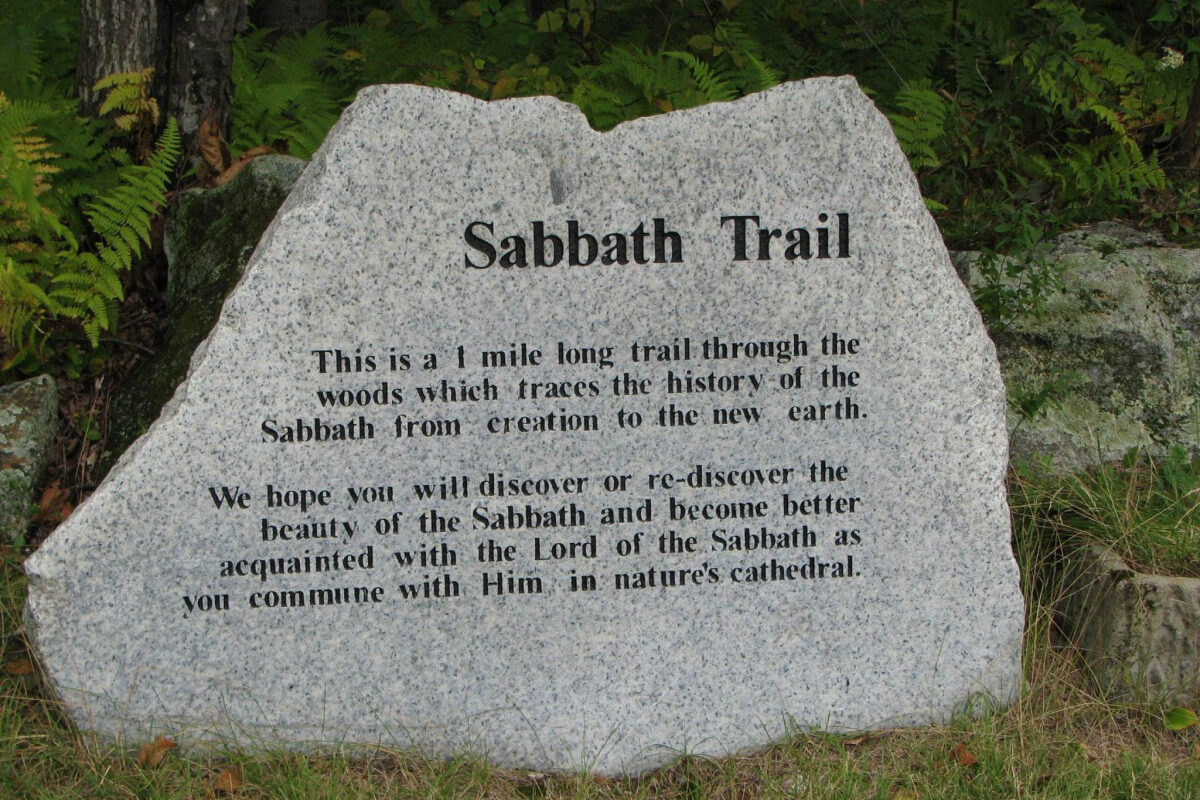
The Sabbath Trail


01 Mar 2026

Walking through the history of the Sabbath

Amy Whitsett


Meandering through the woods in central New Hampshire, United States, is a modest wood chip walking trail. Its gentle twists and turns lead across small wooden bridges spanning a forest stream, where sunlight filters through the canopy and casts dappled shadows on the path. The air carries the scent of pine needles and damp soil, while birdsong pulls you away from the busyness of life into an almost holy stillness and peace.

Welcome to the Sabbath Trail at the Seventh-day Adventist church in Washington, New Hampshire, a trail tracing the history of the Sabbath from creation to the new earth.

The Vision

The Washington, New Hampshire, Seventh-day Adventist Church is a small one-room church built in the early 1840s. Situated at the crest of a hill beside a dirt road, the church was home to a small congregation that would meet throughout the year until it grew too cold for the little stove to fight winter’s chill.

But the church had another, bigger problem. Because the church lot was so small, cars would frequently line the narrow dirt road, causing difficulty for neighbors. It was also challenging, even impossible, to park the buses that would bring students or Adventist Heritage tourists to visit the historically significant church. The church often prayed that God would open a way for nearby land to become available to meet this need.

Then, in the late 1980s, 18 acres of wooded land surrounding the church property were put up for sale. Recognizing that the land would be a solution to the parking needs, church members seized the opportunity, and the land was purchased.