Showing posts with label interrogation. Show all posts

Wednesday, April 02, 2014

Senate Report Shows CIA Torture Ineffective


A Senate Intelligence Committee report on the CIA’s use of “enhanced interrogation” is poised to elevate hostility between the two groups into an all-out war.


By Frederick Reese @FrederickReese | April 2, 2014


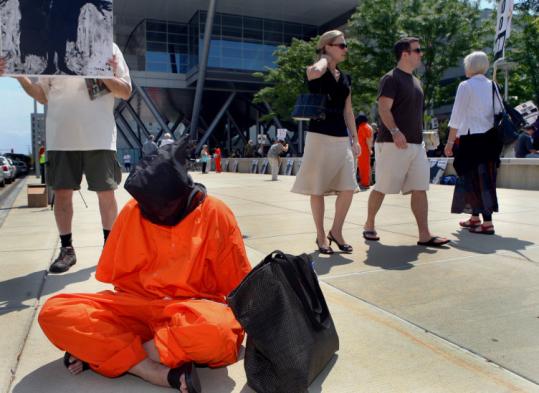
Protestors demonstrate the use of water boarding to volunteer Maboud Ebrahim Zadeh, Monday, Nov. 5, 2007, in front of the Justice Department in Washington. (AP/Manuel Balce Ceneta)


In recent months, the CIA and the Senate Intelligence Committee have been in a perceived state of hostility. A disagreement over the CIA’s handling of the “enhanced interrogation” program under former President George W. Bush has evolved into a rare fight between a federal agency and its oversight board. The escalation of harsh words and allegations — including the Intelligence Committee accusing the CIA of illegal spying on, and hacking into the computers of the committee and vice versa — has turned the investigation into allegations of George W. Bush-era torture into an embarrassment for both the Democrat-ran Senate and the Obama White House.

A 6,300-page Senate Intelligence Committee report is set to add fuel to this spreading fire. As reported by The Washington Post, the classified, recently-concluded report alleges that the CIA knowingly misled the government and the American people about the severity and effectiveness of the “enhanced interrogation” program. The agency allegedly took credit for intelligence obtained without the use of “enhanced interrogation” and overstated the importance of information that “enhanced interrogation” did manage to extract.

“The CIA described [its program] repeatedly both to the Department of Justice and eventually to Congress as getting unique, otherwise unobtainable intelligence that helped disrupt terrorist plots and save thousands of lives,” one U.S. official briefed on the report told The Washington Post. The official spoke on the condition of anonymity due to the classified nature of the report. “Was that actually true? The answer is no.”

However, with the committee stating that it does not seek any administrative or criminal inquiries based on the findings of the report, and considering that the administration has already closed the door on seeking culpability in the question of the use of “enhanced interrogation,” the question begs to be asked: What is the net result of this investigation?

As this report will likely reignite the debate on the use of torture, it will also likely create a screaming match this election year between Republicans defending the actions of the last Republican president and Democrats defending their rationale for not prosecuting these “crimes against humanity.”


“Enhanced interrogations”

“Enhanced interrogations” refer to a set of interrogation methods involving torturous or physically- and mentally-stressing activities to coerce cooperation. It includes tactics such as inducing hypothermia, waterboarding and stress positioning, or positioning the body in such a way that extraordinary weight is supported by just one or two muscle groups, as in forcing someone to stand on the balls of his feet and making him squat low to the ground.

Waterboarding is a form of water torture in which a victim is immobilized on a downward-inclined table with a cloth covering his face while water is poured over the cloth. This triggers the gag reflex and causes the victim to think he is drowning. As the gag reflex can cause the victim to vomit, the procedure is potentially fatal. In World War II, the United States arrested and hanged Japanese soldiers accused of waterboarding, as pointed out by Sen. John McCain (R-Ariz.) during a 2007 Republican Presidential Primaries debate.

“Enhanced interrogations” were carried out in “black sites,” or secret detention facilities, spread throughout the Afghan and Iraqi war zones and within allied nations. In 2009, President Obama brought an end to such interrogation activities, and the CIA and the U.S. Department of Defense closed all of the “black sites.” The Senate Intelligence Committee’s report mentions undisclosed acts of terror that do not appear on the U.S. Department of Justice’s approved list of interrogation techniques, such as the repeated dunking of a terrorism suspect in Afghanistan in tanks of ice water.

Torture is recognized as a grave violation of basic human rights and is explicitly prohibited by the United Nations Convention Against Torture and all four of the Geneva Conventions. However, due to the United States’ status as a veto-carrying permanent member of the Security Council, the agency charged with the enforcement of international law, the international community does not have the power to force the U.S. to obey these laws or punish the nation if it breaks them.


Differences in interpretation

Defenders of “enhanced interrogations” point to Khalid Sheikh Mohammed, al-Qaida’s propagandist from 1999 to 2001. In 2003, Mohammed was captured in Pakistan in a joint CIA-Pakistan raid. In 2006, Mohammed left CIA custody and was transferred to the Guantanamo Bay detention camp.

According to early reports of the death of Osama bin Laden, news agencies reported that CIA interrogators were able to retrieve the pseudonym of one of bin Laden’s aides from Mohammed and Mohammed’s successor, Abu Faraj al-Libi. Officials from the George W. Bush administration credited this information gathering to “enhanced interrogation.”

However, later reports indicated that waterboarding did not prompt Mohammed to reveal the information. Instead, he gave the information up under standard interrogation months before the military started the procedure. Mohammed’s disclosure occurred three years after the CIA waterboarded him 183 times. The Senate report indicated that the National Security Agency — not the CIA — was the most useful in securing intelligence that led to the death of bin Laden.

While the report’s favoring of the NSA over the CIA may reflect the current politics of the committee, which is trying to justify the NSA’s current surveillance apparatus as being both useful and essential for national security, it still points to the George W. Bush administration’s willingness to use violence to gather information, despite the fact that most experts agree that torture is not an effective means of gathering credible intelligence.

“The defenders of ‘enhanced interrogation’ believe it ‘saved American lives,’ yet never identified which life it saved,” Joseph Wippl, a former CIA officer and currently a professor of the practice of international relations, told MintPress News. “Had it really done so, I am confident that person or persons would have been identified.

“The debate about whether enhanced interrogation was effective against terrorists is the wrong debate. What if it was effective? Would you still engage in methods defined as torture — that is, ‘cruel, inhumane, degrading?’ Those methods of enhanced interrogation which can be defined as torture are wrong, even if justified by Justice Department memorandum, under all circumstances — even at the expense of American lives.”


Making amends


The American Civil Liberties Union, which has been working to expose the “enhanced interrogation” program, argues that the Obama administration must do four things in order to redress the fact that the U.S. submitted to the use of torture: fully investigate the use of torture and kidnapping by the federal government and prosecute those responsible; release the records documenting the planning and approval of the program; honor and pardon those service members that objected to the use of torture; and publicly apologize for what has happened and duly compensate the victims and their families. While there is no indication that the administration will agree to every term dictated by the ACLU, there are signs that the White House seeks disclosure on this issue.

“There needs to be a further accounting of what took place during this period, I think for Congress to examine ways that it can be done in a bipartisan fashion, outside of the typical hearing process that can sometimes break down and break it entirely along party lines, to the extent that there are independent participants who are above reproach and have credibility, that would probably be a more sensible approach to take,” President Obama said on April 21, 2009.

With the Senate Intelligence Committee set to vote Thursday on whether the report should be sent to the White House for declassification, this report may be the first step in the nation’s reconciliation with its use of torture. However, with the CIA fervently refuting its accounting, the report is more likely to result in in-fighting and political arguments than healing.


Source
.
.

Wednesday, March 12, 2014

Feinstein: CIA searched Intelligence Committee computers


.


Video: Senate Intelligence Chair Dianne Feinstein (D-Calif.) accused the CIA of breaking the law by searching her committee's computers. The Post's Karen Tumulty, Scott Wilson, Terence Samuel and Adam Goldman explain the impact in Washington.


By Greg Miller, Ed O’Keefe and Adam Goldman, Published: March 11

A behind-the-scenes battle between the CIA and Congress erupted in public Tuesday as the head of the Senate Intelligence Committee accused the agency of breaking laws and breaching constitutional principles in an alleged effort to undermine the panel’s multi-year investigation of a controversial interrogation program.

Chairman Dianne Feinstein (D-Calif.) accused the CIA of ­secretly removing documents, searching computers used by the committee and attempting to intimidate congressional investigators by requesting an FBI inquiry of their conduct — charges that CIA Director John Brennan disputed within hours of her appearance on the Senate floor.


Video


Sen. Dianne Feinstein (D-Calif.) questioned whether a CIA search of congressional records might have undermined government oversight during a Senate floor speech Tuesday.


Read more:

Why the CIA and lawmakers are feuding


Adam Goldman MAR 11

What you need to know about the dispute over an investigation o the agency’s interrogation program.

Transcript: Feinstein says CIA searched Intelligence panel computers


MAR 11

“Let me say up front that I come to the Senate floor reluctantly,” she said.

Transcript: Brennan says his agency has done nothing wrong


MAR 11

“If I did something wrong, I will go to the president and I will explain to him exactly what I did and what the findings were,” he said.

Senators praise Feinstein speech, want answers from CIA


Wesley Lowery and Ed O'Keefe MAR 11

If true, “this is Richard Nixon stuff,” one senator says.


Feinstein described the escalating conflict as a “defining moment” for Congress’s role in overseeing the nation’s intelligence agencies and cited “grave concerns” that the CIA had “violated the separation-of-powers principles embodied in the United States Constitution.”

Brennan fired back during a previously scheduled speech in Washington, saying that “when the facts come out on this, I think a lot of people who are claiming that there has been this tremendous sort of spying and monitoring and hacking will be proved wrong.”

The dueling claims exposed bitterness and distrust that have soared to new levels as the committee nears completion of a 6,000-page report that is expected to serve as a scathing historical record of the agency’s use of waterboarding and other brutal interrogation methods on terrorism suspects held at secret CIA prisons overseas after the attacks of Sept. 11, 2001.

Displaying flashes of anger during her floor speech, Feinstein said her committee would soon deliver the report to the White House and push for declassification of a document that lays bare “the horrible details of the CIA program that never, never, never should have existed.”

The latest dispute is in some ways a proxy for a deeper conflict over that document. The CIA and the committee are at odds over many of the report’s conclusions about the effectiveness of the interrogation program, but they are battling primarily over tension that surfaced during the investigation.

Feinstein’s remarks provided the most detailed account of that investigation, describing an arrangement in which the CIA set up a secret facility in Northern Virginia with computers where committee investigators were promised unfettered access to millions of operational cables, executive memos and other files on the interrogation program.

The disagreement between Feinstein and Brennan centers on whether agency employees or committee staff members — or both — abused their access to that shared network to gain an upper hand.

Feinstein implied that the CIA sabotaged the committee’s efforts from the outset, loading a massive amount of files on computers with no index, structure or ability to search. “It was a true document dump,” she said.

Over a period of years, investigators pored over more than 6.2 million classified records furnished by the CIA, using a search tool that agency technical experts agreed to install. But U.S. officials said the committee gained access to a set of documents that the agency never intended to share, files that were generated at the direction of former director Leon E. Panetta as part of an effort to take an inventory of the records being turned over to Feinstein’s panel.

The two sides have engaged in heated exchanges in recent days over the nature of those files and how they were obtained.

Referring to them as the “Panetta internal review,” Feinstein insisted that committee staff members discovered the documents during an ordinary search of the trove. She said they are particularly valuable because in tracking the flow of documents, CIA employees in some cases drew conclusions about their contents that match the subsequent interpretations made by committee staff members.
Jeremy Bash, Panetta’s former chief of staff, said Tuesday that that was never the director's intent. Panetta “did not request an internal review of the interrogation program,” he said. “He asked the CIA staff to keep track of documents that were being provided. . . . He asked that they develop short summaries of the material, so that we would know what was being provided.”

Meanwhile, a letter that Brennan distributed to the CIA workforce on Tuesday raised questions about Feinstein’s claims and her awareness of how and when the committee obtained what she is calling the Panetta review files.

The letter, which Brennan sent to Feinstein on Jan. 27 and which was attached to a message he sent the workforce, recounts a meeting they had weeks earlier to discuss the matter. During that meeting, Feinstein said she didn’t know that the committee already had copies of the Panetta review. Brennan pushed her to explain why the panel had recently requested the files when they were already in its possession.

“You informed me that you were not aware that the committee staff already had access to the materials you had requested,” Brennan wrote, according to a copy obtained by The Washington Post. Brennan urged Feinstein to work with the agency to determine how the committee had obtained the documents, a request she ultimately rejected, officials said.

The CIA began to suspect that the panel had obtained those files this year after lawmakers referred to the supposed “internal review” publicly. U.S. officials said CIA security personnel then checked the logs of the computer system it had set up for the committee, and found that the files had been moved to a part of the network that was off-limits to the CIA.

“They did something to get those documents,” said a U.S. official briefed on the matter. A security “firewall was breached. They figured out a work-around to get it.” The official declined to elaborate.
Feinstein said the review documents were “identified using the search tool provided by the CIA” but she was careful not to say precisely how they were obtained. “We don’t know whether the documents were provided intentionally by the CIA, unintentionally by the CIA, or intentionally by a whistleblower,” she said.

She acknowledged, however, that committee investigators made hard copies of those files and whisked them away to its offices on Capitol Hill, in part because the committee had previously seen cases in which more than 900 pages of records dis­appeared from the database with no explanation.
Feinstein expressed outrage that the CIA referred the matter to the FBI. “There is no legitimate reason to allege to the Justice Department that Senate staff may have committed a crime,” she said, describing the move as a “potential effort to intimidate this staff, and I am not taking it lightly.”
She also noted that the referral was made by Robert Eatinger, the CIA’s acting general counsel, who previously served as the top lawyer for the department that ran the CIA’s secret prisons, and who “is mentioned by name more than 1,600 times in our study.”

Feinstein, who has been a staunch supporter of other CIA programs including its drone campaign, said the agency may have violated Fourth Amendment protections against unreasonable searches, as well as laws against domestic surveillance.

Although Republicans on the committee initially voted in favor of opening the investigation, GOP members abandoned the effort after it began and none has voted to endorse it.

Sen. Marco Rubio (R-Fla.), a member of the intelligence panel, told Bloomberg News that the dispute is “more complicated than what’s being put out there by Senator Feinstein or others. . . . I don’t think anyone has a clean hand and I think it’s important for the full truth to come out. I think people may be surprised to learn that, in this case, there were no good guys and maybe two or three bad ones.”

[Read a full transcript of Feinstein’s remarks.]

Brennan said he had ordered the CIA’s inspector general to review the agency’s conduct. The inspector general, in turn, has issued a separate referral seeking a Justice Department review.

Asked whether he would resign if the CIA was found to be in the wrong, Brennan said he would let the president decide his fate. “If I did something wrong, I will go to the president,” the director said. “He is the one who can ask me to stay or to go.”


Ellen Nakashima and Julie Tate contributed to this report.


Source
.

Saturday, February 01, 2014

The Inquisition: A Model For Modern Interrogators


Listen to Story

All Things Considered

38 min 12 sec

An illustration shows heretics being tortured and nailed to wooden posts during the first Inquisition.

An illustration shows heretics being tortured and nailed to wooden posts during the first Inquisition.
Hulton Archive/Getty Images
 
This interview was originally broadcast on Jan 23, 2012.

The individuals who participated in the first Inquisition 800 years ago kept detailed records of their activities. Vast archival collections at the Vatican, in France and in Spain contain accounts of torture victims' cries, descriptions of funeral pyres and even meticulous financial records about the price of torture equipment.

"[There are] expense accounts [for things] like how much did the rope cost to tie the hands of the person you burnt at the stake," says writer Cullen Murphy. "The people who were doing interrogations were meticulous."

Murphy's book God's Jury: The Inquisition and the Making of the Modern World comes out in paperback next week. It traces the history of the Inquisitions — there were several — and draws parallels between some of the interrogation techniques used in previous centuries with the ones used today.

"A few years ago, the intelligence agencies had some transcripts released ... of interrogations that were done at Guantanamo, and the interrogations done by the Inquisition were surprisingly similar and just as detailed," he tells Fresh Air's Terry Gross. "[They were] virtually verbatim."

Eight-hundred years ago, the first Inquisition was initially designed to deal with an upsurge in heretical activity from the Cathars in France. The Cathars' unconventional interpretation of religious doctrine worried Pope Gregory and other Vatican leaders.

God's Jury

The Inquisition and the Making of the Modern World
by Cullen Murphy
Paperback, 310 pages

"The papacy was trying to centralize itself and assert its authority," says Murphy. "So the pope basically deputizes various clerics. ... They would come to a town, announce that they were there. They would begin to question people. Sometimes they would use harsh methods. ... They would conduct tribunals and they would sentence people to various punishments."

The Use Of Torture

Clerics were given authority to use torture in a document issued by the pope in 1252. They were also given advice manuals with instructions for interrogating suspected heretics. Murphy says he was astonished by the similarities between the Inquisitor advice manual and modern-day guides for intelligence agencies and police departments.

"You see that everything that is being suggested now had already been anticipated," he says. "For instance, you want to spook the person you're interrogating. [The Inquisitors] have a whole bunch of tricks they lay out. The person to be interrogated comes into the room and the inquisitor [advice manual advises]: 'Be sitting there. Have a huge stack of documents in front of you. And as the person is answering questions, flip through the documents as if you have more information than this person could dream of. And every so often, shake your head as if you can't believe what they're saying.' It's almost word for word, you find the same thing in modern handbooks."

When Inquisitors needed a confession, they could elevate their interrogations to include torture.
"The basic line here was, 'Has this person confessed or not?' " says Cullen. "The answer is, 'If they confess, it's true. So torture comes into the picture when you need a confession."

But the Inquisitors were aware that confessions given under torture could be problematic, says Murphy.

"If a person confessed to something under torture, the Inquisitors were not prepared to accept that confession as evidence," he says. "They said, 'Now you have to give it some time. Let a day go by. Bring the person someplace else. Then ask them again. And if they still confess, then we'll accept that confession.' But it's not as if the person who made the confession has forgotten the fact that they were just tortured and couldn't be tortured again. [The Inquisitors] were mindful of the flaws of torture, but they went ahead and did it anyway."

Cullen Murphy is the editor-at-large for Vanity Fair and previously served as managing editor at The Atlantic Monthly.

Cullen Murphy is the editor-at-large for Vanity Fair and previously served as managing editor at The Atlantic Monthly.
Gasper Tringale/Houghton Mifflin Harcourt 
 
More Elaborate Forms Of Torture

A century later, during the Spanish Inquisition, interrogators began using more elaborate forms of torture, such as the rack, the pulley and waterboarding. They also began parading their victims through the streets in elaborate displays of punishment.

"You would invite the diplomatic core to come and watch. The nobility would be there," he says. "People would be lined up in the streets to watch everyone going by. If people who were condemned had in fact already died, their bodies would be dug up and they'd be brought by on carts."

The dead bodies were burned on public funeral pyres. The living were publicly tried, and then tortured for several hours. Some were burned at the stake. Others were forced to become galley slaves or returned to prison for more bouts of torture.

"Technically during the Inquisition, there were guidelines in place that said ... you were supposed to torture a person only once," says Murphy. "But if you wanted to torture a person a second time or a third time, there was a way in which you could simply define the second, third or fourth time as simply a continuance of the first time."

Interview Highlights


On accounts of torturers from the first Inquisition

"The idea that the pope would authorize the use of something as heinous as torture by priests or people working for priests is a pretty astonishing development. Ultimately, the justification that it invokes is the same one anyone uses when they're using torture for reasons that are not sadistic and that is, in essence: 'The moral cause that we're engaged in is too important to settle for half-measures.' ... When you read accounts of torture, you get the unmistakable impression that the people doing the torture or conducting the torture — somewhere inside them, they think they are saving souls."

On the number of people killed in the first Inquisition

"There were thousands of people who were killed. ... I think the rough ratio [was] for every person burned at the stake, maybe 50 others who were sentenced to something. But then if you factor in the families of those people and the people called as witnesses, you have a great deal of penetration into society. Everybody was aware that this was going on. It's not hard to see why the Inquisition weighs so heavily on the psychology of people at the time."

On the state-run Spanish Inquisition

"The reason for it was that Jews who had converted to Christianity were reverting to Judaism. That was the charge. And the degree to which it was or wasn't true is one of those things historians debate to this day. These charges were leveled at a time when anti-Semitism in Spain was on the increase. There had been terrible pogroms beginning in the 14th century, forced conversions, continual rounding up of Jews into ghettos. The situation was terrible even before the Inquisition began, and once the Inquisition began, it became worse."

"The pope had control over the Medieval Inquisition and over the Inquisition that came later, but the pope had no control over the Spanish Inquisition. As a result, you had the government — the monarchs — presented with this extraordinary tool that they could use for a variety of purposes. ... The Spanish government did not have the welfare of victims in mind. What it did have was the uses it could put prisoners to. And one of the things the monarchy needed was galley slaves [to row ships]. It's probably the worst punishment that can ever be meted out. Your life expectancy was not more than a couple years."

The Inquisition: Alive And Well After 800 Years


On waterboarding

"Many people in the Bush administration were insisting [it] was not torture at all. The Inquisition was actually very clear on the matter. It obviously was torture. That's why they were using it."

On the printing press and the third Inquisition 

"For a long time, the church had had an effective monopoly on the intellectual life in Europe. Publishing was something that involved copying manuscripts. ... Suddenly, there's a new technology on the block. And the church sees this as a threat. So the church sees a combined attack — from the printing press and the Protestant Reformation — [and that] is really the thing that instigates the third Inquisition. ... This is the Inquisition that puts Galileo on trial. ... It's the Inquisition that starts the index of forbidden books."

Read an Excerpt: God's Jury


Source.
.
.

Tuesday, January 07, 2014

Review: John Rizzo gets candid in CIA memoir Company Man


By Matt Apuzzo, The Associated Press January 6, 2014


Company Man: Thirty Years of Controversy and Crisis in the CIA (Scribner), by John Rizzo

This book cover image provided by Scribner shows "Company Man:Thirty Years of Controversy and Crisis in the CIA," by John Rizzo. This CIA memoir reveals what nobody stopped to ask during the interrogation debate. (AP Photo/Scribner)


WASHINGTON - There is a moment in John Rizzo's new memoir when the longtime CIA lawyer has the chance to change history. It is March 2002, and Rizzo has just been briefed on the agency's proposals for interrogating suspected terrorists.

Rizzo walks the grounds of the CIA, smoking a cigar, thinking about waterboarding and other unprecedented tactics that seem "sadistic and terrifying."

Rizzo realizes that, on his own say-so, he can end the discussion right there. With the stroke of a pen, Rizzo, the CIA's acting general counsel, could kill the program before it starts.

"It would have been a relatively easy thing to do, actually," he writes.

Then he thinks about what would happen if terrorists struck again. People would blame the CIA. Rizzo would blame himself. And he couldn't deal with that.

So despite his reservations, Rizzo sends the interrogation proposal to the Justice Department, beginning a process that gave the green light to tactics the United States once considered and prosecuted as torture.

Moments like this occur again and again in the roughly six chapters Rizzo dedicates to the CIA's post-9-11 response: People set aside nagging questions about morality (should we?) and focused instead on the legalistic question (can we?).

Rizzo's portrayal of key meetings offers an unprecedented and sometimes startling look at how uncomfortable the enhanced-interrogation techniques made people.

Defence Secretary Donald Rumsfeld "didn't want to get his fingerprints anywhere near the EITs." Secretary of State Colin Powell seemed "intensely uncomfortable." National Security Adviser Condoleezza Rice was disturbed that the detainees were forced to be nude.

Yet there were no discussions about whether this path would damage U.S. relationships with allies, harm U.S. long-term interests or weaken its moral standing.

Even though the interrogation program is more than a decade in the past, the topic remains timely. Since leaked documents showed the U.S. vacuuming up millions of domestic phone records, tracking cellphone locations and eavesdropping on calls, officials have defended the tactics as legal.

Once again, the question of whether the government should do something is getting less attention than the question of whether it can.

Many insiders have written memoirs about the post-9-11 CIA. Often, those who approved the interrogation program are portrayed as two-dimensional heroes willing to make unpopular decisions to help the country.

Rizzo paints a less flattering but more revealing picture, one in which fear hung over important decisions. Fear of another attack, fear of blame, fear of political liability.

Depending on your politics and your views on waterboarding, that may make these figures more relatable and human, their decisions that much more wrenching.

Or it may make them seem cowardly.

Whatever conclusion you draw, Rizzo's book makes an important contribution to history and the debate over interrogation. And it serves as a reminder of how much fear drives decision-making in Washington.

For instance, Rizzo regrets not presenting the interrogation program to more people in Congress. Not because the legislative branch should have been fully aware of this unprecedented step, but because it would have headed off criticism of the CIA years later.

In a few key places, Rizzo skips the opportunity for what would have been important reflection. There is no analysis, for example, of the two psychologists who became the architects of the interrogation program despite limited background and expertise.

"Company Man" is tailor-made for CIA buffs. Rizzo's career as an agency lawyer spanned the decades from Iran-Contra to drones, with Russian turncoat Aldrich Ames, the rise of al-Qaida and some interrogation videos destroyed in between.

Though Rizzo never sheds his role as the company man, his book manages to strike notes that are both earnest and candid. That alone sets "Company Man" apart in the genre.


Source
.

Sunday, March 03, 2013

What happened to Timothy Geithner?

A  news story from the 'as quiet as it's kept department'...    This info never came to my attention until now!

Here's infomation how the incident took place 1 year ago:


U.S. Treasury Secretary Timothy Geithner arrested and questioned.


slavmart

Published on Mar 10, 2012


As predicted, the collapse of the financial mafia is accelerating. U.S. Treasury Secretary Timothy Geithner was detained for questioning by New York police on February 24th and was released after giving evidence about many high level financial criminals, according to New York police sources. "In most cases we have to slap people to get them to talk but in his case we had to slap him to shut him up," one of the interrogators joked. Geithner has been released but is accompanied at all times by an armed deputy to make sure he does not leave the country.

Former Prime Minister Silvio Berlusconi of Italy is also proving to be very talkative, sources in Europe say. Berlusconi has been released. Meanwhile, meetings between White Dragon Society representatives and South Korean government officials last week in Seoul were very productive.

In general what has happened is that dozens of high level informants have come forth in the past weeks and detailed testimony by them is being gathered. Apart from Geithner and Berlusconi, the talking big fish include members of the Rothschild family who have come forth with startling information.

The cabalists for their part are still fighting to preserve their expired power and control. The latest scam they are working on involves the $6 trillion worth of 1934 gold back securities that were seized in Switzerland recently.


.

Thursday, April 19, 2012

Secret Service Calls Nugent Over Anti-Obama Screed

Wednesday, 18 Apr 2012 04:45 PM


Rocker and gun rights champion Ted Nugent says he will meet with the Secret Service on Thursday to explain his raucous remarks about what he called Barack Obama's "evil, America-hating administration" — comments some critics interpreted as a threat against the president.

"The conclusion will be obvious that I threatened no one," Nugent told radio interviewer Glenn Beck on Wednesday. Nugent said he'd been contacted by the agency and would cooperate fully even though he found the complaints "silly."

The controversy erupted after the self-styled "Motor City Madman" made an impassioned plea for support for Republican presidential candidate Mitt Romney during the National Rifle Association meeting in St. Louis last weekend. "We need to ride into that battlefield and chop their heads off in November," Nugent said of the Obama administration.

He also included a cryptic pronouncement: "If Barack Obama becomes the next president in November, again, I will either be dead or in jail by this time next year."

Outraged Democrats circulated the remarks and suggested they were threatening. Secret Service spokesman George Ogilvie confirmed that the agency was looking into the matter but declined to give details. "We are aware of the incident and we are taking appropriate follow-up," Ogilvie said.

Nugent said he was simply trying to galvanize voters. The hard rocker, best known for '70s hits like "Cat Scratch Fever," is a conservative activist and has a history of heated and sometimes vulgar criticism of Obama. Nugent endorsed Romney after speaking to him last month.

Democratic National Committee Chairwoman Debbie Wasserman Schultz called on Romney to "condemn Nugent's violent and hateful rhetoric."

Romney spokeswoman Andrea Saul addressed the issue with a brief statement: "Divisive language is offensive no matter what side of the political aisle it comes from. Mitt Romney believes everyone needs to be civil."


Source

.

Wednesday, March 10, 2010

The Enemy Belligerent, Interrogation, Detention, and Prosecution Act of 2010


March 9th, 2010

Via: The Atlantic:

Why is the national security community treating the “Enemy Belligerent, Interrogation, Detention, and Prosecution Act of 2010,” introduced by Sens. John McCain and Joseph Lieberman on Thursday as a standard proposal, as a simple response to the administration’s choices in the aftermath of the Christmas Day bombing attempt? A close reading of the bill suggests it would allow the U.S. military to detain U.S. citizens without trial indefinitely in the U.S. based on suspected activity. Read the bill here, and then read the summarized points after the jump.

According to the summary, the bill sets out a comprehensive policy for the detention, interrogation and trial of suspected enemy belligerents who are believed to have engaged in hostilities against the United States by requiring these individuals to be held in military custody, interrogated for their intelligence value and not provided with a Miranda warning.

(There is no distinction between U.S. persons–visa holders or citizens–and non-U.S. persons.)

It would require these “belligerents” to be coded as “high-value detainee[s]” to be held in military custody and interrogated for their intelligence value by a High-Value Detainee Interrogation Team established by the president. (The H.I.G., of course, was established to bring a sophisticated interrogation capacity to the federal justice system.)

Any suspected unprivileged enemy belligerents considered a “high-value detainee” shall not be provided with a Miranda warning.

The bill asks the President to determine criteria for designating an individual as a “high-value detainee” if he/she: (1) poses a threat of an attack on civilians or civilian facilities within the U.S. or U.S. facilities abroad; (2) poses a threat to U.S. military personnel or U.S. military facilities; (3) potential intelligence value; (4) is a member of al Qaeda or a terrorist group affiliated with al Qaeda or (5) such other matters as the President considers appropriate. The President must submit the regulations and guidance to the appropriate committees of Congress no later than 60 days after enactment.

To the extent possible, the High-Value Detainee Interrogation Team must make a preliminary determination whether the detainee is an unprivileged enemy belligerent within 48 hours of taking detainee into custody.

The High-Value Detainee Interrogation Team must submit its determination to the Secretary of Defense and the Attorney General after consultation with the Director of National Intelligence, the Director of the Federal Bureau of Investigation, and the Director of the Central Intelligence Agency. The Secretary of Defense and the Attorney General make a final determination and report the determination to the President and the appropriate committees of Congress. In the case of any disagreement between the Secretary of Defense and the Attorney General, the President will make the determination.

Note that the president himself doesn’t get to make the call.
.
.
,