Showing posts with label Gain of Function. Show all posts

Thursday, August 20, 2026

AI just created a virus not found in nature, and scientists are worried


This technique could lead to new treatments for antibiotic-resistant bugs, but some scientists say the technology could be misused

By Adam Kovac edited by Claire Cameron

August 7, 2026


Brian Hie and Aditi Merchant, both at Stanford University, examine a protein structure generated by Evo 2, an artificial intelligence tool that can suggest genome designs. Lab tests of Evo 2’s designs for an Escherichia coli killer exceeded expectations.
Andrew Brodhead/Stanford University

Viruses

Scientists used artificial intelligence to generate new viruses. The landmark first could lead to new antimicrobial drugs—and may pose immense danger to human health.

Scientists at Stanford University and the Arc Institute, a nonprofit AI and biology research organization, made the viruses using the actual genome of a bacteriophage—a type of virus that can kill bacteria—called ΦX174 (pronounced FYE-ex-174) as a template.

Using two large language models trained on the genomes of more than two million other bacteriophages, the scientists generated new, not-found-in-nature viruses. In a paper in the journal Science, they show that these viruses can kill even antibiotic-resistant bacteria.

“In this case, we wanted the model to generate the entire genome end-to-end in a single left-to-right pass,” said Brian Hie, an assistant professor at Stanford and co-author of the paper, in a statement. “We didn’t add anything.”

Making novel genes is not new, but creating an entire functional genome is much trickier—genes have complex patterns of interaction, and all their cascading effects need to be taken into account for the result to function as a comprehensive body. A single mutation can disrupt that delicate system, making the entire thing nonviable. Simple viral genomes are a fraction of a fraction as large as a human’s, but they are still incredibly complex.

The AI models were able to come up with thousands of bacteriophage genomes, nearly 300 of which the researchers then chemically synthesized. Of these, 16 of them proved to be viable and able to kill certain strains of Escherichia coli—including strains of the bacterium that had mutated to be resistant to the original reference genome of ΦX174.

The impetus for this work, according to the researchers, is that drug-resistant bacteria are rife and growing. More than 2.8 million antimicrobial-resistant infections occur in the U.S. each year, killing more than 35,000 people on average, according to the Centers for Disease Control and Prevention. Having a drug based on the 16 phages could help fight antibiotic-resistant strains more effectively, Hie said.

Wednesday, July 29, 2026

Fauci journals prove he funded research that created COVID-19, biologist says | Elizabeth Vargas Rep


Fauci journals prove he funded research that created COVID-19, biologist says | Elizabeth Vargas Rep

NewsNation

Jul 29, 2026  #VargasReports

Dr. Anthony Fauci is set to appear on Capitol Hill on Wednesday after being subpoenaed to testify about the origins of COVID-19. Dr. Richard Ebright, a professor of biology at Rutgers, has testified on this issue before, and tells NewsNation's Rich McHugh that the recent pages from Fauci's private journals are beyond damning.

Sunday, May 03, 2026

Pressure on DOJ to prosecute Anthony Fauci grows after adviser indicted—with days left to charge COVID ‘lies’


By
Steven Nelson
Published April 28, 2026, 6:41 p.m. ET

WASHINGTON — The indictment of Dr. Anthony Fauci’s former adviser David Morens Tuesday revived calls for the Justice Department to prosecute Fauci himself for allegedly lying to Congress about funding risky research in China before the COVID-19 pandemic.

Just two weeks remain before the five-year legal deadline on May 11 to indict Fauci for denying under oath that he funded “gain of function” experiments that modified bat coronaviruses in the same city where the pandemic started.

Morens, 78, was charged with one count of conspiracy, two counts of destruction, alteration, or falsification of records in federal investigations and two counts of concealment, removal, or mutilation of records relating to the origins of COVID-19. He faces up to 51 years in prison.

Dr. Anthony Fauci allegedly lied to Congress in 2021 about funding gain of function research.Getty Images

Critics say Fauci, 85, bears the most responsibility and that he should be hauled into court.

Trump told The Post in a phone interview on March 31 that he intended to “look into” Fauci’s status and Republicans say they believe acting attorney general Todd Blanche, who is seeking the role permanently, might be willing to test Trump’s assertion that former President Joe Biden’s preemptive autopen pardons, including for Fauci, are invalid.

“99% of this country has no idea who Morens is,” said Oversight Project President Mike Howell.

“It’s Fauci that they will blame for one of the worst government catastrophes in history in America. And so the test is Fauci. The Morens indictment is great, and we applaud it. But there are a lot of people out there that want to see Fauci held to account for the damage he wrought.”

Howell, whose group sent the Justice Department a draft indictment for Morens last year, believes the adviser’s actions were closely linked to his boss.

“[Fauci] lied about one of the most damaging events in American history routinely and was behind a massive coverup of the key factors,” Howell said.

Sen. Rand Paul (R-Ky.), to whom Fauci allegedly lied, told The Post that “we’ve been looking through a lot of information on this for the last year or so. The Trump administration has been much more forthcoming than the Biden administration ever was.”

Tuesday, January 11, 2022

Military Documents about Gain of Function contradict Fauci testimony und...

Leaked DARPA docs reveal plans for risky research with Wuhan lab


Plan included work on humanized and 'batified' mice, adding furin cleavage sites, and 'vaccinating' wild bats

By Keoni Everington, Taiwan News, Staff Writer

2021/09/27 13:26


Top of cover page of grant proposal EHA submitted to DARPA. (EcoHealth Alliance DEFUSE screenshot)


TAIPEI (Taiwan News) — Leaked documents from a scuttled research grant proposal calling for collaboration between labs in Wuhan and the U.S. military are raising concerns about the dangerous nature of the experiments on coronaviruses possibly conducted prior to the start of the pandemic

On Sept. 21, Drastic Research, an international network of scientists investigating the origins of the pandemic, exposed a grant proposal presented to the Defense Advanced Research Projects Agency (DARPA) by U.S.-based research organization EcoHealth Alliance (EHA) and headed by British zoologist Peter Daszak. The documents, which were leaked by an anonymous whistleblower, detail a US$14 million proposal dubbed “Project DEFUSE" that sought to identify the spillover risk of coronaviruses to "US warfighters" but was ultimately rejected due to potential gain of function (GoF) and DURC (dual use research of concern) research elements.

The proposal for the US$14 million grant, titled DEFUS (Defusing the Threat of Bat-Borne Coronaviruses), was submitted in 2018 and would have run from that year until 2022. EHA was requesting US$14,209,245 in funding and would have allocated US$1,182,877 to the Wuhan Institute of Virology (WIV), with much of the rest subcontracted to the University of North Carolina, National University Singapore, United States Geological Survey Wildlife Health Center, and Palo Alto Research Center.

Among the more controversial proposed experiments presented in the application were the creation of bat coronavirus chimeras that would contain human-specific furin cleavage sites (FCS), the introduction of these viruses into humanized and "batified" mice, and a grandiose plan to "vaccinate" wild bats in caves against coronaviruses.

The mention of inserting FCS is significant because scientists consider the presence of these on the spike protein of SARS-CoV-2 to be one of the reasons why the virus is able to easily infect humans. Within the betacoronaviruses of sarbecovirus lineage B, the polybasic furin cleavage site is unique to SARS-CoV-2, according to News Medical Life Sciences.

Scientists who favor the lab-leak hypothesis point to the unusual presence of the FCS as an indication of manipulation in a laboratory. Advocates of the natural origin hypothesis argue that although the FCS is not documented in other sarbecoviruses, it does appear in other distant relatives such as MERS.

"Humanized mice" describes mice that have been genetically modified to express the human ACE2 protein, and in this proposal, WIV lead researcher Shi Zhengli (石正麗) — also known as "Bat Woman," would oversee work on these rodents. "Batified mice" refers to mice that have been irradiated and injected with the bone marrow of bats to simulate the response of bats to viruses and treatments.

The most ambitious phase of the project was to vaccinate wild bats using aerosolized viruses. This was to include both broadscale immune boosting with "immune modulators" and targeted immune boosting with "novel chimeric polyvalent recombinant spike proteins."

In one of the most controversial segments, the authors of the project proposed synthesizing spike glycoproteins, which bind to human cell receptors, and inserting them into SARSr-CoV backbones to assess whether they could cause SARS-like disease while declaring that it would not constitute GoF or DURC." However, in his summary sheet of the grant proposal, James Gimlett, program manager of DARPA's Biotechnical Technolgies Office, wrote that the team had failed to "mention or assess the potential risks" of GoF or DURC.

Gimlett then stated that the team's approach of synthesizing spike proteins and inserting them into the backbones of SARS-related coronaviruses "does potentially involve GoF/DURC research" and that if the project was approved, an "appropriate DURC risk mitigation plan should be incorporated" into the documentation. His conclusion was to deny funding for the proposal due to lack of "data, statistical analyses, model development," doubts about the efficacy of the bat inoculation program, and concerns over GoF/DURC.

As for similar projects that successfully secured funding, The Intercept on Sept. 6 released 900 pages of documents detailing work that EHA engaged with the WIV with funding from the U.S. National Institute of Health (NIH). One of the grants was a 5-year project slated to run from 2014 to 2019 titled “Understanding the Risk of Bat Coronavirus Emergence," which provided EHA with a total of US$3.1 million, including US$599,000 allocated to the WIV.

In the grant notice, EHA stated that it had generated a chimeric virus with a spike protein with a 10% divergence from SARS-CoV. The notice added that the chimera had "replicated in primary human airway epithelium, using the human ACE2 receptor to enter into cells" in the transgenic mice.

In 2019, just before the known start of the pandemic, WIV assistant researcher Hu Ben (胡犇) began his work on a project titled "Pathogenicity of 2 new bat SARS-related covs to transgenic mice expressing human ACE2." No information about this research has been released to the public since the start of the pandemic, including data on the eight chimeric viruses the WIV had been infecting the mice with.

Stuart Neil, a professor of virology at King's College London, conceded on Twitter that the DARPA documents reveal "GoF however you want to cut it." Neil said that he was "troubled" that the information is only being released at this late date and that there are "aspects of this proposal that are concerning from a DURC and GoF point of view."

Jamie Metzl, a WHO committee member, said on Twitter that given the revelation of Daszak's "undisclosed conflicts of interest & material nondisclosure" of the DARPA grant application, the time has come for the WHO to begin an official investigation into his participation in the study of COVID's origins and to "retract its deeply flawed report." Rutgers University microbiologist Richard Ebright wrote that the EHA application "outlines several risky research projects" that included the introduction of human-specific cleavage sties into SARS-like viruses.

Alina Chan, a molecular biologist at the Broad Institute of MIT and Harvard, reacted on Twitter to the leaked DARPA documents by remarking that such information would have been invaluable at the start of the pandemic: "Imagine if the public had this info in Jan 2020."

Chan noted that while scientists such as Neil have pointed out that the proposal was not successful, it does not mean such work was not already underway at the time of the proposal. "When you see this level of detail, there's a good chance some preliminary work has been done."



Monday, October 25, 2021

Fauci Pushes Back After New Documents on US-Funded Virus Research in China Fuel Criticism


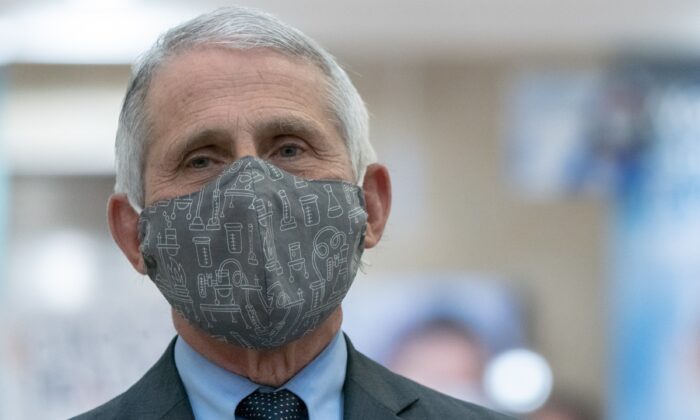
Dr. Anthony Fauci is seen in New York City in a file photograph. (Jeenah Moon/Getty Images)MORE
AMERICA


By Zachary Stieber
October 25, 2021 Updated: October 25, 2021


Top American health officials who critics say misled Congress with claims regarding U.S.-funded virus research in China are pushing back after documents were released appearing to show that the United States did pay for gain-of-function research, contrary to the officials’ testimony.

The National Institutes of Health (NIH) sent the documents last week to lawmakers. They show that the NIH funded research that increased the function of coronaviruses and MERS, experts said.

Dr. Francis Collins, the head of the NIH, and Dr. Anthony Fauci, who heads one of the institutes, told Congress earlier this year that the agency did not fund gain-of-function research.

Critics said the new documents were further proof Collins and Fauci misled Congress.

“In the letter they acknowledge that yes, the viruses did gain in function, they became more dangerous. So they’ve created a virus that doesn’t exist in nature to become more dangerous, that is gain-of-function,” Sen. Rand Paul (R-Ky.), a doctor, said on an “Axios on HBO” episode released Sunday.

“You take an unknown virus, you combine it with another virus and you get a super virus. You have no idea whether it gains functions or loses function, that’s what the experiment is, but I don’t know how anybody could argue that that’s not gain-of-function research,” he added later.

Fauci, though, is insisting that his testimony to Congress was not undercut by the agency’s disclosures.

MOST READ

Vaccine Mandate Threatens Major Trucking Disruption, Industry Insiders Say

“Neither I nor Dr. Francis Collins, the director of the NIH, lied or misled about what we’ve done,” he said on ABC’s “This Week.”

A key issue in the arguments revolves around how the parties define gain-of-function, a type of research that generally means increasing a biological agent’s transmissibility or pathogenicity.

Fauci acknowledged using a narrower term established under a framework (pdf) issued in late 2017 after the agency lifted a funding pause on most gain-of-function research.

RELATED


Fauci, Washington's Highest-Paid Fed, Got Big Break Under George W. Bush

That term is called “gain-of-function research of concern” and entails “a small subset” of gain-of-function research projects that “entail risks that are potentially significant enough to warrant additional oversight,” according to the NIH.

“Under those conditions which we have explained very, very clearly, [the research in question] does not constitute research of gain-of-function of concern,” Fauci said. “There are people who interpret it that way, but when you look at the framework under which the guidance is, that is not the case.”

Fauci used the broader term before a Senate panel on May 11. “The NIH and NIAID categorically has not funded gain-of-function research to be conducted in the Wuhan Institute of Virology,” he said at the time.

Gain-of-function research “describes a type of research that modifies a biological agent so that it confers new or enhanced activity to that agent,” the NIH said on its website, before removing the description last week.

The Wuhan labs that comprise the institute are located near where the first cases of COVID-19 were detected in late 2019.

The newly disclosed documents from the EcoHealth Alliance, which funneled NIH grant money to the institute, outline research conducted between June 1, 2018 and May 31, 2019.

Collins, who is stepping down before the end of the year, has also pushed back against critics, telling The Washington Post that the research did not meet the definition of gain-of-function.

Some experts disagree.

“The genetic manipulation of both MERS and the SARS conducted in Wuhan clearly constituted gain-of-function experiments,” Jonathan Latham, executive director of the Bioscience Research Project, told The Epoch Times in an email.

Others have said the experiments were risky and should not have been conducted.

EcoHealth Alliance has not responded to requests for comment.


He Killed Snoopy??? #ArrestFauci Trending On Twitter

Fauci Claims Wuhan Lab Leak Theory IMPOSSIBLE After NIH CAUGHT Lying Abo...