Showing posts with label Laudate Deum. Show all posts

Friday, May 10, 2024

Finally, (some) US dioceses are taking the pope's climate message seriously


Editorial: Finally, (some) US dioceses are taking the pope's climate message seriously


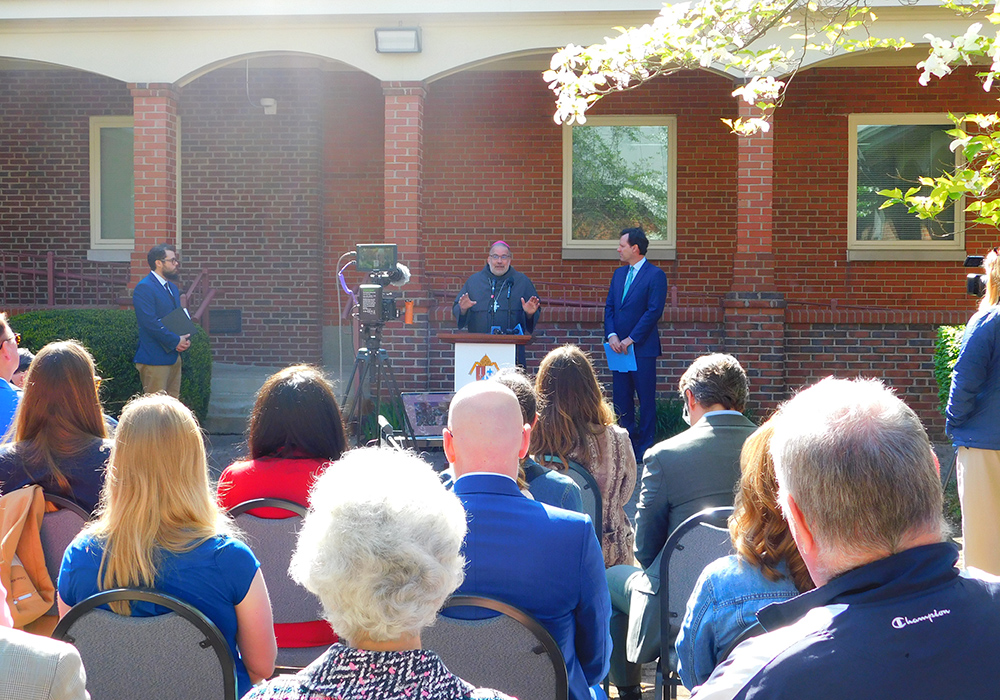
Bishop John Stowe of the Diocese of Lexington, Kentucky, at a press conference April 23 announces a net-zero initiative to make the diocese one of the first in the U.S. to adopt such a commitment. At right is Adam Edelen, founder and CEO of Edelen Renewables. At left is Joshua van Cleef, director of the diocese's peace and justice office. (Courtesy of Diocese of Lexington)


BY NCR EDITORIAL STAFF

View Author Profile

Join the Conversation

Send your thoughts to Letters to the Editor. Learn more

April 30, 2024

Nine years after the publication of Pope Francis' encyclical "Laudato Si', on Care for Our Common Home," four years following the announcement of the Vatican-led Laudato Si' Action Platform and six months since the release of Francis' apostolic exhortation "on the climate crisis," Laudate Deum, Catholics in the United States are beginning to see the type of clear, tangible and decisive climate action for which the pope has called.

Catholics in the U.S. are also starting to see glimpses of the type of leadership and community promoted by the global synod process that Francis has identified as the way forward for the church today.

The latest encouraging news came from the Diocese of Lexington, in the middle of Kentucky coal country, when on April 23 Bishop John Stowe announced his diocese has committed to achieving net-zero emissions by 2030. As reported for EarthBeat by NCR environment correspondent Brian Roewe, they've assembled an 11-member task force of diocesan officials and business leaders of major industries in the area, including Toyota and Lexmark.

It's a bold goal from an unlikely region of the country, but the apparent enthusiasm surrounding the initiative goes to show what might be possible when leadership prioritizes climate issues and engages the community in pursuing solutions together. Some might even call it an exercise in synodality, an organizational process that rests on the type of mutual listening and collaboration many people weren't sure the U.S. church hierarchy was capable of practicing. And yet, it's precisely the approach demanded by an integral ecology that recognizes the connectedness of all creation and every facet of a community with a focus on the common good.

Stowe has long been a champion of such themes of the Francis papacy and here again strives to show others how it can be done. He said during the April 23 press conference, "On this day we take this important step forward because our Holy Father, Pope Francis, has invited us to take seriously the encyclical, the teaching, that he gave us back in 2015. … Pope Francis has picked up on [the teachings of] Francis of Assisi as an example of how humanity needs to work together to cross over all kinds of lines of separation and division, culture and every other way that we find to separate ourselves, and work together to preserve, protect and allow to flourish our common home."
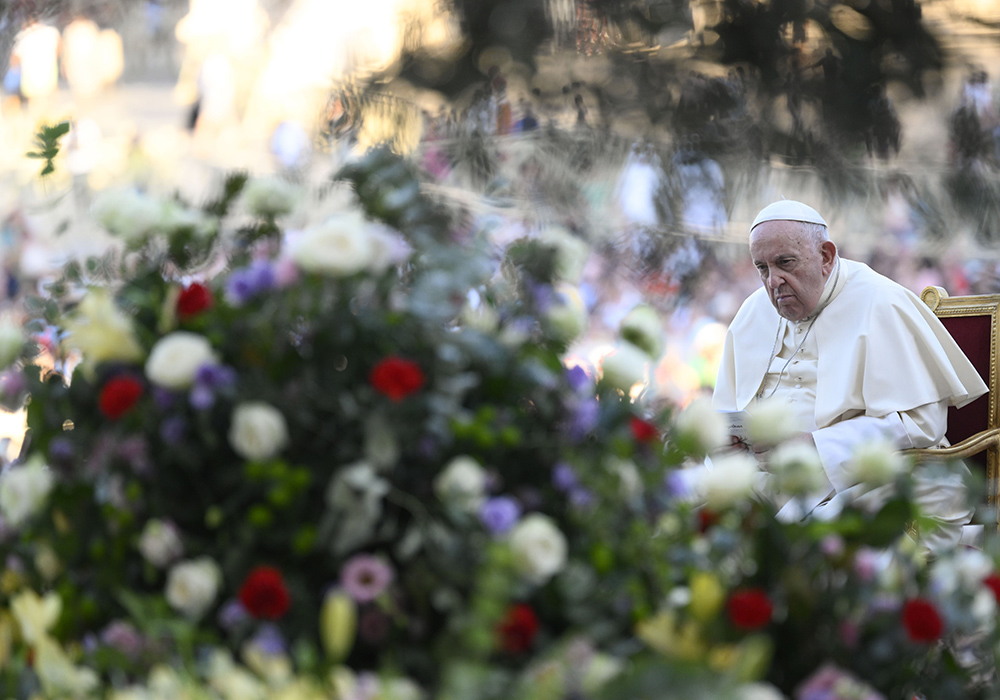


Pope Francis listens during an ecumenical prayer vigil before the assembly of the Synod of Bishops in St. Peter's Square at the Vatican Sept. 30, 2023. (CNS/Vatican Media)


Stowe also called attention to the urgency of the issue, and the thus far large lack of attention from the U.S. church, noting that the pope's tone in 2023's Laudate Deum "was almost scolding in nature because not much has happened since 2015. … He says we're losing time. We have to begin to act."

Of the Lexington Diocese's decision to pursue a net-zero future, he added, "We're grateful to say we're gonna do this, and reduce our carbon consumption, our carbon footprint, and bring ourselves to net-zero, in a pretty short amount of time, because we only have a pretty short amount of time to make an impact in a lasting way on this world."

Adam Edelen, CEO and founder of Lexington-based Edelen Renewables, who will be partnering with the diocese on the net-zero initiative, said, "I think the real soul-building stuff here is that we can provide a roadmap for others who want to do the same thing."

And despite reports earlier this year that even some U.S. bishops themselves feel the U.S. church is failing on the pope's climate goals (an opinion NCR has also often expressed within our editorial pages), it does seem that at least some diocesan leadership is ready to rise to the challenge and might be interested in that roadmap.

In January, the Archdiocese of Chicago, led by Cardinal Blase Cupich, began to power its parishes and schools with 100% renewable energy and the Diocese of San Diego, led by Cardinal Robert McElroy, was the first diocese in the U.S. to divest from fossil fuels.

These are measurable, long-term and large-scale systemic changes to how Catholic dioceses operate in the United States that reflect a holistic approach to creation care beyond the ministry office. These initiatives require cooperation with the offices of facilities, finance, maintenance, human resources and more. They require input from experts in sectors outside religion, including energy, economics, sustainability, labor and business.

"It's one thing to talk about doing something. It's another thing to put something out there that you can be held accountable to and have measured for you," said Stowe of the Diocese of Lexington's net-zero plans.

And while the first U.S. diocese to commit to net-zero emissions is incredibly important news, it's that invitation for accountability and the implementation of a structure to follow through with it that may signify an even more important shift for the church in the U.S. today.


Wednesday, October 04, 2023

APOSTOLIC EXHORTATION LAUDATE DEUM


Francis Apostolic Exhortations
[ AR - DE - EN - ES - FR - IT - PL - PT ]


APOSTOLIC EXHORTATION

LAUDATE DEUM

OF THE HOLY FATHER
FRANCIS

TO ALL PEOPLE OF GOOD WILL
ON THE CLIMATE CRISIS


1. “Praise God for all his creatures”. This was the message that Saint Francis of Assisi proclaimed by his life, his canticles and all his actions. In this way, he accepted the invitation of the biblical Psalms and reflected the sensitivity of Jesus before the creatures of his Father: “Consider the lilies of the field, how they grow; they neither toil nor spin, yet I tell you, even Solomon in all his glory was not clothed like one of these” (Mt 6:28-29). “Are not five sparrows sold for two pennies? Yet not one of them is forgotten in God’s sight” (Lk 12:6). How can we not admire this tenderness of Jesus for all the beings that accompany us along the way!

2. Eight years have passed since I published the Encyclical Letter Laudato Si’, when I wanted to share with all of you, my brothers and sisters of our suffering planet, my heartfelt concerns about the care of our common home. Yet, with the passage of time, I have realized that our responses have not been adequate, while the world in which we live is collapsing and may be nearing the breaking point. In addition to this possibility, it is indubitable that the impact of climate change will increasingly prejudice the lives and families of many persons. We will feel its effects in the areas of healthcare, sources of employment, access to resources, housing, forced migrations, etc.

3. This is a global social issue and one intimately related to the dignity of human life. The Bishops of the United States have expressed very well this social meaning of our concern about climate change, which goes beyond a merely ecological approach, because “our care for one another and our care for the earth are intimately bound together. Climate change is one of the principal challenges facing society and the global community. The effects of climate change are borne by the most vulnerable people, whether at home or around the world”. [1] In a few words, the Bishops assembled for the Synod for Amazonia said the same thing: “Attacks on nature have consequences for people’s lives”. [2] And to express bluntly that this is no longer a secondary or ideological question, but a drama that harms us all, the African bishops stated that climate change makes manifest “a tragic and striking example of structural sin”. [3]

4. The reflection and information that we can gather from these past eight years allow us to clarify and complete what we were able to state some time ago. For this reason, and because the situation is now even more pressing, I have wished to share these pages with you.

Presentation of the Apostolic Exhortation: "Laudate Deum"


 NOTE:

The Vatican in Rome is "6" hours ahead of Eastern Standard Time.

P.S.


Wednesday, September 27, 2023

'Laudate Deum,' to be title of Pope's Apostolic Exhortation on climate


Pope Francis' audience with rectors of Latin American universities
 
POPE

The title of Pope Francis' next Apostolic Exhortation will be "Laudate Deum," the Pope himself revealed, while addressing participants in a meeting of Latin American university rectors in the Vatican, and as he vehemently warned against a throwaway culture.


By Father Johan Pacheco

The name of Pope Francis' next Apostolic Exhortation on the environment will be Laudate Deum, Pope Francis has revealed.

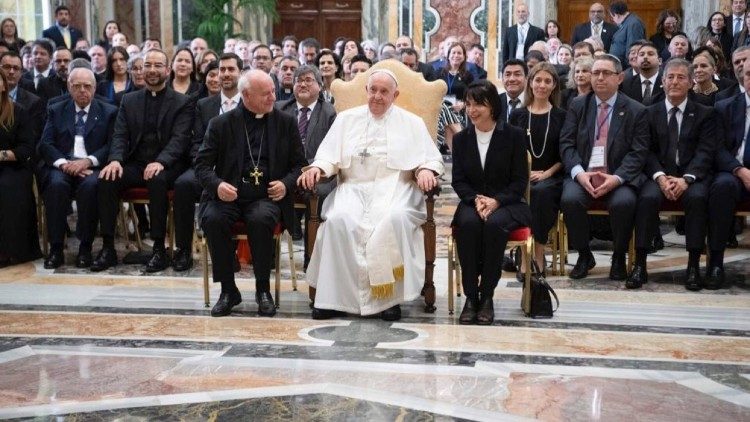
The Holy Father shared this on Thursday, Sept. 21 when addressing in the Vatican some 200 participants in the meeting of the Rectors of public and private universities of Latin America and the Caribbean, sponsored by the Red de Universidades para el Cuidado de la Casa Común and the Pontifical Commission for Latin America on Sept. 20 and 21 at the Augustinianum on the theme "Organizing Hope," with the participation of some Prefects and Secretaries of Dicasteries of the Holy See.

During the occasion, the Pope reflected on various issues raised by the educators, including climate change, migration, and the culture of waste.

The Holy Father urged them to be creative in the formation of young people from today's realities and challenges. The rectors asked the Pope questions on environmental and climate issues to which he responded by emphasizing the deplorable "throwaway culture or culture of abandonment." He explained that it is "a culture of misuse of natural resources, which does not accompany nature to full development and does not let it live. This culture of abandonment," he said, "harms all of us."

The proper use of nature

Pope Francis also described it from the human point of view: "There is a throwaway culture that is always going on, there is a lack of education to use the things that remain, to remake them, to replace them in the order of the common use of things. And this throwaway culture also affects nature." And he insisted on the urgency of returning to the proper use of nature: "Today humanity is tired of this misuse of nature, and must return to the path of good use of nature. And how we use nature, a word that may sound strange, I would say: dialogue with nature, dialogue."

To this end, the Pope urged universities to create networks of awareness. "And at this point, you use a very beautiful word, which is organizing hope." "Reclaiming and organizing hope," Pope Francis said, "I like this phrase that you have said to me and one cannot help but consider it in the context of integral ecology, in this dimension according to which the youth of today have the right to a balanced cosmos and they have the right to hope and we have to help them to organize this hope, to make very serious decisions from this moment."

Nature is for all

Pope Francis also alluded to a "regenerative culture," identifying it as the fruit "of an economic crisis that is not always at the service of the development of the most needy. I would say that sometimes, or many times, it is not at the service of the development of everyone and creates more people in need. It is a culture of dispossession, we all have the right to the use of nature," to dominion over nature to make it grow and use it for the common good.

The Pope expressed his concern about "some abstract scientific type universities" that "do not use reality but science, an abstract science, not real, and so they walk on economic theories, social theories, everything is theory, but they never land" on the reality of the most needy. "The discarded, the outcasts, are men and women, whole peoples that we leave on the street like garbage, are they not? We have to be aware that we use the wealth of nature only for small groups through socio-economic theories that do not integrate nature, the discarded."

"Laudate Deum," the title of the next Apostolic Exhortation

Pope Francis called for alternatives to help overcome the environmental crisis and cited as an example the use of solar panels to provide electricity to Paul VI Hall and other areas of the Vatican. "We have to be very creative in these things to protect nature" because obviously electricity is made on the basis of coal or other elements, which always create problems in nature itself and "the young people we train have to become leaders on this point, convinced."

In his reflection, the Pope announced the name of his next Apostolic Exhortation: Laudate Deum, which will be published on the feast day of St. Francis of Assisi, Oct. 4: "a look at what has happened and say what needs to be done," he said.

Human and environmental degradation go together

The Holy Father also denounced the process of degradation that humanity is undergoing.

"There is a process of environmental degradation, we can say that in general. But this leads down, to the bottom of the ravine. Degradation of living conditions, degradation of the values that justify these living conditions, because they go together." And he explained that "inequality" is also "evident in the lack of access to basic necessities, and from here come all those visions that sociologically, in fact, without naming them, make women, indigenous peoples, Africans, people with fewer capabilities."

One of the forms of degradation and inequality, Pope Francis denounced, is "extractivism," that is, the hoarding of natural resources. "When this extractivist model goes on and enters people," he pointed out, "I extract the dignity of people, and this happens, never a geological extractivist model, so to speak, goes alone, it is always accompanied by the human extractivist model, the dignity of the person is extracted, they are slaves, said in another word. And please get this into children's heads, value education, so that they can evaluate these situations and can say clearly that this is called slavery."

Politics as the noblest vocation

Faced with this situation, the Pope called on university rectors to promote education in humanistic values and fraternal dialogue, helping students "enter politics" as a "noble vocation."

"Let us not forget that the noblest vocation of the human person is politics. Let us train our young people to be politicians, in the broadest sense of the term. Let us not forget that the noblest vocation of the human person is politics. We must train our young people to be politicians, in the broadest sense of the word. Not only to act in a political party, which is a small group, but to have political openness and to know how to dialogue with political groups with maturity, politics is not a disease, in my opinion it is the noblest vocation in a society, because it is the one that carries out development processes."

A human and Christian response to the migration crisis

The Pope also spoke about the current migration crisis.

"The migration drama in Europe today is extremely serious, extremely serious. And it cannot be solved by a mutual aid society, no. Here there is a humanistic and Christian question. Here there is a humanistic issue and a political decision, there are decisions that are human and Christian."

"I ask you," the Pope told the rectors, "out of respect for suffering humanity, to address this issue in your universities, but with the human density that it has. "So in summary I say this to you: migrants must be welcomed, accompanied, promoted and integrated. If we fail to integrate the migrant, we fail," he added.

"I want to say all this about migrants because the problem of migrants is very close to my heart," the Pope said again. He went on to say that "it is criminal what is being done today, here in Europe, sending them back, it is criminal. And I don't want to use euphemisms, I tell it like it is."
The three human languages: head, heart and hands

After reviewing all these situations, the Pope reminded that the task of universities should not be only to "teach things." "You must train boys and girls in the three human languages, that of the head, that of the heart and that of the hands.

"So that they learn to think what they feel and what they do, to feel what they do and what they think, and to do what they feel and what they think." Finally, he thanked those present and summed up his words by calling on universities to be: "creative in the face of reality and challenges, educators and not just dispensers of information."