Showing posts with label 2010. Show all posts

Friday, December 01, 2017

Just a Name Or a ®egistered Trademark?


an anyone who says they’re a Seventh-day Adventist use the church name in an official capacity? The General Conference Office of General Counsel—which provides legal counsel on issues such as employment, church assets, and protection of the church’s name—says “No.” Adventist Review features editor Sandra Blackmer talks with general counsel Karnik Doukmetzian and associate general counsel Dionne A. Parker to explore the specifics of this increasingly complex issue.—Editors.

BLACKMER: What exactly does the term “registered trademark” mean?
PARKER: A trademark, registered or otherwise, includes any word, name, symbol, or device—or any combination—used or intended to be used in commerce to identify and distinguish the goods of one manufacturer or seller from goods manufactured or sold by others, and to indicate the source of the goods. For example, the trademark “Adventist” is registered in specific areas such as missionary services, religious observances, education, and health care. So we have protection in those specific areas.

Does the Adventist Church’s registered trademark include just the church logo and the name “Seventh-day Adventist,” or does it involve more than that?
PARKER: The names “Seventh-day Adventist” and “Adventist,” and the church logo, are all registered trademarks. The acronym “SDA” is used with what’s called common-law rights, meaning that the Adventist Church has been using it for a long period of time as a name that identifies our organization. So we have rights with that, as well.

Who has the legal right to use these trademarks?
PARKER: Any entity listed in The Seventh-day Adventist Church Yearbook. This includes the General Conference, divisions, unions, local conferences, local churches and companies, educational institutions, health-care institutions, and so forth. Lay and professional groups, however, must apply to the GC Office of General Counsel for a license to use the name “Seventh-day Adventist” and then wait for approval from administration.

DOUKMETZIAN: One thing to point out is that the General Conference Administrative Committee—the group that gives the ultimate approval for licenses to use the church name—doesn’t issue licenses to use the church logo. That use is restricted to official organizations, which don’t need additional permission.

Saturday, December 19, 2015

Sabbath debated on FOX with Huckabee


Published on Dec 15, 2010


Find out about the Sabbath: http://SabbathTruth.com/
How Sunday became the popular day of worship:
http://www.worshiponsabbath.com/how-s...

BOTH MEN ARE WRONG. Don't be fooled.
It's Satan's tactic to give 2 wrong options and ask you to choose.

Mike Huckabee (Pastor, Newscaster, Politian) Newscaster says:
-Constitution can be amended
-America is based on Bible
-no where were the 10 commandments made into the 10 suggestions and ready to be amended to the constitution -We should not amend the Bible to the constitution
-Jesus did not amend the 10 commandments, he gave better understandings
-It's not enough that you practice it outwardly, you must practice it inwardly as well.
-Saturday to Sunday is not an amendment, its an interpretation -An amendment is where you actually change the entire direction...
-Love your neighbor as yourself
-Jesus did not amend or change, he clarified.

Alan Dershowitz (Jewish Harvard Lawyer Professor) Visitor says:
-America was based on the constitution -America is not based on Bible
-its wrong to say "we shouldn't amend the Bible principles to the constitution"
-Christians changed the commandments specifically the 2nd and 4th
-In 10 commandments, adultery only applied to women, Jesus amended that among other things.
-10 commandments refer to slavery twice
-Jefferson pointed out that the sins of the fathers shall be inflicted on the sons for 3 generations and said "thank goodness no one takes that seriously anymore".
-Saturday to Sunday is a Christian clear amendment, clear amendment
-It's not a different interpretation, the Christians have said thay changed it.
-Religion thrives on change
-"Love your neighbor as yourself comes from Helail" lived 40 years before Jesus.

Monday, August 31, 2015

Inter-America: Church Grants Commissioned Minister Credentials to Eight Employees


Seventh-day Adventist leaders of the church in Inter-America recognized the service of eight of its church employees by granting commissioned minister credentials during a special ceremony held at the Smyrna Seventh-day Adventist Church, in Fort-de-France, Martinique, on November. 6, 2010. The ceremony took place at the end of the church’s executive committee meetings.

“We are communicating that the leaders of the division are committed, consecrated people able to do a quality job under the leadership of the Holy Spirit,” said Israel Leito, president of the church in Inter-America. “This is why we have had this commissioning ceremony: To give witness to the division and gratitude to them for the faithful years they have served well.”


CREDENTIAL PRESENTED: Héctor Sánchez, ministerial secretary for Inter-America, grants a commissioned minister credential to Dinorah Rivera, children’s ministries 
director for the church in Inter-America, during a special ceremony in Fort-de-France, Martinique, November 6, 2010.  Five workers were granted commissioned minister credentials in May. Two others, both women, were commissioned in 2006, marking the first such commissioning in the Inter-American Division (IAD). In total, there are now 15 men and women commissioned as ministers in active service in the IAD and its publishing association.

“This is the highest recognition the church can give to nonministerial workers, so we wanted them to have that assurance and that affirmation as they do their work in the division territory,” Leito said.

According to the church’s working policy, whenever an employing organization considers it prudent to offer commissioned minister credentials to any of its workers, a ceremony is held to officially confer upon such a worker this high honor of the organization’s approval of the service of the worker. It is also a ceremony that sends the worker forward to continue toward fulfillment of the mission through organizational service.

In order to be considered for the commissioned minister credential, the employee must be in regular standing in the Seventh-day Adventist Church with more than five years of service, and be able to demonstrate proficiency in the assigned responsibilities.

Commissioned ministers may serve as associates in pastoral care, Bible instructors, treasurers, departmental directors, associate and assistant departmental directors, institutional chaplains, presidents and vice presidents of major institutions, auditors, and directors for Christian Record Services International, Inc. “In addition, such commissioned ministers are not normally on the path of ordination,” states the General Conference Working Policy (“Credentials and Licenses,” pp. 191, 192).

The ceremony was held to officially confer the special credential to IAD employees Belkis Archbold, health ministries director, with 31 years of service; Myrna Costa, vice president, with 31 years of service; Leticia De Los Santos, Shepherdess coordinator, with 13 years of service; Cecilia Iglesias, women’s ministries director, with 26 years of service; Abel Márquez, associate communication director, with 18 years of service; Louise Nocandy, youth ministries director, with 30 years of service; Dinorah Rivera, children’s ministries director, with 28 years of service; and Faye Patterson, associate education director, with 28 years of service.

Ella Smith Simmons, a general vice president of the General Conference of Seventh-day Adventists, delivered a special message during the ceremony to a packed church.


SPECIAL CEREMONY: Eight Inter-American Division employees were granted commissioned minister credentials during a special ceremony in the Smyrna Seventh-day Adventist Church in Fort-de-France, Martinique.Simmons reflected on Matthew 25:1-13 and the need for the candidates to be constantly filled with the power of the Holy Spirit as they continue in the service of the mission of the church.

“We must shine as lights; we must set it out for the benefit of the cause,” said Simmons as she reminded candidates to be different in the sight of God and ensure that evidence of what’s inside shines bright on the outside.

“This may be a high turn for you and the church,” continued Simmons, “but you must come down and walk on earth like Jesus did. This [commissioning] is for life; you don’t drop out when the going gets tough or you get tired. You are now bound to God in a special relationship.”

Before the prayer of commission, Héctor Sánchez, ministerial secretary for the church in Inter-America, charged those being commissioned to continue serving God.

“It is wonderful to work for God, to live for God, and to work for this wonderful church. May people see in you and be influenced by your determination and commitment to finish the work,” Sánchez said.

For Myrna Costa, one of three vice presidents for the church in Inter-America, the ceremony signaled a renewed commitment to her work.

“To me this caps my experience in working for the church; it gives me a thrust to go forward, to do more, to reach other goals and levels in the cause,” she said.

“This ceremony means recognition,” said Dinorah Rivera. “It empowers you to accomplish your mission with a stamp.” She added that while this credential does not change her responsibilities, it does inspire a renewed commitment to the mission of the church.

Elsewhere in the territory, men and women have been granted commissioned minister credentials in the Caribbean and the West Indies regions. Other church regions are open to granting such credentials in the near future, while other leaders agree that it may be in the future.

The Seventh-day Adventist Church in Inter-America has more than 3.3 million members worshipping in more than 10,395 churches and congregations. It operates dozens of education and health institutions, schools, and health food companies throughout its 21 church regions. 


—Reported by Libna Stevens, assistant communication director, Inter-America Division.

Monday, June 29, 2015

6 Catholics, 3 Jews

Blogger's statement:
In the light of the paradigm shifting nature of the Supreme Court's recent decisions, I wanted to re-post this article on my blog. 


Does it matter that there might soon be no Protestants on the Supreme Court?

Elesha Coffman/ MAY 11, 2010


If Elena Kagan, President Obama's nominee to the Supreme Court, is confirmed, the nation's high court will be, for the first time in its history, devoid of Protestants. Kagan is Jewish, as are Justices Stephen Breyer and Ruth Bader Ginsburg. All of the other justices—Chief Justice John Roberts, Samuel Alito, Anthony Kennedy, Antonin Scalia, Clarence Thomas, and Sonia Sotomayor—are Catholic. How did this situation come about in a historically Protestant-dominated country? And should evangelicals be concerned?

It's important to note that the composition of the Supreme Court has never reflected the composition of the country. All justices were white until the appointment of Thurgood Marshall in 1967, and all justices were male until the appointment of Sandra Day O'Connor in 1981. When President Andrew Jackson appointed the court's first Catholic member, Roger Taney, in 1836, the Roman Catholic Church was already well on its way to becoming the country's largest single Christian body. Most justices have also shared connections to a small group of elite schools. Harvard Law School trained the highest number, 14 justices, including five members of the current court. (Justice Ginsburg attended HLS but graduated from Columbia.) Kagan, a graduate and former dean of HLS, would make a sixth.

Throughout the court's history, some groups—notably Episcopalians, Presbyterians, Unitarians, and Jews—have been significantly overrepresented in comparison to their prevalence in the American population, while other groups have been significantly underrepresented. Though Baptists constitute the country's largest Protestant group, there have been just three Baptist justices. The second-largest Protestant group, Methodists, have supplied only five. There has never been a Pentecostal justice, despite that movement's explosive growth since the Azusa Street Revival of 1906.

The mismatch between Supreme Court members and average Americans is in part an example of the generally non-representational nature of elites, even in the supposedly egalitarian United States. From the late eighteenth to the middle of the twentieth century, a white Protestant establishment held sway, as Congregationalists (the heirs of the New England Puritans), Episcopalians, and Presbyterians pretty much ran the country and the rest of America's Christians pretty much let them. Unitarians, who controlled Harvard, got to participate heavily in governance as well, despite the fact that most Americans considered them heretics. The revivalist traditions that caught fire in the nineteenth century, including Baptists, Methodists, and Disciples of Christ, rapidly outstripped the establishment churches in membership but never overtook them in terms of cultural power. Evangelicals, for the most part descendents of the revivalists, have enjoyed even less access to the country's most exclusive halls of power, including the Supreme Court, the Senate, and the presidential offices at Ivy League universities.

The makeup of the current Supreme Court also reflects trends peculiar to jurisprudence. Judaism and Catholicism have extremely long and rich legal traditions, while Protestantism generally, and evangelicalism specifically, does not. American Jewish legal thinking has aligned well with liberal politics, which helps explain why all but one of the seven (soon, potentially, eight) Jewish Supreme Court justices have been nominated by Democratic presidents. American Catholic legal thinking has not aligned so closely with either political party, but Catholic teachings on Natural Law and the sanctity of life have made conservative Catholic nominees particularly attractive to Republican presidents who oppose abortion. As Robert Wuthnow argued in The Restructuring of American Religion, conservative Protestants have consistently made common cause with conservative Catholics on the subject of abortion in recent decades, nearly to the point of erasing centuries-old antipathies between these two branches of Christianity. The evangelical electorate might prefer to see one of their own on the high court, but they have had no problem supporting the current crop of conservative Catholic justices.

The jury is out on whether evangelicals are poised for greater influence in elite arenas like the Supreme Court. Sociologist D. Michael Lindsay, author of Faith in the Halls of Power, based on interviews with 360 evangelical leaders, suggests that they are. Sociologist John Schmalzbauer, in People of Faith: Religious Conviction in Journalism and Higher Education, agrees, though he, significantly, looks at both evangelicals and Catholics, assuming a significant overlap in interests between the two groups. But James Davidson Hunter sounds an emphatic no in his recent bookTo Change the World. According to Andy Crouch's review in Books & Culture,

Christianity in America, as Hunter sees it, is very much on the periphery, for all its numerical strength. Its institutions, such as they are, are weak, they tend to not be in culturally central locations, and they tend to address the "lower and peripheral areas" of culture—secondary education rather than university research, popular culture rather than high art, ministries of mercy rather than public policy. At their worst they glory in their marginal status, feeding a subculture that churns out substandard cultural products for consumption by other Christians, simultaneously the most energetic and the least effective culture-makers you could imagine.

Whether or not Hunter is correct in this bleak assessment, given the current occupant of the White House and the slow rate of turnover on the Supreme Court, evangelicals should not expect to see a member of their own ranks on the bench anytime soon. Instead, they must ask whether the likely roster of six Catholics and three Jews on the court represents their interests and worldview. Regarding Elena Kagan, the answer is, probably not. There has never been a consistently conservative female justice on the Supreme Court (O'Connor, though nominated by Ronald Reagan, turned out to be a moderate who voted to uphold Roe v. Wade), nor a socially conservative Jewish justice. There is almost nothing with which American evangelicals can identify in either Kagan's personal or professional life, and the same is likely to be true of her legal philosophy as it emerges. Fortunately for evangelicals, in replacing liberal Justice John Paul Stevens, Kagan would not markedly alter the balance of power on the court. At the same time, unfortunately for evangelicals, that balance of power will leave them in the position of highly engaged outsiders looking in.
Elesha Coffman is assistant professor of history at Waynesburg University in Waynesburg, Pennsylvania.


.

Saturday, March 07, 2015

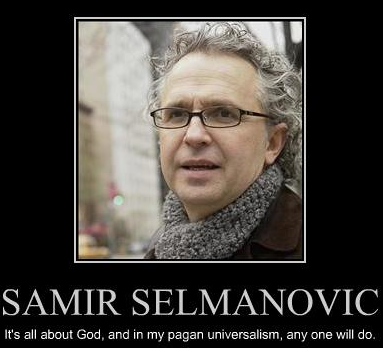
EMERGING CHURCH LEADER SAMIR SELMANOVIC WORSHIPS WITH WITCHES


By Ken Silva pastor-teacher on Oct 14, 2010


Hear the word that the Lord speaks to you, O house of Israel. Thus says the Lord: “Learn not the way of the nations, nor be dismayed at the signs of the heavens because the nations are dismayed at them, for the customs of the peoples are vanity. A tree from the forest is cut down and worked with an axe by the hands of a craftsman.

They decorate it with silver and gold; they fasten it with hammer and nails so that it cannot move. Their idols are like scarecrows in a cucumber field, and they cannot speak; they have to be carried, for they cannot walk. Do not be afraid of them, for they cannot do evil, neither is it in them to do good.” There is none like you, O Lord; you are great, and your name is great in might. (Jeremiah 10:1-6)

If It Was Ever In It, The Emerging Church Has Now Left The Building Of Christianity

Apprising Ministries has been making you aware of the now upgraded Emerging Church 2.0 with its newer, more clearly delineated, postmodern Progressive Christian theology—a Liberalism 2.0—that this sinfully ecumenical neo-liberal cult of the Emergent Church often refers to as “big tent” Emergence Christianity. You’re likely aware of leaders within this EC—seeker driven for the “counter-culture”—movement like the Emerging Church trinity of apostates, Living Spiritual Teacher and EC guru Brian McLaren, universalist Emerging Church pastor Doug Pagitt, and his friend Tony Jones, the progressive “theologian in residence” at Solomon’s Porch.

The fact is, this is all kind of a reimagined bohemian hippie counter-culture deal I would see as I was growing up in the late 60′s; where we were careful not to “sell out” and become part of “the establishment.” Well, now we have it in a spiritual form within the rhetoric of the Emergent Church and many of its faithless followers. It was phony then, and it’s just as phony now; you see, one by one I watched the pop philosophers of my youth who “spoke my language”—my then cherished rock stars—gladly take the money and run to blend right in to what we once said were so against. Have you ever noticed that these EC leaders never miss an opportunity to promote their books.

In pieces like God Is Father Of All Religion and Faith House Manhattan: Project Of Apostasy I have introduced you to one of the lesser known EC luminaries, and one of their up-and-coming ear-ticklers, Samir Selmanovic. Selmanovic is an interspiritual advocate and “an ordained pastor of the Seventh-day Adventist church” whose website tells us that he’s “been integral to the birth of the emerging church movement, serving as a member of the Coordinating Group of Emergent Village and representing emergents at the Interfaith Relations Commission of the National Council of Churches.”[1]

Selanovic’s main shtick is something called Faith House Manhattan (FHM), whose motto is Experience Your Neighbor’s Faith:


(Online source)

This is completely reflected in the book Selmanovic wrote in 2009 called It’s Really All About God: Reflections of a Muslim Atheist Jewish Christian. Wow, and interestingly enough this man who’s here with other Emerging Church leaders in order to rescue us from the imperialistic capitalist system oppressing the downtrodden because we need to redistribute the wealth, somehow; even manages to find a way to plug his book below. Such sacrifice, eh. We also note that this FHM is personally blessed by Tony Campolo as well as Living Spiritual Teacher and EC guru Brian McLaren , his fellow Red Letter Christian:


(Online source)

Well, accolades from apostates aside, you should be able to see that with FHM Samir Selmanovic is in violation of God’s Word with this interspiritual worship; it’s well beyond simply befriending people of other faith, which is desirable for the Christian. No, with Selmanovic and others in the Emergent Church we cross the line into participating in pagan religions, which has always been something God forbids. O, but just because Jesus wants us to know — what pagans sacrifice they offer to demons and not to God. I do not want you to be participants with demons (1 Corinthians 10:20), heretics like Selmanovic aren’t going to let a little thing like what the Lords says stop them because they are — lovers of self (2 Timothy 3:2).

Come Now, Let Us Bow Down As One Before Pagan Idols And Religious Superstitions

You think I overstate; think again, and consider the following tweet from Samir Selmanovic earlier today:


(Online source)

Briefly, “the other” is Liberalism 2.0-speak for their belief that God is at work within all other religions; these neo-Gnostics believe they need to discover what God is supposedly doing in these other religions. Selmanovic told us his views in an earlier book, which was edited by the dubious duo of Tony Jones and Doug Pagitt; when he mused this mythology:


Can it be that the teachings of the gospel are embedded and can be found in reality itself rather than being exclusively isolated in sacred texts and our interpretations of those texts? If the answer is yes, can it be that they are embedded in other stories, other peoples’ histories, and even other religions?…


God’s table is welcoming all who seek, and if any religion is to win, may it be the one that produces people who are the most loving, the most humble, the most Christlike. Whatever the meaning of “salvation” and “judgement,” we Christians are going to be saved by grace,like everyone else, and judged by our works, like everyone else…


For most critics of such open Christianity, the problem with inclusiveness is that it allows for truth to be found in other religions. To emerging Christians, that problem is sweet… Moreover, ifnon-Christians can know our God, then we want to benefit from their contribution to our faith.[2]

This is not Christianity; it’s at best universalism, and at worst, it’s pagan universalism as we see when we follow Selmanovic’s link above to LIVING ROOM Samhain: A Season of Harvest, a Circle of Remembrance:


Um, yeah; that is a pentagram you’re looking at, and:


(Online source)

Yet Selmanovic gushes:


(Online source)

Uh-huh; that’s an allegedy Christian Emerging Church leader “celebrating,” with a coven of witches, the superstition of Samhain:


(Online source)

Apparently while he’s been busy with his study of pagan practices Samir seems to have forgotten that Jesus told us in Luke 16:19-31 that once one departs this life they either end up in hades or in paradise; there is no time of any thin veil, and they are not free to walk about anywhere. Sadly, Selmanovic apparently forgot that practices of craft are an abomination to the Lord:


There shall not be found among you anyone who burns his son or his daughter as an offering, anyone who practices divination or tells fortunes or interprets omens, or a sorcerer or a charmer or a medium or a necromancer or one who inquires of the dead, for whoever does these things is an abomination to the Lord. And because of these abominations the Lord your God is driving them out before you. (Deuteronomy 18:10-12)

Yeah, that really doesn’t look to me like God thinks His children ought to be learning from Wiccans; but this is exactly what Selmanovic was doing:


(Online source)

Remind me again; why are these Emerging Church apostates even remotely considered to be evangelical?


_________________________________________________________________________
Endnotes

[1] http://www.samirselmanovic.com/about/, 10/14/10.

[2] Samir Selmanovic, “The Sweet Problem of Inclusiveness – Finding Our God in the Other,” in An Emergent Manifesto of Hope, Doug Pagitt and Tony Jones editors [Grand Rapids: Baker,
2007], 192, 195, 196, emphasis mine.

See also:

SAMIR SELMANOVIC AND BEING UNABLE TO FOLLOW JESUS WITHOUT ISLAM

CHRISTIAN AGNOSTIC ADELE SAKLER AND SAMIR SELMANOVIC DISCUSS CHRISTIAN ATHEISM

SAMIR SELMANOVIC HAS LEFT THE BUILDING

FULLER SEMINARY SPONSORS EMERGING CHURCH HERETIC DOUG PAGITT

THE EMERGING CHURCH AND THE NEW PROGRESSIVE THEOLOGY ON OTHER RELIGIONS

THE EMERGING CHURCH AND THE NEW PROGRESSIVE THEOLOGY ON CHRIST

IS SHANE CLAIBORNE A CHRISTIAN-MUSLIM?


.

Wednesday, February 04, 2015

Immigration by the Numbers -- Off the Charts


Uploaded on Sep 10, 2010


A startling look at how U.S. immigration will add 300 million people to the country this century if immigration policies are not changed. This dramatic presentation of the latest Census data raises serious immigration questions about the ability of the country to achieve environmental sustainability and to meet the quality-of-life infrastructure needs of the national community considering current immigration policy.

Presented by immigration author/journalist Roy Beck

Learn More http://www.NumbersUSA.org

Numbers
USA Education & Research Foundation is a non-profit, non-partisan organization that favors an environmentally sustainable and economically just America and seeks to educate the public about the effects of high levels of immigration on U.S. overpopulation, the environment, jobs, and wages. We use government data to conduct research on the impacts of U.S. population growth, consumption, sprawl, and current levels of immigration and educate the public, opinion leaders and policy makers on the results of those and other studies.
.
.

Wednesday, July 16, 2014

Catholic Teaching on Immigration


May 3, 2010 - 3:06 PM


There is no scriptural injunction regarding immigration policy other than the Torah's admonition to treat the resident alien living among you fairly. The Gospels and other New Testament writings simply adjure Christians obey the laws of the state and to be good citizens of the cities in which they live.


By Rev. Michael P. Orsi


There is no scriptural injunction regarding immigration policy other than the Torah's admonition to treat the resident alien living among you fairly. The Gospels and other New Testament writings simply adjure Christians obey the laws of the state and to be good citizens of the cities in which they live.

The church, therefore, has to extrapolate from the Bible what should constitute a Christian response regarding immigration and a policy for illegal aliens.

Ever since the publication of the encyclical Rerum Novarum (1893), which dealt with emerging social issues brought on by industrialization and the rise of the secular state, Catholic moral teaching has attempted to inform the contemporary humans as to what is vital for a good society.

Church teaching has re-iterated core Christian principles: the dignity of the person, concern for the common good, and the obligation of the state to protect itself and its citizens. It counsels that all just laws must be obeyed. And, as Pope Benedict XVI reminds us in his encyclical Caritas In Veritate (2009), true justice must be tempered with charity since this is how God deals with us.

In light of the above, what should constitute a legitimate Catholic position on immigration?

The Catholic tradition upholds a universal destination for the goods of the earth.

This acknowledges that people have a right to emigrate in order to procure a better life for themselves and their families. The role of government is to enable this to happen in an orderly, fair, and safe way. This stems from the concept of "distributive justice."

States therefore must implement a reasonable plan for peaceful assimilation. To do this they have the right to establish quotas based on a country's capacity to sustain the new residents as well as the host country's needs, and some assurance that the incoming alien can be self-supporting. Illegal immigration bypasses all of these safeguards. It endangers established civil society and for that matter the illegal aliens themselves.

In an era wrought with terrorist threats, in cities overwhelmed by illicit drug trafficking, human trafficking, the exploitation of undocumented workers by unscrupulous employers, and the drain illegal aliens put on social services, civil authorities are compelled to uphold the rule of law for the common good.

The recent legislation passed by the State of Arizona, which permits a more stringent inspection of documentation to enforce immigration laws, is specifically designed to do this.

There are those who believe, like Los Angeles Cardinal Roger Mahony, that the Arizona law is "the country's most retrogressive, mean-spirited and useless anti-immigration law." They contend that, especially in the case of those illegal aliens who have resided in the U.S. for a number of years that it "could lead to separation of family members."

They hold that deportation would place an undue burden on them and their children, who in many cases were born here, and therefore, are "allegedly" U.S. citizens. More often than not, they prescribe amnesty as the solution. But, amnesty condones delinquency.

It sends the wrong message to our citizens, to some potentially new citizens, and encourages others to take the same route.

Therefore, I propose the following suggestions which are in the mainstream of traditional Catholic social thinking. They are sensitive to both charity and justice.

1. The 14th Amendment (1866) which confers the rights of citizenship on those born in this country must be interpreted according to its original intent which was to guarantee citizen's rights for the newly freed slaves. It was not meant to confer citizenship on children born here to illegal immigrants. Congress should pass a law stating that babies born here to foreign nationals do not have a birth right to U.S. citizenship. This will stop the use of so-called "anchor babies" from enabling their relatives to enter the country in conjunction with the Family Reunification Act (1965).

2. The entire Family Reunification Act should be revoked.

3. A quota system should be established for those wishing to enter the country. This will help America to control assimilation and choose among those persons who will help the nation prosper.

4. State and local police should be able to question the immigration status of a person if there is "reasonable suspicion" to believe they are in the country illegally. This merely extends the "stop and question" rule created by the Supreme Court. Police may not consider race, color, or national origin in carrying out their duty. This will prevent racial profiling.

5. Illegal immigrants are law breakers. They should be subject to deportation.

6. For illegal immigrants who can establish that undue hardship will be caused by deportation, state courts similar to federal immigration courts dealing with political or religious refugees and other hardship cases should be established. If their case bears merit this does not preclude a fine since it is necessary that illegal aliens recognize that they broke the law and must make retribution for their crime.

7. Immigrants must be treated with dignity and respect throughout the entire process. These measures capture the essence of Catholic social teaching. They recognize that justice without love may be inhumane and that charity without justice is destructive to society.


Source
.

Monday, May 19, 2014

Lunar Sabbath: Jesuit Tools Used to Unleash Messianic Judaism


...........


Thursday, May 16, 2013

Satan's Assault on the Christian - Ivan Plummer


Satans Assault on the Christian - Part 1 - Ivan Plummer


Michael Walston

Published on Jul 13, 2011


2010 Campmeeting


Satans Assualt on the Christian - Part 2 - Ivan Plummer


Satans Assualt of the Christian - Part 3 - Ivan Plummer.

.

Sunday, April 21, 2013

More Than Waco: Chapter 1, The Early Years


More Than Waco: Chapter 1, The Early Years


DavidEMould

Uploaded on Dec 27, 2010


David Mould & Lincoln Steed discuss some of the hot-potato issues surrounding the genesis of The (New, Illustrated) Great Controversy.

.


Tuesday, March 05, 2013

Leaked Document: Military Internment Camps in U.S to be Used for Political Dissidents


Published on Mar 4, 2013


Internment camps for political dissidents in the U.S. aren't a conspiracy theory. The Department of Defense document entitled "INTERNMENT AND RESETTLEMENT OPERATIONS" or FM 3-39.40 proves this beyond a shadow of a doubt.

Follow us on Facebook:http://facebook.com/StormCloudsGathering
Follow us on Twitter: http://twitter.com/collapseupdates
If you support our work please consider making a donation:http://StormCloudsGathering.com/donate
Visit our website: http://StormCloudsGathering.com
Get weekly email updates: http://tinyurl.com/naturalrightsnewsl...

Download link for FM 3-39.40: http://info.publicintelligence.net/US...

Army hiring for these internment camps:
http://www.goarmy.com/careers-and-job...


....


Monday, February 06, 2012

Elena Kagan could reshape the US Supreme Court


For the first time since it was set up 221 years ago by America's Protestant founding fathers, the US Supreme Court is poised to have a bench without a single Protestant justice, if Jewish candidate Elena Kagan is chosen.

President Barack Obama introduces Solicitor General Elena Kagan as his choice for Supreme Court Justice in the East Room of the White House in Washington
Barack backing: President Barack Obama introduces Solicitor General Elena Kagan as his choice for Supreme Court Justice in the East Room of the White House in Washington Photo: AP

If the Senate confirms Elena Kagan, President Barack Obama's choice to replace retiring justice John Paul Stevens, she will join two other Jewish justices and six Roman Catholics serving on the highest court in the land.

The thought of a Protestant-free Supreme Court bench was too much to bear for some.

"I'd like to offer here... a lament for the passing of American Protestantism," American religion scholar Diana Butler Bass wrote on BeliefNet.com about Obama's decision to nominate Kagan, a Jew.

"There will be no one with Protestant sensibilities on the court, no one who understands the nuances of one of America's oldest and most traditional religions - and the religion that deeply shaped American culture and law."

The United States was, after all, once the largest Protestant nation in the world, she noted. Protestants currently make up the country's biggest religious group.

To Frances Kissling, a visiting scholar at the University of Pennsylvania's Center for Bioethics, a changing Supreme Court was the natural reflection of demographic developments in US society.

"The image of America as Kansas - wheatfields and farmers and European Protestant stock - is no longer what America is," she said.

"Most of our presidents, our justices, our powerful people have been mainline Protestants but that has changed and we have an America now with a president who has combined Muslim-Christian roots, a Supreme Court with six Roman Catholics and what will be three Jews," she added.

"I think that's marvelous."

Not too long ago, having all Jewish or Catholic justices and zero Protestants on the high court was just as unthinkable as an African-American president of the United States.

"Can you imagine going back in time and telling the founders that the day would come when there were no Protestants on the Supreme Court?" Rod Dreher wrote on Beliefnet.

"Can you imagine telling someone born 50 years ago that within their lifetime they'd live to see a SCOTUS (Supreme Court) populated exclusively by Catholics and Jews?"

Both Catholics and Jews have fought to overcome discrimination in the United States, including exclusion from plum jobs at law firms and quotas on numbers for admission to Ivy League colleges, which were in place until the second half of last century.

"Prior to the 1970s, no Catholic or Jew got high enough in the law profession that they could be considered for the Supreme Court," said Kissling.

"The opening of employment and education opportunities in 1960s is a dominant factor in this change in the court."

Catholics already hold 67 per cent of the seats on the Supreme Court and Jews will hold 33 per cent, if Kagan passes muster with the Senate as expected.

"Some anti-Semites will see something dangerous about having three Jews on the Supreme Court but I think it's a real tribute to how far one can go in America, whatever one's religion or ethnicity, on the basis of hard work if barriers are removed," Dreher said.

Bass, meanwhile, expressed sadness at seeing a Protestant-free high court.

"I can't help but think that losing the lived memory of American Protestantism will be a loss for all of us," she wrote.

A survey released two years ago by the Pew Forum on Religion and Public Life showed that barely 51 per cent of Americans were Protestants, compared to nearly two-thirds in the 1960s, and predicted that Protestants would no longer be in the majority in the United States by the middle of this century.

Catholics made up a quarter of the US population and Jews less than two per cent, the 2008 survey showed.

At the time the survey was released, Pew fellow John Greene foretold what is playing out today at the Supreme Court.

"So many of the values and institutions in American public life came out of Protestantism," Greene said.

"I think you're likely to see a change in those institutions and the cultures that support them" as the religion of the founding fathers loses ground in America, he added.


Source

.

Saturday, September 10, 2011

Edinburgh 2010


Centenary of the 1910 World Missionary Conference

About Edinburgh 2010

The Centenary of the World Missionary Conference, held in Edinburgh 1910, is a suggestive moment for many people seeking direction for Christian mission in the 21st century. The initial driving force behind Edinburgh 2010 was the Towards 2010 network under the leadership of Prof. Ken Ross. Since 2005 an international group has worked collaboratively to develop an intercontinental and multi-denominational project, now known as Edinburgh 2010. The project is based at New College and the Church of Scotland offices in Edinburgh, and headed by an International Director, Dr. Daryl Balia. It is governed by a 20 member General Council representative of most of the Christian family.

http://edinburgh2010.oikoumene.org/index.php?id=4646

Closing celebration at the Assembly Hall

http://edinburgh2010.oikoumene.org/index.php?id=7419#c33174
The Edinburgh 2010 General Council was established as an international body and met for the first time in September 2006. It has met twice since, once in 2008 and again in April 2009. The General Council represents all the main parts of the worldwide Church family.


Members of the Edinburgh 2010 General Council (October 2010)

* denotes member of the Executive Committee
# denotes Chairpersons


Former members of the Edinburgh 2010 General Council

Source

27 July 10 - Adventist News Network (USA)

Adventist outreach earns church role in world mission conference
by Elizabeth Lechleitner
Seventh-day Adventists were among representatives from more than 100 Christian denominations who met in Edinburgh, Scotland last month to envision the future of world mission. The event marks 100 years since the first Edinburgh World Missionary Conference, considered a watershed in the collaborative shaping of mission. While several Adentists attended the 1910 conference as delegates, church leaders participated for the first time this year, a testament to the denomination's reputation for outreach, says Ganoune Diop, director of the Adventist Church's Global Mission Study Centres. [Read full story]

Saturday, June 11, 2011

750-800 Christians Unite to Pray for Australia at National Australia Day Prayer in Melbourne


Published by Office 2 January 28th, 2010

Dear family & friends in Christ in Australia and around the World,

We thank our faithful Father in heaven for an amazing unity in the Body of Christ at the National Australia Day Prayer Gathering in Melbourne, buzzing with more than 3 hours of Holy Spirit empowered prayer, praise and worship to the reigning King of kings and Lord of lords, our Lord Jesus Christ!

Between 750-800 Christians from many churches, denominations, generations, and ethnicities (many travelling from interstate and some from overseas) packed the Springvale City Hall in Melbourne, Australia to pray for this Great South Land of the Holy Spirit! Many brought their Australian flags with them and waved them throughout the entire service declaring ‘Australia for Jesus’!

The CTFM worship team led the interdenominational Christian prayer gathering in ushering in the manifest glory of God’s awesome and holy presence, as God’s people passionate for Australia’s transformation, joined hearts and hands in Kingdom unity to worship King Jesus!

The 20+ denominational representatives from the Salvation Army, CRC, Catholic Charismatic, Baptist, Anglican, AOG, Seventh Day Adventist, Uniting, Indigenous, and Christian ministry representatives from Culturewatch, Catch the Fire, Australian Marketplace Connections, Gospel Ministry, and Salt Shakers, led their prayer segment with the passion, fire, and love of Jesus for our nation of Australia, to absolutely storm heaven in prayer, standing on the sure promise of God’s Word from 2 Chronicles 7:13-14. We asked the Lord to protect Australia from natural disasters, especially during this bushfire season. There was also much intercessory and prophetic prayer for Rain, Farmers, Persecuted Church Worldwide, Government, Harvest of Lost Souls, Armed Forces, Pastors & Unity in the Body of Christ, Families, Children & Youth, Business & Marketplace, Indigenous People, and additional critical issues in the Kingdom of God. The Samoan Choir stirred up the crowd with 2 special songs of exuberant praise and worship!

I thank the Lord for giving me (Pastor Jason) the exciting opportunity to pray for the Children and Youth of Australia to become the Holy Spirit Revival Fire of the Glorious Gospel of the Lord Jesus Christ to the Nations of the World! At the altar, more than 150 young people (under 25 years old) received impartation prayer and commissioning to do and to become the supernatural miracles, signs, and wonders of God in their generation! (Acts 2:17-18, Isaiah 8:18)

We thank our loving Father God in heaven for the few beautiful atheists who gathered outside the National Australia Day Prayer Gathering to protest! Most of the Christian crowd ignored their opposition by simply worshipping the Lord although some had the opportunity to share the love and truth of Jesus with them!

Dr Jackson from the USA encouraged the Body of Christ in Australia to trust in the Lord as our Shepherd! (Psalm 23) Many were mightily touched by the prophetic Word from the Lord and the presence of God! Pastor Daniel also received his Honorary Doctorate of Divinity Degree from St Thomas Christian College in Jacksonville, Florida, USA. Dr Jackson officially conferred this degree on him and then pronounced, “from today you shall now be called Dr Daniel Nalliah.” At this point the whole crowd erupted in a standing ovation of highly emotional shouts of joy and praise to God!


Then the lovely wife and beautiful children of Dr Daniel joined hands with him, along with his sister and her husband who had travelled all the way from Sri Lanka for this very special day, to thank their Lord and Saviour Jesus Christ for this wonderful honour. With tears of joy, Dr Daniel shared, “I do not deserve this. It is nothing but the grace of God. I thank you all for standing together with us as a family and ministry. I know for sure that we can reclaim Australia for Jesus. We cannot let another generation pass by. I believe that we in this generation will see the promises of God and His prophetic destiny for our nation of Australia fulfilled in this Great South Land of the Holy Spirit.”

The service finished with the singing of our national anthem as many were in tears, thanking the Lord for our great nation of Australia!

To order the DVD ($15 plus $5 postage) of the National Australia Day Prayer Gathering in Melbourne please email angelene@catchthefire.com.au or call (03) 9794 8211.

Click the following link to read a local newspaper report on the National Australia Day United Prayer in Melbourne (Springvale). Although the newspaper claims that Pastor Daniel cures people, this is not true, as he said that he prays for people and the Lord heals them, as only Jesus is the Healer!

http://www.starnewsgroup.com.au/story/84776

Rising Up Australia and the Nations as His Kingdom Comes,

Jason Golden
Catch the Fire Ministries


Source
.

Monday, November 15, 2010

Wednesday, November 10, 2010

Transcript: Obama Speech at the University of Indonesia Jakarta


Transcript of Obama’s Jakarta speech

The text of US President Barack Obama’s speech at Jakarta’s University of Indonesia delivered on Wednesday.


Thank you for this wonderful welcome. Thank you to the people of Jakarta. And thank you to the people of Indonesia.

I am so glad that I made it to Indonesia, and that Michelle was able to join me. We had a couple of false starts this year, but I was determined to visit a country that has meant so much to me. Unfortunately, it’s a fairly quick visit, but I look forward to coming back a year from now, when Indonesia hosts the East Asia Summit.

Before I go any further, I want to say that our thoughts and prayers are with all of those Indonesians affected by the recent tsunami and volcanic eruptions – particularly those who have lost loved ones, and those who have been displaced. As always, the United States stands with Indonesia in responding to this natural disaster, and we are pleased to be able to help as needed. As neighbors help neighbors and families take in the displaced, I know that the strength and resilience of the Indonesian people will pull you through once more.

Let me begin with a simple statement: Indonesia is a part of me. I first came to this country when my mother married an Indonesian man named Lolo Soetoro. As a young boy, I was coming to a different world. But the people of Indonesia quickly made me feel at home.

Jakarta looked very different in those days. The city was filled with buildings that were no more than a few stories tall. The Hotel Indonesia was one of the few high rises, and there was just one brand new shopping center called Sarinah. Betchaks outnumbered automobiles in those days, and the highway quickly gave way to unpaved roads and kampongs.

We moved to Menteng Dalam, where we lived in a small house with a mango tree out front. I learned to love Indonesia while flying kites, running along paddy fields, catching dragonflies, and buying satay and baso from the street vendors. Most of all, I remember the people – the old men and women who welcomed us with smiles; the children who made a foreigner feel like a neighbor; and the teachers who helped me learn about the wider world.

Because Indonesia is made up of thousands of islands, hundreds of languages, and people from scores of regions and ethnic groups, my times here helped me appreciate the common humanity of all people. And while my stepfather, like most Indonesians, was raised a Muslim, he firmly believed that all religions were worthy of respect. In this way, he reflected the spirit of religious tolerance that is enshrined in Indonesia’s Constitution, and that remains one of this country’s defining and inspiring characteristics.

I stayed here for four years – a time that helped shape my childhood; a time that saw the birth of my wonderful sister, Maya; and a time that made such an impression on my mother that she kept returning to Indonesia over the next twenty years to live, work and travel – pursuing her passion of promoting opportunity in Indonesia’s villages, particularly for women and girls. For her entire life, my mother held this place and its people close to her heart.

So much has changed in the four decades since I boarded a plane to move back to Hawaii. If you asked me – or any of my schoolmates who knew me back then – I don’t think any of us could have anticipated that I would one day come back to Jakarta as President of the United States. And few could have anticipated the remarkable story of Indonesia over these last four decades.

The Jakarta that I once knew has grown to a teeming city of nearly ten million, with skyscrapers that dwarf the Hotel Indonesia, and thriving centers of culture and commerce. While my Indonesian friends and I used to run in fields with water buffalo and goats, a new generation of Indonesians is among the most wired in the world – connected through cell phones and social networks. And while Indonesia as a young nation focused inward, a growing Indonesia now plays a key role in the Asia Pacific and the global economy.

This change extends to politics. When my step-father was a boy, he watched his own father and older brother leave home to fight and die in the struggle for Indonesian independence. I’m happy to be here on Heroes Day to honor the memory of so many Indonesians who have sacrificed on behalf of this great country.

When I moved to Jakarta, it was 1967, a time that followed great suffering and conflict in parts of this country. Even though my step-father had served in the Army, the violence and killing during that time of political upheaval was largely unknown to me because it was unspoken by my Indonesian family and friends. In my household, like so many others across Indonesia, it was an invisible presence. Indonesians had their independence, but fear was not far away.

In the years since then, Indonesia has charted its own course through an extraordinary democratic transformation – from the rule of an iron fist to the rule of the people. In recent years, the world has watched with hope and admiration, as Indonesians embraced the peaceful transfer of power and the direct election of leaders. And just as your democracy is symbolized by your elected President and legislature, your democracy is sustained and fortified by its checks and balances: a dynamic civil society; political parties and unions; a vibrant media and engaged citizens who have ensured that – in Indonesia -- there will be no turning back.

But even as this land of my youth has changed in so many ways, those things that I learned to love about Indonesia – that spirit of tolerance that is written into your Constitution; symbolized in your mosques and churches and temples; and embodied in your people – still lives on. Bhinneka Tunggal Ika – unity in diversity. This is the foundation of Indonesia’s example to the world, and this is why Indonesia will play such an important role in the 21st century.

So today, I return to Indonesia as a friend, but also as a President who seeks a deep and enduring partnership between our two countries. Because as vast and diverse countries; as neighbors on either side of the Pacific; and above all as democracies – the United States and Indonesia are bound together by shared interests and shared values.

Yesterday, President Yudhoyono and I announced a new, Comprehensive Partnership between the United States and Indonesia. We are increasing ties between our governments in many different areas, and – just as importantly – we are increasing ties among our people. This is a partnership of equals, grounded in mutual interests and mutual respect.

With the rest of my time today, I’d like to talk about why the story I just told – the story of Indonesia since the days when I lived here – is so important to the United States, and to the world. I will focus on three areas that are closely related, and fundamental to human progress – development, democracy, and religion.

First, the friendship between the United States and Indonesia can advance our mutual interest in development.

When I moved to Indonesia, it would have been hard to imagine a future in which the prosperity of families in Chicago and Jakarta would be connected. But our economies are now global, and Indonesians have experienced both the promise and perils of globalization: from the shock of the Asian financial crisis in the 1990s to the millions lifted out of poverty. What that means – and what we learned in the recent economic crisis – is that we have a stake in each other’s success.

America has a stake in an Indonesia that is growing, with prosperity that is broadly shared among the Indonesian people – because a rising middle class here means new markets for our goods, just as America is a market for yours. And so we are investing more in Indonesia, our exports have grown by nearly 50 percent, and we are opening doors for Americans and Indonesians to do business with one another.

America has a stake in an Indonesia that plays its rightful role in shaping the global economy. Gone are the days when seven or eight countries could come together to determine the direction of global markets. That is why the G-20 is now the center of international economic cooperation, so that emerging economies like Indonesia have a greater voice and bear greater responsibility. And through its leadership of the G-20’s anti-corruption group, Indonesia should lead on the world stage and by example in embracing transparency and accountability.

America has a stake in an Indonesia that pursues sustainable development, because the way we grow will determine the quality of our lives and the health of our planet. That is why we are developing clean energy technologies that can power industry and preserve Indonesia’s precious natural resources – and America welcomes your country’s strong leadership in the global effort to combat climate change.

Above all, America has a stake in the success of the Indonesian people. Underneath the headlines of the day, we must build bridges between our peoples, because our future security and prosperity is shared. That is exactly what we are doing – by increased collaboration among our scientists and researchers, and by working together to foster entrepreneurship. And I am especially pleased that we have committed to double the number of American and Indonesian students studying in our respective countries – we want more Indonesian students in our schools, and more American students to come study in this country, so that we can forge new ties that last well into this young century.

These are the issues that really matter in our daily lives. Development, after all, is not simply about growth rates and numbers on a balance sheet. It’s about whether a child can learn the skills they need to make it in a changing world. It’s about whether a good idea is allowed to grow into a business, and not be suffocated by corruption. It’s about whether those forces that have transformed the Jakarta that I once knew –technology and trade and the flow of people and goods – translate into a better life for human beings, a life marked by dignity and opportunity.

This kind of development is inseparable from the role of democracy.

Today, we sometimes hear that democracy stands in the way of economic progress. This is not a new argument. Particularly in times of change and economic uncertainty, some will say that it is easier to take a shortcut to development by trading away the rights of human beings for the power of the state. But that is not what I saw on my trip to India, and that is not what I see in Indonesia. Your achievements demonstrate that democracy and development reinforce one another.

Like any democracy, you have known setbacks along the way. America is no different. Our own Constitution spoke of the effort to forge a “more perfect union,” and that is a journey we have travelled ever since, enduring Civil War and struggles to extend rights to all of our citizens. But it is precisely this effort that has allowed us to become stronger and more prosperous, while also becoming a more just and free society.

Like other countries that emerged from colonial rule in the last century, Indonesia struggled and sacrificed for the right to determine your destiny. That is what Heroes Day is all about – an Indonesia that belongs to Indonesians. But you also ultimately decided that freedom cannot mean replacing the strong hand of a colonizer with a strongman of your own.

Of course, democracy is messy. Not everyone likes the results of every election. You go through ups and downs. But the journey is worthwhile, and it goes beyond casting a ballot. It takes strong institutions to check the concentration of power. It takes open markets that allow individuals to thrive. It takes a free press and an independent justice system to root out abuse and excess, and to insist upon accountability. It takes open society and active citizens to reject inequality and injustice.

These are the forces that will propel Indonesia forward. And it will require a refusal to tolerate the corruption that stands in the way of opportunity; a commitment to transparency that gives every Indonesian a stake in their government; and a belief that the freedom that Indonesians have fought for is what holds this great nation together.

That is the message of the Indonesians who have advanced this democratic story – from those who fought in the Battle of Surabaya 55 years ago today; to the students who marched peacefully for democracy in the 1990s, to leaders who have embraced the peaceful transition of power in this young century. Because ultimately, it will be the rights of citizens that will stitch together this remarkable Nusantara that stretches from Sabang to Merauke – an insistence that every child born in this country should be treated equally, whether they come from Java or Aceh; Bali or Papua.

That effort extends to the example that Indonesia sets abroad. Indonesia took the initiative to establish the Bali Democracy Forum, an open forum for countries to share their experiences and best practices in fostering democracy. Indonesia has also been at the forefront of pushing for more attention to human rights within ASEAN. The nations of Southeast Asia must have the right to determine their own destiny, and the United States will strongly support that right. But the people of Southeast Asia must have the right to determine their own destiny as well. That is why we condemned elections in Burma that were neither free nor fair. That is why we are supporting your vibrant civil society in working with counterparts across this region. Because there is no reason why respect for human rights should stop at the border of any country.

Hand in hand, that is what development and democracy are about – the notion that certain values are universal. Prosperity without freedom is just another form of poverty. Because there are aspirations that human beings share – the liberty of knowing that your leader is accountable to you, and that you won’t be locked up for disagreeing with them; the opportunity to get an education and to work with dignity; the freedom to practice your faith without fear or restriction.

Religion is the final topic that I want to address today, and – like democracy and development – it is fundamental to the Indonesian story.

Like the other Asian nations that I am visiting on this trip, Indonesia is steeped in spirituality – a place where people worship God in many different ways. Along with this rich diversity, it is also home to the world’s largest Muslim population – a truth that I came to know as a boy when I heard the call to prayer across Jakarta.

Just as individuals are not defined solely by their faith, Indonesia is defined by more than its Muslim population. But we also know that relations between the United States and Muslim communities have frayed over many years. As President, I have made it a priority to begin to repair these relations. As a part of that effort, I went to Cairo last June, and called for a new beginning between the United States and Muslims around the world – one that creates a path for us to move beyond our differences.

I said then, and I will repeat now, that no single speech can eradicate years of mistrust. But I believed then, and I believe today, that we have a choice. We can choose to be defined by our differences, and give in to a future of suspicion and mistrust. Or we can choose to do the hard work of forging common ground, and commit ourselves to the steady pursuit of progress. And I can promise you – no matter what setbacks may come, the United States is committed to human progress. That is who we are. That is what we have done. That is what we will do.

We know well the issues that have caused tensions for many years – issues that I addressed in Cairo. In the 17 months that have passed we have made some progress, but much more work remains to be done.

Innocent civilians in America, Indonesia, and across the world are still targeted by violent extremists. I have made it clear that America is not, and never will be, at war with Islam. Instead, all of us must defeat al Qaeda and its affiliates, who have no claim to be leaders of any religion – certainly not a great, world religion like Islam. But those who want to build must not cede ground to terrorists who seek to destroy. This is not a task for America alone. Indeed, here in Indonesia, you have made progress in rooting out terrorists and combating violent extremism.
In Afghanistan, we continue to work with a coalition of nations to build the capacity of the Afghan government to secure its future. Our shared interest is in building peace in a war-torn land – a peace that provides no safe-haven for violent extremists, and that provides hope for the Afghan people.

Meanwhile, we have made progress on one of our core commitments - our effort to end the war in Iraq. 100,000 American troops have left Iraq. Iraqis have taken full responsibility for their security. And we will continue to support Iraq as it forms an inclusive government and we bring all of our troops home.

In the Middle East, we have faced false starts and setbacks, but we have been persistent in our pursuit of peace. Israelis and Palestinians restarted direct talks, but enormous obstacles remain. There should be no illusions that peace and security will come easy. But let there be no doubt: we will spare no effort in working for the outcome that is just, and that is in the interest of all the parties involved: two states, Israel and Palestine, living side by side in peace and security.

The stakes are high in resolving these issues, and the others I have spoken about today. For our world has grown smaller and while those forces that connect us have unleashed opportunity, they also empower those who seek to derail progress. One bomb in a marketplace can obliterate the bustle of daily commerce. One whispered rumor can obscure the truth, and set off violence between communities that once lived in peace. In an age of rapid change and colliding cultures, what we share as human beings can be lost.

But I believe that the history of both America and Indonesia gives us hope. It’s a story written into our national mottos. E pluribus unum – out of many, one. Bhinneka Tunggal Ika – unity in diversity. We are two nations, which have travelled different paths. Yet our nations show that hundreds of millions who hold different beliefs can be united in freedom under one flag. And we are now building on that shared humanity – through the young people who will study in each other’s schools; through the entrepreneurs forging ties that can lead to prosperity; and through our embrace of fundamental democratic values and human aspirations..

Earlier today, I visited the Istiqlal mosque – a place of worship that was still under construction when I lived in Jakarta. I admired its soaring minaret, imposing dome, and welcoming space. But its name and history also speak to what makes Indonesia great. Istiqlal means independence, and its construction was in part a testament to the nation’s struggle for freedom. Moreover, this house of worship for many thousands of Muslims was designed by a Christian architect.

Such is Indonesia’s spirit. Such is the message of Indonesia’s inclusive philosophy, Pancasila. Across an archipelago that contains some of God’s most beautiful creations, islands rising above an ocean named for peace, people choose to worship God as they please. Islam flourishes, but so do other faiths. Development is strengthened by an emerging democracy. Ancient traditions endure, even as a rising power is on the move.

That is not to say that Indonesia is without imperfections. No country is. But here can be found the ability to bridge divides of race and region and religion – that ability to see yourself in all individuals. As a child of a different race coming from a distant country, I found this spirit in the greeting that I received upon moving here: Selamat Datang. As a Christian visiting a mosque on this visit, I found it in the words of a leader who was asked about my visit and said, “Muslims are also allowed in churches. We are all God’s followers.”

That spark of the divine lies within each of us. We cannot give in to doubt or cynicism or despair. The stories of Indonesia and America tell us that history is on the side of human progress; that unity is more powerful than division; and that the people of this world can live together in peace. May our two nations work together, with faith and determination, to share these truths with all mankind.

.
Source