
Showing posts with label Solidarity. Show all posts

Tuesday, August 11, 2026

Churches respond to earthquake in Colombia with solidarity and accompaniment


World Council of Churches (WCC) member church, the Presbyterian Church of Colombia, and ecumenical organizations in Colombia are mobilizing in solidarity with communities affected by a powerful earthquake that struck the western and central parts of the country on 10 August.


Photo: Marcelo Schneider/WCC

11 August 2026

According to preliminary figures, the 7.4-magnitude earthquake, with an epicentre near San José del Palmar in Chocó, has affected 16 departments. Authorities report over 110 deaths, hundreds of people injured, and over 1,000 homes damaged.

In a communiqué to ecumenical partners, the leadership of the Presbyterian Church of Colombia expressed its solidarity and called for prayers for affected families and communities, as well as for those engaged in rescue and emergency response efforts. The church is monitoring the situation in areas where it has a presence and is coordinating with its Presbyteries to develop an organized and responsible response based on the needs identified locally.

"May the God of all consolation sustain those who today face fear, pain, or uncertainty, strengthen those who are serving in the midst of this emergency, and enable us, as a church, to walk together and be instruments of hope, solidarity, and service,” reads the message signed by Rev. Leonardo Vargas Delgado, moderator of the church, and Marwin Hurtado Echavarria, executive secretary.

“Christian fellowship becomes especially visible through prayer, closeness, service and solidarity.”

Community infrastructure, including schools, health centres, and community buildings, has also been affected, while damage to roads and bridges has disrupted connectivity in several areas.

The ACT Alliance Colombia Forum is likewise in close contact with local churches, partner organizations, and community networks to assess the impact of the earthquake and identify humanitarian needs.

The forum will assess how its members and the ACT Alliance’s response mechanisms can complement the national emergency response, according to available capacities and presence in affected territories.

Churches and ecumenical partners emphasize that any response will be locally led, needs-based, and grounded in dignity and human rights. Alongside humanitarian assistance, they will continue providing pastoral presence, psychosocial support, and accompaniment through existing church and community networks.

The churches call on the ecumenical family to remain attentive to official updates and coordinated opportunities to support affected communities.


Sunday, June 21, 2026

Samosa Caucus condemns Frisco Indian flag-burning incident


Samosa Caucus condemns Frisco Indian flag-burning incident

By Sumit Jangir • June 16, 2026 12:00 PM PDT


FRISCO, Texas (Diya TV) — The six Indian American members of Congress, known collectively as the Samosa Caucus, have strongly condemned the burning and tearing of an Indian flag during an anti-immigration protest in Frisco, Texas, calling the act hateful and harmful to the Indian American community.

The lawmakers issued a joint statement on June 15 after a video of the incident spread widely across social media. The footage showed a man tearing an Indian flag outside Frisco City Hall while demonstrators cheered and shouted anti-India slogans. The protest focused on opposition to immigration and what organizers described as an “Indian immigration invasion” in Texas.

The incident sparked outrage among Indian Americans and community leaders across the United States. Members of the Samosa Caucus said the event reflected a troubling rise in anti-Indian rhetoric and xenophobia.

The joint statement was signed by Reps. Raja Krishnamoorthi, Ami Bera, Pramila Jayapal, Ro Khanna, Shri Thanedar, and Suhas Subramanyam. Together, they represent the entire Indian American caucus in Congress.

The lawmakers expressed solidarity with Indian Americans in Frisco and across the country. They emphasized that all people deserve to live safely and with dignity, regardless of their background.

“We strongly support the constitutional right to freedom of expression for all Americans,” the lawmakers said in their statement. “At the same time, we condemn the tearing of an Indian flag outside Frisco City Hall alongside hateful anti-India rhetoric, which continues to fuel anti-Indian violence and xenophobia.”The group also stated that acts of intimidation and hate directed at any community have no place in the United States.

Sunday, June 07, 2026

Magnificent humanity and shared responsibility at Delaney Hall


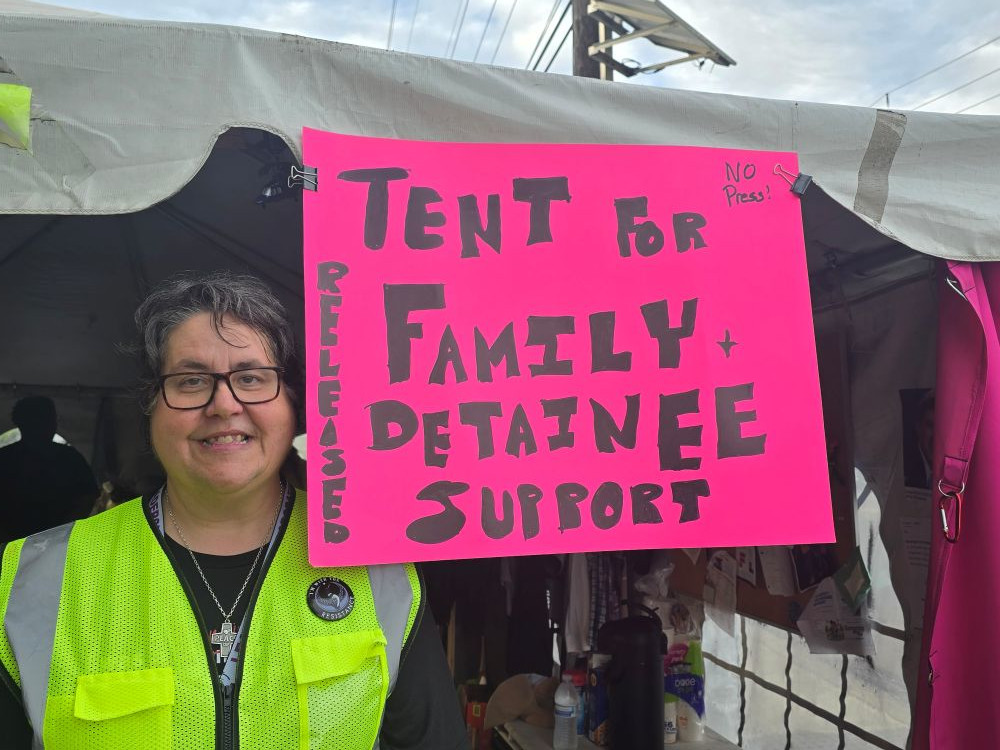
Sr. Susan Rose Francois of the Sisters of St. Joseph of Peace poses next to the sign outside the family and detainee support tent in front of Delaney Hall in Newark, New Jersey. (Courtesy of Eyes on ICE NJ/Joseph O'Leary)


by Susan Rose Francois

NCR Contributor

View Author Profile

June 1, 2026

For more than a year, a network of community leaders has provided public witness, solidarity and mutual aid in support of detained immigrant neighbors and their families at Delaney Hall in Newark, New Jersey.

Delaney Hall opened in May 2025 and is operated by the private prison corporation GEO Group under a 15-year $1 billion government contract. It is the largest detention center on the East Coast. Five miles from my convent, it has been on my radar for over a year but has just recently entered the national consciousness due to a courageous hunger and labor strike by those held captive behind its walls.

The Eyes on ICE NJ coalition includes a diverse collection of organizations: Catholics like the Sisters of St. Joseph of Peace and Pax Christi New Jersey, other faith groups, peace organizations, earnest people from local community and political organizations and immigration advocates. Then there are just ordinary folks who are looking for a way to make a real difference in the face of the cruelty that is happening in our name. We are committed to a common mission to oppose Delaney Hall and the unjust operations of ICE through nonviolence, mutual aid, radical hospitality and interfaith cooperation until the facility ceases operations. We are here for the long haul, and we center the concerns of our immigrant neighbors who are detained and the real needs of their families left behind. For the past year, volunteers have been present every visiting day to staff the "Radical Hospitality" tent or to peacefully stand vigil outside the facility on non-visiting days.

I have come to consider my fellow volunteers as my friends and could not help but think of them as I read these words from Pope Leo XIV in Magnifica Humanitas:
[B]uilding a world in which everyone can flourish requires shared responsibility and courage. No one can singlehandedly bear the weight of the challenges the world is facing, just as no one is so weak that they cannot play their part, for "power is made perfect in weakness" (2 Cor 12:9). … We should not be intimidated by tensions or differences because they can become creative forces when guided by shared responsibility.

I'll be honest: We don't always at first agree on details, but we agree on our values and that is what matters. We agree that the cruelty happening in our name is unacceptable. We believe that our friends in detention and their families come first. This isn't easy on the best of days, and it has become even more difficult with the recent attention and activity outside Delaney Hall this past week. The increased focus was sparked by a family-led press conference the Friday before Memorial Day weekend, highlighting the inhumane conditions their loved ones are facing. More than 300 people held at Delaney Hall then went on a hunger and labor strike to raise awareness and concern for the most vulnerable among them.

Sunday, April 26, 2026

Terrorist lecture at UC Berkeley — symptom of a much bigger problem


By Tammi Rossman-Benjamin

Published April 24, 2026, 5:43 p.m. ET


A recent event hosted by students at UC Berkeley’s law school drew national criticism after featuring Israa Jaabis, a failed Palestinian suicide bomber released from Israeli prison in November 2023 as part of the hostage-prisoner exchange following Hamas’s Oct. 7 attack.

Berkeley’s response was to invoke free speech, insisting that the university must remain content-neutral toward protected expression.

But the deeper threat to academic freedom at Berkeley is not a single student-sponsored event. It is the conduct of faculty who are using departments, speaker series, official academic programming, and university authority to turn anti-Israel activism into institutional practice.

That conduct was recently on display in UC Berkeley’s Rhetoric Department, which sponsored a talk titled “Anti-Zionism Is Not a Luxury.” The event was promoted as one that “articulates and embraces an affirmative anti-Zionism,” calls for “the end of a Zionist world,” and presents anti-Zionism as “a vital necessity of existence.”


A recent event hosted by students at UC Berkeley’s law school drew national criticism after featuring Israa Jaabis, a failed Palestinian suicide bomber released from Israeli prison in November 2023 as part of the hostage-prisoner exchange following Hamas’s October 7 attack.

Nor was it a one-off for the Rhetoric Department. Since Oct. 7, 2023, it has sponsored or co-sponsored more than a dozen similarly one-sided anti-Israel events, raising an obvious question: Why would a rhetoric department become a reliable sponsor of activist programming?

The answer lies in the political commitments of the department’s members. Half of Berkeley rhetoric’s faculty, including the chair and other senior leaders, signed a statement issued just days after Hamas’ attack on Israel that openly took sides in the war — declaring solidarity “without hesitation” with those “who fight for justice in Palestine,” endorsing an academic boycott of Israeli universities, and omitting any mention of Hamas’ massacre of Israeli civilians.

The Rhetoric Department is far from unique. According to recent research, from fall 2023 through spring 2025, 34 Berkeley departments sponsored or co-sponsored 40 Israel-related events with an anti-Israel bias, and none without.

The pattern is unmistakable: The 10 Berkeley departments that sponsored the most anti-Israel events were all led by faculty who had publicly backed an academic boycott of Israel.

These aren’t random student groups organizing protests. These are professors using their institutional authority to advance a political agenda.

Sunday, July 13, 2025

2025 – Montréal Inclusive Solidarities: Reimagining Boundaries in Divided Times


Conference dates: 1-3 July 2025 (virtual); 9-12 July 2025 (in Montréal)

Inclusive Solidarities: Reimagining Boundaries in Divided Times

Solidarity is a central value practiced across social and labor movements and a key principle underpinning social democracies. It is also a term with many meanings, referring to the cohesion of groups, the development of social policy and welfare states, or the goals and tactics of labor and social movement organizations. Solidarity in all its forms involves an act of political and social imagination – to identify who one is willing to act in solidarity with, or who are the members of one’s ‘imagined community’ (Anderson 1983). How community is defined, and how the boundaries around that community are drawn or imagined, have implications for who is included and excluded in collective action to redistribute power and resources, to demand rights, and to fight oppression.

The theme of this year’s SASE meeting recognizes the importance of reimagining the boundaries that define commitments to and practices of inclusive solidarity, at a time when the most visible trends are toward intensified divisions. Tens of thousands of lives have been lost in wars, invasions, and violent conflicts over the past year alone. Climate change is fueling displacement and famine, while attempts to mitigate carbon emissions encourage organizing for and against policies to reform farming, manufacturing, and energy production. Far right political parties have experienced growing support, with recent major election wins in Europe and Latin America – and a rising share of the popular vote in many countries world-wide. And multinational companies and their investors continue to adapt to a post-COVID global economy through pursuing particularistic interests within and across national boundaries, from opposing proposed regulation of AI and platform work to challenging the right to strike as a critical dimension of the ILO’s fundamental right to freedom of association.

Saturday, December 21, 2024

Pope Francis sends special Christmas gift to the people of war-torn Ukraine


By Almudena Martínez-Bordiú

ACI Prensa Staff, Dec 19, 2024 / 15:25 pm


Pope Francis blesses small mobile medical unit being donated to Ukraine. | Credit: Dicastery for the Service of Charity


“Martyred” Ukraine has occupied a special place in Pope Francis’ heart since the Russian army invaded the country in February 2022.

The pontiff has regularly called for prayer for the Ukrainian people and appealed for peace. But not only that, the Holy Father has also made concrete gestures of solidarity with the victims of the conflict.

The latest is a special gift as Christmas draws near: a vehicle converted into a small mobile hospital to care for the inhabitants of this country devastated by war.

The person in charge of delivering the vehicle where the injured can be operated on will be the pope’s almoner, Cardinal Konrad Krajweski.

In addition, the Holy Father is sending six ultrasound machines that will be donated to destroyed and bombed hospitals.

During his trip to Ukraine, Krajewski will visit several communities to meet the suffering people, to bring them hope and the closeness of Pope Francis.

The cardinal has already visited the most affected areas on at least eight occasions at the request of the Holy Father.

In June, he brought the third ambulance donated by the pope to Ukraine. On that occasion, the prefect of the Dicastery for the Service of Charity visited the district of Zboriv ​​in the Ternopil region.

He also brought with him a large quantity of essential medicines from the Vatican Pharmacy and the Agostino Gemelli Polyclinic Pharmacy.

This story was first published by ACI Prensa, CNA’s Spanish-language news partner. It has been translated and adapted by CNA.


Wednesday, March 02, 2022

Ash Wednesday and prayer for Peace for Ukraine


28 FEBRUARY 2022

INVITATION

Ash Wednesday and prayer for Peace for Ukraine


Following Pope Francis’s appeal “to everyone, believers and non-believers alike”, to make March 2 – Ash Wednesday – “a day of prayer and fasting for peace in Ukraine”, COMECE, CEC, the Finnish Seamen’s Mission and the Chapel for Europe invite you to join one Ash Wednesday celebration in solidarity with the people of Ukraine.

The event will take place at the Chapel for Europe, Rue Van Maerlantstraat 22-24, Brussels.

For more info, visit www.chapelforeurope.eu

Programme

13:15 (CET)
Catholic Eucharist with the rite of the imposition of ashes
Celebrant: Fr Krystian Sowa sj

18:00 (CET)
Ecumenical Liturgy with the rite of the imposition of ashes
Celebrants: Rev. Tuomas Meurman from the Finnish Seamen’s Mission (Lutheran Church) and Fr Krystian Sowa sj (Catholic Church)

Face mask is mandatory.


Sunday, November 04, 2018

Notorious Antisemite Louis Farrakhan Leads ‘Death to America’ Chant on Solidarity Trip to Iran


NOVEMBER 4, 2018 1:54 PM


Nation of Islam leader Louis Farrakhan speaking in Detroit, Mi. in February 2017. Photo: Reuters/Rebecca Cook.

Nation of Islam leader and prominent antisemite Louis Farrakhan chanted “Death to America” and claimed that “America has never been a democracy” on Sunday during a solidarity trip to Iran, ahead of the re-implementation of US sanctions this week.

According to Iran’s semi-official state news agency Mehr, Farrakhan said at a meeting with the Secretary of Iran’s Expediency Council Mohsen Rezaei that America is conspiring against Iran.

“I understand how the enemies have plotted against the Iranian people and I would like to stay alongside you to stop their plots,” he said.

He also blasted American support for Saudi Arabia, Iran’s arch-rival in the region, and added, “Satan seeks to divide Muslims and wants them to kill each other, while God tells us in the Quran to be united.”


Thursday, May 10, 2018

Pope Francis says Global Christian Forum fosters respect and human dignity, in Colombia message


GCF Bogotá - Thursday, April 26, 2018


Juan Uzma-Gomez from the Pontifical Council for Promoting Christian Unity delivers a message from Pope Francis to the Global Christian Forum's gathering in Bogota, Colombia. Photo: Albin Hillert/WCC


Pope Francis has extended his greetings to participants of the Third Global Gathering of the Global Christian Forum in Bogota, Colombia
saying it provides solidarity that fosters respect and esteem, mutual forgiveness and that defends human dignity
.

Father Juan Usma-Gomez, head of the Western Section of the Pontifical Council for Promoting Christian Unity from Colombia, read the message on 26 April, the third day of the 24-28 April gathering.

Reflecting on this year’s theme of “Let Mutual Love Continue”, Pope Francis emphasised that “humanity is in great need of such solidarity, which fosters respect and esteem, mutual forgiveness and the effective defence of human dignity in every situation.”

Pope Francis expressed his gratitude to God for the occasion to gather together “as the Forum is a grace-filled opportunity for representatives of many Christian communities to meet as brothers and sisters and journey towards the fulfilment of Jesus’ prayer that all may be one so that the world may believe (cf Jn 17:21).”

He referred to the GCF’s unique role as the most comprehensive gathering of global Christianity today and as a safe space for conversation across boundaries of Christian traditions.

Pope Francis said: “I pray that the Forum may be a time to share personal and ecclesial faith experiences and provide an open and respectful space to address together new contemporary challenges, by promoting Christian solidarity and cooperation in a fresh and innovative way.”

“I assure you and all present of my spiritual closeness during these days, and I invoke upon you Almighty God's blessings of wisdom, courage and strength,” he concluded.

The Pontifical Council for the Promotion of Christian Unity is one of the four “pillars” of the GCF, has been an important contributor in the journey towards better understanding among different Christian traditions and the exploration of how common challenges can be addressed together.

The other pillars of the GCF are: the Pentecostal World Fellowship, the World Evangelical Alliance and the World Council of Churches.


Photos from the GCF Global Gathering in Bogota


Saturday, October 28, 2017

Remarks by the Vice President at In Defense of Christians Solidarity Dinner


For Immediate Release
October 25, 2017

Remarks by the Vice President at In Defense of Christians Solidarity Dinner


JW Marriott Washington, D.C.

Washington, D.C.

6:41 P.M. EDT

THE VICE PRESIDENT: Thank you, Carl. Thank you for your eloquent words. Thank you for that overly generous introduction. To Patriarch Rai, to Patriarch Yazigi (ph), to Archbishop Oshagan, Archbishop Kawak, Metropolitan Joseph, to Mother Olga, all the faith leaders from across the Middle East who are here with us today, to distinguished members of Congress, to all of our honored guests, it is deeply humbling for me to join you here tonight at the Fourth Annual National Advocacy Summit and Solidarity Dinner for an organization that is making a difference in the life of believers all across the world -- In Defense of Christians. Thank you for the honor of joining you today, and thank you for all that you do. (Applause.)

And I bring greetings from my friend of mine and a friend to all who are persecuted for their faith around the globe, the 45th President of the United States of America, President Donald Trump. (Applause.)

The President asked me to be here tonight because we both believe, along with all of you, that “American leadership” is crucial to “securing the future of Christians in the Middle East” and to protecting all who are persecuted across the wider world.

And under the leadership of President Donald Trump, I can assure you: The United States of America will always stand with those who suffer for their faith, and we will always support them in the hour of their need. (Applause.)

Let me begin this evening by recognizing everyone gathered here for your compassion, for your commitment to those who have refused to be conformed to this world, as the Old Book says, willing to be mistreated outside the city gates for their faith.

Andrew Doran and all the members of In Defense of Christians, thank you. Thank you for your leadership in this noble cause. (Applause.) The Bible tells us that we’ll know followers of Christ by their fruits. Since the founding only three years ago, your work and your testimony has been evident for all to see.

And to Carl Anderson and the Knights of Columbus, thank you for your extraordinary work caring for the persecuted around the world. (Applause.)

And to Mother Olga, thank you for raising your voice on behalf of the victims of persecution in your homeland and across the Middle East. We are all inspired by your faith. (Applause.)

And let me also thank two leaders of Congress in particular who are with us here tonight, two men that I had the opportunity to serve with when I was a member of the House of Representatives. They are tireless defenders of believers across the Middle East and the wider world, my friend Congressman Jeff Fortenberry and the recipient of tonight’s Cedars of God award, my friend Congressman Chris Smith. (Applause.)

And finally, allow me to thank all the faith leaders who traveled from near and far to be with us tonight -- leaders of the Armenian Apostolic Church, the Antiochian Orthodox Church, the Syriac Orthodox Church, the Melkite Catholic Church, the Maronite Catholic Church, and so many other faith traditions from across the Middle East. I had the opportunity to meet with many of these leaders at the White House not long ago. And I know I speak on behalf of everyone here when we look at these great examples of courage and faith, your witness in an inspiration to us all, and it’s an honor to share this evening with you. (Applause.)


Wednesday, October 05, 2016

Role of the Catholic Church in a process of the European integration


EVENT REPORT 21-22.09.2016 

THE CATHOLIC CHURCH IN THE EUROPEAN UNION

XVI International Conference


EUROPEAN SOLIDARITY

A series of incidents that dismayed Europe and the world in the past couple of years, have
revealed an urgent need for a greater solidarity among the member states of the European
Union. The war in Syria, political instability in the south-Mediterranean region, Crimea’s
annexation by Russia, the economic crisis in Greece and other countries, the so-called
‘bloody terrorism’ of ISIS against Europe and finally crowds of asylum seekers and migrants
on their way to the old continent from all over the world, require a thorough discernment of the
new situation and a joint action taken in a spirit of solidarity by all the European Union’s
countries.

The sixteenth edition of the conference on the role of the Catholic Church in the process of
European integration co-organised by COMECE together with partners in Cracow, on
September 21-22, 2016 focused this time on four specific issues imperatively necessitating
solidarity in the EU, namely the solidarity in security and defence policy, solidarity towards the
challenges of migrations and asylum, solidarity in reference to the energy and climate policy
and finally the role of Churches and religious communities in strengthening solidarity in
Europe.

The Catholic Church and other religious communities have their role to play in encouraging
European solidarity, not only providing with the best practice examples, but also through the
institutional dialogue with the EU. Acknowledging churches’ identity as well as their specific
contribution in shaping the process of the European integration shows their impact on the EU
policy. Fr. Olivier Poquillon OP, Comece Secretary General highlighted the need for a more
participative approach in order to combat the perception of the European Union as a
centralized, disembodied administration detached from the people’s reality. He also
mentioned the importance to promote EU good practices that led to the achievement of
decades of peace and prosperity in the old continent. Finally, he stressed the need for a better
involvement of the citizen across a constructive articulation of solidarity and subsidiarity.

The experts’ knowledge, as well as the discussions allowed the participants to better
understand European solidarity, which is a value often referred to at the EU level, but not
always soundly interpreted or subjected to possible reductions or even withdrawals resulting
in undesirable socio-political developments.

First panel focussed on the security and defence issues. The entire European security
architecture has trembled as the eastern flank of the continent has been destabilised. The
current Russian-Ukrainian conflict has been described as a game changer for European
security. In this context, the debaters agreed on considering that the unity of all of the EU
Member States was the best safeguard for their security.

Another panel discussed the threats against EU energy policy raising awareness about its
geopolitical fragility because of its excessive concentration on short term economical aspects.
Strategic EU energy security policy should be at the very heart of the European construction
without forgetting its geopolitical and ecological dimension, reminded by pope Francis. The
energy solidarity approach can boost prosperity for the people of Europe and enhance EU
position in the neighbourhood.

Last panel was dedicated to migration and asylum. The panellists addressed the principles
that should guide European societies in this matter, including respect of human dignity,
promotion of common good, solidarity and subsidiarity. Jose Luis Bazan, COMECE Legal
Advisor on Migration and Asylum, emphasised the importance of a responsible solidarity that
takes into account the reality of societies, reminding the “intelligent hospitality” and openness
that the Church must promote.

At the invitation of Card. Dziwisz, High representatives of all the Churches present in Ukraine
had an chance to dialogue together and to express their commitment to work jointly on
rebuilding Peace.

Irmina Nockiewicz


More information : http://www.kosciol-europa.org.pl


Series of conferences on the role of the Catholic Church
in the process of European integration


This initiative of the series of conferences on the role of the Catholic Church in the
process of European integration dates back to 2000 and aims at promoting a diversified
perspectives on the horizon of European unity, as well as at showing the substantial of the
Catholic Church in the process of European integration. Catholic Church brings its specific
contribution into the EU debate on the basis of Article 17(3) of the Treaty on the Functioning of
the EU.

Each year the conference is structured around workshops held on topics related with the
general theme relevat to the current state of play of EU policies. The event, inspired by H.E.
Mgr Tadeusz Pieronek, is organized by the Pontifical University of John Paul II, Konrad
Adenauer Foundation in Poland, the Robert Schuman Foundation in Luxembourg in cooperation
with the COMECE (Commission of the Episcopates of the European Community),
the Group of the European People's Party (Christian Democrats) in the European Parliament,
the Polish Delegation in the EPP (Christian Democrats) in the European Parliament, the
European People's Party and the publishing house "Around Us" (Gliwice).


Source


Monday, September 19, 2016

Catholic Church and the European Solidarity

 
latest press releases


Webnews 15/09/2016


Catholic Church and the European Solidarity

September 21-22, 2016, Kraków (Poland)

The appreciation of solidarity is a key competence in solving multifaceted problems that Europe is facing today. The sixteenth edition of the Conference on the role of the Catholic Church in the process of European integration co-organised by COMECE together with partners will focus this time on an imperative necessity of the European solidarity: in the security and defence policy, in the migration and asylum issues, in the energy and climate policy to finally draw attention to the role of Churches and religious communities in strengthening solidarity in Europe. http://kosciol-europa.org.pl/


Saturday, May 30, 2015

International: 48 organisations endorse a joint statement for the World Humanitarian Summit


02 March 2015


A large truck delivers aid to Syrians in Aleppo (Jesuit Refugee Service).


Relief services are time-sensitive. We cannot wait to act. All states, donors and aid agencies must follow core humanitarian standards to ensure that the millions affected by conflict across the world get the assistance and protection they need, when they need it.

Rome, 2 March 2015 – Together with organisations such as Christian Aid, Caritas International, the Islamic Relief Worldwide, and the International Rescue Committee, the Jesuit Refugee Services (JRS) calls on humanitarian actors and states in conflict regions to "re-affirm their commitment to respect and to promote the humanitarian principles of humanity, neutrality, impartiality and independence, towards any stakeholders involved in humanitarian crises."

JRS, alongside 47 other agencies, signed a joint statement in Hungary in late February to protect the fundamental right of those affected by conflict to access humanitarian aid. The NGOs developed the statement as part of the European consultations that will contribute to the 2016 World Humanitarian Summit hosted by the United Nations. The signatories recognise that "humanitarian action is driven by a sense of humanity, a willingness to relieve human suffering, regardless of culture, origins or religion."

Humanitarian aid operations are a matter of international solidarity, which should not threaten national sovereignty. Governments in conflict regions must not only provide national humanitarian support, they must also facilitate the work of others actors in the region to deliver humanitarian aid, the statement urges.

In many volatile and insecure environments, lines are blurred between military and political activities (i.e. counter-terrorism tactics) and humanitarian aid, making it difficult for aid agencies to operate. The joint statement insists that governmental and institutional funding must remain independent of political agendas. Furthermore, the NGOs call on conflict-affected states to "allow and support full unimpeded access to all people in need of assistance and promote the safety, protection and freedom of movement of humanitarian personnel."

"We are in the midst of some of the worst humanitarian crises since World War II: the Central African Republic, South Sudan, Syria. Reaching people quickly and effectively must to be our priority. We call on governments to cooperate with international humanitarian actors and to hasten the delivery of relief services," JRS International Director Peter Balleis SJ said.

"Relief services are time-sensitive. We cannot wait to act. All states, donors and aid agencies must follow core humanitarian standards to ensure that the millions affected by conflict across the world get the assistance and protection they need, when they need it."

Consequently, the support provided by outside actors must remain needs-based, rather than be used as a crisis management tool by donors. The aid agencies should abide by these humanitarian principles to remain accountable to those they serve. The signatories call on all international actors to "review and design all humanitarian policies in compliance with the humanitarian principles and enhance existing commitments for good donor practices such as the Good Humanitarian Donorship principles."

The World Humanitarian Summit next year aims to find innovative methods to approach humanitarian crises and reduce persons' vulnerability. Looking forward, Fr Balleis said "next year's World Humanitarian Summit in Istanbul is the time to stress the importance of these humanitarian principles. Only then will we have a solid foundation from which to serve others."

Jacquelyn Pavilon, International Communications Assistant


Joint Statement on humanitarian principles endorsed by 48 humanitarian NGOs as a common contribution to the World Humanitarian Summit consultations as of 27 February.


Today, the humanitarian sector faces an unprecedented number of protracted and acute humanitarian crises, such as the crisis in Syria, in Central African Republic, in South Sudan or the regional Ebola crisis, compelling humanitarian actors to stretch existing structures and practices to breaking point. Considering the role the World Humanitarian Summit may play in the future of humanitarian action, it is of utmost importance that the international community uses this opportunity to reaffirm the shared value of humanitarian principles of humanity, neutrality, impartiality and independence.

The humanitarian principles emerged from International Humanitarian Law and are based on a common understanding that humanitarian action is driven by a sense of humanity, a willingness to relieve human suffering, regardless of culture, origins or religion. They are encompassed within the core of key humanitarian references, such as the Code of Conduct for the International Red Cross and Red Crescent Movement and Non-Governmental Organizations (NGOs) in Disaster Relief or the European Consensus on Humanitarian Aid.

NGOs are operating in exceptionally volatile and insecure environments where political agendas are interfering with the delivery of humanitarian aid, causing increased threats to the safety and security of humanitarian aid workers and assets, and in some situations hamper impartial access of affected population to relief operations. For example, the growing numbers of counter-terrorism laws and measures adopted by States and inter- governmental organizations are restricting humanitarian actor's ability to develop partnerships, run projects in complex environments, and are delaying programs implementation. The involvement of some donor states in stabilization operations in many contexts where humanitarian aid is needed, are increasingly blurring lines between political, military and humanitarian objectives, thus reducing humanitarian NGOS abilities to deliver aid. Therefore, due respect of the principles implies that governmental and institutional funding must remain detached from political or other agendas.

While affected states keep the primary responsibility to organize and deliver humanitarian support, they also have the fundamental duty to facilitate the work of other actors in situations when international solidarity is requested to answer the needs. Relief operations should not be considered as a challenge to State sovereignty nor the humanitarian imperative be undermined by making national sovereignty an excuse.

We concur that re-shaping aid is urgent with new actors and new donors playing bigger roles. Humanitarian aid must remain based on the needs as assessed by humanitarian actors and donors should abstain from using aid as a crisis management tool.

Consequently humanitarian NGOs, concerned about the threats posed on these principles, take the opportunity of the World Humanitarian Summit to strongly reassert their commitment to the humanitarian principles, as being critical in guaranteeing people in need will have safe access to humanitarian aid. The humanitarian principles must be fully supported and adequately implemented by states and all organizations, and systematically feed all policies and practices on humanitarian aid.

As humanitarian NGOs involved in crises around the world today, we strongly call upon Humanitarian actors, Donors, States and all parties involved in conflicts, to:
  • Re-affirm their commitment to respect and to promote the humanitarian principles of humanity, neutrality, impartiality and independence, towards any stakeholders involved in humanitarian crises, and re-affirm the value of the humanitarian imperative;
  • Review and design all humanitarian policies in compliance with the humanitarian principles and enhance existing commitments for good donor practices such as the Good Humanitarian Donorship principles;
  • Reaffirm and protect the fundamental right for affected populations to access humanitarian aid;
  • Allow and support full unimpeded access to all people in need of assistance and promote the safety, protection and freedom of movement of humanitarian personnel.

We request that these recommendations be fully part of the outcomes of the World Humanitarian Summit.

Signatories

ACF International, ACT Alliance, ACTED, ADRA, Alianza por la Solidaridad, Arche noVa e.V., Bioforce, CARE International, Caritas Internationalis, CBM International, Center for Vicitms of Torture, ChildFund International, Christian Aid, Comitato Internazionale Sviluppo dei popoli (CISP), Concern Worldwide, DanChurchAid, Danish Refugee Council, Diakonie Katastrophenhilfe, Finnish Church Aid, Habitat For Humanity International, Handicap International, Help - Hilfe zur Selbsthilfe, HelpAge International, International Catholic Migration Commission (ICMC), International Medical Corps, International Rescue Committee, Islamic Relief Worldwide, Jesuit Refugee Service, Life for Relief and Development, Malteser International, MEDAIR, Médecins du Monde, Mercy Corps, Norwegian Church Aid, Norwegian Refugee Council, Oxfam, People In Need, Premiere Urgence - Aide Medicale Internationale, Questscope for Social Development in the Middle East, Relief International, Secours Islamique France, Solidarites International, Terre des homes, The Lutheran World Federation, Tierarzte ohne Grenzen, Welthungerhilfe, World Vision International

Contacts
Camille Gosselin
cgosselin@handicap-international.org

Pauline Chetcuti
pchetcuti@actioncontrelafaim.org


Press Contact Information
James Stapleton
international.communications@jrs.net


Source
.
.

Monday, September 22, 2014

Catechism of the Catholic Church - Social justice


PART THREE
LIFE IN CHRIST

SECTION ONE
MAN'S VOCATION LIFE IN THE SPIRIT

CHAPTER TWO
THE HUMAN COMMUNION

ARTICLE 3
SOCIAL JUSTICE


1928 Society ensures social justice when it provides the conditions that allow associations or individuals to obtain what is their due, according to their nature and their vocation. Social justice is linked to the common good and the exercise of authority.

I. RESPECT FOR THE HUMAN PERSON

1929 Social justice can be obtained only in respecting the transcendent dignity of man. The person represents the ultimate end of society, which is ordered to him:
What is at stake is the dignity of the human person, whose defense and promotion have been entrusted to us by the Creator, and to whom the men and women at every moment of history are strictly and responsibly in debt.35
1930 Respect for the human person entails respect for the rights that flow from his dignity as a creature. These rights are prior to society and must be recognized by it. They are the basis of the moral legitimacy of every authority: by flouting them, or refusing to recognize them in its positive legislation, a society undermines its own moral legitimacy.36 If it does not respect them, authority can rely only on force or violence to obtain obedience from its subjects. It is the Church's role to remind men of good will of these rights and to distinguish them from unwarranted or false claims.

1931 Respect for the human person proceeds by way of respect for the principle that "everyone should look upon his neighbor (without any exception) as 'another self,' above all bearing in mind his life and the means necessary for living it with dignity."37 No legislation could by itself do away with the fears, prejudices, and attitudes of pride and selfishness which obstruct the establishment of truly fraternal societies. Such behavior will cease only through the charity that finds in every man a "neighbor," a brother.

1932 The duty of making oneself a neighbor to others and actively serving them becomes even more urgent when it involves the disadvantaged, in whatever area this may be. "As you did it to one of the least of these my brethren, you did it to me."38

1933 This same duty extends to those who think or act differently from us. The teaching of Christ goes so far as to require the forgiveness of offenses. He extends the commandment of love, which is that of the New Law, to all enemies.39 Liberation in the spirit of the Gospel is incompatible with hatred of one's enemy as a person, but not with hatred of the evil that he does as an enemy.

II. EQUALITY AND DIFFERENCES AMONG MEN


1934 Created in the image of the one God and equally endowed with rational souls, all men have the same nature and the same origin. Redeemed by the sacrifice of Christ, all are called to participate in the same divine beatitude: all therefore enjoy an equal dignity.

1935 The equality of men rests essentially on their dignity as persons and the rights that flow from it:

Every form of social or cultural discrimination in fundamental personal rights on the grounds of sex, race, color, social conditions, language, or religion must be curbed and eradicated as incompatible with God's design.40

1936 On coming into the world, man is not equipped with everything he needs for developing his bodily and spiritual life. He needs others. Differences appear tied to age, physical abilities, intellectual or moral aptitudes, the benefits derived from social commerce, and the distribution of wealth.41 The "talents" are not distributed equally.42

1937 These differences belong to God's plan, who wills that each receive what he needs from others, and that those endowed with particular "talents" share the benefits with those who need them. These differences encourage and often oblige persons to practice generosity, kindness, and sharing of goods; they foster the mutual enrichment of cultures:
I distribute the virtues quite diversely; I do not give all of them to each person, but some to one, some to others. . . . I shall give principally charity to one; justice to another; humility to this one, a living faith to that one. . . . And so I have given many gifts and graces, both spiritual and temporal, with such diversity that I have not given everything to one single person, so that you may be constrained to practice charity towards one another. . . . I have willed that one should need another and that all should be my ministers in distributing the graces and gifts they have received from me.43
1938 There exist also sinful inequalities that affect millions of men and women. These are in open contradiction of the Gospel:
Their equal dignity as persons demands that we strive for fairer and more humane conditions. Excessive economic and social disparity between individuals and peoples of the one human race is a source of scandal and militates against social justice, equity, human dignity, as well as social and international peace.44
III. HUMAN SOLIDARITY

1939 The principle of solidarity, also articulated in terms of "friendship" or "social charity," is a direct demand of human and Christian brotherhood.45
An error, "today abundantly widespread, is disregard for the law of human solidarity and charity, dictated and imposed both by our common origin and by the equality in rational nature of all men, whatever nation they belong to. This law is sealed by the sacrifice of redemption offered by Jesus Christ on the altar of the Cross to his heavenly Father, on behalf of sinful humanity."46
1940 Solidarity is manifested in the first place by the distribution of goods and remuneration for work. It also presupposes the effort for a more just social order where tensions are better able to be reduced and conflicts more readily settled by negotiation.

1941 Socio-economic problems can be resolved only with the help of all the forms of solidarity: solidarity of the poor among themselves, between rich and poor, of workers among themselves, between employers and employees in a business, solidarity among nations and peoples. International solidarity is a requirement of the moral order; world peace depends in part upon this.

1942 The virtue of solidarity goes beyond material goods. In spreading the spiritual goods of the faith, the Church has promoted, and often opened new paths for, the development of temporal goods as well. And so throughout the centuries has the Lord's saying been verified: "Seek first his kingdom and his righteousness, and all these things shall be yours as well":47
For two thousand years this sentiment has lived and endured in the soul of the Church, impelling souls then and now to the heroic charity of monastic farmers, liberators of slaves, healers of the sick, and messengers of faith, civilization, and science to all generations and all peoples for the sake of creating the social conditions capable of offering to everyone possible a life worthy of man and of a Christian.48
IN BRIEF

1943 Society ensures social justice by providing the conditions that allow associations and individuals to obtain their due.

1944 Respect for the human person considers the other "another self." It presupposes respect for the fundamental rights that flow from the dignity intrinsic of the person.

1945 The equality of men concerns their dignity as persons and the rights that flow from it.

1946 The differences among persons belong to God's plan, who wills that we should need one another. These differences should encourage charity.

1947 The equal dignity of human persons requires the effort to reduce excessive social and economic inequalities. It gives urgency to the elimination of sinful inequalities.

1948 Solidarity is an eminently Christian virtue. It practices the sharing of spiritual goods even more than material ones.


35 John Paul II, SRS 47.
36 Cf. John XXIII, PT 65.
37 GS 27 § 1.
38 Mt 25:40.
39 Cf. Mt 5:43-44.
40 GS 29 § 2.
41 Cf. GS 29 § 2.
42 Cf. Mt 25:14-30; Lk 19:27.
43 St. Catherine of Siena, Dial. I,7.
44 CS 29 § 3.
45 Cf. John Paul II, SRS 38-40; CA 10.
46 Pius XII, Summi pontificatus, October 20, 1939; AAS 31 (1939) 423 ff.
47 Mt 6:33.
48 Pius XII, Discourse, June 1, 1941.


.

Monday, August 11, 2014

Lebanese Patriarch Rai Calls for Action in Iraq to Protect Christians


Daily Star, Lebanon
Posted 2014-08-10 23:24 GMT


Patriarch Beshara Rai heads Sunday's mass at Diman, Aug. 10, 2014. (The Daily Star/Maronite Patriarchate Bkerke, HO)

BEIRUT -- Maronite Patriarch Beshara Rai called Sunday for solidarity with the Christians of Iraq and asked the international community to intervene to put a stop to the persecution of Christians by the Islamic State of Iraq and Greater Syria (ISIS).

"We pray for our national unity, and for the unity of the communities of the Middle East afflicted by divisions and wars, for the spread of peace and understanding," he said during Sunday Mass at his summer residence in Diman, north Lebanon.

"We renew the patriarchate's call to the Arab League, the United Nations, the Security Council and the International Criminal Court to put a stop to ISIS' attacks and those of other fundamentalist organizations against the Christians of Mosul and the villages of Ninevah in dear Iraq, and allow the return of those Christians to their homes and properties with dignity, securing for them a decent life in their home countries with all the rights of citizens."

In July, ISIS began expelling Christians from Mosul, Iraq's second largest city. Earlier this month, the extremist group took over Iraq's largest Christian town.

Rai lamented the fate of some 150,000 displaced Christians, some of whom have been stranded in the mountains without food or water. He went on to call for solidarity from civil and religious groups and asked members of the community to assist with providing shelter and food for Christian refugees in coordination with the Chaldean Church and other congregations.

"We thank everyone who extends a hand to our Iraqi brothers who have sought refuge in Lebanon."

The Maronite religious leader also touched on Lebanese politics, continuing his shame campaign against Lebanese lawmakers.

"We renew our call on the conscience of parliamentarians and political blocs to respect the Constitution which obliges them ... to elect a president," he said, referring to the presidential vacancy, now in its third month. "Let us pray, brothers and sisters, that God's hand touches these hearts, and liberates [lawmakers] from interests, alliances and dependencies, and from their divisions, so that they elect a president who is the most appropriate and best given the current conditions in Lebanon and the region."

He emphasized that the church does not propose or back any candidate, but would support anyone elected to the office.


.