Thursday, May 29, 2025


Tuesday, April 16, 2024
Wednesday, August 30, 2023
Religious Liberty Event Pays Tribute to 130 Years of Advocacy
AUGUST 23, 2023
Religious Liberty Event Pays Tribute to 130 Years of Advocacy
IRLA 9th World Congress encourages participants to reflect and act for the good of all people.
Marcos Paseggi, Adventist Review

Attendees of the IRLA’s 9th World Congress follow the proceedings in Silver Spring, Maryland, on August 21. [Photo: Marcos Paseggi, Adventist Review]
Nearly 150 religious liberty leaders, scholars, and advocates from around the world met for the 9th World Congress of the International Religious Liberty Association (IRLA) in Silver Spring, Maryland, United States, August 21-23.
The international event invited attendees to discuss “a wholistic understanding of freedom of religion or belief as a pivotal human right,” organizers said.
In his remarks on August 21, Ted N. C. Wilson, president of the General Conference of Seventh-day Adventists, welcomed attendees, reminding them of the historical focus of the denomination on the topic.
“Adventist pioneers … saw in religious liberty an incontrovertible value without which our very humanity could be at risk of being diminished and impaired,” thus embracing “the priceless value of religious freedom, and the foundation of freedom itself,” Wilson said.
Wilson shared how Adventist pioneers fought against oppression of others, against slavery, and against early attempts at Sunday laws. “Adventist leaders officially adopted a solidarity with the whole human family through the advocacy of religious liberty,” he reminded attendees.
Saturday, February 11, 2023
U.N. Trying To Push Religious Communities To ‘Fully Comply’ With LGBTQ Agenda
U.N. Trying To Push Religious Communities To ‘Fully Comply’ With LGBTQ Agenda
February 7, 2023 NewsHound

The United Nations is releasing a report in June regarding the “perceived contradictions” between religious freedom and sexual orientation and gender identity, or SOGI, laws and is looking to push governments to “fully comply with their obligations under international human rights law to protect and empower LGBT+ persons,” according to a U.N. announcement.
The U.N. closed a call for LGBT+ and religious freedom organizations to submit input to the report earlier this month and is scheduled to introduce its findings at the 53rd Human Rights Council meeting in June, according to the announcement. The announcement explains that while there are “perceived contradictions” between the LGBT+ community and religious freedom, the report aims to find ways to “protect LGBT+ persons’ access to faith and spirituality” while also indicating that religious beliefs that would contradict this are not “justified” under the protection of human rights.
“Religious and spiritual narratives have also historically been used to promote, enable, and condone institutional and personal violence and discrimination against individuals based on sexual orientation or gender identity (real or presumed); repress sexual and gender diversity; and promote cis-gendered and heteronormative norms of sexual orientation and gender identity,” the announcement read. “These practices cannot be justified under the rubric of Freedom of Religious Beliefs, or indeed any other human right, to circumvent and defeat the rights of marginalized populations.”
Any organization that wished to comment for the inquiry was tasked with keeping their comments to a minimum of 2,500 words and providing answers to 11 questions on religious freedom and the rights of the LGBT+ community, according to the announcement. Respondents were asked whether or not any religious beliefs and LGBT+ rights were “mutually exclusive,” to point out policies that protect discriminatory religious practices and about the extent to which religious individuals have the right to a conscientious objection.
The U.N. didn’t disclose who commented ahead of the report’s release, but two organizations publicly published their comments for the inquiry, focusing on their concerns about the impact on the religious community. The Religious Freedom Institute and the Heritage Foundation’s comments worried that the special inquiry would “undermine” and result in the “politicization” of religious freedom as a human right.
We reached out to the Seventh-day Adventist PARL department, to see if they submitted concerns to the UN. No response yet.
Observations
The United Nations increasingly sees LGBTQ rights (agenda) and religious convictions as being in conflict. Their default position is the elevation of human rights (ie. LGBTQ) over biblical morality.
Reports like the one from the U.N. are based on a “narrative” that “religion is an oppressor and that religious freedom can be weaponized to harm others.”
This narrative is not only harmful because it could make people doubt the importance of religion in their own lives and their communities, but it’s also harmful because it will undermine important social protection.
Religion and religious freedom is a stabilizing presence, and for the cases where religion is being misused to oppress (ie Islam etc), the answer isn’t to shut down religion entirely.
The United Nations position is that religious and spiritual narratives have historically been used to promote discrimination against individuals based on sexual orientation or gender identity (real or presumed); repress sexual and gender diversity; and promote cisgendered and heteronormative norms of sexual orientation and gender identity. This has resulted in a variety of discriminatory normative constructions reinforced over time. In other words, the Bible premise of male and female uniting in marriage for life and producing children in that union is discriminatory towards sexual confusion and deviancy. Yes it is. Delightfully so.
The United Nations is three parts incompetent and one part corrupt, yet the GC PARL Department still trusts them.
Our PARL department director’s affinity for the United Nations could result in him being conflicted by such pro-LGBTQ initiatives from the UN. He is also deeply embedded in ecumenical initiatives — in our opinion, dangerously so.. He may have to choose whether to follow the Bible or the United Nations. It can’t be both.
****
Friday, December 27, 2019
Ganoun Diop: The Truth About Inter-Church/Interfaith Relations

Commentary
By: Ganoune Diop, director of General Conference Public Affairs and Religious Liberty
This article addresses some concerns that have been expressed regarding the Seventh-day Adventist Church’s engagement with other Christians.
Though most Adventists, since the establishment of a department of Public Affairs and Religious liberty in 1901, understand the necessity to mingle with other Christians, the questions are still asked: “Why mingle with other Christians? Is this not a betrayal of Adventist identity, message, and mission?” To these, our unequivocal answer is no, it is not. The mission of the Seventh-day Adventist Church cannot be fulfilled without mingling as Jesus did. Fears and objections are part of human experience, but they have to be addressed rationally.
First, a clarification. Inter-church and interfaith relations do not mean ecumenism in the sense of union with other churches, doctrinal alliances, obliteration of differences, or the loss of distinctive emphasis on biblical truths.
A misunderstanding of this basic fact has prompted a few at the fringes of the church to accuse Adventist leaders of betraying the church’s position, which they assume demands there be no interaction with other Christians at all. This radical rejection of mingling with others is, at times, expressed through violent and angry rhetoric.
Saturday, May 18, 2019
Stop Blending Religious Liberty With Global Leftism, Please
`Ello me lads! Mouse here, fresh off a stroll around Turtle Bay in Manhattan. I highly recommend Patsy’s Pizzeria, satisfying my peckish impulses at a reasonable price—a mere 21 Pound sterling.
What I don’t recommend—indeed I recoil at the notion—is the grand Seventh-day Adventist Movement hitching itself to the United Nations through the dubious efforts of one Ganoune Diop. The blighter is singled-handedly demonstrating that timeless cosmological maxim: Any nation, organization, or individual will eventually and ultimately be liberalized, save for a conscious decision to resist it. But I digress.
The United Nations
The United Nations is not simply inept, like the League of Nations was.
It came together in 1945 as an artifact of another age, even as its delegates marched into the modern glass and steel building on Turtle Bay. The motivation in favor of its organization—persuasive at the time—concealed the fact that it was built to counter the wrong threat. The world’s problems no longer lay with rogue industrialized nations on a conquering spree, but rather with an international ideology determined to subjugate civilization with its own global agenda (think Agenda 21, the Earth Charter, and Agenda 2030).
The UN helped a little during the Korean War, but was of little use against communism, which essentially infiltrated and shaped the UN Agenda. Today, the UN busies itself by making sure its doors are thrown open to an army of Third World dictatorships—for sale to the highest bidder—and by implementing a progressive global agenda. Quite accordingly, the UN is three parts incompetent and one part corrupt (or is it the other way around?). I suppose it doesn’t matter.
Agenda 2030—Sustainable Development Goals
Their most recent agenda is a grab bag of leftist goodies with a few human rights fixations tossed in—known affectionately by misty-eyed liberals as the Sustainable Development Goals. Or Agenda 2030, for short.
On paper, the Sustainable Development Goals are: poverty, hunger, health, education, global warming, gender equality, water, sanitation, energy, urbanization, environment and social justice (I presume they want to end poverty and hunger—and increase gender equality and social justice).
I daresay, who isn’t against ending poverty and hunger? All Bill Clinton had to say, under duress for his moral transgressions in the 1998 impeachment hearings was “I just want to feed the hungry children.” Goodbye heel. Hello hero. Glitterati movie stars, celebrating their fourth award for yet another licentious cinema flick are wont to say “I’m working to end world poverty.” Goodbye smuttiness. Hello greatness.
But the real UN Agenda, on display in Agendas 21 and 2030, is implementing global leftism amidst the empty shriek of self-righteous human rights outrage. Weary of the transcendent Law of God, they seek to make us the multilateral shell of international organizations, assigning to themselves the task of fashioning a New Moral law for a New Global machine. In that New Law, human justice prevails over all. Social justice!
It's not that the multicultural society is an unheard of thing. Africans and Pakistanis have been changed by their exposure to jolly old England. And England (God save the Queen) has been changed by its exposure to them. But it is generally the worst qualities that have been passed to each side, especially recently as grinning Muslim rape hordes have invaded the British commonwealth.
While liberal elites parcel out the carbon atoms of the North Pole, their anorexic souls are being carved up into offerings placed upon the altar of multicultural new world order. And they are taking us with them.
Adventists Wonder After The UN
On January 29, 2019, the Seventh-day Adventist Church helped to organize a symposium at the United Nations (UN) Secretariat in New York City, New York. The theme of this meeting was how church organizations can assist the UN in achieving its 2030 Sustainable Development Goals. Various speakers, including Ganoune Diop, urged faith-based organizations to join in promoting this agenda—creating a harmonious multicultural paradise, constructed on the sands of social justice.

Thursday, February 14, 2019
FREEDOM OF RELIGION SEMINAR IN FINLAND
13 February 2019 | Helskinki, Finland
Dr Ganoune Diop, Director of Public Affairs and Religious Liberty for the worldwide Seventh-day Adventist Church, made the opening presentation at a Seminar on religious freedom held in the Finnish Parliament library on Wednesday, 6 February.
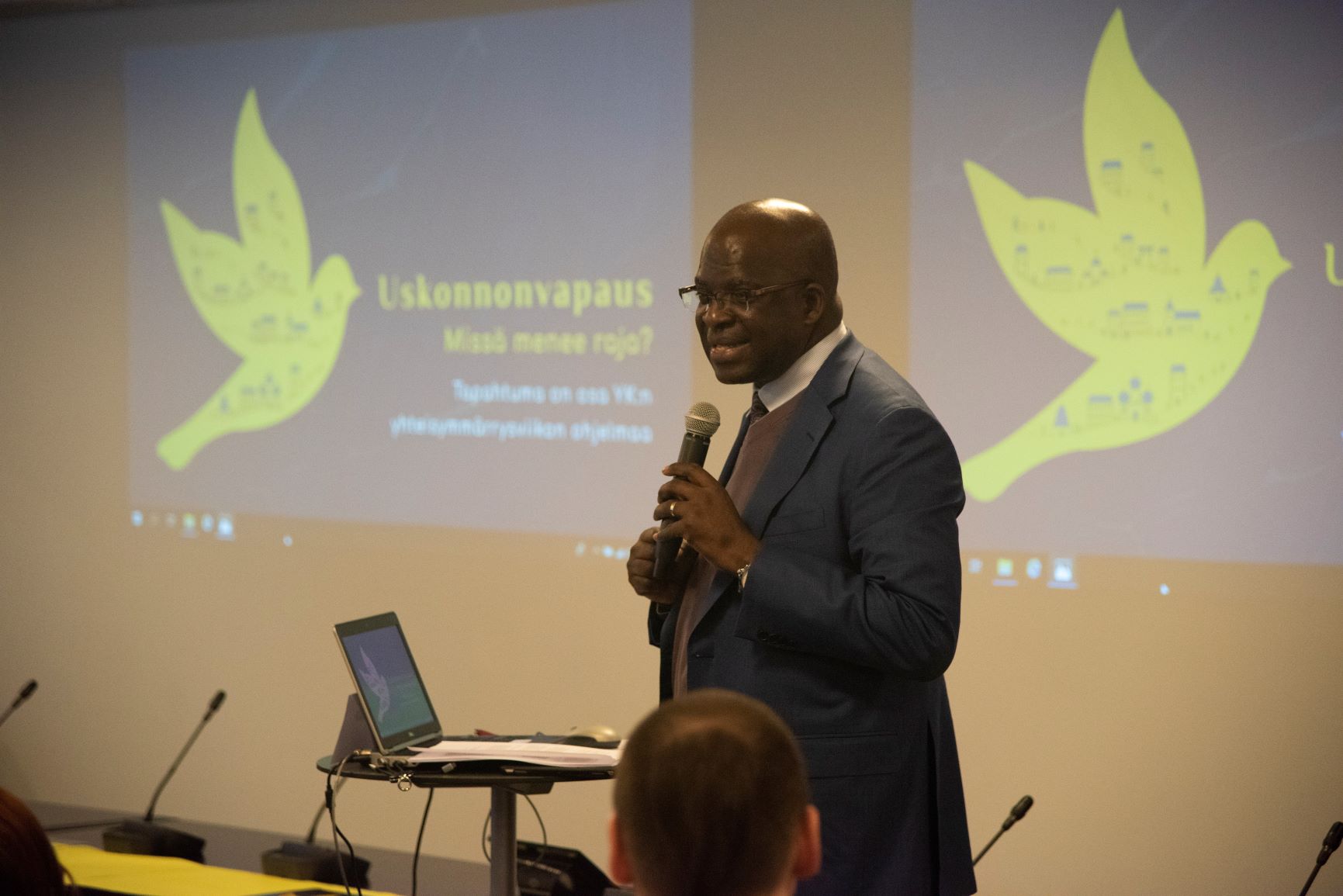
About 80 interested people listened as Diop dealt with the issue of freedom of religion as an inalienable human right. He emphasised that freedom of religion is not only a legal right but is fundamentally connected with the idea of humanity. “It is a global principle that defines what it means to be human,” he said. According to Diop, freedom of religion is about freedom of conscience, freedom of speech, the right to gather together, and the freedom to make decisions. It is equally an antidote to human exploitation.
Diop was one of three speakers and eight Members of Parliament who were invited. Former President of Finland Tarja Halonen also participated in the event, which was part of the United Nation’s Week of Mutual Understanding. The event was opened and concluded by the President of the Seventh-day Adventist Church in Finland, pastor Kalervo Aromäki.
Professor Elina Vuola from the University of Helsinki then dealt with the issue of the importance of understanding religions. She noted how important religious values are outside of Western Europe. More attention is now paid to religions and their values in international relations, she stated. She also warned against the danger of generalizing a religion and its practitioners based on a single crime committed by a member of that religion. She noted some newspapers that like to sensationalise in this way.
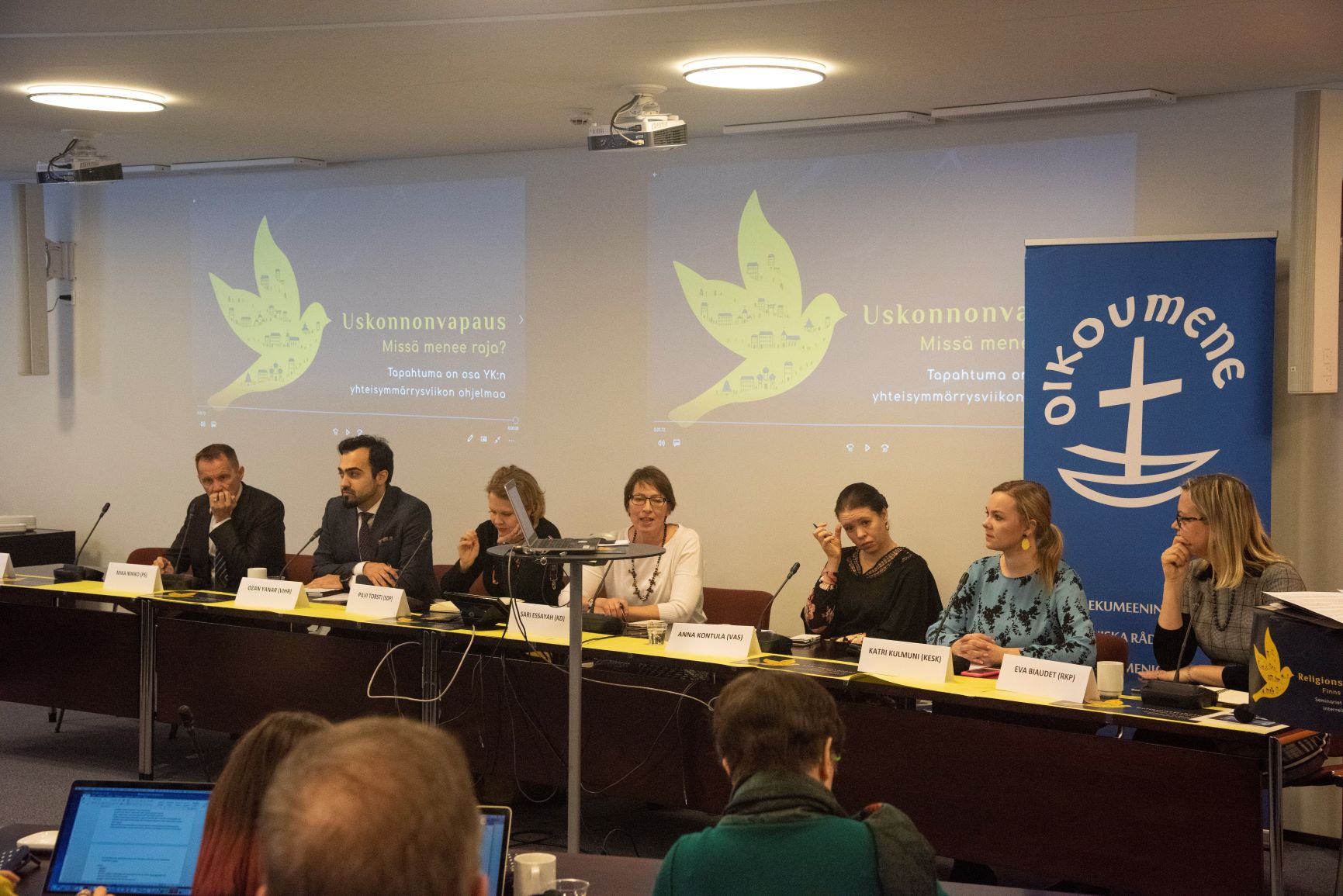
The seminar concluded with a panel of seven Members of Parliament answering questions about the topic. Their views varied considerably in an effort to balance rights between the individual and society, although everyone was ready to support the principle of freedom of religion as a human right.
In addition to the actual seminar, Dr Diop and Pastor Aromäki visited the Council of the Lutheran church. They met representatives and shared their thought that Adventists and Lutherans must continue to dialogue on this important topic now that the door has been opened for it.
Aromäki was the one who first introduced the idea for the symposium at one of the SVKN meetings. He noted that one of the benefits for the smaller denominations in Finland could be that they will be recognized as a viable voice on important human matters. For him, this very seminar is positive proof that this can happen.
tedNEWStaff: Victor Hulbert, editor; Sajitha Forde-Ralph, associate editor
119 St Peter's Street, St Albans, Herts, AL1 3EY, England
E-mail: tednews@ted.adventist.org
Website: www.ted.adventist.org
tedNEWS is an information bulletin issued by the communication department of the Seventh-day Adventist Church in the Trans-European Division. Readers are free to republish or share this article with appropriate credit including an active hyperlink to the original article.
Thursday, November 29, 2018
Unprecedented numbers of migrants and refugees means new religious freedom challenges, say scholars

[Photo courtesy of the International Religious Liberty Association] View Larger
As the number of migrants and refugees worldwide continues to surge, a panel of scholars convened last month by the International Religious Liberty Association (IRLA) says more must be done to deal with related religious freedom challenges.
The IRLA’s 19thMeeting of Experts, held in Cordoba, Spain, brought together renowned scholars from a variety of academic disciplines to explore this issue. But the topics discussed were anything but academic for the many millions of men, women and children who are currently on the move, fleeing poverty, violence, or religious persecution, according to IRLA Secretary General Dr. Ganoune Diop.
“Managing migration, with all its associated difficulties—physical, legal, and social—is recognized as one of the most urgent and perplexing challenges of our time,” Diop said. “But the picture is incomplete unless we also understand just how frequently religious practice and identity intersect with these issues.”
He points out that in many world regions, from Myanmar to Nigeria to Syria and Iraq, religiously motivated hostility or violence help drive migration. But also challenging, according to Diop, are the clashes of religious and social identities that often occur later, as migrants and refugees are absorbed into new cultures.
“This process of integration raises very practical—and confronting—questions in many Western countries, such as whether to grant permits for building temples or mosques, how to relate socially and legally to those who wear religious garb, like the hijab, or even whether to allow traditional slaughtering of animals,” said Diop. “The presence and practices of religious minorities are sometimes seen as dividing wedges in society, threatening national unity and traditions.”
Scholars at the IRLA Meeting of Experts presented papers on these and other topics, including why faith-based organizations should be involved in migrant and refugee issues and how they can better collaborate. Other presenters looked at issues specific to particular world regions, such as Europe, Latin America, and North America.
The Meeting of Experts is an annual event of the IRLA, an organization chartered by the Seventh-day Adventist Church in 1893 and that today works around the world to promote freedom of religion or belief for all people, regardless of their religious traditions. This year’s meeting was also co-sponsored by Spain’s Ministry of Justice and Ministry of Foreign Affairs. The papers presented at the Cordoba meeting will be published in next year’s Fides et Libertas, the academic journal of the IRLA.
At this year’s meeting, the IRLA paid tribute to long-time IRLA supporter and contributor Professor Alberto de la Hera. Professor de la Hera is Emeritus Professor of Canon Law and Legal History at Complutense University in Madrid and is the former Director General of Religious Affairs for Spain’s Ministry of Justice. Ambassador John Nay, president of IRLA, presented Professor de la Hera with a plaque that acknowledged his many years of scholarly work in the field of religious freedom, and his important contributions to IRLA events and activities.
Among the more than 20 scholars who presented papers at the meeting were: Silvio Ferrari, University of Milan; Cole Durham, Brigham Young University; Raimundo Barreto, Princeton University; David Little, Harvard University; Rosa Maria Martínez de Codes, Complutense University; Blandine Chellini-Pont, Aix-Marseille Université; and, Nicholas P. Miller, Andrews University.
The Meeting of Experts is held at a different location each year. Recent venues have included Harvard University and Princeton University in the United States, and next year’s Meeting of Experts will take place in Morocco.
Saturday, September 29, 2018
G20 Interfaith Forum 2018: Argentina

“Building Consensus for Fair and Sustainable Development:
Religious Contributions for a Dignified Future”
The 2018 G20 Interfaith Forum will take place 26-28 September 2018 in Buenos Aires, Argentina. Meetings will be held in the Auditorio Manuel Belgrano in the historic Palacio San Martín of Argentina’s Cancillería, the Ministry of Foreign and Religious Affairs, and in the nearby Sheraton Buenos Aires Hotel and Convention Center. This is the fifth annual event in a series of G20 Interfaith Forums held in relation to the meetings of the international “Group of Twenty” (G20) Economic Summit. This year’s Forum takes place in anticipation of the G20 Summit in Buenos Aires to be held 30 November-1 December.
The G20 Interfaith Forum is pleased this year to partner with meetings of the Argentinian project Ética y Economía, an ongoing dialogue on religiously–and ethically–informed dimensions of the economy, development, and society.
Previous Interfaith Forums have been held in Gold Coast, Australia (2014); Istanbul, Turkey (2015); Beijing, China (2016); and Potsdam, Germany (2016). (Summary videos and programs of previous events can be viewed here.)
Rationale. Practical and ethical insights of global religious communities make substantial if often unrecognized contributions to priority global agendas. The annual G20 Interfaith Forum aims to build a network of networks of faith and interfaith leaders from around the world, together with non-governmental organizations and other policy leaders. Through three days of discussion and dialogue, the culmination of extensive prior consultations, participants highlight the roles that religious communities can play in promoting the goals of successive G20 Economic Summits. The Forums draw on the expertise of a range of opinion leaders, including political leaders, academics, lawyers, and civil society leaders.
Objective. The Forum helps to identify and showcase the policy and societal contributions of faith traditions and philosophies on leading global issues. It creates opportunities for communication and relationship building, and raises the profile of participating communities, groups, and organizations. The aim is to develop recommendations on priority issues that draw on interfaith insight and experience. Particular attention is paid to ways that religious communities can contribute to the host country’s priorities. Thus, the agenda of this year’s Forum reflects topics that the Argentine government has identified for this year’s G20 Summit and broader objectives of the continuing G20 Summit process. The long-term objective is to enhance the capacity of different groups to work together to strengthen human development, understood in the broadest sense. Dialogue and networking facilitated by the Forum aim to raise the level and effectiveness of religious input on major global policy issues with recommendations and action geared to the achievement of the United Nation’s Sustainable Development Goals (SDGs) a key outcome.
Forum Title and Theme
The overarching theme for this year’s G20 Interfaith Forum is “Building Consensus for Fair and Sustainable Development: Religious Contributions for a Dignified Future.” Over three days, presentations, panel discussions, and working group sessions aim to build networks and develop concrete policy recommendations on the following sub-themes:
Inequality, Religion, and the Future of Work
Accommodating Religion in the Workplace and Schools of the Future
Changing Women’s Roles to Reflect Equal Rights and Opportunities: Religious Debates and Action
Religious Perspectives on Innovation, Labor, and Education
Religion, Environmental Change, and a Sustainable Food Future
Religious Contributions in Movements to Protect the Environment
Religion and the Fight against Hunger
Religious Action Regarding Extractive Industries
Urgent Priorities for Social Cohesion
Refugees, and Migration: Religious Insights and Action
Religious Perspectives and Action Regarding Violent Extremism, Conflict Resolution, and Peacebuilding
The Role of Freedom of Religion or Belief: Practical Dimension
Religion, Good Governance and Sustainable Development
Sustainable Finance and Financial Inclusion
Debates and Action on Economic Policies including Financial Inclusion (Infrastructure)
Priorities for Equal Opportunities and Respect for Human Rights
Monday, September 24, 2018
Festival Draws 30,000 Advocates to Celebrate Religious Liberty In Rwanda,...

A crowd of 30,000 watched as ministries of the Rwanda Union Mission paraded in support of religious freedom in Amahoro National Stadium, Kigali, Rwanda, on September 15, 2018. [Photo: Abraham Bakari]
Marcos Paseggi
Senior Correspondent, Adventist Review
SEPTEMBER 22, 2018
Festival Draws 30,000 Advocates to Celebrate Religious Liberty
In Rwanda, church members and friends called to uphold freedom of conscience.
By: Marcos Paseggi,
A30,000-seat stadium filled with church leaders, government officials, religious liberty advocates, and Adventist church members was the venue to celebrate religious freedom in Rwanda and the African continent on September 15, 2018. The “Religious Freedom for All” festival, which took place in the Amahoro National Stadium in Kigali, the country’s capital, crowned the proceedings of the 3rd All Africa Congress and Festival of Religious Liberty, which had begun two days earlier.
Saturday, June 02, 2018
IRLA Secretary General Highlights Unique Faith-based Understanding of Religious Freedom

This is the text of the address presented by Dr. Ganoune Diop, Secretary General of the IRLA, at the 16th annual Religious Liberty Dinner in Washington, D.C., May 22, 2018. [Photo: Mylon Medley/NAD]
Religious Freedom Beyond Current Polarizations: A Global Vision of Human Dignity
In recent years, what is known as “religious liberty” has been an object of polarized and diametrically conflicting opinions. On the one hand, religious freedom is praised as the first freedom, the freedom which undergirds all fundamental freedoms, the freedom which is so compelling that it needs an ambassador at large to promote it in the international arena.
The United States and then Canada, though for a short time, have appointed an ambassador at large for the promotion of this special freedom. On January 1, 2018, the Danish government established the Office of the Special Representative for Freedom of Religion or Belief to strengthen international cooperation on freedom of religion or belief. Germany, also, has appointed a Commissioner of the Federal Government for International Religious freedom (Beauftragter der Bundesregierung für internationales Religionsfreiheit), Mr. Markus Grübel.
Clearly freedom of religion or belief has gained worldwide recognition. It is an integral part of international laws. It is also enshrined in most national constitutions. It is thus understood as a civil and a political right.
On the other hand, “Once a self-evident truth, religious freedom is now subject to the deepest deconstructionist suspicion.” This is not just a debate among intellectual experts.
In the political realm, not long ago, the chairman of the U.S. Commission on Civil Rights (USCCR), is quoted as saying, “The phrases ‘religious liberty’ and ‘religious freedom’ will stand for nothing except hypocrisy so long as they remain code words for discrimination, intolerance, racism, sexism, homophobia, Islamophobia, Christian supremacy or any form of intolerance.”
“Religious liberty was never intended to give one religion dominion over other religions, or a veto power over the civil rights and civil liberties of others,” he said in the 307-page document.
At the heart of the “Peaceful Coexistence” report is a USCCR assertion that granting religious exemptions “significantly infringe” on the civil rights of those claiming civil rights protections on the basis of “race, color, national origin, sex, disability status, sexual orientation, and gender identity.” In short, “religious liberty” as such perceived and defined, must yield before anti-discrimination laws.
This framing of the debate positions religious freedom on an unfortunate trajectory that deprives the whole human family of the depth and beauty of the principle of religious liberty inseparable from what it means to be human.
The positioning of religious freedom in a unfavorable light is not the whole story. Obviously, in spite of its importance which we will briefly highlight, one has to admit that religious freedom is not immune from being instrumentalized and used to discriminatory ends. Some critics have argued that religious liberty is part of the self-perpetrating tools privileged people use to subjugate people in developing countries. Religious freedom can also be narrowly thought of when, for example, the plight and predicament of indigenous peoples, natives of the Americas, are ignored.
But a misuse or corruption of a good thing does not discredit the principle of religious freedom itself and make it irrelevant and obsolete.
Saturday, May 26, 2018
Thursday, May 10, 2018
Leader Brings Distinctly Adventist Voice to International Christian Gathering

4MAY 5, 2018
By: Bettina Krause, Public Affairs and Religious Liberty
The third meeting of the Global Christian Forum, held April 24 to 27 in Bogotá, Colombia, provided an invaluable opportunity to be “salt and light” and to share key Seventh-day Adventist values with a unique audience, says Dr. Ganoune Diop, director of Public Affairs and Religious Liberty for the Adventist world church. Diop, who was a plenary speaker in the closing session of the event, addressed some 400 Christian leaders from 65 countries who represented a broad range of Christian traditions, including Eastern Orthodox, Evangelicals, Anglicans, and many independent churches.

In his presentation, Diop spoke about the centrality of Jesus Christ in human history. “One of the most fascinating revelations of Scripture is how Jesus embraced the story of the whole human family; how He fulfils our stories,” said Diop. “He came to embrace our destiny in order to defeat death from inside. He came to deliver us from evil. And to do so, he chose to live our story, and our stories.”
The Global Christian Forum provides an informal space for Christians of many different denominations to share information about themselves and to discuss common challenges facing Christians around the world. The group, which has no constitution and makes no decisions, is focused on facilitating open dialogue about shared concerns, such as religious freedom, persecution, and other barriers to mission.
In an interview after the event, Diop said that the presence of Adventists at gatherings such as this is an important part of the work of the General Conference Public Affairs and Religious Liberty department, which is entrusted with the task of making the Adventist Church more visible in the public realm.
“Ellen White describes the ministry of Christ on Earth as ‘mingling with men as one who desired their good,’” says Diop. “Mingling—being salt and light in the world—is at the heart of our mission as Seventh-day Adventists. For our department, that means building bridges with people of influence in society, whether in the political or religious arenas, sharing who Adventists are, and how we are a blessing to society in so many different ways.”
Diop, who also serves on the Global Christian Forum oversight committee, says it provides a way to introduce Adventism to other Christians “on our own terms,” to learn about other denominations, and to help dispel prejudices or misconceptions on both sides.
Sunday, January 28, 2018
At the United Nations, Adventists Emphasize Compassion for Refugees

January 26, 2018
New York event brings together faith-based organizations and other advocates.
By: Bettina Krause, International Religious Liberty Association
Migrants and refugees are not “problems to be solved,” but vulnerable individuals who must be treated with respect and compassion, said participants this week at a United Nations symposium co-sponsored by the Seventh-day Adventist Church. The event, held Jan. 22 at the United Nations Secretariat in New York, United States, was the Fourth Annual Symposium on the Role of Religion and Faith-based Organizations in International Affairs, and it brought together some 250 representatives from the UN community, religious groups, and non-governmental organizations.
“They are part of the history and present of the global family story.”
“Refugees and migrants are not ‘others,’ they are us,” said UN Deputy Secretary-General Ms. Amina J. Mohammed in her opening address to the group. “They are part of the history and present of the global family story.” She urged religious leaders and faith-based organizations to bring their moral voice and experience to bear in caring for these vulnerable people, and she said that faith groups are in a unique position to focus on people, rather than politics. “You tirelessly assert the human rights and dignity of migrants and refugees, independent of national interests and agendas,” said Mohammed.
The statistics on migrants and refugees are staggering. According to UN, the world is currently experiencing a movement of people, driven from their countries by conflict, poverty, and many other challenges, that is unprecedented in human history. Last year saw an estimated 65.6 million people displaced from their homes. A vast number of these—almost 50 percent—were children and young people.
Public Affairs and Religious Liberty director for the Adventist Church Ganoune Diop was one of the main organizers of the symposium, and he told attendees that the event was intended to be more than “just talk.”
“We not only want to make a difference on the ground, at the grassroots level, but we want to help change the narrative about migrants and refugees,” said Diop.
He said that the Adventist Church remains committed to helping alleviate the suffering of displaced people, and he also spoke about the Adventist Church’s “portfolio of services”—including its focus on health care, its worldwide education network, and the global humanitarian work of the Adventist Development and Relief Agency (ADRA).
Saturday, February 25, 2017
Blatant Ecumenism
November 15, 2016

Between October 11-13, 2016, the annual conference of Secretaries of Christian World Communions met in Rome where the participants were able to inform one another about “important events of their Church or confession and to give an update on the bilateral dialogues in which they are all involved.” 1 It is not surprising that this “unformal ecumenical forum” which was formed in 1957, also had an audience with Pope Francis. 2
In his speech to the Secretaries on October 12, Francis stressed the importance of the ecumenism of all Christians by stating “all Christians are on the way towards unity with Christ.” He then pointed out that ecumenism is not only about theology, but more importantly, uniting as one in Jesus. He spoke of the ecumenism of prayer, where Christians are to unite in praying for one another and for unity; the ecumenism of the way, where Christians are to unite and work together; and finally, referring to persecuted Christians, the blood ecumenism. 3
It is not surprising the pope’s message was one to promote ecumenism. CRUX, a Catholic news website, reports that Francis has “gone on to lead a distinctly ecumenical papacy” 4 and “two of Pope Francis’ most ardent priorities are environmental protection and Christian unity.” 5
So what does this have to do with Seventh-day Adventists? According to the Adventist News Network, for the past 46 years, the Secretary-General of the Secretaries of the Christian World Communions has been a Seventh-day Adventist. 6
Between 1970 and 2003, Dr. Bert B. Beach was Secretary-General. As a representative for the General Conference, it is a documented fact that, on behalf of the Seventh-day Adventist Church, Beach gave the pope a gold medal in 1977.


Between 2003 and 2014, Dr. John Graz was elected the Secretary-General of the Secretaries of the Christian World Communions. And finally, in December, 2014, Dr. Ganoune Diop was elected as the Secretary-General. The appointment lasts for two years, usually with re-elections. For more information about Dr. Diop, please see episode 7 of the “Apostasy in our Midst” video series on the For My People Ministry website.
The Adventist News Network reported, “The Conference of Secretaries represents about two billion Christians and covers more churches than any other organization.” It argues that this organization “isn't a [sic] ecumenical movement” and its “purpose is not to build the visible unity of the Christian family.” 7
Clearly, this description is not correct. According to Wikipedia, “The Conference of Secretaries of World Christian Communions is an international ecumenical organization with annual meetings.” 8
Those present at this year’s ecumenical meeting, include: “the Anglican Communion, the Baptist World Alliance, the Disciples Ecumenical Consultative Council, the Ecumenical Patriarchate, the Friends World Committee for Consultation, the General Conference of Seventh-day Adventists, the Global Christian Forum, the Lutheran World Federation, the Mennonite World Conference, the Moravian Church, the Organization of African Instituted Churches, the Pentecostals, the Roman Catholic Church, the Russian Orthodox Church, the Union of Utrecht (Old Catholics), the World Communion of Reformed Churches, the World Convention of Churches of Christ, the World Council of Churches, the World Evangelical Alliance and the World Methodist Council.” 9
We need to ask ourselves, how can Seventh-day Adventists preach the three angels’ messages and call people out of Babylon when at the same time they are uniting with Babylon? How can they teach people the pope is the antichrist when they allow themselves to be addressed by the pope who says, “And I walk with Jesus, not with my Jesus against your Jesus, but with our Jesus”? 10 The truth is that the Jesus the pope walks with is not the same Jesus we are to walk with.
Martin Luther had a clear understanding of this. In the book, The Great Controversy, we read: “When the papal bull reached Luther, he said: ‘I despise and attack it, as impious, false. ... It is Christ Himself who is condemned therein. ... I rejoice in having to bear such ills for the best of causes. Already I feel greater liberty in my heart; for at last I know that the pope is antichrist, and that his throne is that of Satan himself.’ ” -d'Aubigné, B. 6, Ch. 9. 11
The reformers were not afraid to proclaim the truth about the pope and the papacy, even at the peril of their lives. Today, however, Protestantism has changed. One hundred years ago, God’s messenger could write:
“But Romanism as a system is no more in harmony with the gospel of Christ now than at any former period in her history. The Protestant churches are in great darkness, or they would discern the signs of the times. The Roman Church is far-reaching in her plans and modes of operation. She is employing every device to extend her influence and increase her power in preparation for a fierce and determined conflict to regain control of the world, to re-establish persecution, and to undo all that Protestantism has done. Catholicism is gaining ground upon every side. See the increasing number of her churches and chapels in Protestant countries. Look at the popularity of her colleges and seminaries in America, so widely patronized by Protestants. Look at the growth of ritualism in England and the frequent defections to the ranks of the Catholics. These things should awaken the anxiety of all who prize the pure principles of the gospel. Protestants have tampered with and patronized popery; they have made compromises and concessions which papists themselves are surprised to see and fail to understand. Men are closing their eyes to the real character of Romanism and the dangers to be apprehended from her supremacy. The people need to be aroused to resist the advances of this most dangerous foe to civil and religious liberty.” 12
Not only are the Protestant churches in great darkness, but the majority of Seventh-day Adventists also demonstrates that they are unable to discern the signs of the times.
We can be encouraged because God is waking up His faithful people to discern the meaning of current events, as well as to prepare them for what will soon take place.
1. ↑ http://www.ecupatria.org/2016/10/14/conference-of-secretaries-of-christian-world-communions/
2. ↑ ibid.
3. ↑ http://m.vatican.va/content/francescomobile/it/speeches/2016/october/documents/papa-francesco_20161012_christian-world-communions.html
4. ↑ https://cruxnow.com/church/2016/01/25/francis-proving-to-be-a-very-ecumenical-pope/
5. ↑ https://cruxnow.com/church/2015/09/02/pope-francis-blends-environmental-ecumenical-agendas-in-day-of-prayer/
6. ↑ http://news.eud.adventist.org/en/all-news/news/go/2014-12-02/adventist-leader-new-secretary-general-of-the-christian-world-communions/
7. ↑ ibid.
8. ↑ https://en.wikipedia.org/wiki/Conference_of_Secretaries_of_World_Christian_Communions
9. ↑ http://www.ecupatria.org/2016/10/14/conference-of-secretaries-of-christian-world-communions/
10. ↑ http://m.vatican.va/content/francescomobile/it/speeches/2016/october/documents/papa-francesco_20161012_christian-world-communions.html
11. ↑ Ellen G. White, The Great Controversy (1911), p. 141
12. ↑ Ellen G. White, The Great Controversy (1911), pp. 565-566
Source
Friday, November 18, 2016
Interfaith Engagement and Faithfulness to the Three Angels’ Messages

Dr. Ganoune Diop, director of Public Affairs and Religious Liberty for the world church, presents at a United Nations conference in Geneva in June 2016. (United Nations photo)
NEWS & COMMENTARY
Bettina Krause
Interfaith Engagement and Faithfulness to the Three Angels’ Messages
An interview with Ganoune Diop, Director, Public Affairs and Religious Liberty for the General Conference of Seventh-day Adventists
Dr. Ganoune Diop, director of Public Affairs and Religious Liberty (PARL) for the Seventh-day Adventist world church, recently returned from two major international gatherings: a meeting of the Conference of Secretaries of Christian World Communions held in Rome, Italy; and, the African Council of Religious Leaders, Religions for Peace which took place in Abuja, Nigeria.
He sat down with PARL Communication director, Bettina Krause, to talk about why he accepts invitations to represent the Adventist Church at these and many other similar events.
Bettina Krause: Your travel schedule is filled with a wide range of different meetings, including religious gatherings, events sponsored by international organizations such as the United Nations, and visits with secular and political leaders. Why does PARL engage with groups and individuals such as these?
Ganoune Diop: The first two words in the name of our department — “Public Affairs” — succinctly describes a core part of our mission. In all our activities, we seek to position the church to a standing of visibility, credibility, trust, and relevance in the public sphere. That means being prepared to share the mission and values of the Adventist Church with anyone, whether a public official or representative of another faith group. Our department here at the General Conference, and each PARL director in every world church division, has this responsibility of working to shape public perceptions of our church, and forming helpful relationships with people of influence in society.
Wednesday, November 02, 2016
Adventist leaders mark Religious Freedom Day
The church’s Public Affairs and Religious Liberty director calls for church members to reject complacency in the face of growing global challenges to religious freedom.
Nov 01, 2016 | Silver Spring, Maryland, United States | Bettina Krause, communication director, International Religious Liberty Association

Islamic cleric Seyyed Mohammad Ali Abtahi addresses the church-sponsored IRLA World Congress for Religious Freedom in South Africa in 2007. These events are held every five years and the next IRLA Congress will be held in Ft. Lauderdale, Florida, in August 2017. [Photo Credit: IRLA]
Seventh-day Adventist religious liberty leaders marked International Religious Freedom Day October 27 by asking church members around the world to remember those who suffer discrimination or persecution for their faith.
According to recent statistics from the Pew Research Institute, some two-thirds of the world’s population lives in countries where religious freedom is compromised either by laws or by social attitudes. Dr. Ganoune Diop, director of Public Affairs and Religious Liberty for the Adventist world church, says these religious freedom challenges can take many different forms.
“For some church members, Sabbath-keeping in the workplace or at school is a continuing challenge that makes it difficult to find a job or advance professionally,” he said, citing recent cases reported from South Korea, India, and some African nations. “In other countries, there may be discrimination within the legal system, making religious minorities vulnerable to false accusations or injustice.”
Diop points to the case of Sajjad Masih Gill, an Adventist Church member currently serving a life sentence under Pakistan’s controversial blasphemy laws. He was convicted in 2013 in a trial marked by irregularities and tainted evidence.
In the West African country of Togo, Adventist Church member Bruno Amah has been in prison since 2012 and is serving a life sentence for a murder conviction that has generated international concern and sparked worldwide prayer vigils and letter-writing campaigns. (Link to earlier coverage.) Adventist pastor Antonio Monteiro was arrested along with Amah, but was acquitted in 2014.
For other church members, says Diop, religiously motivated violence poses real dangers to individuals and their families. He points to recent news reports, such as one from Nigeria, which documents the flight of Christians, including Adventists, from ongoing religious conflict. According to one account, up to 40 Christians were killed and eight wounded when Muslim Fulani herdsmen attacked the town of Godogodo late afternoon on October 15 with guns and machetes. This is the second time in as many months that the town has been targeted; a similar attack in September had already caused many Christians to leave. Samuel Musa, a 60-year-old Adventist elder, spoke to a reporter before the second attack, saying that he was one of only four remaining church members out of a former congregation of 50.
Also this week, a news report from Pakistan describes the violent eviction of an Adventist pastor and his family from their home as part of a property dispute fueled by religious tensions. Christian Today reports that Pastor Michael Robert of the Adventist Church in Farooqabad, Sheikhupura District, sustained serious injuries along with his wife and members of his family when an armed mob entered his house.
“The plight of these church members is known,” says Diop. “Yet there are countless other men, women and children of many different faiths who suffer the consequences of religious intolerance.”
Other recent international religious freedom concerns include a Russian law enacted in July this year regulating missionary activity, as well as the continuing plight of members of Christian minorities in the Middle East, many of whom have fled discrimination and violence.
It is this complex global reality that will be the focus of scholars, experts and religious liberty advocates from around the world who will gather in August 2017 near Ft. Lauderdale, Florida, for the 8th World Congress for Religious Freedom. This event, organized by the church-supported International Religious Liberty Association (IRLA), will bring together some of the world’s foremost thinkers in the field of religious freedom.
According to Diop, who also serves as IRLA’s Secretary General, the focus of the Congress—Religious Freedom and the Hope for Peaceful Co-existence—is especially relevant. “Learning to share the public space with those with whom we disagree; learning to overcome humanity’s abysmal record of religious wars, religious ethnic cleansing, and genocide fuelled religious bigotry—these have become some of the most urgent challenges of our time.”
The IRLA’s 8th World Congress for Religious Freedom will be held August 22-24, 2017 at the beach-side Diplomat Resort and Spa by Hilton, in Hollywood, Florida. For more information visit www.irla.org.
Source