Showing posts with label christian World Communions. Show all posts

Wednesday, December 31, 2025

DPCU represented at annual Conference of Secretaries of Christian World Communions

6 Nov 2025


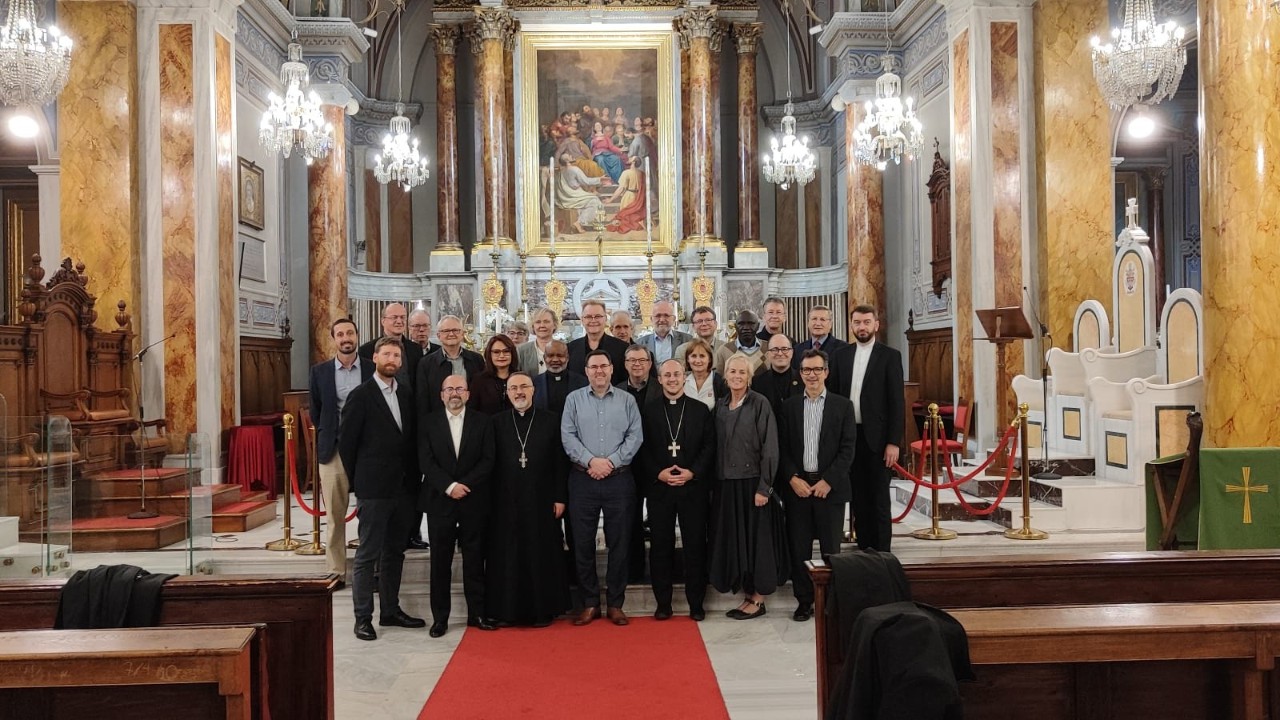
The annual Conference of Secretaries of Christian World Communions (CS/CWCs) took place in Istanbul, Turkey, from 4 to 6 November 2025, hosted by the Ecumenical Patriarchate. The gathering brought together representatives from a wide range of Christian communions to share updates on their activities and reflect on current challenges and opportunities in the service of Christian unity.

The Catholic Church was represented by Archbishop Flavio Pace, Secretary of the Dicastery for Promoting Christian Unity, assisted by Monsignor Andrzej Choromański, staff member responsible for multilateral relations within the Dicastery.

The Conference was chaired by Reverend César García, General Secretary of the Mennonite World Conference, with the assistance of Commissioner Jane Paone, The Salvation Army’s Secretary for International Ecumenical Relations, serving as secretary. Each day opened and concluded with a prayer time led by one of the participants according to his or her own tradition, offering a tangible sign of the spiritual diversity and communion that characterize the Christian family.

Saturday, February 25, 2017

Blatant Ecumenism


November 15, 2016


Between October 11-13, 2016, the annual conference of Secretaries of Christian World Communions met in Rome where the participants were able to inform one another about “important events of their Church or confession and to give an update on the bilateral dialogues in which they are all involved.” 1 It is not surprising that this “unformal ecumenical forum” which was formed in 1957, also had an audience with Pope Francis. 2

In his speech to the Secretaries on October 12, Francis stressed the importance of the ecumenism of all Christians by stating “all Christians are on the way towards unity with Christ.” He then pointed out that ecumenism is not only about theology, but more importantly, uniting as one in Jesus. He spoke of the ecumenism of prayer, where Christians are to unite in praying for one another and for unity; the ecumenism of the way, where Christians are to unite and work together; and finally, referring to persecuted Christians, the blood ecumenism. 3

It is not surprising the pope’s message was one to promote ecumenism. CRUX, a Catholic news website, reports that Francis has “gone on to lead a distinctly ecumenical papacy” 4 and “two of Pope Francis’ most ardent priorities are environmental protection and Christian unity.” 5

So what does this have to do with Seventh-day Adventists? According to the Adventist News Network, for the past 46 years, the Secretary-General of the Secretaries of the Christian World Communions has been a Seventh-day Adventist. 6

Between 1970 and 2003, Dr. Bert B. Beach was Secretary-General. As a representative for the General Conference, it is a documented fact that, on behalf of the Seventh-day Adventist Church, Beach gave the pope a gold medal in 1977.

Between 2003 and 2014, Dr. John Graz was elected the Secretary-General of the Secretaries of the Christian World Communions. And finally, in December, 2014, Dr. Ganoune Diop was elected as the Secretary-General. The appointment lasts for two years, usually with re-elections. For more information about Dr. Diop, please see episode 7 of the “Apostasy in our Midst” video series on the For My People Ministry website.

The Adventist News Network reported, “The Conference of Secretaries represents about two billion Christians and covers more churches than any other organization.” It argues that this organization “isn't a [sic] ecumenical movement” and its “purpose is not to build the visible unity of the Christian family.” 7

Clearly, this description is not correct. According to Wikipedia, “The Conference of Secretaries of World Christian Communions is an international ecumenical organization with annual meetings.” 8

Those present at this year’s ecumenical meeting, include: “the Anglican Communion, the Baptist World Alliance, the Disciples Ecumenical Consultative Council, the Ecumenical Patriarchate, the Friends World Committee for Consultation, the General Conference of Seventh-day Adventists, the Global Christian Forum, the Lutheran World Federation, the Mennonite World Conference, the Moravian Church, the Organization of African Instituted Churches, the Pentecostals, the Roman Catholic Church, the Russian Orthodox Church, the Union of Utrecht (Old Catholics), the World Communion of Reformed Churches, the World Convention of Churches of Christ, the World Council of Churches, the World Evangelical Alliance and the World Methodist Council.” 9

We need to ask ourselves, how can Seventh-day Adventists preach the three angels’ messages and call people out of Babylon when at the same time they are uniting with Babylon? How can they teach people the pope is the antichrist when they allow themselves to be addressed by the pope who says, “And I walk with Jesus, not with my Jesus against your Jesus, but with our Jesus”? 10 The truth is that the Jesus the pope walks with is not the same Jesus we are to walk with.

Martin Luther had a clear understanding of this. In the book, The Great Controversy, we read: “When the papal bull reached Luther, he said: ‘I despise and attack it, as impious, false. ... It is Christ Himself who is condemned therein. ... I rejoice in having to bear such ills for the best of causes. Already I feel greater liberty in my heart; for at last I know that the pope is antichrist, and that his throne is that of Satan himself.’ ” -d'Aubigné, B. 6, Ch. 9. 11

The reformers were not afraid to proclaim the truth about the pope and the papacy, even at the peril of their lives. Today, however, Protestantism has changed. One hundred years ago, God’s messenger could write:

“But Romanism as a system is no more in harmony with the gospel of Christ now than at any former period in her history. The Protestant churches are in great darkness, or they would discern the signs of the times. The Roman Church is far-reaching in her plans and modes of operation. She is employing every device to extend her influence and increase her power in preparation for a fierce and determined conflict to regain control of the world, to re-establish persecution, and to undo all that Protestantism has done. Catholicism is gaining ground upon every side. See the increasing number of her churches and chapels in Protestant countries. Look at the popularity of her colleges and seminaries in America, so widely patronized by Protestants. Look at the growth of ritualism in England and the frequent defections to the ranks of the Catholics. These things should awaken the anxiety of all who prize the pure principles of the gospel. Protestants have tampered with and patronized popery; they have made compromises and concessions which papists themselves are surprised to see and fail to understand. Men are closing their eyes to the real character of Romanism and the dangers to be apprehended from her supremacy. The people need to be aroused to resist the advances of this most dangerous foe to civil and religious liberty.” 12

Not only are the Protestant churches in great darkness, but the majority of Seventh-day Adventists also demonstrates that they are unable to discern the signs of the times.

We can be encouraged because God is waking up His faithful people to discern the meaning of current events, as well as to prepare them for what will soon take place.


1. ↑ http://www.ecupatria.org/2016/10/14/conference-of-secretaries-of-christian-world-communions/
2. ↑ ibid.
3. ↑ http://m.vatican.va/content/francescomobile/it/speeches/2016/october/documents/papa-francesco_20161012_christian-world-communions.html
4. ↑ https://cruxnow.com/church/2016/01/25/francis-proving-to-be-a-very-ecumenical-pope/
5. ↑ https://cruxnow.com/church/2015/09/02/pope-francis-blends-environmental-ecumenical-agendas-in-day-of-prayer/
6. ↑ http://news.eud.adventist.org/en/all-news/news/go/2014-12-02/adventist-leader-new-secretary-general-of-the-christian-world-communions/
7. ↑ ibid.
8. ↑ https://en.wikipedia.org/wiki/Conference_of_Secretaries_of_World_Christian_Communions
9. ↑ http://www.ecupatria.org/2016/10/14/conference-of-secretaries-of-christian-world-communions/
10. ↑ http://m.vatican.va/content/francescomobile/it/speeches/2016/october/documents/papa-francesco_20161012_christian-world-communions.html
11. ↑ Ellen G. White, The Great Controversy (1911), p. 141
12. ↑ Ellen G. White, The Great Controversy (1911), pp. 565-566


Source


Saturday, November 19, 2016

The Pope to the Christian World Communions delegation: ecumenism of prayer, journeying and blood,


12.10.2016


This morning, before the general audience and in the room adjacent to the Paul VI Hall, the Pope received in audience the participants in the Conference of Secretaries of Christian World Communions, the international ecumenical association that meets annually in October, each year in a different country, to improve mutual awareness. It is made up of the Anglican Communion, the World Baptist Alliance, the Disciples Ecumenical Consultative Council, the Ecumenical Patriarchate (Eastern Orthodox), General Conference of Seventh-Day Adventists, the International Old Catholic Bishops’ Conference, the World Lutheran Foundation, the Mennonite World Conference, the Moravian Church Worldwide Unity Board, the Patriarchate of Moscow (Eastern Orthodox), the Pentecostals, the Pontifical Council for Promoting Christian Unity (Catholic Church), the Reformed Ecumenical Council, the Salvation Army, the Friends World Committee for Consultation (Quakers), the World Convention of Churches of Christ, the World Evangelical Alliance and the World Methodist Council. A representative of the World Council of Churches is also usually present.

In his brief address, the Pope referred to two phrases used by the Head of the Delegation: “Jesus is with us”, and “Jesus is journeying with us”. “These phrases made me reflect, and they pose two questions: am I capable of believing that Jesus is with us? Am I capable of journeying with all, together, and also with Jesus? Often we think that ecumenical work is only that of theologians. It is therefore important that theologians study, they agree, and they express their disagreement: this is very important. But in the meantime ecumenism journeys on. It journeys with Jesus, not ‘my Jesus against your Jesus’, but with our Jesus. The journey is simple: it is consists of prayer, with the help of others. Praying together: the ecumenism of prayer, for each other and all for unity. And then, the ecumenism of work for the many who are in need, for many men and women who today suffer as a result of injustice, wars, these terrible things. … All together, we must help. Love for our neighbour. This is ecumenism. This is already unity. Unity in journeying with Jesus”.

The Holy Father went on to add that there is another form of ecumenism that typifies our age: that of blood. “When terrorists or world powers persecute Christian minorities or Christians”, he observed, “they do not ask: ‘Are you Lutheran? Are you Orthodox? Are you Catholic? Are you Reformed? Are you Pentecostal?’ No. ‘You are Christian’. They recognise one only: the Christian. The enemy is not wrong: he recognises where to find Jesus. And this is the ecumenism of blood. Nowadays we are witnesses to this, and I think of the Orthodox brethren beheaded on the beaches of Libya, for example: they are our brothers. They gave witness to Jesus and they died saying, ‘Jesus, help me!’. With His name: they confessed the name of Jesus”.

“Therefore, ecumenism in prayer, ecumenism in our journey, and the enemy teaches us the ecumenism of blood. Thank you, many thanks for this visit”.


Source


Sunday, November 13, 2016

Conference of Secretaries of Christian World Communions


Conference of Secretaries of Christian World Communions


Organization

Pontifical Council for Promoting Christian Unity

Traditions

Ecumenical

The annual Conference of Secretaries of World Christian Communions brings together representatives from diverse Christian traditions to discuss their work and fellowship together. As general secretaries, participants are often the global face of a particular Christian theological tradition. Participating communions include the following: the Anglican Communion, Baptist World Alliance, Disciples Ecumenical Consultative Council, Ecumenical Patriarchate (Eastern Orthodox), General Conference of Seventh-day Adventists, International Old Catholic Bishops' Conference, Lutheran World Federation, Mennonite World Conference, Moravian Church Worldwide Unity Board, Moscow Patriarchate (Eastern Orthodox), Pentecostals, Pontifical Council for Promoting Christian Unity (Catholic Church), Reformed Ecumenical Council, The Salvation Army, Friends World Committee for Consultation, World Alliance of Reformed Churches, World Convention of Churches of Christ, World Evangelical Alliance, and the World Methodist Council. A representative from the World Council of Churches is often present, as well.

Conference of Secretaries of Christian World Communions


ECUMENICAL
PATRIARCHATE
PERMANENT
DELEGATION
TO THE WORLD
COUNCIL OF CHURCHES


Conference of Secretaries of Christian World Communions


October 14, 2016


The annual conference of Secretaries of Christian World Communions took place in Rome on October 11–13, 2016. This unformal ecumenical forum that goes back to 1957 sees itself as “communions of Churches belonging to the same tradition and held together by this common heritage, conscious of living in the same universal fellowship and giving to this consciousness at least some structured visible expression” (Study Encounter, IV, 1, 1968, p. 46).

The annual conference is an occasion for participating secretaries to inform each other about important events of their Church or confession and to give an update on the bilateral dialogues in which they are involved. At this year’s meeting, reports were given by representatives of the Anglican Communion, the Baptist World Alliance, the Disciples Ecumenical Consultative Council, the Ecumenical Patriarchate, the Friends World Committee for Consultation, the General Conference of Seventh Day Adventist, the Global Christian Forum, the Lutheran World Federation, the Mennonite World Conference, the Moravian Church, the Organisation of African Instituted Churches, the Pentecostals, the Roman Catholic Church, the Russian Orthodox Church, the Union of Utrecht (Old Catholics), the World Communion of Reformed Churches, the World Convention of Churches of Christ, the World Council of Churches, the World Evangelical Alliance and the World Methodist Council.

The participants of the conference had an audience with Pope Francis on October 12. In his address⇒, the Pope of Rome underlined that each Christian is with Christ, and that all Christians are on the way towards unity with Christ. He stressed the importance of prayer and of helping each other. He spoke as well of “ecumenism of blood”, remembering the contemporary Christian martyrs, especially in Middle East, and stressed that these terrorist acts are not directed against Christ of a particular confession, but against our common Christ.

The next conference of Secretaries of Christian World Communions will be held in Colombia in November 2017.


Saturday, June 13, 2015

Christian World Communions: Five Overviews of Global Christianity, AD 1800–2025

This 8-page report is the twenty-fifth in an annual series in the IBMR. This year we set out a 5-fold panorama of descriptors of the relatively unknown Conference of Christian World Communions (CCWC)—historical, documentary, photographic, confessional, and statistical.

A Christian World Communion (CWC) is defined here as an ongoing body uniting only churches and denominations with one similar ecclesiastical tradition or characteristic (Adventist, Anglican, Baptist, Disciples, Eastern Orthodox, Evangelical, Lutheran, Methodist, Old Catholics, Oriental Orthodox, Pentecostal, Reformed, Roman Catholic, Salvationist, etc.) though recognizing the existence and legitimacy of all the others.

Persons invited to the annual conference are few enough to allow everyone to get to know the others in the short three days. Those invited are heads of Communions¬—patriarchs, presidents, popes, archbishops, bishops, chairmen—with each bringing no more than one or two colleagues. No press are invited, nor observers. There is no centralized budget. Subjects discussed can be seen in the notes in Global Table 1's right-hand column. Average attendance in the early days was 15, rising gradually to 35 today (see Global Table 1 column T).

This first page draws attention to noteworthy aspects of the five tables that follow.

Global Table 1: Historical Overview

CCWC leadership has always insisted on a 3-day conference every October as top priority. This first global table reveals the success of this policy. The first Communion in this sense was the Lambeth Conference (1873), attended by 76 bishops, followed closely by 5 other Communions. By 1957 the movement was strong enough for the 7 major CWCs to hold their inaugural CCWC (see top photo in Global Table 3). Each year's activities and personages are described using the 26 letters A to Z as codes. This permits us to compress a large amount of data about each conference on its own line.

Landmark personages in this history of development are W. A. Visser 't Hooft, E. Perret, H. Meyer, B. B. Beach, J. Hale, P. Duprey, L. Vischer, John Paul II, D. Lotz, J. Peterson, J. Graz, A. D. Falconer, and S. Nyomi.

Global Table 2: Documentary Overview

Two streams of documents are relevant here. First, the CCWC has commissioned 97 research papers from 1957 as listed here in this table. A minority have been published, but most remain unpublished.

The second stream consists exclusively of published International Bilateral Dialogues (IBDs). These are agreements between any 2 worldwide CWCs who agree to sit down for a period of at least several months to discuss each other's difficult doctrines or central dogmas and to seek mutual answers and explanations. When each party feels satisfied, a joint statement of agreement is compiled and then jointly published. As Global Table 5 Line 48 indicates, by 2009 there exist at present 290 published IBDs, with 8 new ones currently under way.

In our accounting process in Global Table 1, category D enumerates only the first stream above, but category S includes the IBD summaries in Growth in Agreement I (1984), II (2000), and III (2007). Total IBDs = 300 by AD 2010. This means that the total professional documents generated by the CCWC has now passed 850—a formidable amount of scholarship and planning.

Global Table 3: Photographic Overview

Photos taken at each year's CCWC convey the humor, excitement, learning, and fellowship experienced, as well as the determination of all present to strive for the fulfillment of Christ's keyword: "so that they all may be one." The 1957 2nd meeting (top) identifies all 14 of those present by name and Communion. Note the large number of research reports as Visser 't Hooft finishes his opening paper. In 1986 Pope John Paul II (right) addresses the other 20 CWCs, drawing attention to the value of personal friendship. And on the last day of the 20th century, CCWC delegates (bottom) met in Bethlehem and Jerusalem, representing 91 percent of global Christianity, conversing in an estimated 3,000 different languages.

Global Table 4: Confessional Overview

The CCWC has 23 committed regular attending Communions. Some 50 additional CWCs are in full sympathy but have not been invited. Another 100 have friendly links to existing CCWC members. Lastly, some 110 may be described as opposed to ecumenism or conciliarism in general.

Global Table 5: Statistical Overview

This final table presents a statistical overview of the entire world's 2.2 billion Christians and their activities, encompassing 2 alternative parallel but different groupings: first, the (a) Global Christian Forum (GCF), which is bringing together all Christians of every variety. So far the Forum has held conferences together at the global level (Nairobi 2007, New Delhi 2008) and increasingly at regional levels. There has been remarkable success in the determination to invite as speakers church leaders who hitherto have avoided each other. Second, the ministry of (b) the Conference of Christian World Communions (CCWC) over its 50 years has developed such cooperation to a fine art.

These two global enterprises are now discovering powerful ways of working together in 80 varieties of ministry under 10 main global ministries or concepts or keywords in widespread or current use (background, presence, mission, common witness, baptism, unity, renewal, communications, evangelism, evangelization), for the period AD 1800–AD 2025.

In the light of history's 20 centuries of Christian disagreements, misunderstandings, rivalries, and even excommunications and outright warfare, the recent global developments sketched in this report are clearly of immense significance. {26}


This report, which is also available as a separate offprint, was prepared by David B. Barrett, a contributing editor, Todd M. Johnson, and Peter F. Crossing, who publish widely in the field of missiometrics. Most subjects mentioned in this report are expanded in detail in their World Christian Encyclopedia (1982, 2001) andWorld Christian Trends (2001), and are updated in http://worldchristiandatabase.org. Detailed footnotes for Global Table 5 can be found atwww.globalchristianity.org/ibmrnote.php.


.
Thursday, May 09, 2013

Conference of Secretaries of Christian World Communions


Conference of Secretaries of Christian World Communions

The annual Conference of Secretaries of World Christian Communions brings together representatives from diverse Christian traditions to discuss their work and fellowship together. As general secretaries, participants are often the global face of a particular Christian theological tradition. Participating communions include the following: the Anglican Communion, Baptist World Alliance, Disciples Ecumenical Consultative Council, Ecumenical Patriarchate (Eastern Orthodox), General Conference of Seventh-day Adventists, International Old Catholic Bishops' Conference, Lutheran World Federation, Mennonite World Conference, Moravian Church Worldwide Unity Board, Moscow Patriarchate (Eastern Orthodox), Pentecostals, Pontifical Council for Promoting Christian Unity (Catholic Church), Reformed Ecumenical Council, The Salvation Army, Friends World Committee for Consultation, World Alliance of Reformed Churches, World Convention of Churches of Christ, World Evangelical Alliance, and the World Methodist Council. A representative from the World Council of Churches is often present, as well.


Related: 
Flashback


World Church: Christian World Communions Meet, Elect Leaders


Nov. 09, 2004 Buenos Aires, Argentina


ANN Staff
Dr. John R. Graz, public affairs and religious liberty director for the Seventh-day Adventist Church world headquarters. [Photo ANN Staff]


John R. Graz, Public Affairs and Religious Liberty director for the Seventh-day Adventist Church, was re-elected secretary general of the Conference of Secretaries of Christian World Communions, or CS/CWC. The group represents 2 billion Christians from a variety of denominations globally. Dr. Setri Nyomi of the Evangelical Presbyterian Church of Ghana, and executive secretary of the World Alliance of Reformed Churches, was elected CS/CWC president at the Oct. 23 to 28 conference.

Since 1957, the CS/CWCs have met annually for an informal exchange of ideas and information. Graz was among several Christian leaders who met with Argentinian officials including Alberto Fernández, chief of the cabinet; Oscazr Parrilli, general secretary of the Presidency; and José Cardoso, general director of the National Registry of Religions. Presentations were made to the group by representatives of the ecumenical community: the Baptists, Pentecostals, Anglicans and the Seventh-day Adventist Church.

Graz’s election continues a 34-year run of Adventist Church representatives participating in the world organization. Last year he succeeded Dr. Bert B. Beach, director for Interchurch Relations for the Adventist world church, in that position.

“The meeting was important because our [local church] president was invited to introduce the work of the Adventist Church in Argentina,” Graz noted. “During that meeting we heard several lectures about the religious and social situation in Argentina and how the various Christian churches live together. We also had a government report on church and state relations,” he added.

The substance of those reports, Graz said, is that while the Roman Catholic Church is the official church of the country, other churches are not discriminated against.


Source: © 2013, Adventist News Network

Source: http://news.adventist.org/en/archive/articles/2004/11/09/world-church-christian-world-communions-meet-elect-leaders

.