Showing posts with label IRAQ. Show all posts
Showing posts with label IRAQ. Show all posts
Thursday, March 12, 2026


Wednesday, October 15, 2025
Jesuit Education Could Bring Hope for Iraq's Future
OPINION
Jesuit Education Could Bring Hope for Iraq's Future
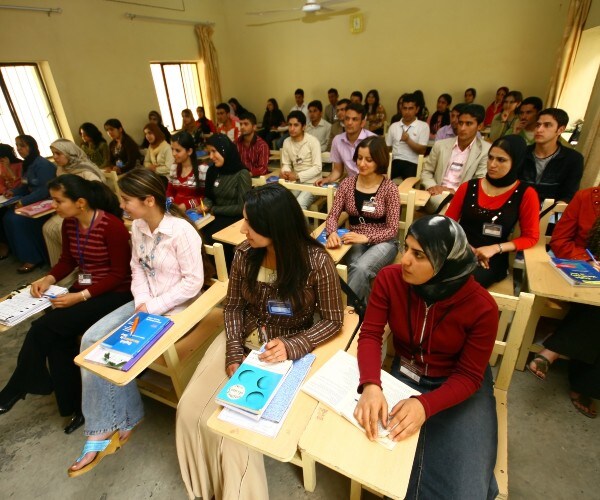
Dohuk University. University students in Dohuk City, Kurdistan, Northern Iraq. (Sadık Güleç/Dreamstime.com)

Jesuit Education Could Bring Hope for Iraq's Future
Dohuk University. University students in Dohuk City, Kurdistan, Northern Iraq. (Sadık Güleç/Dreamstime.com)
Friday, 10 October 2025 10:09 AM EDT
Between the Tigris River and Hope: A Father's Vision for Iraq's Future
We know that all things work for good for those who love God, who are called according to his purpose.
—Romans 8:28
The nightmare of my brother's assassination (in a car) in Baghdad, Iraq has never left me.
Like an interminable shadow, it hovers over me, pressing against my chest until I can hardly breathe. At times, I feel as though I am inside that crushed car with him, unable to escape.
When the news of his death reached us, I was at my family's home (in Baghdad).
The weight of it sank into the walls, into the silence that followed. A few days later, I felt obliged to go to the scene to see where his life had ended, to try to understand what had happened.
I've learned that the combination of grief and faith asks us to believe in something we cannot yet see — to quote St. Paul, "all things work for good for those who love God, who are called according to his purpose," Romans 8:28.
Saturday, February 03, 2024
Monday, December 10, 2018
Mass Celebrated in ISIS Destroyed Town Rebuilt by Knights of Columbus
12/10/2018
By Andrew Fowler
War, persecution, and ruin. This was the reality of life in Karamles, an Iraqi town home to Christians and other religious minorities that was ravaged by the genocidal campaign of ISIS that began in 2014.
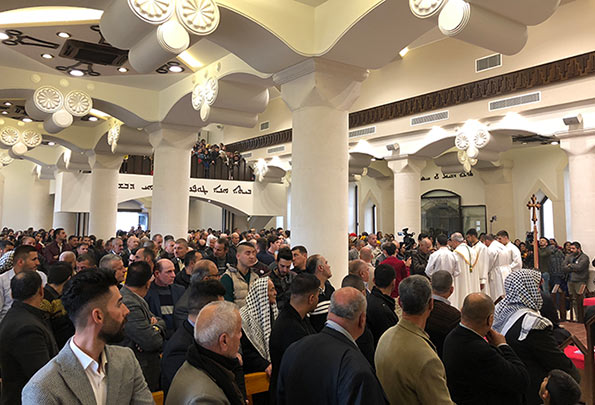
On Dec. 7, a Mass was held in Karamles as people returned to the town thanks to the efforts and donations made by the 1.9 million members of Knights of Columbus.
In 2016, the Knights committed to raising $2 million to rebuild Karamles and partnered with the Archdiocese of Erbil to resettle refugees, from the town and the surrounding area. Since 2014, the Order has committed more than $20 million to aid persecuted Christians and religious minorities in the Middle East.
The Mar Addai Chaldean Catholic Church, which had been destroyed and desecrated by ISIS along with most of the town's Christian homes, celebrated a rededication Mass that had an overflowing congregation of more than 1,000 people.
In a speech at the end of Mass, Father Thabet Habib Yousif thanked the many groups that made the rebuilding of his town possible, including the United States Agency for International Development (USAID) and the United Nations Development Programme (UNDP). He offered particular thanks to the continuing U.S. diplomatic efforts to save his threatened people and the Archdiocese of Erbil and Archbishop Bashar Warda, who sheltered and fed the displaced people of his town during the genocide.
"While many people have helped us, 97 percent of the restoration of homes and church buildings came from the Knights of Columbus,” said Father Thabet.
Father Thabet then presented the Knights with a wooden cross made from the remnants of the destroyed church that has a stone embedded in it from the original altar, which had been destroyed and used for target practice by ISIS during their occupation.
During the occupation by ISIS, hundreds of families fled the area, resettling and rebuilding in places like the Archdiocese of Erbil. ISIS declared Christians their “favorite prey.” Christians and other religious minorities faced beheadings and crucifixions, while women and girls as young as 1 year old, were sold into sexual slavery. In the last several years, the Christian population declined in Iraq from 1.4 million before 2002 to barely more than 250,000 in 2017, according to the U.S. State Department’s International Religious Freedom Report.
Meanwhile, the Knights have worked with the U.S. Congress and the Obama and Trump administrations to assist in the humanitarian efforts. The Order also commenced a joint effort with USAID in assisting religious minorities in the rebuilding and stabilization of their communities. Learn more about the Knights’ efforts here.
The latest milestone is the unanimous passage of the “Iraq and Syria Genocide Relief and Accountability Act of 2018,” an act that will provide humanitarian relief for victims of genocide in Iraq and Syria, while holding ISIS perpetrators accountable.
President Donald Trump is set to sign the bipartisan legislation on Dec. 11.
The Knights will continue to help rebuild these communities. Please donate here to help.
For questions, or to tell your Knights of Columbus, reach out to andrew.fowler@kofc.org
Source
Monday, October 24, 2016
The Islamic State in Iraq: TERROR Episode 3 (Full Episode)
Warning: May be not appropriate for all audiences.
The Islamic State in Iraq: TERROR Episode 3 (Full Episode)

VICE News
Published on Oct 24, 2016
VICE founder Suroosh Alvi travels to the front lines in Iraq to bring you the full story of the Islamic State’s rise, from the inception at Camp Bucca to the battle for Mosul.
Subscribe to VICE News here: http://bit.ly/Subscribe-to-VICE-News
Check out VICE News for more: http://vicenews.com
Follow VICE News here:
Facebook: https://www.facebook.com/vicenews
Twitter: https://twitter.com/vicenews
Tumblr: http://vicenews.tumblr.com/
Instagram: http://instagram.com/vicenews
More videos from the VICE network: https://www.fb.com/vicevideo
Monday, August 08, 2016
Swedish free church to drop bibles into Isis areas

A file photo of a Livets Ord meeting. Photo: Fredrik Persson/TT
The Local · 8 Aug 2016, 07:55
A Swedish evangelical free church has said it plans to use drones to drop thousands of bibles into Isis-controlled areas in Iraq.
Man kicked off flight from Sweden over 'Isis tattoo'
Isis: Sweden calls for talks to discuss plans
At a meeting in Uppsala, the Livets Ord (Word of Life) organization presented how drones flying at a high altitude would release thousands of small, electronic bibles into Iraq.
“The bibles are the size of pill boxes and have a display. They require no electricity, but work on their own,” its mission director Christian Åkerhielm told broadcaster SVT.
“Our ambition is to pass on the hope and love of the Christian gospel to a population living in closed areas where they are being denied human rights,” Livets Ord wrote on its website.
It said another organization in the area would be carrying out the operation, but did not name the other group.
“We start our project in a few weeks and hope to drop thousands of bibles,” it said.
A spokesperson later told The Local that the operation was not intended as a provocation.
"This missions project is closer to traditional smuggling of bibles, and it is not connected to any military or aggressive action in any way," he said.
Story continues below…
More from The Local
18 mistakes foreigners make when first moving to Sweden
Swedish bus driver fired for hitting asylum seeker
Founded in the 1980s, Livets Ord is one of relatively secular Sweden's largest and arguably most controversial free churches, often accused of a sect-like image. Its founders Ulf and Birgitta Ekman left the church in 2014 to convert to Catholicism.
It also runs a series of evangelical schools for children. The current leader of the Christian Democrat party, Ebba Busch Thor, who is from Uppsala, attended one of them until she turned 16.
Source
Tuesday, December 09, 2014
Knights send $2.2 million to assist Christian refugees in Iraq, Syria
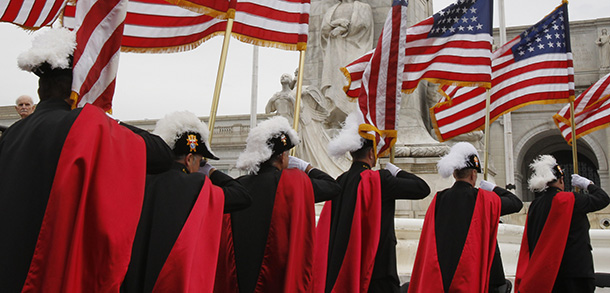
Photo (Courtesy) http://www.thecatholictelegraph.com/pope-thanks-knights-of-columbus-for-prayers-solidarity/16138
12/8/2014 9:48:00 AM
Catholic News Service
NEW HAVEN, Conn. — The Knights of Columbus announced its Christian Refugee Relief Fund has donated $2.2 million to help displaced Iraqi and Syrian Christians and other religious minorities who continue to face violent persecution "and the very real prospect of extinction."
"This is a concrete response to the unfolding humanitarian crisis in Iraq and to the urgent appeals from the region as well as Pope Francis' request for material assistance for those affected by this persecution," Supreme Knight Carl Anderson said in a statement.
The funds will help provide permanent housing for the increasing number of displaced families in Iraq, according to a news release.
Specifically, it said, the Knights' donation of $2 million will pay for the construction of new homes on property owned by the Chaldean Catholic Archdiocese of Irbil in the Kurdish-controlled region of northern Iraq.
The Knights' Supreme Council, which has its headquarters in New Haven, began the fund in August with $1 million and has since raised an additional $1.7 million in donations from individual Knights, local Knights councils and others, for a total of $2.7 million.
The donations were "accompanied by fervent prayers for all those suffering in the land of the holy apostles," Anderson said.
Houses will be built for Iraqi Christians who were driven from their homes in Mosul and the surrounding area and who have been living in emergency shelters and random locations far from home.
"With winter setting in, already grave conditions are expected to only worsen as these families are going without proper shelter, which is so fundamental to living their lives," said Anderson. "These new homes are signs of hope that will allow this community to begin to blossom once again."
The Knights' Christian Refugee Relief Fund also has made a separate donation of $200,000 in general aid to the Melkite Catholic Archdiocese of Aleppo, Syria.
The Knights of Columbus is the world's largest Catholic fraternal organization with more than 1.8 million members worldwide.
.
Wednesday, September 17, 2014
Jimmy Carter: U.S. bombing of Islamic State ‘justified’
2 hours ago
Share this video
September 17, 2014 1:40 PM EDT - Former president Jimmy Carter says he hopes President Obama is successful in recruiting allies to join the fight against extremists and that he thinks Islamic State forces are a threat to the entire Middle East. (AP)
Source
.
.
Thursday, September 11, 2014
2 years after withdrawal, Obama makes case for new military action in Iraq

President Obama addresses the nation from the Cross Hall in the White House in Washington. (Associated Press)
By Dave Boyer - The Washington Times - Wednesday, September 10, 2014
President Obama announced an escalation of the war against Islamic State terrorists Wednesday night with plans to intensify airstrikes in Iraq, send more U.S. military advisers to Baghdad, provide arms to Syrian rebels and likely expand airstrikes into Syria.
“If left unchecked, these terrorists could pose a growing threat beyond that region — including to the United States,” Mr. Obama said in a prime-time address from the White House. “We will conduct a systematic campaign of airstrikes against these terrorists.”
SEE ALSO: Analysis: Chastened, changed Obama suddenly echoes Bush 41
The president ordered another 475 military advisers to Iraq, on top of 300 advisers he sent there in June and 130 U.S. personnel he sent last month to aid in a humanitarian mission.
In addition to ramping up the bombing missions that will be flown by U.S. warplanes and drones against the Islamic State in Iraq, Mr. Obama said the air war likely will be expanded into Syria when U.S. reconnaissance missions identify more targets of the terrorist organization also known by the acronyms ISIL and ISIS.
Indeed, in an echo of President George W. Bush’s anti-terror doctrine, he specified that terrorists will not be safe in any country.
“I have made it clear that we will hunt down terrorists who threaten our country, wherever they are,” Mr. Obama said. “That means I will not hesitate to take action against ISIL in Syria, as well as Iraq. This is a core principle of my presidency: If you threaten America, you will find no safe haven.”
SEE ALSO: HAYDEN: Obama will need to put more boots on the ground
While the president outlined a multipronged military and diplomatic strategy for going on the offensive against the surging Sunni militants, he took pains to contrast the expanded campaign with Mr. Bush’s wars in Afghanistan and Iraq.
For example, he referred to this campaign, which has surpassed more than 150 airstrikes in Iraq, as a counterterrorism operation instead of a war — a word he used in only two references to what his plan is not.
“I want the American people to understand how this effort will be different from the wars in Iraq and Afghanistan,” Mr. Obama said. “It will not involve American combat troops fighting on foreign soil. This counterterrorism campaign will be waged through a steady, relentless effort to take out ISIL wherever they exist using our air power and our support for partner forces on the ground.”
The strategy, unveiled just two weeks after Mr. Obama said he had no plan for defeating the militants in Syria, will rely on the U.S. and its allies arming moderate Syrian rebels who are battling both the Islamic State and the regime of President Bashar Assad in a 3-year-old civil war.
While some in Congress have been urging Mr. Obama for years to arm the Syrian rebels, other lawmakers reacted warily to the plan.
“We have to make sure that we’re not putting weapons into the hands of al Qaeda or other jihadis,” Rep. Peter T. King, New York Republican, said on CNN.
In Iraq, the president said the formation of a new government under Prime Minister Haidar al-Abadi will be the key to rehabilitating the dubious Iraqi army and taking the fight to the militants.
“With a new Iraqi government in place, and following consultations with allies abroad and Congress at home, I can announce that America will lead a broad coalition to roll back this terrorist threat,” Mr. Obama said. “Our objective is clear: We will degrade, and ultimately destroy, [the Islamic State] through a comprehensive and sustained counterterrorism strategy.”
On the eve of the 13th anniversary of the 9/11 terrorist attacks, Mr. Obama’s announcement of the military escalation was a dramatic turnaround by a president who dismissed the Islamic State nine months ago as a “JV” terrorist group. Last year, the president told Americans that the large-scale war against Islamist extremism was all but over.
The gains by the terrorist group have brought Mr. Obama to a decision to carry out a military campaign in Syria only one year after he announced — and then withdrew — plans to launch missile attacks against the Assad regime for using chemical weapons in the civil war.
Although Mr. Obama didn’t announce a specific air campaign in Syria, aides said U.S. airstrikes against militants there are only a matter of time.
“We are going to take airstrikes in Syria at a time and place of our choosing,” said a senior administration official. “We will take action on the Syrian side of the border … but we’re not going to telegraph our punches.”
Mr. Obama has said he has the authority to proceed with much of his plan without formal approval from Congress. But he is seeking lawmakers’ authorization for $500 million to train and equip Syrian rebels, a request he first made in May in a speech at the U.S. Military Academy at West Point.
House Republicans raised a potential roadblock for that operation Wednesday by not including the measure in temporary funding legislation. Mr. Obama and Vice President Joseph R. Biden were calling lawmakers and urging them to include the authorization in the funding bill.
The president also ordered $25 million under the Foreign Assistance Act to be spent on equipment and training for the Iraqi army, including Kurdish forces.
House Speaker John A. Boehner said after the speech that Mr. Obama made a welcome turn and “recanted his earlier dismissals of ISIL’s capabilities and rightly acknowledged the grave and growing threat posed by the spreading global epidemic of radicalized Islam.”
But the Ohio Republican said questions remain about the president’s plan because training Iraqi forces “could take years to fully implement at a time when ISIL’s momentum and territorial gains need to be immediately halted and reversed.”
“It is also a cause for concern that the president appears to view the effort against ISIL as an isolated counterterrorism campaign, rather than as what it must be: an all-out effort to destroy an enemy that has declared a holy war against America.”
Before the speech, Sen. Ted Cruz, Texas Republican, said Mr. Obama must seek congressional authorization for proposed military action against the Islamic State.
“Only Congress has the authority to declare war. While our commander in chief has constitutional authority to respond to an imminent danger, Obama has not suggested that is the case,” Mr. Cruz wrote in an op-ed for CNN. “He is reportedly planning a mission that could last as long as three years and may require a range of actions.”
Some Democrats, too, are expressing reservations about expanding the offensive. Rep. John Garamendi, California Democrat, said he wants to make sure the plan isn’t limited to airstrikes.
“We cannot win this with bombing,” he said. “This is going to have to be a diplomatic effort with the countries in the area coming together and deciding it is in their best interests to stifle and snuff out [the Islamic State].”
After Mr. Obama’s speech, several liberal advocacy groups reacted negatively to the president’s plan.
“We remain deeply troubled by any plan for U.S. military engagement that has not been explicitly debated by the American people and voted on by Congress,” said Neil Sroka, a spokesman for Democracy for America. “After more than a decade of war, the American people and their representatives in Congress must have a calm, rational public debate of that response and the appropriate level of U.S. involvement.”
The president and his top advisers also were working to firm up a coalition including Arab states to fight the militants. Mr. Obama spoke by phone with King Abdullah of Saudi Arabia, ahead of a gathering of Arab leaders on their contributions to a global coalition against the Islamic State.
Secretary of State John F. Kerry is heading to Saudi Arabia and Jordan this week, after stopping in Baghdad on Wednesday to meet with Iraq’s new leaders and pledging U.S. support for eliminating the extremist group and the threat it poses.
Mr. Kerry said the Iraqis have achieved a historic result by forming a new government under Prime Minister Haidar al-Abadi, a key to Mr. Obama’s plan to rebuild the Iraqi army to fight the militants more effectively.
“This is a broad-based, comprehensive strategy that is being laid out,” Mr. Kerry said. “And it will not just be reserved to bombs or direct military assistance. It will be comprehensive with Iraqi forces on the ground in Iraq with an army that will be reconstituted and trained and worked on in terms of a number of different strategies.”
France’s foreign minister said his country was ready to take part in airstrikes against extremist fighters in Iraq if needed. The German government announced that it was sending assault rifles, ammunition, antitank weapons and armored vehicles to Kurdish forces in Iraq, breaking with the NATO member’s decadeslong reluctance to send weapons into conflict areas.
Mr. Kerry also announced that the U.S. is providing nearly $48 million in additional humanitarian aid for Iraqis internally displaced and refugees who have fled to Jordan, Lebanon and Syria. It brings the total amount of U.S. humanitarian assistance to displaced Iraqis to more than $186 million in fiscal year 2014.
Wednesday, August 13, 2014
U.S. Boots Stepping Closer to Iraq
Mark Thompson @MarkThompson_DC
8:41 PM ET

Getty Images
Administration asserts they wouldn’t be in combat, but the enemy might disagree

Those increasingly loud footsteps you hear could be the sound of U.S. military boots marching closer to Iraq, following a visit Wednesday by 20 U.S. troops to plot a way to rescue thousands of Yezidi refugees on a mountain surrounded by Islamic militants in northern Iraq. While they reported fewer stranded than originally thought, Pentagon officials said, a rescue operation still might be needed.
Administration asserts they wouldn’t be in combat, but the enemy might disagree
MOREThe Yezidis—and the Kurds—Hope for U.S. Salvation in IraqEvacuation Mission ‘Less Likely’ After U.S. Special Forces Land on Iraq MountainHow the Pentagon Would Save the Stranded Refugees in Northern Iraq
Those increasingly loud footsteps you hear could be the sound of U.S. military boots marching closer to Iraq, following a visit Wednesday by 20 U.S. troops to plot a way to rescue thousands of Yezidi refugees on a mountain surrounded by Islamic militants in northern Iraq. While they reported fewer stranded than originally thought, Pentagon officials said, a rescue operation still might be needed.
President Obama made it clear two months ago that American combat boots wouldn’t be headed back there, where 4,486 U.S. troops died between 2003 and 2011.
“We will not be sending troops back into combat in Iraq,” Obama pledged.
But you can drive an M-1 tank through that “into combat” caveat. It implies, as a top White House aide suggested anew Wednesday, that U.S. troops can go into harm’s way in Iraq and avoid combat. The first rule of war, old soldiers say, is that the enemy always gets a vote.
Other aides have been making similar distinctions. “This is not a combat, boots-on-the-ground operation,” Defense Secretary Chuck Hagel told Marines on Tuesday in California about a possible Iraq mission. “We’re not going to have that kind of operation.”
Hagel’s spokesman, Rear Admiral John Kirby, repeated that refrain Wednesday. “The president’s been very clear,” he told CNN. “There’s not going to be boots on the ground in a combat role.”
Deputy National Security Adviser Ben Rhodes said Wednesday that U.S. troops might be put on the ground to help rescue Yazidi refugees stranded along the Sinjar mountain range in northern Iraq. “The role of U.S. forces is not one of re-entering combat on the ground,” Rhodes said. “In terms of the kinetic actions that are being taken”—bullets and missiles, in other words—“those are in the form of airstrikes.”
But that assumes that if U.S. forces go into Iraq to help rescue the refugees, they’ll be calling the shots. Literally.
Unfortunately, the militants of the Islamic State of Iraq and Syria are eager to fight U.S. troops, Pentagon officials believe. Some are suicidal, and would like nothing more than to die in a firefight with American soldiers or Marines.
There are limits to how much protection U.S. troops on the ground can expect from U.S. warplanes and helicopter gunships above. And the nearer aircraft come to provide such firepower, the more vulnerable they become to whatever anti-aircraft weapons ISIS has.
Whatever Obama decides, U.S. troops will be able to defend themselves. “Force protection is always a mission for U.S. personnel in any country in the world,” Rhodes said. What Obama has “ruled out is re-introducing U.S. forces into combat on the ground in Iraq.” In other words, if U.S. troops are sent into Iraq on a rescue mission, think of them as a football team that plays only defense.
.
Tuesday, August 12, 2014
Obama administration is arming Kurds
THE OVAL
 David Jackson, USA TODAY3:18 p.m. EDT August 11, 2014

(Photo: Charles Dharapak, AP)
The Obama administration has begun providing weapons to Kurdish forces who are battling a militant army in northern Iraq, officials said Monday.
The militant group Islamic State, known also as both ISIS and ISIL, is the target of U.S. airstrikes that began last week, designed to protect U.S. personnel and religious minorities under siege from the militants.
State Department spokeswoman Marie Harf said "ISIL has obtained some heavy weaponry, and the Kurds need additional arms and we're providing those — there's nothing new here."
White House officials said last week they would be providing arms to the Kurds; officials in the U.S. and Iraq are working to accelerate the deliveries of weapons.
"This is being done in full coordination," Harf said. "The cooperation between Baghdad and Erbil (the Kurdish capital) has been at historic levels, with the Iraqi air force even providing direct support now to Kurdish forces engaged in combat against ISIL."
The Associated Press reports:
The officials wouldn't say which U.S. agency is providing the arms or what weapons are being sent, but one official said it isn't the Pentagon. The CIA has historically done similar quiet arming operations.
The officials spoke on condition of anonymity because they were not authorized to discuss the operation publicly.
The move to directly aid the Kurds underscores the level of U.S. concern about the Islamic State militants' gains in the north, and reflects the persistent administration view that the Iraqis must take the necessary steps to solve their own security problems.
.
U.S. Actions in Iraq Fueled Rise of a Rebel
Baghdadi of ISIS Pushes an Islamist Crusade
By TIM ARANGO and ERIC SCHMITT
AUG. 10, 2014

An image of Abu Bakr al-Baghdadi, taken from a video of a sermon he gave in July in Mosul.
CreditReuters Tv/Reuters
BAGHDAD — When American forces raided a home near Falluja during the turbulent 2004 offensive against the Iraqi Sunni insurgency, they got the hard-core militants they had been looking for. They also picked up an apparent hanger-on, an Iraqi man in his early 30s whom they knew nothing about.
The Americans duly registered his name as they processed him and the others at the Camp Bucca detention center: Ibrahim Awad Ibrahim al-Badry.
That once-peripheral figure has become known to the world now as Abu Bakr al-Baghdadi, the self-appointed caliph of the Islamic State in Iraq and Syria and the architect of its violent campaign to redraw the map of the Middle East.
“He was a street thug when we picked him up in 2004,” said a Pentagon official who spoke on the condition of anonymity to discuss intelligence matters. “It’s hard to imagine we could have had a crystal ball then that would tell us he’d become head of ISIS.”
RELATED COVERAGE
Iraqis Nominate Maliki Successor, Causing StandoffAUG. 11, 2014

Capitalizing on U.S. Bombing, Kurds Retake Iraqi TownsAUG. 10, 2014

Iraq Airstrikes May Continue for Months, Obama SaysAUG. 9, 2014

News Analysis: As ISIS Militants Exert Their Control, U.S. Pursues a Military Middle RoadAUG. 9, 2014

For Refugees on Mountain, ‘No Water, Nothing’AUG. 9, 2014

At every turn, Mr. Baghdadi’s rise has been shaped by the United States’ involvement in Iraq — most of the political changes that fueled his fight, or led to his promotion, were born directly from some American action. And now he has forced a new chapter of that intervention, after ISIS’ military successes and brutal massacres of minorities in its advance prompted President Obama to order airstrikes in Iraq.

Abu Bakr al-Baghdadi
CreditAssociated Press
Mr. Baghdadi has seemed to revel in the fight, promising that ISIS would soon be in “direct confrontation” with the United States.
Still, when he first latched on to Al Qaeda, in the early years of the American occupation, it was not as a fighter, but rather as a religious figure. He has since declared himself caliph of the Islamic world, and pressed a violent campaign to root out religious minorities, like Shiites and Yazidis, that has brought condemnation even from Qaeda leaders.
Despite his reach for global stature, Mr. Baghdadi, in his early 40s, in many ways has remained more mysterious than any of the major jihadi figures who preceded him.
American and Iraqi officials have teams of intelligence analysts and operatives dedicated to stalking him, but have had little success in piecing together the arc of his life. And his recent appearance at a mosque in Mosul to deliver a sermon, a video of which was distributed online, was the first time many of his followers had ever seen him.
Mr. Baghdadi is said to have a doctorate in Islamic studies from a university in Baghdad, and was a mosque preacher in his hometown, Samarra. He also has an attractive pedigree, claiming to trace his ancestry to the Quraysh Tribe of the Prophet Muhammad.
Beyond that, almost every biographical point about Mr. Baghdadi is occluded by some confusion or another.
The Pentagon says that Mr. Baghdadi, after being arrested in Falluja in early 2004, was released that December with a large group of other prisoners deemed low level. But Hisham al-Hashimi, an Iraqi scholar who has researched Mr. Baghdadi’s life, sometimes on behalf of Iraqi intelligence, said that Mr. Baghdadi had spent five years in an American detention facility where, like many ISIS fighters now on the battlefield, he became more radicalized.
Mr. Hashimi said that Mr. Baghdadi had grown up in a poor family in a farming village near Samarra, and that his family was Sufi — a strain of Islam known for its tolerance. He said Mr. Baghdadi had come to Baghdad in the early 1990s, and over time became more radical.
Early in the insurgency, he gravitated toward a new jihadi group led by the flamboyant Jordanian militant operative Abu Musab al-Zarqawi. Though Mr. Zarqawi’s group, Al Qaeda in Iraq, began as a mostly Iraqi insurgent organization, it claimed allegiance to the global Qaeda leadership, and over the years brought in more and more foreign leadership figures.
It is unclear how much prominence Mr. Baghdadi enjoyed under Mr. Zarqawi. Bruce Riedel, a former Central Intelligence Agency officer now at the Brookings Institution, recently wrote that Mr. Baghdadi had spent several years in Afghanistan, working alongside Mr. Zarqawi. But some officials say the American intelligence community does not believe Mr. Baghdadi has ever set foot outside the conflict zones of Iraq and Syria, and that he was never particularly close to Mr. Zarqawi.
The American operation that killed Mr. Zarqawi in 2006 was a huge blow to the organization’s leadership. But it was years later that Mr. Baghdadi got his chance to take the reins.
As the Americans were winding down their war in Iraq, they focused on trying to wipe out Al Qaeda in Iraq’s remaining leadership. In April 2010, a joint operation by Iraqi and American forces made the biggest strike against the group in years, killing its top two figures near Tikrit.
A month later, the group issued a statement announcing new leadership, and Mr. Baghdadi was at the top of the list. The Western intelligence community scrambled for information.

“Any idea who these guys are?” an analyst at Stratfor, a private intelligence company that then worked for the American government in Iraq, wrote in an email that has since been released by WikiLeaks. “These are likely nom de guerres, but are they associated with anyone we know?”
In June 2010, Stratfor published a report on the group that considered its prospects in the wake of the killings of the top leadership. The report stated, “the militant organization’s future for success looks bleak.”
Still, the report said, referring to the Islamic State of Iraq, then an alternative name for Al Qaeda in Iraq, “I.S.I.’s intent to establish an Islamic caliphate in Iraq has not diminished.”
The Sunni tribes of eastern Syria and Iraq’s Anbar and Nineveh Provinces have long had ties that run deeper than national boundaries, and ISIS was built on those relationships. Accordingly, as the group’s fortunes waned in Iraq, it found a new opportunity in the fight against Bashar al-Assad’s government in Syria.
As more moderate Syrian rebel groups were beaten down by the Syrian security forces and their allies, ISIS increasingly took control of the fight, in part on the strength of weapons and funding from its operations in Iraq and from jihadist supporters in the Arab world.
That fact has led American lawmakers and political figures, including former Secretary of State Hillary
Rodham Clinton, to accuse President Obama of aiding ISIS’ rise in two ways: first by completely withdrawing American troops from Iraq in 2011, then by hesitating to arm more moderate Syrian opposition groups early in that conflict.
“I cannot help but wonder what would have happened if we had committed to empowering the moderate Syrian opposition last year,” Representative Eliot L. Engel, the senior Democrat on the House Foreign Affairs Committee, said during a recent hearing on the crisis in Iraq. “Would ISIS have grown as it did?”
But well before then, American actions were critical to Mr. Baghdadi’s rise in more direct ways. He is Iraqi to the core, and his extremist ideology was sharpened and refined in the crucible of the American occupation.
The American invasion presented Mr. Baghdadi and his allies with a ready-made enemy and recruiting draw. And the American ouster of Saddam Hussein, whose brutal dictatorship had kept a lid on extremist Islamist movements, gave Mr. Baghdadi the freedom for his radical views to flourish.
In contrast to Mr. Zarqawi, who increasingly looked outside Iraq for leadership help, Mr. Baghdadi has surrounded himself by a tight clique of former Baath Party military and intelligence officers from the Hussein regime who know how to fight.
Analysts and Iraqi intelligence officers believe that after Mr. Baghdadi took over the organization he appointed a Hussein-era officer, a man known as Hajji Bakr, as his military commander, overseeing operations and a military council that included three other officers of the former regime’s security forces.
Hajji Bakr was believed to have been killed last year in Syria. Analysts believe that he and at least two of the three other men on the military council were held at various times by the Americans at Camp Bucca.
Mr. Baghdadi has been criticized by some in the wider jihadi community for his reliance on former Baathists. But for many others, Mr. Baghdadi’s successes have trumped these critiques.

“He has credibility because he runs half of Iraq and half of Syria,” said Brian Fishman, a counterterrorism researcher at the New American Foundation.
Syria may have been a temporary refuge and proving ground, but Iraq has always been his stronghold and his most important source of financing. Now, it has become the main venue for Mr. Baghdadi’s state-building exercise, as well.
Although the group’s capture of Mosul, Iraq’s second-largest city, appeared to catch the American intelligence community and the Iraqi government by surprise, Mr. Baghdadi’s mafia-like operations in the city had long been crucial to his strategy of establishing the Islamic caliphate.
His group earned an estimated $12 million a month, according to American officials, from extortion schemes in Mosul, which it used to finance operations in Syria. Before June, ISIS controlled neighborhoods of the city by night, collecting money and slipping in to the countryside by day.
The United Nations Security Council is considering new measures aimed at crippling the group’s finances, according to Reuters, by threatening sanctions on supporters. Such action is likely to have little effect because, by now, the group is almost entirely self-financing, through its seizing oil fields, extortion and tax collection in the territories it controls. As it gains territory in Iraq, it has found new ways to generate revenue. For instance, recently in Hawija, a village near Kirkuk, the group demanded that all former soldiers or police officers pay an $850 “repentance fine.”
Though he has captured territory through brutal means, Mr. Baghdadi has also taken practical steps at state-building, and even shown a lighter side. In Mosul, ISIS has held a “fun day” for kids, distributed gifts and food during Eid al-Fitr, held Quran recitation competitions, started bus services and opened schools.
Mr. Baghdadi appears to be drawing on a famous jihadi text that has long inspired Al Qaeda: “The Management of Savagery,” written by a Saudi named Abu Bakr Naji.
Mr. Fishman called the text, “Che Guevara warmed over for jihadis.” William McCants, an analyst at the Brookings Institution who in 2005, as a fellow at West Point’s Combating Terrorism Center, translated the book in to English, once described it as “the seven highly effective habits of jihadi leaders.”
American officials say Mr. Baghdadi runs a more efficient organization than Mr. Zarqawi did, and has unchallenged control over the organization, with authority delegated to his lieutenants. “He doesn’t have to sign off on every detail,” said one senior United States counterterrorism official. “He gives them more discretion and flexibility.”
A senior Pentagon official said of Mr. Baghdadi, with grudging admiration: “He’s done a good job of rallying and organizing a beaten-down organization. But he may now be overreaching.”
But even before the civil war in Syria presented him with a growth opportunity, Mr. Baghdadi had been taking steps in Iraq — something akin to a corporate restructuring — that laid the foundation for the group’s resurgence, just as the Americans were leaving. He picked off rivals through assassinations, orchestrated prison breaks to replenish his ranks of fighters and diversified his sources of funding through extortion, to wean the group off outside funding from Al Qaeda’s central authorities.
“He was preparing to split from Al Qaeda,” Mr. Hashimi said.
Now Mr. Baghdadi commands not just a terrorist organization, but, according to Brett McGurk, the top State Department official on Iraq policy, “a full blown army.”
Speaking at a recent congressional hearing, Mr. McGurk said, “it is worse than Al Qaeda.”
Tim Arango reported from Baghdad, and Eric Schmitt from Washington. Omar al-Jawoshy contributed reporting from Baghdad; Hwaida Saad from Beirut, Lebanon; and Karam Shoumali from Istanbul.
A version of this article appears in print on August 11, 2014, on page A1 of the New York edition with the headline: U.S. Actions in Iraq Fueled Rise of a Rebel
.
Monday, August 11, 2014
Lebanese Patriarch Rai Calls for Action in Iraq to Protect Christians
Daily Star, Lebanon
Posted 2014-08-10 23:24 GMT

Patriarch Beshara Rai heads Sunday's mass at Diman, Aug. 10, 2014. (The Daily Star/Maronite Patriarchate Bkerke, HO)
BEIRUT -- Maronite Patriarch Beshara Rai called Sunday for solidarity with the Christians of Iraq and asked the international community to intervene to put a stop to the persecution of Christians by the Islamic State of Iraq and Greater Syria (ISIS).
"We pray for our national unity, and for the unity of the communities of the Middle East afflicted by divisions and wars, for the spread of peace and understanding," he said during Sunday Mass at his summer residence in Diman, north Lebanon.
"We renew the patriarchate's call to the Arab League, the United Nations, the Security Council and the International Criminal Court to put a stop to ISIS' attacks and those of other fundamentalist organizations against the Christians of Mosul and the villages of Ninevah in dear Iraq, and allow the return of those Christians to their homes and properties with dignity, securing for them a decent life in their home countries with all the rights of citizens."
In July, ISIS began expelling Christians from Mosul, Iraq's second largest city. Earlier this month, the extremist group took over Iraq's largest Christian town.
Rai lamented the fate of some 150,000 displaced Christians, some of whom have been stranded in the mountains without food or water. He went on to call for solidarity from civil and religious groups and asked members of the community to assist with providing shelter and food for Christian refugees in coordination with the Chaldean Church and other congregations.
"We thank everyone who extends a hand to our Iraqi brothers who have sought refuge in Lebanon."
The Maronite religious leader also touched on Lebanese politics, continuing his shame campaign against Lebanese lawmakers.
"We renew our call on the conscience of parliamentarians and political blocs to respect the Constitution which obliges them ... to elect a president," he said, referring to the presidential vacancy, now in its third month. "Let us pray, brothers and sisters, that God's hand touches these hearts, and liberates [lawmakers] from interests, alliances and dependencies, and from their divisions, so that they elect a president who is the most appropriate and best given the current conditions in Lebanon and the region."
He emphasized that the church does not propose or back any candidate, but would support anyone elected to the office.
.
AJC calls on world leaders to protect persecuted Iraqi Christians
Story
Posted: Friday, August 8, 2014 10:23 am | Updated: 1:47 pm, Sun Aug 10, 2014.
JNS.org
The American Jewish Committee (AJC) is urging world leaders to step up efforts to protect Iraqi Christians and other minorities who are under threat from the jihadist terror group Islamic State of Iraq and Greater Syria (ISIS).
“ISIS barbarity is now a top threat to security and stability in the Middle East,” AJC Executive Director David Harris said. “The Christian and Yazidi communities in Iraq are on the run, seeking refuge from ISIS forces who do not hesitate to use brutal violence against anyone who does not succumb to their extremist ideology.”
ISIS jihadists this week invaded the Iraqi city of Sinjar, home to the Yazidis, an ethno-religious group drawing influences from Zoroastrianism, Christianity, and Islam. Considered heretics by ISIS, more than 50,000 Yazidis were driven from their homes. According to the U.N., thousands of Yazidis were killed in the seizure of Sinjar, while the ones driven from their homes have been dying of heat and thirst in the desert.
Previously, ISIS drove Iraqi Christians from their ancient home in Mosul, the country’s second-largest city, as well as from the Nineveh Plains region. ISIS jihadists told Mosul’s Christians that they had to either convert, flee, or face death.
Emerging from the chaos of the Syrian civil war, ISIS has seized large swaths of Syria and northern Iraq while also threatening Iraq’s Kurdish and Shi’a-dominated areas.
US Catholics organize prayers for peace in Iraq
August 11, 2014 by CNA Daily News

Washington D.C., Aug 11, 2014 / 12:01 am (CNA/EWTN News).- Catholics in various parts of the U.S. have organized efforts to pray for peace in Iraq, especially for persecuted Christians.
The chairman of the U.S. bishops’ international justice and peace committee, Bishop Richard Pates of Des Moines, has called for collective prayer for peace in Iraq on Aug. 17 using a prayer written by the Chaldean Patriarch of Babylon.
“Lord, the plight of our country is deep and the suffering of Christians is severe and frightening,” reads the prayer of Patriarch Louis Rafael I Sako. “Therefore, we ask you Lord to spare our lives, and to grant us patience, and courage to continue our witness of Christian values with trust and hope.”
“Lord, peace is the foundation of life; grant us the peace and stability that will enable us to live with each other without fear and anxiety, and with dignity and joy,” the prayer concludes. “Glory be to you forever.”
The bishop noted the struggles of Christians and other minorities in Iraq. Militants with the Islamic State have burned and looted churches, homes, and businesses, and have threatened those who do not convert to Sunni Islam.
Bishop Pates cited Pope Francis’ call for peace, citing the Pope’s declaration that “violence generates more violence” and dialogue is “the only path to peace.”
The bishop encouraged Catholics to tell their legislators about their concerns for Christians and other religious minorities suffering in Iraq, Syria, and elsewhere.
The Archdiocese of Washington is encouraging Catholics to say a prayer attributed to St. Francis, “Lord, make me an instrument of your peace.”
The archdiocese is also encouraging fasting. It encourages sharing the story of persecuted Christians on social media under the hashtag “#WeAreN.” The hashtag refers to the first letter of the word “Nusrani,” indicating “Christian.” Militants are painting nun, the Arabic equivalent of “N”, on the homes of Christians to target them for harassment and violence.
In the Archdiocese of New York, Holy Innocents parish is holding a prayer vigil for peace Aug. 11. Marking the feast of the transitus of St. Clare of Assisi, it will include Mass at the parish, followed by a candlelight prayer rally at Manhattan's Herald Square.
In the Archdiocese of Denver, Archbishop Samuel Aquila will host an interreligious prayer gathering for Middle East peace at the Cathedral of the Immaculate Conception on Aug. 11. Together with the Maronite Eparchy of Our Lady of Lebanon’s ecumenical and interfaith office, the effort aims to halt the murder of Christians and the destruction of Christians’ homes, properties, and churches.
“Though no simple resolution to these tragedies is readily apparent, we, as people of faith, cannot help but be moved to respond in some way,” Archbishop Aquila said.
The prayer effort also seeks an end to the persecution of Jewish and Muslim minorities in the Middle East.
Representatives at the event will include Catholic and Orthodox Churches from the Middle East; Protestant and Catholic representatives from Western Christianity; and Jews and Muslims.
“We are coming together as a people who believe in God … proud of our diversity, yet honored to call one another brothers and sisters, to celebrate and protect the civilization of diversity, peace, love and co-existence,” said Father Andre-Sebastian Mahanna, pastor of St. Rafka Maronite parish in Lakewood and director of the Maronite eparchy’s interfaith office.
The prayer service will include readings from the Pentateuch, the New Testament, and the Koran, as well as hymns and prayers for peace.
The Our Father will be chanted in Hebrew, Syro-Aramaic, Greek, Latin, and English. There will be prayers in Arabic, as well.
Archbishop Aquila will deliver a statement expressing solidarity on behalf of the religions gathered.
Source: http://www.patheos.com/blogs/catholicnews/2014/08/us-catholics-organize-prayers-for-peace-in-iraq/#ixzz3A5K3MmEE
.
.
Thursday, August 07, 2014
The Spread of the Caliphate: The Islamic State (Part 1)

VICE News
Published on Aug 7, 2014
Subscribe to VICE News here: http://bit.ly/Subscribe-to-VICE-News
The Islamic State, a hardline Sunni jihadist group that formerly had ties to al Qaeda, has conquered large swathes of Iraq and Syria. Previously known as the Islamic State of Iraq and Syria (ISIS), the group has announced their intention to reestablish the caliphate and declared their leader, the shadowy Abu Bakr al-Baghdadi, as the caliph.
Flush with cash and US weapons seized during recent advances in Iraq, the Islamic State’s expansion shows no sign of slowing down. In the first week of August alone, Islamic State fighters have taken over new areas in northern Iraq, encroaching on Kurdish territory and sending Christians and other minorities fleeing as reports of massacres emerged.
Elsewhere in territory it has held for some time, the Islamic State has gone about consolidating power and setting up a government dictated by Sharia law. While the world may not recognize the Islamic State, in the Syrian city of Raqqa, the group is already in the process of building a functioning regime.
VICE News reporter Medyan Dairieh spent three weeks embedded with the Islamic State, gaining unprecedented access to the group in Iraq and Syria as the first and only journalist to document its inner workings. In part one, Dairieh heads to the frontline in Raqqa, where Islamic State fighters are laying siege to the Syrian Army’s division 17 base.
Watch our 5 Part documentary 'The Battle for Iraq' -http://bit.ly/1nmit6C
Read Now: Total Chaos in Northern Iraq as Islamic State Takes Country's Largest Dam - http://bit.ly/1yaqbSO
Check out the VICE News beta for more: http://vicenews.com
Follow VICE News here:
Facebook: https://www.facebook.com/vicenews
Twitter: https://twitter.com/vicenews
Tumblr: http://vicenews.tumblr.com/
.
.
Monday, August 04, 2014
US House Passes Resolution on Protecting Religious Minorities in Iraq
Posted 2014-08-03 02:34 GMT
(AINA) -- A resolution in the United States House of Representatives calling for the protection of minorities was passed today. The resolution was introduced by Rep. Juan Vargas (D-CA-51) on July 24, 2014. The resolution expresses "the sense of the House of Representatives on the current situation in Iraq and the urgent need to protect religious minorities from persecution from the Sunni Islamist insurgent and terrorist group the Islamic State in Iraq and Levant (ISIL) as it expands its control over areas in northwestern Iraq."
The Congressional Research Service summarized the resolution as follows:
Reaffirms the commitments of the House of Representatives to promoting and protecting religious freedom around the world and providing relief to minority groups facing persecution.
Calls on the Department of State to work with the Kurdistan Regional Government, the Iraqi central government, neighboring countries, the diaspora community in the United States, the United Nations (U.N.) High Commissioner for Refugees, and other key stakeholders to help secure safe havens for those claiming amnesty in Iraq.
Requests the addition of a Special Representative for Religious Minorities to be included in Prime Minister al-Maliki's newly reconstructed government.
Here is the full text of the resolution:
IN THE HOUSE OF REPRESENTATIVES
July 24, 2014
Mr. Vargas submitted the following resolution; which was referred to the Committee on Foreign Affairs
RESOLUTION
Expressing the sense of the House of Representatives on the current situation in Iraq and the urgent need to protect religious minorities from persecution from the Sunni Islamist insurgent and terrorist group the Islamic State in Iraq and Levant (ISIL) as it expands its control over areas in northwestern Iraq.
Whereas Iraq is currently embroiled in a political and religious insurrection stemming from an Islamic State in Iraq and Levant (ISIL)-led offensive that began in the Anbar province and has spread to key locations such as Mosul, Tikrit, and Samarra and continues to engulf the region in violence and instability;
Whereas ISIL is a transnational Sunni insurgency whose ideological and organizational roots lie in both al Qaeda in Iraq and the Syria-based Jabhat al Nursa and has a stated mission of establishing an Islamic state and a caliphate across the Levant through violence against Shiites, non-Muslims, and unsupportive Sunnis;
Whereas Iraq's population is approximately 31,300,000 with 97 percent identifying themselves as Muslim and the approximately 3 percent of religious minorities groups comprising of Christians, Yezidis, Sabean-Mandaeans, Bahais, Shabaks, Kakais, and Jews;
Whereas the Iraqi Christian population is estimated to be between 400,000 and 850,000 with two-thirds being Chaldean, one-fifth Assyrian, and the remainder consisting of Syriacs, Protestants, Armenians, and Anglicans;
Whereas the Iraqi constitution provides for religious freedom by stating--
(1) "no law may be enacted that contradicts the principles of democracy";
(2) "no law may be enacted that contradicts the rights and basic freedoms stipulated in this Constitution"; and
(3) "[This Constitution] guarantees the full religious rights to freedom of religious belief and practice of all individuals such as Christians, Yazidis, and Mandean Sabeans";
Whereas over 500,000 people have been displaced by the current situation in Iraq and reports have surfaced of targeted harassment, persecution, and killings of Iraqi religious minorities by ISIL with little to no protection from the Iraqi Government and other security forces;
Whereas the fall of Mosul in particular has sparked enough anxiety among the Christian population that for the first time in 1,600 years there was no Mass in the city;
Whereas over 50 percent of Iraq's Christian population has fled since the fall of Saddam Hussein, 1,100,000 people of diverse religious backgrounds remain internally displaced and the government under Prime Minister Nouri al-Maliki has not upheld its commitment to protect the rights of religious minorities;
Whereas the United States has provided over $73,000,000 of cumulative assistance to Iraq's minority populations since 2003 through economic development, humanitarian services, and capacity development;
Whereas 84,902 Iraqis have resettled to the United States between 2007 and 2013 and over 300,000 Chaldean and Assyrians currently reside throughout the country, particularly in Michigan, California, Arizona, Illinois, and Ohio; and
Whereas President Barack Obama recently declared on Religious Freedom Day, "Foremost among the rights Americans hold sacred is the freedom to worship as we choose ... we also remember that religious liberty is not just an American right; it is a universal human right to be protected here at home and across the globe. This freedom is an essential part of human dignity, and without it our world cannot know lasting peace": Now, therefore, be it
Resolved, That the House of Representatives--
(1) reaffirms its commitments to promoting and protecting religious freedom around the world and providing relief to minority groups facing persecution;
(2) calls on the United States Department of State to work with the Kurdistan Regional Government, the Iraqi central government, neighboring countries, the diaspora community in the United States, the United Nations High Commissioner for Refugees, and other key stakeholders to help secure safe havens for those claiming amnesty in Iraq; and
(3) respectfully requests the addition of a Special Representative for Religious Minorities to be included in Prime Minister al-Maliki's newly reconstructed government.
.
Thursday, January 09, 2014
Book review: ‘Duty: Memoirs of a Secretary at War’ by Robert M. Gates

View Photo Gallery — Robert Gates: A look at his career in government: He served as defense secretary under presidents Obama and George W. Bush, bridging the two administrations and earning a reputation as careful, conservative and consensus-oriented.
By Greg Jaffe, Published: January 7
Greg Jaffe covered the Pentagon for The Washington Post and is a co-author of “The Fourth Star: Four Generals and the Epic Struggle for the Future of the United States Army.”
Maybe it was the time of year, just before the Christmas holidays. Maybe it was the setting — a bare-bones combat outpost in the violent mountains of eastern Afghanistan. Maybe it was the strain of more than four years of signing deployment orders that he knew would lead to the deaths of more young Americans. But in December 2010, speaking to troops clustered around him,Robert M. Gates was overcome by an uncharacteristic flood of emotion.
The soldiers in their dirt-splattered uniforms had been ordered to stop whatever they were doing and listen to the defense secretary, who, with his neatly parted white hair, khakis and starched button-down shirt, looked as if he had helicoptered in from another planet. “I feel a personal responsibility for each and every one of you,” Gates said. “I feel the sacrifice and hardship and losses more than you’ll ever imagine. I just want to thank you and tell you how much I love you.”

(Knopf) - “Duty: Memoirs of a Secretary at War” by Robert M. Gates.
More on Bob Gates
Gates issues harsh critique of Obama in new memoir ‘Duty’

Bob Woodward JAN 7
The former defense secretary describes a contentious relationship with the president and his top aides.
How Bob Gates’s memoir could haunt Hillary in 2016

Chris Cillizza JAN 7
The former defense secretary says Clinton opposed the Iraq surge for political reasons.
Gates bashes Biden in memoir
Aaron Blake JAN 7
“I think he has been wrong on nearly every major foreign policy and national security issue over the past four decades,” Gates wrote of Biden, according to the New York Times.
It is impossible to imagine former wartime defense secretaries Donald Rumsfeld, Dick Cheney or Robert McNamara ever telling his troops that he loved them.
As a military reporter who covered Gates throughout his nearly five-year tenure and witnessed many of his increasingly emotional thank yous to troops in Afghanistan, I often wondered what was going on inside his head: He rarely showed anger or frustration. “I have a pretty good poker face,” he explains in his new memoir, “Duty.”
While his rivals at the White House, the State Department and the Pentagon loudly staked out their positions, Gates held back his opinion. The uncertainty about where he stood was a source of his power, allowing him to swoop in at the last moment and broker a bargain, usually on terms that were most acceptable to him. Unlike his predecessors, he had a reputation for quietly and ruthlessly holding subordinates accountable. He fired senior people, including Gen. David McKiernan, his top wartime commander in Afghanistan, whom Gates thought wasn’t up to the job — the first such dismissal since the Korean War.
In his new book, which has nearly 600 pages of text, Gates takes the reader inside the war-room deliberations of Presidents George W. Bush and Barack Obama and delivers unsentimental assessments of each man’s temperament, intellect and management style. “It is difficult to imagine two more different men,” Gates writes.
Gates left Washington in 2011 with a reputation as a steady, sober-minded member of the foreign policy establishment, who had served eight presidents and was admired equally by Republicans and Democrats. The next time Gates visits the capital, his reception may not be quite so warm. “Duty” is his second memoir, and this time he cuts loose.
He slams Congress for its grandstanding and gridlock. “I would listen with growing outrage,” he writes, “as hypocritical and obtuse American senators made all these demands of Iraqi legislators and yet themselves could not even pass budgets.” He describes members of the House Foreign Affairs Committee as “rude, nasty and stupid.”
Joe Biden haters will enjoy Gates’s description of the vice president as loud, garrulous and obsessed with politics over substance. “I think he has been wrong on nearly every major foreign policy and national security issue over the past four decades,” Gates writes. He accuses the vice president of poisoning Obama’s relationship with his generals: “I thought Biden was subjecting Obama to Chinese water torture, every day saying, ‘the military can’t be trusted.’ ”
Gates admires Obama’s decisiveness and smarts, but accuses him of sending troops to fight and die in support of a strategy in Afghanistan that, according to Gates, the president himself believed would fail. “I never doubted Obama’s support for the troops, only his support for their mission,” Gates writes.
He recounts his thoughts during a tense 2011 meeting with Obama and Gen. David H. Petraeus, then in charge of U.S. and NATO forces in Afghanistan, in the White House Situation Room: “As I sat there I thought: The president doesn’t trust his commander, can’t stand Karzai, doesn’t believe in his own strategy and doesn’t consider the war to be his. For him, it’s all about getting out.”
The critique will infuriate the parents and spouses of troops who were killed trying to execute Obama’s Afghan war strategy. But Gates doesn’t prove his damning accusation and can be maddeningly self-contradictory in his criticism of Obama. He describes the president’s decision to send 33,000 more troops to Afghanistan as courageous and politically unpopular. “Obama overruled the policy and domestic political concerns of his vice president and virtually all the senior White House staff,” Gates writes. Why would the president pursue a politically unpopular strategy that he believed would fail? Gates never attempts to explain the contradiction.
Though he decries Obama’s White House staff as the “most centralized and controlling” since the Nixon administration, he offers little substantive criticism of the president’s big decisions on Afghanistan. Hawkish Republicans and some in the military slammed Obama for putting firm limits on the number of troops he was willing to send to Afghanistan and for setting a withdrawal date, saying the timelines and troop caps betrayed a lack of resolve and emboldened the enemy. Gates, however, dismisses this argument, writing, “I believe Obama was right in each of these decisions.”
Gates’s problem with the president is less about strategy or substance than about heart. “I myself, our commanders, and our troops had expected more commitment to the cause and more passion for it from him,” Gates writes. He compares Obama unfavorably with Bush, who “had no second thoughts about Iraq, including our decision to invade.”
No civilian in Washington was closer to the wars in Iraq and Afghanistan than Gates. As Washington and the rest of the country were growing bored with the grinding conflicts, he seemed to feel their burden more acutely. He describes how his trips to Afghanistan and Iraq wore on him: “On each visit I was enveloped by a sense of misery and danger and loss.” His anger at Obama, Congress and even some in the Pentagon seems to spring from his belief that they didn’t match his sense of mission in Afghanistan. They didn’t feel the sting of the troops’ deaths with the intensity that he felt.
More than 3,800 soldiers and Marines died on Gates’s watch in Iraq and Afghanistan. The losses are small compared with the numbers in the Civil War, World War II or Vietnam. But for Gates and his generals, they were extraordinarily difficult to bear. Gates spent most of his evenings as defense secretary alone, writing condolence letters to the families of the deceased. He asked his staff for a picture of the soldier and some hometown news clippings so that he would be able to personalize his message. It was a major change from the early days of the war, when Rumsfeld relied on an autopen machine to sign the letters — a practice he abandoned after lawmakers publicly flayed him for it.
Like Gates’s profession of love for the troops in Konar, his descriptions of the guilt and pain he felt from these losses are touching, heartfelt and occasionally a little over the top, especially when he recounts his predawn jogs around the Mall in Washington: “I would ritually look up at that stunning white statue of Lincoln, say good morning, and sadly ask him, How did you do it?”
McNamara published his autobiography, “In Retrospect,” two decades after the Vietnam War as a kind of pre-death-bed confession. “We were wrong, terribly wrong,” he wrote of his and his colleagues’ mistakes. Rumsfeld’s autobiography, “Known and Unknown,” was fueled by his desire to settle scores with his Bush administration foes and shoot back at critics of his tenure as defense secretary.
Gates, widely considered the best defense secretary of the post-World War II era, seems to have been driven by a desire to sort through all of the anger, frustration, sadness and guilt that he held inside during his tenure. The book comes off a bit like an extended therapy session.
In public Gates was always polite and in control. His private and deep sense of obligation to the men and women he was sending to war made him an effective defense secretary. He fought to buy special mine-resistant vehicles for U.S. troops in Iraq and Afghanistan over the objections of many of his generals, who didn’t want to spend the money. He forced the Air Force to scale back its plans to buy high-tech fighter jets and instead to boost spending on surveillance drones that were desperately needed in Iraq and Afghanistan.
He insisted that the military add field hospitals and helicopters in Afghanistan to ensure that every wounded soldier or Marine would receive treatment within an hour of his injuries. Military doctors insisted that two hours was fast enough. Gates imagined a wounded soldier waiting for a helicopter in the dirt and dust, and told the military doctors and generals to make it an hour.
There are moments when Gates seems to realize that he let his pain, guilt and frustration overwhelm his judgment in the latter days of his tenure. “My fuse was really getting short,” he writes. “It seemed like I was blowing up — in my own, quiet way — nearly every day, and no longer just in the privacy of my own office with my staff.”
Like most soldiers, journalists and civilians who passed through Iraq and Afghanistan, Gates still seems to be struggling to make sense of his war years and the toll they took on him. He says he is “indescribably proud” of the U.S. military’s efforts to stem the chaos in Iraq and believes that the American war effort in Afghanistan is on a path to reasonable success. He also carries the heavy burden of knowing that troops were killed and maimed following his orders.
This confusing, frustrating and sometimes fascinating book is best summed up by a pair of conflicting statements Gates uttered during his tenure.In a meeting with Obama’s national security team a few days before the president’s inauguration, Gates described being defense secretary as “the most gratifying experience of my life.” Only days earlier, in an e-mail to a friend, he confided: “People have no idea how much I detest this job.”
Source
.
Monday, January 06, 2014
Al-Qaida Extremists Fight For Influence In Iraq, Syria
This is from the - No,.. really?, department:
by David Greene and Deborah Amos
January 06, 2014 5:07 AM
Morning Edition
4 min 58 sec
In Syria, militias linked to al-Qaida have taken the lead in the fight against the Assad government. In Iraq, they've caused a wave of violence including bombings against civilians and attacks on government forces.
.
.
Friday, August 23, 2013
A post-Christian Middle East?
By Peter Bergen and Jennifer Rowland
updated 5:57 PM EDT, Thu August 22, 2013

Christians targeted in Egypt
STORY HIGHLIGHTS
Christians have been targeted in Egypt, Syria and Libya
Bergen: Egypt's Christians largely supported the coup that overturned Morsy regime
In turn, Christians have been attacked by Islamists over the past week, he says
Bergen: The region has become increasingly hostile to non-Muslims
Editor's note: Peter Bergen is CNN's national security analyst, a director at the New America Foundation and the author of "Manhunt: The Ten-Year Search for bin Laden -- From 9/11 to Abbottabad." Jennifer Rowland is a program associate at the New America Foundation.
(CNN) -- There have been Christians in the Middle East since the time of, well, Christ.
Now that two millennium-long history could be in danger.
Islamist thugs have attacked dozens of churches across Egypt in the past few days, burning many of them down.

Peter Bergen
The attacks seemed to be protests against the brutal military government crackdown on the Muslim Brotherhood that killed many hundreds of Egyptian Islamists over the past week.
Pope Tawadros II, the leader of Egypt's Christian Copts, met publicly with top military officers as they announced the coup that removed President Mohamed Morsy and his Muslim Brotherhood government from power in early July.
Christians, who make up 10% of the population, and other minorities had complained that a new constitution that had been passed by the Morsy government infringed on their rights.
For some Islamist militants, now it's payback time. According to one report, 52 churches across Egypt were attacked in 24 hours last week. The Egyptian Initiative for Personal Rights has counted at least 30 churches attacked, along with other Christian facilities.
After Morsy was removed from power, a mob armed with axes hacked a Christian businessman to death near Luxor in southern Egypt and then continued their rampage in the village of Nagaa Hassan, burning dozens of Christian homes and killing three other Christians.
Today there are more than 10 million Christians in the Middle East and they make up an estimated 5% of the Middle East's population.
A century ago they made up an estimated 20%.
Much of this fall can be attributed to factors such as emigration and the high birth rates of many Arab Muslims, but some of it is also attributable to the increasing marginalization and targeting of Christians; a worrying trend being seen not just in Egypt but also in other Arab countries.
Take Syria. Many Syrian Christians have tacitly supported the regime of President Bashar al-Assad, which draws much of its strength from the small Shia Alawite sect and therefore has historically favored and protected Syria's other religious minorities.
As a result, the jihadists who have come to dominate a significant portion of the Syrian rebel movement have supplemented their war against the government with attacks that target Christians. On June 27, a suicide bombing in a Christian area of Damascus killed at least four people.
Al Qaeda-affiliated rebels are suspected of killing an Italian priest who had spent most of his life rehabilitating a monastery north of the Syrian capital of Damascus and who disappeared last month. The Rev. Paolo Dall'Oglio had reportedly been trying to secure the release of several hostages in the custody of an al Qaeda-aligned group.
Meanwhile, in March in Benghazi, Libya, where a militant attack on a U.S. government complex left four Americans dead in September 2012, around 60 Christians were rounded up by extremists and handed over to the government on suspicion of immigrating from Egypt illegally. The militants tortured several of their captives, killing one of them.
That bout of vigilantism followed the arrest in February of four Christians accused of proselytizing to Muslim Libyans.
The consequence of such attacks and harassment has been an exodus of Christians from the region.
Residents of northeastern Syria, where Christians have historically been concentrated, estimate that one-third of the Christians there have fled the country during the past two years.
Similarly in Iraq, since the fall of Saddam Hussein in 2003, the Christian Iraqi population may have dropped by as much as 50%, according to a CIA assessment.
And despite making up only about 3% of the Iraqi population, Christians accounted for half the Iraqis who fled the country in 2010, about 200,000 people.
Egypt's religious tensions have a longer history than the recent clashes between Muslim Brotherhood supporters and Christians. Although then-President Hosni Mubarak kept a tight lid on the country's Islamist extremists, clashes between Muslims and Christians erupted sporadically throughout the '90s.
But since Mubarak's fall, extremist violence against Christians has picked up in Egypt. In early October 2011, Egypt saw its worst instance of sectarian violence in 60 years, when two-dozen Christians died in clashes with the military.
As a result of these kinds of attacks, by one estimate, around 100,000 Christians left Egypt in 2011.
This kind of homogenization has happened before in the Middle East, which boasted a sizable Jewish population in the '50s. But with the creation of the state of Israel and the rise of Arab nationalism and then Islamism, the region has become more hostile to non-Muslims.
Around World War II there were 100,000 Jews in Egypt, a community that had existed in Egypt since the time of the pharaohs.
Now, there are a handful of synagogues operating in Cairo. They are heavily guarded and generally empty as they cater only to the few dozen elderly Jews who are still left in Egypt.
One can only hope that this is not to be the fate of the Christians of the Middle East.
Source
.
Subscribe to:
Posts (Atom)