Elura Nanos May 22nd, 2025, 12:34 pm
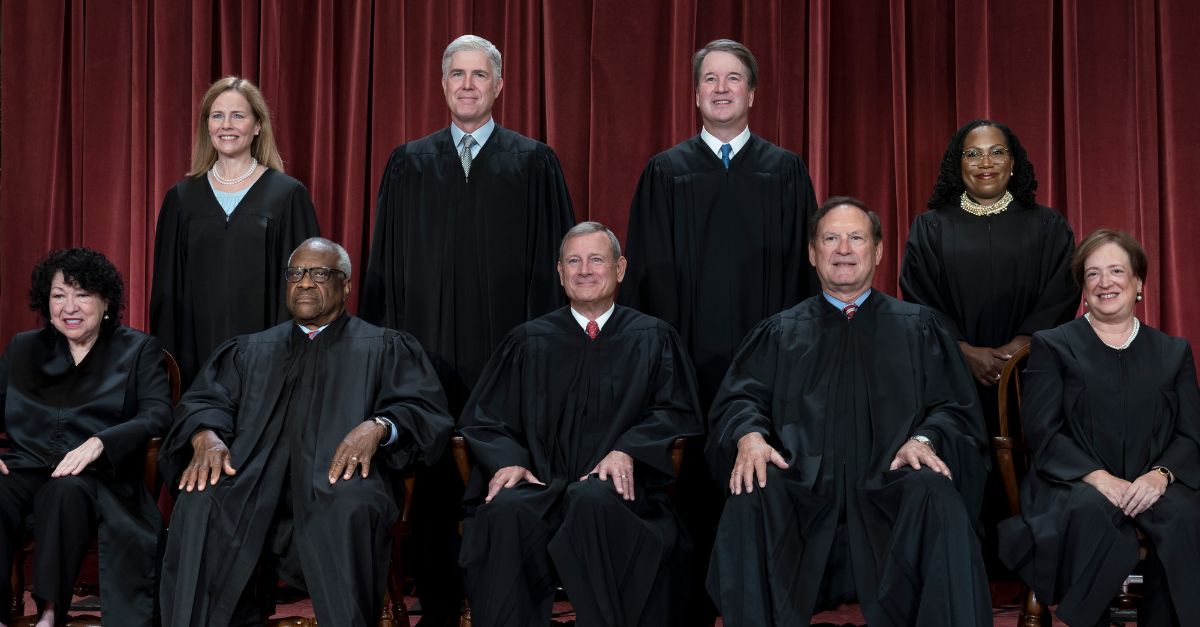
Members of the Supreme Court sit for a new group portrait following the addition of Associate Justice Ketanji Brown Jackson, at the Supreme Court building in Washington, Friday, Oct. 7, 2022. Bottom row, from left, Associate Justice Sonia Sotomayor, Associate Justice Clarence Thomas, Chief Justice of the United States John Roberts, Associate Justice Samuel Alito, and Associate Justice Elena Kagan. Top row, from left, Associate Justice Amy Coney Barrett, Associate Justice Neil Gorsuch, Associate Justice Brett Kavanaugh, and Associate Justice Ketanji Brown Jackson. (AP Photo/J. Scott Applewhite)
As some court watchers
predicted,
the U.S. Supreme Court issued a 4-4 ruling Thursday that preserves the distinction between church and state — for the time being. Despite the eight participating justices having been vocal during oral arguments just three weeks ago, however, the Court issued its ruling without a single word of opinion, guidance, or information as to the lineup of votes.
“A robust Catholic education”
The case, stylized as Oklahoma Charter School Board v. Drummond, was a contentious one in which the justices heard several hours of exhaustive oral arguments over whether a virtual Catholic charter school has a right to operate despite Oklahoma’s requirement that its charter schools be nonreligious. The St. Isidore of Seville school —
named for an unofficial patron saint of the internet —
aims to provide a “robust Catholic education,” and is open to both Catholic and non-Catholic students. The school, which would operate entirely online,
projected an initial enrollment of 500 students with the expectation of reaching 1,500 students by 2028, half from lower-income families.
Although Oklahoma’s charter school board initially approved St. Isidore’s application for the 2024-25 school year, Oklahoma’s Republican attorney general and current gubernatorial candidate,
Gentner Drummond, opposed the school’s participation in the charter program on the grounds that
under both Oklahoma law and the establishment clause of the U.S. Constitution, all public schools in the state are required to be nonsectarian.