Showing posts with label judges. Show all posts
Showing posts with label judges. Show all posts
Thursday, December 11, 2025


Wednesday, October 29, 2025
Who is Sara L. Ellis, U. S. District Judge for the Northern District of Illinois?
Sara L Ellis

Education

Personal details
Born 1969 (age 55–56)
London, Ontario, Canada
Education
Loyola University Chicago (JD)
Sara Lee Ellis (born 1969) is a United States district judge of the United States District Court for the Northern District of Illinois.
Early life
Ellis was born in 1969, in London, Ontario, Canada,[1] to Jamaican-born parents. She became a naturalized citizen of the United States when she was 15 years old.[2][3]
Education and career
She received a Bachelor of Arts in 1991 from Indiana University. She received a Juris Doctor in 1994 from Loyola University Chicago School of Law. She worked as a staff attorney at the Federal Defender Program in Chicago from 1994 to 1999. From 2000 to 2004, she worked at Stetler, Duffy & Rotert, Ltd., a white-collar criminal defense law firm. From 2004 to 2008, she served as assistant corporation counsel for the Chicago Department of Law, handling claims for injunctive relief and civil rights lawsuits. From 2008 to 2013, she served as counsel at the law firm of Schiff Hardin LLP in Chicago, where she was a member of the litigation and white-collar crime practice groups.[4][3]
Federal judicial service
On May 6, 2013, President Barack Obama nominated Ellis to be a United States district judge of the United States District Court for the Northern District of Illinois, to the seat vacated by Judge Joan B. Gottschall, who assumed senior status on April 23, 2012.[4] She received a hearing before the Senate Judiciary Committee on June 19, 2013, and her nomination was reported to the floor of the Senate on July 18, 2013, by voice vote. The Senate confirmed her nomination on October 7, 2013, by voice vote. She received her commission on October 8, 2013.[3]
Monday, August 25, 2025
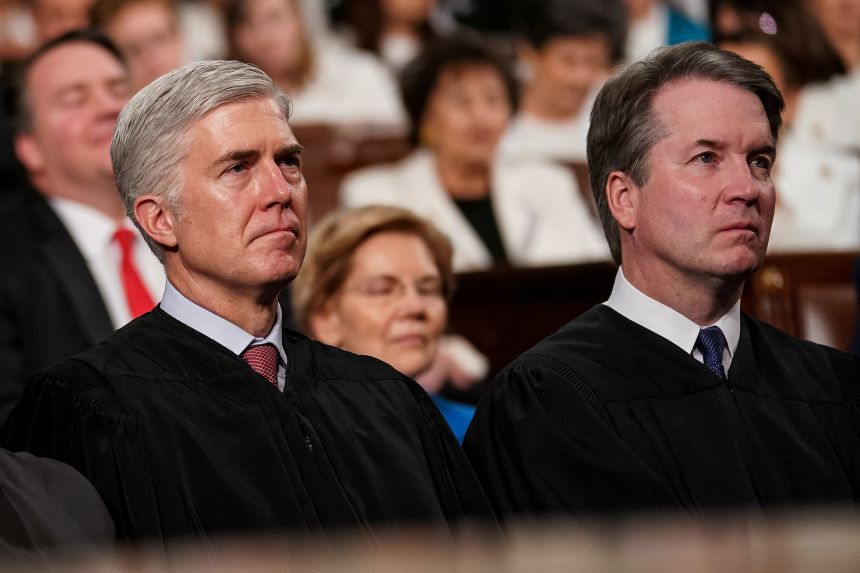
Gorsuch and Kavanaugh warn lower court judges in Trump cases
By
John Fritze
Updated 11 hr ago
John Fritze
Updated 11 hr ago
Neil Gorsuch and Brett Kavanaugh during the ...
In Donald Trump’s long-running feud with federal judges, the president has found some support in an unlikely place: the nation’s highest court.
A growing sense of frustration with some lower courts — articulated in terms that at times sound similar to Trump’s own rhetoric — has crept into a series of opinions this summer from the Supreme Court’s conservative justices as they juggle a flood of emergency cases dealing with Trump’s second term.
“Lower court judges may sometimes disagree with this court’s decisions, but they are never free to defy them,” Justice Neil Gorsuch admonished in an opinion last week tied to the court’s decision to allow Trump to cancel nearly $800 million in research grants.
The rebuke, which was joined by Justice Brett Kavanaugh, flipped the narrative that it is Trump who has pushed legal boundaries with his flurry of executive orders and support for impeaching judges who rule against him. A wave of legal conservatives took to social media to tout Gorsuch’s warning.
“This is now the third time in a matter of weeks this court has had to intercede in a case ‘squarely controlled’ by one of its precedents,” wrote Gorsuch, who was Trump’s first nominee to the high court. (Kavanaugh was Trump’s second.) “When this court issues a decision, it constitutes a precedent that commands respect in lower courts.”
Other conservatives have been just as harsh this year. Justice Samuel Alito in March accused a federal judge in another case involving a Trump policy as committing an “act of judicial hubris” and “self-aggrandizement of its jurisdiction.”
The Supreme Court has been consistently siding with Trump on the emergency docket for months, including in high-profile cases dealing with immigration, spending and the leadership of independent agencies. And Trump has won even in cases in which there are serious arguments that his administration defied a lower court, said Steve Vladeck, CNN Supreme Court analyst and professor at Georgetown University Law Center.
Wednesday, August 06, 2025
Sunday, November 17, 2024
Thursday, December 21, 2023
Saturday, November 24, 2018
Adventist named Chief Justice of Papua New Guinea
By Maritza Brunt - November 19, 2018

Justice Salika. (Photo: Facebook)
A Seventh-day Adventist Church member has been named Chief Justice of Papua New Guinea (PNG).
Sir Gibbs Salika, a member of Hohola Adventist Church in Port Moresby, was appointed on November 13 for a term of 10 years.
“Justice Salika is the longest-serving judge of the National and Supreme Courts and will be a strong and independent Chief Justice of Papua New Guinea,” said PNG Prime Minister Peter O’Neill. “I congratulate Justice Salika on his appointment and I am confident he will provide the sound leadership required of the Chief Justice.”
Adventist Church leaders from PNG also expressed their congratulations and offered words of wisdom for the newly-appointed Chief Justice.
“Justice Salika is one of the longest-serving elders in our Church, and has been a strong, vibrant church member for many years now,” said Central Papua Conference general secretary Pastor Rex Koi. “We praise God for his leadership, representing as an Adventist in the highest responsibility in the [judicial] system of our country.”
“On behalf of our worker-force and the church members, I would like to congratulate Chief Justice Gibbs Salika on his new appointment,” said Papua New Guinea Union Mission president Pastor Kepsie Elodo. “We are proud of his achievement and believe God has appointed him to this post.
“We urge Justice Salika to allow the Holy Spirit to lead and guide at all times, and encourage him to be loyal to his work and be fair in decision making to please both men and God. We wish him God’s blessings in all endeavours and our prayers will be with him.”
Justice Salika is currently serving his first term as Deputy Chief Justice. He had served as a judge of the National and Supreme Court for more than two consecutive terms since 1989.
Saturday, September 29, 2018
Why the Supreme Court is now America’s most dangerous branch
Why the Supreme Court is now America’s most dangerous branch
By Mary Kay Linge
September 29, 2018 | 11:44am

As members of Congress have shied away from passing unpopular laws, the Supreme Court has rushed to fill the void. AP
With its dramatic reveals, shocking allegations and stunning confessions, the fight over the confirmation of Supreme Court nominee Brett Kavanaugh has had more plot twists than a telenovela.
And the Court has only itself to blame.
“The Court’s adventurism and self-aggrandizement has had insidious consequences,” said David A. Kaplan, author of “The Most Dangerous Branch” (Crown), out now.
This month’s bare-knuckle brawl in the Senate is all the proof we need that judicial activism has grotesquely warped American politics, Kaplan argues.
“By inserting themselves into our most controversial political issues, the justices raised the stakes and led us into to these confirmation battles,” he told The Post. “They didn’t intend that, but you can draw a straight line.”
If the Senate’s Republican majority holds together and seats Kavanaugh for the Court term that begins this week, the effects could be profound.
But in recent decades, dysfunctional legislators have prioritized incumbency and shied away from contentious debates. Their refusal to write laws that would force them to choose sides has conferred power on the judicial branch — and judges have leapt into the vacuum to make the rules themselves.
“I’ve talked to senators and congressmen who say, ‘Why should we get involved in tough political issues like immigration? Across the street at the Court, they’ll resolve it for us,’ ” Kaplan said. Supreme Court justices, who serve for life, never have to worry about re-election.
“Given the potential political costs, members of Congress are thrilled to stay out of the sewer,” he said.
Sunday, July 01, 2018
How Justice Kennedy's 30 years helped and hurt religious freedom
ByKelsey Dallas@kelsey_dallas
Published: June 30, 2018 8:00 am

Charles Dharapak, AP
Supreme Court Justice Anthony Kennedy arrives for a roundtable discussion titled "Making Law Work for Everyone", Friday, June 13, 2008, at the Organization of American (OAS) in Washington. In writing for the court majority on the Supreme Court's decision on Guantanamo Bay on Thursday, Kennedy acknowledged the terrorism threat the country faces and the administration's justification for the detentions, but he declared, "The laws and Constitution are designed to survive, and remain in force, in extraordinary times." (AP Photo/Charles Dharapak)
SALT LAKE CITY — Justice Anthony Kennedy spent three decades on the Supreme Court, playing a pivotal role in rulings that expanded LGBT rights, protected religion in the public square and ensured access to abortions.
But when it comes to his religious freedom legacy, he may be remembered most for the questions he never answered, according to legal experts.
In his opinions legalizing same-sex marriage and condemning anti-religion bias, Kennedy advocated for tolerating religious beliefs. However, his rulings rarely gave a clear picture of how to legislate tolerance through state and federal policies, said Thomas Berg, a professor of law and public policy at the University of St. Thomas.
Kennedy's rulings "are partly responsible for religious freedom being such a political hot potato," he said.
By retiring this year, Kennedy creates the possibility for a justice to join the Supreme Court who may be more willing to directly address public policy but less willing to work with liberal colleagues. Kennedy may come to regret not taking stronger positions when he had the chance, said Fred Gedicks, a law professor at Brigham Young University.
"It's almost as if he lost the courage of his convictions in the last few years," he said.
Matt Slocum, APFILE - In this Oct. 3, 2013, file photo, Supreme Court Justice Anthony Kennedy speaks to faculty members at the University of Pennsylvania law school in Philadelphia. The 81-year-old Kennedy said Tuesday, June 27, 2018, that he is retiring after more than 30 years on the court.(AP Photo/Matt Slocum, File)
Hot-button issues
Kennedy was then-President Ronald Reagan's third choice for the Supreme Court when he was nominated in 1987. A Democrat-led Senate had rejected the Republican president's first choice, and the second nominee withdrew from the process after previous marijuana use came to light.
Sunday, October 01, 2017
Five justices attend Red Mass with homily addressing immigration, religious freedom
Five justices attend Red Mass with homily addressing immigration, religious freedom
Posted Sun, October 1st, 2017 7:15 pm by Andrew Hamm
This morning Chief Justice John Roberts and Justices Anthony Kennedy, Clarence Thomas, Stephen Breyer and Samuel Alito attended the Red Mass, a Roman Catholic liturgy held annually the Sunday before the Supreme Court’s new term to invoke God’s blessing on those responsible for the administration of justice. The justices sat – by seniority, as always – in the first two pews at St. Matthew’s Cathedral in Washington. Noel Francisco, the newly confirmed solicitor general, and Jeffrey Wall, the former acting solicitor general, also attended the mass.
The homilist for the mass, Jose Gomez, archbishop of Los Angeles, indirectly referred to two issues before the justices this term – immigration and religious freedom.
In introducing himself at the start of his homily, Gomez noted that Los Angeles has the largest Roman Catholic congregation in the United States, which he described as an “immigrant church” with masses in over 40 languages. Although “the American dream is still a work in progress,” Gomez argued, “America is still a beacon of hope for refugees and all who long for freedom and equality under God.” “God doesn’t see color, the country we come from, or the language we speak,” Gomez preached.
Gomez also argued that “religious freedom is essential to America” because believers have led movements for justice and social change through America’s history – including movements for abolition, women’s suffrage, civil rights, farm workers, peace and the right to life.
Gomez is vice president of the United States Conference of Catholic Bishops, which has taken positions on Supreme Court cases pertaining to both issues Gomez addressed. The USCCB filed an amicus brief in support of the challengers to the Trump administration’s entry ban in Trump v. International Refugee Assistance Project, which Wall argued in the lower courts and which was recently removed from the justices’ October calendar. The USCCB filed an amicus brief in Masterpiece Cakeshop, Ltd. V. Colorado Civil Rights Commission supporting a devout Christian baker who claims that Colorado’s requirement that he create a wedding cake for a same-sex couple violates the free speech and free exercise clauses of the First Amendment. Last term the USCCB also filed an amicus brief for the church in Trinity Lutheran Church of Columbia, Inc. v. Comer. In an opinion written by Roberts, the court in that case held that the Missouri Department of Natural Resources’ policy of denying grants to applicants controlled by religious entities violated the free exercise clause of the First Amendment.
Gomez was not the only priest at the altar with involvement in recent Supreme Court cases. Cardinal Donald Wuerl, archbishop of Washington, was the plaintiff in Roman Catholic Archbishop of Washington v. Burwell, one of the cases consolidated as Zubik v. Burwell, a recent challenge to the Affordable Care Act’s birth-control mandate. When he was still an attorney at Jones Day, Francisco was the counsel of record for the archbishop and the other challengers in that case.
The Supreme Court’s October 2017 term begins Monday at 10 a.m., with oral argument in Epic Systems Corp. v. Lewis.
Friday, September 30, 2016
Alabama Chief Justice Roy Moore suspended from office over same-sex marriage order
Court of Judiciary finds him guilty on all six counts

By Tim Lockette, Star Staff Writer, tlockette@annistonstar.com
45 min ago
A panel of judges suspended Alabama Chief Justice Roy Moore from office for the remainder of his term Friday, finding Moore guilty on all six charges related to his order telling probate judges to enforce the state’s ban on same-sex marriage.
Members of the Court of the Judiciary cited Moore’s “disregard for binding federal law” and “his history with this court” as their reasons for suspending the judge without pay, according to their 50-page ruling against the judge.
In January, six months after the U.S. Supreme Court’s historic ruling legalizing same-sex marriage, Moore issued an order telling the state’s probate judges they had a “ministerial duty” to enforce Alabama’s ban on same-sex marriage, due to a challenge filed in state court.
The order had little impact. Most counties continued to issue marriage licenses to all, gay and straight. Some counties don’t issue marriage licenses to anyone, but those battle lines were largely drawn before Moore’s order.
Same-sex marriage proponents filed a complaint against Moore with the state’s Judicial Inquiry Commission, arguing that by telling probate judges to defy federal court orders, Moore had violated judicial ethics. On the stand Wednesday, Moore claimed that his order was not a directive to judges, just advice.
“I would never tell them what to do, except to advise them,” Moore said Wednesday.
The nine-member court disagreed. They cited Moore’s last trial before the court – he was removed from office in 2003 after disobeying a court order to remove a Ten Commandments monument from the Supreme Court building in Montgomery – as evidence of a pattern of behavior.
“Chief Justice Moore’s arguments that his actions and words mean something other than what they clearly express is not a new strategy,” the judges wrote.
The order notes that Moore’s complete removal from office would require a unanimous vote, and says that a majority of judges support Moore’s suspension.
Thursday, May 07, 2015
This damning quote from judges reveals the unprecedented scope of NSA spying


Rick Bowmer/APThe National Security Agency's Utah Data Center in Bluffdale, Utah.
See Also


A US appeals court has ruled the Patriot Act never authorized the National Security Agency's collection of Americans' phone records, and its opinion reveals just how unprecedented in scope that collection was.
The laws that the US government used to defend its vast surveillance program "have never been interpreted to authorize anything approaching the breadth of the sweeping surveillance at issue here," the opinion from the US Court of Appeals for the Second Circuit stated.
Ex-NSA contractor Edward Snowden blew the whistle in 2013 on the agency's surveillance program, which collected so-called metadata from phone calls. (Metadata includes phone numbers, duration of calls, and times of calls.)
While metadata collection doesn't monitor the content of what people say, the appeals court described the volume of the information the government sought as "staggering" and not authorized by Section 215 of the Patriot Act as the government argued it was.
The NSA's metadata collection was much broader in scope than other methods the government uses to collect information like search warrants and subpoenas, the appeals court said. From the opinion:
Search warrants and document subpoenas typically seek the records of a particular individual or corporation under investigation, and cover particular time periods when the events under investigation occurred. The orders at issue here contain no such limits ... The records demanded are not those of suspects under investigation, or of people or businesses that have contact with such subjects, or of people or businesses that have contact with others who are in contact with the subjects — they extend to every record that exists, and indeed to records that do not yet exist ... The government can point to no grand jury subpoena that is remotely comparable to the real‐time data collection undertaken under this program.
Section 215 of the Patriot Act is set to expire this summer. If Congress renews it the US government may ask the Supreme Court to overturn the Second Circuit's spying decision.
"This was a surprising decision given the reluctance of courts to second-guess intelligence-gathering in the war on terror," UCLA law professor Adam Winkler told Business Insider in an email. "Given the importance of this ruling for national security, the Supreme Court is likely to step in."
Source: http://www.businessinsider.com/second-circuit-reveals-scope-of-nsa-metadata-collection-2015-5#ixzz3ZTFJStlt
.
Thursday, April 30, 2015
Among Justices, Considering a Divide Not of Gender or Politics, but of Beliefs
U.S.
JULY 11, 2014

A rally at the Supreme Court last month after a ruling in favor of Hobby Lobby, a move that has been parsed and picked over.
Doug Mills/The New York Times
On Religion
By SAMUEL G. FREEDMAN
During its last term, the Supreme Court narrowly decided two cases bearing extensively on the separation of church and state. Both of them broke along familiar 5-4 lines, and both of them implicitly raised a question hardly anyone has asked about a court that is entirely composed, for the first time in American history, of Roman Catholic and Jewish justices.
In the first of the cases, Greece v. Galloway, the court ruled to allow public prayer at a government meeting. In the other, Burwell v. Hobby Lobby Stores, the court said that a corporation closely held by a religious family should not have to offer several forms of contraception that it opposed to its female employees, as required by the Affordable Care Act.
To the degree that these decisions, especially Hobby Lobby, have been parsed and picked over, the analysis has gone along the lines of politics (conservative majority against liberal minority) or gender (male majority against mostly female minority).


Yet it is at least as compelling to consider the Catholic-Jewish divide. In both cases, five of the court’s six Catholic justices — Samuel A. Alito Jr., Anthony M. Kennedy, John G. Roberts Jr., Antonin Scalia and Clarence Thomas — formed the majority that espoused a larger place for religious practice in public life. All three Jewish justices — Stephen G. Breyer, Ruth Bader Ginsburg and Elena Kagan — joined by one Catholic, Sonia Sotomayor, dissented on behalf of a wider, firmer separation.
What attention has been paid to the denominational nature of the decisions has too often echoed with America’s sordid history of anti-Catholic bigotry, the presumption that Catholic public servants take their orders from the Vatican. A recent advertisement in The New York Times by the Freedom From Religion Foundation, for instance, linked the court’s Roman Catholic majority to “the growing dangers of theocracy.”
Surely, though, there is a legitimate way to explore the Catholic and Jewish contexts of the court’s votes. The point is not to pretend to climb inside the psyche of each justice but to appreciate that these jurists are simultaneously results and embodiments of historical experience. To put it simply: Did nine individuals just coincidentally disagree based on their legal reasoning, or have American Catholics and American Jews arrived at different communal positions about where to properly draw the line between church and state?
On Religion
On Religion
By SAMUEL G. FREEDMAN
During its last term, the Supreme Court narrowly decided two cases bearing extensively on the separation of church and state. Both of them broke along familiar 5-4 lines, and both of them implicitly raised a question hardly anyone has asked about a court that is entirely composed, for the first time in American history, of Roman Catholic and Jewish justices.
In the first of the cases, Greece v. Galloway, the court ruled to allow public prayer at a government meeting. In the other, Burwell v. Hobby Lobby Stores, the court said that a corporation closely held by a religious family should not have to offer several forms of contraception that it opposed to its female employees, as required by the Affordable Care Act.
To the degree that these decisions, especially Hobby Lobby, have been parsed and picked over, the analysis has gone along the lines of politics (conservative majority against liberal minority) or gender (male majority against mostly female minority).
RELATED COVERAGE
Yet it is at least as compelling to consider the Catholic-Jewish divide. In both cases, five of the court’s six Catholic justices — Samuel A. Alito Jr., Anthony M. Kennedy, John G. Roberts Jr., Antonin Scalia and Clarence Thomas — formed the majority that espoused a larger place for religious practice in public life. All three Jewish justices — Stephen G. Breyer, Ruth Bader Ginsburg and Elena Kagan — joined by one Catholic, Sonia Sotomayor, dissented on behalf of a wider, firmer separation.
What attention has been paid to the denominational nature of the decisions has too often echoed with America’s sordid history of anti-Catholic bigotry, the presumption that Catholic public servants take their orders from the Vatican. A recent advertisement in The New York Times by the Freedom From Religion Foundation, for instance, linked the court’s Roman Catholic majority to “the growing dangers of theocracy.”
Surely, though, there is a legitimate way to explore the Catholic and Jewish contexts of the court’s votes. The point is not to pretend to climb inside the psyche of each justice but to appreciate that these jurists are simultaneously results and embodiments of historical experience. To put it simply: Did nine individuals just coincidentally disagree based on their legal reasoning, or have American Catholics and American Jews arrived at different communal positions about where to properly draw the line between church and state?
On Religion
Reporting and commentary on religion.
Easing the Difficult Path to the Pulpit for African-American Women APR 3
Woman Breaks Through Chains of Forced Marriage, and Helps Others Do the Same MAR 20
Los Angeles Police Leader Makes Outreach to Muslims His Mission MAR 6
Muslim Scholar, Looking to ‘Speak the Truth,’ Teaches the Holocaust and Islam FEB 20
Strains Grow Between Israel and Many Jews in the U.S. FEB 6
See More »
“Try as they might to claim judicial independence, justices are still the products of where they came from and who they were before going onto the bench,” said Thane Rosenbaum, a law professor at Fordham University and a widely published author on legal ethics. “Why do you want robed robots? Why aren’t we more honest that you are where you come from? The robe doesn’t shield you from that consolidated history.”
The history of Jews and Catholics in America has involved attitudes about church and state. The immigrant waves of both groups, having endured persecution in Europe, saw separation as a guarantee of their own freedom as religious minorities here. Experience had taught Jews to fear the anti-Semitism of Christian rulers, and Catholics were wary of proselytization and cultural domination by a Protestant majority.
For Jews, said the political scientist Kenneth D. Wald of the University of Florida, a secular state became synonymous with their comfort and accomplishment in the United States.
“Defending and extending the secular definition of the American state,” he has written, “became the (often unstated) core political priority of America’s organized Jewish community.” The emergence of the evangelical Christian “religious right” in the 1980s especially reinforced that belief.
The Catholic experience has had its share of nuance. Leslie C. Griffin, a professor of constitutional law at the University of Nevada, Las Vegas, spoke recently of the way earlier generations of Catholics teased apart good and bad types of church-state separation. Good meant denying formal state power to Protestants. Bad meant refusing governmental aid and accommodation to Catholic institutions, especially parochial schools.
And while the Jewish organizational sphere developed largely along secular lines — Hadassah, Anti-Defamation League, American Jewish Committee to cite just a few examples — American Catholics advocated largely through overtly religious bodies such as the United States Conference of Catholic Bishops.
Far from being predictably conservative, the bishops have taken liberal positions on issues such as nuclear arms, welfare overhaul and immigrant rights. Always, though, their positions have been put forth as the product of Catholic doctrine and social teaching, theology deemed a legitimate part of public debate.
“The Catholic Church has wanted separation in the sense we don’t want the king picking the bishops, but we also believed you could have cooperation in civil society,” said Richard W. Garnett, a professor of law at the University of Notre Dame. “Whereas in America, separation became a code for no money for Catholic schools or we don’t want religiously oriented morality shaping public policy.”
The divergent Jewish and Catholic sensibilities are measurable. In a 2007 survey by the Pew Forum on Religion and Public Life, 43 percent of Catholics agreed that “government should do more to protect morality”; just 22 percent of Jews concurred. The survey also found that Catholics were more than three times as likely as Jews (33 percent to 10 percent) to attend a religious service weekly. Catholics are also twice as likely as Jews (55 percent to 27 percent) to rate religion as the most important or a very important factor in their lives, according to a 2012 survey by the Public Religion Research Institute.
All of which helps one make historical sense of the two court decisions. Yes, the conservative bent of the court has as much to do with the number of vacancies that happened to come up during Republican presidencies. Yes, too, Catholic identity does not trump every other personal or legal consideration. Justice Kennedy, usually part of the court’s conservative wing, cast the decisive vote last year to overturn the Defense of Marriage Act, giving a major victory to the movement for same-sex marriage.
Even so, in amicus briefs in the Hobby Lobby case, the preponderance of Jewish groups filed in opposition to the religious exemption from the health care law. The heavyweights among Catholics — led by the bishops’ conference and the Knights of Columbus, as well as 67 theologians — submitted on behalf of Hobby Lobby.
That Hobby Lobby is owned not by Catholics but by evangelical Protestants, their erstwhile antagonists, speaks volumes about the diminution of old animosities and the societal influence of those people who once were the reviled outsiders.
“How could Catholics say they are now opposed, that they’re a minority religion, when they’re a majority on the court?” said Professor Griffin, who is an alumna of Notre Dame and has written for the Jesuit publication America. “And now they’re reducing the barrier between church and state in a way that’s comfortable with their values.”
Email: sgf1@columbia.edu;
Twitter: @SamuelGFreedman
A version of this article appears in print on July 12, 2014, on page A13 of the New York edition with the headline: Among Justices, Considering a Divide Not of Gender or Politics, but of Beliefs.
.
Tuesday, April 22, 2014
How retired Supreme Court Justice Stevens would amend the constitution
April 21, 2014 at 6:25 PM EDT
Former Supreme Court Justice John Paul Stevens talks to Judy Woodruff about his new book, “Six Amendments: How and Why We Should Change the Constitution.” In his book, the 94-year-old liberal justice calls for major changes to the Constitution on issues such as the death penalty, firearms, redistricting and campaign finance.
SEE PODCASTS
TRANSCRIPT
JUDY WOODRUFF: Now: A former Supreme Court justice takes on the U.S. Constitution and the court he stepped away from.
John Paul Stevens was known in his 35 years in office for views that evolved from the time he was appointed by Republican President Gerald Ford to one of the court’s most outspoken liberal voices.
Today, four years after retiring, the 94-year-old continues to make waves with an ambitious new book. It’s titled “Six Amendments: How and Why We Should Change the Constitution.”
I talked to him last week in his chambers at the Supreme Court.
Justice John Paul Stevens, thank you for talking with us.
FMR. JUSTICE JOHN PAUL STEVENS, U.S. Supreme Court: Well, I’m happy to be here.
JUDY WOODRUFF: You’re asking to amend the Constitution six different ways. How practical is that?
FMR. JUSTICE JOHN PAUL STEVENS: Well, it certainly would take time to do that job completely, but there’s no reason why — one or two amount amendments might be adopted before the others.
And I think the issues in each of the ones I discussed are sufficiently important that it’s worth spending time debating them and thinking about it.
JUDY WOODRUFF: You single out rules, Justice Stevens, that were handed down, as you point out, by a slim majority of the court over the last 40 years that you say — and I’m quoting you now — “have had such a profound and unfortunate impact on our basic law, that resort to the process of amendment is warranted.”
You’re essentially taking on the modern Supreme Court.
FMR. JUSTICE JOHN PAUL STEVENS: Well, because I have been trying to do that for a good many years.
But I think there were incorrect — incorrect decisions that were profoundly unwise, and really contrary to a lot of things that our country stands for. And I think they should be changed.
JUDY WOODRUFF: You’re speaking in a mild mannered way, Justice Stevens, but I can tell you feel pretty strongly about this.
FMR. JUSTICE JOHN PAUL STEVENS: Well, I do.
(LAUGHTER)
FMR. JUSTICE JOHN PAUL STEVENS: There’s no doubt about that.
JUDY WOODRUFF: Let’s talk about some of the ways that you would like to see the Constitution changed.
Among other things, you want an amendment that would require the states not to draw legislative or congressional districts in a way to increase partisan strength. We know, clearly, there is partisan redistricting. But most redistricting is done around where populations live, whether it’s an urban area, a suburban area. Why isn’t this something that is better left to the political process?
FMR. JUSTICE JOHN PAUL STEVENS: Well, because the political process has misfired.
And in a number of states, the dominant party has redistricted with its own objective of strengthening its control of the state in the future and of its congressional delegation at the time by drawing bizarre districts that have no purpose whatsoever, other than to enhance the political strength of the party in power.
Now, it’s my very profound view that a person in public office has a primary duty to follow — to make impartial decisions, not motivated by personal profit or personal gain or advantage just to the political party of whom — of which he is a member.
JUDY WOODRUFF: So you’re saying take it out of politics?
FMR. JUSTICE JOHN PAUL STEVENS: Well, not entirely. But don’t allow districts to be drawn for no reason other than political advantage.
There are times when political — political considerations can be taken into account in making certain minor adjustments such as that.
But the examples that I talked about in the book are examples of districts that are bizarre in shape and have absolutely — obviously no justification, other than the impermissible justification of partisan advantage to those who drafted the districts.
JUDY WOODRUFF: You also want to amend the Constitution to abolish the death penalty. People who have always opposed the death penalty lament how long they say it took you to change your mind, from the time you came on the court in 1975 until 2008.
Why do you think it took you as long as it did to change your mind? And was it for humane reasons or constitutional reasons?
FMR. JUSTICE JOHN PAUL STEVENS: Well, I think that what has happened in the period that I have been on the court is that the court has used death penalty litigation to develop rules that make conviction more likely than it should be, the rules governing the selection of the jury, for example, rules governing the admissibility of victim-impact evidence at the penalty phase of the trial.
Those rules have slanted the opportunity for justice in favor of the prosecutor. And I think it’s particularly incorrect to do it in the capital context, because the cost is so high. If you make a mistake in a capital case, there is no way to take care of it later on.
And the risk of an incorrect execution in any case to me is really intolerable. And the system shouldn’t permit that possibility to exist.
JUDY WOODRUFF: Another controversy you’re jumping right into is campaign finance. You believe Congress should be able to put limits on the amount of money candidates spend on their campaigns…
FMR. JUSTICE JOHN PAUL STEVENS: Yes.
JUDY WOODRUFF: … and that the Supreme Court has made mistakes in several decisions, allowing corporations, labor unions to advocate and spend money on candidates.
Considering all the court has done, Justice Stevens, to open the door for huge money to pour into American politics, including the recent McCutcheon decision, what effect does all this have on American politics?
FMR. JUSTICE JOHN PAUL STEVENS: Well, I don’t think it’s a healthy effect.
And I think it’s a change from what the people who direct — framed our basic government envisioned. For the — as the chief justice said, I think, in the first sentence of his opinion in the McCutcheon case the other day, there is nothing more important than participation in electing our representatives.
But the law that developed in that case and in a number of other cases involved not electing the representatives of the people who voted for them, but electing representatives of — in other jurisdictions where the financing is used. In other words, that was a case that involved the right of the — of an individual to spend as much of its money as he wanted to elect representatives of other people. He didn’t use any of that money to elect his own representatives.
And I think that’s a distortion of the concept that we started with many, many years ago.
JUDY WOODRUFF: The last area that I want to ask you about is what this country should do about guns. You would change the wording of the Second Amendment to the Constitution to say the right of people to bear arms to own a gun should apply only when serving in the militia.
Is it your ultimate hope that there would be no right to own a gun for self-defense?
FMR. JUSTICE JOHN PAUL STEVENS: Well, it would be my ultimate hope that legislatures would decide the issues, and not be hampered by constitutional restrictions, because, clearly, legislators are in a much better position than judges are to decide what could be permissible in different contexts.
And the effect of the Second Amendment as it is now construed is to make federal judges the final arbiters of gun policy, which is quite, quite wrong, I think, and quite contrary to what the framers intended when they drafted the Second Amendment, to protect states from the danger that a strong federal armed force would have been able to the states of their own militias.
JUDY WOODRUFF: When you look at all of these changes that you would like to see in the Constitution, and whether it’s campaign finance, redistricting or something else, do you believe the more conservative members of the Supreme Court have a partisan agenda? Do you think they are actually trying to get conservatives elected to office?
FMR. JUSTICE JOHN PAUL STEVENS: No, I don’t think so. I wouldn’t question their motives at all.
I think they have come to the incorrect conclusion, but I do think they have — where they have had chances to take a different tack, I think they have acted incorrectly. But I wouldn’t suggest that any of them were improperly motivated.
JUDY WOODRUFF: Do you think you should have stayed on the court longer?
FMR. JUSTICE JOHN PAUL STEVENS: Should I have stayed on — no.
(LAUGHTER)
FMR. JUSTICE JOHN PAUL STEVENS: If anything, I stayed on too long.
JUDY WOODRUFF: How does a justice know when it is the right time to retire? What do you think?
FMR. JUSTICE JOHN PAUL STEVENS: Well, in my case, the time — I can remember the events that triggered the specific decision.
I announced my dissent in the Citizens United orally, and I stumbled in my announcement. I had a little difficulty expressing myself. And that was out of character. And I used to have no problem at all being articulate and coherent.
And I took that as a warning sign that maybe I had been around longer than I should.
JUDY WOODRUFF: Justice John Paul Stevens, thank you very much for talking with us.
The book is “Six Amendments: How and Why We Should Change the Constitution.”
FMR. JUSTICE JOHN PAUL STEVENS: Thank you. It’s been a pleasure being here.
Source
.
Tuesday, December 17, 2013
Federal judge rules against NSA spying
Kevin Johnson and Richard Wolf, USA TODAY 9:48 p.m. EST December 16, 2013
Decision by U.S. District Court Judge Richard Leon is the first of several expected over the next few months and is certain to be appealed.

(Photo: Patrick Semansky, AP)
Story Highlights
- The ruling is the first of several that are likely in the coming months on the scope of NSA's surveillance program
- The Department of Justice says it is reviewing the decision
- NSA Director Keith Alexander: "There isn't a better way'' to help defend the country from potential terror threats
WASHINGTON — A federal judge ruled Monday that the National Security Agency's controversial surveillance program that collects millions of Americans' telephone records may be unconstitutional.
U.S. District Court Judge Richard Leon ruled in a lawsuit brought by conservative activist Larry Klayman that the legal challenge to the massive surveillance program — disclosed in full earlier this year by former NSA contractor Edward Snowden — would likely succeed.
Leon, appointed to the bench by President George W. Bush, issued a preliminary injunction against the program but suspended the order to allow an appeal by the Justice Department, which said it was reviewing the decision.
The ruling is the first of several that are likely in the coming months as federal judges from New York to California review complaints from liberals and conservatives alike about the scope of the NSA's snooping. Leon's acknowledgment that the case is sure to be appealed is an indication that those appeals might wind up at the U.S. Supreme Court.
STORY: Snowden says ruling vindicates leak of NSA files
WHITE HOUSE: No amnesty for Snowden
OBAMA: To meet with tech execs to talk NSA, health care
"The court concludes that plaintiffs have standing to challenge the constitutionality of the government's bulk collection and querying of phone record metadata, that they have demonstrated a substantial likelihood of success on the merits of their Fourth Amendment claim (of unlawful search and seizure), and that they will suffer irreparable harm absent…relief,'' Leon wrote.
And in perhaps the most definitive assessment of the program's effectiveness, Leon said the government "does not cite a single instance in which analysis of the NSA's bulk metadata collection actually stopped an imminent attack.''
"Given the limited record before me at this point in the litigation — most notably the utter lack of evidence that a terrorist attack has ever been prevented because searching the NSA database was faster than other investigative tactics — I have serious doubts about the efficacy of the metadata collection program as a means of conducting time-sensitive investigations in cases involving imminent threats of terrorism,'' the judge said.
The government has publicly asserted that the NSA's surveillance programs have assisted in averting dozens of terrorist threats, but Leon said "no proof of that has been put before me.'' He said the government could have requested permission to offer such evidence in a closed hearing, "but it chose not to do so.''
Snowden, in a statement published first by The New York Times, said he believed that the "mass surveillance programs would not withstand a constitutional challenge, and that the American public deserved a chance to see these issues determined by open courts.''
"Today, a secret program authorized by a secret court was, when exposed to the light of day, found to violate Americans' rights. It is the first of many," said the former contractor, who was granted limited asylum in Russia to avoid espionage-related charges in the U.S.
Klayman, a former Reagan administration official who heads the conservative watchdog group Freedom Watch, heralded the judge for "standing in the breach for the American people."
"Judge Leon is a hero," Klayman said. "This is the first time in my experience that any judge has stuck his neck out, and he did what's right. Let's hope other judges will follow suit and take an example from Judge Leon, because the American people have felt defenseless."
Leon's decision comes less than a week after NSA Director Keith Alexander told a Senate committee that "there isn't a better way'' to help defend the country from potential terrorist threats than the ongoing sweep of telephone records.
"There is no other way to connect the dots,'' Alexander told the Senate Judiciary Committee in a renewed defense of NSA surveillance programs. "We cannot go back to a pre-9/11 moment.''
Alexander noted that the national security threat had been mounting in recent months, referring in particular to the "crisis" in the Middle East. "Taking these programs off the table is not the thing to do,'' he said.
Of all of Snowden's disclosures, details about the vast phone record program has driven a six-month debate on Capitol Hill and across the country about the scope of the government's surveillance operations. That debate has produced a wave of proposed legislation to limit or eliminate parts of the government's surveillance apparatus.
"Because we can do something, it doesn't really make sense to do it,'' Senate Judiciary Chairman Patrick Leahy, D-Vt., told Alexander last week, adding that aspects of the bulk collection programs are "beyond extraordinary in the U.S.''
During oral arguments in the Klayman case last month, the former Reagan administration lawyer who leads the advocacy group Freedom Watch called the judge "the last guard ... the last sentry to the tyranny in this country."
MORE:: Coverage of oral arguments in the case
Justice Department lawyer James Gilligan argued that Klayman lacked standing to bring the case because he could not prove the NSA examined his phone or Internet records.

Conservative activist Larry Klayman brought the legal challenge to the NSA massive surveillance program.(Photo: Hillery Smith Garrison, AP)
Gilligan also said Leon could not review the statutory authority granted by Congress under the Foreign Intelligence Surveillance Act (FISA) — only the secret courts and the Supreme Court have that power. Leon did not rule on the congressional authorization, only on Fourth Amendment grounds.
U.S. District Judge William Pauley heard a separate case filed by the American Civil Liberties Union that also sought a preliminary injunction against the telephone surveillance program. The ACLU case, based on First and Fourth Amendment protections of speech and privacy, contends that the USA Patriot Act does not authorize such widespread spying.
Jameel Jaffer, the ACLU's deputy legal director who argued that case in court, hailed Monday's ruling. "This is a strongly worded and carefully reasoned decision that ultimately concludes, absolutely correctly, that the NSA's call-tracking program can't be squared with the Constitution," Jaffer said.
"We hope that Judge Leon's careful decision will inform the larger debate about the proper scope of government surveillance powers. It should certainly inform the debate in Congress about the reforms necessary to bring the NSA's surveillance activities back in line with the Constitution."
A third case denied last month by the Supreme Court was brought directly there by the Electronic Privacy Information Center. While the target in the other cases is the government, EPIC went after the top-secret FISA court that authorized the surveillance of Verizon phone records under FISA.
In all the cases, the Justice Department argued that the challengers lack standing to bring the lawsuits because they were not directly involved or cannot prove their records were examined.
However, the department has been notifying criminal defendants in separate cases when the terrorism-related charges against them stem from the warrantless surveillance program. That makes the prospect of a future Supreme Court case more likely.
The solicitor general's briefs also defend the surveillance on national security grounds. Its Supreme Court brief says the program "authorizes the production of business records where there are 'reasonable grounds to believe' that the records are 'relevant' to an authorized and properly predicated ongoing FBI investigation of specific terrorist organizations."
Amnesty International and other civil libertarians brought the last Supreme Court challenge to government surveillance programs in 2012. But in February, the justices ruled 5-4 that the challengers lacked standing because they could not prove they had been wiretapped.
"This theory of future injury is too speculative," Justice Samuel Alito said in announcing the decision, calling it "hypothetical future harm."
Since then, however, a continued stream of leaks from former Snowden have led the government to make much of the programs public, enabling challengers to claim their privacy was invaded.
Source
.
Wednesday, June 05, 2013
Judge: FBI Doesn't Need a Warrant to Access Google Customer Data

AP
SARA MORRISON
MAY 31, 2013
In what looks very much like a blow to that whole Constitutional thing about due process, a federal judge has ordered Google to release customer data to the FBI, despite the fact that the FBI has no warrant for the information.
The FBI made its request via 19 "National Security Letters." Here's CNET with a short explainer on what National Security Letters are:
NSLs are controversial because they allow FBI officials to send secret requests to Web and telecommunications companies requesting "name, address, length of service," and other account information about users as long as it's relevant to a national security investigation. No court approval is required, and disclosing the existence of the FBI's secret requests is not permitted.
At least, it wasn't permitted -- as the AP points out, the same federal judge who ruled against Google on May 20 ruled back in March that the gag order demand was unconstitutional. That was in response to a petition from the Electronic Frontier Foundation, which has long opposed NSLs. The government filed an appeal to the decision on May 6.
We don't get to see what evidence the FBI provided in the May 10 hearing, but Judge Susan Illston said that it was good enough for her to rule that 17 of the 19 letters were in accordance with the law. She said she needed more information before she could rule on the other two. Exactly what the FBI was looking for in its request or to which customers' accounts it wanted access is still unknown.
The FBI has been eager to ramp up its surveillance on social media networks, and up until now, companies like Facebook and Google went with it. According to EFF's attorney Matt Zimmerman, of the roughly 300,000 NSLs the government has issued since 2000, only "four or five" recipients have tried to challenge them.
.
Monday, May 13, 2013
Judge Rules For Cheerleaders In Bible Banner Suit
by THE ASSOCIATED PRESS
May 08, 201310:45 PM
HOUSTON (AP) — A judge ruled Wednesday that cheerleaders at a Southeast Texas high school can display banners emblazoned with Bible verses at football games.
But the ruling might not have settled the issue of whether the banners are protected free speech, according to an attorney for the cheerleaders' school district.
State District Judge Steven Thomas determined the Kountze High School cheerleaders' banners are constitutionally permissible. In the ruling, Thomas determined that no law "prohibits cheerleaders from using religious-themed banners at school sporting events."
The Kountze school district had initially said the banners could not be displayed after receiving a complaint about them in September from the Freedom From Religion Foundation. The foundation argued the banners violated the so-called First Amendment Establishment Clause that bars government — or publicly funded school districts in this case — from establishing or endorsing a religion.
Thomas ruled that the establishment clause does not prohibit the use of such religious-themed banners at school sporting events.
"This is a great victory for the cheerleaders and now they're going to be able to have their banners," said Hiram Sasser, a lead attorney for the Liberty Institute, a Plano, Texas-based nonprofit law firm that represented the cheerleaders.
But Thomas Brandt, the school district's attorney, argued that Judge Thomas also granted a school district motion in his ruling that says the district can permit the banners under the establishment clause but is not required to do so. Brandt said the motion also says the banners are the speech of the school, not private speech, so the school has a right to have editorial control of the banners.
Initially, the school district ruled the banners could not be displayed. But after a public meeting in February, the school board of trustees issued a resolution in which it wrote that the district was not required to prohibit messages on school banners that displayed "fleeting expressions of community sentiment solely because the source or origin of such messages is religious." But the trustees said the district retained the right to restrict the content of school banners.
Brandt said while he has yet to talk to the school district about whether or not it will appeal, it may seek some clarification from the judge on his ruling.
But Sasser said there is no ambiguity in the ruling and that the banners are the cheerleaders' protected private speech.
"We won and they didn't," he said, adding that he expects the school district to appeal.
The dispute began during the last football season when the district barred cheerleaders from using run-through banners that displayed religious messages, such as "If God is for us, who can be against us."
In October, Thomas temporarily allowed the cheerleaders to continue displaying the banners pending the lawsuit's outcome. Thomas at the time said the school district's ban on the practice appeared to violate the students' free speech rights. The Liberty Institute had argued the banners' messages were not asking anyone to believe in Christianity or accept the faith.
The cheerleaders in Kountze, located about 95 miles northeast of Houston, were supported by various state officials, including Gov. Rick Perry and Texas Attorney General Greg Abbott, who filed court papers seeking to intervene on their behalf. A Facebook group created after the ban, Support Kountze Kids Faith, has more than 45,000 members.
Abbott praised the court's ruling on Wednesday, calling it a "victory for religious liberties."
Perry in a statement said the cheerleaders "showed great resolve and maturity beyond their years in standing up for their beliefs and constitutional rights."
The Freedom From Religion Foundation's co-president, Annie Laurie Gaylor, was disappointed with the ruling, saying the banners "carry the appearance of school endorsement and favoritism, turning Christians into insiders and non-Christians and nonbelievers into outsiders."
The Anti-Defamation League also criticized the ruling, calling it "misguided" and saying it "flies in the face of clear U.S. Supreme Court and other rulings."
Attorneys for the Kountze school district, in initially advising the superintendent to ban the religious statements on the cheerleaders' banners, argued there have been several precedent-setting rulings by the Supreme Court.
In one of the more well-known cases, the court ruled in 2000 that a practice of allowing student-led prayer ahead of high school football games in Texas' Santa Fe Independent School District violated the Constitution. In 1992, the Supreme Court made a similar ruling in a Rhode Island case that argued a rabbi's prayer at a middle school graduation ceremony also violated the Constitution.
Source
.
Friday, March 08, 2013
How Moral Imbeciles Choose Judges
By Lee Duigon
March 7, 2013
NewsWithViews.com
Down in Mordor-on-the-Potomac, the buzz is that we’re about to get our nation’s very first “openly gay black man” as a federal judge, and, as a bonus, our first “Asian-American lesbian” on the federal bench, too.
So man’s laws will now be administered by unrepentant sinners in open rebellion against God’s laws. Nothing can possibly go wrong with that, can it?
Oh? I’m a “racist” and a “homophobe” for bringing that up? But I didn’t bring it up. It wasn’t I who decided that skin color and sexual practices ought to be key factors in determining who’s fit to be a federal judge. We owe this innovation to our first Voter Fraud president and his merry band of yes-men in the media.
No one will dare to say, in the Senate confirmation hearings, “Since when have such external characteristics become our criteria for appointing federal judges?” It’s a perfectly sensible question, but the media mincing-machine will devour anyone bold enough to ask it. Don’t hold your breath waiting to see that kind of courage and integrity displayed by any Senator.
The Republicans in the Senate are supposed to be the opposition party. When are we going to see some opposition from the opposition party? Jane Fonda or Big Bird could be named to head the National Security Administration, and you wouldn’t hear a peep out of the Republicans.
In recent weeks, in fact, we’ve seen a stampede of Republicans over to the “gay” side. I supposed we might have expected this from Colin Powell, John Huntsman, Christie Whitman, and the rest of the media suck-ups in the GOP. But Clint Eastwood? And Jonah Goldberg, from The National Review? Is there anyone left in the Republican Party who thinks the divinely-ordained institutions of marriage and the family are worth conserving? Is there any big-name “conservative” left who wants to conserve anything?
If the American people truly want homosexuals to sit in judgment over them, then God help us. But surely it doesn’t matter what the people want. We don’t want Obamacare, but we’ve got it. Now that Democrats have mastered the art of drumming up 130 percent voter turnouts in the swing states, no national government needs to listen to the people anymore. Our representatives don’t have to bother to represent us.
Countries, and whole civilizations, can and do fail. Remember the day we woke up one morning, and there was no more Soviet Union? A state whose highest values are taxation, class envy, sodomy, abortion, perpetual and rancorous competition between groups of people arbitrarily and foolishly classified as “races,” radical moral uncertainty, and sophomoric mockery of the living God, is headed down the drain and no two ways about it. It will be forced to give way to something better.
So what do we do about it? If elections will not serve us anymore, what can we do to save our country?
Well, it’s not in our power to save the country. So what should we do, whether it saves the country or not?
Two things spring to mind.
First, and above all, we must pray, repent, seek God, and take shelter under His wings. We aren’t praying hard enough. We aren’t spending enough time in God’s Word. I suspect we aren’t loving one another as we should. Prayer is powerful—but do we really believe in it? Getting our own lives in order, getting our families in order, getting our churches in order, getting it all to line up with what pleases God—can any of us say he or she has done enough?
Turn to God, and He will turn to you.
Second, the single most important action we can take, in practical and worldly terms, the one thing that can actually do us any good—
Get your Christian children out of the anti-Christian public schools and universities.
Tens of millions of Christian children, five days a week, from toddlerhood to adulthood, sit in the kiln of public education until an ideology inimical to Christianity is thoroughly baked into them. But it’s so easy for the Christian parents not to believe this. So easy not to school your kids at home, or in a Christian school.
But one thing’s for sure. If you seek God, you’re not going to find Him in the public schools. All you’ll find there is all the folly and the pride and the secular delusion that brought us to the point where we have to have “openly gay” federal judges.
.
Tuesday, February 19, 2013
Samson and Delilah

1 Then went Samson to Gaza, and saw there an harlot, and went in unto her.
2 And it was told the Gazites, saying, Samson is come hither. And they compassed him in, and laid wait for him all night in the gate of the city, and were quiet all the night, saying, In the morning, when it is day, we shall kill him.
3 And Samson lay till midnight, and arose at midnight, and took the doors of the gate of the city, and the two posts, and went away with them, bar and all, and put them upon his shoulders, and carried them up to the top of an hill that is before Hebron.
4 And it came to pass afterward, that he loved a woman in the valley of Sorek, whose name was Delilah.
5 And the lords of the Philistines came up unto her, and said unto her, Entice him, and see wherein his great strength lieth, and by what means we may prevail against him, that we may bind him to afflict him; and we will give thee every one of us eleven hundred pieces of silver.
6 And Delilah said to Samson, Tell me, I pray thee, wherein thy great strength lieth, and wherewith thou mightest be bound to afflict thee.
7 And Samson said unto her, If they bind me with seven green withs that were never dried, then shall I be weak, and be as another man.
8 Then the lords of the Philistines brought up to her seven green withs which had not been dried, and she bound him with them.
9 Now there were men lying in wait, abiding with her in the chamber. And she said unto him, The Philistines be upon thee, Samson. And he brake the withs, as a thread of tow is broken when it toucheth the fire. So his strength was not known.
10 And Delilah said unto Samson, Behold, thou hast mocked me, and told me lies: now tell me, I pray thee, wherewith thou mightest be bound.
11 And he said unto her, If they bind me fast with new ropes that never were occupied, then shall I be weak, and be as another man.
12 Delilah therefore took new ropes, and bound him therewith, and said unto him, The Philistines be upon thee, Samson. And there were liers in wait abiding in the chamber. And he brake them from off his arms like a thread.
13 And Delilah said unto Samson, Hitherto thou hast mocked me, and told me lies: tell me wherewith thou mightest be bound. And he said unto her, If thou weavest the seven locks of my head with the web.
14 And she fastened it with the pin, and said unto him, The Philistines be upon thee, Samson. And he awaked out of his sleep, and went away with the pin of the beam, and with the web.
15 And she said unto him, How canst thou say, I love thee, when thine heart is not with me? thou hast mocked me these three times, and hast not told me wherein thy great strength lieth.
16 And it came to pass, when she pressed him daily with her words, and urged him, so that his soul was vexed unto death;
17 That he told her all his heart, and said unto her, There hath not come a razor upon mine head; for I have been a Nazarite unto God from my mother's womb: if I be shaven, then my strength will go from me, and I shall become weak, and be like any other man.
18 And when Delilah saw that he had told her all his heart, she sent and called for the lords of the Philistines, saying, Come up this once, for he hath shewed me all his heart. Then the lords of the Philistines came up unto her, and brought money in their hand.
19 And she made him sleep upon her knees; and she called for a man, and she caused him to shave off the seven locks of his head; and she began to afflict him, and his strength went from him.
20 And she said, The Philistines be upon thee, Samson. And he awoke out of his sleep, and said, I will go out as at other times before, and shake myself. And he wist not that the Lord was departed from him.
21 But the Philistines took him, and put out his eyes, and brought him down to Gaza, and bound him with fetters of brass; and he did grind in the prison house.
22 Howbeit the hair of his head began to grow again after he was shaven.
23 Then the lords of the Philistines gathered them together for to offer a great sacrifice unto Dagon their god, and to rejoice: for they said, Our god hath delivered Samson our enemy into our hand.
24 And when the people saw him, they praised their god: for they said, Our god hath delivered into our hands our enemy, and the destroyer of our country, which slew many of us.
25 And it came to pass, when their hearts were merry, that they said, Call for Samson, that he may make us sport. And they called for Samson out of the prison house; and he made them sport: and they set him between the pillars.
26 And Samson said unto the lad that held him by the hand, Suffer me that I may feel the pillars whereupon the house standeth, that I may lean upon them.
27 Now the house was full of men and women; and all the lords of the Philistines were there; and there were upon the roof about three thousand men and women, that beheld while Samson made sport.
28 And Samson called unto the Lord, and said, O Lord God, remember me, I pray thee, and strengthen me, I pray thee, only this once, O God, that I may be at once avenged of the Philistines for my two eyes.
29 And Samson took hold of the two middle pillars upon which the house stood, and on which it was borne up, of the one with his right hand, and of the other with his left.
30 And Samson said, Let me die with the Philistines. And he bowed himself with all his might; and the house fell upon the lords, and upon all the people that were therein. So the dead which he slew at his death were more than they which he slew in his life.

31 Then his brethren and all the house of his father came down, and took him, and brought him up, and buried him between Zorah and Eshtaol in the buryingplace of Manoah his father. And he judged Israel twenty years.
Judges 16
King James Version (KJV)
King James Version (KJV)
.
Subscribe to:
Posts (Atom)