Showing posts with label Magazine. Show all posts

Friday, September 11, 2026

It's Head Lice Season. Here's What to Know


A head louse on hairOxford Scientific—Getty Images


by
Dominique Mosbergen
Health correspondent
Sep 9, 2026 10:15 AM ET


As children return to school, families have a lot to look forward to: fresh routines, new connections, crisper weather—and a greater risk of head lice.

September is National Head Lice Prevention Month in the U.S, coinciding with a time of year when infestations tend to surge. “Head lice can occur throughout the year, but cases are often noticed more frequently in late summer and early fall, when children return to school and resume close-contact activities,” says Dr. April Armstrong, chief of dermatology at the University of California, Los Angeles.

Head lice is a common childhood condition, with up to 12 million head lice infestations occurring among children ages 3 to 11 every year in the U.S., according to estimates from the U.S. Centers for Disease Control and Prevention (CDC).

The insects don’t spread disease, but they can still cause a great deal of distress, doctors say. “Having head lice is not a sign of poor hygiene, but it can cause stress and anxiety because there is this stigma that it is,” says Dr. Carla Torres Zegarra, a pediatric dermatologist at Children’s Hospital Colorado. “If left untreated, it can also be very bothersome, causing itching and disturbing sleep.”

Here’s what to know about the pesky parasites, and how to spot, treat, and prevent them.

What are head lice?

Head lice, or Pediculus humanus capitis, are tiny, wingless insects that feed on human blood. They are found mostly on the scalp, but sometimes appear on eyebrows and eyelashes.

Adult head lice are about the size of a sesame seed and are usually tan to grayish-white in color, according to the American Academy of Pediatrics (AAP). Head lice lay and attach their eggs—known as nits—to the base of hair shafts using a glue-like substance. Infested people may have a combination of adult and juvenile head lice, nits, and empty egg casings on their scalp and in their hair.

Are they the same as pubic or body lice?

No. There are three different types of lice that feed exclusively on humans: head lice, pubic or “crab” lice, and body lice. Unlike head lice, which have elongated bodies, pubic lice have short and round bodies, resembling crabs. Pubic lice typically spread through sexual contact and are most common in adults.

When people have body lice, the insects are found primarily on their clothing and bedding, and sometimes on their bodies. Unlike head lice, body lice is connected to hygiene practices and access to clean clothing, and spread primarily through direct contact with someone who has body lice or with their contaminated clothing or bedding. In the U.S., body lice mostly affects people without access to housing, clean clothes, and regular bathing, CDC says.

How do head lice spread?

Since head lice can only crawl and not jump or fly, they typically spread via head-to-head contact. “That’s why it happens more in kids, because they play in close proximity,” Torres Zegarra says.

Head lice can also spread through objects that touch the head, such as combs, hats, helmets, and pillowcases. But this type of indirect transmission is much less likely since head lice typically survive for less than a day when away from the scalp, and nits can’t hatch at temperatures cooler than that of the human scalp, AAP says.

Getting head lice has nothing to do with personal hygiene or the cleanliness of the environment, and is caused solely by exposure to an infested person.

If there’s an outbreak of lice at your child’s school or daycare, that’s not a guarantee they’ll get it. Though head lice frequently spread in schools, research has found that head lice actually have a low contagion rate in classrooms. That’s why the CDC, AAP, National Association of School Nurses and other medical groups don’t recommend keeping children with head lice away from school.

Animals don’t get or spread head lice.

How do you know if you or your child has head lice?

An itchy scalp is the most common symptom of head lice, “particularly behind the ears and near the back of the neck,” Armstrong says. “Some people also describe a tickling sensation or the feeling that something is moving in the hair. Scratching may produce redness, small sores, or, occasionally, a secondary bacterial infection.”

People can have head lice without symptoms, too. “With a first infestation, itching may not begin for four to six weeks because it takes time for the body to develop an allergic response to louse saliva,” Armstrong says.

Examining the hair and scalp under bright light and finding live crawling lice is the best way to diagnose a head lice infestation. Using a magnifying glass or a special lice comb can help with this process, AAP says. “Nits located farther from the scalp are often empty or no longer viable, so their presence alone does not necessarily indicate an active infestation,” Armstrong says.

Misdiagnosis of head lice is common. “Many presumed lice and nits submitted by physicians, nurses, teachers, and caregivers to a laboratory for identification were found to be artifacts such as dandruff, hairspray droplets, scabs, dirt, or other insects,” such as those blown by the wind and caught in the hair, AAP says.

The CDC recommends that people visit a doctor if they suspect they may have lice.

Who is at risk of head lice?

Head lice infestations most commonly occur in preschool- and elementary school-age children and their families.

Research suggests that girls may get head lice more often than boys. But the AAP says head lice infestations do not appear to be influenced by hair length, hair type, and frequency of shampooing or brushing.

How do you treat head lice?

There are several over-the-counter and prescription medications approved by the U.S. Food and Drug Administration (FDA) to treat head lice, including lotions and shampoos that contain the insecticides permethrin or pyrethrin. Treatment of head lice often involves using one of these medications, combined with “careful combing using a fine-toothed lice comb,” Armstrong says.

Some of these medications kill only lice, while others target both lice and nits. Depending on the medication, a second application may be needed seven to ten days after the first treatment, Armstrong says.

In some cases, head lice can be resistant to these topical medications, AAP says. In those situations, manual removal of lice and nits might be necessary—an option also available to people who want to avoid insecticide-containing products. The AAP says home remedies such as using mayonnaise, melted butter, or olive oil could work to suffocate the lice, though these methods are not FDA approved or recommended, and more research still needs to be done on their effectiveness. A prescription oral medication can also be used.

Some internet sites recommend using essential oils and other botanical products to kill head lice, but the AAP says “the safety and efficacy of natural or herbal products are currently not regulated by the FDA, and until more data are available, their use in infants, children, and adolescents should be avoided.” The AAP also stresses that head lice treatment is only recommended for people “in whom diagnosis is highly suspected or proven.”

Torres Zegarra says she sometimes sees patients with itchy scalps who developed irritation because they tried head lice treatments despite not having any evidence of lice. “What I end up treating is not lice but the skin irritation caused by multiple treatments that were tried on the scalp,” she says.

Doctors say that cutting or shaving the hair of an infested person isn’t necessary, and it does not always work to get rid of head lice.

“Long or very thick hair may require more product and more time to comb thoroughly, but it can be treated successfully without removing the hair,” Armstrong says. “If live lice remain after treatment has been used correctly, a clinician should determine whether the cause is medication resistance, reinfestation, or an incorrect diagnosis before additional treatments are applied.”

How do you prevent head lice?

“There is no completely reliable way to prevent head lice, especially among young children who naturally play in close contact. The most effective step is to limit direct head-to-head or hair-to-hair contact when lice are known to be circulating,” Armstrong says.

If someone is confirmed to have head lice, members of their household and other close contacts should be carefully checked for infestation. “Clothing, towels, and bedding used during the two days before treatment can be washed and dried using heat,” Armstrong says. “Combs and brushes can be soaked in hot water. Extensive cleaning, fumigation, and pesticide sprays are unnecessary.”

AAP says parents and other caregivers could check children regularly to catch and treat early infestations, and children can be taught not to share personal items such as combs and hats. They shouldn’t refuse to wear helmets because of fear of head lice, however, particularly since the spread of lice through objects is uncommon, AAP says.

Ultimately, Torres Zegarra says “there’s no need to panic” when head lice arise. “It’s a nuisance problem but not a health crisis,” she says, adding that children with head lice shouldn’t be quarantined or kept away from school.

“No healthy child should lose out on education because of head lice. They should avoid head-to-head contact, but they shouldn’t be shamed or isolated,” Torres Zegarra says.


Friday, June 26, 2026

“We Are Here.” Glendale City Church Attends Pride in the Park


Tony Biehl|June 23, 2026|Reports


Earlier this month, the Glendale City Church in Glendale, California, was invited to join GlendaleOUT’s Pride in the Park event—a bring your own lunch picnic in Adam’s Square Mini Park a couple of miles from the church. To honor our LGBTQ+ siblings, about a dozen of us trundled down to the park after church. I like to attend Pride events, so I looked forward to this one. Parking, however, was impossible. I wandered in the parking wilderness for a while, despairing at the sight of what seemed like endless cars and no spaces until a spot finally appeared—Yay!

I clumped two blocks down the street and over a crosswalk with earth tone patterns artistically adorning it—nice. The Mini Park was indeed mini, though well maintained—its central a retired 50s gas station building which served as the main attraction, decorated with Pride banners. There was a crowd, of course, but not overwhelming, and I easily found our group sitting on blankets under a small tree. Since my aging body does not like blankets on the ground—let alone getting on them—I unfolded my special cane into a seat and sat. I munched on my lunch along with everyone else (their own lunches, not mine). Our pastor offered me some chips the church had brought and his wife loaned me a little cloth stand for my soda. They also brought pie for dessert!


Glendale City Church announced the Pride in the Park event on social media. Glendale City has long been an affirming congregation and was home to Adventism’s longest-serving, out pastor. @glendalecitychurch/Facebook

Sunday, January 11, 2026

Baptizing the lie about ICE and the killing of Renee Nicole Good


by James T. Keane
January 9, 2026


People gather around a makeshift memorial honoring Renee Nicole Good on Jan. 8 in Minneapolis, near the site where she was fatally shot. Credit: AP Photo/Tom Baker


“The nuns were not just nuns. The nuns were also political activists.”

These infamous words were spoken in 1980 by Jeane Kirkpatrick, one of the top foreign policy advisors to incoming President Ronald Reagan, after the brutal murder of four American women, three of them nuns, by government forces in El Salvador. The four—Maryknoll sisters Maura Clarke and Ita Ford, Ursuline sister Dorothy Kazel and lay missionary Jean Donovan—had been raped, killed and dumped in a shallow grave on Dec. 2, 1980, by soldiers of the Salvadoran National Guard on orders from higher up.

Ms. Kirkpatrick sensed, correctly, that such a savage crime might turn public opinion against the massive military and economic aid the United States was providing to the brutal junta ruling El Salvador. So why not put the responsibility on the unarmed, defenseless nuns instead? After all, they were already dead.

A few months later, U.S. Secretary of State Alexander Haig took that gambit and ran with it, stating that any investigation of the killings was “a complex issue. The facts on this are not clear enough for anyone to draw up a definitive conclusion.”

He had thoughts of his own, though. Maybe the nuns were to blame for their own murder:

Wednesday, August 20, 2025

Pope Leo sets Friday as day of prayer and fasting for peace in Ukraine and the Holy Land

 
Vatican Dispatch

by Gerard O’Connell

August 20, 2025

Pope Leo XIV talks to visitors during his weekly general audience in the Paul VI Audience Hall at the Vatican Aug. 20, 2025. Credit: CNS photo/Lola Gomez


Deeply concerned at the ongoing wars and killing in the Holy Land and Ukraine and anxious for peace efforts to succeed, Pope Leo XIV has called on believers worldwide to observe this Friday, Aug. 22, the feast of the Blessed Virgin Mary Queen of Peace, as a special day of prayer and fasting for peace in the Holy Land, Ukraine and other regions of the world that are “wounded by wars.”

He issued his appeal at the end of his public audience in the Vatican on Wednesday, Aug. 20, as efforts are underway to bring a ceasefire in Gaza and broker a peace accord between Ukraine and Russia.

Addressing thousands of pilgrims from many countries, including the United States, gathered in the Vatican’s Paul VI Audience Hall, the pope said that “Mary is the Mother of believers here on earth, and is also invoked as Queen of Peace, while our earth continues to be wounded by wars in the Holy Land, in Ukraine, and in many other regions of the world.”

“I invite all the faithful to devote the day of August 22 to fasting and prayer, imploring the Lord to grant us peace and justice, and to dry the tears of those who suffer as a result of the ongoing armed conflicts. Mary, Queen of Peace, intercede so that peoples may find the path to peace,” the pope said

Tuesday, July 08, 2025

A Catholic challenge to American exceptionalism


(iStock)


Thomas J. Massaro
July 07, 2025


Editor's note: This essay is adapted from the McGinley Lecture delivered at Fordham University on April 9, 2025.

While being a U.S. citizen includes many wonderful features and certainly accords many advantages, it also brings along some stigma and cringeworthy aspects. For example, as a people, we tend to be hopelessly monolingual and (perhaps relatedly) do not travel well at all. We all know the stereotype of the “ugly American” traveling abroad with no clue about appropriate behavior regarding local standards of etiquette or respect for cultural differences.

A more consequential aspect of behaviors and attitudes prevalent among the people of the United States is the phenomenon of American exceptionalism—a loose bundle of concepts that have fascinated observers of our national life for generations, despite being notoriously hard to define with any precision.

In the literature of the social sciences, that term has been employed to document how the United States is a statistical outlier among other nations on many scales, from material prosperity and productivity (we are fortunate to be way up on those scales) to the prevalence of gun violence and incarceration (sadly, we are also a world leader in many such measures).

But if we wish to conduct a theologically grounded evaluation of American exceptionalism, we have more work to do than just counting up instances of nation-specific phenomena. Any theological assessment of the phenomenon will engage the inherited claim that the United States possesses a special mission in the world. Such a project aspires to dig considerably deeper into the culture, history and collective value commitments of the American people than sociologists typically attempt.

This essay seeks to identify both constructive and potentially regrettable aspects of these prevalent attitudes regarding the supposedly unique status of the United States. Key questions will include these two: When Americans affirm that our nation is special and somehow set apart from other countries, are we betraying a delusional arrogance? Is it possible to embrace the idea of a special, evenly divinely ordained mission for America without violating Christian ethical principles and dismissing key religious virtues like mercy and humility?

Civil Religion

Any study of the collective values and virtues of a given people builds upon the seminal insights of Plato. In his treatment of justice in the Republic, Plato contended that the state is the individual writ large, or more precisely that the polis is somehow the magnified image of the souls of its residents, reflecting their collective virtues as well as their vices and pathologies. Many subsequent commentators have proposed a supposed invariant national character as an explanation for why countries behave in certain ways and not others. Wandering too far down this path risks adopting a determinism that pigeonholes entire peoples based on rank generalizations and arbitrarily ascribed traits, and of course this type of reductionism quickly becomes objectionable.

Saturday, July 05, 2025

Adventist World magazine with 1.5 million circulation closes, merges with Adventist Review


By Michael Gryboski, Editor

Thursday, July 03, 2025


The General Conference of Seventh-day Adventist Church is located in Silver Spring, Maryland. | Wikimedia Commons/Eldridge roy2017 https://commons.wikimedia.org/wiki/File:General_Conference.jpg


Adventist World, a magazine of the Seventh-day Adventist Church with a circulation of around 1.5 million, has ceased publication, with its final edition released in June.

Merle Poirier, a former Adventist World staff member and current operations manager for Adventist Review, announced the closing of the 20-year-old publication in last month’s edition.

“You hold in your hand the last issue of Adventist World,” she wrote. “Just let that sink in a bit. Even though I’ve known this day was coming, it’s still difficult for me to write, let alone read.”

The Adventist Review, an old denominational publication that was restricted to North America, will take on the role that Adventist World had in distributing stories to the denomination worldwide.

“[W]hen one is a person of faith and a follower of God, while times might be disheartening, we can never remain there long, because we know who is in charge,” wrote Poirier.

Wednesday, September 13, 2023

Pope Francis caused a stir by quoting Teilhard de Chardin. Here’s what you need to know about the ‘often misunderstood’ Jesuit.


September 05, 2023


(Photo by James T. Keane)


“To celebrate Mass in this land brought to my mind the prayer that the Jesuit Father Pierre Teilhard de Chardin offered to God exactly a hundred years ago, in the desert of Ordos, not far from here,” said Pope Francis at the conclusion of Mass in Ulaanbaatar on Sunday, Sept. 3, during his historic visit to Mongolia.
Calling him “often misunderstood,” the pope concluded with a quote from Teilhard’s The Mass on the World (La Messe sur le Monde), a version of which was written in 1923 near the northern border with Mongolia, where Teilhard was participating in a scientific expedition:
Radiant Word, blazing Power, you who mold the manifold so as to breathe life into it, I pray you, lay on us those your hands—powerful, considerate, omnipresent.

The mention of Teilhard caused a bit of a stir among reporters and Vatican watchers, not least because many fans of Pierre Teilhard de Chardin, S.J.—whose writings were placed under a Vatican monitum in 1962 (renewed in 1981, just in case) for “dangerous ambiguities and grave errors”—have hoped for years that Pope Francis would remove any Vatican warnings from Teilhard’s writings and rehabilitate the theologian/scientist. In 2017, after all, scholars from the Vatican’s Pontifical Council for Culture itself noted Teilhard’s “prophetic vision,” and four different popes—Paul VI, John Paul II, Benedict XVI and Francis—have referenced his writings (including, most recently, in “Laudato Si’”).


Thomas M. King, S.J.: "Teilhard was striving for sanctity by working in science, and this effort would require a new understanding of what it means to be holy."
Tweet this


The renowned (or notorious, depending on whom you’re talking to) Jesuit priest was born in 1881 in France and entered the Society of Jesus in 1899. The forced exile of the Jesuits from France in 1902 meant that he completed most of his studies in England and taught for three years at a Jesuit high school in Egypt. Ordained in 1911, he spent several years studying paleontology (including work on the dig that supposedly discovered “Piltdown Man,” later exposed as a fraud) before being drafted into the army in World War I, where he served as a stretcher-bearer, an experience reflected in some of the images of The Mass on the World.

In 1923, he traveled to China on a scientific expedition and completed the text for The Mass on the World that Pope Francis referred to last week in Mongolia; he would return to China repeatedly over the next 25 years. His scientific work did not always endear him to his superiors. His work on evolutionary theory drew the attention of both his Jesuit superiors and the Holy Office, the precursor to today’s mostly defanged Dicastery for the Doctrine of the Faith, and Teilhard was ordered to sign six statements on points where his thought appeared to conflict with traditional church teaching.

As the well-known Teilhard scholar Thomas M. King, S.J., once noted in America, “Teilhard was striving for sanctity by working in science, and this effort would require a new understanding of what it means to be holy.” Once it became clear to him that he would not be allowed to publish or teach during his lifetime, he accepted a position with a scientific foundation in New York in 1951.

In recent years, scholars have identified racist and eugenicist passages in Teilhard’s work on the biological and spiritual evolution of humanity; earlier this summer, America published an exchange between two scholars on the issue.

Teilhard died in New York City on Easter Sunday, April 10, 1955, and is buried on the grounds of the former novitiate of the New York Province of the Society of Jesus in Hyde Park, N.Y. Though the Culinary Institute of America (a different C.I.A., not the one the Jesuits control) has owned the property for more than 50 years, visitors can still request a key to the cemetery gate to visit Teilhard’s grave.


Among those who championed Teilhard's work was the famed theologian of the Second Vatican Council, Henri de Lubac, S.J.
Tweet this


Much of Teilhard’s fame came posthumously, particularly with the publication of his major works The Divine Milieu and The Phenomenon of Man. Teilhard is remembered most for his concepts of the social evolution of humanity, which could be partially directed by humanity itself (transcending physical evolution); the convergence of all creation toward a moment of omniscience and unity of consciousness, which he called the “Omega Point” and identified with the Logos of Christ; and the integral relationship between humanity and the rest of matter in a constantly evolving universe.

That summary is painfully inadequate to the person or the subject: Readers seeking a more in-depth survey of Teilhard’s life and work might appreciate an online biography by the American Teilhard Association.

Among those who championed his work was the famed theologian of the Second Vatican Council, Henri de Lubac, S.J., who in 1965 published Teilhard de Chardin: The Man and His Meaning, followed by four more books on Teilhard in the coming years; others included Joseph Ratzinger, the future Pope Benedict XVI, who wrote of Teilhard’s Christology in his Introduction to Christianity that “[i]t must be regarded as an important service of Teilhard de Chardin’s that he rethought these ideas from the angle of the modern view of the world.”

Flannery O’Connor used a quote from Teilhard for a 1961 short story that later became the title of a collection, “Everything That Rises Must Converge.” And probably Teilhard’s most famous quote comes from his 1936 essay, “The Evolution of Chastity”:
Someday, after mastering the winds, the waves, the tides and gravity, we shall harness for God the energies of love, and then, for a second time in the history of the world, man will have discovered fire.

A personal moment, reflected in the picture above: In October 2014, while departing the subway at 231st and Broadway in New York City, I came across a street vendor selling secondhand books and magazines. Square in the middle of the table, among all those harlequin romances and old issues of Time, there it was: The Phenomenon of Man.

Perhaps a far more exacting authority than the Vatican had rehabilitated Teilhard de Chardin: The Bronx.

Flannery O’Connor used a quote from Teilhard for a 1961 short story that later became the title of a collection, “Everything That Rises Must Converge.”
Tweet this


•••

Sunday, December 18, 2022

Pope Francis puts Matteo Ricci on path to sainthood

December 17, 2022


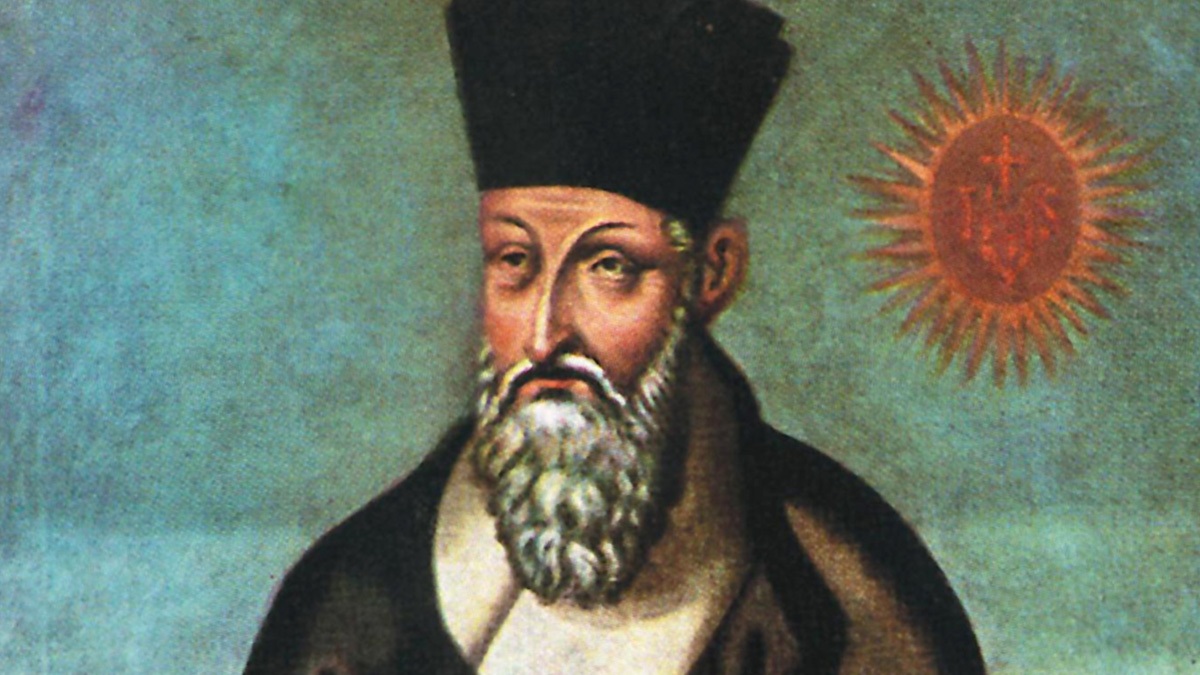
A portrait of Matteo Ricci, date unknown. (Wikimedia Commons)


Recognizing that Matteo Ricci “lived the Christian virtues to a heroic degree,” Pope Francis has officially put the famous 16th-century Italian Jesuit missionary to China on the path to sainthood.

On Dec. 17, the Vatican announced that the pope has authorized Cardinal Marcello Semeraro, the prefect of the Vatican Dicastery for the Causes of the Saints, to promulgate a degree recognizing “the heroic virtues of the Servant of God, Matteo Ricci, a professed priest of the Society of Jesus, [who was] born at Macerata, Italy, on Oct. 6, 1552, and died in Peking [now Beijing], China, on May 11, 1610.”

Pope Francis described Father Ricci as "a man of encounters, who went beyond being a foreigner and became a citizen of the world.”
Tweet this


Pope Francis is known to be inspired by Father Ricci, and the decree comes on the pope’s 86th birthday today. The Vatican’s announcement is also an important one for the Catholic Church in China and its 12 million members.

In a meeting last May with a delegation from the University of Macerata, Pope Francis described Father Ricci as a “champion” of the “culture of dialogue.” He said, the Jesuit missionary is famed not only for his actions and his writings, but for being "a man of encounters, who went beyond being a foreigner and became a citizen of the world.”

Father Ricci began his missionary work in China in 1582 when he arrived in Macau, then a Portuguese colony. Moving to mainland China, where he adopted the Chinese style of life and became fluent in the Chinese language, he spent the remaining 27 years of his life in China.

Father Ricci made history in 1601 by becoming the first European to enter China’s Forbidden City in Peking (now Beijing); the Wanli Emperor of China’s Ming dynasty had invited him because of his knowledge of astronomy and calendrical science. Known as “​​Li Madou” to the Chinese, Father Ricci produced scholarly works in optics, astronomy, music, geography, geometry and numerous other fields.

Known as “​​Li Madou” to the Chinese, Father Ricci produced scholarly works in optics, astronomy, music, geography, geometry and numerous other fields.
Tweet this


Father Ricci subsequently converted several prominent Chinese officials to Christianity, including Xu Guangqi, a Chinese scholar and a high-ranking official in the Chinese government. Xu Guangqi’s cause for sainthood is also under consideration and had been hoped to be announced together with the cause of Father Ricci, but that was not possible due to the difficulty of getting access to the necessary documentation in the Diocese of Shanghai.

Father Ricci cooperated together with Xu Guangqi and others in translating Western classics like Euclid’s Elements into Chinese and translating important Confucian texts into Latin. In an unprecedented honor, at his death he became the first Westerner to be buried in Imperial Ground in the capital city by a special decree of the Chinese emperor. (Previously, all foreigners who died in China were taken to Macau for burial). His grave is in the Zhalan Cemetery on the grounds of the Beijing Administrative College, previously the Beijing Communist Party School.

The Chinese recognize Father Ricci as a bridge builder between the East and the West, and have honored him by commemorating him in the Millenium Monument in Beijing, the only other Westerner so honored is Marco Polo.

The diocesan phase of Father Ricci’s cause was opened in 1984. Documentation attesting to his achievements and personal holiness was collected and sent to the Vatican’s congregation (now dicastery) for the causes of the saints in 2014. In Rome, the postulator of the cause prepared what is known as the “positio,” a summary of the documentary evidence from the diocesan phase that aims to prove that Ricci lived the Christian life and virtues in a heroic way. The Christian virtues are of two kinds: the “cardinal” virtues of justice, temperance, prudence and fortitude, and the “theological” virtues of faith, hope and love.

The positio was then submitted to a committee of nine theologians, who concluded by voting that Matteo Ricci had lived a Christian life to a heroic degree. Father Ricci’s cause was next examined by the cardinals and bishops who are members of the dicastery. After their vote in favor of the cause, the pope authorized the dicastery to draft a decree declaring Father Ricci “Venerable.”

In order for the pope to declare him blessed (the next step on the path to sainthood), the postulator of the cause will need to provide evidence of a miracle through the intercession of Matteo Ricci; by Vatican convention, a second miracle will be needed for him to be declared a saint.


Friday, November 09, 2018

How Catholics influence U.S. politics


November 09, 2018


Photo by rawpixel on Unsplash


Steven P. Millies is the author of Good Intentions: A History of Catholic Voters’ Road from Roe to Trump. In his book, Steven analyzes the history of the Catholic vote, from the Supreme Court’s decision in Roe v. Wade to the presidential elections of 2016.

We talk to Steven about the role of Catholics in U.S. politics and why so many Catholics feel politically homeless and the 2018 midterm elections. (Full disclosure: Our interview with Steven happened a week before the elections.)

In Signs of the Times, first up, November just started, but Christmas is already making headlines: Bishop Edward Braxton of Belleville, Ill., tells kids at Our Lady of Peace that Santa Claus isn’t real. Next, The Boston Globe and the Philadelphia Inquirer co-published an article on Nov. 4 analyzing the second wave of the sexual abuse crisis in the Catholic Church.

And finally, we discuss the decision by the Supreme Court to overturn the death sentence of Asia Bibi, a 47-year-old Pakistani Catholic who has been in prison since 2009 and was sentenced to death in November 2010 on charges of blasphemy against the Prophet Mohammed. Following the court’s decision, Bibi remained in prison due to safety concerns; however, since Tuesday’s recording, Bibi has been freed.


Links from the show:

Parents angry after Illinois bishop tells Catholic school kids that Santa isn’t real

Pakistani Christians fear violence after Asia Bibi’s blasphemy death sentence is overturned

Newspapers examine U.S. bishops’ responses to abuse allegations
What’s on tap?

Yuengling Lager


Tuesday, March 27, 2018

Repeal the Second Amendment


POLITICS & SOCIETYEDITORIALS

FEBRUARY 25, 2013 ISSUE


The Editors

February 12, 2013


Plagued by rising levels of violent crime, in the autumn of 1976 the District of Columbia enacted one of the nation’s toughest gun control laws. The law effectively banned handguns, automatic firearms and high-capacity semiautomatic weapons. Police officers were exempt from the provisions of the law, as were guns registered before 1976. Over the following decade, the murder rate in Washington, D.C., declined, then increased, shadowing a national trend. Overall, however, the new law helped to prevent nearly 50 deaths per year, according to one study published in The New England Journal of Medicine. “We knew there were problems we couldn’t wipe out,” said Sterling Tucker, chair of the district council at the time, as he reflected on the law 22 years later. “But we had a little more control over it.”

On June 26, 2008, in a closely watched, far-reaching decision, the Supreme Court of the United States struck down the D.C. law, ruling that it violated the Second Amendment to the U.S. Constitution, which states: “A well regulated militia being necessary to the security of a free state, the right of the people to keep and bear arms shall not be infringed.” In the court’s majority opinion, Associate Justice Antonin Scalia wrote: “We are aware of the problem of handgun violence in this country, and we take seriously the concerns raised by the many amici who believe that the prohibition of handgun ownership is a solution.... But the enshrinement of constitutional rights necessarily takes certain policy choices off the table.”

Justice Scalia was right. Even those who subscribe to methods of constitutional interpretation other than Mr. Scalia’s brand of modified originalism must concede the basic point: The Second Amendment impedes the power of the government to regulate the sale or possession of firearms. Unfortunately, the grim consequence of this constitutional restriction is measured in body counts. The murder of 20 elementary school children and six adults in Newtown, Conn., in December was merely the latest in a string of mass shootings: Virginia Tech, Fort Hood, Tucson, Aurora, Oak Creek. In the last 30 years, there have been 62 mass shootings (each leaving at least four people dead) in the United States. Since the 1999 shooting at Columbine High School in Columbine, Colo., there have been 130 shootings at schools; nearly half involved multiple deaths or injuries.

Friday, December 01, 2017

If They Knew How to Bridge This Gap with Me - Michael: Outspoken


21 November 2017 | Jared Wright


By now, for those who pay attention to LGBT+ stories from within the Seventh-day Adventist community, it is a familiar narrative: young person grows up in traditional, rural Adventist home; young person is raised knowing that homosexuality is wrong; young person realizes (s)he identifies as homosexual; young person tries to be straight, agonizes over same-gender attractions, fears that people will find out, prays for feelings to be taken away; prayer does not change things; and young person (now a bit older) comes to terms with and accepts his/her sexual identity. Tension remains between young person and the family members who have difficulty coming to terms with non-hetero identities.

And of course, as is the case for Michael, the subject of the 7th installment of the "Outspoken" documentary series, there is always more to the story. There are feelings of isolation, of not being heard or understood, and feelings of being disconnected from family and the faith community that cannot or will not embrace LGBT+ people.

In addition to all that for Michael, there was—there is—partnership: a committed relationship with Peter that began with the dating app OKCupid. Michael lights up as he discusses finding someone with whom he fits so well.


Peter (left) and Michael in a still image from the latest installment of "Outspoken."


“That feels very surreal but very good,” Michael says. But there is also a bitter to that moment’s sweet.

“I don’t know if my parents can fully appreciate how happy I am now because I don’t know if they fully understand how sad I was . . . and sometimes I still am,” Michael says.

“I know that if they knew how to bridge this gap with me, I know that they would do it in an instant. . . . Adventism is such a core thing for them and who they are.”

We’re left wondering whether Michael’s family—and whether the families of so many others like him—will ever be able to accept and embrace this part of their child.

In just sixteen minutes, filmmakers Daneen Akers and Stephen Eyer manage to fill up our eyes with stars and with tears in turn.

That is the power of story . . . of Michael’s story.

Watch Michael: Outspoken,,,,,


Michael - Outspoken from Stephen Eyer on Vimeo.


Source

Sunday, September 03, 2017

The decline of unions is part of a bad 50 years for American workers


August 23, 2017


Workers at an embroidery factory (iStock/andresr)


The current imbalance between supply and demand in the labor force should be good news for American workers still waiting to see a few extra bucks in their pockets after decades of income stagnation. Unfortunately, the nation’s 4.3 percent unemployment rate is not translating into fatter paychecks. Wages for most U.S. workers are still stagnant. In a tightening labor market, people are essentially working for less money than they did in the 1970s, at least when inflation is taken into account. What is going wrong?

According to some economists, part of the downward pressure on wages comes from the vast reserve of workers who, despite that low official rate of unemployment, remain on the sidelines of the formal economy. These discouraged workers are no longer tracked by the Bureau of Labor Statistics because of their long absence from the labor force, but many are still competing for full-time jobs. At the same time, mismatches between skills and job openings, as well as less direct effects on employment capacity (like the nation’s opioid epidemic), are keeping many U.S. workers from jobs with good wages.


Labor’s decline just about matches up to the swan dive of middle-class income in the United States since the 1970s.


Sunday, October 09, 2016

Internet Space: A New Moral Geography


An excerpt from an article of the current America Magazine (October 17, 2016 Issue):

The internet enables our eyes to see around the world, but it does not extend the reach of our hands in the same way. Whereas physical space holds knowledge and action together, the internet separates them. The problem here is not disembodiment but the particular construction of moral space. Disembodiment is nothing new. Written text, phone calls, radio and television are all disembodied. Each communication medium constructs a particular form of presence and absence and mediates a certain type of encounter. In order to understand how the internet transforms moral geography we have to look at the details of how it works.

Technologists likes Jaron Lanier point to the importance of the internet’s underlying “packet switching” network architecture. This architecture was inspired in part by the Cold War-era need to build networks that could withstand nuclear attack. The standard networks of the time were hierarchical, like the first telephone systems. They routed data through central switchboards. Attack the switchboard and you disconnect all its connected nodes (e.g., radar sites and missile silos). This weak link could be targeted to disable an entire system. Packet switching addresses this weakness. In such a network, data does not require a fixed connection between two points. Instead, messages are broken into packets, and those packets are sent out into a web of routers that passes them on to other routers on multiple and varied paths to their final destination, with the final recipient reassembling them into the original message. If part of the network is compromised, the packets can be routed through the remaining sections.

What do missile silos have to do with our experience of the internet? This network architecture was designed to free data from the contingencies of geographical space. No particular pathway through the network is crucial; if one is blocked, finding another path is automatic. Once a packet has arrived, the particular route it took is unimportant, and indeed that information is generally discarded. This architecture creates a nonlocal space where the Silicon Valley mantra “information wants to be free” is a fundamental law. As a result, data comes to us from everywhere and our sight is extended far beyond the reach of our hands.

But the internet as we know it is built in many layers on top of this underlying spatial geometry. The search services, social media and apps we use employ this underlying spatial freedom to facilitate individual choice. This is a result of particular historical decisions. When internet companies were seeking a business model that could convert clicks into profits, they chose to offer “free” services paid for by advertising revenue. Thus began the monitoring of our preferences, messages and social circles in order to personalize the ads we are shown. Google tracks the results we choose so it can filter search results in the future—to better give us what we are searching for. This threatens to structure the information we receive according to our preferences and prejudices. All of this is symbolized well by the empty search engine box: what do you want?

As we receive more and more news through our social media feeds, our informal social circles become de facto editorial boards. In a group of about 20 mostly white young people at a recent lecture, all were familiar with an image of Omran Daqneesh, and about two-thirds had watched the video. Far fewer were familiar with Philando Castile, and only one had watched the video of his death. Both were featured prominently in traditional, edited media sites like newspapers and broadcast networks.

We spend time in internet space even when we are out in the world rather than sitting at a computer. The smartphone was no small revolution. Through mobile phone networks, the internet’s reach expanded into just about all spaces and its depth into the capillary times of our lives. Notifications chime and buzz, calling us to turn to this space and attend to social networks constructed by its logic of choice. As a result, the internet writes over the physical geography in which we as embodied persons ostensibly dwell. We are free to choose to be elsewhere by simply glancing at our phones—and we do much more than glance. The very same day that Philando Castile was killed this summer saw the release of Pokémon Go, the augmented reality sensation that literally overwrites physical reality with an engrossing world of intriguing monsters and engaging competition. Parks and public spaces are now filled with people walking about literally viewing the world through smartphone screens.

Read more


The Geography of Mercy

October 17, 2016 Issue

Vincent J. Miller

On the internet, we encounter suffering from afar. How do we respond?

Friday, August 12, 2016

Lebanon Shows Christians and Muslims Can Live Together in Peace in the Middle East


DISPATCHES


Gerard O'Connell | May 5 2016 - 10:28am


Syrian refugee children stand outside their school in Zahle, Lebanon, in the country's Bekaa Valley April 12. The international Catholic charity Caritas has been instrumental in helping Syrian refugees attend Lebanese public schools to continue their education. (CNS photo/Dale Gavlak)


“It has been an explosive situation in the Lebanon for the past four years. But I’m amazed that while Lebanon is on the brink of an explosion the miracle is that there is no explosion,” Michael Zammit, S.J., Jesuit Refugee Service regional director for the Mideast and North Africa, told me in Beirut last week.

Thursday, December 24, 2015

A 'most powerful woman' – National Geographic's major hat tip to the Virgin Mary


Mary. Credit: Wendell via Flickr (CC BY-NC-ND 2.0) filter added.


Washington D.C., Dec 23, 2015 / 06:02 pm (CNA).- Our Lady. Blessed Mother. Virgin Mary. Queen of Peace. Theotokos. Handmaid of the Lord. Mother Mary.

These are just some of the titles used to describe the young woman to whom an angel appeared some 2,000 years ago with the message that she would conceive and bear the Savior of the World.

Mary has very few recorded words in the New Testament, but her worldwide devotion spans across time, cultures and even religions.

In a Nov. 8 feature for National Geographic, “How the Virgin Mary Became the World’s Most Powerful Woman,” Maureen Orth explores the worldwide phenomenon of devotion to the Mother of God in anticipation of the Dec. 13 National Geographic Channel special, “The Cult of Mary.”

In her piece, Orth spoke with Marian scholars and experts and even followed pilgrims to Marian apparition sites to learn more about this “most powerful woman.”

“We see the relationship of Mary with us isn’t just any relationship – it’s sacred,” María Enriqueta García, who did her sacred theology dissertation at the International Marian Research Institute at the University of Dayton, told Orth.

The idea of Mary as an intercessor before God comes from scripture at the Wedding Feast of Cana, when Jesus performs his first miracle after his mother’s prompting of, “They have no wine” followed by her instruction to the servers to, “Do whatever he tells you.”

“Since then no other woman has been as exalted as Mary,” Orth said. “As a universal symbol of maternal love, as well as of suffering and sacrifice, Mary is often the touchstone of our longing for meaning, a more accessible link to the supernatural than formal church teachings. Her mantle offers both security and protection.”

For her story, Orth accompanied pilgrims around the world to Marian apparition sites including Lourdes, Kibeho, Mexico City, and even Medjugorje – where apparitions are said to still be occurring and the Vatican has not yet ruled on its authenticity.

In Kibeho, Rwanda she met with Anathalie Mukamazimpaka, one of the young women to whom the Virgin Mary appeared from 1981 to 1983 with the message of repentance and foretold the events of the 1994 Rwandan Genocide.

“The first time she appeared,” Anathalie said, “I was reciting the rosary, and she called me by my name … She never told me why she chose me. She said she appears to anyone she wants, anytime she wants, anywhere she wants,” Anathalie said. “She only asks us to love her as much as she loves us.”

Mary even helped give a nation their identity, Orth said, in the case of Our Lady of Guadalupe with Mexico.

“Anyone witnessing the outpouring of love and devotion that pilgrims demonstrate for their beloved Madre on the days leading up to the Feast of Our Lady of Guadalupe … can see that the Virgin Mary is deeply embedded in Mexican hearts and souls,” Orth said as she followed pilgrims to Mexico City where St. Juan Diego’s tilma bearing the miraculous image of Our Lady of Guadalupe is still intact and on display.

In addition to Christians, Muslims hold the Blessed Mother in high regard, Orth said, noting that her name appears more in the Koran than in the New Testament.

“So the Virgin Mary is not at all strange to Muslims,” Fr. Johann Roten, director of research and special projects at the University of Dayton’s Marian Library, said.

“In fact, wherever there is a connection between Christians and Muslims – or any two groups that know and love her – there is a common value in the covenant mother.”

In Egypt, Orth spoke with Muslims who were drawn to churches because of their devotion to Mary.

“Her story tells us a lot of things,” a young Muslim woman praying outside the Abu Serga church on Easter said. “She is able to face lots of hardships in her life because of her faith, her belief in God.”

This article was originally published on CNA Nov. 10, 2015.


.

Wednesday, November 11, 2015

Pope Seeks End to Worker Exploitation


NEWS

Nov 10 2015 - 11:01am | Carol Glatz - Catholic News Service


Birds fly as Pope Francis leaves the Duomo, the Cathedral of Santa Maria del Fiore, in Florence, Italy, Nov. 10. Pope Francis attended a meeting of Italy's bishops and cardinals in the Duomo during a one-day visit to Florence Nov. 10. The pope also met young people and was to celebrate Mass at a soccer stadium. (CNS photo/Paul Haring)


Meeting workers and addressing a major gathering of the Catholic Church in Italy, Pope Francis demanded an end to economic exploitation, to clerics "obsessed" with power, to apathy among youth and to a cold, fearful church that forgets Christ is always by its side.

"These times of ours demand that we experience problems as challenges and not like obstacles: The Lord is active and at work in the world," he said Nov. 10 inside Florence's Cathedral of Santa Maria del Fiore -- the third-largest church in Europe.

In a trip that covered a normal 8 a.m.-to-5 p.m. workday, the pope rallied workers, young people and hundreds of church leaders representing the entire Italian peninsula; he met with the sick, kissed babies, admired Renaissance artwork and venerated an ancient relic. He ate lunch with the poor and homeless and celebrated Mass in a city soccer stadium.

Much of the city seemed empty of residents, yet filled with people who came to see the pope and tourists curious about the beefed-up security and roadblocks.

Speaking to hundreds of Italian cardinals, bishops and laypeople attending a national congress held only every 10 years, the pope gave a lengthy, yet clear indication of where their discussions and pastoral mission should be heading.

"We must not tame the power of the face of Jesus," who takes on the face of the humiliated, the enslaved and "the emptied," he said.

A divine Christ reflects a very human gaze of humility and selflessness, and he insists his disciples follow the beatitudes like he did, the pope said.

"We must not be obsessed with power," the pope said, even if it is a useful or seemingly innocuous way of getting things done. Otherwise the church "loses its way, loses its meaning."
Please support our journalism. Subscribe now!

Standing at a lectern beneath a stunning painted dome ceiling representing the Last Judgment, the pope said the beatitudes indicate whether the church is following its mission or is only thinking of protecting its own interests. Measuring oneself against the beatitudes "is a mirror that never lies," he said.

Reading animatedly from his written remarks, the pope also found moments to offer a bit of humor, like when warning church leaders against various temptations.

"I'll present at least two" temptations, but not a huge list of 15 like he spelled out in a memorable pre-Christmas address to the Roman Curia in 2014, he said to applause and laughter in the pews.

Do not feel superior and place complete trust in structures and perfect plans, he said. This focus on the abstract and on security "often leads us to take on a style of control, harshness, regulation."

When "facing evils or problems in the church," he said, "it is useless to seek solutions in conservatism and fundamentalism, in the restoration of outdated conduct and forms" that are no longer culturally relevant or meaningful.

Christian doctrine, in fact, isn't a closed system void of questions or doubts, but is alive, restless, animated. Its face "isn't rigid, its body moves and develops, it has tender flesh. Its name is Jesus Christ."

The same spirit that drove Italian explorers to seek new worlds, unafraid of storms and open seas, can drive the church in Italy, Pope Francis said, if it lets itself be driven by the breath of the Holy Spirit, "free and open to challenges of the present, never in defense out of fear of losing something."

He also told priests and bishops to be shepherds, "nothing more. Shepherds." To illustrate what that looked like, the pope told a story of a bishop who was riding the subway during rush hour.

It was so packed, there was nothing to hold onto, and "pushed right and left" by the swaying car, the bishop leaned on the people around him so as not to fall. A bishop will find support, he said, by leaning on his people and through prayer, he said.

Underlining the importance of caring for the poor -- who know well the suffering and face of Christ, the pope asked God to protect the church in Italy from all forms of power, facades and money.

He recalled an old practice in Italy when mothers, who were unable to care for their newborns, left behind a small medallion, snapped in half, with the babies they gave up for adoption at a Catholic hospital. The birth mothers would keep the other half, he said, in the hopes that one day, when times had improved, they would be able to find their children.

"We have that other half. The mother church has the other half of everyone's medallion and it recognizes all of its abandoned, oppressed and tired children," he said. "The Lord shed his blood for everyone, not a select few."

"I like a restless church in Italy, ever close to the abandoned, the forgotten, the imperfect," the pope said.

"I want a happy church with the face of a mother, who understands, accompanies, caresses. Dream for this church, too, believe in this, innovate with freedom," he told the bishops, pastors and lay leaders.

The pope flew by helicopter from Rome early in the morning to land first in the industrial town of Prato on the outskirts of Florence. He apologized for his brief 90-minute visit there, saying he had come as "a pilgrim, a pilgrim in passing."

In the town's cathedral, he venerated the Holy Belt of Our Lady -- an ancient band of wool traditionally believed to have belonged to Mary and used to wrap her flowing robes around her waist.

From the cathedral balcony, he greeted thousands of people who had woken very early for the 8 a.m. encounter or slept there overnight in sleeping bags.

Addressing young people and workers, especially foreign workers, the pope criticized the "cancer" of corruption and exploitation, calling it the "venom" of a culture built on operating outside the law.

He recalled the seven Chinese textile workers who were killed two years ago when the pre-fab warehouse they worked and slept in caught fire and caused the roof to collapse.

The pope said the deaths of those men and women, who slept in a tiny alcove jerry-rigged out of cardboard and drywall, "is a tragedy of exploitation and inhumane living conditions."

To people's cheers and applause, he urged young people and workers to fight to the very roots of the problem of "the cancer of corruption" and "the cancer of human and worker exploitation."


.