Showing posts with label Lebanon. Show all posts
Showing posts with label Lebanon. Show all posts
Sunday, April 19, 2026


Thursday, March 26, 2026
A reporter’s view in Lebanon finds Christianity in the US-Israel-Iran conflict
Jovel Álvarez
Mar 24, 2026
Mar 24, 2026
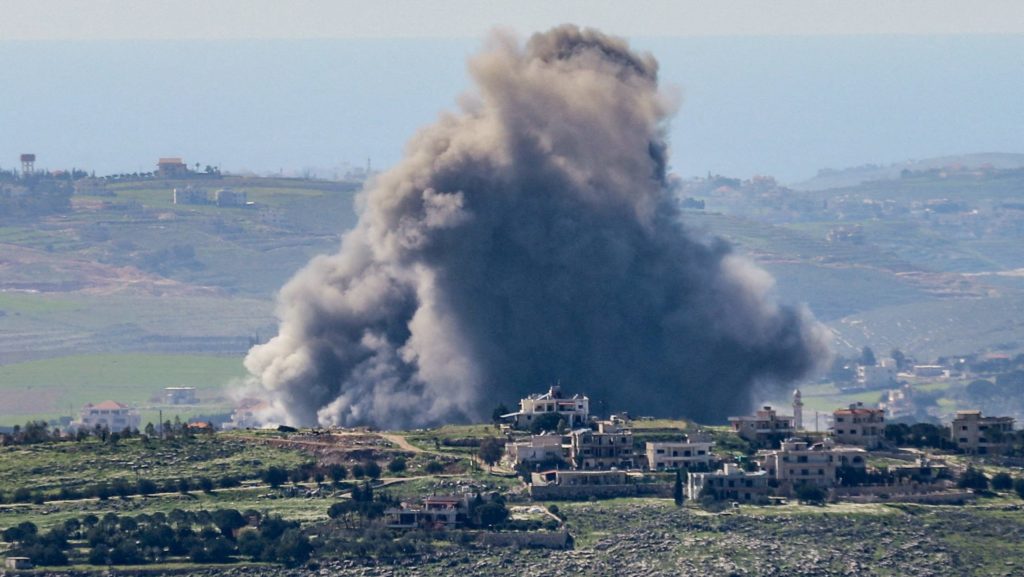
Smoke rises after Israeli strikes in Lebanon, following an escalation between Hezbollah and Israel amid the U.S.-Israeli conflict with Iran, as seen from Marjayoun, Lebanon, March 5, 2026. (OSV News/Karamallah Daher, Reuters)
Watching Abu Ali Hamiyeh use a stone to hammer the nails that will hold together the wooden planks of his new house on a corner of Beirut’s waterfront, you’d never guess that just a few months ago, Pope Leo XIV passed by that very spot.
At a special Mass nearby that day, the Holy Father called on Lebanese like Hamiyeh to be “builders of peace.”
“The path of mutual hostility and destruction in the horror of war has gone too far, with the deplorable results that are plain for all to see,” said Leo on Dec. 2, not knowing that a few weeks later, the country would be caught up in the largest war the region has seen so far this century.
“We need to change course; we need to educate our hearts for peace,” he urged.
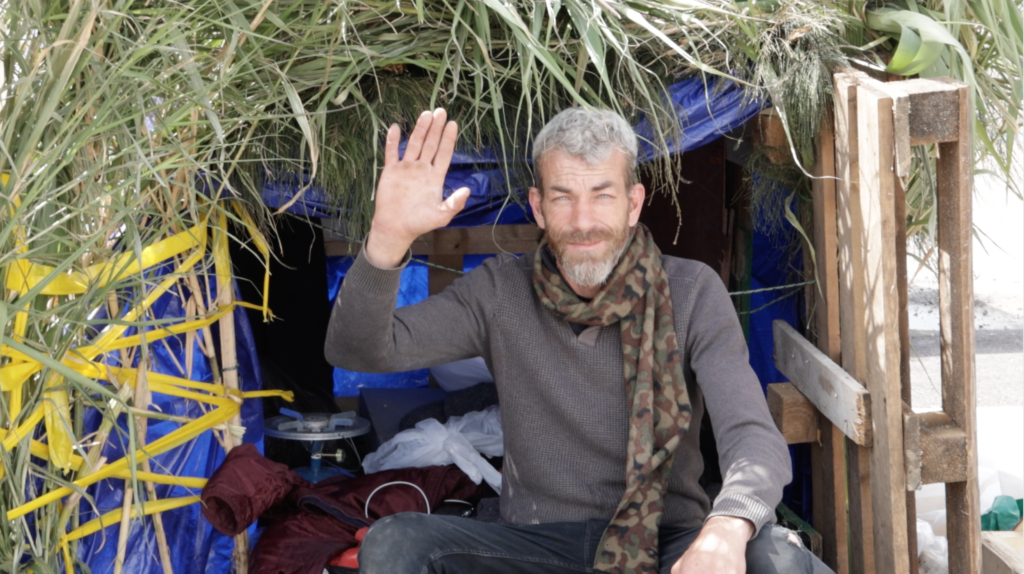
Abu Ali Hamiyeh, a Lebanese Muslim, at his makeshift shack in the new refugee camp along Beirut’s waterfront where Pope Leo XIV visited last December. (Jovel Álvarez)
Hamiyeh is one of those displaced by this conflict. A Muslim, he comes from the Bekaa Valley, a stronghold of Hezbollah, an Islamist militant group with which he sympathizes. He, like a million of his compatriots, has had to abandon his home due to evacuation orders from the Israeli army.
No one wants to speak to the press, except Hamiyeh. The day is Friday, March 20, and he speaks with me as he patches together a wooden shack covered with a blue tarp and a thatched roof. He pulls over a plastic trash can and invites me to sit down so we can talk more comfortably.
“Here with us there are Syrians, Palestinians, Jordanians, Turks, Sri Lankans, etc. … Everyone is here. We will not leave this place unless we achieve a great victory. We fought against them for 66 days; we gave martyrs!”
“The Bekaa Valley is the bastion of the resistance; we have given martyrs and blood, and our children, and we remain steadfast on this path of resistance — and we will give even more. Hezbollah is the victorious faction, according to the Quran. Without a doubt, they are victorious,” he says with great conviction.
Hamiyeh regrets not being able to offer me coffee and show me some of that legendary Arab hospitality.
Little by little, the coastline is turning into a refugee camp. No one knows when they will be able to return to their homes, or if there are any homes left to return to.
Sunday, March 15, 2026
Christians evacuated from Lebanese town gather at church and mourn man killed in Israeli strike
------------------------------
BREAKING NEWS Lebanon Priest Killed/Pope Appeal/Arrested Bishop Resigns/Cathedral Fire/New US Nuncio
Thursday, March 12, 2026
Monday, December 01, 2025
Pope Leo XIV doubles down on insistence for 2-state solution to resolve Israeli-Palestinian conflict

Pope Leo XIV talks to reporters aboard an aircraft on his way to Beirut, Lebanon, Sunday, Nov. 30, 2025. (Andreas Solaro/Pool Via AP)
By Nicole Winfield | Associated Press
PUBLISHED: November 30, 2025 at 1:08 PM CST | UPDATED: November 30, 2025 at 1:14 PM CST
ABOARD THE PAPAL PLANE — Pope Leo XIV doubled down Sunday on the Holy See’s insistence on a two-state solution to resolve the Israeli-Palestinian conflict, saying in his first airborne news conference that it was the “only solution” that could guarantee justice for both sides.
Leo made the comments as he flew from Istanbul to Beirut for the second and final leg of his maiden voyage as pope. Though Leo has been fielding journalists’ questions at informal gatherings at his country house, the brief encounter marked his first news conference as pope and followed the tradition of his predecessors of using his foreign trips to engage with the media.
Because of the short flight, the news conference was limited to two questions from Turkish journalists. When Leo returns to Rome on Tuesday, the encounter will presumably be longer.
Saturday, November 15, 2025
Pope Leo's first papal trip signals desire to bridge Catholic-Orthodox divides
ISTANBUL (RNS) — An upcoming visit between two of Christianity's most prominent figures is a welcome sign that reflects what's already happening in many churches in Turkey.

David I. Klein
November 14, 2025
ISTANBUL (RNS) — Pope Leo XIV is set to touch down in Istanbul at the end of November before visiting Lebanon for his first international trip since his papal election in May. The pontiff will visit eight cities from Nov. 27 to Dec. 2, sitting down with both political and faith leaders and leading Masses for Catholic locals and pilgrims.
Though Leo will first meet with Turkish President Recep Tayyip Erdoğan and various religious leaders, one of the most significant aspects of his visit will be joint ceremonies with Bartholomew I, ecumenical patriarch of Constantinople and one of Eastern Orthodox Christianity’s chief spiritual leaders.
The two together are slated to visit the Turkish city of İznik, once Greek-speaking Nicaea that 1,700 years ago played host to the first ecumenical council. There, early church fathers determined some of Christianity’s most basic doctrines, such as setting the date of Easter, explaining the trinity and clarifying the divinity of Jesus. It was agreed that Jesus was “God from God, light from light, true God from true God, begotten not made, of one s ubstance with the Father,” as reads the Nicene Creed, which many churches hold to be the fundamental declaration of Christian faith.
The anniversary of Nicaea isn’t just a historical moment. It’s a symbol around which ecumenically minded leaders in both Orthodox and Catholic churches have continued to work on bridging the centuries-old divisions between the churches.
RELATED: On anniversary of the first Council of Nicaea, Christian leaders seek to return to ecumenism
The pope and patriarch standing together at Nicaea has been in the works for some time. Luca Refatti, an Istanbul-based Catholic priest, told RNS the trip was planned by Pope Francis but delayed by his sickness and canceled by his death earlier this year. That it was chosen for Pope Leo’s first apostolic international trip is a signal he will follow in Francis’ footsteps in bridging relations with other churches, Refatti said.
“To celebrate this moment is important because it is reminding us of our unity,” said Refatti, who stressed that the First Council of Nicaea — which occurred only a few years after Christianity was legalized in the Roman Empire — predates divisions of most modern churches. “Nicaea is important because it is basically the symbol, the creed, where every Christian is united. Now, Orthodox, Catholics, Syriacs, Armenians, everybody recognizes and accepts the creed of Nicaea.”
French pilgrims look at archaeological excavations of the ancient Byzantine-era Christian Saint Neophytos Basilica, in İznik, also known by its ancient name Nicaea, northwestern Turkey, Thursday, Nov. 13, 2025, ahead of the visit of Pope Leo XIV to mark the 1,700th anniversary of the First Council of Nicaea. (AP Photo/Francisco Seco)
David I. Klein
November 14, 2025
ISTANBUL (RNS) — Pope Leo XIV is set to touch down in Istanbul at the end of November before visiting Lebanon for his first international trip since his papal election in May. The pontiff will visit eight cities from Nov. 27 to Dec. 2, sitting down with both political and faith leaders and leading Masses for Catholic locals and pilgrims.
Though Leo will first meet with Turkish President Recep Tayyip Erdoğan and various religious leaders, one of the most significant aspects of his visit will be joint ceremonies with Bartholomew I, ecumenical patriarch of Constantinople and one of Eastern Orthodox Christianity’s chief spiritual leaders.
The two together are slated to visit the Turkish city of İznik, once Greek-speaking Nicaea that 1,700 years ago played host to the first ecumenical council. There, early church fathers determined some of Christianity’s most basic doctrines, such as setting the date of Easter, explaining the trinity and clarifying the divinity of Jesus. It was agreed that Jesus was “God from God, light from light, true God from true God, begotten not made, of one s ubstance with the Father,” as reads the Nicene Creed, which many churches hold to be the fundamental declaration of Christian faith.
The anniversary of Nicaea isn’t just a historical moment. It’s a symbol around which ecumenically minded leaders in both Orthodox and Catholic churches have continued to work on bridging the centuries-old divisions between the churches.
RELATED: On anniversary of the first Council of Nicaea, Christian leaders seek to return to ecumenism
The pope and patriarch standing together at Nicaea has been in the works for some time. Luca Refatti, an Istanbul-based Catholic priest, told RNS the trip was planned by Pope Francis but delayed by his sickness and canceled by his death earlier this year. That it was chosen for Pope Leo’s first apostolic international trip is a signal he will follow in Francis’ footsteps in bridging relations with other churches, Refatti said.
“To celebrate this moment is important because it is reminding us of our unity,” said Refatti, who stressed that the First Council of Nicaea — which occurred only a few years after Christianity was legalized in the Roman Empire — predates divisions of most modern churches. “Nicaea is important because it is basically the symbol, the creed, where every Christian is united. Now, Orthodox, Catholics, Syriacs, Armenians, everybody recognizes and accepts the creed of Nicaea.”
Tuesday, August 26, 2025
Wednesday, June 11, 2025
Sunday, August 18, 2024
Unmasking Hezbollah - Drug trafficking and terror | DW Documentary
Who was behind the assassination of Rafic Hariri? (2/3)
Money laundering in Europe (3/3)
xxxxxxxxxxxxxxxxxxxxxxx
Tuesday, July 30, 2024
Sunday, October 08, 2023
Monday, April 08, 2019
Sunday, February 19, 2017
Friday, August 12, 2016
Lebanon Shows Christians and Muslims Can Live Together in Peace in the Middle East
DISPATCHES

Syrian refugee children stand outside their school in Zahle, Lebanon, in the country's Bekaa Valley April 12. The international Catholic charity Caritas has been instrumental in helping Syrian refugees attend Lebanese public schools to continue their education. (CNS photo/Dale Gavlak)
“It has been an explosive situation in the Lebanon for the past four years. But I’m amazed that while Lebanon is on the brink of an explosion the miracle is that there is no explosion,” Michael Zammit, S.J., Jesuit Refugee Service regional director for the Mideast and North Africa, told me in Beirut last week.
Sunday, April 17, 2016
Beirut Marine Barracks Bombing Fast Facts
CNN Library
Updated 5:27 PM ET, Mon October 19, 2015

U.S. marines searching for victims in Beirut eight days after an attack that killed 241 American soldiers on October 23, 1983.
(CNN) Here is a look at what you need to know about the 1983 bombing at a Marine compound in Beirut, Lebanon that killed 241 U.S. service personnel.
Facts:
October 23, 1983 - 241 U.S. service personnel -- including 220 Marines and 21 other service personnel -- are killed by a truck bomb at a Marine compound in Beirut, Lebanon.
Three hundred service members had been living at the four-story building at the airport in Beirut. There were 1,800 Marines stationed in Beirut at the time.
A multi-national force with units from France, Italy and the United Kingdom was also on peacekeeping duty in Lebanon at the same time.
At the same time the Marine barracks was hit, a suicide bomber drove a pickup truck full of explosives and crashed into a building housing French paratroopers. Approximately 58 French soldiers were killed in the attack.
This was the deadliest attack against U.S. Marines since the battle over Iwo Jima in February 1945.
The bombing was traced to Hezbollah, a militant and political group that originated in Lebanon in 1982. Iranian and Syrian involvement was also suspected.
The Marines were criticized for having lax security at the barracks.
The commander of the barracks, Col. Timothy J. Geraghty, said in congressional hearings investigating the attacks that the compound was hard to defend because it was on flat ground and vehicles drove by it daily to access the airport.
Timeline:
1982 - President Ronald Reagansends Marines to Lebanon on a peacekeeping mission.
October 23, 1983 - At 6:22 am, a truck carrying 2000 pounds of explosives drives into the Marine compound in Beirut, Lebanon, and crashes into the 1st Battalion, 8th Marine Regimental Battalion Landing Team barracks.
February 1984 - U.S. troops withdraw from Lebanon.
1985 - The Inman Report is released. It finds that Marine officers did not take proper steps to protect the barracks against terrorist attacks.
May 30, 2003 - A U.S. federal judge rules that the terrorist group Hezbollah carried out the attack at the direction of the Iranian government. The ruling allows families of the victims to sue Iran.
September 7, 2007 - U.S. District Judge Royce C. Lamberth orders Iran to pay $2.65 billion to survivors and to family members of the service members killed in the 1983 bombing.
March 1, 2010 - A lawsuit is filed in New York City seeking to force Iran to pay the $2.65 billion awarded to survivors and family members in 2007.
March 30, 2012 - U.S. District Court Judge Royce Lamberth issues a judgment against Iran of $2.1 billion, to be paid to the families and survivors of the attack.
July 2013 - U.S. District Court Judge Katherine Forrest rules to release $1.75 billion of Iranian funds, held in a New York Citibank account, to set up a fund for victims of the 1983 bombing.
July 9, 2014 - A federal appeals court affirms a 2013 ruling that $1.75 billion in Iranian funds should be awarded to the victims' family members.
Thursday, November 12, 2015
Suicide bombers kill 43 in Beirut, 240 wounded
Nov 13 2015 - 12:43am

Scene of the deadly blasts in Beirut
At least 43 people were killed and more than 240 wounded on Thursday in two suicide bomb blasts claimed by Islamic State in a crowded residential district in Beirut’s southern suburbs, a stronghold of the Shi’ite Muslim group Hezbollah.
The explosions were the first attacks in more than a year to target a Hezbollah stronghold inside Lebanon, and came at time when the group is stepping up its involvement in the Syrian civil war — a fight which has brought Sunni Islamist threats and invective against the Iran-backed Shi’ite group.
Hezbollah has sent hundreds of fighters to support Syrian President Bashar al-Assad’s forces in the four-year-old conflict over the border. Government forces backed by Hezbollah and Iranian troops have intensified their fight against mostly Sunni insurgents, including Islamic State, since Russia launched an air campaign in support of Assad on Sept. 30.
Syria’s civil war is increasingly playing out as a proxy battle between regional rivals, including Iran and Saudi Arabia, which supports the rebels. The two foes also back opposing political forces in Lebanon, which suffered its own civil war from 1975 to 1990, and where a political crisis has been brought about by factional and sectarian rivalries.
The blasts occurred almost simultaneously late on Thursday and struck a Shi’ite community centre and a nearby bakery in the commercial and residential area of Borj al-Barajneh, security sources said. A closely guarded Hezbollah-run hospital is also nearby.
Health Minister Wael Abu Faour said 43 people were killed and 240 people were wounded.
Islamic State said in a statement posted online by its supporters that its members blew up a bike loaded with explosives in Borj al-Barajneh and that when onlookers gathered, a suicide bomber blew himself up among them. The group said the attacks killed 40 people.
Hezbollah vowed to continue its fight against “terrorists”, warning of a “long war” against its enemies.
.
Monday, August 11, 2014
Lebanese Patriarch Rai Calls for Action in Iraq to Protect Christians
Daily Star, Lebanon
Posted 2014-08-10 23:24 GMT

Patriarch Beshara Rai heads Sunday's mass at Diman, Aug. 10, 2014. (The Daily Star/Maronite Patriarchate Bkerke, HO)
BEIRUT -- Maronite Patriarch Beshara Rai called Sunday for solidarity with the Christians of Iraq and asked the international community to intervene to put a stop to the persecution of Christians by the Islamic State of Iraq and Greater Syria (ISIS).
"We pray for our national unity, and for the unity of the communities of the Middle East afflicted by divisions and wars, for the spread of peace and understanding," he said during Sunday Mass at his summer residence in Diman, north Lebanon.
"We renew the patriarchate's call to the Arab League, the United Nations, the Security Council and the International Criminal Court to put a stop to ISIS' attacks and those of other fundamentalist organizations against the Christians of Mosul and the villages of Ninevah in dear Iraq, and allow the return of those Christians to their homes and properties with dignity, securing for them a decent life in their home countries with all the rights of citizens."
In July, ISIS began expelling Christians from Mosul, Iraq's second largest city. Earlier this month, the extremist group took over Iraq's largest Christian town.
Rai lamented the fate of some 150,000 displaced Christians, some of whom have been stranded in the mountains without food or water. He went on to call for solidarity from civil and religious groups and asked members of the community to assist with providing shelter and food for Christian refugees in coordination with the Chaldean Church and other congregations.
"We thank everyone who extends a hand to our Iraqi brothers who have sought refuge in Lebanon."
The Maronite religious leader also touched on Lebanese politics, continuing his shame campaign against Lebanese lawmakers.
"We renew our call on the conscience of parliamentarians and political blocs to respect the Constitution which obliges them ... to elect a president," he said, referring to the presidential vacancy, now in its third month. "Let us pray, brothers and sisters, that God's hand touches these hearts, and liberates [lawmakers] from interests, alliances and dependencies, and from their divisions, so that they elect a president who is the most appropriate and best given the current conditions in Lebanon and the region."
He emphasized that the church does not propose or back any candidate, but would support anyone elected to the office.
.
Saturday, April 05, 2014
Maronite bishops urge end to kidnapping, chaos
April 02, 2014 01:27 PM
The Daily Star

Maronite bishops attend the monthly meeting in Bkirki, Wednesday, March 5, 2014. (The Daily Star/HO)
BEIRUT: Authorities must put an end to all forms of kidnappings and chaos plaguing Lebanon, Maronite bishops said Wednesday.
The Council of Maronite Bishops “urges the government and security forces to take the necessary measures to stop the phenomenon of kidnapping and to prosecute kidnappers,” said a statement at the end of their monthly meeting.
Last week, Maronite Bishop Semaan Atallah escaped an attempted kidnapping in the eastern town of Zahle.
The Council also called for an “end to chaos" and the "safeguarding of the dignity of citizens.”
The bishops hailed a security plan to restore stability in the northern city of Tripoli and called for similar measures to be carried out elsewhere in Lebanon.
The bishops reiterated the need to respect constitutional deadlines and called on political forces to speed up presidential elections before President Michel Sleiman’s term expires May 25.
(The Daily Star :: Lebanon News :: http://www.dailystar.com.lb)
Source
.
Wednesday, January 08, 2014
Vatican's Cor Unum council travels to Lebanon to coordinate Syria aid

romereports
Published on Jan 4, 2014 The nearly three-year conflict is pushing the people fleeing Syria to a breaking point. As they challenges grow, Card. Robert Sarah, president for the Pontifical Cor Unum Council, and Secretary Giampiero Dal Toso, witnessed them first hand
.
.
Sunday, December 29, 2013
Subscribe to:
Posts (Atom)