Showing posts with label JRS. Show all posts

Monday, October 12, 2026

Haiti & Jesuit Refugee Service


 AI Overview

JRS in relation to Haiti most commonly refers to the Jesuit Refugee Service (known as Service jésuite aux réfugiés or through its close regional/partner network like SJM Haïti / Service Jésuite aux Réfugiés et Migrants).

Key Activities and Context

• Accompanying Migrants & Returnees: Operating in Haiti since 1999 (via partner networks like SJM Haïti), JRS and its partners defend the rights, safety, and dignity of migrants, displaced persons, and returnees facing violence, abuse, or forced repatriation.

• Education & Community Support: JRS has historically supported localized educational infrastructure and school construction projects in vulnerable or rural Haitian communities (such as in Thiotte) and aided children and stateless people of Haitian descent.

• Advocacy in North America: JRS/USA actively advocates for Haitian migrants abroad—including campaigning for the protection and extension of Temporary Protected Status (TPS) and humanitarian relief for hundreds of thousands of Haitians affected by ongoing domestic instability and violence.

(Note: "JRS" can also occasionally appear in sports contexts as an abbreviation or reference tied to Haitian football/athletes, such as player Jean-Ricner Bellegarde or Derrick Etienne Jr.).

Wednesday, September 23, 2026

Catholic groups urge government to defend asylum right


Reuters

Tue Sep 22 2026by Kelly Valencia


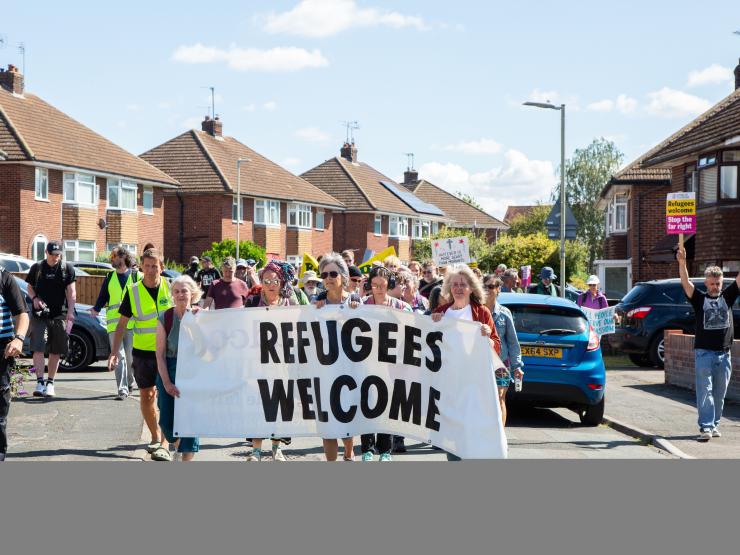
Catholic charities have called on the government to protect the rights and dignity of people seeking asylum in the UK.

A petition organised by the Caritas Social Action Network (CSAN), St Vincent de Paul Society (SVP) and Jesuit Refugee Service UK (JRS UK) was handed in ahead of the Catholic Church's World Day of Migrants and Refugees on 27 September.

The groups have criticised the changes made to the asylum system and are calling for the right to asylum to be restored, greater protection for refugees and an end to immigration detention.

Under rules introduced earlier this year, adults and accompanied children who are granted refugee status or humanitarian protection will receive 30 months' permission to stay, rather than five years, but those granted protection are required to apply for further permission if they still need it once their time is off.

The Home Office says these applications will involve a "safe return review", assessing whether conditions in a person's country of origin have changed sufficiently for them to return.

The changes are part of a wider government effort to reshape the asylum system. Ministers say the new approach is intended to provide protection to people who need it while encouraging those whose countries become safe to return.

However, charities argue that the changes risk making an already difficult system more restrictive.

Monday, June 22, 2026

World Refugee Day 2026


World Refugee Day 2026

Stand with refugees. Defend the right to safety and protection.


On World Refugee Day 2026, JRS/USA invites people of faith and goodwill to stand in solidarity with refugees and defend the right to seek safety. As the world marks the 75th anniversary of the 1951 Geneva Convention, we are reminded that protection was never meant for a select few. It is a promise rooted in human dignity — and it must be kept alive.

What is World Refugee Day?

World Refugee Day is observed each year on June 20 to honor the strength, courage, and resilience of people who have been forced to flee their homes because of conflict, persecution, or violence. It is also a day to recommit ourselves to protecting the rights, safety, and dignity of refugees around the world.

In 2026, World Refugee Day carries special significance. The world marks the 75th anniversary of the 1951 Geneva Convention, the international agreement that protects the rights of refugees and affirms the right to seek safety.

World Refugee Day 2026 Theme: Until Everyone Is Safe

The UNHCR theme for World Refugee Day 2026, “Until Everyone Is Safe,” reminds us that safety is not divisible. No community is truly secure while people forced to flee are denied protection, dignity, and the chance to rebuild their lives.

For JRS/USA, this theme reflects our mission of accompaniment, service, and advocacy. Protection is not only a legal principle. It is a moral responsibility and a shared commitment that grows across communities through welcome, relationships, services, and action.

Tuesday, March 24, 2026

A Call to Welcome: Archbishop Moth visits Jesuit Refugee Service

Eileen Cole
Mar 24th, 2026


Archbishop Moth with JRS team

Source: JRS UK

Archbishop Richard Moth today highlighted the Catholic Church's commitment to welcoming and supporting people seeking sanctuary in the UK, during a visit to Jesuit Refugee Service UK (JRS UK).

At the Hurtado Jesuit Centre, in the Archdiocese of Westminster, the Archbishop met refugees served by JRS UK, as well as volunteers and staff providing accompaniment, advice and practical support.

Archbishop Richard said: "The root of the call of the Gospel to welcome the stranger is that recognition of the value of the human person, which comes from recognizing that God is present in everyone, and keeping ourselves rooted in that space is so important. If we lose touch with that, then people become numbers, they become statistics. We lose sight of the value of that human person for who they are. So that welcome is a key part of the Gospel.

Jesus says we're going to be judged on it and so making that welcome available to all is absolutely key. JRS UK lives that out so clearly and is a sign to the society in which we live of what all of us are called to do.

Thursday, March 05, 2026

Regularisation of migrants in Spain: ‘Every person is an end in themselves'


A man walks the beach in Las Palmas, Spain, a week after arriving from Gambia (AFP or licensors)
World

Regularisation of migrants in Spain: ‘Every person is an end in themselves'

Amaya Valcárcel, International Advocacy Advisor at Jesuit Refugee Service, speaks to Vatican News about the Spanish government’s recent decision to grant legal residency to hundreds of thousands of undocumented immigrants.


By Joseph Tulloch

Last month, the Spanish cabinet approved a decree granting legal residency to hundreds of thousands of undocumented migrants.

At a time when deportation and detention dominate discussions on migration elsewhere, it was a striking choice.

In Spain, irregular migrants had lived “for years in the shadows,” said Amaya Valcárcel, International Advocacy Advisor at Jesuit Refugee Service. For the estimated 500,000 to one million affected, regularisation means “recognition of their civil existence” and “a step toward legal security.”

Speaking to Vatican News via email, Valcárcel, who is Spanish, emphasised that irregular migrants carry out “indispensable” work in Spain, in sectors such as agriculture, hospitality, construction and domestic work. However, without access to formal job contracts or safety nets, they live “under constant risk”.

Wednesday, January 14, 2026

JRS/USA 2026 Advocacy Day | April 21


Raise Your Voice for Refugees on Capitol Hill.

Join advocates from across the country for a day of community and congressional meetings focused on dignity, protection, and hope.


JRS/USA’s Advocacy Day for 2026 will bring together supporters, students, parish communities, and partners across the Jesuit network to advocate for policies that protect refugees, asylum seekers, potential deportees, and Catholic institutions.

Participants will receive training from policy experts, hear stories from the field, and meet with congressional offices in support of JRS/USA policy priorities and in solidarity with displaced persons, refugees, and vulnerable immigrants in the United States.

Built on the Ignatian ethic of service, accompaniment, and advocacy, the Day offers a powerful opportunity to turn faith into action.

Register by March 5

Jesuit Refugee Service


The Jesuit Refugee Service (JRS) is an international Catholic organisation with a mission to accompany, serve, and advocate on behalf of refugees and other forcibly displaced persons, that they may heal, learn, and determine their own future. Founded in November 1980 as a work of the Society of Jesus, JRS was officially registered on 19 March 2000 in Vatican City as a foundation. The impetus to found JRS came from the then superior general of the Jesuits, Pedro Arrupe, who was inspired to action by the plight of Vietnamese boat people.[1] JRS has programmes in over 55 countries. The areas of work are in the field of education, emergency assistance, health care, livelihoods, reconciliation, and psychosocial support. JRS is also involved in advocacy and human rights work. This involves ensuring that refugees are afforded their full rights as guaranteed by the 1951 Geneva Convention relating to the Status of Refugees[2] and working to strengthen the protection afforded to Internally displaced persons (IDPs).[3] JRS's international headquarters is located in Rome at the Society's General Curia. The International Director is Br Michael Schöpf SJ.

Jesuit Refugee Service
Abbreviation JRS
Formation 14 November 1980; 45 years ago
Founder Fr Pedro Arrupe SJ
Headquarters Rome

Region over 50 countries worldwide
Affiliations Society of Jesus
Website https://jrs.net

Superior General Arturo Sosa, S.J. Honors 45 Years of Jesuit Refugee Ser...

Thursday, February 13, 2025

Jesuit Refugee Service says Trump funding freeze will impact more than 100,000 refugees


In 2023, over half a million migrants headed toward the United States crossed the Darien Gap, the inhospitable jungle region between Colombia and Panama. | Credit: Gonzalo Bell/Shutterstock.com


By Madalaine Elhabbal

Washington, D.C. Newsroom, Feb 11, 2025 / 15:50 pm

More than 100,000 refugees across the globe who are recipients of critical aid from an international Jesuit nonprofit organization will be negatively impacted in the wake of the Trump administration’s 90-day funding freeze, according to Jesuit Refugee Service (JRS) USA.

According to a Feb. 7 document shared with CNA, the funding freeze has “initiated a total work stoppage” for the organization, which provides assistance to refugees and other displaced people across nine countries.

Funding from the Department of State’s Bureau of Population, Refugees, and Migrants for fiscal year 2025 would have totaled over $18 million, and the funding freeze “could adversely impact 103,000-plus refugees and other forcibly displaced people,” JRS said. In 2024, JRS received $24,049,039 in government funding and $9,224,422 in private donations, according to its financial statements from last year.

JRS was founded by the then-Superior General of the Society of Jesus Father Pedro Arrupe to serve Vietnamese refugees who fled their home country at the end of the Vietnam War in 1975. Gradually, the Jesuit-run organization grew to accommodate refugees from conflicts around the world. The organization was recognized officially by the Vatican in March 2000.

Since the Trump administration directive halted all foreign aid on Jan. 24 for a 90-day review, Catholic nonprofits internationally that depend on federal funding, such as Catholic Charities and Catholic Relief Services, are facing a crisis situation.

Despite Secretary of State Marco Rubio’s announcement that exemptions will be granted for certain “life-saving” programs, the document explained, “there is a lack of understanding and certainty about what this means, so funds are still not flowing.”

JRS USA carries out its operations in Chad, Colombia, Ethiopia, India, Iraq, South Africa, South Sudan, and Uganda. They provide critical services such as food, medicine, transportation, cash assistance, care for orphans and unaccompanied children, and psychiatric care.

According to information shared with CNA, Chad, Colombia, and Iraq have the largest number of refugees that will be negatively affected by the funding freeze, with more than 160,000 direct and indirect beneficiaries in Chad, some 54,000 in Iraq, and nearly 13,000 in Colombia.


JRS’ country director in Thailand, where over 12,000 refugees are expected to be impacted by the freeze, said in a statement shared with CNA that “the sudden suspension of JRS work with people of concern from Myanmar have left many at high risk of life-altering psychosocial distress.”

“They already found it hard to recover their lost social support network and livelihoods while in exile, and the uncertainty of restarting a life or surviving itself continues to bother them deeply,” the country director, who was not named, added.

The JRS coordinator for an education program center in India said in another statement: “It was once a place of hope, love, and joy, their safe space, but now it is an abandoned center that has an impact on the education of 200+ students.”

“More than 300 [children from Myanmar] rely entirely on JRS to continue their education in the hopes that they will be the ones to bring about change and put an end to the conflict,” the statement continued. “Though some may believe they have no other choices, they are survivors who can shape the future, and they come at the center every day shining.”


Saturday, January 25, 2025

With the migrants – In search of peace


24 Jan 2025

By Pierre Bélanger, SJ

Jesuits and their partners in mission are present at the very heart of the world. They are sensitive to the challenges of our time. They reach out especially to those in need of support. They want to help create a better world for everyone.

This is what emerges from the 2025 edition of the yearbook published by the General Curia of the Society of Jesus: Jesuits 2025. More than 40 articles and 10 personal testimonies provide food for thought on two key issues facing our times: forced migration and the search for peace for so many peoples suffering from war and other divisions.

The cover is striking: Rohingya refugees persecuted in Burma had fled to Bangladesh. They were forced to take to the sea again, and have now landed in Indonesia in the hope of finding a welcoming home.

The section on support for migrants

• highlights many facets of the work of JRS, the Jesuit Refugee Service;
• presents several examples of the welcome given to migrants by groups linked to the Society of Jesus;
• helps to raise awareness of the challenges of internal migration, particularly in South Asia;
• introduces the testimonies of Jesuits and JRS team members who have themselves been refugees or stateless.

The section entitled ‘In search of peace’ helps us to reflect on the meaning of peace according to Sacred Scripture, on the implications of reconciliation between individuals and peoples, on the dangers posed to peace by capitalism and its pursuit of profit, and on what it means to pray for peace. It presents several peace initiatives with which Jesuits have been or are associated, in the Holy Land, in India and Pakistan, in the Democratic Republic of Congo, in Northern Ireland... But also projects that help people who are trapped in labyrinths of destructive tensions.

What a rich collection of articles! Above all, how rich is the commitment of the Society of Jesus to helping build societies where life will be better! Download ‘Jesuits 2025’ in the language of your choice. You can also request one or more paper copies, at a low price, to distribute to those around you by contacting us here.


Wednesday, February 07, 2024

Free to choose whether to migrate or to stay – 109th World Day of Migrants and Refugees


FREE TO CHOOSE WHETHER TO MIGRATE OR TO STAY – 109TH WORLD DAY OF MIGRANTS AND REFUGEES 22 Sep 2023

Communications Office
Stories

World Day of Migrants and Refugees 2023

24 September: World Day of Migrants and Refugees. The Church has been celebrating this day since 1914. It is always an occasion for her to express her concern for various vulnerable people, who have had to leave their homes for one reason or another; it is also an occasion to pray for them as they face many challenges.

For us, members and partners of the Society of Jesus, this is an important day. The Jesuit Refugee Service (JRS) is at the heart of our social apostolate. We are actively involved in all continents in accompanying, serving and defending the rights of migrants, particularly refugees. Each year, the WDMR is celebrated on the last Sunday of September; JRS and the Society of Jesus as a whole invite us to pray and commit ourselves to the tens of millions of people forced to move and who are looking for new horizons.

Let us be guided by the words of Pope Francis in his message to us this year on the theme: “Free to choose whether to migrate or to stay”.


Photo by JRS.


“I have chosen to devote the Message for the 109th World Day of Migrants and Refugees to the freedom that should always mark the decision to leave one’s native land. “Free to leave, free to stay” was the title of an initiative of solidarity promoted several years ago by the Italian Episcopal Conference as a concrete response to the challenges posed by contemporary migration movements. From attentive listening to the Particular Churches, I have come to see that ensuring that that freedom is a widely shared pastoral concern.

Joint efforts are needed by individual countries and the international community to ensure that all enjoy the right not to be forced to emigrate, in other words, the chance to live in peace and with dignity in one’s own country. This right has yet to be codified, but it is one of fundamental importance, and its protection must be seen as a shared responsibility on the part of all States with respect to a common good that transcends national borders.


Photo by Don Doll SJ.


Indeed, since the world’s resources are not unlimited, the development of the economically poorer countries depends on the capacity for sharing that we can manage to generate among all countries. Until this right is guaranteed - and here we are speaking of a long process - many people will still have to emigrate in order to seek a better life.

As we work to ensure that in every case migration is the fruit of a free decision, we are called to show maximum respect for the dignity of each migrant; this entails accompanying and managing waves of migration as best we can, constructing bridges and not walls, expanding channels for a safe and regular migration. In whatever place we decide to build our future, in the country of our birth or elsewhere, the important thing is that there always be a community ready to welcome, protect, promote and integrate everyone, without distinctions and without excluding anyone.”


Wednesday, April 04, 2018

First woman to head Jesuit agency takes on refugee crisis


Apr 2, 2018NATIONAL CORRESPONDENT


(Credit: photo courtesy of Catholic Relief Services)


NEW YORK - As a young student studying social work at the University of Iowa, Joan Rosenhauer dedicated her spare time to community organizing, and was pleasantly surprised to find out that her very own Catholic Church was one of the world’s largest responders to human need around the world.

Despite being raised Catholic, Rosenhauer told Crux that it was “eye-opening” to realize “just how many programs” and initiatives the Catholic Church runs, particularly through the Catholic Campaign for Human Development (CCHD), the domestic anti-poverty program of the United States Conference of Catholic Bishops (USCCB).

Three decades later, after working in some of the U.S. Church’s most critical social development and advocacy programs, Rosenhauer has been appointed as the new executive director of Jesuit Refugee Service USA (JRS/USA), effective March 27.

Rosenhauer’s appointment serves as a one-two punch of sorts, coming at a time in which more than 65 million refugees are currently displaced around the world, and also when the topic of women’s leadership within the Church continues to dominate conversation - indicating a strong vote of confidence on the part of the Jesuits to put a woman in charge of one of the most pressing issues facing the Church and the world today.

Sunday, January 28, 2018

Global: Year-end letter from JRS International Director


27 December 2017


Fr Smolich SJ (right) with Fr Arturo Sosa SJ, the Superior General of the Society of Jesuits, in Rome this past December. (Isabelle Shively/Jesuit Refugee Service)


Dear Friends,

The true measure of any society can be found in how it treats its most vulnerable members.

Mahatma Gandhi would not give our society high marks for its treatment of forcibly displaced people this year. But in the midst of xenophobia and closing borders, there is hope.

In a February audience, Pope Francis emphasised four verbs – to welcome, to protect, to promote, and to integrate migrants and refugees. His focus on these action verbs in the first person--I and we--is a call for everyone to see themselves and others, despite differences, as part of ‘we’. We must welcome, protect, promote, and integrate migrants and refugees. JRS did just that this year.

From Brussels to Bangkok, from Addis Ababa to Amman, our message has been one of welcome to those looking for safety and a new life. Through their I Get You campaign, JRS Europe explored how to build a culture of encounter and welcome our migrant brothers and sisters throughout the region.

JRS continued to focus on education in 2017, seeing it as the best way to protect young children and give them hope for a future. We increased the quality schooling and number of education courses offered in Chad, Afghanistan and in other JRS project locations, and we expanded our teacher training programs in the Middle East, Africa, and Asia.

To promote forcibly displaced people means giving them the chance to develop skills that offer economic security. The Arrupe Training Centers in Johannesburg and Pretoria, South Africa do this for refugee women from all over Africa. The skills they teach include beauty and nails, computer training, and even baking French pastries – I tasted all six varieties on my visit this year, and they were great!

As the chance of repatriation for forced migrants around the world decreases, the need to integrate refugees into new communities grows more urgent. With 60% of refugees now living in cities, JRS’s psychosocial accompaniment plays a key role in helping refugees and asylum seekers living in urban contexts make new lives.

With your support, JRS will continue to put these four verbs into practice. Together, we can offer dignity and hope to our displaced sisters and brothers in 2018 and beyond.


Fr Thomas H Smolich SJ


Source


Friday, January 27, 2017

Fr. General's message for World Day of Refugees 2017


(14-Jan-2017)


Rome

I wish to begin by expressing my gratitude, and how deeply moved I am, to have this opportunity to share with you this moment of reflection and prayer.

This moment presents an important invitation to the Society of Jesus to accompany, with its few resources, and to share in the anxieties and hopes of the refugees here in Italy and everywhere in the world. As you may be aware, I come from Latin America, a continent in teeming with millions of refugees and migrants for the same reasons that we have heard in the moving testimonies of Asiz, Dhurata, Mortezza, Mirvat and Edelawit.

I have encountered similar situations on the border between Colombia and Venezuela, where I lived for ten years before being called to Rome. I met entire families that had been forced to abandon everything to save lives threatened by injustice and violence that has taken hold of our societies. I met children and young people who had been forced to become soldiers and to participate in wars so far away from their dreams, thoughts and desires. But importantly, I also encountered the generosity of many families who welcomed the refugees as brothers and sisters in search of a new life. I came across some schools, teachers, Christian communities willing to lend a hand to the new arrivals. Through these encounters, I became more and more aware of the challenges states face in facilitating the legal integration for refugees, which would grant the refugees access to job opportunities and personal development. I have witnessed the human pain resulting from abuse by police bodies and human traffickers.

Therefore, the efforts of closely accompanying the refugees and migrants, particularly the young and vulnerable, are close to my heart. I wish to encourage and promote efforts that ensure the protection of life and the hope of the child and adolescent refugees, especially those recruited by traffickers to convert them into the so-called baby-traffickers.

It is necessary to promote citizens' movements that put pressure on states and governments of Europe and other parts of the world in order to create safe access to legal channels for children and teenagers forced to leave their homes, their countries, and many times, even their families to make a future elsewhere. The absence of these channels adds new dangers to the path of migrants and increases the injustice suffered by those who have had to flee their homeland. The absence of adequate protection, the difficulty of access to humanitarian visas and efficient policies of social inclusion nourishes one of the greatest scourges of humanity in our times: human trafficking. And that is what we heard in the testimonies of young people today.

The political development of Europe has created multiplicity of public institutions that aim at protecting the rights of people, especially children and young people. The increasing flow of migration challenges these institutions to ensure that there is reliable and adequate protection for many who arrive each day to knock on the doors of European countries seeking to be included and not excluded. Europeans, children of a culture that claims human rights as a sign of human and social progress, are invited by migrants to deepen their human and political conscience to demand that governments create reception systems, with facilities adequate and conveniently located throughout their territories to ensure a humane reception of migrants, especially to young people.

Europe and all other migrant receiving countries should become a source of pride by creating the circumstances in which those who come find human conditions to rebuild their lives and young people can dream about their future with the ability to make it happen if they too will put in the necessary effort.

Dear friends, we are gathered here today in Gesù Church in honour of so many migrants and refugees who are struggling to rediscover the worthiness of their human life. I invite you all to step up your effort to make our societies places of genuine welcome to those who are suffering because of the need to migrate.

Thank you so much.
Arturo Sosa, S.I.


Source


Friday, October 07, 2016

Jesuit Refugee Service: Accompanying, serving and advocating


Jesuit Refugee Service volunteers attend Mass April 15 at Assumption of the Blessed Virgin Mary Church in Mytilene, Greece (CNS/Alkis Konstantinidis, Reuters)


Jesuit Fr. Thomas Smolich (CNS/Paul Haring)


Thomas Reese | Oct. 6, 2016

Faith and Justice


As representatives from the Society of Jesus gather in Rome from all over the world for their General Congregation, there is a relatively new ministry that they can be very proud of -- the Jesuit Refugee Service.

This program was initiated by Fr. Pedro Arrupe, the Jesuit superior general, who had seen the devastating impact of war on people in Japan where he cared for the victims of the atomic bomb in Hiroshima. The initiative was even more remarkable because it occurred at a time when the Jesuits were being forced to cut back because of declining numbers.

It was 1980 and the victims of war this time were refugees fleeing Vietnam.

"He didn't have any great ideas beyond walking with them to see what would happen," explains Jesuit Fr. Thomas Smolich, international director of Jesuit Refugee Service. "Being Jesuits, we can't just stop with walking with people, so we began very quickly to train people, to prepare people for their relocation, often times in English-speaking countries like the States, Canada or Australia."

Today Jesuit Refugee Service works in 45 countries serving 724,000 people, 55 percent of whom are Muslim. It has a staff of 1,800 people and a budget of about $50 million. It is quite small in comparison with Catholic Relief Services, Caritas International, Doctors without Borders, and the United Nations High Commissioner for Refugees, which also work with refugees.


There's more to NCR than what you read online. Request a sample of our print edition.

Jesuit Refugee Service's motto is to accompany, serve, and advocate for and with refugees.

"It's very Ignatian," explains Smolich. "It's very consistent with who we are. We listen to people's stories, we walk with people, we hear who they are, we hear what they want, and we do our best to provide services that meet those needs. More than anything, we help people find a voice, a voice to express what has happened to them, what they want, and what they can do in their future."

Jesuit Refugee Service is not usually involved in conflict situations, although it is present in Homs, Syria, where it runs a number of what the UNHCR calls Child Protection Programs. Functionally, they are schools for children who are not in school or in school only a couple of days a week.

Those working in the program are all Syrians, many of whom had actually left Homs and came back. "We want to protect our children," they explained to Smolich when he visited them in July. "We want to give these children a chance at whatever their future might be."

"We’re rarely the first group in some place," reports Smolich. Typically they are asked to help by the UNHCR, a local bishop, or some agency. Generally that is psychosocial work and education.

"Psychosocial care is basically accompanying people," he said. "It’s going to people's homes, learning what their stories are, listening to them, and at times bringing people together to share those stories. If it's a Catholic group, we might have an explicitly religious dimension to that coming together."

This helps the refugees deal with the trauma they have experienced so that they are better able to make the transition to the next stage of their lives. "We all do better if we’re able to talk to somebody about what has happened to us," he explains. "One never forgets these things, but the more you deal with it, the more chance of success there is to be wherever the next step is found."

This "accompanying" is a signature feature of Jesuit Refugee Service. "Even if we're giving away food, there's always an accompaniment piece of walking with people and learning about their lives," reports Smolich. Francis appears to like "accompaniment" and has chosen accompanying young people as the theme for the next Synod of Bishops in 2018.

Education is another major focus of JRS, which is involved with everything from preschool to university education.

Related: JRS hoping to answer call to mercy with education for more refugees (April 25, 2016)

"Sometimes we run the programs; sometimes we help governments run the programs," explains Smolich. "We train teachers, we provide scholarships to refugee students, and we help out in various ways." This includes schools, online university courses, and even vocational training for hair dressers, manicurists, carpenters, and other "basic things that can generate income."

Typically, Jesuit Refugee Service takes on what others are not doing. "In one large camp in northwest Kenya, there's another agency that has been doing the primary and secondary education for years and years, so we don’t do that," explains Smolich. Instead JRS got involved in special education.

"There's an incredible amount of cerebral palsy in refugee camps," reports Smolich. "Cerebral palsy typically results from birth trauma." A lack of medical care results in a staggering number of children with cerebral palsy.

"Nobody else was doing that so people said, 'We need somebody to care for these kids,'" explains Smolich. "So that’s what we do. In any one place we're probably not doing everything, but if you add it all together, somewhere we are doing all sorts of educational interventions."

As a Jesuit operation, it is not surprising that JRS emphasizes education. "We are doubling down on education because it's the thing we can contribute," explains Smolich. "We've got this tradition; it's got roots all over the world, frankly."

"We've been doing teacher training all over the place," because "the best way to impact an educational system is to train the teachers." Through the generosity of a large foundation, JRS is developing a global teacher-training program. It wants to train teachers not only with skills but values. "It's not just classroom management and knowledge," he said. It's about "accompanying" children. It about how you treat them.

"The one thing you can't take away from a refugee is his or her education," asserts Smolich. He would be happy if people said of JRS, "Those are the folks who educate refugees. Those are the folks who give refugees skills that they will need wherever they wind up going."

Besides accompaniment and service, JRS is also involved in advocacy for refugees at the local, national and international level.

"Locally, we would be specifically working on particular cases," Smolich explains. "Here is somebody who has arrived, she's still being chased by people, there's a real lack of safety in this place. What can we do? Who can we connect her with? How can we get UNHCR to give her the protection that she needs?"

On the regional level, it is a question of how governments are handling refugees, for example Kenya with Somali refugees. "We’ve been working very closely with the bishops' conference of Kenya," explains Smolich. "What do we do as Catholics, as Christians, as people who take the lives of refugees seriously? What do we need to be saying at this point?"

Then there is global advocacy. "We do a lot with other groups," reports Smolich. "But I have to tell you, this is the mystery area right now: What does global advocacy look like in the digital age? I don’t think anybody has figured it out yet."

"It sure isn't tweeting," he says. "Tweeting is important, but that doesn't change hearts and minds; nor do 30-page position papers that you put on the Internet."

For example, what does global advocacy for Syria look like right now? "Nobody has an easy answer to that because there are no easy answers in Syria," he admits. "But what's the right thing to do and how do you get people to look at it?" Giving leaders position papers or doing petitions doesn't work. "Those are old. We're all wrestling with how does the voice of refugees, the voice of people suffering get heard in these bigger contexts? That’s the challenge right now."

Of the some 1,800 JRS employees, only about 65 are Jesuits. This requires a robust orientation program to keep the Jesuit character of the organization, especially since local employees reflect the religious character of the refugees.

"We serve everybody and we're not sectarian," explains Smolich. But "there are dimensions of Ignatian spirituality that makes sense to anybody who has some sort of value structure, has some sort of belief structure." Part of that is having a sense of discernment and accompaniment.

"This is all about what's your starting place," he explains. "Is it the rules or is it listening to somebody's story?" Is it some grand global socioeconomic theory? "No," responds Smolich, "JRS says you start with the 10-year-old who showed up on your doorstep and you listen to her and you talk to her mother and father and you just sort of build it up from that."

"It's also entering into dialogue with people of faith to see where that takes us," thinks Smolich. "Where does that take us in terms of being able to respect and incorporate that experience into where this refugee community goes and to how we serve them?"

During his first year as international director, Smolich met some of the extraordinary people helped by JRS. In Delhi, he met a refugee from Afghanistan who is now working on a master's degree in education. "She's from the Hazara tribe, which is looked down on by the ruling class," he said. "She's a remarkably intelligent young woman, wanting to make a difference in her home country and is on fire to do that."

Another refugee from the Congo is living in Nairobi in a two-room place with 13 children along with her sister. They are her family, her sister's family, and the family of another sister who had been killed. "She told me a little bit about her story, what had happened to her personally -- the violation, seeing family members killed in front of her eyes, her nephew being tortured. Somehow when she got to Nairobi, eventually she found JRS."

"We were able to connect her with somebody who gives scholarships to kids to go to school," said Smolich. “Even though the education is free, there are uniforms, books and fees, so there’s always something to pay.”

"This woman has been through more than any of us could ever imagine; a difficult life, more difficult than anything we could possibly imagine here in the States, and yet she has holiness and hope for these kids," he said. "There's not a whole bunch we can do, but by being present to her we do something." She asked him to pray for her. He responded, "Only if you pray for me too because you are far holier than I will ever be."

As the Jesuits in Rome reflect on the state of the Society of Jesus, a very bright spot will be the work of JRS in helping refugees all over the world. Sadly, it is a work that will not become irrelevant.

[Jesuit Fr. Thomas Reese is a senior analyst for NCR and author of Inside the Vatican: The Politics and Organization of the Catholic Church. His email address is treesesj@ncronline.org.]


Friday, August 12, 2016

Lebanon Shows Christians and Muslims Can Live Together in Peace in the Middle East


DISPATCHES


Gerard O'Connell | May 5 2016 - 10:28am


Syrian refugee children stand outside their school in Zahle, Lebanon, in the country's Bekaa Valley April 12. The international Catholic charity Caritas has been instrumental in helping Syrian refugees attend Lebanese public schools to continue their education. (CNS photo/Dale Gavlak)


“It has been an explosive situation in the Lebanon for the past four years. But I’m amazed that while Lebanon is on the brink of an explosion the miracle is that there is no explosion,” Michael Zammit, S.J., Jesuit Refugee Service regional director for the Mideast and North Africa, told me in Beirut last week.

Friday, June 17, 2016

Media advisory: World Refugee Day


June 16, 2016


A refugee from Central African Republic who attends the JRS school in Cameroon (Denis Bosnic / Jesuit Refugee Service)


(Rome) June 16, 2016 – This World Refugee Day (Monday, June 20) Jesuit Refugee Service calls upon all of us not only to provide refugees with a safe place to stay, but with opportunities to grow and contribute to society. To truly protect means keeping people safe from all evils, including poverty, isolation, exploitation, misconception and neglect. For this reason, this year JRS is using the theme, Open minds, unlock potential.

On April 19, in a video message, Pope Francis told JRS to continue walking with refugees. On June 20, JRS will be releasing a short video with the words of Pope Francis and of refugees worldwide telling – in their words – what being a refugee actually means.

"When I hear people use the word 'refugee' or 'foreigner', it just makes me realize then how people won't accept me for who I am,” said Valerie, a refugee from the Democratic Republic of Congo. “They know I'm a refugee, but they make it sound like a bad thing."

We must genuinely open ourselves, our minds and our communities to unlock our potential as a society. On World Refugee Day, for the Jubilee year, let's take the opportunity to mobilize our compassion and put our mercy in motion.

Source


Monday, June 15, 2015

World Refugee Day: push forward, not back


June 15, 2015


Boats in the Andaman Sea wandering off the coast of Thailand carrying Rohingya refugees and Bangladeshi migrants from Myanmar. Estimations had eight thousand people stranded at sea. (Thapanee Letsrichai)


(Rome) June 15, 2015 — For World Refugee Day this weekend, Jesuit Refugee Service urges you to remember that the key to change is within each of us. While governments decide to accept or reject refugees, only we have the power to truly welcome them. We must change our fixed view of refugees as 'the other.'

Refugees around the world are being pushed back and pushed out. Australia is pushing refugees from Nauru to Cambodia. Colombians are being kicked out of Venezuela. Kenya has threatened to expel nearly half a million Somali and other refugees. Boats with Rohingya asylum seekers are turned away again and again by countries in Asia Pacific, left stranded at sea. Thousands of people are drowning attempting to cross the Mediterranean Sea from the Middle East and North Africa.

Even where refugees are not literally expelled, they are often shunned, mistreated or jailed. Their very presence is criminalised and they are often excluded from their host communities. In South Africa, foreigners are facing violence and riots, forcing them to flee their homes. In Europe, refugees are forced to rely on the informal labour and housing markets. In the United States, refugees fleeing widespread violence in Central America are held in detention.

The key to change need not always be a top-down approach. German and Swedish policy makers have exemplified that leaders can encourage this shift in our societal perception, but we must start with our own individual perceptions. Refugees are the 'we,' the 'us,' as opposed to 'they' or 'them.' Let’s not just save lives; let's save dignity.


.

Saturday, May 30, 2015

International: 48 organisations endorse a joint statement for the World Humanitarian Summit


02 March 2015


A large truck delivers aid to Syrians in Aleppo (Jesuit Refugee Service).


Relief services are time-sensitive. We cannot wait to act. All states, donors and aid agencies must follow core humanitarian standards to ensure that the millions affected by conflict across the world get the assistance and protection they need, when they need it.

Rome, 2 March 2015 – Together with organisations such as Christian Aid, Caritas International, the Islamic Relief Worldwide, and the International Rescue Committee, the Jesuit Refugee Services (JRS) calls on humanitarian actors and states in conflict regions to "re-affirm their commitment to respect and to promote the humanitarian principles of humanity, neutrality, impartiality and independence, towards any stakeholders involved in humanitarian crises."

JRS, alongside 47 other agencies, signed a joint statement in Hungary in late February to protect the fundamental right of those affected by conflict to access humanitarian aid. The NGOs developed the statement as part of the European consultations that will contribute to the 2016 World Humanitarian Summit hosted by the United Nations. The signatories recognise that "humanitarian action is driven by a sense of humanity, a willingness to relieve human suffering, regardless of culture, origins or religion."

Humanitarian aid operations are a matter of international solidarity, which should not threaten national sovereignty. Governments in conflict regions must not only provide national humanitarian support, they must also facilitate the work of others actors in the region to deliver humanitarian aid, the statement urges.

In many volatile and insecure environments, lines are blurred between military and political activities (i.e. counter-terrorism tactics) and humanitarian aid, making it difficult for aid agencies to operate. The joint statement insists that governmental and institutional funding must remain independent of political agendas. Furthermore, the NGOs call on conflict-affected states to "allow and support full unimpeded access to all people in need of assistance and promote the safety, protection and freedom of movement of humanitarian personnel."

"We are in the midst of some of the worst humanitarian crises since World War II: the Central African Republic, South Sudan, Syria. Reaching people quickly and effectively must to be our priority. We call on governments to cooperate with international humanitarian actors and to hasten the delivery of relief services," JRS International Director Peter Balleis SJ said.

"Relief services are time-sensitive. We cannot wait to act. All states, donors and aid agencies must follow core humanitarian standards to ensure that the millions affected by conflict across the world get the assistance and protection they need, when they need it."

Consequently, the support provided by outside actors must remain needs-based, rather than be used as a crisis management tool by donors. The aid agencies should abide by these humanitarian principles to remain accountable to those they serve. The signatories call on all international actors to "review and design all humanitarian policies in compliance with the humanitarian principles and enhance existing commitments for good donor practices such as the Good Humanitarian Donorship principles."

The World Humanitarian Summit next year aims to find innovative methods to approach humanitarian crises and reduce persons' vulnerability. Looking forward, Fr Balleis said "next year's World Humanitarian Summit in Istanbul is the time to stress the importance of these humanitarian principles. Only then will we have a solid foundation from which to serve others."

Jacquelyn Pavilon, International Communications Assistant


Joint Statement on humanitarian principles endorsed by 48 humanitarian NGOs as a common contribution to the World Humanitarian Summit consultations as of 27 February.


Today, the humanitarian sector faces an unprecedented number of protracted and acute humanitarian crises, such as the crisis in Syria, in Central African Republic, in South Sudan or the regional Ebola crisis, compelling humanitarian actors to stretch existing structures and practices to breaking point. Considering the role the World Humanitarian Summit may play in the future of humanitarian action, it is of utmost importance that the international community uses this opportunity to reaffirm the shared value of humanitarian principles of humanity, neutrality, impartiality and independence.

The humanitarian principles emerged from International Humanitarian Law and are based on a common understanding that humanitarian action is driven by a sense of humanity, a willingness to relieve human suffering, regardless of culture, origins or religion. They are encompassed within the core of key humanitarian references, such as the Code of Conduct for the International Red Cross and Red Crescent Movement and Non-Governmental Organizations (NGOs) in Disaster Relief or the European Consensus on Humanitarian Aid.

NGOs are operating in exceptionally volatile and insecure environments where political agendas are interfering with the delivery of humanitarian aid, causing increased threats to the safety and security of humanitarian aid workers and assets, and in some situations hamper impartial access of affected population to relief operations. For example, the growing numbers of counter-terrorism laws and measures adopted by States and inter- governmental organizations are restricting humanitarian actor's ability to develop partnerships, run projects in complex environments, and are delaying programs implementation. The involvement of some donor states in stabilization operations in many contexts where humanitarian aid is needed, are increasingly blurring lines between political, military and humanitarian objectives, thus reducing humanitarian NGOS abilities to deliver aid. Therefore, due respect of the principles implies that governmental and institutional funding must remain detached from political or other agendas.

While affected states keep the primary responsibility to organize and deliver humanitarian support, they also have the fundamental duty to facilitate the work of other actors in situations when international solidarity is requested to answer the needs. Relief operations should not be considered as a challenge to State sovereignty nor the humanitarian imperative be undermined by making national sovereignty an excuse.

We concur that re-shaping aid is urgent with new actors and new donors playing bigger roles. Humanitarian aid must remain based on the needs as assessed by humanitarian actors and donors should abstain from using aid as a crisis management tool.

Consequently humanitarian NGOs, concerned about the threats posed on these principles, take the opportunity of the World Humanitarian Summit to strongly reassert their commitment to the humanitarian principles, as being critical in guaranteeing people in need will have safe access to humanitarian aid. The humanitarian principles must be fully supported and adequately implemented by states and all organizations, and systematically feed all policies and practices on humanitarian aid.

As humanitarian NGOs involved in crises around the world today, we strongly call upon Humanitarian actors, Donors, States and all parties involved in conflicts, to:
  • Re-affirm their commitment to respect and to promote the humanitarian principles of humanity, neutrality, impartiality and independence, towards any stakeholders involved in humanitarian crises, and re-affirm the value of the humanitarian imperative;
  • Review and design all humanitarian policies in compliance with the humanitarian principles and enhance existing commitments for good donor practices such as the Good Humanitarian Donorship principles;
  • Reaffirm and protect the fundamental right for affected populations to access humanitarian aid;
  • Allow and support full unimpeded access to all people in need of assistance and promote the safety, protection and freedom of movement of humanitarian personnel.

We request that these recommendations be fully part of the outcomes of the World Humanitarian Summit.

Signatories

ACF International, ACT Alliance, ACTED, ADRA, Alianza por la Solidaridad, Arche noVa e.V., Bioforce, CARE International, Caritas Internationalis, CBM International, Center for Vicitms of Torture, ChildFund International, Christian Aid, Comitato Internazionale Sviluppo dei popoli (CISP), Concern Worldwide, DanChurchAid, Danish Refugee Council, Diakonie Katastrophenhilfe, Finnish Church Aid, Habitat For Humanity International, Handicap International, Help - Hilfe zur Selbsthilfe, HelpAge International, International Catholic Migration Commission (ICMC), International Medical Corps, International Rescue Committee, Islamic Relief Worldwide, Jesuit Refugee Service, Life for Relief and Development, Malteser International, MEDAIR, Médecins du Monde, Mercy Corps, Norwegian Church Aid, Norwegian Refugee Council, Oxfam, People In Need, Premiere Urgence - Aide Medicale Internationale, Questscope for Social Development in the Middle East, Relief International, Secours Islamique France, Solidarites International, Terre des homes, The Lutheran World Federation, Tierarzte ohne Grenzen, Welthungerhilfe, World Vision International

Contacts
Camille Gosselin
cgosselin@handicap-international.org

Pauline Chetcuti
pchetcuti@actioncontrelafaim.org


Press Contact Information
James Stapleton
international.communications@jrs.net


Source
.
.

Monday, December 15, 2014

Social Justice – IgnatianSpirituality.com


Social Justice


Social justice is an area of concern for those interested in Ignatian spirituality. The early Jesuits often described their work as simply “helping souls.” The great Jesuit leader Pedro Arrupe updated this idea in the 20th century by calling those formed in Ignatian spirituality “men and women for others.” Both phrases express a deep commitment to social justice and a radical giving of oneself to others. Many organizations and colleges informed by Ignatian spirituality offer opportunities to work for social justice in the world today. Here we highlight some of the social justice work being done by Jesuits and their friends.

National Jesuit and Ignatian Social Ministries
California Province
Chicago-Detroit Province
Maryland Province
Missouri Province
New England Province
New Orleans Province
New York Province
Oregon Province
Wisconsin Province
Colleges and Universities

National Jesuit and Ignatian Social Ministries


Jesuit Refugee Service International
Jesuit Refugee Service (JRS) serves, accompanies, and defends the rights of refugees held in detention. JRS staff around the world visit people who have been deprived of their liberty simply for entering or remaining in a country or moving without authorization. JRS is concerned about the inadequate conditions in which refugees, asylum seekers, and migrants are being held in detention and their lack of access to proper procedures.

Jesuit Refugee Service/USA
Jesuit Refugee Service/USA (JRS/USA) witnesses to the reality that God is present in human history, even in the most tragic experiences of persons driven from their homes by conflict, natural disaster, economic injustice, or violation of other human rights.

Ignatian Solidarity Network
The Ignatian Solidarity Network facilitates and enhances the effectiveness of existing social justice and advocacy efforts that are currently present in Jesuit-affiliated high schools, universities and colleges, parishes, retreat centers, independent organizations, and lay individuals across the nation.

Center of Concern
The Center of Concern is a faith-based organization working in collaboration with ecumenical and interfaith networks to bring a prophetic voice for social and economic justice to a global context.

Ignatian Volunteer Corps
The Ignatian Volunteer Corps (IVC) provides men and women, aged 50 and greater, opportunities to serve others, to address social injustice, and to transform lives. IVC matches the talents of capable volunteers with the greatest social needs of our time.

Jesuit Volunteer Corps
The Jesuit Volunteer Corps is a national and international program operated by five regional offices. Thus local JVC staff can continue to understand community needs, retain regional ties, and provide strong personal and programmatic support to the volunteers. Jesuit Volunteers make a commitment to serve where the need is greatest, to work with people who are marginalized by society, and to live in apostolic community with other Jesuit Volunteers.

National Jesuit Committee on Investment Responsibility
The primary purpose of the National Jesuit Committee on Investment Responsibility (NJCIR) is to advocate for and effect change in corporate behavior by coordinating shareholder advocacy initiatives at both the province and national levels.

Ignatian Social Ministries Database
“Iggy” (short for the Ignatian Social Ministry Database) was developed by Dr. Chris Huntley of Fairfield University and is hosted by the Jesuit Conference in Washington, D.C. It provides a listing of Jesuit and Ignatian-inspired social ministries in the United States.


In addition to working to advance social justice with national Jesuit ministries, different provinces work to help with local needs and issues.

California Province

Jesuit Volunteer Corps Southwest
The Jesuit Volunteer Corps works with other social service organizations to serve people who have the greatest need, especially those whose needs society often ignores.

Jesuit Refugee Service/Southwest Kino Border Initiative
The Kino Border Initiative “is the culmination of a three-year process of reflection, discernment and conversations along the Arizona–Mexico border about the reality of migration and the most urgent needs with respect to migration in general and for our Church in particular,” says Fr. Sean Carroll, SJ, of the California Province, Executive Director of the KBI.

Homeboy Industries
Homeboy Industries assists at-risk and formerly gang-involved youth to become positive and contributing members of society through job placement, training, and education.

Chicago-Detroit Province

Poder Learning Center
Since 1997, Poder Learning Center has responded to the educational needs of immigrants in the primarily Latino areas of Pilsen/Little Village and Back of the Yards, on Chicago’s southwest side. In less than 10 years, 4,500 students have attended tuition-free classes through Poder. But with 20,000 new immigrants arriving annually, the need for Poder’s services has never been greater.

Ignatian Spirituality Project
A remarkable Chicago-based Jesuit ministry which offers retreats to those who are homeless and seeking recovery, to help them find meaning and purpose as they reclaim their lives. The Ignatian Spirituality Project also trains the formerly homeless to assist in giving retreats.

Jesuit Volunteer Corps Midwest
Jesuit Volunteers in the Midwest work and live in inner-city environments, serving populations where the issues of poverty, hunger, homelessness, racism, drugs, abuse, unemployment, and lack of housing and quality education are prevalent.

Maryland Province


Institute on Migration, Culture, and Ministry
The primary purpose of the Institute on Migration, Culture, and Ministry is to advance ministry with and on behalf of those who have found it necessary to leave their homelands and seek employment, shelter, and a more dignified life.

Missouri Province


Ignatian Volunteer Corps St. Louis
Ignatian Volunteer Corps (IVC) St. Louis positions volunteers in grade schools, prison ministry, and in legislative advocacy on behalf of the poor.

New England Province

Ignatian Volunteer Corps New England
Ignatian Volunteer Corps (IVC) expanded to New England in 2009.

Jesuit Volunteer Corps East
Jesuit Volunteer Corps serving in the East work and live in inner-city environments from North Carolina up to Maine with people from a wide range of ethnic and racial backgrounds. Poverty, homelessness, racism, addiction, abuse, unemployment, and lack of housing and quality education are prevalent.

New Orleans Province

Twomey Center for Peace Through Justice
The Twomey Center for Peace Through Justice seeks to shape social justice consciousness through education, and to take action on critical social problems confronting society. The Twomey Center acts as a catalyst for research and action on critical issues of workers’ rights, racism, poverty, and justice.

Jesuit Social Research Institute
The Jesuit Social Research Institute (JSRI) exists to promote research, social analysis, theological reflection, and practical strategies for improving the social and economic conditions in the southern United States and in select parts of the Caribbean and Latin America, with a particular focus on issues of race, poverty, and migration.

New York Province


Centro Altagracia de Fe y Justicia
The Centro Altagracia de Fe y Justicia is dedicated to putting faith into action, promoting social justice, through dynamic collaborations and needs-based initiatives, in service to the communities of Washington Heights and Inwood (New York).

Oregon Province


Oregon Province Social Ministries
The Society of Jesus undertakes specific social ministries, like the establishment of interdisciplinary institutes for research, criticism, discernment, and public advocacy, and specific initiatives aimed at defending human rights, struggling for economic justice, alleviating need, protecting the environment, and building peace.

Native American Ministries
Northwest Jesuits currently work with Native American people on reservations in many parts of the Northwest and the Yup’ik and Cup’ik populations of the Yukon-Kuskokwim Delta in Alaska.

Intercommunity Peace and Justice Center
The Intercommunity Peace and Justice Center promotes just structures in the church and in the world. IPJC is sponsored by 16 religious communities, including the Oregon Province Jesuits, and collaborates with Catholic, ecumenical, interfaith and other organizations in carrying out this mission.

Jesuit Volunteer Corps Northwest
Jesuit Volunteer Corps (JVC) Northwest connects women and men with one or more years of volunteer service that focus on the core values of community, spirituality, simple living, and social and ecological justice. JVC Northwest provides opportunities for young, motivated individuals to reach out to persons living on the margins of society and vulnerable places throughout the Pacific Northwest.

Wisconsin Province


Wisconsin Province Ignatian Associates
Ignatian Associates are Catholic adults, married and single. Their spiritual formation is rooted in the Spiritual Exercises of St. Ignatius. Following a two-year formation program, Ignatian Associates may accept an invitation to make public “Promises” of Simplicity of Life, Fidelity to the Gospel and to our Associate and Jesuit Companions, and Apostolic Availability.

Red Cloud Volunteers
Red Cloud offers volunteers a unique opportunity to work amid the Oglala Lakota, in some of the poorest counties of the United States. Red Cloud Indian School strives to provide an education that is a key requirement for a better future.

Colleges and Universities

Boston College
Appalachia Volunteers
The Appalachia Volunteers Program is committed to working with the poverty stricken populous of the United States.

4 Boston
The 4 Boston program is committed to weekly community service promoting spirituality, community, and social justice.

Ignatian Family Teach-In and School of the Americas Vigil
The Ignatian Family Teach-In is an annual gathering that serves both to honor the Jesuits and other martyrs in El Salvador and to protest the activities of the U.S. military and government in the region.

Urban Immersion
In Boston College’s Urban Immersion program students engage in direct service with impoverished people, study some of the many issues confronting city-dwellers, and form a community of prayer and hope.

Canisius College
Community Service at Canisius College
Canisius College Campus Ministry offers a variety of ways to become engaged in the pursuit of justice.

Creighton University
Creighton Center for Service and Justice
The Creighton Center for Service and Justice seeks to spark passion for truth and justice and nourish courage and lives of commitment.

Creighton University Justice and Advocacy Action Alerts
The Creighton Center for Service and Justice provides student alerts and links on issues of peace, poverty and economic justice, immigration and refugees, and humanitarian relief agencies.

Fairfield University
Fairfield University Service and Social Justice Groups
Social justice opportunities at Fairfield University include advocating for issues and participation in the Ignatian Family Teach-In/Vigil at Fort Benning, Georgia. Students also have the opportunity to volunteer at local soup kitchens, Best Buddies, or spring break service experiences.

Annual Hunger Clean-Up
For over 25 years, Hunger Cleanup has been a Fairfield tradition. 500 students, faculty, staff, and alumni join together to volunteer for a one-day serve-a-thon at 40-plus local agency sites in Bridgeport, Fairfield, Norwalk, and Stamford.

Fordham University
Global Outreach
Fordham University Global Outreach teams are challenged to embrace and incorporate the program’s four pillars of community, spirituality, simple living/cultural immersion, and social justice, while fostering an ongoing commitment that embodies these values in the university, local, and global communities.

Georgetown University
Center for Social Justice
In order to advance justice and the common good, the Center for Social Justice promotes and integrates community-based research, teaching, and service by collaborating with diverse partners and communities.

Center for Intercultural Education and Development
The Center for Intercultural Education and Development’s goals are to empower people, promote greater mutual understanding, strengthen democratic values, and support sustainable development.

Center for Peace and Security Studies
The Center for Peace and Security Studies is dedicated to examining the full range of political, economic, historical, cultural, and technological factors that influence global peace and security.

Georgetown Law Center Clinical Program
The mission of the Georgetown Law Center Clinical Program is to educate students in the practical art of lawyering while providing quality legal representation to under-represented individuals and organizations.

Pro Bono and Community Service Programs
Georgetown Pro Bono and Community Service Programs are dedicated to the principle that members of the legal profession and those aspiring to enter the legal profession have a professional obligation to assist in providing quality legal services to individuals, groups, or causes that are under-represented in the legal system.

Holy Cross College
Student Coalition on Homelessness and Housing
The Student Coalition on Homelessness and Housing (SCOHAH) is responsible for educating the Holy Cross College campus about hunger and poverty, advocating for the poor, and working directly through local housing groups and shelters to create affordable housing and end hunger and homelessness.

John Carroll University
J.U.S.T.I.C.E.
J.U.S.T.I.C.E. (Jesuit University Students Together in Concerned Empowerment) strives to achieve sustaining social change through its experiences with and for others.

Le Moyne College
Le Moyne College Campus Ministry
Le Moyne College Campus Ministry offers a number of opportunities for students to participate in social justice activities including Ignatian House, Habitat for Humanity, the Ignatian Family Weekend, and Alternative Break Programs.

Loyola College in Maryland
Jamaican Experience
The Jamaican Experience allows participants to learn about the lives of and to be in solidarity with people who have been socially, economically, and/or politically marginalized.

Center for Community Service and Justice
The Center for Community Service and Justice engages students and the broader Loyola College in Maryland community in education through service for a just and equitable world. The Center is committed to collaboration with community partners and to involvement with people who are marginalized, especially those who are materially poor.

Loyola Marymount University
Center for Service and Action
The mission of the Center for Service and Action is to educate and form men and women with and for others, especially with and for the disadvantaged and the oppressed. Through direct personal contact between students and the marginalized in service experiences, the Center for Service and Action fosters a solidarity with the poor that will lead to intellectual inquiry, moral reflection, and social action.

Human Rights Coalition
The Human Rights Coalition (HRC) is a group of Loyola Marymount University students that have united in their common concern for human rights all over the world.

Loyola University Chicago
Hunger Week
The mission of Hunger Week at Loyola University Chicago is to cultivate compassion in the community by educating and raising funds while striving to stand in global solidarity with those who hunger.

Loyola4Chicago
Loyola4Chicago students work in service teams at various sites including work with children, teens, refugees, low-wage workers, and persons experiencing homelessness.

Loyola University New Orleans
Loyola University Community Action Program
Loyola University Community Action Program (LUCAP) volunteers serve in different ways, including feeding the homeless, tutoring learners of all ages, spending time with the elderly, attending protests, rebuilding the Gulf Coast, and sponsoring speakers and events for social justice.

Loyola Life
The nature and dignity of the human person is today threatened on many sides. In the face of these threats to life, Loyola University New Orleans students, faculty, and staff come together for purposes of prayer, witness, and solidarity with the vulnerable.

Marquette University
Marquette University Campus Ministry—Service and Justice
Marquette University’s Service and Justice page has links for ministry and justice initiatives.

Regis University
Social Justice Committee
The Regis University Social Justice Committee works to enhance the awareness of the student body regarding social justice issues both domestically and abroad.

Rockhurst University
Center for Service Learning
The Center for Service Learning at Rockhurst University helps students experience the service that is at the heart of Jesuit education. Through service we use the gifts we have developed and put them into action to transform the world.

Saint Louis University
College for Public Health and Social Justice
The college combines SLU’s programs in public health, health management, social work, emergency management, applied behavior analysis, and criminology and criminal justice. As the only accredited Catholic, Jesuit school of public health in the nation, they are committed to social justice and the Jesuit mission.

Doerr Center for Social Justice Education and Research
The Emmet J. and Mary Martha Doerr Center for Social Justice Education and Research is an independently funded center within the Saint Louis University School of Social Work that promotes long-range solutions to social problems through education and research.

Service Through the Saint Louis University Office of Community Outreach
The Saint Louis University Office of Community Outreach operates in the Ignatian paradigm to provide students, faculty, and staff a variety of service opportunities that develop individuals into lifelong learners while they serve the community as a response to their faith.

Saint Peter’s College
Service, Justice, and Leadership Opportunities at Saint Peter’s College
In cooperation with the Office of Community Service and Service Learning, Saint Peter’s College Campus Ministry organizes Global Outreach service projects, domestic and abroad. Past destinations have included Mexico, Appalachia, Washington D.C., and Haiti. Activities also include the Hunger Banquet and the Ignatian Family Teach-In at the School of Americas.

Santa Clara University
Arrupe Community Partnerships for Community-Based Learning
The Arrupe Partnerships for Community-Based Learning create opportunities, through community placements in Santa Clara County, for active engagement, research, and service oriented toward questions of social justice.

Center for Social Justice and Public Service
The Center for Social Justice and Public Service provides Santa Clara students with a legal education that instills a commitment to social justice, public interest, and public service.

Northern California Innocence Project
The Northern California Innocence Project works to create a more just and humane world through working to exonerate innocent prisoners and pursue legal reforms that address the causes and consequences of wrongful convictions.

Sustainability at Santa Clara University
Santa Clara University is dedicated to improving environmental sustainability, to meet the needs of the present without compromising the ability of future generations to meet their needs.

Seattle University
Seattle University Campus Ministry
Seattle University Campus Ministry invites students to participate in social justice initiatives locally and nationwide, including the School of Americas Watch, Jesuit Refugee Services, and Global Exchange.

Soup with Substance
Soup with Substance gathers Seattle University students, faculty, and staff in a discussion about current social justice issues within the context of faith while sharing a simple meal of soup and bread.

Spring Hill College
Faith and Justice Formation
Faith and Justice Formation at Spring Hill College outlines a variety of ways students can participate in faith and justice activities, including March for Life, Mardi Gras Break Immersion trips to Belize and Guatemala, and participating in the Ignatian Family Teach-In for Justice at the School of the Americas Protest.

St. Joseph’s University
Service and Social Justice at Saint Joseph’s University
Many opportunities are available for Saint Joseph’s University students to get involved in service and social justice.

University of Detroit Mercy
Ignatian Family Teach-In
Each year a group of students and leaders travel to the School of the Americas Vigil / Ignatian Family Teach-In for Justice. The Ignatian Family Teach-In (IFT) is an annual event marking the anniversary of the slain Jesuits and laywomen of El Salvador. During this gathering of the Ignatian family, participants reflect on our collective commitment to live “a faith that does justice” and rally around our Catholic call for peace.

Peace and Justice Floor
The Peace and Social Justice Floor is a unique place on the University of Detroit Mercy campus to learn and grow in a community devoted to encountering issues of peace and social justice.

University of San Francisco
University Ministry Community Action
University Ministry’s Community Action program collaborates with a variety of other Bay Area non-profit agencies to provide students with opportunities to serve in their local community.

Arrupe Immersions
The Arrupe Immersion Program provides students with the opportunity to experience different cultures and socioeconomic environments, to witness firsthand the challenges faced by marginalized communities and to begin asking difficult questions.

Justice Lecture Series
The Justice Lecture Series brings speakers who are actively committed to promoting social change to the University of San Francisco campus.

University of Scranton
Community Outreach Office
The University of Scranton Community Outreach Office allows students to meet, work with and develop relationships with people—other college student volunteers, community agency personnel, and the population they are serving.

International Service Programs
University of Scranton international service trips provide opportunities for students, faculty, and staff to be immersed in cultures and experiences in developing countries of our world.

Wheeling Jesuit University
The Service for Social Action Center
The Service for Social Action Center (SSAC) coordinates service and course-based service-learning activities for members of the Wheeling Jesuit University campus community.

Xavier University
Eigel Center for Community-Engaged Learning
The Eigel Center is a catalyst for Xavier University’s involvement in partnerships that advance learning and pursue social justice through practices of direct service, community building, and public policy advocacy.


.