Showing posts with label Separation of Church and State. Show all posts

Saturday, October 24, 2026

The Founding Fathers Warned America About This. Now It's Happening.

The Founding Fathers Warned America About This. Now It's Happening.

Heritage & Hope Ministries

Was America really founded as a Christian nation, and what did the Founding Fathers actually believe about the separation of church and state? 

🔔 Subscribe for more insights on prophecy, history, and current events: ‪@heritageandhope‬ 

As Christian nationalism gains momentum and religious liberty becomes an issue of increasing discussion, we return to the original writings of America's Founders to uncover what they really believed about Christianity, government, and freedom of conscience. Join us as we examine the historical evidence, challenge popular narratives about America's founding, and explore how these principles connect to Bible prophecy and the future of religious liberty in America.


Tuesday, October 13, 2026

Left follows right in abandoning wall between church, state | Opinion


For a country with strong separation of church and state values, the sudden shift toward religious testimonials is one of the most surprising changes in American politics in decades.

Jonathan Turley
Opinion contributor
Oct. 12, 2026, 6:04 a.m. ET

Across the country, a curious trend is taking hold in the Democratic Party: The left has found God in politics.

As Politico noted most recently, Democrats are running for Congress by leaning on their Christian bona fides. Democrats hope they have found the key to political salvation in states like Texas. However, as Democratic candidates like Texas senatorial candidate James Talarico campaign on their religious credentials, the result has been to insert faith into the broader political debate, which now includes questions ranging from the gender of God to whether Christians have to believe that Jesus actually existed.

The rival views on Christianity by Talarico and his Republican opponent for the U.S. Senate, Texas Attorney General Ken Paxton, are now being debated by voters. Republicans have long emphasized faith-based politics, and the new Democratic shift has created arguably the most religious-themed election season in modern history.

For a country with strong separation of church and state values, the sudden shift toward religious testimonials is one of the most surprising changes in American politics in decades. The result has been a debate over the character of candidates based on their religious views and associations.Opinion: Polls are shouting in favor of Talarico in Texas. We'll seeLove crosswords? Explore the Crossword page and play the new MidGrid Crossword.

'Resistance preaching'

Morality and faith have long been part of American politics. However, the November midterm elections at times have sounded like candidates are running for the College of Cardinals rather than Congress.

For more secular voters, the debate has the unnerving sense of a plebiscite of the devout covering church dogma.

For religious voters, it can be equally unnerving as religion is reduced to political sound bites and bumper stickers.

Tuesday, October 06, 2026

Supreme Court Set to Hear Case Involving Religious Exemptions for Private Schools to Receive Public Funds


by Craig Nash | Oct 6, 2026 | News


(Credit: Mark Thomas / Pixabay / https://tinyurl.com/5tnsvvak)

Among a handful of religious-liberty cases the U.S. Supreme Court (SCOTUS) will hear this session, which began yesterday, one pits a Colorado nondiscrimination law against the state’s Universal Preschool Program (UPK). The early childhood program provides preschool tuition for up to 15 hours per week for students in their final year before kindergarten. Yet Colorado law prohibits funding for preschools that discriminate on the basis of sexual orientation or gender identity.

Two Catholic parishes in the Archdiocese of Denver contend the nondiscrimination policy, which forbids them from denying admission to students with same-sex parents, violates their First Amendment rights. They have refused to sign the nondiscrimination agreement, denying them state funds from the UPK program.

According to Linda Greenhouse, who covers SCOTUS cases for The New York Times, St. Mary Catholic Parish v. Roy concerns a 2022 ruling that declared Maine’s exclusion of religious schools from receiving publicly funded private school subsidies was unconstitutional. Plaintiffs in the Colorado case are arguing that the religious exemption in the Maine case also applies to Colorado religious schools.

The State of Colorado argues that the Maine decision prohibited disqualifying private schools from public funding solely because they provided religious education. They contend that their refusal to allow a school to receive UPK funds has nothing to do with the schools’ right to provide religious education, but with their refusal to serve particular students.

The case, scheduled to appear before the court in early November, will clarify what counts as a religious exemption in public education.


Thursday, October 01, 2026

Anti-blasphemy laws in America?


By Mark Tooley

Published September 30, 2026 4:00pm ET


America’s previous longtime consensus for universal religious freedom is fraying. Policies that targeted traditional Christian merchants who would not cater to same-sex nuptials or shuttered Catholic adoption agencies for similar reasons foreshadowed the end of the consensus.

Those challenges came from the secular left. Now some religious conservatives are disputing America’s traditional commitment to religious freedom for all.

In recent years, small numbers of often highly educated young men have embraced Catholic integralism or Protestant confessional statism, sometimes self-identifying as Christian nationalism. The former aspires to a society that, as in medieval times, makes the Catholic Church paramount, including in matters of civil law. The latter, often romanticizing John Calvin’s Geneva or Puritan New England, wants a government specifically committed to their version of Christianity.

Both groups would restrict non-Christians and punish blasphemers and heretics in civil law. Both groups think “liberalism,” with its assumption of legal equality and freedom of speech for all, has failed. Both groups have gained outsized attention thanks to our current “postliberal” political moment.

Postliberal Catholic integralists typically think American democracy, founded on Protestant and Enlightenment principles, was flawed from the start. Postliberal Protestant Christian nationalists try to claim the founders were fine with religious establishments and legal privilege for Christians.

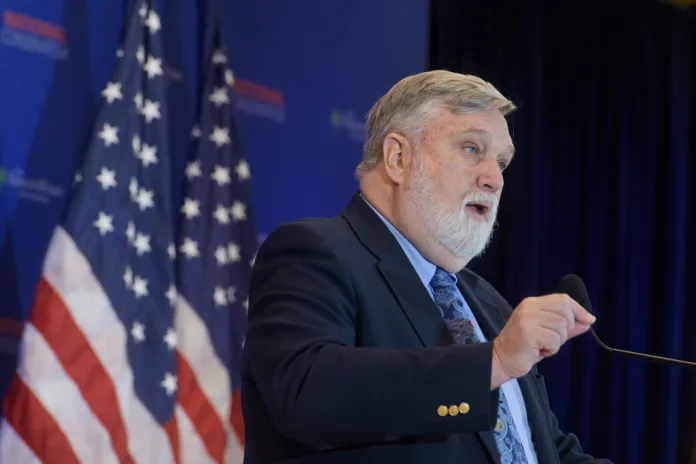
These arguments had seemed confined to the margins of religious conservatism. But recently, Al Mohler, president of America’s second-largest seminary, has aligned with their cause. In 2024, Mohler shared a platform at the annual National Conservatism Conference with Doug Wilson, the patriarch of Protestant confessional state Christian nationalism.


Douglas Wilson, Senior Minister of Christ Church, Moscow, Idaho, speaks at the National Conservatism Conference, Thursday, Sept. 4, 2025, in Washington. (AP Photo/Rod Lamkey, Jr.)

“I want to maximize the Christian commitments of the state,” Mohler said at the National Conservatism convo. “I call that ‘acknowledgment.’ I’m not claiming that every citizen will be a confessing Christian, but that does not mean they are not obligated to the acknowledgment of the Christian structure of this civilization.”

Monday, September 28, 2026

On Pope Leo’s World Day of Migrants, Cardinal McElroy Indicts Trump’s War on Immigrants


Preaching on the Good Samaritan for World Day of Migrants, Washington’s archbishop named Minneapolis, a five-year-old used as bait, and a nation that “passed on by.” He told Catholics to fight every dimension of it.

Christopher Hale


Thank you for reading! Letters from Leo is a reader-supported publication and the fastest-growing Catholic community in the country. To receive new posts and support this movement, consider becoming a free or paid subscriber.

Subscribe

Make A One-Time Gift to Support My Work

Cardinal Robert McElroy stood at the ambo of the Cathedral of St. Matthew the Apostle on Sunday evening, less than a mile from the White House, and told Washington’s Catholics that their country has spent a year and a half walking past a man left bleeding by the road.

“For the last year and a half, the people of the United States have witnessed the suffering of the undocumented in our midst, purposely and strategically magnified by our government,” the archbishop of Washington said, “and for the most part, we have simply passed on by.”

The Mass marked the 112th World Day of Migrants and Refugees, which Pope Leo XIV devoted this year to children under the theme “Even Just One of These Children.” McElroy preached on the Good Samaritan. He borrowed a rule from one of his seminary scripture professors: in any parable, look for the character you most dislike, “and that is you.”

For Americans in 2026, he said, that character is the priest who crossed to the other side of the road (and the Levite who followed him).

The parable came second. McElroy opened with what he called the two great legacies that shape America’s duty to the stranger: the command in Deuteronomy that “you shall not violate the rights of the alien or the orphan,” and the words Emma Lazarus wrote for the Statue of Liberty. “There was a time when these words brought tears to every American,” he said of the poem. “Now they are shunned, riddled with conditions, or ignored altogether because they remind us of what we have become.”

LIVE: Pope Leo visits Metz, France

LIVE: Pope Leo visits Metz, France
Reuters

Pope Leo finishes his four-day visit to France with meetings and a mass in the eastern city of Metz, before returning to Rome.

Thursday, September 17, 2026

Faith Leaders React to Trump’s Religious Liberty Commission Targeting Separation of Church and State

Pastor Hal Mayer
Speaker / Director

Wednesday September16th,  2026


WTTW, by Blake Thor: A report from the Presidential Religious Liberty Commission calls for a clawback of the separation of church and state, a fundamental American legal principle for more than two centuries.

Speaking at the White House Friday, Texas Lt. Gov. and Commission Chair Dan Patrick said the separation of church and state is not in the U.S. Constitution.

“The separation of church and state is not in the Constitution,” Patrick said. “And from this day forward, if anyone says that to you and they’re in public office or serve in any agency, in any official capacity, they have to point out exactly where you have violated the Constitution, because you have not. And from this day forward, that phrase should have no power over people of all faiths ever again in America.”

President Donald Trump created the commission via executive order last May. Composed almost entirely of White Christians, the commission made a series of policy recommendations based on the underlying assertion that religious Americans have suffered discrimination for expressing their beliefs in public settings.

Recommendations include creating a Presidential Medal of Religious Liberty, establishing a hotline for individuals experiencing religious discrimination and confirming “federal judges with the courage to decide religious liberty cases on the merits.”

Monday, September 07, 2026

The Wall That Made America Great and The Prophecy That Ends It


September 3, 2026 Gary Blanchard


Were Daniel and his three friends disobeying God when they refused to bow to the golden image, and when Daniel refused to stop praying to anyone but the king for thirty days?

Years earlier, the prophet Jeremiah had spoken to the children of Israel. He told them the Babylonians were coming and that, rather than resisting, they should “put their necks under his yoke.” In other words, they were to submit to Babylonian rule. This was not merely Jeremiah’s opinion. As a true prophet, he delivered a directive that came from God Himself:

“If, however, any nation or kingdom will not serve Nebuchadnezzar king of Babylon or bow its neck under his yoke, I will punish that nation with the sword, famine and plague, declares the Lord, until I destroy it by his hand. … But if any nation will bow its neck under the yoke of the king of Babylon and serve him, I will let that nation remain in its own land to till it and to live there, declares the Lord” (Jeremiah 27:8, 11, NIV)

Jeremiah repeated the same message to King Zedekiah: “Bow your neck under the yoke of the king of Babylon; serve him and his people, and you will live” (Jeremiah 27:12).

So why, then, did Daniel’s three friends (Shadrach, Meshach, and Abednego) refuse the king’s command in Daniel 3, and why did Daniel himself refuse the king’s decree in Daniel 6? On the surface they appear insubordinate to the very authority God had told His people to accept. They would not bow to the golden image when commanded, and Daniel would not stop praying to God when ordered to petition only the king for thirty days.

Their response in the furnace episode is clear:

“King Nebuchadnezzar, we do not need to defend ourselves before you in this matter. If we are thrown into the blazing furnace, the God we serve is able to deliver us from it, and he will deliver us from Your Majesty’s hand. But even if he does not, we want you to know, Your Majesty, that we will not serve your gods or worship the image of gold you have set up.” (Daniel 3:16-18, NIV)

Daniel, knowing the decree had been signed, continued his lifelong practice of praying three times a day with his windows open toward Jerusalem (Daniel 6:10).

Sunday, September 06, 2026

Chick-Fil-A Fires Employee for Refusing to Work on Saturday Sabbath

Chick-Fil-A Fires Employee for Refusing to Work on Saturday Sabbath

Faith and Politics

Premiered Sep 4, 2026

In the first segment, our panelists discuss President Trump’s proclamation encouraging Americans to observe Shabbat 250 as part of the nation’s 250th anniversary celebration. The discussion explores the significance of a presidential recognition of the Jewish Sabbath, its historical context, and the relationship between government acknowledgments of religious traditions and religious liberty.

In the second segment of the show, we explore the court case United States Equal Employment Opportunity Commission v. Hat Trick, Inc. Panelists examine allegations that a Chick-fil-A franchise failed to accommodate an employee’s Saturday Sabbath observance, raising questions about employers’ obligations under federal law to provide reasonable religious accommodations in the workplace.

About the Show: 

Faith & Politics is a show dedicated to discussing issues surrounding the intersection of Church, State and politics and the examination of whether you are allowing your faith to shape your politics or your politics starting to shape your faith. What do you do when God and government come face to face?

Panelists: 

Judith Hawkins, Former Judge and Attorney in Tallahassee Florida; Blayre Marley, Director Legal Corporate Counsel for a Fortune 500 Company; Dr. Andrew Polk, Professor of History at Middle Tennessee State University; and Joseph Richards, General Counsel and Director of Public Affairs and Religious Liberty for the Seventh-day Adventist Church in Canada.

About Us:

North American Division Public Affairs & Religious Liberty (PARL) is a ministry dedicated to proclaiming and defending the God-given gift of religious freedom which is integral to our identity as Seventh-day Adventist Christians. Learn more about PARL at www.religiousliberty.info

Here is what we’ll cover in this video:

00:00 Show opener 
00:34 Introduction 
01:30 Pentagon Reduces Number of Recognized Religions 
14:18 United States Conference of Catholic Bishops v. EEOC 
26:30 Tell Me Something I Don’t Know

Friday, August 21, 2026

THE NEHEMIAH ALLIANCE


THE NEHEMIAH ALLIANCE

Rebuild our walls, restore our homes, and renew our hearts through unified prayer, fasting & repentance

Sundown September 10th (9/10/26) to Sundown All Saints Sunday (11/1/26)

Nehemiah Alliance is a growing global grassroots movement of “We His People” for Spiritual Renewal.

Inspired by the example of Nehemiah in Sacred Scripture, who rebuilt the walls of his homeland in just 52 days, we have surveyed the spiritual condition of our own nations and recognize that the spiritual walls of blessing and protection are in need of rebuilding.

Likewise, we are seeking the official blessing of our governmental authorities, just as Nehemiah sought the blessing of his king, while gathering an Alliance of Leaders, as Nehemiah gathered the Gatekeepers, to mobilize “We His People” for 52 days of unified prayer, fasting, and repentance unto our merciful Father.

Together, we are crying out to God in One Voice to rebuild our walls, restore our homes, revive our hearts, renew Liberty and Justice for all, and reunite us one Nation, One Blood under God.

Thursday, August 20, 2026

The Vatican isn’t a campaign stop and Rep. Salazar shouldn’t have treated it as one | Opinion


Mary Anna Mancuso

Wed, August 19, 2026 at 3:08 PM EDT

As a Catholic, I'm offended. As a Floridian, I'm exhausted. It seems there are no lengths to which U.S. Rep. Maria Elvira Salazar, a Miami Republican, won't go to promote her immigration bill.

Even the pope isn't off limits. Last week, after meeting with Pope Leo XIV at the Vatican, she quickly took to social media to say she was grateful to "place the DIGNITY Act in the Holy Father's hands." The video posted to her social media channels, shot in front of the Vatican, was in poor taste. What I saw was a South Florida congresswoman using the Vatican as a backdrop to push her legislation.

You don't have to be Catholic to understand why it's offensive. It looks like Salazar used her meeting with the pope to create the impression of support for her legislation. That should bother anyone, religious or not.

The meeting itself wasn't a problem. There's nothing wrong with an elected official discussing immigration with the pope. Immigration is both a moral and political issue that affects millions, and people of faith often bring their convictions into public life.

Leo has spoken directly on immigration. On June 25, 2026, the pope wrote a letter to America marking the 250th anniversary of the United States: "To receive [immigrants] with compassion and generosity is not only an act of charity, but also a recognition of the dignity that belongs to every human person," he wrote.

Many politicians have visited the Vatican and afterward have posted photos of their time with the pope. I don't think that's wrong. The difference is that Salazar used the opportunity to spotlight her legislation. The pope hasn't endorsed her bill; she shouldn't be trying to make it look that way.

But in politics, optics matter. And that was the point. Salazar, in what appeared to be a staged moment, created an impression the facts don't support.

Salazar's office told me it was "entirely appropriate to discuss immigration and the bipartisan work she is leading" during the visit. The statement from her office said Salazar spoke with the pope "about immigration and the dignity of migrants, issues that are central to the Catholic Church and that Pope Leo himself has made a priority, and shared with him the bipartisan solution she has been working on for years."


Republican Congresswoman María Elvira Salazar (R-FL) spoke with Pope Leo XIV at the Vatican on Aug. 13, 2026

Sunday, August 16, 2026

The Common Good: The Coming Threat to Religious Liberty - Pastor Michael Avaylon


The Common Good: The Coming Threat to Religious Liberty - Pastor Michael Avaylon
Countryside Sabbath Fellowship

Aug 12, 2026 
What happens when the “common good” begins to override religious liberty and obedience to God?

In this powerful present truth message, we examine the trial of Jesus, the dangers of church and state uniting, and the growing pressure to compromise Biblical truth for the sake of unity. Will God’s people stand faithful when the final crisis comes?

Matthew McConaughey drops new hint about politics after meeting Pope Leo XIV Story by Eren Waris


Story by Eren Waris


Matthew McConaughey drops new hint about politics after meeting Pope Leo XIV

Matthew McConaughey drops new hint about politics after meeting Pope Leo XIV

NEW YORK CITY, NEW YORK: Actor Matthew McConaughey said he could see himself “adding to or working on” a constitution built around common ground among religions.

McConaughey, who calls himself an aggressively centrist Christian, has previously been asked about running for office, including governor of his home state.

The comments came in a USA TODAY interview, published on Saturday, August 15, after his meeting with Pope Leo XIV in Vatican City.


Actors Woody Harrelson and Matthew McConaughey speak onstage at Nokia Theatre LA Live on August 25, 2014 in Los Angeles, California (Kevin Winter/Getty Images)

Matthew McConaughey says religion could inform politics

McConaughey said he sees common ground among religions as something that could inform a political system.

“There’s still a constitution out there to be written that all religions could agree on,” he told USA TODAY. “There's so much commonality.”

He said he was interested in the possibility of “adding to or working on” such a constitution, calling it “a great thing to share.”


Pope Leo XIV waves as he leaves after his weekly general audience in St Peter's Square at The Vatican, Wednesday, June 3, 2026 (AP Photo/Andrew Medichini)

McConaughey also drew a line between religious teachings and the separation of church and state.

“Even though I agree with the separation of church and state, the values of those should bleed down into the values of any political system,” he said.

Friday, July 31, 2026

Religious Liberty Essential to Preserving Life


(Zimmytws/Dreamstime.com


Monday, 27 July 2026 09:53 AM EDT

Religious liberty is more than the freedom to hold private beliefs — it is the freedom to live according to one's faith in public life. The recommendations recently presented by the Religious Liberty Commission to President Trump reinforce the principle that Americans should never have to choose between following their faith and following the law.

This has particular impact on Americans who fight every day to protect children in the womb from the violence of abortion. Concerns for such Americans came up in one way or another in every one of the hearings that the Religious Liberty Commission held.

The anti-abortion movement is rooted in the very American conviction that every human life deserves equal protection under the law, despite its age.

That conviction, coupled with the American belief in peaceful protest, motivates those who are anti-abortion to stand for hours outside abortion facilities, enduring the hostile stares and words - and occasional vicious beatings - from abortion advocates in the hope of changing the mind of one mother, of saving one baby.

These same Americans believe that mothers and fathers need day to day support, and the pregnancy help movement provides such support across the country.

So often maligned for being "fake clinics" because they do not perform abortion, these vitally important centers are almost exclusively started and staffed with people of faith who are trying not to impose their faith on others but to use it to lead mothers and fathers to a much better choice than abortion.

Yet these centers are constantly harassed in abortion-friendly states and all too often find themselves embroiled in lawsuits or fighting unjust laws.

The First Amendment wins every time, with these suits settled in favor of pregnancy centers. Religious liberty helps protect the ability to advocate for life without compromising sincerely held beliefs.

One of the commission's key recommendations is to clarify the proper understanding of the Establishment Clause and the separation of church and state.

The Separation of Church and State | Straight Talk, episode 19 (Tim Rumsey)

Pathway to Paradise Ministries

Jul 29, 2026  Straight Talk: The Religious Liberty Podcast

The separation of church and state has served this country well for nearly 250 years. If morality is declining, let the churches start preaching truth once again. If attacks against Christians continue, let the courts fulfill their appointed duty and administer justice. But don't eradicate the separation that has protected both church and state from each other, and granted religious liberty to millions of people of all faiths.


Tuesday, July 21, 2026

The Footprints of the Jesuits by R. W. Thompson.

The civil institutions of the United States could not have been formed without the separation of Church and State, and could not continue to exist if they were again united. Christianity could not maintain its primitive purity if politics and religious faith were mingled together; nor could the State preserve its capacity to provide for the general welfare if subjected to the dominion of ecclesiastical authority. Our success as a nation is mainly attributable to the fact that these sentiments are deeply imbedded in the American mind.

A party pledged to restore to the pope the temporal power which the Italian people have taken away, must necessarily be politico-religious in character, because it proposes to interfere with the temporal affairs of one of the European nations. And if the attempt to do this is justified upon the ground that such restoration involves religious duty, any one can see that the obligation is the same in the United States as in Italy, for the laws of God do not shift to suit the exigencies of human affairs.

In the times before the Reformation the temporal affairs of Governments were required to conform to the commands of the ecclesiastical authority—that is, the pope—and it was held to be a necessary and essential part of religion that this union should be continued, no matter what might be the degree of popular ignorance and humiliation. The founders of our Government started out upon a different theory, believing it to be[Pg 4] their duty to separate "the things of God" from "the things of Cæsar," so that each could reach perfection in its own distinct sphere. Therefore, it is clear that a politico-religious party in this country, pledged to unite Church and State in Italy, against the expressed will of the Italian people, not only must oppose one of the fundamental principles of our Government, but disturb the public peace.

To my mind it is also clear that a nation acts politically, and not religiously, when it decides upon the structure of its temporal Government—that is, whether its affairs shall be managed by an absolute or elective monarch, or by machinery provided by a written constitution. I have, therefore, refrained from the discussion or criticism of religious belief—as it is understood in the American sense—any further than it is made the pretext for the reversal of this opinion, so generally prevalent in this country. It would be an evil day for the people of the United States if they should be persuaded to permit any power whatsoever, whether temporal or spiritual, at home or abroad, to share with them any portion of their political authority, or to dictate, in any degree, the measures of their civil polity.