Showing posts with label blockade. Show all posts

Friday, October 16, 2026

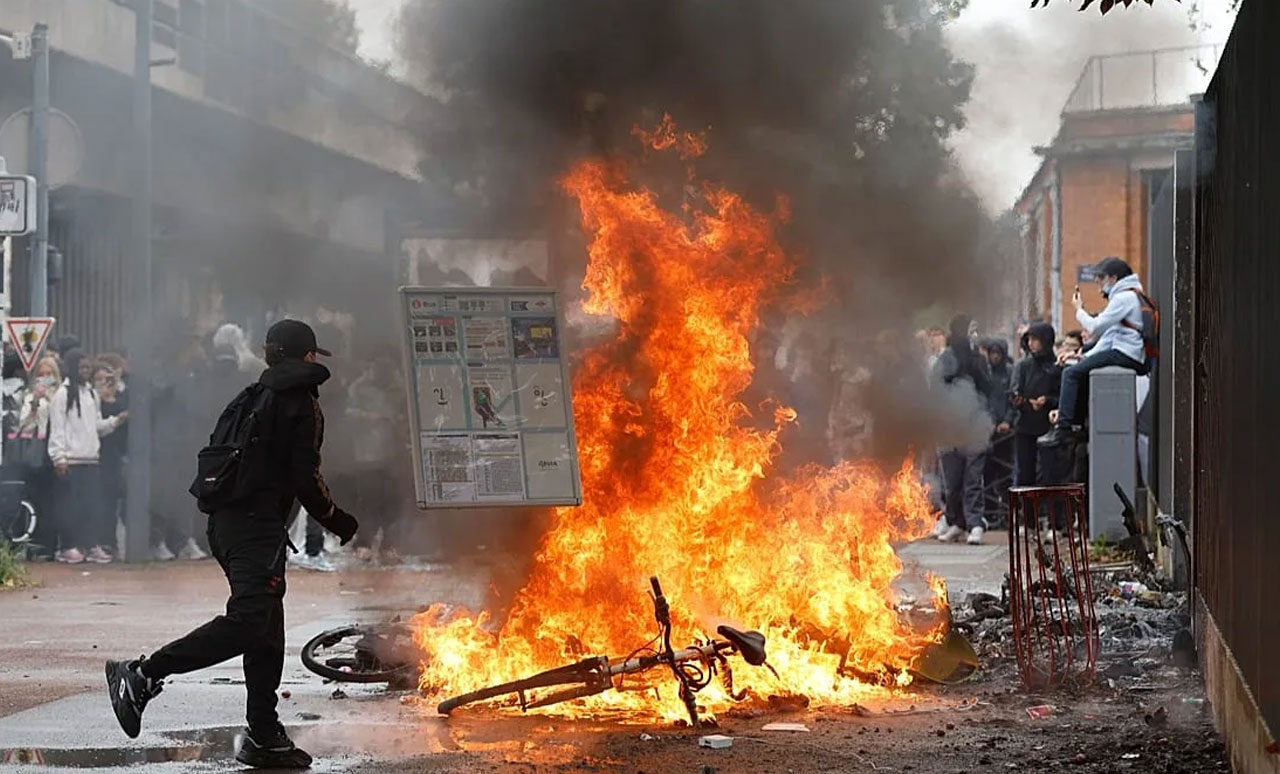
School Blockades Continue Across France as Protesters Are Called to the Bastille


Image: Srpske Novine from Euronews


Pastor Hal MayerSpeaker / Director

School Blockades Continue Across France as Protesters Are Called to the Bastille

Thursday October 15th, 2026

The Epoch Times, by Etienne Fauchaire: Blockades at high schools and universities continued across France on Oct. 7, a day before students and teachers were expected to return to the streets for another nationwide protest.

The Student Union called on high school and university students to resume blockades on the morning of Oct. 8 before “converging on Bastille” in Paris at 3 p.m., a call seen as a reference to the storming of the Bastille on July 14, 1789, during the French Revolution.

Several education unions, including SNES-FSU, France’s largest secondary school teachers’ union, also called for strikes and demonstrations in support of the students.

The number of disrupted high schools fell significantly on Oct. 7. Classes were fully or partially suspended at 459 schools, compared with 891 the previous day, according to the Education Ministry, which described the movement as being in sharp decline.

The Oct. 8 demonstrations will mark the fourth nationwide day of action in a protest movement led largely by far-left student organizations and initially fueled by grievances over school conditions.

Monday, October 05, 2026

French students close hundreds of schools in protest

Reuters

Oct 5, 2026  

French high school students have blockaded hundreds of schools across the country in protest against poor conditions in education. According to officials, between 400 and 500 schools remain closed amid the unrest.

Tuesday, August 25, 2026

Economic D-Day and the Prophesied Buy and Sell Restrictions


AI Overview

President Trump's announced "Economic D-Day" is a modern geopolitical campaign to totally isolate Iran, while "prophetic buy and sell restrictions" refer to biblical end-times prophecies about a centralized system controlling global commerce.

The "Economic D-Day" Against Iran

The Announcement: U.S. President Donald Trump declared an unprecedented financial operation to cut off Iran's remaining economic lifelines. Details were covered by sources like Iran International.

The Goal: The strategy targets oil smuggling, cash transfers, and front companies to force Tehran to halt its nuclear program and reopen the Strait of Hormuz.

The Penalties: The U.S. administration warned that any foreign country, bank, or business continuing to trade with Iran will face severe secondary economic consequences.

Prophetic Buy and Sell Restrictions

The Biblical Source: In the New Testament book of Revelation (Revelation 13:17), prophecy speaks of a future system where no one can buy or sell unless they have the "mark, name, or number" of the beast.

The Interpretation: Many theologians and believers view this as a total restriction on personal economic freedom for those who refuse to comply with a future global authority.

Modern Parallels: Commentators often link current events—such as strict international banking sanctions, asset freezes, and the rise of digital currencies—to the potential framework for future prophetic economic controls.

How They Connect

"Economic D-Day" is a specific political and military-linked sanction strategy against a single nation. However, prophetic observers often use these sweeping government actions and threats of total financial isolation as modern examples of how quickly global trade can be restricted.


Source: Google AI

Monday, March 23, 2026

Russia may test Trump’s Cuba’s blockade with oil tankers crossing Atlantic


by: Sophie Brams, The Hill

Posted: Mar 20, 2026 / 06:30 PM CDT

Updated: Mar 20, 2026 / 06:30 PM CDT


Two vessels carrying Russian oil are reportedly heading for Cuba in the coming days in a move that could test President Trump’s longstanding blockade, according to the Financial Times, citing maritime intelligence companies.

One of the tankers making its way to the Caribbean island is Sea Horse, a Hong Kong-flagged ship estimated to be carrying approximately 190,000 barrels of gasoil from Russia, according to tracking from maritime AI company Windward.

The Associated Press reported on Thursday that another ship, the Russian-flagged Anatoly Kolodkin, is roughly 3,000 nautical miles from Cuba and expected to reach the island in 10 days.

Cuba has plunged into a deep economic and energy crisis due to an oil embargo put in place by the Trump administration in January following the U.S. military operation in Venezuela that led to the capture of President Nicolás Maduro.

The island’s electrical grid collapsed earlier this week, leaving nearly 11 million people in the dark for more than 29 hours before power was partially restored. The nation is also facing a worsening humanitarian crisis with limited access to food, water and medication.

The U.S. has sought to leverage economic pressure to push political reform in Cuba, with President Trump warning other countries not to do business with them.

The Treasury Department has maintained the blockade, even as it eases sanctions on some Russian and Venezuelan oil in a bid to boost global supply amid the conflict with Iran. Analysts have told The Hill that the Trump administration’s actions are unlikely to have much of an effect on surging prices and that the only meaningful way to do so would be to reopen the Strait of Hormuz.

No shipments of oil have arrived on Cuba’s shores in three months, but that could change if the two tankers arrive as anticipated over the next several weeks.

Despite Trump’s threats, Kremlin spokesperson Dmitry Peskov said Tuesday that Moscow was “ready to provide all possible assistance” to officials in Havana, according to the Moscow Times.

The potential escalation comes as the U.S. and Cuba are holding discussions to address “bilateral differences” and identify “areas of cooperation,” according to Cuban President Manuel Díaz-Canel.

Díaz-Canel on Wednesday accused the U.S. of threatening the country “almost daily” and pledged to meet any potential aggression with “impregnable resistance,” days after Trump said he believes he will have the “honor” of taking over Cuba.

“Whether I free it, take it, I think I can do anything I want with it,” Trump told reporters on Monday. “You want to know the truth? They’re a very weakened nation now.”


Friday, March 20, 2026

U.S. says Cuba is prohibited from taking Russian oil as two tankers head to island


Key Points
  • The U.S. Treasury Department has made clear that Cuba is not allowed to take delivery of Russian crude.
  • The warning comes at a time when two tankers carrying Russian oil and gas are thought to be on their way to Havana.
  • The fuel-starved Caribbean island is facing its biggest test since the collapse of the Soviet Union under a U.S. oil blockade.


An old Soviet-era Lada car drives past a truck belonging to a private Cuban company (mipyme) parked in front of a gas station with an IsoTank of imported fuel in Havana on March 19, 2026.
Adalberto Roque | Afp | Getty Images

Published Fri, Mar 20 202
64:54 AM EDT


The U.S. Treasury Department has said Cuba won’t be allowed to take delivery of Russian crude, even as the fuel-starved island appears poised to receive two tankers carrying oil and gas.

In a general license published Thursday, the Treasury’s Office of Foreign Assets Control (OFAC) added Cuba to a list of countries that would be blocked from transactions involving the sale, delivery or offloading of crude or petroleum products that originate from Russia.

The U.S. had temporarily authorized the purchase of Russian oil stranded at sea last week, as part of an effort to stabilize energy markets during the U.S. and Israeli-led war on Iran. The short-term measure suspended sanctions that were first imposed on Moscow following its full-scale invasion of Ukraine.

The update comes as maritime intelligence providers have been tracking two tankers carrying Russian oil and gas heading toward Cuba.

Beset by blackouts and a worsening economic crisis under a U.S. oil blockade, the communist-run Caribbean island is currently facing its biggest test since the collapse of the Soviet Union. U.S. President Donald Trump said earlier in the week that he thinks he’ll have the “honor” of taking Havana in some form.

Russia, which has been allied to Cuba for decades, has sharply criticized the Trump administration’s fuel blockade and pledged to provide the country with “necessary support, including financial aid.”

Sunday, September 16, 2012

On the Brink of War: Armada of U.S. and British Naval Power is Missing in the Gulf

SUNDAY, SEPTEMBER 16, 2012


Sean Rayment is reporting for the UK's Telegraph:

Battleships, aircraft carriers, minesweepers and submarines from 25 nations are converging on the strategically important Strait of Hormuz in an unprecedented show of force as Israel and Iran move towards the brink of war.

Western leaders are convinced that Iran will retaliate to any attack by attempting to mine or blockade the shipping lane through which passes around 18 million barrels of oil every day, approximately 35 per cent of the world’s petroleum traded by sea.

A blockade would have a catastrophic effect on the fragile economies of Britain, Europe the United States and Japan, all of which rely heavily on oil and gas supplies from the Gulf.
The Strait of Hormuz is one of the world’s most congested international waterways. It is only 21 miles wide at its narrowest point and is bordered by the Iranian coast to the north and the United Arab Emirates to the south.

Can Iran close the Strait of Hormuz?

This is what I reported in the EPJ Daily Alert in November 2010:
This afternoon I attended a meeting where the speaker was Capitan Jeffrey Kline. Kline is the Program Director, Maritime Defense and Security Research Programs, Naval Postgraduate School. He is an Adjunct Professor at the Naval War College where he teaches, "Joint Analysis for the Warfare Commander".

While his speech was about piracy on the high seas, I took the opportunity after his speech to ask him about the Strait of Hormuz. The strait is a very strategically important waterway between the Gulf of Oman in the southeast and the Persian Gulf. A lot of oil passes through the straight, 20% of all world oil trade. You can't spend more than 5 minutes with an oil trader after bringing up the possibility of war with Iran before talk turns to the closure of the Strait.

There are many, many opinions as to the whether the strait can be closed. I even heard Boone Pickens (Who knows more about oil than any other man I have met) say at a Michael Milken Conference that he couldn't imagine that the strait could be closed, given that at its narrowest point, the traffic lanes are 6 miles wide.

I thought I would ask Kline, who might have a pretty damn good idea if the Straight could be closed by Iran. His answer was it could. When I asked him how long it would take, he said 3 or 4 days for Iran to position ships and lay mines. He did say that the blockade could eventually be broken, but it would depend upon international co-operation and that it would take "some time". He said that Iran has missiles onshore aimed at the strait that would have to be taken out, and that Iran had other sophisticated equipment in the area including drones that could listen in on ship communications. He said ship mine sweeping can also get "very tricky".


I am not sure how much of Kline's analysis holds up if there is already a major joint U.S.-U.K. presence in the area. My guess this would make the operation more difficult, but notice Kline did mention that Iran has drones that can listen to ship communications. Thus, if Iran is capable of knowing where U.S. and U.K. ships are presumably they will have limited ability to place some mines.


Source