Showing posts with label Algeria. Show all posts

Thursday, October 08, 2026

America owes Mahmoud Khalil nothing


Pro-terrorist activist Mahmoud Khalil was asked by CNN the other day if he would condemn Hamas. He, of course, would not, calling the question “silly” and “disingenuous.” It is not “black and white,” he whined.

Even if you oppose Israel’s reaction to the Oct. 7, 2023, massacre, the answer is still black and white for any person with a conscience. Certainly, it should be for any person who wants to become a naturalized citizen of the United States. After all, Hamas is designated by the State Department as a terrorist organization for, among other things, murdering Americans.

But the fact that Khalil can’t condemn Hamas — and anyone paying attention understands that he supports the terrorist army — not only tells us that he deserves to be deported but also that it’s imperative we deport him.

During the 1960s and 1970s, immigration officials grilled newcomers to the U.S. and elsewhere about their affiliations with communist parties. Why would we import people who want to destroy our system? Newcomers were, and still are, compelled to disavow associations with illiberal movements, violent groups, and ideologies. They were also required to promise not to engage in any subversive or revolutionary activity.

Well, Khalil’s entire job as an “activist” is to engage in subversive or revolutionary activity.

Khalil is an Algerian, incidentally, not a Palestinian, though he is a champion of Palestinianism, one of the most nihilistic, bigoted, violent, anti-Western ideologies of the age. There’s no anti-American or Marxist protest or riot anywhere in the world these days where Palestinian flags are not prominent.

The French, of course, don’t need much impetus to riot. But protests that began over a lack of school funding a few weeks ago have now escalated into increasingly destructive and violent riots across France, clearly fueled in part by Marxist pro-Palestinian elements. The red-green alliance between Islamists and communists isn’t new — it’s just more popular than ever. France has over 5 million Muslims.

What you see happening on the streets of Paris is exactly what Khalil hopes to see in the U.S. We saw as much when he was the lead “negotiator” for Columbia University Apartheid Divest, which rioted at the school in 2025. The group’s goal is to fight for the “total eradication of Western civilization,” “global intifada,” and the “armed resistance” of Hamas. That doesn’t sound very American.

Khalil’s friend, Mohsen Mahdawi, another leader of CUAD fighting against deportation, reportedly has a propensity to make Hamas-like statements, such as “I like to kill Jews,” “soon, very soon, we will annihilate the Jews,” and that “servants of the Jews or the Americans” will have their heads “cut off.” Would we give citizenship to a foreigner who said, “I like to kill blacks” or “I like to kill Christians”? I hope not.

Khalil is being deported for lying on his application, though he was initially picked up by Immigration and Customs Enforcement officers for threatening U.S. foreign policy. These deportations should not be treated as a matter of botched paperwork but as a matter of national security.

Thursday, August 06, 2026

Oppressed Christians in Algeria go underground


By Morning Star News Aug 4, 2026


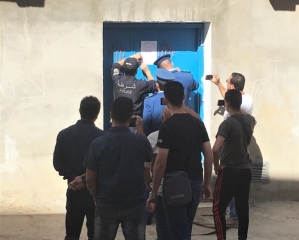
Sealing of Tafath church in Tizi-Ouzou, Algeria on Oct. 16, 2019. Morning-Star News


Following Algeria’s closure of nearly all evangelical churches in waves of repression that began in 2017, Christians have been forced underground in what they describe as an internal exile, sources said.

Christians in the 99-percent Muslim country gather discreetly in homes, garages or under olive trees, isolating many who are deprived of regular spiritual guidance. Some turn to the internet and social media, where heresies proliferate, thus fostering internal divisions, the spread of false teaching and the rise of conflicts.

Despite such challenges, some Christians express gratitude to God, viewing this period as a spiritual cleansing to build stronger and more mature churches.

“Believers maintain fraternal bonds within small family groups,” said one Christian community leader. “We celebrate Holy Communion and baptisms privately, and dedicate significant resources to charitable aid, in accordance with biblical commandments.”

One church leader continues to serve by visiting families in various villages to offer moral and spiritual support. Like all pastors mentioned in this story, his name cannot be published for security reasons.

“The situation is undeniably difficult because we are deprived of fellowship,” he said. “But God’s work must not stop. We desperately lack Bibles and Christian books, as customs officials systematically confiscate them even when friends bring them from the West.”

Along with blocked book imports, police searches and confiscated equipment, Christians have increasingly been shut out of regular fellowship since authorities effectively left the evangelical umbrella group, the Protestant Church of Algeria (EPA), without legal status. When the EPA re-applied for legal status in August 2014 and July 2015 following implementation of the 2012 Law on Associations No. 12-06, authorities withheld mandatory registration receipts, leaving the umbrella group in a legal limbo that provided the pretext for forced closures of most affiliated churches from 2017 to 2019.

Since Law 12-06 blocks the official registration of the EPA, security forces have sealed shut 46 of the group’s affiliated 47 churches, leaving only a church headquarters in Algiers operational thanks to the presence there of some foreigners and diplomats.

Tuesday, February 11, 2014

Over 100 killed in Algerian military plane crash


One report says there was a lone survivor in the Algerian military plane crash. The aircraft involved in the plane crash was built in the US.

By Aomar Ouali, Associated Press / February 11, 2014
Algiers, Algeria

An Algerian military transport slammed into a mountain Tuesday in the country's rugged eastern region. A civil defense official said 102 people on board were killed but one managed to survive.


The Christian Science Monitor
Weekly Digital Edition

The US-built C-130 Hercules transport crashed about noon near the town of Ain Kercha, 30 miles southeast of Constantine, the main city in eastern Algeria.

Commander Farid Nechad, who is based in Algiers but was coordinating recovery efforts, told The Associated Press that 103 people including the crew had been on the plane but so far only 55 bodies had been found due to the difficult conditions at the crash site.

He did not give any further details about the survivor except to say the person had been sent to Constantine hospital.

Civil defense officials at the scene told journalists that women and children were among the dead at the snowy crash site. Local reporters said the C-130 plane could be seen broken into three parts.


The plane had taken off from the southern Saharan city of Tamanrasset and was heading to Constantine.

Officials have so far not given an official death toll.

"Unfavorable weather conditions and storms accompanied by snow in the region were behind the crash," the Defense Ministry said in a statement.

Winds were 17-28 knots at the time, according to the aviation-safety.net website.

The worst plane crash in Algerian history occurred in 2003, when 102 people were killed after a civilian airliner crashed at the end of the runway in Tamanrasset. There was also a single survivor in that crash.

In November 2012, an Algerian military cargo plane crashed in southern France, killing all six people aboard.

Source
.

Wednesday, January 16, 2013

Dozens held after Islamists attack Algerian gas field


Related News

Qaeda-linked groups says holding 41, including Americans, in Algeria
11:06am EST
BP says Algerian field still occupied by armed men
10:57am EST
Briton killed in Algerian attack: APS news agency
9:59am EST
Norwegian among kidnapped in Algeria: newspaper
8:20am EST
French national killed in Islamist attack in Algeria: source
6:51am EST
Irishman among oil-workers kidnapped in Algeria: govt
7:25am EST


Analysis & Opinion

Mali risks in focus
Insight: Foreign fighters seek to establish an Islamic state in post-Assad Syria

Related Topics

World »
France »
Mali »


By Lamine Chikhi

ALGIERS | Wed Jan 16, 2013 12:01pm EST

(Reuters) - Islamist militants attacked a gas field in Algeria on Wednesday, claiming to have kidnapped up to 41 foreigners including seven Americans in a dawn raid in retaliation for France's intervention in Mali, according to regional media reports.

The raiders were also reported to have killed three people, including a Briton and a French national.

An al Qaeda affiliated group said the raid had been carried out because of Algeria's decision to allow France to use its air space for attacks against Islamists in Mali, where French forces have been in action against al Qaeda-linked militants since last week.

The attack in southern Algeria also raised fears that the French action in Mali could prompt further Islamist revenge attacks on Western targets in Africa, where al Qaeda in the Islamic Maghreb (AQIM) operates across borders in the Sahara desert, and in Europe.

AQIM said it had carried out Wednesday's raid on the In Amenas gas facility in Algeria, Mauritania's ANI news agency reported.

The Algerian interior ministry said: "A terrorist group, heavily armed and using three vehicles, launched an attack this Wednesday at 5 a.m. against a Sonatrach base in Tigantourine, near In Amenas, about 100 km (60 miles) from the Algerian and Libyan border."

The gas field is operated by a joint venture including BP, Norwegian oil firm Statoil and Algerian state company Sonatrach.

ARMED MEN

BP said armed men were still occupying facilities at the gas field.

"The site was attacked and occupied by a group of unidentified armed people at about 0500 UK time. Contact with the site is extremely difficult, but we understand that armed individuals are still occupying the In Amenas operations site," it said.

Algeria's official APS news agency said a Briton and an Algerian security guard had been killed and seven people were injured. A French national was also killed in the attack, a local source said.

Also among those reported kidnapped by various sources were five Japanese nationals working for the Japanese engineering firm JGC Corp, a French national, an Irishman, a Norwegian and a number of Britons.

A member of an Islamist group styling itself the "Blood Battalion" was quoted by Mauritanian media as saying that five of the hostages were being held at the gas facility and 36 were in a housing area. APS said the Islamist raiders had freed Algerians working at the gas facility.

"The operation was in response to the blatant interference by Algeria and the opening of its air space to French aircraft to bomb northern Mali," the Islamist spokesman told Mauritania's ANI news agency.

ANI, which has regular direct contact with Islamists, said that fighters under the command of Mokhtar Belmokhtar were holding the foreigners.

Belmokhtar for years commanded al Qaeda fighters in the Sahara before setting up his own armed Islamist group late last year after an apparent fallout with other militant leaders.

The Algerian army was in the area of the gas facility, according to French and Algerian sources.

SECURITY IMPLICATIONS

The attack was the first time in years that Islamist militants are known to have launched an attack on an Algerian energy facility.

The attack could have implications for security across the whole of Algeria's energy sector, which supplies about a quarter of Europe's natural gas imports and exports millions of barrels of crude oil each year.

Such an attack would require a large and heavily-armed insurgent force with a degree of freedom to move around -- all elements that al Qaeda has not previously had.

However, the conflict in neighboring Libya in 2011 changed the balance of force. Security experts say al Qaeda was able to obtain arms, including heavy weapons, from the looted arsenals of former leader Muammar Gaddafi.

Statoil, a minority shareholder in the gas venture, said it had 17 employees at the plant and four of them had been evacuated. The company declined to comment on the other 13.

The five Japanese work for the engineering firm JGC Corporation, Jiji news agency reported, quoting company officials. JGC has a deal with Sonatrach-BP-Statoil Association for work in gas production at In Amenas.

A reporter for Japan's NHK television managed to call a JGC worker in Algeria.

The worker said he got a phone call from a colleague at the gas field. "It was around 6 a.m. this morning. He said that he had been hearing gunshots for about 20 minutes. I wasn't able to get through to him since."

French troops launched their first ground operation against Islamist rebels in Mali on Wednesday in an action to dislodge from a strategic town al Qaeda-linked fighters who have resisted six days of air strikes.

(Additional reporting by Catherine Bremer and John Irish in Paris, Laurent Prieur in Nouakchott, Andrew Osborn in London, Balazs Koranyi in Oslo, Antoni Slodkowski in Tokyo, Raissa Kasolowsky in Abu Dhabi and Christian Lowe in Warsaw; Editing by Giles Elgood)


.

Monday, November 28, 2011

Algeria surrounded by Islamism in the east and terrorism in the south

ennahar

image

The Maghreb and the Sahel regions have become France’s zones of influence after the fall in a series of regimes in North Africa and south of the grand Sahara, as what happened in Libya, Tunisia, Morocco and in terms of security in Mauritania, Chad, Niger and Mali.

  • The Maghreb and the Sahel regions have become France’s zones of influence after the fall in a series of regimes in North Africa and south of the grand Sahara, as what happened in Libya, Tunisia, Morocco and in terms of security in Mauritania, Chad, Niger and Mali.
  • These Sahelian countries have become French provinces that receive orders from Paris and accept its military intervention on their land under the guise of the fight against terrorism in the region.
  • The latest events experienced by the Maghreb and the Sahel countries throughout the year, show how France has managed to establish its influence on a number of former colonies like Chad, Mali and Niger, and the exploitation by France of what is called the "Arab spring" to install political systems that obey her in Libya, Tunisia and Morocco, although the latter is since the sixties as French protectorate, when King Hassan II had proclaimed himself Governor General of French policies in his own kingdom.
  • A plain reading of the new political map, after the latest developments in these areas, confirms the revival of France. As a result, Algeria remains the only country outside the circle, surrounded from the east and the west by pro-France Islamist governments and from the southeast by a country ruled by armed gangs after the fall of Gaddafi and from the extreme south by weak regimes that can not disobey orders from the Elysee.
  • Observers see in this new situation the return of the traditional war of interests between France and the United States, mainly regarding countries like Algeria for their strategic position and its oil. Algeria will not be immune against the French attempts to extend its influence in the Arab Maghreb region.

  • Ennahar / Yacine Abdelbaki


Source


Algerian prelate speaks of ministry in a Muslim state


Photo (Courtesy) http://www.asianews.it/news-en/The-Algerian-Church-has-the-same-right-to-spread-its-message-(as-Muslims-do)-17654.html


November 28, 2011

Algeria’s leading prelate discusses at length the challenges of ministering in an overwhelmingly Muslim state where conversion is punished by fine or imprisonment. Only 4,000 of the nation’s 34.8 million people are Catholic, according to Vatican statistics.

“The Church is alive, it is present and doing its best for the well-being of its faithful and the country,” said Archbishop Ghaleb Moussa Abdalla Bader of Algiers. “Our first mission is to be there, to live our faith, and to be faithful to our religion and to respect the other faiths despite our differences. The Church believes--and I believe--that religious freedom is a human right.”


Sunday, January 16, 2011

Night in Tunisia


Riots in Algeria, where a man burned himself to death in an apparent echo of a suicide that began the Tunisian protests. Photograph: Ap

Tunisia's protests spark suicide in Algeria and fears through Arab world
The Guardian
-Tunisia's "jasmine revolution" sent new shockwaves across north Africa today, with a copycat suicide protest reported in Algeria and official dismay in ...

.
Clinton To Arab Leaders: Reforms Needed Now
NPR - ‎Jan 13, 2011‎
Secretary of State Hillary Clinton on Thursday warned Arab leaders that corruption and despotism threatens their countries with increasing extremism and ...

Egypt warns West to stay out of Arab affairs
AFP - Mona Salem
CAIRO — Egypt's Foreign Minister Ahmed Abul Gheit warned Sunday the West to stay out of Arab affairs, days after US Secretary of State Hillary Clinton ...

.