30 September 2022
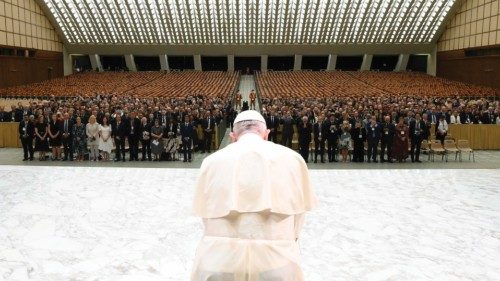
On Thursday, 22 September, Pope Francis met with participants in the meeting of Deloitte Global. “I encourage you to become ‘integral consultants’ in order to cooperate in reorienting our way of living on this our planet, which we have damaged in terms of both the climate and inequality”, the Pope said to them. The following is the English text of the Holy Father’s address.
Dear friends, welcome!
I thank Mr Renjen for his words summarizing your work of assisting the business world to make right decisions in diverse situations. I have learned that at any given time of the day there are 350,000 people working for your company engaged in providing advice and assistance to other organizations. This is a weighty responsibility!
Today, the world is suffering from worsening environmental conditions. Moreover, many populations and social groups live in undignified manner due to a lack of nutrition, health, education and other fundamental rights. While our human family is globalized and interconnected, poverty, injustice and inequalities remain.
In what ways, then, can consultants, managers and experienced professionals help in reversing or at least correcting this situation? How are they to organize their work in order to strive for a more humane, just and fraternal world? I would like to suggest three such ways.
The first is always to remain aware that you can leave a mark. This means ensuring that your mark is positive and moves towards integral human development. Your knowledge, experiences, skills and vast network of relationships constitute an immense “non-material fund” that can help entrepreneurs, bankers, managers and public administrators to understand their situations, to imagine the future and to make decisions. By helping them to understand, therefore, you help them to make decisions. This gives your organization, and each one of you, the ability to guide choices, influence criteria and evaluate priorities for companies, universities, supranational bodies, national and local governments, and decision makers at the political level.
You are well aware of your “power”. This should be accompanied constantly by the desire to direct your analysis and proposals towards choices consistent with the paradigm of integral ecology. A good question to ask yourselves when evaluating what is and what is not effective would be: “What kind of world do we want to leave for our children and grandchildren?”
The second suggestion I would offer is to take up and fulfil your cultural responsibility, which also stems from your wealth of intelligence and connections. By “cultural responsibility” I mean two things: ensuring adequate professional standards, and also an anthropological and ethical standard that enables you to suggest responses that are consistent with an evangelical vision of the economy and society; in other words, with Catholic social doctrine. This is a matter of assessing the direct and indirect effects of decisions, and their impact, first on communities, individuals and the environment, and only then on businesses. “The different cultures that have flourished over the centuries need to be preserved, lest our world be impoverished. At the same time, those cultures should be encouraged to be open to new experiences through their encounter with other realities” (Fratelli Tutti, 134).
A third suggestion is to enhance diversity. All human organizations — institutions, businesses, banks, associations, movements — have the right, if honestly and correctly led, to be able to safeguard and develop their own identity. Here we can speak of “entrepreneurial biodiversity”, to use a good expression, as a guarantee of freedom of enterprise and freedom of choice for customers, consumers, savers and investors. Entrepreneurial biodiversity is also an indispensable condition of stability, equilibrium and human prosperity. This is what takes place in nature and can also happen in economic “ecosystems”.
Over the past fifteen years, the world has experienced severe and continuing crises. We had not finished dealing with the financial crisis of 2007 before we had to face the crisis of sovereign debt and of real economies, followed by the pandemic and the war in Ukraine with all its global consequences and threats.
In the meantime, our planet continued to suffer from the effects of climate change; cruel and hidden wars were being fought in various regions, and tens of millions of people have been forced to migrate from their homelands. While daily life improved for one part of humanity, the other part has suffered from unscrupulous choices and has become the main victim of a sort of counter-development. Indeed, Saint Paul VI explained clearly that development of social justice is the new name for peace (cf. Populorum Progressio, 76-80).
What can professional consultants do in this difficult and uncertain situation? They can do a great deal by organizing their analyses and proposals with an integral perspective and vision. Indeed, dignified employment for people, care for our common home, economic and social value, and positive impact on communities are all interconnected.
Today’s consultants, aware of their role, are called to propose and discuss new directions for new challenges. The old schemes worked only partially, in different contexts. I would call this new generation of consultants “integral consultants”: experts and professionals who take into account the connections between problems and their respective solutions and who embrace the concept of relational anthropology. Such an anthropology “helps the human person to recognize the validity of economic strategies that aim above all to promote the global quality of life that, before the indiscriminate expansion of profits, leads the way toward the integral wellbeing of the entire person and of every person. No profit is in fact legitimate when it falls short of the objective of the integral promotion of the human person, the universal destination of goods, and the preferential option for the poor,”1 and, we can add, the care of our common home.
My hope is that you can assist organizations to respond to this call. You have the right skills to cooperate in building that necessary bridge between the current economic paradigm — based on excessive consumption and which is experiencing its final phase — and the emerging paradigm centred on inclusion, moderation, care and wellbeing. I encourage you to become “integral consultants” in order to cooperate in reorienting our way of living on this our planet, which we have damaged in terms of both the climate and inequality.
Dear friends, in thanking you for this meeting and expressing my good wishes for your work, I bless you and your families, especially your children, the sick and the elderly, who are our wisdom. And I ask you, please, to pray for me. And if any of you do not pray or believe, at least wish me well. I need it! Thank you.
1Congregation for the Doctrine of the Faith — Dicastery for Promoting Integral Human Development, Oeconomicae et pecuniariae quaestiones. Considerations for an ethical discernment regarding some aspects of the present economic-financial system” (6 January 2018), 10


