Thursday, May 07, 2026


Tuesday, August 20, 2013
Obama Administration Mulled Ending Holy See Ambassadorship
Monday, 19 Aug 2013 03:32 PM
By John Gizzi
During the past year, the Obama administration strongly considered ending diplomatic relations with the Vatican as it pondered whether it should appoint a new envoy to the Holy See, Newsmax has learned.
The recent Obama nomination and Senate confirmation on August 1 of Ken Hackett as the new U.S. Ambassador has ended internal Obama administration debate on the matter.
"I have heard the rumors and I believe them to be true," Jim Nicholson, former U.S Ambassador to the Vatican under President George W. Bush, told Newsmax. "It wouldn't surprise me in the least if the Obama White House seriously discussed downgrading U.S. diplomatic relations with the Holy See, given the devalued view they clearly hold this relationship in." Special Report: Obama’s Assault on Religion — Click Here Now
"This administration does not want a strong Catholic Church, nor a strong relationship with it, as it sees the Church as an obstacle to its liberal social agenda," Nicholson said.
The Obama administration has been in conflict with the Roman Catholic Church on a host of issues ranging from Obamacare's contraceptive requirements for Catholic hospitals to the administration's strong stance in favor of abortion rights. After Obama's first ambassador, Miguel Diaz, resigned last year, President Barack Obama had difficulty identifying a nominee who would represent his administration, but at the same time would be acceptable to the Holy See, according to one source familiar with the selection.
Faced with finding such a candidate, the Obama administration considered closing its Vatican offices, and opening offices in the U.S.'s Rome embassy for a smaller office to deal with Catholic matters.
In the end, the Obama administration moved to select Hackett, whose choice has won strong applause from Catholic leaders of all political stripes.
Hackett is the retired president of Catholic Relief Services (CRS), one of the Church's largest social welfare organizations supported by the U.S. Catholic bishops. Hackett, a graduate of Boston College, also served in the Peace Corps.
"I think Ken Hackett is an excellent choice," Thomas P. Melady, who was Ambassador to the Holy See under President George H.W. Bush, told Newsmax.
Melady, who is also a past president of Sacred Heart College in Connecticut, noted that prior to assuming the presidency of CRS in 1993, Hackett began his career with the group in Africa and oversaw its operations in East Africa during the Somali crisis in the late 1980s.
"The Holy See needs a good person and they've got one," Francis Rooney, George W. Bush's envoy to the Vatican, told the Catholic Standard, saying Hackett "is tremendously qualified to do the job, given his background with Catholic Relief Services."
Along with what he called "an excellent record" at CRS, Melady said that the nominee "knows the hierarchy at the Vatican well from his years [at CRS] and that is very important."
Since the U.S. extended full diplomatic recognition to the Holy See under President Ronald Reagan, U.S. ambassadors to the Vatican have always been practicing Catholics who accept the teachings of their church — even when they conflict with those of the administration in the White House.
Melady pointed out that the two ambassadors to the Vatican under Democratic President Bill Clinton — former Boston Mayor Ray Flynn and Rep. Lindy Boggs of Louisiana — were both strong abortion opponents and took stands that differed strongly with the stated policy of their party and Clinton himself.
The same was true of Diaz, President Obama's ambassador throughout his first term.
Because more than six months went from the time of Diaz's resignation and the naming of Hackett to succeed him, there were mounting rumors that the administration was having difficulty recruiting someone to represent it at the Holy See.
"As far as I know, while there was talk of many choices to be ambassador, there we
Source
.
Thursday, May 30, 2013
The Vatican and America - Amazing Documentary!

Published on Mar 18, 2013
Please listen to what is being said in this documentary. This is a secular documentary made by the History Channel, and yet it provides amazing insight into the beasts of Revelation 13 and the Whore of Babylon.
Revelation 13 prophesied about two world powers that would change the world. And this documentary supports that prophecy.
- Miguel H. Diaz (Cuban), U.S. Ambassador to the holy see (August 5, 2009 – November 5, 2012), seen at 23:33 min. and onward.
- "In New York City the value of its property is valued at $2.5 Billion..."
- "In Rome the land occupied by the Vatican is valued at about $1.5 Billion..."
Saturday, February 23, 2013
Diaz: “Now Mahony should pull out of the Conclave”

MIGUEL DIAZ
“Vatican Insider” interviews the former U.S. ambassador to the Holy See, Miguel Diaz
NEW YORK
“Just like everyone else, Cardinal Mahony should reflect on the example set by the Pope.” Miguel Diaz, who up until two months ago was the U.S. ambassador to the Holy See, is using all his diplomatic skill to persuade the Archbishop Emeritus of Los Angeles, who was involved in the Church sex-abuse scandal, not to take part in the Conclave. Regarding the election of the Pope’s successor, he added: “There are obvious divisions. What the Church needs now is a leader that is able to say “that is enough”.” Diaz returned to his post as theologian at the University of Dayton, in Ohio, but the post of U.S. ambassador to the Holy See remains vacant: “I am waiting for President Obama and Secretary of State, Kerry, decide though of course I would be glad to participate in the election of the new Pope.”
What were your thoughts when you heard about the Pope’s resignation?
“I wasn’t particularly surprised because Benedict XVI had spoken about it previously. He gave a human dimension to the papacy and acted as an example to all leaders, religious and non: when one is no longer in a condition - not only physical - to do their job, one has the right and the duty to resign.”
Mahony’s case is the most disputed one in the United States.
“The decision lies with him and he certainly has the legal right to vote in the Conclave, but the Pope also had the right to continue as Pope but instead chose to step down, accepting his human limits. A Pope’s physical conditions are not the only thing that can prevent him from serving to the best of his ability. We should all learn from Benedict’s example and ask ourselves whether there are obstacles and act responsibly, to ensure the common good of the institution, of the people of God and of all human beings.”
President Obama was also often criticised by the American hierarchy: how did he react?
“It is impossible for two institutions to be perfectly in line with each other. We knew there were differences but we made sure these did not paralyse us: the first conference I attended in Rome was on AIDS prevention.”
Why has Hilary Clinton never visited the Vatican?
“Organisational problems, that’s all. She told all ambassadors to do three things: listen to others, learn and lead based on what we have heard. I have done just this.”
What was your experience of the scandals during your time in the Vatican?
“Divisions do exist and all Catholics can see them. We are too divided politically, ideologically, theologically and on a regional level. What we need now is a leader who is able to say “that is enough”: this Church is Catholic, differences should not create division but opportunities.”
What do you expect from the next Conclave, an American Pope perhaps?
“It has nothing to do with nationality but quality of leadership. We need a bridge builder who can take on the world’s challenges. A manager who is able to manage God’s plan for mankind.”
Monday, September 17, 2012
Can Truth and Diplomacy Be Reconciled?

Rome—The “Courtyard of the Gentiles” is an initiative of the Pontifical Council for Culture to promote dialogue between believers and non-believers, the result of a suggestion that Benedict XVI offered to the Roman Curia on the occasion of his Christmas greetings in 2009.
The most recent of these gatherings was held on June 26, at the Italian Embassy to the Holy See, housed at Palazzo Borromeo, a stately and historic mansion originally owned by the noble household of the Borromeos, among whose members there is a famous saint, San Carlo Borromeo (1538-1584). He was a leading figure during the Counter-Reformation and was responsible for significant reforms in the Catholic Church, following the Council of Trent and the implementation of its decrees.
As one can already and easily guess from the meeting’s title, “Diplomacy and Truth,” the event saw not only the participation of several cardinals and churchmen, but also, for the first time at a Courtyard of the Gentiles gathering, senior representatives of the diplomatic corps accredited to the Holy See and the Italian Republic. The possibility of reconciling diplomacy and truth, which are generally thought to be poles apart, was under the spotlight.
Among the keynote speakers were Cardinal Jean-Louis Tauran, president of the Pontifical Council for Interreligious Dialogue; the US ambassador to the Holy See, Miguel Humberto Diaz; the ambassador of Morocco to Italy, Hassan Abouyoub; Stefano Folli, editorialist for the Italian business daily Il Sole 24 Ore; and Hon. Gianni De Michelis, president of Ipalmo, an institute dedicated to improving Italy’s relations with Africa, Latin America, and the Middle and Far East.
“I believe that the Courtyard of the Gentiles is the most appropriate forum to discuss truth and diplomacy, precisely because it is a natural environment for dialogue,” said the Italian Ambassador to the Holy See, Francesco Maria Greco, introducing the proceedings over which he presided with the president of the Vatican’s Pontifical Council for Culture, Cardinal Gianfranco Ravasi. “And because diplomacy is no longer the art of reporting, but much more directly the art of tackling cultural, ideological, geopolitical, and geoeconomic diversity, I believe that in a forum such as the Courtyard of the Gentiles, we can address this dialogue, in the literal sense of a word that breaks through the moat of the lack of communication.”
Then the floor was taken by Cardinal Ravasi. “We have to say that truth is one of the major categories of human communication at all levels,” said the cardinal. “It’s true that diplomacy, many times, resorts to alternative routes, but we must also recognize [that diplomacy needs] a virtue that is essential also in communication: prudence, discretion, undertone. Here, in light of this we can also recognize that those two words, diplomacy and truth, are not so antithetical to each other after all.”
This, then, is the central question of the Courtyard of the Gentiles gathering: is it possible to reconcile truth and diplomacy? The answer is yes, if diplomats identify human nature and natural law as the foundation of a common truth, recovering a classical conception of truth that opposes the current subjectivism.
And, according to Cardinal Jean-Louis Tauran, the Vatican’s former secretary for Relations with States, it is precisely because of this objective, not subjective, conception that “an ambassador who tells lies, rarely does he reach his/her goal.” Much less so today, since in an increasingly globalized world information is by now relayed in real time, with diplomacy and transparency increasingly forced to go hand-in-hand.
This phenomenon has accelerated with the end of World War II, when “the leaders of nations got convinced of the need for diplomacy to be put at the service of a truth that would become the yardstick of the particular national truths.” On the other hand, Cardinal Tauran noted, for a diplomat to best fulfill his mandate, won’t he have to win the confidence of his counterparts? “And it’s right here that truth comes into the picture,” the cardinal said. Ultimately “who is the good diplomat? It’s the one who can remain silent in several languages.” Unsurprisingly, he then wound up his speech by quoting the diplomat par excellence, the Prince de Talleyrand, who used to say: “There is something more terrible than slander—truth.”
US Ambassador Diaz, almost as an unwitting representative of the “secular” front at the debate, took up the argument of natural law as the common ground between diplomacy and truth.
When, “for example, Secretary of State Clinton says that we Americans strongly support democracy,” it is not because “we want the other countries to be like us, but because we want all peoples to enjoy the constant protection of their natural rights, to which they are entitled regardless of whether they were born in Tallahassee or Tehran,” Diaz said. What is needed, he went on, is the building of bridges between truth and diplomacy, in order to deepen the bond of interdependence and friendship among peoples and nations of the world.
“What Pope Benedict XVI proclaims in his encyclical Caritas in Veritate about the light of reason and the role of reason in the proper exercise of love can be applied mutatis mutandis to the relationship between truth and diplomacy,” he said. “Diplomacy needs truth and the hand of reason not to lapse into mere self-centered human instrumentality. Diplomacy needs truth to foster transparent debates and authentic processes of community building.”
Ambassador Diaz again quoted the Holy Father’s encyclical, “Truth, in fact, is logos which creates dia-logos and hence communication and communion.” For without truth, the Pope contends, “charity degenerates into sentimentality. Love becomes an empty shell, to be filled in an arbitrary way. In a culture without truth, this is the fatal risk facing love.”
As the meeting concluded, Cardinal Ravasi extended an invitation to the next session of the Courtyard of the Gentiles, to be held in Stockholm September 13-14 in conjunction with the Swedish Embassy to the Holy See and focusing on the topic of faith-science interaction.Tuesday, January 10, 2012
"Liberal family values ... threatening the future of humanity"

US ambassador to The Holy See Miguel H. Diaz (L) walks past two Swiss Guards as he arrives to the Vatican for the audience to the diplomatic corps on January 9, 2012. Pope Benedict XVI the same day warned that liberal family values were threatening the future of humanity, in a veiled reference to homosexual marriage and adoptions by gay couples.
http://www.daylife.com/photo/0fqJ3TudCjdbW?__site=daylife&q=Same-sex+Marriage
Tuesday, September 20, 2011
Miguel Díaz and the Rev. Gary Riebe-Estrella, SVD, featured presenters for Changing Faces Series
Miguel H. Díaz and the Rev. Gary Riebe-Estrella, SVD, will be the featured presenters for the 2009 Changing Faces Series April 2-3 at Saint John’s University, Collegeville. The April 2 lecture is free and open to the public, but registration is requested for the April 3 workshop.

Riebe-Estrella leads a workshop, “Crossing Borders: Cultural Diversity in Ministry,” from 9 a.m. until 1 p.m. Friday, April 3. Check-in begins at 8:30 a.m. This workshop will examine some of the pastoral challenges of cross-cultural communications and will include discussions with local pastoral ministers.
Díaz is an associate professor of systematic theology at Saint John’s School of Theology•Seminary and Saint John’s University and at the College of Saint Benedict in St. Joseph, Minn. A graduate of the University of Notre Dame, he is past president of the Academy of Catholic Hispanic Theologians of the United States (ACHTUS). He recently served as a member of Barack Obama's Catholic advisory group during the 2008 presidential campaign.

The Changing Faces Series is sponsored by Saint John’s School of Theology∙Seminary and Companions on a Journey at CSB, which is funded by a grant from the Lilly Endowment, Inc. The Changing Faces Series seeks to engage more people in transformative approaches to intercultural ministry. The series invites members of local and regional communities, including students, faculty and staff at CSB and SJU, to experience all ministry and service as intercultural.
For more information, contact Bernadette Dunn at bdunn@csbsju.edu or 320-363-2839 or visit www.csbsju.edu/sot.
Tuesday, February 08, 2011
Profile: US ambassador seeks to 'build bridges' with Vatican
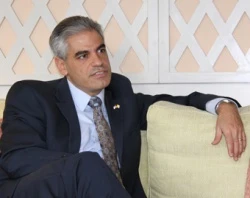
“What brings us together is far, far, far more than what sets us apart, and I want to focus on that," Ambassador Miguel H. Diaz told CNA in a wide-ranging interview at his hilltop residence in Rome Jan. 19.
Ambassador Diaz said that during his 16 months in Rome he has seen “significant signs that show the ongoing commitment of this President, the White House, and our government in general to fostering and deepening this relationship.”
He said the scandal of the alleged U.S. diplomatic cables, released on the website WikiLeaks has not affected the Vatican-U.S. working relationship.
According to an analysis by CNA, more than 700 cables from the U.S. embassy to the Vatican were among the 250,000 State Department cables obtained by WikiLeaks.
To date, only a handful of them has been released. But some of those have proven embarrassing, including one in which a U.S. embassy staffer poked fun at the “poor communications culture” in the Vatican and another in which Vatican Secretary of State Tarcisio Bertone was described as “yes man.”
The WikiLeaks affair has been a bump in the road in an otherwise easy and low-key relationship between the Vatican and the administration of U.S. President Barack Obama, during his first two years in office.
Ambassador Diaz is credited with running a smooth diplomatic operation — especially considering that prior to this he has had no previous diplomatic experience.
The 47-year old Cuban-American was a professor of theology at the College of Saint Benedict and Saint John's University in Minnesota when the call came from the White House in May 2009, five months after President Obama was inaugurated.
Reportedly, he was not first on the list for the position. However, the president’s top choices had to be rejected because they favored abortion or embryonic stem cell research — positions that would have made their appointment appear to be a snub to the Vatican.
The U.S. Senate confirmed Ambassador Diaz in August 2009, and since then he and his wife, also a theology professor, have been living with their four children in the ambassador's residence atop Rome’s Janiculum Hill.
When Pope Benedict XVI received Ambassador Diaz for the first time to accept his credentials, he did so warmly. But he made a point of emphasizing the Church’s differences with the U.S. administration.
“I think particularly of the need for a clear discernment with regard to issues touching the protection of human dignity and respect for the inalienable right to life from the moment of conception to natural death, as well as the protection of the right to conscientious objection on the part of health care workers, and indeed all citizens,” the Pope told the new ambassador.
Despite broad disagreements on basic policies, Ambassador Diaz said he is focusing on the values and the interests the two sides share.
"I think it's important to recognize that there are differences,” he said. “But I think it's important not to be paralyzed by those differences. The things that we have in common far exceed the things that divide us," said Ambassador Diaz.
As the ninth U.S. ambassador, Diaz said he is really "standing on the shoulders" of the "giants" that have gone before him.
Unofficial relations between the two states go back to the birth of America, when President George Washington assured Pope Pius VI that the Pope would have full freedom to appoint bishops in the new land.
It would take until President Ronald Reagan in 1984 for the U.S. to establish its first official embassy here. At that time, it was widely perceived that the U.S. president saw the Vatican and then-Pope John Paul II as an important ally in the fight against communism.
The embassy recently celebrated its 27th anniversary. Ambassador Diaz has as a staff of 19 — a formidable presence for promoting U.S. foreign policy at the world's smallest state.
"The size is really inversely proportional to the scope of influence," said Ambassador Diaz. “You can't just think of the Holy See as boxed with the Vatican City walls. We have to think of it as this vast network."
Since his Senate confirmation hearings, Ambassador Diaz has spoken of his vision for the embassy as one of “building bridges.”
And he has pursued that strategy during his 16-month tenure. He has worked diligently to build relationships not only with Vatican officials, but also with the wider institutions of the universal Church — pontifical universities, religious communities, even hospitals, non-profits and humanitarian agencies.
The embassy has sponsored several high-profile meetings to highlight areas of mutual interest.
An embassy-sponsored conference in 2009 brought professionals to the city to raise awareness of the need to stop mother-child transmission of AIDS. The embassy co-sponsored a concert with the Church aid agency Caritas to raise money for Haitian earthquake victims.
An embassy-sponsored conference at the Pontifical Gregorian University last October encouraged members of different faith traditions to come together in "building bridges." At the event, the director of the White House's Office of Faith-Based and Neighborhood Partnerships, Joshua DuBois, gave the keynote address.
But Ambassador Diaz said much of his diplomatic work is done in one-on-one conversations — what he called "diplomacy at the table" during luncheons and dinners, and "targeted diplomacy" with Vatican contacts through more formal channels.
The issues of concern to the U.S. and the Vatican are broad and far-reaching.
"One of the greatest challenges,” he said, was how the “human family” is going to “reconcile” its “incredible diversity” of religions and cultures. This diversity, he said, “increasingly threatens to tear us apart.”
On that note, Ambassador Diaz called Pope Benedict’s annual speech to diplomats Jan. 10 “ambitious.”
The Pope used strong language to condemn religious discrimination and persecution around globe, especially in the Middle East, North Africa and China.
"The task of building bridges is essential if we are to bring about reconciliation and peace, and if we are going to tackle ongoing problems such as the trafficking of persons and basic violations of human dignity — including violations for persons to exercise a right to religious freedom," Ambassador Diaz said.
He sees a "bridge-building" opportunity in Pope Benedict's call for world religious leaders to gather in Assisi next October to pray for peace. It is fitting that such an encounter should take place in the birthplace of St. Francis, whose name is associated with peace and reconciliation.
In an "interconnected" world, St. Francis’ message that all things are tied together is important, Ambassador Diaz said. The day of prayer called by the Pope has the potential to "do what religion is intended to do — bring people together and not drive them apart."
"In this interdependent world, civic leaders cannot act alone, no nation can act alone, and the contribution of religious leaders is essential in the building of peace, the defending of human dignity, the fight against any type of abuse. And certainly the religious leaders have a central role to play in that outgoing, noble task," Ambassador Diaz said.
He identified ending human trafficking and promoting education and migration issues as the embassy's top priorities.
"There are so many different areas that wherever the dignity of the human person is violated, that persons … and organizations associated with the Church can help," he explained.
"I think that's where the effective work of building those bridges and defending that dignity would come in, the day-to-day exercise of this relationship."
He does not downplay the continued differences between the U.S. and the Holy See on issues such as abortion, embryonic stem cell research, the homosexual lifestyle, and the promotion of condoms for AIDS prevention.
No diplomatic relationship finds both sides seeing eye-to-eye on every issue, Ambassador Diaz noted. "That's the ideal, the ideal will never be there."
He prefers to concentrate on his responsibility as President Obama's personal representative to the Holy See.
"As a person of integrity, I would not be sitting here if I did not believe that there was a significant convergence in my ability to carry out this duty here at the Holy See,” he said. “I'm defending the dignity of human persons in different ways. I am building bridges. And these are fundamental tenets of this administration and fundamental tenets of who I am as a person.”
He would like his time as ambassador to be remembered as one in which U.S. foreign policy and the common interests of the Holy See were united "to advance the common good of the human family."
"If I can do that, even if it's just in little ways, during my tenure here, then I'll call it a success,” he said. “I'll be happy that I did my job, which is to answer the call — certainly of President Obama and of my country, to serve it — and also the call of the human family and the Church to advance the common good."