Showing posts with label Latin America. Show all posts

Thursday, August 27, 2026

In Latin America, Democratic Socialists Are the Toast of the Party


The success of progressive candidates in the United States is inspiring leftists abroad struggling under pressure from the Trump administration and its allies.

Participants at the Panamerican Congress on Saturday in Montevideo, Uruguay.Credit...

By Jack Nicas

Photographs by Anita Pouchard Serra

Reporting from Montevideo, Uruguay
Aug. 27, 2026

Leer en español

Left-wing politicians from across the Western Hemisphere gathered in Uruguay this past weekend to lick their wounds from a string of election losses and strategize on how to counter growing aggression from the Trump administration.

There were ex-presidents and expected presidential contenders, national lawmakers and campaign strategists, best-selling authors and protest leaders. But perhaps the toast of the weekend — viewed by the group as the inspiration for a path forward — were the democratic socialists from the United States, fresh off their primary victories.


Darializa Avila Chevalier is a democratic socialist and candidate for the House in New York’s 13th Congressional District.

Those candidates — Darializa Avila Chevalier and Claire Valdez of New York, Chris Rabb of Pennsylvania and Dr. Adam Hamawy of New Jersey — were all special guests at the Panamerican Congress in Montevideo, an annual meeting of leftist political leaders from across the Americas. (Dr. Hamawy identifies as progressive but not democratic socialist.)

They received a standing ovation, were asked for selfies and were repeatedly cited by fellow attendees as examples on how the left can succeed in the current political moment.


Claire Valdez, a democratic socialist assemblywoman and close ally of Mayor Zohran Mamdani of New York, is a candidate for the House in the city’s 13th Congressional District.

Their victories “give us hope that if this can be fought from within, it can also be fought from the outside,” said Gabriel Boric, the former president of Chile, who was succeeded in March by a hard-right politician aligned with President Trump.

Mr. Boric, 40, a former protest leader, said the left had been failing to make the case to the working class that it was best positioned to help them, but the democratic socialists in the United States were showing they could.

“There is a tendency in our movement to constantly talk about the right and all the evils it represents, instead of convincing and giving hope to the people,” he said in an interview. “Now that debate is happening in the United States.”

Wednesday, August 26, 2026

Congressman García Participates in the Third Panamerican Congress


Congressman García Participates in the Third Panamerican Congress

August 24, 2026
Press Release


Congressman Jesús “Chuy” García (IL-04) participated in the Third Panamerican Congress that took place from Friday, Aug. 21, through Sunday, Aug. 23. The opening day began with a press conference and an opening ceremony at Uruguay’s Legislative Palace led by Uruguayan Vice President Carolina Cosse. The gatherings’ first closed-door working session started right after.

That afternoon, a public event entitled “This Is America” brought together more than 600 people to the historic Teatro Solís. Former Chilean President Gabriel Boric, former Colombian President Gustavo Petro, U.S. Sen. Bernie Sanders, Buenos Aires Governor Axel Kicillof, former Uruguayan Vice President Lucía Topolansky, former Chilean presidential candidate Jeannette Jara and former Chilean government spokesperson Camila Vallejo were among the progressive leaders from across the Americas who shared their visions for the region’s future.

On Saturday, delegations continued with additional closed-door working sessions and workshops on emerging issues, including the defense of democracy, the new global economy and cybersecurity.

The Third Panamerican Congress concluded Sunday with a closing session at the MERCOSUR Parliament, or Parlasur, in Montevideo. The parliamentary forum of democratic forces across the Americas brought together more than 150 lawmakers, former presidents, ministers and political leaders from 15 countries. Participants reviewed the outcomes of the working sessions held in Montevideo and announced Brazil as the next host country of the fourth Panamerican Congress in 2027.

The closing session began with presentations of the conclusions from four working groups focused on peace, multilateralism and security; sustainable economic development and regional integration; digital sovereignty and artificial intelligence; and well-being and care for the majority. Lawmakers agreed that the hemisphere’s challenges—from financial coercion and weaponized sanctions to concentrated technological power and the erosion of traditional welfare systems—require coordinated regional action rather than fragmented national responses.

Participants from the United States included a Congressional delegation led by U.S. Reps. Pramila Jayapal (D-WA-7), and Jesús “Chuy” García (D-IL-04).

U.S. Rep. Jesús “Chuy” García said members of the U.S. delegation share the Congress’ vision.

“Those of us who serve in the United States Congress share the vision of this Panamerican Congress,” García said. “I believe winning back the majority in Congress can open space to change U.S. policy toward the region and the Global South. We will center working-class well-being, respect for human rights and respect for the sovereignty of Latin American nations.”

Wednesday, January 21, 2026

Catholicism shrinks in Latin America while more are religiously unaffiliated, Pew surveys find


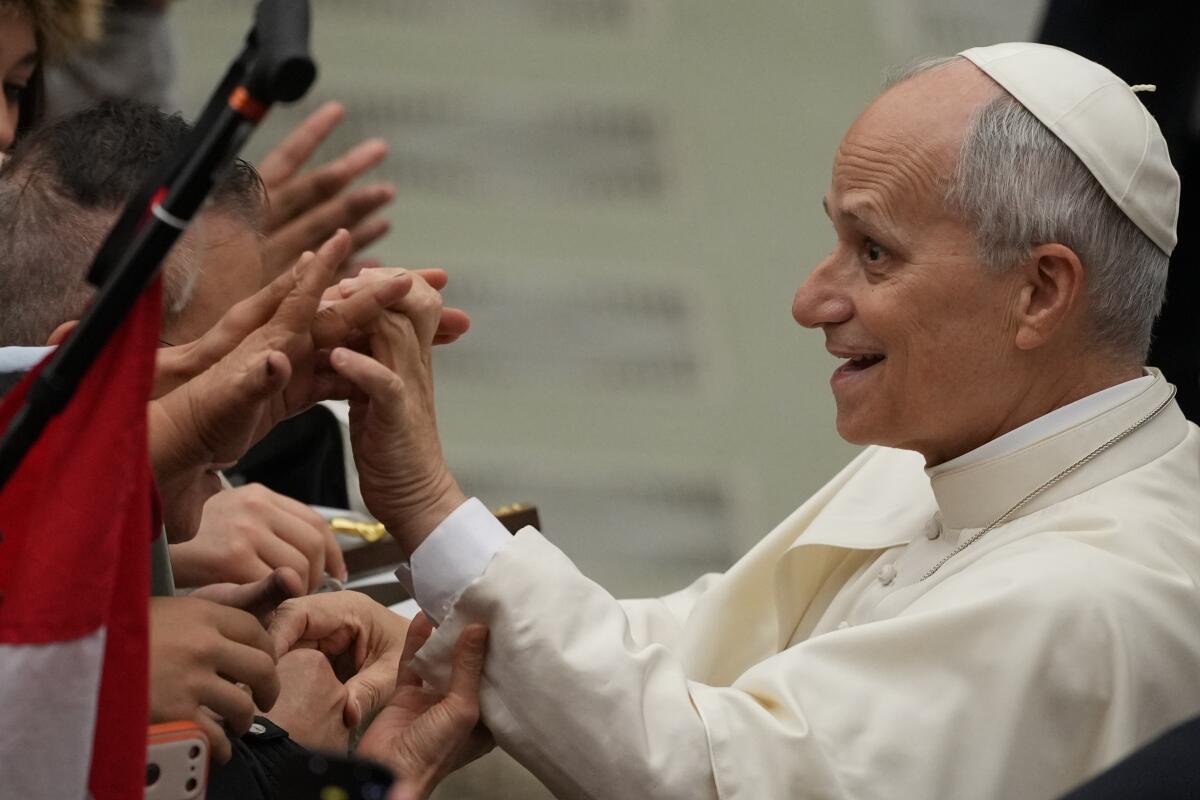
Pope Leo XIV greets people during his weekly general audience in the Pope Paul VI hall at the Vatican, Wednesday, Jan. 14, 2026.
(Andrew Medichini / Associated Press)

By Luis Andres HenaoJan. 21, 2026 7:44 AM PT
  • Catholic affiliation has plummeted across six major Latin American countries over the past decade, while the religiously unaffiliated population has surged dramatically.
  • The share of unaffiliated adults now exceeds that of Protestants in Argentina, Chile, Colombia and Mexico, marking a historic shift in the region’s religious landscape.
  • Despite declining church affiliation, Latin Americans remain deeply religious, with about 90% believing in God and majorities praying daily.
Catholicism in Latin American countries has shrunk over the last decade, while a growing percentage of adults identify as religiously unaffiliated, describing themselves as atheist, agnostic or “nothing in particular.”

Those are among the key findings in a report released Wednesday by the Pew Research Center based on surveys conducted in early 2024 of adults in six of the region’s most populous countries: Argentina, Brazil, Chile, Colombia, Mexico and Peru.

“Our analysis found that the Catholic share of the population in Argentina, Brazil, Chile, Colombia, Mexico and Peru — which collectively make up about 75% of Latin America’s population — has significantly declined since 2013-14, while a growing share of adults in the region are religiously unaffiliated,” said Kirsten Lesage, a Pew research associate and the lead author of the report.

Wednesday, April 23, 2025

As the first Latin American pope, Francis shifted the Catholic Church's center


(RNS) — Drawing on Latin American theology that emphasizes collaboration, developed in response to continued struggles with colonialism, Francis pushed for a Catholic Church with broader inclusion of people on the margins.


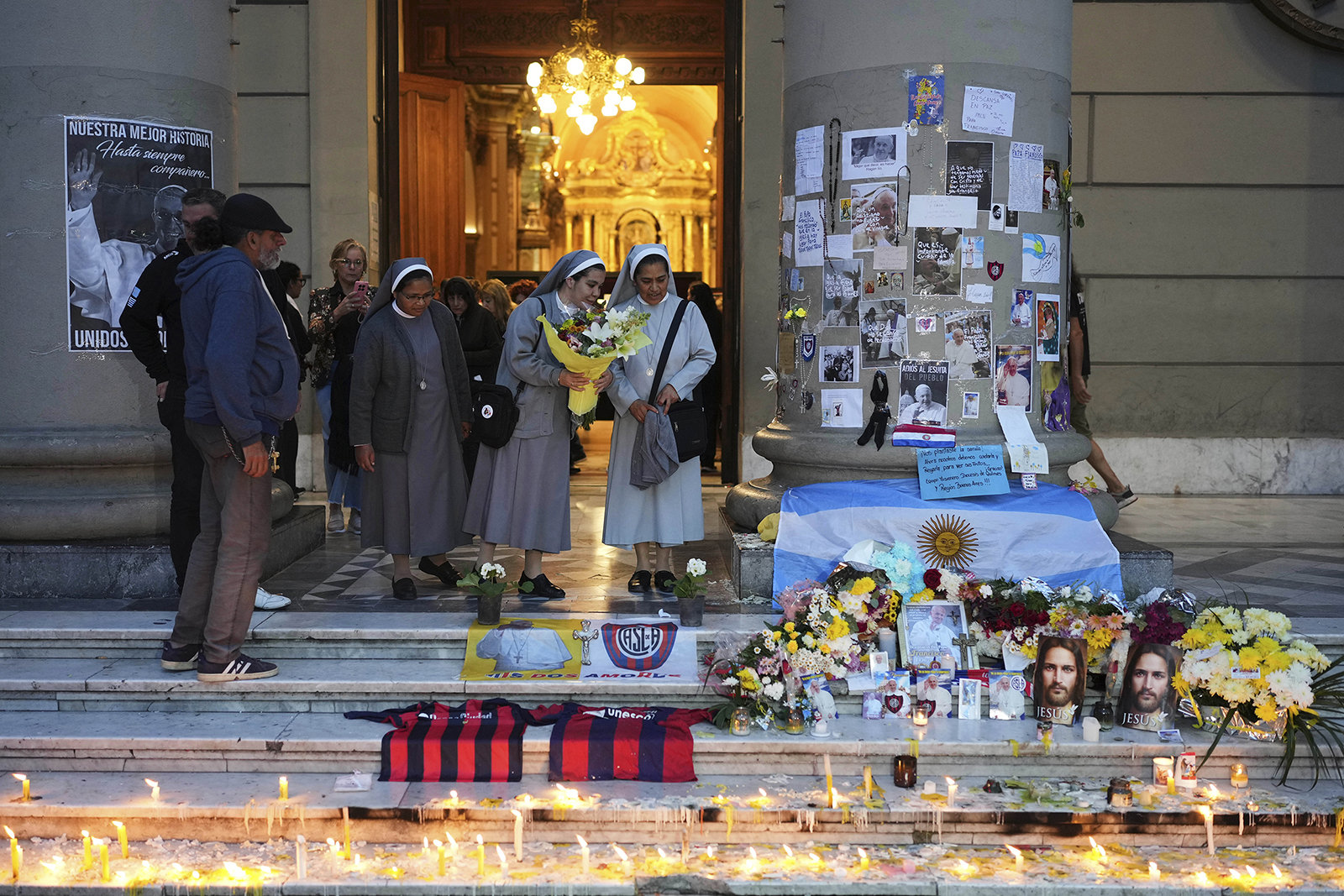
Nuns hold flowers and look at a memorial to the late Pope Francis outside the Metropolitan Cathedral in Buenos Aires, Argentina, Tuesday, April 22, 2025. (AP Photo/Rodrigo Abd)

Aleja Hertzler-McCain
April 22, 2025


(RNS) — When Pope Francis stepped onto the balcony of St. Peter’s Basilica for the first time back in 2013, he told the crowds below him that the College of Cardinals had gone “almost to the ends of the earth” to find the new bishop of Rome.

Over 500 years after papal bulls authorized the violent, colonial conquest of non-Christian peoples, paving the way for Catholicism to take root in the Americas, Francis was the first pope to emerge from those lands. Drawing on the region’s theology that emphasizes collaboration and developed in response to continued struggles with colonialism, Francis pushed for a Catholic Church with broader participation and inclusion of people on the margins, scholars told RNS before and after his death on Monday (April 21).

“We were, for several centuries, a church that reflected what they do in Europe — we repeated, copied Europe,” said Maria Clara Lucchetti Bingemer, a theology professor at the Pontifical Catholic University of Rio de Janeiro, in Spanish.

Latin American bishops began to implement the teachings of the modernizing Second Vatican Council right after the council in the early 1960s. And as a result, “we try to be a church that is a source, a church that generates its own content, that generates the way we celebrate our rituals, that generates our priorities,” Bingemer said. Francis made sure those efforts grew “in a strong and exponential way.”

As archbishop of Argentina, Cardinal Jorge Bergoglio, who would take the name Francis when he became pope in 2013, came up within the Latin American bishops’ conference, known as CELAM. That school of thought would become prominent during his papacy.

In 2007, he chaired the committee that drafted the final document for CELAM’s general conference in Aparecida, Brazil, which encouraged Catholics to be “missionary disciples” and described the church as the “home of the poor.” Both became key concepts six years later in Francis’ first apostolic exhortation, “Evangelii Gaudium,” in which the new pope encouraged the church to “go forth,” share “the joy of the Gospel” and understand “God’s heart has a special place for the poor.”

Sunday, February 09, 2025

Marco Rubio reiterated his position regarding the regimes of Cuba, Venezuela and Nicaragua

by yourNEWS | Feb 6, 2025


During a press conference in the Dominican Republic, the US Secretary of State explained to a journalist why the regimes of Cuba, Venezuela and Nicaragua are enemies of humanity

US Secretary of State Marco Rubio reiterated his position on the regimes of Cuba, Venezuela and Nicaragua, which he considers enemies of humanity, at a press conference in the Dominican Republic.

In a joint press conference with President Luis Abinader in the Ambassadors’ Hall of the National Palace, the seat of the Caribbean nation’s government, Dominican journalist Nelson Rodriguez told Rubio that saying that the governments of Cuba, Venezuela and Nicaragua were enemies of humanity was very strong, and that he should perhaps temper the expression.

The US Secretary of State told Nelson Rodriguez: “I don’t know any other way to talk about a regime, for example, that has forced almost 8 million of its citizens to leave Venezuela in the last ten years, that imprisons, tortures, and kills innocent people; in the case of Cuba, more than ten percent of the population has left the country, it has imprisoned more than 500 people, young children of 16-17 years old because they went out to demonstrate in the streets; and in the case of Nicaragua, it continues to fall on all its opponents, all the candidates for the Nicaraguan presidency have been prosecuted for justice or the lack of justice, they are even deporting nuns, they have declared war on the Catholic Church and all religious people, they have turned the country into a family dynasty where there is a co-presidency.”

Marco Rubio continued to argue with the Dominican journalist who suggested lowering the tone when referring to Cuba, Venezuela and Nicaragua: “I don’t know who is offended, but that is how I can describe those regimes. Not only do they do that to their own people, but all three have contributed to the instability of the region. All countries in the region have had to pay to some extent the price for the instability that exists in those three. In the case of Venezuela, it cooperates with Iran, with Hezbollah, with Hamas; in the case of Cuba, it has given shelter to Chinese espionage, a Russian presence. That remains my opinion. I hope there is a change in those countries, but I don’t expect it to happen. It is the way I talk about those regimes because it is the reality of how they have behaved. I wish it were not like that, but that is how it has been for a long time, unfortunately.”

Rubio said that the regimes in Cuba, Nicaragua and Venezuela “are enemies of humanity” and are causing the migration crisis in the region at a press conference in San José, Costa Rica, accompanied by the president of that country, Rodrigo Chaves.

Nelson Rodriguez also asked the Secretary of State if the US would pressure those three governments not to be invited to the 10th Summit of the Americas (to be held next December), or if the US would not attend. Rubio replied that “the decision of who to invite is up to the Dominican Republic.”

Asked whether the United States would sit down with these three governments, the Secretary of State emphasized: “The regimes can change, stop violating the human rights of so many people and stop abusing them. That would be perfect. But I think that politics works well when we speak clearly, we don’t get confused, and I’m not confused.”

During his official visit to the Dominican Republic, the last stop on his first international tour as Secretary of State, Rubio and President Luis Abinader discussed key issues such as the crisis in Haiti, the fight against drug trafficking, and cooperation in strategic industries. @ADNCuba


Sunday, October 03, 2021

Pandora Papers in Latin America: Three active heads of state and 11 former presidents operated in tax havens


PANDORA PAPERS

Pandora Papers in Latin America: Three active heads of state and 11 former presidents operated in tax havens


Chile’s Sebastián Piñera, Dominican Republic’s Luis Abinader and Ecuador’s Guillermo Lasso feature in the new data leak. Among the region’s former presidents are Colombia’s Gaviria and Pastrana. In Brazil, the investigation has turned up the names of both the economy minister and the governor of the central bank


SR. GARCÍA
JAN MARTÍNEZ AHRENSJAVIER LAFUENTE
Mexico - 03 OCT 2021-19:41 CEST


Three current and 11 retired presidents, 90 politicians in the upper echelons of power, entire religious congregations, world-famous artists, billionaires and even the governor of a central bank; in Latin America a constellation of influential figures has made use of tax havens over the years.

Despite inhabiting the region dogged by more inequality than anywhere else in the world, members of its elite have used a network of trusts, shell companies and opaque business records in places such as the British Virgin Islands and Panama to keep a substantial portion of their assets from public scrutiny.

It is a complex, obscure corporate web that the publication of the Pandora Papers will put under the spotlight. Obtained by the International Consortium of Investigative Journalists (ICIJ), the data leak is based on 11.9 million files containing the work of 14 offshore law firms. This body of information has been reviewed and analyzed by a team of 600 journalists, with the participation of EL PAÍS and other media giants such as The Washington Post, The Guardian and the BBC as well as numerous local media sites.

While the results of the investigation have a global impact, they are particularly earth-shattering in Latin America, where around $40 billion is diverted to tax havens each year. As will be published in the coming days by EL PAÍS and the other media participants, of the 35 presidents or former presidents that appear in the documents, 14 are from this region. Most are conservative. Among them are three active heads of state, who have all been wealthy businessmen: Chile’s Sebastián Piñera, Ecuador’s Guillermo Lasso and the Dominican Luis Abinader. Eleven former presidents also emerge, such as César Gaviria and Andrés Pastrana from Colombia, Pedro Pablo Kuczynski of Peru, Porfirio Lobo of Honduras, Horacio Cartes of Paraguay, and Juan Carlos Varela, Ricardo Martinelli and Ernesto Pérez Balladares, all of Panama.

Regarding the Chilean president, whose business dealings involved sectors such as airlines, banking and real estate, the investigation carried out by Chilean media outlets CIPER and LaBot has exposed a particularly controversial activity among his offshore operations – namely, the sale of the environmentally sensitive copper and iron mine, Minera Dominga, in the British Virgin Islands together with businessman Carlos Alberto Délano, one of his childhood friends.

In December 2010, when Piñera had been in the presidential residence, La Moneda Palace, for just nine months, the presidential family sold the business to Délano with a deed signed in Chile for $14 million and another in the Virgin Islands for $138 million. The amount was to be paid in three installments, with a caveat: the last payment was conditional on there not being environmental protection imposed on the mining operations area, as environmental groups were demanding.

The decision on the viability of Minera Dominga was left in the hands of the Piñera government, which failed to promote environmental protection, so the third installment was finally paid. Despite the lack of transparency, the manager of Piñera’s business affairs stated, when asked, that the president had not managed his own companies for 12 years; that he had been not informed of the process of Minera Dominga’s sale, and that the judicial investigation into the operation had been wound up.

Another president featured in the Pandora Papers is the Dominican Luis Abinader, whose successful business career was in the hotel sector. The documents link him to two companies in Panama, Littlecot Inc. and Padreso SA. Both were created before he took office and were used to manage assets in Dominican Republic. Local media outlet Noticias Sin’s investigation flags up the fact that the shares of these companies were initially “payable to the bearer,” an instrument used to hide the beneficial owner of the companies.


The president of Dominican Republic, Luis Abinader, in a file photo from December 16, 2020.GLADYS SERRANO

A legislative reform in 2018 obliged the Abinader family to publicly register as beneficial owners. Upon becoming president in 2020, Abinader declared nine offshore companies that he controlled through a trust. Both he and Piñera used the Panama-based law firm, OMC Group, the firm used by Colombian singer Shakira for at least three of the offshore companies the Spanish Treasury has been tracking for years.

The third active head of state who appears in the documents obtained by the ICIJ is Guillermo Lasso, a conservative millionaire and former banker who was voted president of Ecuador last year. According to the documents and the investigation carried out by local media site El Universo, Lasso ended up operating through 14 offshore companies, most of them in Panama, closing them only after former left-wing Ecuadorian premier Rafael Correa promoted a law banning candidates from being the beneficial owners of companies located in tax havens.

In his defense, Lasso claims that he opened these opaque companies because national legislation prevents bankers from investing in his country. He also claims that 10 of these companies are already inactive; he denies any relationship with or profit from the other four.

Lasso was a client of Trident Trust, one of the largest providers of offshore entities in the world. This Swiss company is known for its discretion regarding these types of solutions and appears again and again in the operations uncovered by the data leak, together with the law firm Alemán, Cordero, Galindo & Lee (Alcogal), which has a host of clients in Latin America. Alcogal created the majority of the 78 companies used by the Venezuelans accused of hiding $2 billion from the state-owned oil company, Petróleos de Venezuela (PDVSA), in accounts in Andorra. A significant number of the Chavista hierarchy are among the beneficiaries of this scheme, according to Armando.info’s investigation.

In Brazil, the Pandora Papers shed light on the activities of the two most powerful men in the country’s economic sector: the economy minister, Paulo Guedes, and the president of the central bank, Roberto Campos Neto. Neither disclosed their offshore activities to the public before assuming positions involving decisions on these types of investments. This possible conflict of interest is particularly pertinent in the case of the economy minister who has pushed through a tax reform to reduce the pressure on private money in tax havens.

Guedes, 72, is listed as a shareholder in Dreadnoughts International Group, a company registered in the British Virgin Islands. It is what is known in financial jargon as a shelf company: firms that are opened in tax havens but can remain inactive for years, waiting for someone to give them a purpose. The documents show that Guedes, who is economic guru to Brazil’s premier, Jair Bolsonaro, and one of the country’s most controversial figures due to his connections with the financial elite, had at least $8 million invested in the company in 2014, registered in his name, that of his wife, Maria Cristina Bolivar Drumond Guedes, and that of his daughter, Paula Drumond Guedes. In response to the investigation, Guedes sent a statement to Piauí magazine pointing out that these activities “were duly declared to the tax authorities and other competent bodies, including his participation in the company Dreadnoughts International Group.” The statement also says: “His actions always respected the relevant legislation and were guided by both ethics and responsibility.”

Meanwhile, the central bank president, Campos Neto, owns two companies, Cor Assets and ROCN Limited, both registered in Panama in partnership with his wife, lawyer Adriana Buccolo de Oliveira Campos. The stated purpose of the companies was to invest in financial assets from Santander Private Bank, as a member of its executive board. The other opaque companies are Peacock Asset, managed by Goldman Sachs, and which was discovered in the Bahama Leaks investigation in 2016; and Darling Group, a “real-estate management” company.


Roberto Campos Neto.UESLEI MARCELINO (REUTERS)

Like Guedes, the central bank president claims that he declared all his money abroad to the Presidency of the Republic’s Ethics Commission, as well as to the Brazilian tax authorities and to the central bank itself. He also insists that he has built his “assets with the income acquired from 22 years working in the financial sector.”

Colombia is another Latin American country where a lack of transparency in the financial dealings of the political elite has been particularly extensive. Among the public figures who appear in the leak are two former presidents: the liberal César Gaviria Trujillo, who was in office from 1990 to 1994, and the conservative Andrés Pastrana Arango, who governed between 1998 and 2002. Both men, who retain significant political influence, resorted to these obscure corporate vehicles once they had already left power.

In Argentina, the Pandora Papers shed light on the activities of Jaime Durán Barba, a political consultant who catapulted Mauricio Macri to the presidency in 2015; and Zulema Menem, daughter of former president Carlos Menem (1989-1999). Also flagged up for murky offshore dealings is the late Daniel Muñoz, secretary of former President Néstor Kirchner, as well as several key figures that feature in the lawsuit filed for the receipt of alleged illegal commissions paid by public works contractors to Peronist governments.

The results of the investigation in Mexico are significantly more far-reaching, with the documents implicating more than 3,000 people, including three of the richest business tycoons in the country: the mining magnate Germán Larrea, the heiress of the Modelo beer group, María Asunción Aramburuzabala, and Olegario Vázquez Aldir, whose group controls private hospitals, hotel chains, insurance companies and the media. Their combined fortunes amount to more than $30 billion. Julio Scherer Ibarra.VICTORIA VALTIERRA (CUARTOSCURO)

All three used tax havens to create corporate vehicles through which to operate internationally. Larrea went so far as to open nine companies in the British Virgin Islands between 2013 and 2016 through which he managed the acquisition of luxury real estate in the US, leaving scarcely a trace. Aramburuzabala bought million-dollar properties in Utah and New York as well as two private planes. And Vázquez Aldir and his entourage acquired yachts, a plane and at least two mansions through eight shell companies. Neither Larrea nor Aramburuzabala have responded to questions from journalists working on the investigation while, speaking through a lawyer, Vázquez maintains that he complies with all tax and legal obligations both in Mexico and abroad.

A political figure in Mexico whose activities have featured big in the investigation is Julio Scherer Ibarra, who was legal advisor to president Andrés Manuel López Obrador up until a month ago. In 2017, he was listed as the sole owner of a firm based in the British Virgin Islands with assets valued at $2 million from his work as a private lawyer. The firm owned a company in the US that had a luxury apartment in an exclusive area of Miami. The business in the Virgin Islands became inactive in 2019, 11 months after Scherer joined the Mexican government, but the company in the US still owns the Miami apartment. Asked about these activities, the former presidential advisor has pointed out that on the dates he made the investments he was not a public official but an independent professional.

The Pandora Papers also show how there was a proliferation of people close to certain centers of Mexican power making intensive use of offshore financial services. This was the case in circles close to former president Enrique Peña Nieto (2012-2018) and also with large suppliers linked to the Mexican public oil company Pemex, an energy giant that is currently in debt to the tune of almost $114 billion.

EL PAÍS reporters Georgina Zerega, Elías Camhaji, Zorayda Gallegos, Eliezer Budasoff, Federico Rivas, Carla Jiménez and Inés Santaeulalia contributed to the reporting for this article.

The Pandora Papers investigations in Latin America counted on reporting from journalists at the following media outlets: La Nación, elDiarioAR, Infobae, El Deber, Agência Pública, Metrópoles, Poder360, Revista Piauí, Ciper, LaBot, CLIP, El Espectador/CONNECTAS, Costa Rica Noticias, Proyecto Inventario, Noticias Sin, El Universo, El Faro, Plaza Pública, Contracorriente, Proceso, Quinto Elemento Lab, Univision, Confidencial, Grupo ABC Color, Convoca, IDL-Reporteros, Centro de Periodismo Investigativo, Armando.info.