Indian Wedding Baraat in New York: Traffic jams due to wedding processions are common in India, but when they happen on New York's Fifth Avenue, home to showrooms of the world's biggest brands, it becomes news. Recently, an Indian-origin couple made their wedding so memorable that even New York police had to stop traffic.
AND THE THIRD ANGEL FOLLOWED THEM, SAYING WITH A LOUD VOICE, IF ANY MAN WORSHIP THE BEAST AND HIS IMAGE, AND RECEIVE HIS MARK IN HIS FOREHEAD, OR IN HIS HAND. *** REVELATION 14:9
Thursday, April 30, 2026
Indian Wedding Baraat Shuts Down New York!...
Saturday, February 28, 2026
Friday, February 20, 2026
Wednesday, February 11, 2026
Tuesday, January 27, 2026
Long Range Acoustic Device (LRAD) Minneapolis MN
Wednesday, May 09, 2018
Shouting Match Erupts On House Floor Over Chaplain Rev. Patrick Conroy SJ
A shouting match erupted on the House floor between Reps. Joe Crowley (D-NY) and Tom MacArthur (R-NJ) on Tuesday over House Chaplain Rev. Patrick Conroy, who was abruptly fired in April and quickly reinstated by House Speaker Paul Ryan (R-WI) earlier this month, according to a Tuesday Politico report.
Crowley, a Catholic, proposed launching a special investigation into the mysterious firing of the Jesuit chaplain, who claimed he had never received a complaint about his work before he was pushed to resign by Ryan’s staff.
MacArthur, an Episcopalian, reportedly walked over to the Democratic side of the chamber and accused Crowley of politicizing a non-political issue, saying that he, a Republican, prays with Conroy. Crowley reportedly gestured angrily at the speaker’s seat, saying that Ryan made it a political issue when he fired Conroy in the first place.
According to Politico, the interaction became so heated that Minority Whip Steny Hoyer (D-MD) came over to intervene, as bystanders were concerned that the argument would become physical.
Newly reinstated Conroy said his first opening prayer on Monday, calling for a spirit of cooperation and problem-solving to infuse the chamber’s work.
Sunday, January 17, 2016
America’s Death Zones: Where NOT To Be When It Hits the Fan
Mac Slavo
April 4th, 2013
SHTFplan.com
As the potential for a globally destabilizing event becomes ever more probable, many concerned Americans are starting to wonder where they’d go if the worst were to happen.
To help answer that question, we can start by identifying the areas of the country to avoid.
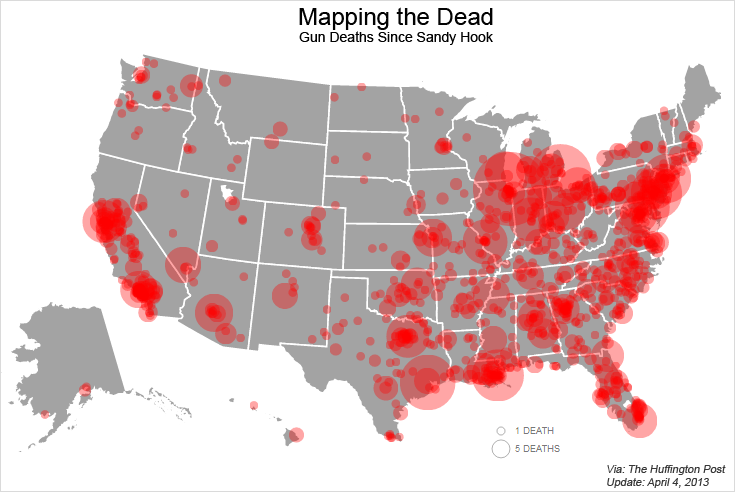
The following map of the United States takes into account all of the gun related deaths since the Sandy Hook school shooting. You’ll likely notice that there is one common denominator. The majority of the violence has occurred in major metropolitan areas, with some incidents spreading into outlying ex-urban and rural areas. As of this writing 2,244 people have been killed since December of 2012.
If this is the state of our nation during relative peacetime and perceived prosperity, imagine what it’ll look like in the midst of financial, economic or political turmoil.
Americans living east of the Mississippi River will likely experience the brunt of it. But anyone residing in and around any major U.S. city will, likewise, have a tough road ahead of them.
If you live in one of these red zones, you’d better plan accordingly:
…every crisis that threatens, even a local crisis, can turn exponential because of close proximity to people who cannot help themselves. Even good people panic in a crisis…
Wherever we find large groups of people, when crisis strikes we will also find the worst that mankind has to offer – rioting, looting, starvation and violence.
Survival expert James Rawles refers to them as the golden horde; the thousands of people who will be desperate for supplies, shelter and safety in the aftermath of a major catastrophe:
…there is just a thin veneer of civilization on our society. What is underneath is not pretty, and it does take much to peel away that veneer. You take your average urbanite or suburbanite and get him excessively cold, wet, tired, hungry and/or thirsty and take away his television, beer, drugs, and other pacifiers, and you will soon seen the savage within. It is like peeling the skin of an onion—remove a couple of layers and it gets very smelly. (Survival Blog)
Given the probability of the United States succumbing to any number of devastating catastrophes that may include an economic collapse, food shortages,pandemic, regional earthquakes, solar storms, or war, there is ample motivation for those with the means to do so to get out of densely populated areas of the country. Likewise, living in locales with close proximity to major thoroughfares such as interstate highway systems could pose a danger as the ‘horde’ evacuates disaster-struck areas.
For many, relocation is not possible because of job requirements or other factors. Thus, those of us who are left with no choice but to remain in populated urban or sub-urban areas, it is strongly recommended that you consider preparedness planning for staying put, or bugging in, during an emergency. It’s not the ideal scenario, but if you plan on hunkering down then you may find it advantageous to have food stores and other long-term supplies, as well as home defense plans. And, should things get so bad that you have to leave your primary residence, be sure to have evacuation plansin place.
The U.S. government is actively preparing to deal with the aftermath of many of the possible crises cited above, namely the civil unrest that will follow. Police and military units are training to deal specifically with urban scenarios because emergency services planners understand that America’s metropolitan death zones will be completely devoid of law & order.
If you’re in one of these areas, and plan on staying during a major crisis, take steps now to prepare for the inevitability of mass chaos.
Wednesday, July 03, 2013
Wayne Dodge Starts Church Brawl Over ‘Seat Saving’ Practices
Posted: July 2, 2013
Church attendee Wayne Dodge was booked into Weber County Jail this week on suspicion of aggravated assault, a third-degree felony, and disorderly conduct, a class C misdemeanor.
Dodge was arrested after he caused a church brawl over a few seats that were being saved for other parishioners during an unusually packed service.
An argument broke out in the pews because more than 400 people were attempting to fit inside the church for a missionary’s farewell and a baby blessing.
A deputy for the Plain City police department said it was the “seat saving” practice that led to the initial argument. The officer then revealed that a fistfight broke out in the church’s parking and that one man was hit by a car.
The Weber County Sheriff’s deputies received numerous 911 calls from members of the LDC chapel.
The bishop of The Church of Jesus Christ of Latter-day Saints’ Meadows Ward told FOX 13:
“There was some seats that were allegedly saved, and there was a disagreement over whether they were saved or not and an individual sitting there. This continued to escalate throughout the day.”
Weber County Sheriff’s Lt. Mark Lowther explains what happened to the man who was hit by a car:
“He ended up on the hood of the car. We did an investigation, there was conflicting stories (between the two men), but according to witness accounts there was enough probable cause to make an arrest for aggravated assault.”
Here’s a mugshot of Wayne Dodge:
Nobody was hospitalized because of the church brawl.
According to the church’s bishop: “This is a place of worship. The bottom line is we have to come back to church next Sunday.”
It’s still not clear why Wayne Dodge resorted to an outright fist fight over a simple seat saving issue.
Source: http://www.inquisitr.com/826336/wayne-dodge-starts-church-brawl-over-seat-saving-practices/#6FCT7CejuL0bWwSA.99
Monday, September 24, 2012
Wednesday, March 28, 2012
Passenger on US Airways flight from North Carolina to Florida arrested after allegedly attacking crew
| Associated Press
CHARLOTTE, North Carolina – A passenger aboard a US Airways flight from North Carolina to Florida has been arrested after witnesses say she attacked crew members before being wrestled to the floor.
A spokeswoman for the airport authority in Fort Myers, Florida, said Wednesday police arrested a US Airways passenger. Spokeswoman Victoria Moreland would not provide details until an arrest report is released. US Airways did not return calls.
WNCN-TV in Raleigh reports a passenger from Charlotte to Fort Myers kicked, scratched and spit on crew members. The TV station said one of its reporters was in the Fort Myers terminal and spoke to crew members.
The incident came hours after passengers aboard a JetBlue flight from New York to Las Vegas had to restrain that plane's agitated pilot.
Source: http://www.foxnews.com/us/2012/03/28/passenger-on-us-airways-flight-from-north-carolina-to-florida-arrested-after/#ixzz1qQrNTc00
.
Thursday, November 17, 2011
Wall Street protesters tie up traffic in protests around the US; more than 200 arrested
By: Karen Matthews, The Associated Press
Posted: 11/17/2011 10:12 AM | Last Modified: 11/17/2011 5:27 PM
SETH WENIG / THE ASSOCIATED PRESS Enlarge Image
An Occupy Wall Street protester yells as he is arrested by the police after blocking an intersection near The New York Stock Exchange in New York, Thursday. Two days after the encampment that sparked the global Occupy protest movement was cleared by authorities, demonstrators marched through New York's financial district and promised a national day of action with mass gatherings in other cities.
NEW YORK, N.Y. - Occupy Wall Street protesters clogged streets and tied up traffic around the U.S. on Thursday to mark two months since the movement's birth and signal they aren't ready to quit, despite the breakup of many of their encampments by police. More than 200 people were arrested, most of them in New York.
The demonstrations — which took place in such cities as Los Angeles, Las Vegas, St. Louis, Washington and Portland, Oregon — were for the most part peaceful. Most of the arrests were for blocking streets, and the traffic disruptions were brief.
Chanting "All day, all week, shut down Wall Street," more than 1,000 protesters gathered near the New York Stock Exchange and sat down in several intersections. Helmeted police broke up some of the gatherings, and operations at the stock market were not disrupted.
As darkness fell, a crowd of several thousand people, their ranks swelled by union members, jammed Manhattan's Foley Square, where their chants boomed off the surrounding courthouses and other government buildings. From there, they began a march over the Brooklyn Bridge.
The protests came two days after police raided and demolished the encampment at New York's Zuccotti Park that had served as headquarters of the Occupy movement.
"This is a critical moment for the movement given what happened the other night," said demonstrator Paul Knick, a software engineer from Montclair, New Jersey. "It seems like there's a concerted effort to stop the movement, and I'm here to make sure that doesn't happen."
At least 177 people were arrested in New York. Some were bloodied during the arrests. One man was taken into custody for throwing liquid, possibly vinegar, into the faces of several police officers, authorities said. Many demonstrators were carrying vinegar as an antidote for pepper spray.
A police officer needed 20 stitches on his hand after he was hit with a piece of thrown glass, police said.
In Los Angeles, about 500 sympathizers marched downtown between the Bank of America tower and Wells Fargo Plaza, chanting, "Banks got bailed out, we got sold out!" More than two dozen people were arrested.
Police arrested 21 demonstrators in Las Vegas, and 20 were led away in plastic handcuffs in Portland, Oregon, for sitting down on a bridge. At least a dozen were arrested in St. Louis after they sat down cross-legged and locked arms in an attempt to block a bridge over the Mississippi River.
Several of the demonstrations coincided with an event planned months earlier by a coalition of unions and liberal groups, including Moveon.org and the Service Employees International Union, in which out-of-work people walked over bridges in several cities to protest high unemployment.
The street demonstrations also marked two months since the Occupy movement sprang to life in New York on Sept. 17. They were planned well before police raided a number of encampments over the past few days, but were seen by some activists as a way to demonstrate their resolve in the wake of the crackdown.
Thursday's demonstrations around Wall Street brought taxis and delivery trucks to a halt, but police were largely effective at keeping the protests confined to just a few blocks. Officers allowed Wall Street workers through the barricades, but only after checking their IDs.
Mayor Michael Bloomberg said police had been expecting as many as 10,000 protesters based on what activists had been saying online. But he said there had been "minimal disruption."
"Most protesters have, in all fairness, acted responsibly," he said after visiting an injured police officer in the hospital.
Police Commissioner Raymond Kelly said officers confiscated metal devices that some demonstrators had apparently planned to use to lock themselves into the entrances to Wall Street businesses.
The demonstration that drew thousands to Foley Square in the evening was a rarity in the Occupy movement: Union organizers obtained a permit from the city, and speakers were allowed to use a sound system.
Among the demonstrators arrested in New York was a retired Philadelphia police captain, Ray Lewis, who was taken into custody in his dress uniform. Others included actor and director Andre Gregory, who said he hoped the movement would lead to national action on economic injustice.
"It's a possible beginning of something positive," he said.
Some onlookers applauded the demonstrators from open windows. Others yelled, "Get a job!"
"I don't understand their logic," said Adam Lieberman, as he struggled to navigate police barricades on his way to work at JPMorgan Chase. "When you go into business, you go into business to make as much money as you can. And that's what banks do. They're trying to make a profit."
Gene Williams, a bond trader, joked that he was "one of the bad guys" but said he empathized with the demonstrators: "The fact of the matter is, there is a schism between the rich and the poor, and it's getting wider."
The confrontations followed early-morning arrests in other cities. In Dallas, police evicted dozens of protesters near City Hall, citing health and safety reasons. Eighteen protesters were arrested. Two demonstrators were arrested and about 20 tents removed at the University of California, Berkeley.
City officials and demonstrators were trying to decide their next step in Philadelphia, where about 100 protesters were under orders to clear out to make way for a long-planned $50 million plaza renovation at City Hall. Union leaders pressed the demonstrators to leave, saying construction jobs were stake.
___
Associated Press writer Colleen Long in New York contributed to this story.
Monday, November 30, 2009
Shoving Match Ensues After Church Runs Out Of Turkeys
POSTED: 2:33 pm EST November 25, 2009
FORT PIERCE, Fla. -- Police were called to a church-organized Thanksgiving turkey giveaway Wednesday after the church ran out of turkeys and a shoving match ensued.
More than 125 people waited in line to get a free turkey at the Seventh Day Adventist Church.
When church organizers realized there were not enough turkeys to go around, someone apparently cut in line and started a small fracas.
Reatha Smith, one of the church organizers, said with so many people out of work this year, they had a lot more people show up than expected.
"So we did the best we could and, what somebody (said) happened -- I didn't see it -- (was) somebody pushed somebody," Smith said.
Organizers threatened to shut it down if things didn't change.
No one was hurt and no arrests were made.
Copyright 2009 by WPBF.com.
Source: http://www.wpbf.com/news/21724817/detail.html
.
Note: SDA church promoting the eating of flesh; in the latter days no less!
.
Thursday, November 05, 2009
12 Dead in Fort Hood Shooting Spree
posted: 3 MINUTES AGO
The gunman was killed and two other suspects were in custody, Army Lt. Gen. Bob Cone said.
The shooting occurred at 1:30 p.m. local time at the Soldier Readiness Center, where deploying soldiers are processed.
"There were two weapons that the primary shooter had and both were handguns," Cone said.
The number of wounded totaled 31. They were being taken to three area hospital, including Darnall Army Medical Center and Scott & White Memorial Hospital.
The base, located halfway between Austin and Waco, was placed on lockdown. That includes nine schools located there. Fort Hood is home to 33,000 people. It is the largest military base in the country.
2009 AOL LLC. All Rights Reserved.
Thursday, October 15, 2009
Delta Passenger Arrested for Bible Chanting
According to the police report, Paul Marchuk III was charged with disorderly conduct and resisting arrest by airport police. He was being held on $20,000 bond. Passengers on the Delta Airlines flight reported to local television station WSMV that the passenger had to be subdued by other passengers after quoting Bible passages.
The arrest warrant stated, "According to a police arrest warrant, "The suspect would not allow the person sitting next to him to leave her seat to use the restroom. The suspect kept telling her that his blood would be on her and he was not going to let her leave no matter what happened. Several passengers restrained the suspect and the suspect attempted to bite one of the passengers in the leg."
The Boeing 757 with 178 passengers and a six-person Delta Airlines crew continued the flight to Atlanta after the arrest. It arrived 1 1/2 hours late. The passenger who was arrested, Paul Marchuk III, was under evaluation Wednesday in Tennessee and apparently has no attorney.
Cheryl Phillips
HULIQ.com
Wednesday, September 09, 2009
Rep. Wilson shouts to Obama during speech: 'You lie'
"This evening, I let my emotions get the best of me when listening to the president's remarks regarding the coverage of illegal immigrants in the health care bill," the statement said. "While I disagree with the president's statement, my comments were inappropriate and regrettable. I extend sincere apologies to the president for this lack of civility."
Wilson also called the White House to apologize and spoke with Obama's Chief of Staff Rahm Emanuel, who accepted the apology on the president's behalf, according to a senior administration official.
"We can disagree without being disagreeable," Emanuel said to Wilson, according to the official. "That was the point of the president's speech."
The outburst came when Obama denied that proposed health care legislation would provide free health coverage for illegal immigrants. Immediately, Wilson shouted, "You lie!" Watch the outburst and the chamber's response »
The outburst caused Obama to stop and look toward the heckler. "That's not true," the president responded. Fact check: Will reform plan cover illegal immigrants?
Behind him, U.S. House Speaker Nancy Pelosi appeared shocked and turned toward the outburst as Vice President Joe Biden looked down and shook his head. Loud boos echoed through the chamber immediately after the outburst.
While it was the most attention-getting, Wilson's shout wasn't the only demonstration of displeasure made by Republicans during the speech.
Rep. Louie Gohmert, R-Texas, wore a sign around his neck that said, "WHAT BILL?" And when Obama asked Republicans to share their health reform ideas with him, a small group raised up a stack of papers above their heads.
Don't Miss
After the speech, Republican Sen. John McCain, the Republican presidential candidate defeated by Obama last year, called Wilson's outburst "totally disrespectful" and said he should apologize.
Appearing on CNN's "Larry King Live," he said there was "no place for it in that setting or any other and he should apologize immediately."
Other Republicans also criticized Wilson, along with the expected Democratic condemnation.
"It was crude and disrespectful," said Sen. Dick Durbin of Illinois, a top Senate Democrat. "I think the person who said it will pay a price."
Rep. Sheila Jackson Lee, D-Texas, called on Wilson to go to the floor Thursday and apologize.
She said Wilson's comment and other GOP tactics "strike me as odd. ... The minority leader has to get control of his conference."
But Jackson Lee described Wilson as "a likeable guy, seemingly reserved" and said it was "rather surprising" when saw who shouted the comment.
House Majority Whip Jim Clyburn, D-South Carolina, echoed the sentiment.
"I was always taught that the first sign of a good education is good manners. I think that what we saw tonight was really bad manners," he said. "And, having a spirited debate is one thing, exercising bad manners is another. That was beyond the pale -- and I would hope that he would publicly apologize on that same floor to the president of the United States for that insult."
Rep. Dave Camp of Michigan and ranking Republican on the Ways & Means Committee, told CNN Radio he wasn't happy with the outburst.
"I don't advise that. ... I think it's important to listen as respectfully as possible," he said.
Sen. Bob Corker, R-Tennessee, also denounced the heckling.
"Certainly, I respect the office of the president, and I think that's not the kind of thing that is appropriate in that kind of setting especially," he said. "I don't know who said it, but my sense is most people don't think it was a good idea it occurred. And I happen to be one of those."
Sen. Lindsey Graham, R-South Carolina, told CNN affiliate WIS-TV in Columbia that he, too, was disappointed.
"The president's combative tone did not justify a member of Congress shouting out, 'You lie,' " said Graham. "Our nation's president deserves to be treated with respect. It was an inappropriate remark, and I am glad an apology has been made."
South Carolina Democratic Party Chair Carol Fowler took it further.
"Once again a South Carolina Republican has embarrassed our state," Fowler's office said in a statement that referred to S.C. Gov. Mark Sanford's extramarital affair.
"Never has any member of Congress shown such disrespect for the president during a speech," Fowler wrote. "One would think that as a member of the military, Joe Wilson would have more respect and patriotism than he displayed tonight. When Congressman Wilson insulted President Obama, he also insulted the American public. Joe Wilson is a poor example of a statesman and an American. He owes an apology to the president and the American people."
The Democrat hoping to unseat Wilson in next year's midterm elections also quickly seized on the Republican's outburst.
"Rep. Wilson's behavior tonight exemplifies everything that is wrong in Washington," Democrat Rob Miller said in a statement provided to CNN. "Instead of engaging in childish name-calling and disrespecting our commander-in-chief, Joe Wilson should be working towards a bipartisan solution that makes quality, affordable health care available to each and every South Carolinian."
After the speech, Sen. Claire McCaskill, D-Missouri, tweeted that it was the "biggest" disappointment of the evening.
"Biggest disappointmnt of evening, the total lack of respect shown by one member for the President," she wrote. "Never acceptable to behave like a jerk."
Wilson, who has served five terms, represents the state's 2nd congressional district, which includes the state capital, Columbia, and stretches to Beaufort and Hilton Head Island.
Wednesday, July 22, 2009
Preparing for civil unrest
By Claire Wolfe
The most remarkable thing about civil unrest is that there hasn't been more of it.
Politicians are making a hash of this country—and much of the rest of the civilized world. We know it. They know it. They know we know it. But we don't feel we can do anything much to stop them.
That right there is the pre-condition for civil unrest—when people are frustrated and politicians are nervous.
Worse, that was how things stood before last fall's crash. Before pols on both left and right launched the biggest mass transfer of wealth in history—transferring our wealth (what we had left of it!) to their friends on Wall Street and in the banking industry. In other words, that's how things were before things got bad!
Now everybody's talking about the ongoing catastrophe (even if we are in a momentarily sunny mood). But almost nobody is talking about the logical—maybe even inevitable—consequences of cynical or desperate politicians abusing an already fed-up populace: civil unrest.
I mean people taking to the streets. Or mass resistance. Or crackdowns because the government fears we might do something to upset its apple cart. It's going to happen. Somewhere. At some time. It's going to.
One of the few VIPs to mention the matter openly was Zbigniew Brzezinski, former National Security Advisor and the ultimate insider's insider. He commented on the millions of unemployed or soon-to-be-unemployed and the "...public awareness of this extraordinary wealth that was transferred to a few individuals at levels without historical precedent in America." He told "Morning Joe" Scarborough, "Hell, there could be even riots." I'd say that's an understatement.
Although few in power are talking about it, rumors abound that governments at many levels are planning for civil unrest. One rumor is about a document supposedly being circulated right now among top federal officials. It's called the "C&R Document"—with C&R standing for "conflict & revolution." The much-storied paper is said to be a plan for controlling the American people when we get out of hand. True? Who knows. But the very rumor tells us a lot about these times.
Other things are not mere rumor. When the federal government established a North American Army command in 2002, its purpose wasn't to repel foreign invaders. It was domestic operations—something long and rightly forbidden by the Posse Comitatus Act. In February of 2009, when military commanders in Canada and the U.S. signed a pact allowing their armies to operate inside each other's country they didn't even bother to get authorization from Congress—an illegal and unprecedented move. And once again, the purpose was handling "domestic civil emergencies."
For several years, the Centers for Disease Control tried to get states to adopt something called the Model State Emergency Health Powers Act (MEHPA). This act would allow state governments to become police-state dictatorships in event of any ill-defined health emergency—vaccinating people by force, destroying or seizing property without compensation, and rationing medical supplies, food, and fuel. To their credit, most state governments rejected the act. A few adopted portions of it before a fervent opposition campaign caused the CDC to back off. However, the concept of a health dictatorship hasn't gone away. Not hardly. Within days of the news that a new strain of swine flu had arisen in Mexico in April 2009, states were again considering legislation to give themselves martial-law powers in event of an epidemic.
And what of the dozens and dozens of federal agencies that now have SWAT teams? Seriously, what justifies the Bureau of Land Management or the Department of Housing and Urban Development having paramilitary units?
Now maybe you like the idea of an Army that watches over its own citizens. Maybe it makes sense to have a government seize total dictatorial power in event of a health emergency. Maybe you believe SWAT teams will never be used except against bad guys. But do you really trust these people?
After all, these are the same folks, and this is the same mentality, that not only spent $325,000 to produce a souvenir photo of a presidential 747 zooming low over the Statue of Liberty, but ordered the New York Police Department, the FBI, the Secret Service, and the New York mayor's office not to tell the public. Never mind that they realized full well that passenger jets and military planes plunging low over Manhattan would evoke panic.
Still, peace reigns. Mostly. At least here in North America. But not everywhere. Not long ago, France was brought to its knees by night after night of rioting. In that country it's become almost common for workers to hold their bosses hostage in hopes of winning economic concessions. Greece, too, saw its normal life and business shut down by days of rioting. So did Iceland—a country that's normally the picture of civility.
Can the U.S. be forever immune?
It might not take much—and it could be something out of the blue, something impossible to anticipate—to set us against each other and against the "Trust us; we'll fix it" political crowd.
In a way, this national silence on a matter so many people are afraid of is similar to the silence about general preparedness issues before 9-11 or Hurricane Katrina. Only Mormons and us wingnuts spoke of preparedness way back when. Since then, of course, advice on preparedness is mainstream and common.
In another sense, this silence is different. Because when unrest finally erupts, it's not going to be us merely taking care of ourselves. It's going to be "us against them." It might be workers against bosses. Or the poor against bankers. Or blacks against Hispanics. Or little folk against Big Men in public office. Or farmers against the USDA. Or xenophobes against xenophiles. But however it happens, the implications aren't as Boy-Scoutish as just taking care of ourselves in an emergency.
Defining civil unrest
Look up "preparations for civil unrest" on Google and...What's that echo I hear?—you'll find nothing that's going to help you. In fact, you won't even easily turn up a good definition of what civil unrest is.
Like "indecency," the definition seems to be in the eye of the beholder.
I wouldn't consider a peaceful anti-war march to be civil unrest, for instance, but a police chief might. Similarly, I wouldn't consider acts of localized non-violent lawbreaking (like environmental activists chaining themselves to a tree) to be civil unrest; but a timber company official probably believes otherwise.
Civil unrest occurs when anger, frustration, or fear turn disruptive on a mass scale. Or when government officials crack down because they anticipate such disruptions. Crackdowns can lead to further frustration, leading to further crackdowns and so on—especially when the crackdowns look unwarranted and tyrannical.
In other words, civil unrest can arise from the anger of people or the folly of government or both together.
Anger over an unpopular policy, a new war, a collapse of the currency, panic over a pandemic, a food shortage, a bank run—anything like that could cause civil unrest, especially in a population that's already on edge and no longer trusts its authority figures.
Another thing you won't find via Google is how various types or levels of unrest are likely to affect us and how we should respond, if we're affected. Again, although the men and women at the top are quite concerned for their own sakes, they (and their media mouthpieces) would rather not talk about what we should do in event of civil panic.
But that's not good enough for we independent-minded people, is it?
Here are my definitions of levels of civil unrest and a little bit about how they might affect us:
LEVEL ONE: The lowest level of civil unrest is when people turn on their own neighborhoods—as happened during the race riots of the 1960s and the Rodney King riots in Los Angeles. Level One civil unrest can be deadly and destructive, but primarily to people who live, work, or must travel in the immediate area. Level One unrest is spontaneous, Dionysian, is confined to a narrow geographical zone where the protestors live. Police response may be harsh, but it's localized. Unless you're in the middle of it, you're unaffected.
LEVEL TWO: Level Two civil unrest may also be focused on a single area. But in this case, rioters or protesters have deliberately targeted a business district, a facility, a transportation system, or an organization to impose maximum disruption. One example: the World Trade Organization protests in Seattle in 1999; young people with violence in mind and rage in their hearts attacked an entire downtown, affecting hundreds of businesses and tens of thousands of workers who hardly knew what hit them. Another example: This spring, protesters in Thailand shut down the Bangkok airport, affecting who knows how many individuals and businesses. Level Two unrest is usually planned or semi-planned. The target is chosen deliberately. Although still focused in one area, Level Two can disrupt normal life and business in a whole region or country.
LEVEL THREE: Level Three comes when mass unrest or authoritarian crackdown causes disruption at state or regional level. Then, no matter what the original cause or location of the trouble, everyone in the region is affected. Effects might include travel restrictions, random ID checks, mass arrests, food and fuel rationing, controls on money and banking, roadblocks, and other harsh "emergency" restrictions.
LEVEL FOUR: Level Four is Level Three—but on a national or even international scale. It's martial law. If things ever get this bad, it's likely that the government itself will be a far bigger threat to everyone's well being than whatever the original cause of the clampdown was.
And of course, any level of civil unrest can lead to laws, regulations, and harsher police policies that end up affecting everybody in the long run.
Yes, it can involve us
We make a mistake if we think civil unrest is strictly an urban phenomena. It can happen anywhere.
When 400 government agents and soldiers descended on one isolated family in the Idaho mountains, the roadblocks, helicopters, Humvees, media presence, and furious protestors surrounded the Randy Weaver family and brought the normal life of Boundary County, Idaho, to a halt. The siege against the Branch Davidian church in Waco, Texas, wasn't conducted in the inner-city, either. Yet both of these were large scale catastrophes with all the hallmarks of civil unrest—individuals or groups resisting, government insisting.
I can easily envision strictly rural-based unrest that urban dwellers will never even hear about (except perhaps in highly distorted reports). What happens, for instance, if farmers, 4H families, owners of saddle horses, and holders of small chicken flocks decide to resist en masse the National Animal Identification System (NAIS)? It's easy to imagine, in these crazy days, USDA SWAT teams descending on the countryside to make arrests, forcibly register or destroy non-compliant animals, and burn down non-registered facilities.
The future could see rural resistance to invasive census-taking, forced vaccination programs, land takings, water-rights policies, or the destruction of herds for real or bogus health reasons. As country people increasingly see governments as foreign organizations driven by the interests of city dwellers, pharmaceutical companies, and mega-agri-business, it wouldn't surprise me.
If we ever have serious food shortages, expect rural areas to be besieged.
Even when civil unrest confines itself to the cities, airports, or highways it can affect us in crazy ways. Here's a funny example of unpredictable (in this case mild) consequences. A friend was due to have her first book published in Canada. She was very excited—then disappointed when weeks dragged by and the book didn't appear. Turns out that a band of Indians was blocking a highway bridge the printer's truck had to cross. The union truckers, in solidarity, refused to route around the protest. Just one small consequence. But you can see the unpredictability.
The simple truth is that we don't know what kinds of unrest to anticipate. We don't know when, or if, we'll see civil unrest. But thinking about the problem and preparing ourselves mentally and physically to deal with it should be just another aspect of our personal preparedness.
What we can do
1. Keep standard emergency preps up to date. First thing to do is make sure all our typical household preparedness supplies and plans are current. As BHM readers know, backup food, water, and other supplies are our mainstay for everything from bad storms to long-term unemployment, from power outages to social breakdowns. During civil unrest, especially at Level Three or Four, we might not be able to get out to buy things we need—or we might consider it more prudent to stay at home. On the other hand, if we ourselves are part of the unrest, we may need those supplies to sit out a siege.
2. Don't fall into foolish complacency. We who live in the country tend to have an "it can't happen here" attitude toward political violence or social upheaval. We see those things as urban pheonomena. And mostly, they are. But there's no ironclad rule that says they have to be. If anything disrupts the supply chain, for instance, rural areas could be the first to be cut off from food, medicines, fuel, or other necessities. If government breaks down to the point where it can't deliver food stamps, housing vouchers, social security, or bureaucrats' pay, the rural poor and unemployed could become just as restive as their urban counterparts.
3. Watch your health. As I write this, the airwaves are shrilling about swine flu. This outbreak may fizzle; after all, perfectly normal flu kills many every year without causing panic, martial law, or incessant media coverage. On the other hand, it's certain that one day some illness will rampage across the globe. Few things inspire public panic more quickly than contagious disease, and once again rural areas are not immune. Take all the standard recommended precautions like frequent handwashing. Make sure your preparedness kit includes surgical masks and disposable gloves as well as a selection of frequently updated medications. And be ready to lay low at home for a long time in the event a serious plague gets loose.
4. Make common cause with your neighbors. I've said it before, but establishing a strong bond with people in your community—right now—is vital to every sort of emergency preparedness. In event of a Level One or Two emergency, these are the folks who could come to your house to make sure you're okay. They might give you a ride out or a place to sleep if you accidentally end up in a "hot zone" of riot or protest. In a deeper or more long-term emergency, they could pool resources with you to make supply runs. They can advise you if they've spotted a roadblock. They might let you cross their land to avoid a route that has become dangerous.
5. If you grow crops or raise food animals and the unrest is due to a food shortage (or something has driven city people out into the countryside), prepare to protect your resources day and night. Here again neighbors can do each other valuable services, like taking shifts guarding fields, barns, private roads, and gardens. Yes, this is an apocalyptic scenario. Not a likely one. But if it happens, it's a Level Three or Level Four emergency—delivered to your own front yard.
6. Get advance word on local conditions when traveling. We're used to hopping into our vehicles or onto airplanes and going wherever we want to go. But as the worldwide economy deteriorates, it's wise to keep an eye on our destination. Right now, this warning pertains more to overseas travel than jaunts within the U.S. If you plan to go abroad, visit online sites like Travelfish.org. They'll have bulletins about adverse conditions in areas you plan to visit; you may even be able to receive alerts via email that will warn you about anything from political protests to disease outbreaks in places you plan to go.
7. Watch for signs of trouble when in an unfamiliar area. Sometimes the only advance notice you get is the notice your own senses give you. When walking, driving, biking, or otherwise traveling in unfamiliar places, stay in what gunfolk call "condition yellow." This is different than the meaningless colored threat levels the Department of Homeland Security puts out. It just means "be alert!" Never simply allow yourself to slouch along obliviously. Always be aware of who's nearby and what's going on around you. If you spot trouble developing, turn. Avoid it if at all possible.
8. If you stumble into a "hot zone" of unrest, be prepared to think on your feet. Not many people are qualified to give you advice about how to behave if you unavoidably find yourself in the midst of trouble—a riot, a mass protest that suddenly engulfs your familiar downtown, a spot where police are bashing heads or hurling tear gas seemingly at random. That's because not many people have ever been there and every catastrophe is different. If street-level chaos surrounds you, do your best to keep a cool head, move away from the worst of it if you get the chance, and get inside if possible.
9. If you're swept up in mass arrests during a riot or demonstration, the officers probably aren't going to be listening to your protestations of being an innocent bystander. You'll only tick them off and possibly get a charge of resisting arrest. The best advice I've received from my friends who've been busted during out-of-hand protests: Go along as best you can. Usually, all charges in such cases are either dropped or reduced once calm is restored. Only if we've reached the extreme point where police are rounding people up and throwing them into detention camps or "disappearing" them is fighting cops on the street likely to be worth it; then...fight like a demon.
10. Have a good lawyer and carry his or her card with you. Once again, in the heat of chaos it may not do you much good. But that card will come in handy later. Besides, if you and a police officer have an encounter in calmer circumstances, a lawyer's card, along with your calm assertion of your legal rights, will help you to be taken seriously. Police officers are like anybody else; they're more likely to go after easy targets than ones who are obviously knowledgeable and prepared. My lawyer has a helpful little list on the back of his card of the things you should do—and not do— when accosted by a police officer.1 I'd trust that more than my own nerves in a tight situation.
11. Be careful of roadblocks. This is a hard one. If we reach Level Three or Four of unrest, we may not only see the obnoxious police "checkpoints" we're burdened with today. We might also see two other things. One would be expanded police roadblocks, with warrantless searches, harsh questioning, and possibly mass arrests. Another could be "freelance" roadblocks—roadblocks set up by anybody from political protesters to highwaymen. (Just as gangs of home invaders now masquerade as SWAT teams, highwaymen might masquerade as government officials to rob the unwary.) If it's humanly possible, avoid roadblocks. It's not illegal to turn away from them, as long as you don't disobey any traffic laws. Police do consider it suspicious behavior and may come after you, even if you've done nothing wrong; but in a time of civil unrest, avoiding a roadblock could save your skin. Of course, both police and freelancers will set up their blockades to make them as hard as possible to avoid—all the more reason to be alert, know where roadblocks are likely to be, and have a mental map of alternate routes. If, in a time and place of unrest, you're in a line approaching a roadblock, watch what happens to the people ahead of you. If you see any sign that the motorists ahead are being abused, get out of there.
So far, we've talked mostly as if civil unrest is something apart from us—something we might have to be wary of, something we might stumble accidentally into. But the fact is that as our country becomes less free, we might of course be the civil unrest.
We might resist having our premises tagged for NAIS or having our herds slaughtered for real or bogus health reasons. We might end up fighting evictions (as farmers and many rural dwellers have for centuries during hard times). We might be the ones who say, "Hell no, we won't go!" when the mobile vaccination van comes to town, or the ones who try to keep our neighbors from being rounded up and sent to camps. Times are uncertain. We simply don't know.
But in every case, preparedness, foreknowledge, and a cool head will come in handy.
Some of us already have lines in the sand that would inspire us to resist abuses of authority. And that, right there, is something our would-be masters fear—our disobedience. What will happen? And when? Nobody has a crystal ball. But the combination of public frustration and governmental apprehension is an explosive one. Someday, somebody will light the match.
1 Here's the copy on the lawyer's card (capitalization his):
IF YOU ARE ARRESTED OR CONFRONTED BY THE POLICE:
- 1. FIRST, ask to call your lawyer.
2. Be courteous; do not resist.
3. Do not consent to search or entry.
4. Do not talk about anything; do not admit OR DENY anything.
5. Ask if you are free to go. If you are, GO.
I've had several different lawyer's cards over the years that say similar, but slightly different things. Another great source of information on how to handle yourself when confronted by police is the DVD Busted: The Citizen's Guide to Surviving Police Encounters. It's great because it shows very realistic scenarios and coaches you vividly on how to navigate them. Clips from "Busted" are online at the link above.
Source: http://www.backwoodshome.com/articles2/wolfe118.html
Thursday, July 16, 2009
5 Officers Shot and 2 Suspects Killed in N.J. Melee
Members of the Jersey City Police Department investigated the scene of a shooting between a shotgun-wielding suspect and the police.
By LIZ ROBBINS and CHRISTINE HAUSER
Published: July 16, 2009
Five Jersey City police officers were shot and wounded — two critically — as they tried to arrest a shotgun-wielding suspect early Thursday, officials said. The first officer was hit during a predawn encounter with the man, and the others were hit in a furious shootout in a building apartment and hallway that erupted when they tried to arrest the suspect, officials said.
Both the first suspect and a second one, described by some as a woman, were killed in the gun battle at 24 Reed Street near Journal Square, the officials said.
One critically injured officers was shot in the face, the other in the neck.
The officer shot in the face had “no signs of life” when he was brought to the Jersey City Medical Center, according to the hospital’s chief of surgery, Nathaniel Holmes, but was steadily improving in the early afternoon. The officer shot in the neck was in surgery and doing well, the Jersey City mayor, Jerramiah T. Healy, said.
Mr. Healy called the incident a “terrible gunfight.” Of the other officers who were shot, one was hit in his bullet-proof vest, another in the arm, and the third was grazed in the leg by a bullet and already released. Several others had minor injuries. The police would not release the names of the officers.
According to another Jersey City law official who requested anonymity because the case was still under investigation, the two people dead are suspected of conducting a robbery in Jersey City with shotguns in June and were under surveillance. The Jersey City police chief, Thomas J. Comey, would not confirm their identities or their gender.
“These individuals were being sought by our department for a major crime,” Chief Comey said, declining to comment on the crime. “This individual came fully ready to go to war with us. This is not a normal shotgun, this is not a street weapon, this is one meant to hunt nothing other than men, and he took it out on our police officer.”
The horrific scene unfolded in a period of about seven hours in New Jersey’s second-largest city that sits in the reflection of Manhattan. Glittering waterfront condominiums rub up against rundown areas like the gritty corner of Reed Street and Bergen Avenue, a neighborhood of three- and four-story buildings interspersed with empty lots of overgrown grass, bodegas and beauty salons that was witness to warfare: two separate bursts of heavy gunfire, erupting about an hour apart.
Chief Comey said that two officers had been sitting in a parked car at about 11 p.m. Wednesday near what they believed to be the suspect’s car when a man dressed in a cloak that appeared to be priest’s garb walked toward the car.
After driving up alongside the vehicle, the officer on the passenger side jumped out to apprehend the suspect. But concealed under the suspect’s cloak was a pump-action shotgun and a strap of ammunition. The suspect pivoted, threw off his cloak and unloaded two rounds of ammunition.
“As he realized we were on him, he shed an outer garment to make sure that he could pull the shotgun up so he could go to war almost instantly, go to battle,” Chief Comey said of the suspect.
The shotgun blast missed the officer on foot, but the pellets shattered the windshield of the police car, grazing the leg of the officer at the wheel. The gunman then fled into the apartment at 24 Reed Street, and the officers called for emergency backup. Officers from the Port Authority of New York and New Jersey, under a cooperation agreement, joined the Jersey City police.
The building was evacuated, and about an hour after the first shooting, a team of officers entered.
As soon as they started to break down the door into the apartment, one suspect started firing, his bullets piercing the apartment’s walls and through the halfway open door. The first officer inside the door was struck in the neck. The second officer who, was right behind him, was shot in the face, Chief Comey said.
A furious exchange of bullets followed, and the two suspects were fatally wounded. Officers hurried to carry their wounded colleagues down the flight of stairs to rush them to the hospital.
A little more than three hours later, Dr. Holmes, at the New Jersey Medical Center, was standing among other hospital and law enforcement officials expressing his amazement. The officer shot in the face had no vital signs at first. “So the fact that we can talk about him being in surgery is a minor miracle,” Dr. Holmes said.
Source: http://www.nytimes.com/2009/07/17/nyregion/17jersey.html?em
Saturday, July 04, 2009
Ariz. police say they are prepared as War College warns military must prep for unrest; IMF warns of economic riots
Phoenix Business Journal - by Mike Sunnucks
“Widespread civil violence inside the United States would force the defense establishment to reorient priorities in extremis to defend basic domestic order and human security,” said the War College report.
The study says economic collapse, terrorism and loss of legal order are among possible domestic shocks that might require military action within the U.S.
International Monetary Fund Managing Director Dominique Strauss-Kahn warned Wednesday of economy-related riots and unrest in various global markets if the financial crisis is not addressed and lower-income households are hurt by credit constraints and rising unemployment.
U.S. Sen. James Inhofe, R-Okla., and U.S. Rep. Brad Sherman, D-Calif., both said U.S. Treasury Secretary Henry Paulson brought up a worst-case scenario as he pushed for the Wall Street bailout in September. Paulson, former Goldman Sachs CEO, said that might even require a declaration of martial law, the two noted.
State and local police in Arizona say they have broad plans to deal with social unrest, including trouble resulting from economic distress. The security and police agencies declined to give specifics, but said they would employ existing and generalized emergency responses to civil unrest that arises for any reason.
“The Phoenix Police Department is not expecting any civil unrest at this time, but we always train to prepare for any civil unrest issue. We have a Tactical Response Unit that trains continually and has deployed on many occasions for any potential civil unrest issue,” said Phoenix Police spokesman Andy Hill.
“We have well established plans in place for such civil unrest,” said Scottsdale Police spokesman Mark Clark.
Clark, Hill and other local police officials said the region did plenty of planning and emergency management training for the Super Bowl in February in Glendale.
“We’re prepared,” said Maricopa County Sheriff Deputy Chief Dave Trombi citing his office’s past dealings with immigration marches and major events.
Super Bowl security efforts included personnel and resources from the U.S. Department of Homeland Security and U.S. military’s Northern Command, which coordinated with Arizona officials. The Northern Command was created after 9/11 to have troops and Defense Department resources ready to respond to security problems, terrorism and natural disasters.
Northern Command spokesman Michael Kucharek and Arizona Army National Guard Major. Paul Aguirre said they are not aware of any new planning for domestic situations related to the economy.
Nick Dranias, director of constitutional government at the libertarian Goldwater Institute, said a declaration of marital law would be an extraordinary event and give military control over civilian authorities and institutions. Dranias said the Posse Comitatus Act restricts the U.S. military’s role in domestic law enforcement. But he points to a 1994 U.S. Defense Department Directive (DODD 3025) he says allows military commanders to take emergency actions in domestic situations to save lives, prevent suffering or mitigate great property damage.
Dranias said such an emergency declaration could worsen the economic situation and doubts extreme measures will been taken. “I don’t think it’s likely. But it’s not impossible,” he said.
The economy is in recession. Consumer spending is down, foreclosures are up and a host of businesses are laying off workers and struggling with tight credit and the troubled housing and financial markets. The U.S. Federal Reserve Bank and U.S. Treasury Department have pumped more than $8.5 trillion into the economy via equity purchases of bank stocks, liquidity infusions, Wall Street and bank bailouts and taxpayer rebates. U.S. automakers are seeking more than $14 billion in federal loans with fears they could fall into bankruptcy without a bailout. The U.S. housing and subprime lending-induced recession also has hit economies in Europe, Japan and China.
Gov. Janet Napolitano’s office declined comment on emergency planning and possible civil unrest. Napolitano is president-elect Barack Obama’s pick for secretary of Homeland Security, an agency that oversees airport security, disaster response, border security, customs and anti-terrorism efforts.
As governor, Napolitano sent National Guard troops to Palo Verde Nuclear Generating Station in 2003 in response to terrorism threats.
Glendale Police spokesman Jim Toomey said the West Valley suburb developed new emergency plans with the approach of Y2K computer changeovers leading up to the year 2000 and police have updated those plans several times including after 9/11. Toomey said strategies to deal with public unrest usually involve deploying personnel and equipment to deal with specific incidents while still providing usual services.
Thursday, March 26, 2009
Preparing for Civil Unrest in America
by Michel Chossudovsky
The financial meltdown has unleashed a latent and emergent social crisis across the United States.
What is at stake is the fraudulent confiscation of lifelong savings and pension funds, the appropriation of tax revenues to finance the trillion dollar "bank bailouts", which ultimately serve to line the pockets of the richest people in America.
This economic crisis is in large part the result of financial manipulation and outright fraud to the detriment of entire populations, leading to a renewed wave of corporate bankruptcies, mass unemployment and poverty.
The criminalization of the global financial system, characterized by a "Shadow Banking" network has resulted in the centralization of bank power and an unprecedented concentration of private wealth.
Obama's "economic stimulus" package and budget proposals contribute to a further process of concentration and centralization of bank power, the cumulative effects of which will eventually resul in large scale corporate, bankruptcies, a new wave of foreclosures not to mention fiscal collapse and the downfall of State social programs. (For further details see Michel Chossudovsky, America's Fiscal Collapse, Global Research, March 2, 2009).
The cumulative decline of real economic activity backlashes on employment and wages, which in turn leads to a collapse in purchaisng power. The proposed "solution" under the Obama administration contributes to exacerbating rather than alleviating social inequalities and the process of wealth concentration.
The Protest Movement
When people across America, whose lives have been shattered and destroyed, come to realize the true face of the global "free market" system, the legitimacy of Wall Street, the Federal Reserve and the US administration will be challenged.
A latent protest movement directed against the seat of economic and political power is unfolding.
How this process will occur is hard to predict. All sectors of American society are potentially affected: wage earners, small, medium and even large businesses, farmers, professionals, federal, State and municipal employees, students, teachers, health workers, and unemployed. Protests will initially emerge from these various sectors. There is, however, at this stage, no organized national resistance movement directed against the administration's economic and financial agenda.
Obama's populist rhetoric conceals the true nature of macro-economic policy. Acting on behalf of Wall Street, the administration's economic package, which includes close to a trillion dollar "aid" package for the financial services industry, coupled with massive austerity measures, contributes to precipitating America into a bottomless crisis.
"Orwellian Solution" to the Great Depression: Curbing Civil Unrest
At this particular juncture, there is no economic recovery program in sight. The Washington-Wall Street consensus prevails. There are no policies, no alternatives formulated from within the political and economic system. .
What is the way out? How will the US government face an impending social catastrophe?
The solution is to curb social unrest. The chosen avenue, inherited from the outgoing Bush administration is the reinforcement of the Homeland Security apparatus and the militarization of civilian State institutions.
The outgoing administration has laid the groundwork. Various pieces of "anti-terrorist" legislation (including the Patriot Acts) and presidential directives have been put in place since 2001, largely using the pretext of the "Global War on Terrorism."
Homeland Security's Internment Camps
Directly related to the issue of curbing social unrest, cohesive system of detention camps is also envisaged, under the jurisdiction of the Department of Homeland Security and the Pentagon.
A bill entitled the National Emergency Centers Establishment Act (HR 645) was introduced in the US Congress in January. It calls for the establishment of six national emergency centers in major regions in the US to be located on existing military installations. http://www.govtrack.us/congress/billtext.xpd?bill=h111-645
The stated purpose of the "national emergency centers" is to provide "temporary housing, medical, and humanitarian assistance to individuals and families dislocated due to an emergency or major disaster." In actuality, what we are dealing with are FEMA internment camps. HR 645 states that the camps can be used to "meet other appropriate needs, as determined by the Secretary of Homeland Security."
There has been virtually no press coverage of HR 645.
These "civilian facilities" on US military bases are to be established in cooperation with the US Military. Modeled on Guantanamo, what we are dealing with is the militarization of FEMA internment facilities.
Once a person is arrested and interned in a FEMA camp located on a military base, that person would in all likelihood, under a national emergency, fall under the de facto jurisdiction of the Military: civilian justice and law enforcement including habeas corpus would no longer apply.
HR 645 bears a direct relationship to the economic crisis and the likelihood of mass protests across America. It constitutes a further move to militarize civilian law enforcement, repealing the Posse Comitatus Act.
In the words of Rep. Ron Paul:
"...the fusion centers, militarized police, surveillance cameras and a domestic military command is not enough... Even though we know that detention facilities are already in place, they now want to legalize the construction of FEMA camps on military installations using the ever popular excuse that the facilities are for the purposes of a national emergency. With the phony debt-based economy getting worse and worse by the day, the possibility of civil unrest is becoming a greater threat to the establishment. One need only look at Iceland, Greece and other nations for what might happen in the United States next." (Daily Paul, September 2008, emphasis added)
The proposed internment camps should be seen in relation to the broader process of militarization of civilian institutions. The construction of internment camps predates the introduction of HR 645 (Establishment of Emergency Centers) in January 2009. There are, according to various (unconfirmed) reports, some 800 FEMA prison camps in different regions of the U.S. Moreover, since the 1980s, the US military has developed "tactics, techniques and procedures" to suppress civilian dissent, to be used in the eventuality of mass protests (United States Army Field Manual 19-15 under Operation Garden Plot, entitled "Civil Disturbances" was issued in 1985)
In early 2006, tax revenues were allocated to building modern internment camp facilities. In January 2006, Kellogg Brown and Roots, which at the time was a subsidiary of Halliburton, received a $385 million contract from the Department of Homeland Security's Immigration and Customs Enforcement (ICE):
"The contract, which is effective immediately [January 2006], provides for establishing temporary detention and processing capabilities to augment existing ICE Detention and Removal Operations (DRO) Program facilities in the event of an emergency influx of immigrants into the U.S., or to support the rapid development of new programs...
The contract may also provide migrant detention support to other U.S. Government organizations in the event of an immigration emergency, as well as the development of a plan to react to a national emergency, such as a natural disaster. (KBR, 24 January 2006, emphasis added)
The stated objectives of U.S. Immigration and Customs Enforcement (ICE) are to:
"protect national security and uphold public safety by targeting criminal networks and terrorist organizations that seek to exploit vulnerabilities in our immigration system, in our financial networks, along our border, at federal facilities and elsewhere in order to do harm to the United States. The end result is a safer, more secure America" (ICE homepage)
The US media is mum on the issue of the internment camps on US soil. While casually acknowledging the multimillion dollar contract granted to Halliburton's subsidiary, the news reports largely focused their attention on possible "cost overruns" (similar to those which occurred with KBR in Iraq).
What is the political intent and purpose of these camps? The potential use of these internment facilities to detain American citizens under a martial law situation are not an object of media debate or discussion.
Combat Units Assigned to the Homeland
In the last months of the Bush administration, prior to the November 2008 presidential elections, the Department of Defense ordered the recall of the 3rd Infantry’s 1st Brigade Combat Team from Iraq. The relocation of a combat unit from the war theater to domestic front is an integral part of the Homeland Security agenda. The BCT was assigned to assist in law enforcement activities within the US.
The BCT combat unit was attached to US Army North, the Army's component of US Northern Command (USNORTHCOM). The 1st BCT and other combat units would be called upon to perform specific military functions in the case of civil unrest:
The 1st BCT’s soldiers also will learn how to use “the first ever nonlethal package that the Army has fielded,” 1st BCT commander Col. Roger Cloutier said, referring to crowd and traffic control equipment and nonlethal weapons designed to subdue unruly or dangerous individuals without killing them.(
(See Gina Cavallaro, Brigade homeland tours start Oct. 1, Army Times, September 8, 2008).
Under the proposed withdrawal of US forces from Iraq under the Obama administration, one expects that other combat units will be brought home from the war theater and reassigned in the United States.
The evolving national security scenario is characterized by a mesh of civilian and military institutions:
-Army combat units working with civilian law enforcement, with the stated mission to curb "social unrest".
- the establishment of new internment camps under civilian jurisdiction located on US military facilities.
The FEMA internment camps are part of the Continuity of Government (COG), which would be put in place in the case of martial law.
The internment camps are intended to "protect the government" against its citizens, by locking up protesters as well as political activists who might challenge the legitimacy of the Administration's national security, economic or military agenda.
Spying on Americans: The Big Brother Data Bank
Related to the issue of internment and mass protests, how will data on American citizens be collected?
How will individuals across America be categorized?
What are the criteria of the Department of Homeland Security?
In a 2004 report of the Homeland Security Council entitled Planning Scenarios, pertaining to the defense of the Homeland, the following categories of potential "conspirators" were identified:
"foreign [Islamic] terrorists" ,
"domestic radical groups", [antiwar and civil rights groups]
"state sponsored adversaries" ["rogue states", "unstable nations"]
"disgruntled employees" [labor and union activists].
In June of last year, the Bush administration issued a National Security Presidential Directive (NSPD 59- HSPD 24) entitled Biometrics for Identification and Screening to Enhance National Security (For Further details see Michel Chossudovsky, "Big Brother" Presidential Directive: "Biometrics for Identification and Screening to Enhance National Security", Global Research, June 2008)
Adopted without public debate or Congressional approval, its relevant procedures are far-reaching. They are related to the issue of civil unrest. They are also part of the logic behind the establishment of FEMA internment camps under HR 645. .
NSPD 59 (Biometrics for Identification and Screening to Enhance National Security) goes far beyond the narrow issue of biometric identification, it recommends the collection and storage of "associated biographic" information, meaning information on the private lives of US citizens, in minute detail, all of which will be "accomplished within the law":
"The contextual data that accompanies biometric data includes information on date and place of birth, citizenship, current address and address history, current employment and employment history, current phone numbers and phone number history, use of government services and tax filings. Other contextual data may include bank account and credit card histories, plus criminal database records on a local, state and federal level. The database also could include legal judgments or other public records documenting involvement in legal disputes, child custody records and marriage or divorce records."(See Jerome Corsi, June 2008)
The directive uses 9/11 and the "Global War on Terrorism" as an all encompassing justification to wage a witch hunt against dissenting citizens, establishing at the same time an atmosphere of fear and intimidation across the land.
It also calls for the integration of various data banks as well as inter-agency cooperation in the sharing of information, with a view to eventually centralizing the information on American citizens.
In a carefully worded text, NSPD 59 "establishes a framework" to enable the Federal government and its various police and intelligence agencies to:
"use mutually compatible methods and procedures in the collection, storage, use, analysis, and sharing of biometric and associated biographic and contextual information of individuals in a lawful and appropriate manner, while respecting their information privacy and other legal rights under United States law."
The NSPD 59 Directive recommends: "actions and associated timelines for enhancing the existing terrorist-oriented identification and screening processes by expanding the use of biometrics".
The procedures under NSPD 59 are consistent with an earlier June 2005 decision which consisted in creating a "domestic spy service", under the auspices of the FBI. (For further details see Michel Chossudovsky, Bush Administration creates "Secret State Police", June 30, 2005)
Working hand in glove with Homeland Security (DHS), the proposed "domestic intelligence department" would combine FBI counterterrorism, intelligence and espionage operations into a single service.
The new department operating under the auspices of the FBI would have the authority to "seize the property of people deemed to be helping the spread of WMD": They would be able to "spy on people in America suspected of terrorism or having critical intelligence information, even if they are not suspected of committing a crime." (NBC Tonight, 29 June 2005).\
.
Source:http://www.globalresearch.ca/index.php?context=viewArticle&code=CHO20090318&articleId=12793