Showing posts with label Trinidad-Tobago. Show all posts
Showing posts with label Trinidad-Tobago. Show all posts
Wednesday, October 12, 2022
Saturday, March 02, 2013
Adventists caution about threat to T&T’s religious liberty
Published:
Saturday, March 2, 2013
Yvonne Baboolal

Attorney Randolph Hector talks on religious liberty at the Tacarigua SDA church last Saturday.
As the Government sets the stage for constitutional reform, the Seventh-Day Adventist (SDA) church is urging its membership to be mindful of any possible changes that may be made in the area of religious liberty. The reminder is coming from the church’s Public Affairs and Religious Liberty Association (PARL). The association sent out a media release earlier this week on the celebration of PARL Day last Saturday by SDA churches across T&T.
Oswald J Pierre, PARL leader of the Tacarigua church and Assistant Secretary General of the Caribbean Religious Liberty Association (CARLA) told the T&T Guardian religious liberty and the freedom to worship according to one’s faith is enshrined in T&T’s Constitution. Based on global trends, however, he is warning local members to be watchful of any coming changes.
Pierre recalled that in the 1800s there was an attempt in the US to establish a national Sunday law but it was defeated. He warned there is another attempt to institute the law which will affect SDA members whose Sabbath day is Saturday. “While there is no threat to religious liberty in T&T, in the US there is a push to change the constitution to allow churches and religious organisations more control,” he observed.
Pierre said there was a religious liberty threat in Barbados recently but it was resolved with the Shop Steward Act. He said even in T&T, SDA members have reported of instances where their constitutionally enshrined freedom to worship on Saturdays was under threat. Arouca/Maloney MP Alicia Charles, who attended the Tacarigua SDA church’s celebration of PARL Day last Saturday reminded the congregation of the tremendous blessings of religious liberty and the provisions in T&T’s Constitution that allow freedom of worship for all.
.
Sunday, May 02, 2010
OBAMA ADVISOR DEPORTED

By NALINEE SEELAL Saturday, April 24 2010
AMERICAN citizen Henry Bernard Campbell, who was part of the political strategy team which propelled Barack Obama to the White House, was deported from this country early yesterday morning, hours after arriving at Piarco International Airport from the US.
And at an immediate reaction, the US Embassy at Marli Street, Port-of-Spain contacted Government officials requesting an explanation for the treatment meted out to Campbell.
Embassy public affairs officer Matthew Cassetta told Newsday: “We have already contacted the (TT) Government on the matter for further information and for, quite frankly, an explanation.”
“We feel it was not very clearly articulated why Mr Campbell was deported. This is a very uncomfortable incident for the person involved and we are still trying to piece together what happened.”
Cassetta revealed that the US Embassy was at no point contacted during the deportation process for Campbell - an exercise lasting approximately eight hours.
Cassetta said the Embassy recognised TT’s sovereign rights but was monitoring the situation. “I do hope we are able to clarify it a bit more,” he said.
Campbell was a week ago announced by UNC leader Kamla Persad-Bissessar as the head of the party’s campaign strategy team for the May 24 snap general election.
Contacted yesterday, Foreign Affairs Minister Paula Gopee-Scoon said the incident will not have a negative impact on TT’s longstanding diplomatic relations with the United States. While specifics of the matter are being addressed by the National Security Ministry, Gopee-Scoon said, this country’s relations with the US are “state to state” and not between state and an individual.
Gopee-Scoon said as far as she knew, Campbell was a US citizen in the country in a private capacity. She said she was certain there were good reasons why Campbell was deported and did not think it was related to the general election.
In a strongly worded release yesterday, Persad-Bissessar condemned what she termed “an abuse of power” and “an act of political victimisation” of the opposition party and the harassment of a US citizen whose firm conducts similar political work around the world.
“While Calder Hart, a citizen of Canada and the former chairman of Udecott, who is the subject of a criminal probe by police, is allowed to go freely and taken through the VIP channels upon his last entry to this island, the political strategist employed by the UNC, Bernie Campbell, a citizen of the US, was denied entry into TT by the Immigration authorities and escorted by security guards back on a flight leaving this morning,” Persad-Bissessar said in the release.
Giving an account of the incident, Persad-Bissessar said Campbell arrived on American Airlines Flight 1819 and upon presentation of his travel documents, was told he was denied entry on advisement of the National Security Minister, Martin Joseph who incidentally, is the ruling People’s National Movement (PNM) chairman. Campbell was given a document which pertained to his denial of entry, which he declined to sign, and was left standing in what had become an empty terminal, for over one hour.
Persad-Bissessar continued in her statement: “Eventually he was informed that he would be taken by security to a hotel nearby and then brought to the airport in the morning (today) to be placed on the American Airlines flight scheduled for departure at that time.”
After Campbell left the airport in a security vehicle, Persad-Bissessar claimed, that vehicle was intercepted en route to the hotel by an unmarked car containing persons unknown and the security official with Campbell was questioned by two men. The security official informed Campbell that he was unaware as to who the men who intercepted the vehicle were and advised he (Campbell) would be safer at the airport. Campbell was taken back to the airport by the security official where he (Campbell) stayed until his departure. Campbell was escorted by airport security on board American Airlines flight 1818 at 7 am yesterday.
“The team said they have never been subjected to any rejection from any of the countries visited before and were surprised by the experience encountered here. My party and I condemn the high handed authoritarian display perpetrated by the Manning administration upon the legitimate democratic exercise of the party in conducting its election campaign,” Persad-Bissessar said. (SEE PAGE 5)
She added that as a result of this incident: “Members of the Obama team employed by the UNC, left the island this morning and due to the harassment of their colleague, will not be returning. They have, however, confirmed that the work will be conducted on the UNC campaign from the United States.”
“This will however only serve to strengthen the resolve of all concerned and the electorate will be the ultimate judge of the dictatorial behaviour that typifies the Patrick Manning administration. The UNC sees the denial of entry of Mr Campbell as an international outrage and scandal which will be reported negatively across all diplomatic channels and via international media networks worldwide,” Persad-Bissessar declared.
This statement was confirmed by a story on the British Broadcasting Corporation’s (BBC) Caribbean News website last night, which ran a story in its “Caribbean Briefs” section, headlined: “US strategist refused entry.” Also, major American news agency CNN (Cable Network News) reported the story in its “CNN iReport” section.
Persad-Bissessar said the UNC extends its sincerest regrets to Campbell and his firm AKPD over this incident and pledged to issue, “a formal, official apology to him and the people of the United States on May 25, when the party forms the government, on behalf of all our citizens who value the cordial and close relationship.”
Campbell arrived in Trinidad shortly before 11 pm on Thursday night on an American Airlines flight and was told by Immigration officials that they had information he had no work permit and informed him that he was being deported to the United States. UNC sources confirmed yesterday that Campbell did not have a work permit.
Sources revealed that an Immigration officer who saw Campbell being detained contacted a UNC official who alerted Persad-Bissessar. She then in turn, sought the guidance of attorney Anand Ramlogan, who was at the time attending a prayer session, for Persad-Bissessar, at her Siparia constituency office.
Yesterday, National Security Minister Martin Joseph issued a press release which stated that contrary to media reports no deportation order was issued or signed by him or an Immigration Officer.
“Rather, Mr Henry Bernard Campbell, a citizen of the United States of America, was denied entry into Trinidad and Tobago in accordance with Section 8 (1) (q) of the Immigration Act, Chapter 18:01.”
This part of the Act states, “Any person who from information or advice which in the opinion of the Minister is reliable information or advice is likely to be an undesirable inhabitant of, or visitor to Trinidad and Tobago.”
However, despite this denial from Minister Joseph that he had anything to do with the deportation of Campbell, attorney Anand Ramlogan disputed this.
“Mrs Persad-Bissessar sought my intervention and I immediately contacted the Immigration Department and spoke with the officer in charge, Mr Piper, who informed me that the Immigration Department had little or no role or say or choice in the matter, as they were acting pursuant to a directive and instruction from the Minister of National Security.
“I enquired on what basis Mr Campbell was being denied entry and was told that Mr Joseph had invoked Section 8 (1) (q) of the Immigration Act, which allows him to deny entry to any person who is deemed to be an undesirable inhabitant. This is an archaic decision that is often utilised when there is a threat to national security.
“It obviously flies in the face of what we were told by the Immigration officer/supervisor who was on duty at the time. It is clear that this is an act of political victimisation and discrimination, because the PNM is utilising state funds to bombard us with their propaganda through advertisements from ministries and state enterprises blowing their own trumpet.
“I have advised the (UNC) leader to challenge this decision in court, but she has decided against it because she feels it is a trap set by the PNM to distract us from the (election) campaign,” Ramlogan said.
Ramlogan who has filed nomination papers to contest the Tabaquite constituency on a UNC coalition ticket, pointed out that in any event, now that the partnership and coalition of opposition forces has been realised, it will act as a political catalyst and generate a momentum of its own so that little or no external help is now required.
“The finish line is fast approaching and this act shows how desperate the PNM is. We have decided to retain a new political consultant, who will guarantee election victory for us, and that is Prime Minister Patrick Manning,” Ramlogan said.
Campbell, described as a veteran consultant was in Trinidad earlier this month and revealed that election strategies are being pushed forward and moved up to make Persad-Bissessar the next Prime Minister.
Campbell who was a key strategist in the election campaign for then US Senator Barack Obama in his push for the US Presidency, worked for the UNC via Ross Advertising.
/
.
Thursday, November 26, 2009
UN, France push climate at Commonwealth summit

The 53-nation Commonwealth has given Sarkozy the rare opportunity to address the event
By Marc Burleigh (AFP) – 3 hours ago
PORT OF SPAIN — UN chief Ban Ki-moon and French President Nicolas Sarkozy are to fire early shots in a global climate debate to start in earnest next month by dominating a Commonwealth summit opening in Trinidad on Friday.
The 53-nation Commonwealth has given the two leaders, both non-members, the rare opportunity to address the event out of a determination to influence the December 7-18 climate talks to take place in Copenhagen.
Britain's Queen Elizabeth II, the titular head of the Commonwealth, was to officially open the three-day summit before the leaders hear from Ban, Sarkozy and another non-member, Danish Prime Minister Lars Loekke Rasmussen.
Their presence underlined an important quality of the Commonwealth: its diversity.
The organization represents two billion people -- a third of the planet's population -- and acts as a sort of microcosm for the different positions between developed and developing countries to be presented at Copenhagen.Facts: The Commonwealth
Politically and industrially hefty countries such as Britain, India, Australia, South Africa and Canada have seats alongside states such as Vanuatu, Tuvalu and Lesotho, whose points of view are often ignored on the international stage -- but which are directly threatened by rising sea levels and other global warming phenomena.
The Commonwealth "allows the world's small countries to have their voice heard," a spokesman for the body, Eduardo del Buey, told AFP.Related article: Commonwealth seeks makeover
The summit's host, Trinidad and Tobago Prime Minister Patrick Manning said on Thursday that Ban, Sarkozy and Rasmussen had been invited when "there was some concern about the way negotiations were going ahead of Copenhagen next month."
He acknowledged there had also been a suggestion of inviting US President Barack Obama but that went nowhere.
Just a few weeks ago, the Copenhagen meeting was described as all but doomed because of a perceived inability to reach a deal under which developed and big developing countries would commit to big cuts in greenhouse gas emissions.
But this week, Obama announced he would be going to Copenhagen with an offer to curb US emissions by 17 percent by 2020, and China spoke, somewhat confusingly, of using 40- to 45-percent less carbon per unit of gross domestic product.
China and the United States are the world's two biggest emitters of greenhouse gases, so the statements were seen as significant, even if questions remained over how effective they would be.
Sarkozy hailed their moves late Thursday in northern Brazil, where he met with Brazilian President Luiz Inacio Lula da Silva and senior representatives from other South American countries that span the vast Amazon river basin for other preparatory climate talks.
"The latest statements by Barack Obama and China's leaders are extremely encouraging in making Copenhagen a success," said Sarkozy.
Sarkozy and Lula have made a pact to present a common position in Copenhagen, one based on getting wealthier countries to pay developing ones to preserve their environment and make up for economic disadvantage caused by cutting greenhouse gases.
Brazil has also pledged "voluntary" carbon output cuts of 36 to 39 percent by 2020.
.
.
.


Queen Elizabeth II's visit to Trinidad is prelude to global climate talks

TRINIDAD AND TOBAGO
Queen Elizabeth II has arrived in Trinidad and Tobago for a meeting with global leaders on the issue of climate change.
Queen Elizabeth II has arrived in Trinidad and Tobago for a meeting with global leaders on the issue of climate change.
Britain's Queen Elizabeth II arrived in Trinidad and Tobago on Thursday to a wave of enthusiasm but also concern as some world leaders wonder if they can reach an agreement on climate change ahead of an upcoming international summit, and some in the Caribbean question whether they should remain tethered to the British monarch.
The queen's rare visit to the region -- her third to oil-rich Trinidad since 1966 -- comes as the Commonwealth Heads of Government hold meetings in Port of Spain through Sunday. Climate change is expected to dominate discussions among 50 of the 53 self-governing members of the former British empire.
The summit will also feature French President Nicolas Sarkozy, Danish Prime Minister Lars Lokke Rasmussen and U.N. Secretary General Ban Ki-moon. Although none heads a Commonwealth nation, the four have been invited to help forge an agreement on climate change before the U.N.-sponsored Climate Change Summit in Copenhagen, Denmark, next month. That gathering is expected to attract at least 65 world leaders, including President Barack Obama.
``Already, this is turning out to be one of the largest major gatherings of political leaders and heads of governments before next month's summit in Copenhagen,'' said Ben Malor, a spokesman for Ban.
``This is an opportunity where the Secretary General is going to drive up the momentum toward Copenhagen, asking and urging the leaders to make sure success is achieved in Copenhagen because failure would be too costly.''
Malor said Ban will have bilateral meetings with several of the 39 Commonwealth leaders who will be in Trinidad. He will also participate in an executive session on climate change on Friday, as well as discussions on small island developing states, which are being heavily impacted by rising sea levels. There also will be a separate meeting with Australia's prime minister and the least developed countries of the world, focusing on economies and livelihoods.
Earlier this week, the Australian government proposed a pledge of $46 million to assist Grenada and other Caribbean countries in areas including climate-change mitigation, agriculture and small-business development. Australia is seeking to develop stronger ties with the Caribbean.
A RAISED PROFILE
This is the second time this year that Trinidad and Tobago, a natural gas- and petroleum-rich eastern Caribbean nation, is at the center of a diplomatic gathering of huge significance.
In April, the country hosted Latin American leaders along with Obama and U.S. Secretary of State Hillary Clinton during the Fifth Summit of the Americas.
``We have the opportunity to positively influence its outcome,'' Trinidad and Tobago Prime Minister Patrick Manning said about his tiny twin-island nation's big role in the climate-change talks. ``Trinidad and Tobago is doing its utmost to advance the process that could result in a global agreement on this crucial matter affecting all of humanity.''
Just as in April, security measures will be tight throughout Trinidad, where traffic around Port of Spain will be rerouted and hundreds of Caribbean troops will keep a close watch over leaders, including India's Prime Minister Manmohan Singh, fresh from an official visit to the White House this week.
One Commonwealth leader who won't be traveling to Port of Spain: the president of the small West African country of Gambia, who in September threatened to kill human-rights workers.
On Thursday, the queen and her husband, His Royal Highness, Prince Phillip, The Duke of Edinburgh were greeted at Piarco International Airport by schoolchildren waving the Union Jack. The queen wore an apple-green dress, matching high-brimmed hat, and black gloves and pumps. Later, as crowds lined the street for a glimpse, she laid a wreath at Memorial Park in Port of Spain. She also attended a black-tie state dinner hosted by Trinidad and Tobago's president.
As the head of the Commonwealth of Nations, Queen Elizabeth, 83, is expected to deliver a keynote address on Friday as she officially opens the gathering. She is also scheduled to host a luncheon for newly elected Commonwealth leaders while her husband jets off to Tobago. This is the 60th anniversary of the founding of the Commonwealth, which represents 2 billion people.
The queen's last visit to Trinidad was in 1985. This recent visit comes the same week that voters in St. Vincent and the Grenadines, a former British colony, went to the polls to decide on a new constitution that would remove the queen as head of state. In the end, voters opted to keep the queen, with nearly 56 percent of voters rejecting the referendum.
Leaders in the tiny eastern Caribbean nation wanted to join Trinidad and Tobago and Guyana, which both long ago dropped the queen as head of state but remained members of the Commonwealth.
For leaders in all three nations, as well as most of their counterparts in the 15-member mostly English-speaking Caribbean Community bloc known as CARICOM, the Commonwealth meeting comes at an opportune time. Leading up to the meeting, CARICOM launched a campaign on climate change in the region to sensitize citizens to the dangers to coral reefs, coastal barriers and marine ecosystems.
CONTENTION
But they also have more than climate change on their minds. The former British colonies oppose a new airfare tax launched by the United Kingdom. The tax designed to help cut carbon emissions would raise airfare to the tourism-dependent Caribbean by as much as 50 percent next year while keeping taxes to the U.S. low.
In addition to the airfare tax, the leaders plan to push for reforms among international financial institutions to help middle-income nations have access to badly needed funds in the global economic crisis.
Information from The Associated Press was used in this report.
Source:http://www.miamiherald.com/news/americas/haiti/v-fullstory/story/1353497.html
.
Friday, November 06, 2009
Centenarian worried over ills plaguing world

BIRTHDAY BOY: Ekins Worrel and wife Brita Worrel will celebrate his 100th birthday today.
Full story: Express
Tuesday, July 14, 2009
Trinidad and Tobago Insight Guide

Trinidad and Tobago Insight Guide
ISBN: 9812581472
Pub Date: 29 Oct 2004
Learn what it is or was that gave Trinidad and Tobago the cosmopolitan enticements of one of the most fascinating and sophisticated cities in the Caribbean. Discover the true origins (yes true origins) of Trinidad's exuberant bacchanalia of Carnival, its tumultuous past and wealthy and literate present.
Discover why Trinidad and its sister isle have the social pecking order seen today, from the cocoa payols to the "French Creoles", the 'jamets'. Learn of the real history of the carnival, the many mutinies and revolts. Why are the people of Laventille and Belmont are so "bad'? And not least what were the roles of the east Indians (so-called "coolies"), the indigenous Amerindians , and of course Captain Cipriani.
This book provides everything you will ever need to know about TnT - everything you weren't thought at school! Know your history - Get the facts!
Authentic, colourful, and even nostalgic, unhyped - you feel as if you were there while reading it. This is a work every child, youth and adult of TnT should read! Visitors and tourists to the Islands will love and appreciate this book.
.
.
Sunday, July 05, 2009
Trinidad and Tobago - The Concordat of 1960
The Education Concordat (1960) was "approved by cabinet" (not, it seems, the House of Representatives), it was published quietly on Christmas Day, and the Government is not revealing the other signatory (reportedly , "Fr. Pedro Valdez"). Since then this concordat has been extended to other religions.

This ecumenical building is from western Trinidad. Due to its history, Trinidad, (Spanish for "Trinity"), has a Catholic population of almost, 30%, followed by Hindus, Protestants (mostly of the exhuberant varieties) and Muslims. To try to compete with Pentacostalism, orthodoxy has been relaxed in favour of a "Catholic Charismatic Renewal".
"Clause 2 states that materials or books to which the denominational authority formally objects will not be introduced or imposed in their schools. In a multi-religious democracy such as ours this is an untenable imposition in schools that receive public funding and which cater for students of all faiths." -- Senator Professor John Spence
The Minister of Education and Culture wishes to clarify for general information some of the proposals on Education with reference to the re-organization of Education so far as those proposals affect the Denominational Boards of Management, the Governing Bodies and Principals of Assisted Secondary Schools.
1. In relation to property, the ownership and right of direct control and management of all denominational primary and secondary schools will be assured to the denominations in whatever modifications of the existing system that may subsequently be introduced in the New Education Ordinance, and all existing rights, so far as property is concerned, will be respected.
2. In denominational schools, no books or apparatus to which the denominational authority formally objects, will be introduced or imposed.
3. In denominational schools (unless the Denomination concerned otherwise gives its consent) the religion of the particular denomination which owns the school will be taught exclusively and by teachers professing to belong to that Denomination. In Government Schools all recognized religious denominations will have access through their accredited representatives during the times specified in the time-table for the teaching of Religion to the pupils belonging to their faith. Pupils attending the schools of a denomination not of their own faith will not be compelled to take part in the religious exercises or lessons of that denomination.
4. The right of appointment, retention, promotion, transfer and dismissal of teachers in Primary Schools will rest with the Public Service Commission. A teacher shall not be appointed to a school if the denominational board objects to such an appointment on moral or religious grounds. Similarly, if a teacher be found unsatisfactory on these very grounds, moral or religious, the denominational authority shall have the right to request his removal to another school after due investigation. For these reasons it is proposed (provided the legal and constitutional arrangements allow) "that vacancies as they occur in all schools should be advertised and applications submitted in the first instance to the respective Board of management which will examine them and forward them all, with their recommendations, to the Public Service Commission for final action."
Secondary Schools
5. The existing relationship between Government and the Governing Bodies and teachers in Assisted Secondary Schools will remain subject however, to negotiated changes inevitable with the introduction of Free Secondary Education and to a system of inspection of these schools by persons authorized to do so by the Ministry of Education and Culture. The Governing Bodies of these schools will continue to be responsible for the administration of these schools and for their maintenance, repair and furnishing. Those schools will continue to qualify for Government Aid. The Principals of Assisted Secondary Schools will make available a minimum of 80 per centum of the First Form entry places to those who, by passing the test, qualify on the results of the Common Entrance Examination for free secondary education. The Principals will be represented on the panel of examiners to be set up to administer the test. The Principals will be free to allocate up to 20 per centum, the remaining places as they see fit provided normally that the pass list of the Common Entrance Examination serves to provide the pupils. Entry above the First Form will be under the control of the Ministry of Education and Culture and will require the approval of the Minister.
6. Where the need arises for disciplinary reasons or unsatisfactory progress to remove a pupil from the school, the right to request such removal will remain with the Principal who may for the same reasons suspend a pupil pending investigation. Authority to expel a pupil is vested solely in the Cabinet. For disciplinary reasons the same principle will apply to Primary Schools.
7. All new Central Schools may be established only by Government for the simple reason that these schools are to be fed from the Primary Schools of all Denominations, as well as Government Schools, which may be in the area served by the Central School. Where, however, the need arises for converting an existing denominational school into a secondary school, the denominational character of that school will be allowed to remain.
8. The selection of teachers for training at the teachers' college is to remain solely with the Ministry of Education and Culture. Selection of teachers for training in the existing denominational training colleges may be made by the Denominational Boards, but such selection must be approved by the Ministry of Education and Culture.
9. It is the desire of the Government that all teachers be trained at the teachers' college under Government supervision and administration. Government will however respect the rights of the existing training colleges conducted by the denominations; but no expansion of those facilities will be allowed without the expressed permission of Government.
Signed by Hon. J.S. Donaldson,
Minister of Education & Culture,
on behalf of Cabinet on 22 December 1960,
and published on 25 December, 1960
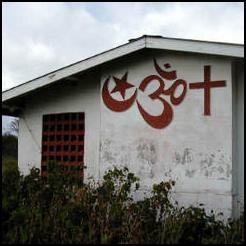
This ecumenical building is from western Trinidad. Due to its history, Trinidad, (Spanish for "Trinity"), has a Catholic population of almost, 30%, followed by Hindus, Protestants (mostly of the exhuberant varieties) and Muslims. To try to compete with Pentacostalism, orthodoxy has been relaxed in favour of a "Catholic Charismatic Renewal".
"Clause 2 states that materials or books to which the denominational authority formally objects will not be introduced or imposed in their schools. In a multi-religious democracy such as ours this is an untenable imposition in schools that receive public funding and which cater for students of all faiths." -- Senator Professor John Spence
The Concordat of 1960
Assurances for the Preservation and Character of Denominational Schools
As approved by Cabinet
Assurances for the Preservation and Character of Denominational Schools
As approved by Cabinet
The Minister of Education and Culture wishes to clarify for general information some of the proposals on Education with reference to the re-organization of Education so far as those proposals affect the Denominational Boards of Management, the Governing Bodies and Principals of Assisted Secondary Schools.
1. In relation to property, the ownership and right of direct control and management of all denominational primary and secondary schools will be assured to the denominations in whatever modifications of the existing system that may subsequently be introduced in the New Education Ordinance, and all existing rights, so far as property is concerned, will be respected.
2. In denominational schools, no books or apparatus to which the denominational authority formally objects, will be introduced or imposed.
3. In denominational schools (unless the Denomination concerned otherwise gives its consent) the religion of the particular denomination which owns the school will be taught exclusively and by teachers professing to belong to that Denomination. In Government Schools all recognized religious denominations will have access through their accredited representatives during the times specified in the time-table for the teaching of Religion to the pupils belonging to their faith. Pupils attending the schools of a denomination not of their own faith will not be compelled to take part in the religious exercises or lessons of that denomination.
4. The right of appointment, retention, promotion, transfer and dismissal of teachers in Primary Schools will rest with the Public Service Commission. A teacher shall not be appointed to a school if the denominational board objects to such an appointment on moral or religious grounds. Similarly, if a teacher be found unsatisfactory on these very grounds, moral or religious, the denominational authority shall have the right to request his removal to another school after due investigation. For these reasons it is proposed (provided the legal and constitutional arrangements allow) "that vacancies as they occur in all schools should be advertised and applications submitted in the first instance to the respective Board of management which will examine them and forward them all, with their recommendations, to the Public Service Commission for final action."
Secondary Schools
5. The existing relationship between Government and the Governing Bodies and teachers in Assisted Secondary Schools will remain subject however, to negotiated changes inevitable with the introduction of Free Secondary Education and to a system of inspection of these schools by persons authorized to do so by the Ministry of Education and Culture. The Governing Bodies of these schools will continue to be responsible for the administration of these schools and for their maintenance, repair and furnishing. Those schools will continue to qualify for Government Aid. The Principals of Assisted Secondary Schools will make available a minimum of 80 per centum of the First Form entry places to those who, by passing the test, qualify on the results of the Common Entrance Examination for free secondary education. The Principals will be represented on the panel of examiners to be set up to administer the test. The Principals will be free to allocate up to 20 per centum, the remaining places as they see fit provided normally that the pass list of the Common Entrance Examination serves to provide the pupils. Entry above the First Form will be under the control of the Ministry of Education and Culture and will require the approval of the Minister.
6. Where the need arises for disciplinary reasons or unsatisfactory progress to remove a pupil from the school, the right to request such removal will remain with the Principal who may for the same reasons suspend a pupil pending investigation. Authority to expel a pupil is vested solely in the Cabinet. For disciplinary reasons the same principle will apply to Primary Schools.
7. All new Central Schools may be established only by Government for the simple reason that these schools are to be fed from the Primary Schools of all Denominations, as well as Government Schools, which may be in the area served by the Central School. Where, however, the need arises for converting an existing denominational school into a secondary school, the denominational character of that school will be allowed to remain.
8. The selection of teachers for training at the teachers' college is to remain solely with the Ministry of Education and Culture. Selection of teachers for training in the existing denominational training colleges may be made by the Denominational Boards, but such selection must be approved by the Ministry of Education and Culture.
9. It is the desire of the Government that all teachers be trained at the teachers' college under Government supervision and administration. Government will however respect the rights of the existing training colleges conducted by the denominations; but no expansion of those facilities will be allowed without the expressed permission of Government.
Signed by Hon. J.S. Donaldson,
Minister of Education & Culture,
on behalf of Cabinet on 22 December 1960,
and published on 25 December, 1960
.
.
.
.
P.S. Bolds and Highlights added.
.
.
Subscribe to:
Posts (Atom)