Showing posts with label crusade. Show all posts

Friday, October 16, 2026

Crusaders VS Puritans - Chris J. Pinto

Christian J. Pinto: Crusaders VS Puritans

The Real Reveal

Oct 9, 2026

Chris examines the history of the Crusades and the fight against Islam, versus the strength of the Puritans and Reformed armies that appeared as a result of the Protestant Reformation. Which were greater or more effective? Did the Protestant movement weaken Christianity in the West? Or strengthen it? How is it that Islam was completely subdued by the end of World War II so that John F. Kennedy remarked that the entire Middle East was in a subjugated condition during the 1960’s?  Furthermore, we look at the history of how the Crusades ended and the possible reasons why the Holy Land was lost in the Middle Ages.


Saturday, September 13, 2014

Pope Francis Says Global Conflicts Are 'Piecemeal' Third World War


REDIPUGLIA, Italy - Pope Francis said on Saturday the spate of conflicts around the globe today were effectively a "piecemeal" Third World War, condemning the arms trade and "plotters of terrorism" sowing death and destruction. "Humanity needs to weep and this is the time to weep," Francis said in the homily of a Mass during a visit to Italy's largest war memorial, a large, Fascist-era monument where more than 100,000 soldiers who died in World War One are buried.

The pope began his brief visit to northern Italy by first praying in a nearby, separate cemetery for some 15,000 soldiers from five nations of the Austro-Hungarian empire which were on the losing side of the Great War that broke out 100 years ago. "War is madness," he said in his homily. "Even today, after the second failure of another world war, perhaps one can speak of a third war, one fought piecemeal, with crimes, massacres, destruction," he said. Francis has made repeated appeals for an end to conflicts in Ukraine, Iraq, Syria, Gaza and parts of Africa.

Pope Francis Preaches Peace in Jordan


First published September 13th 2014, 8:18 am


.

Tuesday, September 09, 2014

"Beware of the Levant (leaven) of the Pharisees"


Beware of "The Levant" of the Pharisees

As they 'ramp up' rhetoric for the 'roll out' of the war against the Islamic State (ISL):

"Beware of the Levant (leaven) of the Pharisees"

On the Eve of the 13th Anniversary of the September 11 destruction, you will hear voices proclaiming the need to go to war against ISL, or Islamic State in the Levant, aka ISIS;  Lately renamed Islamic State.

Can anyone keep up with all the insidious enemy's name changes?

As the rationale for a new crusade is 'ratcheted up'...

I remember the Lord's warning to the Apostles: 

Then Jesus said unto them, "Take heed and beware of the leaven of the Pharisees and of the Sadducees."
Matthew 16:6 

Also:

And he charged them, saying, "Take heed, beware of the leaven of the Pharisees, and of the leaven of Herod."
Mark 8:15

And again:

... "Beware ye of the leaven of the Pharisees, which is hypocrisy."
Luke 12:1b

I believe Jesus' warning applies to the machinations we see while as many as 40 nations (at last count) embark on a "concerted effort" to annihilate the defiant ISIS, ISL, Islamic State. 

ISIS 'resonates' in my mind.  
It reminds me of IHS (Christogram), the Jesuit symbol;  As in "ISIS", Horus, and Set, not as the Jesuits claim IHS stands for 'Iesus Hominum Salvator'.  No, I believe the "I" in IHS stands for ISIS;  And, as I contemplate the current sabre-rattling, the swashbuckling, the revel-rousing...
I am reminded of Jesus' warning (beware of the leaven of the Pharisees),  and I see that we are being sold a bill of goods, we are being bamboozled, hornswoggled, hoodwinked, and flim-flammed as the level of rhetoric escalates and the drums of war foretell another Vatican (Jesuit) inspired, United States lead, 21st Century Crusade.   

Beware of the leaven of the Pharisees and the Saducees...
Beware of the Levant of the Parasites and the Seducers,
Beware of the Lies of the Poli-trickesters,
Beware of the leaven of the Jesuits, the Illuminati, the banksters, the NWO Globalists, the Bilderbergs (http://en.wikipedia.org/wiki/List_of_Bilderberg_participants), the Club of Rome, the Knights of Malta, the Knights of Columbus, the Rockefeller-Rothschilds, ad infinitum...

Don't listen to Henry Kissinger.

While Russia, China, and North Korean are emboldened and increase their aggression;*
 The Coalition of the Mindless set off on a new Crusade against a barefoot, unwashed elusive enemy.

Beware of the Levant of the Pharisees.

Again, I implore you: Don't believe the hype!

Strategy, Smategy.

Arsenio
.

.

Italian publication says it does not see ISIS violence as 'war of religion'


Peter's Basilica in Vatican City. Credit: Daniel Ibanez/CNA.

Rome, Italy, Sep 8, 2014 / 11:10 am (CNA).- Jesuit-run Italian newspaper La Civiltà Cattolica has clarified that it does not view ISIS violence as a 'war of religion,' although it believes the radical group sees its aggression in this manner.

The clarification comments involve an editorial published in the most recent issue of the newspaper.

Fr. Antonio Spadaro, S.J., editor-in-chief of the publication, told CNA that the editorial stated “that ISIS thinks it's in a 'war of religion,' but WE must be on guard against thinking that way.”

He voiced his disappointment at what he described as “false news” being circulated about the editorial.

On Sept. 4, prominent Vatican analyst Sandro Magister noted the editorial in a post for his Settimo Cielo blog at l'Espresso. He said the article expresses a view of ISIS aggression as a religious war, and that this view can in fact be extended to apply to the Holy See as well. CNA covered Magister’s analysis Sept. 4.

“Obviously, to promote peace it is necessary to know what the war truly is, and not what one would like it to be. It is crucial to study and to comprehend why and how the Islamic State fights. Theirs is a war of religion and of annihilation,” reads the editorial penned by Fr. Luciano Larivera, S.J.

The article continues, “It should not be confused or reduced to other forms, such as the Bolsheviks or the Khmer Rouge. They instrumentalize the power of religion, and not vice versa. Their danger is greater than that of al-Qaeda.”

Magister had suggested that the editorial represented the stance of the Holy See, observing that “Each line of 'La Civiltà Cattolica' is passed beforehand for examination by authorities of the Vatican, who allow publication, or not.”

The editorial also suggests that current military efforts to stop the radical group are inadequate and urges that ISIS “should be cut off from its supply of arms, the recruitment and training of new combatants, it financing channels, energy infrastructure, and logistics.”

ISIS – also known as the Islamic State (IS) – emerged as one of the rebel groups fighting in the Syrian civil war; this spring it spread its operations to Iraq, taking control of Mosul and swaths of territory in the country's north and west.

While Iraq's population is majority Shia Muslim, the Islamic State was able to consolidate control of Sunni-majority areas, where the people have perceived discrimination at the hands of the Shia-led government.

The radical terrorist has persecuted all non-Sunni persons in its territory: Christians, Yazidis, and Shias have all fled the caliphate.

Fr. Spadaro said that the editorial was showing the importance of realizing that ISIS militants view the conflict as a war of religion, although La Civiltà Cattolica does not share that view.

Magister, however, maintained that his analysis was true to the views being expressed in the editorial, from which he quoted heavily.

“Euphemisms do not help in bringing clarity,” he told CNA. “Actually, in this case they take us away from reality. For a war to be defined as 'religious,' it suffices that one of the contenders reputes it as such and fights in this perspective. And this is exactly what 'La Civiltà Cattolica' asserts regarding the war unleashed by IS.”

He continued, “Showing its agreement, the magazine justly quotes the editorial of Ernesto Galli della Loggia in 'Corriere della Sera' which begins with this: 'Question number one: How can we make war against an aggressor that continuously invokes God and its religious affiliation without also inevitably giving an equally religious character to any military response? In other words: Is it truly necessary, in order to speak of a religious war that both adversaries proclaim it as such, or does it suffice instead that only one do it? If someone kills me because I am a Shiite, a Christian, a Hebrew or an 'infidel' and I try to defend myself by hitting back, what else is this if not a religious conflict?'”


.

Decline of Morality Fuels Rise of ISIS


Tuesday, 02 Sep 2014 12:57 PM

By Edward Pentin


A decline in moral values in the West, together with Islam’s history of violent conquest and dire education system, are major causes fueling the "diabolical" atrocities committed by Islamic militants in Iraq and Syria.

This is according to Father Samir Khalil Samir, a respected Jesuit professor of Islamic studies and Vatican consulter, who believes today’s moral decadence in the West is a “very important” factor in the rise of Islamism and most Westerners “are not aware of it.”

Although once looked up to in the Arab world, over the past 50 years the West “has given a very bad image of itself, mainly regarding the questions on sexual liberation,” Samir told Newsmax. “Everything about modernity is seen as wrong for these people [Islamists],” and the West is viewed as “imposing” these values on the Arab world through wars, “whether just or not.”

The Egyptian-born Jesuit also warns of a growing “clash of civilizations” as the intolerance of Western moral relativism and Islamism increase. But he directs much of his criticism towards Islam and its inability to reform itself.

“We hear very often Muslims say: ‘This has nothing to do with Islam’”, he said. “This is a spontaneous reaction of Muslims on the street, but in fact it’s a false reaction. This is a part of Islam, and we can find it in the Koran itself, and much more in the life of Muhammad who had a very strong and violent attitude to unbelievers.”

Samir said although Muhammad was “somewhat tolerant” of Jews and Christians, “he was absolutely intolerant” of those who did not believe. “The only solution for them in the Koran and in the life of Muhammad was to convert or die.” But he pointed out that today’s Islamists “are following this line with one difference: They call ‟unbeliever” (kāfir) anyone who is not like them, even the Shia, the Yazīdi, or the Christian.”

“The main thing to note is that violence is an element of Islam,” he continued. “Violence is not an element of Christianity. When Christians were using violence in wars and so on, they were not following the Gospel, nor the life of Christ. When Muslims are using it, they are following the Koran and the sunnah and Muhammad’s model. This is a very important point.”

Samir, a former student of Joseph Ratzinger (later Pope Benedict XVI), said Muslims “have to rethink Islam for today’s world,” as today the religion has “regressed” to the 7th century. To overcome the problem, he said the Islamic world needs to “overhaul its education system” which “is very, very poor.” Currently, Islam is learned through repetition and memory, he said, but Muslims need to learn how to “interpret a text,” and this should begin at a young age.

Asked whether ISIS has a future, Samir said in the short term they are likely to advance. “It’s unthinkable what they are doing. It is so inhuman that people don’t know how to react,” he said.

“They are operating exactly as the prophet did at the beginning, with war and conquest,” he continued, adding they will be hard to stop if they are well armed and equipped. “In each case they are winners: If they kill, they win; if they are killed they win, because they believe they have won paradise . . . They have no principles or norms or values or standards, other than to literally apply Shariah.”

“The astonishing thing,” he added, “is that they are fighting the immorality of the West and Western hedonism. But they are doing many more immoral things in the name of Islam.”

“I don’t like to say this word, but in a way what they are doing is diabolical, it’s something the world has never seen in history,” Samir declared. “We’ve seen a lot of cruelty, but this is a planned cruelty. This is why I think there’s no future for them in the long term. But in the short term, they will win more and more and we have to stop them. Now.”

Edward Pentin began reporting on the Vatican as a correspondent with Vatican Radio in 2002. He has covered the Pope and the Holy See for a number of publications, including Newsweek and The Sunday Times. Read more reports from Edward Pentin — Click Here Now.


© 2014 Newsmax. All rights reserved.


.

Monday, September 08, 2014

Caritas to Hold High Level Meeting on Crises in Middle East


Secretary General Says the Organisation Cannot Accept That Whole Societies Are Being Destroyed


Vatican City, September 08, 2014 (Zenit.org) Staff Reporter


The Church’s umbrella group of Catholic humanitarian organisations, Caritas Internationalis, is to hold a high level meeting next week to examine the crisis in the Middle East, including Syria, Gaza and Iraq.


Presidents and directors of Caritas organisations based in the region and their international partners will be taking part in the meeting that will be held in the Vatican, Sept. 15-17.

Caritas Internationalis Secretary General Michel Roy said: “The Middle East is in turmoil. Caritas organisations are overwhelmed as needs grow and resources shrink. This is far beyond our capacity and anyone else’s. A major move has to take place as we cannot accept that millions of people, whole societies, that used to live together in peace, are destroyed.”

He added: “We’re coming together to plan how best to respond to this regional tragedy in the coming months and years and how we can work together with others in the Catholic Church and beyond to promote peace and stability in the region.”

The crisis in Syria has left over 13 million people in need of aid both inside and outside the country. There is a ceasefire in heavily damaged Gaza, but no long term plan to end the cycle of violence. Resumption of conflict in Iraq has forced over a million people from their homes.

Caritas has responded to the needs of 965,000 people over the last three years affected by the crises in Syria, Gaza and Iraq. This includes shelter, healthcare, food, basic needs, education, protection for women and children, trauma counselling and peacebuilding.

Participants of the meeting will include: Bishop Antoine Audo of Caritas Syria, Fr.Paul Karam of Caritas Lebanon, Wael Suleiman of Caritas Jordan, Nabil Nissan of Caritas Iraq and Fr. Raed Abusahlia of Caritas Jerusalem. Former Lebanese Minister of Finance, Damien Kattar, will be the guest speaker.


(September 08, 2014) © Innovative Media Inc.


.

Sunday, September 07, 2014

David Cameron and Barack Obama: We will not be cowed by barbaric killers


Last updated at 12:01AM, September 4 2014


As Russia holds a gun to Ukraine and Islamic extremists commit despicable murder, Nato must strengthen its alliance

When Nato last met in Britain in 1990 the Cold War was ending. As Margaret Thatcher and President Bush Sr pledged to continue to stand together, many might have thought that a new era of peace and prosperity would make this great security alliance less relevant. But today Nato is as vital to our future as it has ever been.

We meet at a time when the world faces many dangerous and evolving challenges. To the east, Russia has ripped up the rulebook with its illegal, self-declared annexation of Crimea and its troops on Ukrainian soil threatening a sovereign nation

To see the full article you need to subscribe

Source.

Tuesday, August 12, 2014

End-time Biblical signs and beginning of sorrows: July – August 2014


friendofYahushua


Published on Aug 11, 2014

FAIR USE NOTICE: This video may contain copyrighted material. Such material is made available for educational purposes only. This constitutes a 'fair use' of any such copyrighted material as provided for in Title 17 U.S.C. section 107 of the US Copyright Law.

Full credits to fidockave213 / seventhvial213. Thank you friend for producing these great videos based on the prophetic warnings on the end of this age from Christ, the soon returning King.

Christian persecution and even genocide in some areas of the world are rampant and little is mentioned of it in the Vatican / Illuminati-controlled media. The prophecy of Christ, Who is God, is coming to pass in Matthew 24:9, Then shall they deliver you up to be afflicted, and shall kill you: and ye shall be hated of all nations for my name's sake.

In July and early part of August 2014, we also witnessed extreme weather events and climate changes including massive earthquakes, signs in the sun and the moon, sinkholes, cloud outbursts (massive rainfalls), hurricanes, cyclones and typhoons and massive deaths of animals were witnessed around the world.


These signs are harbingers of the plagues of the Most High, which will affect those who have rejected Christ as their Saviour and His holy ten commandments, are mentioned in Revelation 16: /watch?v=8gL3JSsWu0A

The natural disasters in July and August 2014 point to the prophecies of Christ, which are coming to pass. Only His prophecies have, are and will come to pass, along with those of His prophets since only He is Truth.

Please read Matthew 24. Further, in Mark 13:8, we read, For nation shall rise against nation, and kingdom against kingdom: and there shall be earthquakes in divers places, and there shall be famines and troubles: these are the beginnings of sorrows.

In Luke 21:11, Christ says, And great earthquakes shall be in divers places, and famines, and pestilences; and fearful sights and great signs shall there be from heaven. In Luke 21:25, the Creator says, And there shall be signs in the sun, and in the moon, and in the stars; and upon the earth distress of nations, with perplexity; the sea and the waves roaring.

In Romans 8:22, we read, For we know that the whole creation groaneth and travaileth in pain together until now.

More is yet to come including a new world order including a one world government and a one world religion that will see the Vatican and the US join forces to enforce Sunday observance, which will be the mark (Sunday) of the beast (Vatican). In Bible prophecy, a beast represents a nation (Daniel 7:23).

The RFID chip is not the mark of the beast but rather will be the technology that will be used to enforce Sunday rest worldwide, which goes directly against the 7th day Sabbath commandment of the Most High (Exodus 20:8-11).

It is time to turn to Christ for the salvation of your souls. Embrace Him as your Savior, keep His holy ten commandments through the Holy Spirit, which represents His divine love and character (Exodus 20; John 14:15; 1 John 5:3; Revelation 14:12), put your complete faith and trust in Him and He will deliver you. He is the Answer!

Since His prophecies are coming to pass, as they are listed in Matthew 24, Mark 13 and in Luke 21, why are you still refusing to embrace Him as the Son of God and your Saviour?

If you still refuse to accept Christ, prior to His inevitable and imminent return, He will refuse you also! As it is written in Mark8:38, Whosoever therefore shall be ashamed of Me and of My words in this adulterous and sinful generation; of him also shall the Son of man be ashamed, when He cometh in the glory of His Father with the holy angels.

The choice is YOURS (Joshua 24:15).

For more information and videos on Christian beliefs and prophecy, please visit theseventhdayremnantchurch.org, www.remnantofgod.org, www.john1429.org, www.sdrministries.org along with cregen124 and NicholasPoGM's YouTube channels.
.
.

U.S. Actions in Iraq Fueled Rise of a Rebel


Baghdadi of ISIS Pushes an Islamist Crusade


By TIM ARANGO and ERIC SCHMITT
AUG. 10, 2014


An image of Abu Bakr al-Baghdadi, taken from a video of a sermon he gave in July in Mosul.
CreditReuters Tv/Reuters


BAGHDAD — When American forces raided a home near Falluja during the turbulent 2004 offensive against the Iraqi Sunni insurgency, they got the hard-core militants they had been looking for. They also picked up an apparent hanger-on, an Iraqi man in his early 30s whom they knew nothing about.

The Americans duly registered his name as they processed him and the others at the Camp Bucca detention center: Ibrahim Awad Ibrahim al-Badry.

That once-peripheral figure has become known to the world now as Abu Bakr al-Baghdadi, the self-appointed caliph of the Islamic State in Iraq and Syria and the architect of its violent campaign to redraw the map of the Middle East.

“He was a street thug when we picked him up in 2004,” said a Pentagon official who spoke on the condition of anonymity to discuss intelligence matters. “It’s hard to imagine we could have had a crystal ball then that would tell us he’d become head of ISIS.”


RELATED COVERAGE

Iraqis Nominate Maliki Successor, Causing StandoffAUG. 11, 2014


Capitalizing on U.S. Bombing, Kurds Retake Iraqi TownsAUG. 10, 2014


Iraq Airstrikes May Continue for Months, Obama SaysAUG. 9, 2014


News Analysis: As ISIS Militants Exert Their Control, U.S. Pursues a Military Middle RoadAUG. 9, 2014


For Refugees on Mountain, ‘No Water, Nothing’AUG. 9, 2014

At every turn, Mr. Baghdadi’s rise has been shaped by the United States’ involvement in Iraq — most of the political changes that fueled his fight, or led to his promotion, were born directly from some American action. And now he has forced a new chapter of that intervention, after ISIS’ military successes and brutal massacres of minorities in its advance prompted President Obama to order airstrikes in Iraq.


Abu Bakr al-Baghdadi
CreditAssociated Press


Mr. Baghdadi has seemed to revel in the fight, promising that ISIS would soon be in “direct confrontation” with the United States.

Still, when he first latched on to Al Qaeda, in the early years of the American occupation, it was not as a fighter, but rather as a religious figure. He has since declared himself caliph of the Islamic world, and pressed a violent campaign to root out religious minorities, like Shiites and Yazidis, that has brought condemnation even from Qaeda leaders.

Despite his reach for global stature, Mr. Baghdadi, in his early 40s, in many ways has remained more mysterious than any of the major jihadi figures who preceded him.

American and Iraqi officials have teams of intelligence analysts and operatives dedicated to stalking him, but have had little success in piecing together the arc of his life. And his recent appearance at a mosque in Mosul to deliver a sermon, a video of which was distributed online, was the first time many of his followers had ever seen him.

Mr. Baghdadi is said to have a doctorate in Islamic studies from a university in Baghdad, and was a mosque preacher in his hometown, Samarra. He also has an attractive pedigree, claiming to trace his ancestry to the Quraysh Tribe of the Prophet Muhammad.

Beyond that, almost every biographical point about Mr. Baghdadi is occluded by some confusion or another.

The Pentagon says that Mr. Baghdadi, after being arrested in Falluja in early 2004, was released that December with a large group of other prisoners deemed low level. But Hisham al-Hashimi, an Iraqi scholar who has researched Mr. Baghdadi’s life, sometimes on behalf of Iraqi intelligence, said that Mr. Baghdadi had spent five years in an American detention facility where, like many ISIS fighters now on the battlefield, he became more radicalized.

Mr. Hashimi said that Mr. Baghdadi had grown up in a poor family in a farming village near Samarra, and that his family was Sufi — a strain of Islam known for its tolerance. He said Mr. Baghdadi had come to Baghdad in the early 1990s, and over time became more radical.

Early in the insurgency, he gravitated toward a new jihadi group led by the flamboyant Jordanian militant operative Abu Musab al-Zarqawi. Though Mr. Zarqawi’s group, Al Qaeda in Iraq, began as a mostly Iraqi insurgent organization, it claimed allegiance to the global Qaeda leadership, and over the years brought in more and more foreign leadership figures.

It is unclear how much prominence Mr. Baghdadi enjoyed under Mr. Zarqawi. Bruce Riedel, a former Central Intelligence Agency officer now at the Brookings Institution, recently wrote that Mr. Baghdadi had spent several years in Afghanistan, working alongside Mr. Zarqawi. But some officials say the American intelligence community does not believe Mr. Baghdadi has ever set foot outside the conflict zones of Iraq and Syria, and that he was never particularly close to Mr. Zarqawi.

The American operation that killed Mr. Zarqawi in 2006 was a huge blow to the organization’s leadership. But it was years later that Mr. Baghdadi got his chance to take the reins.

As the Americans were winding down their war in Iraq, they focused on trying to wipe out Al Qaeda in Iraq’s remaining leadership. In April 2010, a joint operation by Iraqi and American forces made the biggest strike against the group in years, killing its top two figures near Tikrit.

A month later, the group issued a statement announcing new leadership, and Mr. Baghdadi was at the top of the list. The Western intelligence community scrambled for information.


“Any idea who these guys are?” an analyst at Stratfor, a private intelligence company that then worked for the American government in Iraq, wrote in an email that has since been released by WikiLeaks. “These are likely nom de guerres, but are they associated with anyone we know?”

In June 2010, Stratfor published a report on the group that considered its prospects in the wake of the killings of the top leadership. The report stated, “the militant organization’s future for success looks bleak.”

Still, the report said, referring to the Islamic State of Iraq, then an alternative name for Al Qaeda in Iraq, “I.S.I.’s intent to establish an Islamic caliphate in Iraq has not diminished.”

The Sunni tribes of eastern Syria and Iraq’s Anbar and Nineveh Provinces have long had ties that run deeper than national boundaries, and ISIS was built on those relationships. Accordingly, as the group’s fortunes waned in Iraq, it found a new opportunity in the fight against Bashar al-Assad’s government in Syria.

As more moderate Syrian rebel groups were beaten down by the Syrian security forces and their allies, ISIS increasingly took control of the fight, in part on the strength of weapons and funding from its operations in Iraq and from jihadist supporters in the Arab world.

That fact has led American lawmakers and political figures, including former Secretary of State Hillary

Rodham Clinton, to accuse President Obama of aiding ISIS’ rise in two ways: first by completely withdrawing American troops from Iraq in 2011, then by hesitating to arm more moderate Syrian opposition groups early in that conflict.

“I cannot help but wonder what would have happened if we had committed to empowering the moderate Syrian opposition last year,” Representative Eliot L. Engel, the senior Democrat on the House Foreign Affairs Committee, said during a recent hearing on the crisis in Iraq. “Would ISIS have grown as it did?”

But well before then, American actions were critical to Mr. Baghdadi’s rise in more direct ways. He is Iraqi to the core, and his extremist ideology was sharpened and refined in the crucible of the American occupation.

The American invasion presented Mr. Baghdadi and his allies with a ready-made enemy and recruiting draw. And the American ouster of Saddam Hussein, whose brutal dictatorship had kept a lid on extremist Islamist movements, gave Mr. Baghdadi the freedom for his radical views to flourish.

In contrast to Mr. Zarqawi, who increasingly looked outside Iraq for leadership help, Mr. Baghdadi has surrounded himself by a tight clique of former Baath Party military and intelligence officers from the Hussein regime who know how to fight.

Analysts and Iraqi intelligence officers believe that after Mr. Baghdadi took over the organization he appointed a Hussein-era officer, a man known as Hajji Bakr, as his military commander, overseeing operations and a military council that included three other officers of the former regime’s security forces.

Hajji Bakr was believed to have been killed last year in Syria. Analysts believe that he and at least two of the three other men on the military council were held at various times by the Americans at Camp Bucca.

Mr. Baghdadi has been criticized by some in the wider jihadi community for his reliance on former Baathists. But for many others, Mr. Baghdadi’s successes have trumped these critiques.


“He has credibility because he runs half of Iraq and half of Syria,” said Brian Fishman, a counterterrorism researcher at the New American Foundation.

Syria may have been a temporary refuge and proving ground, but Iraq has always been his stronghold and his most important source of financing. Now, it has become the main venue for Mr. Baghdadi’s state-building exercise, as well.

Although the group’s capture of Mosul, Iraq’s second-largest city, appeared to catch the American intelligence community and the Iraqi government by surprise, Mr. Baghdadi’s mafia-like operations in the city had long been crucial to his strategy of establishing the Islamic caliphate.

His group earned an estimated $12 million a month, according to American officials, from extortion schemes in Mosul, which it used to finance operations in Syria. Before June, ISIS controlled neighborhoods of the city by night, collecting money and slipping in to the countryside by day.

The United Nations Security Council is considering new measures aimed at crippling the group’s finances, according to Reuters, by threatening sanctions on supporters. Such action is likely to have little effect because, by now, the group is almost entirely self-financing, through its seizing oil fields, extortion and tax collection in the territories it controls. As it gains territory in Iraq, it has found new ways to generate revenue. For instance, recently in Hawija, a village near Kirkuk, the group demanded that all former soldiers or police officers pay an $850 “repentance fine.”

Though he has captured territory through brutal means, Mr. Baghdadi has also taken practical steps at state-building, and even shown a lighter side. In Mosul, ISIS has held a “fun day” for kids, distributed gifts and food during Eid al-Fitr, held Quran recitation competitions, started bus services and opened schools.

Mr. Baghdadi appears to be drawing on a famous jihadi text that has long inspired Al Qaeda: “The Management of Savagery,” written by a Saudi named Abu Bakr Naji.

Mr. Fishman called the text, “Che Guevara warmed over for jihadis.” William McCants, an analyst at the Brookings Institution who in 2005, as a fellow at West Point’s Combating Terrorism Center, translated the book in to English, once described it as “the seven highly effective habits of jihadi leaders.”

American officials say Mr. Baghdadi runs a more efficient organization than Mr. Zarqawi did, and has unchallenged control over the organization, with authority delegated to his lieutenants. “He doesn’t have to sign off on every detail,” said one senior United States counterterrorism official. “He gives them more discretion and flexibility.”

A senior Pentagon official said of Mr. Baghdadi, with grudging admiration: “He’s done a good job of rallying and organizing a beaten-down organization. But he may now be overreaching.”

But even before the civil war in Syria presented him with a growth opportunity, Mr. Baghdadi had been taking steps in Iraq — something akin to a corporate restructuring — that laid the foundation for the group’s resurgence, just as the Americans were leaving. He picked off rivals through assassinations, orchestrated prison breaks to replenish his ranks of fighters and diversified his sources of funding through extortion, to wean the group off outside funding from Al Qaeda’s central authorities.

“He was preparing to split from Al Qaeda,” Mr. Hashimi said.

Now Mr. Baghdadi commands not just a terrorist organization, but, according to Brett McGurk, the top State Department official on Iraq policy, “a full blown army.”

Speaking at a recent congressional hearing, Mr. McGurk said, “it is worse than Al Qaeda.”


Tim Arango reported from Baghdad, and Eric Schmitt from Washington. Omar al-Jawoshy contributed reporting from Baghdad; Hwaida Saad from Beirut, Lebanon; and Karam Shoumali from Istanbul.


A version of this article appears in print on August 11, 2014, on page A1 of the New York edition with the headline: U.S. Actions in Iraq Fueled Rise of a Rebel


.

Tuesday, July 08, 2014

C. African Republic church attacks leaves 17 dead


Posted on Tuesday, 07.08.14


THE ASSOCIATED PRESS


BANGUI, Central African Republic -- Officials say at least 17 people are dead after Muslim rebels attacked a Catholic church compound that was housing thousands of displaced civilians.

The Rev. Thibault Ndemaguia said he had counted at least 17 bodies and 10 other people were wounded in the attack. The rebels converged on the St. Joseph Cathedral of Bambari late Monday.

The attack came a day before French Defense Minister Jean-Yves Le Drian was to travel to the area.

Residents say the rebels had launched the attack in retaliation for the killing of a young Muslim man, and they accused church officials of supporting local Christian militia fighters.

The town of Bambari has seen the heaviest fighting in recent weeks in Central African Republic, which exploded into sectarian violence last December.


.

Read more here: http://www.miamiherald.com/2014/07/08/4224226/c-african-republic-church-attacks.html#storylink=cpy

Friday, June 14, 2013

Obama slated to name five openly homosexual foreign ambassadors


BY KIRSTEN ANDERSEN

Wed Jun 12, 2013 16:51 EST


WASHINGTON, D.C., June 11, 2013 (LifeSiteNews) – The Obama Administration’s ongoing celebration of homosexual “Pride Month” has seemingly carried over into its ambassadorial nominations.

On monday, the president announced the nomination of Daniel Baer as ambassador to the Vienna-based Organization for Security and Cooperation in Europe (OSCE). If confirmed, Baer would be the first open homosexual to serve as ambassador to a multilateral institution.


Next on the list is HBO executive James Costos, who together with his boyfriend, decorator Michael Smith, fundraised over $1 million for President Obama’s re-election. He is expected to be named ambassador to Spain as early as this week.

After that, at least three more homosexuals are slated to be announced as ambassadorial picks, including former Office of Personnel Management director John Berry (Australia), former Democratic National Committee finance chairman and Obama fundraising director Rufus Gifford (Denmark), and hedge fund manager James “Wally” Brewster, a high-dollar Obama fundraiser whose assignment is as yet unknown.

If they are confirmed, the five openly gay ambassadors will join the three already appointed, bringing the total to eight.
Emily Heil of the Washington Post speculated that the rash of homosexual appointments is repayment for the massive role gay activists had in the president’s fundraising efforts, as well as on Election Day. Heil reported that a dozen members of Obama’s national finance team are openly homosexual, and said an argument could be made that gay Americans “handed Obama the election” by voting for him by a three-to-one margin.

While the Administration has yet to send an openly gay ambassador to a country that opposes homosexuality, in the wake of the Benghazi terrorist attack on September 11 of last year, it was widelyspeculated that murdered Libyan Ambassador Christopher Stevens may have been targeted by Muslim extremists because of suspicions he was gay.

In 2011, Ambassador Richard Hoagland outraged Pakistanis by hosting a gay pride celebration at the U.S. Embassy in Islamabad, provoking protests in the conservative Muslim nation. At the time, a coalition of religious and political leaders, including Pakistan’s largest Islamic party, Jamaat-e-Islami, released a statement condemning the U.S. government’s homosexual advocacy, calling it the “worst social and cultural terrorism against Pakistan.”

Last week, Secretary of State John Kerry released a recorded message to all State Department employees celebrating the month of June as homosexual “Pride Month” and highlighting the department’s role in spreading homosexual acceptance throughout the globe, describing gay advocacy as “central” to the Obama Administration’s efforts overseas.


.

Thursday, August 23, 2012

General: Ramadan Factor in Afghan Insider Attack


Published on Aug 23, 2012 by AssociatedPress

The top U.S. commander in Afghanistan says one possible explanation for a spike in killings of American troops by their Afghan partners is the strain of fasting during the just-concluded Muslim holy month of Ramadan. (Aug. 23)

.

Monday, December 05, 2011

Egypt: missionary predicts disenchantment with Islamist rule

December 05, 2011

An Italian missionary in Cairo predicts that Egyptians, in time, will become disenchanted with Islamist rule. According to provisional election results, the Muslim Brotherhood received 40% of the vote in November 28 elections, while the even more radical Salafis received 20%.

“Although it will take some years,” said Father Luciano Verdoscia, “ultimately people will prevail in the disenchantment of the formula presented by the political ideology of Islamic parties.”

“In Tahrir Square a liberal core has been created because in fact the Muslim Brotherhood and the Salafis have sided with the army in the fighting in past days,” he added.


Friday, February 11, 2011

Concerns voiced that Middle East Synod was misunderstood by Muslims


By Alan Holdren, Rome Correspondent

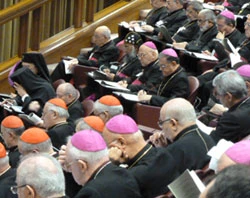
Vatican City, Feb 10, 2011 / 01:52 pm (CNA/EWTN News).- The Vatican’s 2010 meeting for the Middle East has been misunderstood by many in the region as calling for a “new crusade” against Islam.

As officials gathered in Rome recently to assess last October’s special Synod for Bishops, a veteran Vatican adviser on Christian-Muslim dialogue told CNA that many Muslims saw the Synod as “a new project against Islam.”

“Many people, many Muslims, who have no idea of Christianity at all are interpreting it ... as a new crusade,” Father Samir Khalil Samir, SJ, of the Pontifical Oriental Institute said in a late January interview.

Church leaders from the region and Vatican officials met Jan. 20-21 to assess reactions to the Synod, and to suggest themes for the document that Pope Benedict XVI is writing in response to the Synod, known as a “post-synodal apostolic exhortation.”

On Feb. 8, the Vatican issued a statement that concluded: the “socio-political situation in the various countries of the Middle East remains tense.”

Fr. Samir said that the Synod was widely interpreted in political, not religious terms. “When Muslims meet,” he said, “usually they meet on a political level.” As a result, many saw the bishops as meeting to discuss “how to attack Islam.”

“Fifty-seven Muslim countries meet yearly, usually invited by Saudi Arabia and they discuss as nations how to defend Islam,” he said. “In their mentality, the West is still seen as Christian nations. It is still Christianity against Islam – properly because they don’t make a difference between religion and state.”

In its statement, the Vatican reported that the Synod’s final message had been sent to “political figures” throughout the region. It also reported that an international congress had been held in Syria on the state of Muslim-Christian relations in Arab countries. In addition, a meeting of Christians and Jews has been held in Jerusalem to “promote more objective information about the synodal assembly.”

The Vatican insisted in its statement that “respect for Christian communities” is necessary “to eradicate any hotbeds of anti-Christian sentiment in the Middle East, to halt the emigration of Christians from that region, which is their native land, and to favor the common good.”

The Vatican’s press office said the meeting was held to prepare the council members for direct collaboration in the Pope’s eventual preparation of a final document, called an apostolic exhortation. The Pope will set forth his teaching to guide the future of the Church on pastoral and practical questions proposed at the conclusion of the Synod.

The next meeting of the Special Council for the Middle East of the General Secretariat of the Synod of Bishops, under the leadership of the Synod’s secretary general, Archbishop Nikola Eterovic, will be held Mar. 30-31.

.
.
Related news :

Monday, September 13, 2010

Assassin's Creed


From Wikipedia, the free encyclopediaJ
For the video game series, see Assassin's Creed (series).
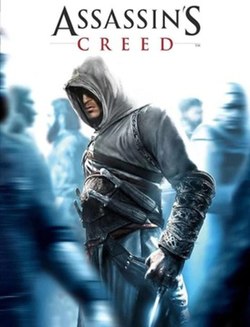
Assassin's Creed

European cover
Developer(s) Ubisoft Montreal
Publisher(s) Ubisoft
Designer(s) Patrice Desilets (creative director), Jade Raymond (producer)
Writer(s) Corey May
Composer(s) Jesper Kyd
Series Assassin's Creed
Version Windows 1.02 (May 13, 2008)[1], PS3 1.10 (October 16, 2008)
Platform(s) PlayStation 3, Xbox 360, Windows
Release date(s) PlayStation 3, Xbox 360:
N
N
Assassin's Creed is a historical fantasy/science fiction third person action-adventure video game developed by Ubisoft Montreal and published by Ubisoft. It was released worldwide in November 2007 on the PlayStation 3 and Xbox 360,[2] and April 2008 for PCs. The game centers on the use of a machine named the "Animus", which allows the viewing of the protagonist's genetic memories of his ancestors.

Through this plot device, details emerge of a struggle between two factions, the Knights Templar and the Assassins, over an artifact known as a "Piece of Eden" and the game primarily takes place during the Third Crusade in the Holy Land in 1191. The game received generally positive reviews, and won several awards at E3 in 2006. A sequel, Assassin's Creed II, was released in November 2009.
N
N
Characters
[edit] 1191 A.D.
[edit] Assassins
Altaïr Ibn La-Ahad - the shining star of the Assassin Brotherhood
Al Mualim - the Master Assassin of Masyaf, later Altaïr's last target.
Malik Al-Sayf - the Assassin Bureau leader in Jerusalem
[edit] Muslim Saracens
Salah al-Din - a military and political leader, Richard the Lionheart's adversary
Tamir - a black market merchant based in Damascus' poor district, Altaïr's first target
Talal - a slave trader based in Jerusalem's rich district, Altaïr's third target
Abu'l Nuqoud - the merchant king of Damascus, Altaïr's fourth target
Majd Addin - Salah al-Din's regent of Old Jerusalem, Altaïr's sixth target
Jubair al Hakim - chief scholar of Damascus, Altaïr's eighth target
[edit] Christian Crusaders
Richard the Lionheart - the "absent king," Salah al-Din's adversary
Garnier de Naplouse - the Grand Master of the Knights Hospitalier, Altaïr's second target
William of Montferrat - Acre's Crusader regent, Altaïr's fifth target
Sibrand - the Grand Master of the Knights Teutonic, Altaïr's seventh target
Maria Thorpe - Robert de Sablé's steward, spared by Altaïr
Robert de Sablé - the Grand Master of the Knights Templar, Altaïr's ninth target
[edit] 2012 A.D.
[edit] Assassins
Desmond Miles - a barman and an estranged Assassin, Altaïr's descendant
Lucy Stillman - an Assassin sleeper agent at Abstergo Industries
[edit] Abstergo Industries
Warren Vidic - a disgraced scientist and a former Ivy League professor of ill repute
.
.

Source: http://en.wikipedia.org/wiki/Assassin
.
Note: Personal Comments
1. Assassins (as in Hashashin: http://en.wikipedia.org/wiki/Hashshashin)
2. Chistian Crusaders (as in Cross)
3. Muslim Saracens


What do I see here?....................1191------------2012?

Looks strikingly similar to the present scenario in the Middle East 'theater'.

Could this be subliminal programing for recruiting more soldiers for the war?

You know, get them to fight before they even leave home?

Assassins vs Christian Crusaders vs Muslim Saracens?....
Piece of Eden?---How about a piece of Salem as in Jeru-Salem?
N
N
Knights Templars?.... (1191)
(2012) Knights of St. John Hospitalers, or Sovereign Military Order of Malta?

It sure looks like home-based basic-training, to me.

Don't they train "drone pilots" with video games? .

Arsenio.
.

Sunday, January 03, 2010

The New Crusade: Imperial U.S. vs Political Islam


Wednesday, December 23, 2009
The New Crusade: Imperial U.S. vs Political Islam
By Rodrigue Tremblay

"I am as intolerant of imperialistic designs on the part of other nations as I was of such designs on the part of Germany. The choice is between two ideals; on the one hand, the ideal of democracy, which represents the rights of free peoples everywhere to govern themselves, and, the ideal of imperialism which seeks to dominate by force and unjust power, an ideal which is by no means dead and which is earnestly [sought] in many quarters still."
U.S. President Woodrow Wilson, July 1919

"Fight and kill the disbelievers wherever you find them, take them captive, harass them, lie in wait and ambush them using every stratagem of war."
The Qur'an (9:5), Islam's holy book

"We are fighting them (the terrorists) over there so that we won't have to fight them here at home."
Former U.S. President George W. Bush's political slogan

“I, like any head of state, reserve the right to act unilaterally if necessary to defend my nation.”
U.S. President Barack Obama, December 10, 2009

“When the tyrant has disposed of foreign enemies by conquest...and there is nothing to fear from them, then he is always stirring up some war.”
Plato, ancient Greek philosopher (428/427-348/347 B.C.)


In the political movie “Charlie Wilson's War” about the Soviet-Afghanistan war, the hero states “America does not fight religious wars.” Is this possibly wrong, dead wrong?

In fact, is it not possible that since September 11, 2001, a new type of “holy war” may have begun? This time, the new crusade with strong religious overtones pits fundamentalist Christian America and its allies, against political Islam and the Islamist al Qaeda terrorist organization. On September 16, 2001, then President George W. Bush set the tone when he said: “This crusade, this war on terrorism, is gonna take awhile.”

On December 1, 2009 Nobel “Peace” laureate Barack Obama, president of the United States since January 20, 2009, decided to follow in the footsteps of his predecessor, President George W. Bush. He announced a policy of stepping up the U.S.-led war in Afghanistan-Pashtunistan. He announced an escalation in the military occupation of Afghanistan by sending extra American troops in that Muslim country, putting the number of American soldiers in Afghanistan at more than 100,000. Not satisfied in using the same vocabulary as George W. Bush, Barack Obama pushed the symbolism by adopting Bush's practice of announcing policies surrounded by more than 4,000 students dressed as soldiers at the West Point Academy. This was all too reminiscent of President Lyndon B. Johnson's fatal decision in 1965 to acquiesce to the request from U.S. commanders to enlarge the Vietnam war by sending scores of additional U.S. soldiers to that Asiatic country.

America seems to be in a constant need of a foreign enemy. First, it was the British. Then it was the Indians. Then it was the Mexicans. Then it was the Spanish. Then it was the Philippinos. Then it was the Japanese. Then it was the Germans. Then it was the Italians. Then it was the Koreans. Then it was the Cubans. Then it was the Vietnamese. Then it was the Soviets. Then it was the Iraqis. Then it was the Islamists. Then it was the Talibans. And, once the current conflict in Pashtunistan-Afghanistan-Pakistan is over, it will possibly be the Iranians, the Chinese, the Russians...etc.!

The reason for such a permanent-war mentality is most likely related to the U.S. military-industrial complex, an enormous beast that must be fed regularly hundreds and hundreds of billions of dollars, if not trillions of dollars, to sustain itself.

In the months following the collapse of the Soviet Union in December 1991, the high echelons at the Pentagon were busy designing a new post-cold-war strategy designed to keep the U.S. war machine humming. Paul Wolfowitz, then Undersecretary of Defense for Policy under Secretary of Defense Dick Cheney in the George H. Bush administration, wrote a memorandum titled “The Defense Policy Guidance 1992-1994”, which was dated February 18, 1992. The new so-called Wolfowitz Doctrine was a blueprint to "set the nation’s [military] direction for the next century." This new neocon military doctrine called for the replacement of the policy of "containment" with one of military "preemption" and international "unilateralism", in effect, discarding the United Nations Charter that forbids such international behavior.

The Pentagon's overall goal was to establish, through military force, a “one-Superpower World”. The more immediate objectives of the new U.S. neocon doctrine was to "...preserve U.S. and Western access to the [Middle East and Southwest Asia] region's oil", and, as stated in an April 16, 1992 addendum, to contribute “to the security of Israel and to maintaining the qualitative edge that is critical to Israel's security”.

Because of some opposition within the U.S. Government, the new policy did not become immediately effective. But the objective remained.
For instance, in September 2000, under the auspices of “The Project for the New American Century”, a new strategic document was issued and was entitled "Rebuilding America's Defenses, Strategy: Forces and Resources For a New Century". The same goals expressed in the 1992 document were reiterated.

The belief was expressed that the kind of military transformation the (neocon) planners were considering required "some catastrophic and catalyzing event — like a new Pearl Harbor”, to make it possible to sell the plan to the American public.

They were either very prescient or very lucky, because exactly one year later, they were served with the "New Pearl Harbor" they had been openly hoping for. Indeed, the Islamist terrorist attacks of Sept. 11, 2001, turned out to have been a bonanza for the American military-industrial complex. The military planners' wish for a "New Pearl Harbor", was fulfilled at the right time. It is important to remember that from 2001 to 2005, Paul Wolfowitz served as U.S. Deputy Secretary of Defense in the George W. Bush administration, reporting to U.S. Secretary of Defense Donald Rumsfeld. In this capacity, he was well positioned to implement his own Wolfowitz doctrine that later morphed into the George W. Bush Doctrine. For the time being, this is the “doctrine” that newly-elected President Barack Obama continues to implement in the Pashtunistan-Afghanistan-Pakistan corridor. As a politician, Barack Obama may be new at the job, but the policy he is being asked to implement was crafted long before he even set foot in Washington D.C.

Another possible reason why the United States is so often involved in foreign wars, besides its obvious aim of imposing a New American Empire on the world, may be due to the strong influence of religion in the United States. Just as for some aggressive Islamic countries, the U.S. is also the most religious of all first world countries. Researchers have found strong positive correlations between a nation's religious belief and high levels of domestic stress and anxiety, and other indicators of social dysfunction such as homicides, the proportion of people incarcerated, infant mortality, drug abuse, sexually transmitted diseases, teenage births and abortions, corruption, large income inequalities, economic and social insecurity...etc.

It is possible that wars serve as an emotional outlet that allows some Americans to forget about their nation's domestic problems. I suppose more research would be necessary on this issue. Indeed, is it possible that foreign wars, including wars of aggression, are a way for the American elites to deflect attention from domestic social problems and, as such, are a convenient pretext to direct tax money to defense expenditures rather than to social programs? The issue deserves at least to be raised. This could explain why U.S. foreign policy is so devoid of fundamental morality.

U. S. politicians who become president understand this American proclivity for war. They know that the best way to popularity is to be seen as a “war president”. A president who does not start a war abroad or who does not enlarge one already in progress is open to criticism and is likely to suffer politically. He must be seen less as a president than as “commander-in-chief”, in effect, as an emperor. How could this be, when the framers of the U.S. Constitution attempted precisely to avoid that?

Indeed, Article One (the War Powers Clause) of the U.S. Constitution gives Congress, and not the President, the authority to declare war.

Since World War II, however, this central article of the U.S. Constitution has been circumvented by having Congress give the President a blanket authorization to deploy troops abroad for euphemistically called "police actions", without an explicit or formal congressional declaration of war. The term was first used by President Harry S. Truman to describe the Korean War.

This artifice has done a lot to trivialize the act of war. It also contributed much in the transfer of the powers of war and peace from the legislative branch to the executive branch. In doing so, it has reinforced the role of the U.S. president as a commander-in-chief or as a de facto emperor. Only a formal constitutional amendment could restore, in practice, the framers' initial intent.

All said, it is easy to understand why when political faces change in Washington D.C., policies do not necessarily change. This push toward empire on the part of the United States can also explain why there is resentment and an anti-Americanism movement abroad.


Rodrigue Tremblay is professor emeritus of economics at the University of Montreal and can be reached at rodrigue.tremblay@yahoo.com.
He is the author of the coming book "The Code for Global Ethics" at: www.TheCodeForGlobalEthics.com/

You can reserve a copy of the book on Amazon

*****The French version of the book is now available. See:
www.lecodepouruneethiqueglobale.com/
or on Amazon.

Register to be alerted when the English version is available by sending the word “Code” to bigpictureworld@yahoo.com
Please visit the book site at:
www.TheCodeForGlobalEthics.com/
_____________________________________
Posted, Wednesday, December 23, 2009, at 5:30 am

Email to a friend:
http://www.TheNewAmericanEmpire.com/tremblay=1119
or,
http://www.thenewamericanempire.com/tremblay=1116

Send contact, comments or commercial reproduction requests (in English or in French) to:
bigpictureworld@yahoo.com
N.B.: Messages may be published in our weblog, unless you request otherwise.

Please register to receive free alerts on new postings of articles.
Send an email with the word "subscribe" to: bigpictureworld@yahoo.com
To unregister, send an email with the word "unsubscribe" to: bigpictureworld@yahoo.com
The above is presented for educational purposes only.

© 2009 by Big Picture World Syndicate, Inc.


.

Wednesday, August 19, 2009

The Knights Templar, Knights of Malta and Blackwater’s Erik Prince

August 6, 2009

The Knights Templar, Knights of Malta and Blackwater’s Erik Prince
By Mitch Cumstein

In a declaration under the penalty of purjury, a former employee of Erik Prince’s Blackwater defense contracting firm said Prince “views himself as a Christian crusader tasked with eliminating Muslims and the Islamic faith from the globe.”

The accuser, only known as John Doe #2 in court documents because he claims he has been threatened with “death and violence” by managers of Prince’s company, wrote that “Prince intentionally deployed to Iraq certain men who shared his vision of Chrisian supremacy, knowing and wanting these men to take every available opportunity to murder Iraqis. Many of these men used call signs based on the Knights of the Templar, the warriors who fought the Crusades.”

This mention of the Knights Templar is an interesting one because it shifts the focus of Iraq from a quest for oil to that of a holy war. Remember when Pres. Bush got laughs for referring to the “war on terror” as a “crusade.” And this isn’t the only time Prince and his company Blackwater have been linked, albeit tenuously, with these shadow elements of the Catholic church and Christian fundamentalists.

The European Parliament published a report by Giovanni Claudio Fava, a Socialist Group legislator, claiming that there are connections between Blackwater and Malta. Malta is where the Knights of Malta, another right-wing element of the Catholic Church similar to the Knights Templar, once lived and still maintain control of Fort St. Angelo.

The Nation’s Jeremy Scahill has also written about connections between Prince, Malta and Pres. Bush’s rendition program in which terrorist suspects were sent to other countries for the purpose of torture. The program, according to Scahill was run by Cofer Black, who is allegedly a Knight of Malta himself and used Malta in the rendition program.

Black is the current vice chairman for Blackwater. At the time of the Sept. 11, 2001 terrorist attacks in New York and Washington, DC, Black was director of the CIA’s Counterterrorist Center.

According to a referenced Wikipedia entry:

[Black] was the United States Department of State coordinator for counterterrorism with the rank of ambassador at large from December 2002 to November 2004. After leaving public service, Black became chairman of the privately owned intelligence gathering company Total Intelligence Solutions, Inc., as well as vice chairman for Xe.

Xe is the current name of Blackwater and Total Intelligence Solutions has been dubbed as Prince’s private CIA.

But all of this “evidence” is largely hearsay and circumstantial at best. The reason for this could be that a common thread between the Knights Templare, the Knights of Malta and Blackwater is that there appears to be a concerted effort to confuse and obfiscate exactly what these groups are doing, or whether they’re even separate entities.

One tactic Prince employs to confuse people is setting up several supposedly different corporate entities. According John Doe #2, “[T]he various Price companies did not observe any corporate formalities or otherwise operate any of the Prince companies as independent entities. Instead, the Prince companies all operated as a single company.”

One of those companies is Greystone Limited headquartered in Barbados where Prince can avoid paying taxes and government scrutiny. The Virginia Pilot published a story last month stating that Greystone was operating in Iraq working for the International Republican Institute. The IRI is funded by the US government. After the slaughter of innocent Iraqis on Sept. 16, 2007 in Baghdad’s Nisoor Square by Blackwater employees, according to a court case filed against Blackwater, Blackwater was banned from operating in Iraq by the Iraqi government. And when Blackwater’s contract expired earlier this year, it was not renewed by the US State department, yet, Blackwater, under the name of Greystone Limited still operates in Iraq today.

There’s no definitive proof that Prince, Bush, Knights Templar or the Knights of Malta are conspiring to wage a modern-day crusade, but there’s something going on here, and it’s certainly worth an intensive investigation by the Dept. of Justice. This might be happening, as court documents trickle out of the US District Court in Virginia indicate. However, it’s illegal for the Dept. of Justice to speak about whether there even is an investigation, so I guess we’ll have to wait and see.

The US District court has consolidated five cases against Prince and his various companies into one. The cases accuse Prince of murder, conspiracy, gun smuggling, child prostitution, war crimes and waging a crusade against Islam for the purpose of global Christian supremacy. Tomorrow there’s a court date scheduled, so stay tuned, this could get really interesting really quick.

More information
I’ve created a page containing an archive of court documents relating to the cases against Prince here.

You can purchase Jeremy Scahill’s book “Blackwater: The Rise of the World’s Most Powerful Mercenary Army” here from Amazon.

An interesting tidbit about the Knights of Malta is that they’ve have been given observer status by the United Nations under the entity called the Sovereign Military Order of Malta. The Sovereign Military Order of Malta is based in Rome, Italy and has diplomat relations with about 100 countries, but not the US.

Blackwater Wiki
Knights Templar Wiki
Knights of Malta Wiki


Photos of Erik Price. Source: Wikipedia.org
.
.