Showing posts with label The Net. Show all posts

Tuesday, March 03, 2015

Cybergeddon: Why the Internet could be the next “failed state”


If you think the Internet can go on being just like it is, here's some bad news.


by Sean Gallagher - Feb 24, 2015 6:30pm EST


Aurich Lawson


In the New York City of the late 1970s, things looked bad. The city government was bankrupt, urban blight was rampant, and crime was high. But people still went to the city every day because that was where everything was happening. And despite the foreboding feelings hanging over New York at the time, the vast majority of those people had at most minor brushes with crime.

Today, we all dabble in some place that looks a lot like 1970s New York City—the Internet. (For those needing a more recent simile, think the Baltimore of The Wire). Low-level crime remains rampant, while increasingly sophisticated crime syndicates go after big scores. There is a cacophony of hateful speech, vice of every kind (see Rule 34), and policemen of various sorts trying to keep a lid on all of it—or at least, trying to keep the chaos away from most law-abiding citizens. But people still use the Internet every day, though the ones who consider themselves "street smart" do so with varying levels of defenses installed. Things sort of work.

 An actual brochure created by the police union in New York City during the 1970s as part of a campaign to stave off job cuts.


Just like 1970s New York, however, there's a pervasive feeling that everything could go completely to hell with the slightest push—into a place to be escaped from with the aid of a digital Snake Plissken. In other words, the Internet might soon look less like 1970s New York and more like 1990s Mogadishu: warring factions destroying the most fundamental of services, "security zones" reducing or eliminating free movement, and security costs making it prohibitive for anyone but the most well-funded operations to do business without becoming a "soft target" for political or economic gain.

That day is not yet nigh, but logic suggests the status quo can't continue forever. The recent rash of major breaches of corporate networks, including the theft of personal information from the health insurer Anthem and the theft of as much as a billion dollars from over 100 banks are symptoms of a much larger trend of cybercrime and espionage. And while the issue has been once again raised to national importance by the White House, it could be argued that governments have done more to exacerbate the problem than address it. Fears of digital warfare and crime are shifting budget priorities, funding the rapid expansion of the security industry and being used as a reason for proposals for new laws and policy that could reshape the Internet.

“If we think our kids and grandkids are going to have as awesome and free an Internet as the one we have, we really have to look at why we think that," Jason Healey, director of the Cyber Statecraft Initiative at the Atlantic Council of the United States, told Ars.

The soothsayer

The alternative futures for the Internet are not pretty. In presentations at multiple security conferences, Healey has suggested that the Internet could “start to look like Somalia”—a failed state where security is impossible, going about daily life is hazardous, and armed camps openly wage war over the network.

Healey's analysis has been reinforced by events over the past two years: record data breaches, zero-day vulnerabilities released that affected a preponderance of Internet services, and visibility into the vast state surveillance of the Internet. The Internet has been “weaponized,” not just by the NSA and its foreign counterparts but by other states and Internet crime organizations. A thriving market for vulnerabilities attracts the bright and ambitious to work on discovering "zero days" for profit.

While a total breakdown of the Internet is unlikely, Healey and others believe that it's nearly as unlikely that today's status quo can be sustained. Other possible scenarios wouldn't bring networked life to its knees, but they all would make the Internet a very different "place" than it is today.

Five years ago, Healey was on a team advising the Department of Defense about the structure of its future IT workforce. To do that, the team needed to understand what the networked world would look like in the next decade. Healey was researching the issue, and he started to look at scenarios where “maybe the future is going to look very different from the past,” he said. “Attackers have had an advantage for 35 years—what if that relationship is going to shift?”

The potential answers Healey found were presented in a 2010 paper. He further refined them in a 2011 article in the Georgetown Journal of International Affairs called “The Five Futures of Cyber Conflict and Cooperation.” The most optimistic and least likely of Healey’s scenarios was a “cyber paradise," he told Ars. "Defense is way better than offense—you’d have to be really amazing, like the NSA or KGB, to get anything done as an attacker.” But as he looked at trends, he realized that maybe the classic relationship above wouldn't be shifting. “It’s way more likely that it’s going to go in the other direction—that offense is going to have a significantly larger advantage than it does now.”


.

Thursday, June 26, 2014

Breaking the Law to Go Online in Iran


The Opinion Pages

OP-ED CONTRIBUTOR


By SETAREH DERAKHSHESH

JUNE 24, 2014


CreditDan Stafford

WASHINGTON — WHEN Anthony Bourdain posted a cryptic message on Facebook at the end of May that he and his television crew would be off the social media grid for the next 10 days because they were “truly going to #PartsUnknown,” his fans around the world were intrigued. Was he shooting his CNN show (titled “Parts Unknown”) in a remote desert or on top of a snowy Himalayan peak?

Ten days later, Mr. Bourdain posted a picture of himself sitting with a small glass of tea at a traditional Iranian teahouse in Isfahan, and it was immediately clear why the famous chef and TV show host had had no other option but to maintain radio silence.

In Iran, the government officially blocks access to Facebook, Twitter, YouTube and almost all other social media platforms. Any attempt to bypass this block by using a virtual private network (VPN) connection or other software solutions is illegal. Numerous reports indicate that Iranian authorities restrict access to thousands of American and European websites, particularly those of international news sources, and even throttle down Internet connections to limit the ability of Iranians to surf the rest of the Web.

“Internet speeds are incredibly slow in Iran, which ranked 164 out of 170 countries in a recent study,” says the latest “Freedom on the Net” report from the human-rights organization Freedom House. The report lists Iran as last in the world in terms of Internet freedom. And that was before an Iranian court banned Instagram last month.

This suppressive approach, zealously pursued by hard-liners and the Islamic Revolutionary Guards Corps, was ridiculed two weeks ago by none other than the minister of culture, Ali Jannati. Addressing members of Iran’s Chamber of Commerce, Mr. Jannati criticized the practice of blocking websites, social media and popular messaging apps. “In social media and the virtual world, we still do not know if we are supposed to block Viber and WhatsApp or not,” Mr. Jannati said, according to the news site Al-Monitor. “There was a time we had problems with video. There was even a time we had issue with the fax machine,” he said.

“Apparently we have to confront every new phenomenon and after time has passed, then accept it,” Mr. Jannati continued. “We always want to have a 20-year distance with the world. Let’s at least move along with the world.”

Meanwhile, several top Iranian officials enjoy what they deny to their citizens: Ayatollah Ali Khamenei, President Hassan Rouhani and the foreign minister, Mohammad Javad Zarif, apparently have accounts on Facebook or Twitter, with Mr. Zarif attracting nearly 900,000 Facebook followers to his page in Farsi.

Mr. Rouhani has staked his reputation on the success of Iran’s talks with the so-called P5-plus-1 countries — the permanent United Nations Security Council members Russia, China, Britain, France and the United States, plus Germany — on a possible nuclear deal before July 20. A deal would ease international sanctions on Iran and allow Western companies to return, giving the struggling Iranian economy a long-needed boost. The reintegration of Iran into the world economy would also require allowing unfiltered access to the Internet and international satellite television broadcasts.

According to “The Iran Primer,” a website and publication of the United States Institute of Peace, “Iran is one of the most tech-savvy societies in the developing world, with an estimated 28 million Internet users, led by youth,” the site says. “Iran boasts between 60,000 and 110,000 active blogs, one of the highest numbers in the Middle East, led by youth.”

The Iranian authorities admit, reluctantly, that it is almost impossible to rein in Iranians who are eager to know about the outside world and know how to use alternative means to gain access to the web. “Four million Iranians are on Facebook, and we have restricted it,” Mr. Jannati said in a speech in March in Tehran. “The preservation of Islamic values cannot be used as an excuse to stop the growth of something in the country.”

Mr. Jannati also cited the 71 percent of Tehran residents who have satellite dishes and watch foreign television, which is also illegal. “This means that millions in the capital are committing a crime every evening,” he said.

Here at the Voice of America Persian Service, we are familiar with this situation firsthand. Even though all of our satellite TV and radio programs, our website, our social media and our mobile apps are officially banned in Iran, our on-air and online audience numbers have shown steady growth, especially after the start of the P5-plus-1 talks with Iran.

The feedback we get from viewers, listeners and website visitors also confirms strong interest from Iranians to know what is really happening in the country they have been taught to call the “Great Satan” — whether we report on President Obama’s speech at West Point, or a recent visit by American Catholic bishops to Qom to start an interfaith dialogue with top Iranian ayatollahs on the need to restrict nuclear weapons, or Goldman Sachs’s predictions for the Iranian national soccer team at the World Cup.

We have to tweak our web content to accommodate low download speeds in Tehran, Mashhad or Shiraz, and we look for ways to help Iranian students win a cat-and-mouse game with authorities over the use of VPNs and other anti-filtering tools. Our experience confirms what “The Iran Primer” finds: Despite the Iranian authorities’ efforts to shield them from Western influences, “Iran’s young are better educated and more worldly than any previous generation” and “most are exposed to global media, ideas and culture through satellite television and the Internet.”

Before leaving Iran, Mr. Bourdain tweeted: “Never would have guessed that of all countries in world, my crew and I would be treated so well everywhere, by total strangers in #Iran.”

It’s a pity that Iranians weren’t able to read these kind words about their own hospitality on Twitter without breaking their country’s law.


Setareh Derakhshesh is the director of the Voice of America Persian Service.

A version of this op-ed appears in print on June 25, 2014, on page A23 of the New York edition with the headline: Breaking the Law to Go Online in Iran.


.

Wednesday, January 16, 2013

Facebook loses 1.4 million active users in U.S.


Jan. 15, 2013, 5:24 p.m. EST

The social network may be reaching a saturation point


Stories You Might Like
Germany looks to repatriate gold; less trust in Fed?
Vera Bradley raises Q4 forecast
Tuesday's Personal Finance Stories


By Quentin Fottrell

Maybe people got tired of their friends and family over the holidays, or perhaps they resolved to do a digital detox for the New Year. Either way, Facebook has been a bit quieter lately.

Shutterstock.com


The number of Americans using Facebook fell by nearly 1.4 million in early December, according to new data from social media monitoring company SocialBakers. While Facebook FB -2.74% has more than 167 million users in the U.S. and 1 billion worldwide, the recent drop in monthly active users is still akin to losing the entire population of San Antonio, Texas. “Facebook is possibly getting to a point where the less engaged part of the audience doesn’t visit every 30 days,” says SocialBakers CEO Jan Rezab.

Why the fall off? The increased advertising on the site and new experimental fees may be grating on some users’ nerves, experts say. Earlier this month, for example, Facebook tested charging users (with fees peaking at $100 within the U.S.) to send a message to someone outside their “friends” list. And in October, it rolled out the option to promote posts to more friends for a $7 fee. “There seems to be a change every other week,” says K. Jason Krafsky, who co-wrote the book “Facebook and Your Marriage.”

With a 54% share of the market in the U.S., some tech experts say Facebook’s growth was bound to start slowing. In fact, its market share may actually be closer to 80%, when you remove users under 13 years of age (not allowed by Facebook) and those over 65 (not big social networkers), Rezab says. “For Facebook, we don’t see a massive user growth opportunity driving the company’s financial results,” says Rick Summer, an analyst at Morningstar, so the company will continue pushing new features instead. (Facebook did not respond to requests for comment.)


Will graph search help Facebook grow its business?

Dan Gallagher discusses how investors are reacting to graph search and whether it can help grow Facebook's business.

Of course, people come and go on Facebook, just as they gain and lose interest with anything in real life. “In the New Year, a number of people take a break from social, and others decide it’s a time suck, so remove their accounts all together,” says independent social media analyst Jennifer P. Brown. Brown says six people in her network quit Facebook in 2013 and she herself took a break from social media this month. Brown says she grew tired of the “vitriol” surrounding the current gun-control debate after the school shooting in Newtown, Conn.

“Students and teachers are headed back to school, and they might not need as much of their digital friendships now that they can interact more in person,” says Jason Keath, founder and CEO of SocialFresh.com, a social media training company. Others seem to have given up on Facebook completely. Brian Smith, a San Francisco-based environmental campaigner, for one, deleted his account, choosing instead to use Google+ for sports and international news, and Twitter for politics. “Facebook felt like a never-ending high school reunion,” he says.


.

Monday, October 15, 2012

National Cyber Security Alliance and McAfee Release New Cybercrime Data for National Cyber Security Awareness Month

Published: October 10, 2012

By National Cyber Security Alliance
 — Nearly One in Five Americans Report Being Victimized Online
WASHINGTON, October 10, 2012 /PRNewswire-USNewswire/ -- Nearly one in five Americans report being victim to a crime that was committed over the Internet, according to a survey by the National Cyber Security Alliance (NCSA) and McAfee. October is National Cyber Security Awareness Month, a coordinated national effort focusing on the need for improved online safety and security for all Americans and the study examines one of the month's focal topics: cybercrime and law enforcement.
Of those surveyed, 17 percent say they have been a victim of a crime that was committed over the Internet such as identity theft, data theft, bullying or auction fraud, and 29 percent know someone who has been a victim of such crimes. One in five Americans also had contact with someone on the Internet who made them feel uncomfortable through persistent emails, stalking or in other various ways.
When asked what puts Americans most at risk of a cybercrime or a loss of personal information the largest number of respondents, one-third (30 percent) said they believe connecting to an unsecured wireless network puts them most at risk while 22 percent said not having any or enough security software. Additionally, Americans' top two concerns while using the Internet include: identity theft (41 percent) and someone hacking into their (or their family's) financial information (13 percent). 
The most cited concern for parents is adult sexual content, with 39 percent stating this is their biggest source of worry.  Additionally, 27 percent of parents report the potential for their child to make contact with strangers when they are online is their biggest point of concern. Other concerns identified include bullying or harassment from peers (ten percent); identity theft (nine percent) – which is continuing to grow as an issue; portrayals of drug or alcohol use (three percent); long-term damage to their child's reputation (two percent).
"The Internet is an incredible resource for connecting with people but as we conduct more of our lives online, we must remain mindful that there are bad actors using it to track, harass or make unwanted contact, and these criminals are more resourceful than ever," said Michael Kaiser, executive director of the National Cyber Security Alliance. "This data supports an ever-increasing need for online users to be vigilant in their actions each day.  Working together, we can provide Americans with the tools and information they need to practice safe online behaviors during October and throughout the year."
NCSA continues to work with leading companies in the cyber industry to determine best practices for users to stay safe online. Roland Cloutier, vice president and chief security officer of ADP added, "Our goal is to shine a spotlight on cybercrime issues, and provide consumers, parents, and the law enforcement community with an engaging dialogue, tools and practical advice to protect against this growing problem. All Internet users must be educated to recognize cyber threats and how to take ongoing action to protect ourselves and our digital infrastructure from victimization."
Tom Kellermann, U.S. vice president of cybersecurity at TrendMicro, said: "The threats posed by cybercrime are very real and can impact every person and organization across the United States and around the world.  By working together, we can learn how to prevent these acts to provide a safer community for all. We're proud to work together with the National Cyber Security Alliance this month and throughout the year to spread the word about steps we can all take to protect ourselves and our youth online."
NCSA is also continuing to work with local law enforcement and cybercrime organizations to help facilitate an increased awareness and uncover best practices with handling cybercrime issues. An example of such collaboration includes an event today in conjunction with National Cyber Security Awareness Month. NCSA board members and executives will join officials from the U.S. Department of Homeland Security, U.S. Secret Service, local law enforcement and others in Miami, FL to discuss cybercrime issues such as credit card skimming, data breaches, viruses and malware and best practices with handling such crimes. 
In addition to the research study and today's cybercrime focused event, NCSA is also introducing new collateral for victims of cybercrime.  These resources include a pamphlet entitled, "If You Become a Victim of Cybercrime" and a coordinating brochure on tips and advice that were created with input from the National Sheriffs' Association and International Association of Chiefs of Police. 
The publications are targeted to victims of malicious acts and detail the realities of cybercrime, how to report cybercrime and who to contact, how to collect and keep evidence of victimization, information on specific types of cybercrime, and additional links for information.  These materials can be found at: http://www.staysafeonline.org/stay-safe-online/protect-your-personal-information/id-theft-and-fraud.
NCSA also advises all Internet users to access the Web using these three simple steps: STOP. THINK. CONNECT. All Internet users should take security measures, understand the consequences of their behavior and actions and enjoy the benefits of the Internet. Here are some additional tips and advice:
  • When in doubt, throw it out: Links in email, tweets, posts, and online advertising are often the way cybercriminals compromise your computer. If it looks suspicious, even if you know the source, it's best to delete or if appropriate, mark as junk email.
  • Get savvy about Wi-Fi hotspots: Limit the type of business you conduct and adjust the security settings on your device to limit who can access your machine.
  • Protect your Money: When banking and shopping, check to be sure the site is security enabled. Look for Web addresses with "https://" or "shttp://", which means the site takes extra measures to help secure your information. "Http://" is not secure.
  • Think before you act: Be wary of communication that implores you to act immediately, offers something that sounds too good to be true, or asks for personal information.
  • Back it up: Protect your valuable work, music, photos, and other digital information by making an electronic copy and storing it safely.
  • Help the authorities fight cybercrime: Report stolen finances or identities and other cybercrime to the Internet Crime Complaint Center (www.ic3.gov) and to your local law enforcement or state attorney general as appropriate.
For additional information on how to prevent cybercrime before it happens, check out the STOP. THINK. CONNECT. Campaign at http://stopthinkconnect.org/tips-and-advice/.  NCSAM supporters can get the latest news and updates on Facebook at www.facebook.com/staysafeonline and on Twitter at @StaySafeOnline. The official Twitter hashtag of NCSAM is #ncsam. The National Cyber Security Awareness Month Web Portal is also available at: http://www.staysafeonline.org/ncsam/and a calendar of additional NCSAM events can be found at:http://staysafeonline.org/ncsam/events.
NCSA also welcomes organizations to show their support for NCSAM by becoming an official NCSAM Champion and submitting their registration at:
Survey Methodology:
JZ Analytics conducted the online safety survey. The survey firm, founded by John Zogby, surveyed 1,000 adults nationwide from August 31, 2012 to September 3, 2012. The margin of error is +/- 3.2 percentage points and margins of error are higher in sub-groups. The full study and fact sheet are available at: http://staysafeonline.org/ncsam/resources/.
About The National Cyber Security Alliance The National Cyber Security Alliance is a non-profit organization. Through collaboration with the government, corporate, non-profit and academic sectors, the mission of the NCSA is to educate and empower a digital citizenry to use the Internet securely and safely protecting themselves and the technology they use and the digital assets we all share. NCSA board members include: ADP, AT&T, Bank of America, EMC Corporation, ESET, Facebook, Google, Intel, McAfee, Microsoft, PayPal, Science Applications International Corporation (SAIC), Symantec, Trend Micro, Verizon and Visa. Visit www.staysafeonline.org for more information and join us on Facebook at www.facebook.com/staysafeonline. 
About McAfee McAfee, a wholly owned subsidiary of Intel Corporation (NASDAQ:INTC), is the world's largest dedicated security technology company. McAfee delivers proactive and proven solutions and services that help secure systems, networks, and mobile devices around the world, allowing users to safely connect to the Internet, browse and shop the Web more securely. Backed by its unrivaled Global Threat Intelligence, McAfee creates innovative products that empower home users, businesses, the public sector and service providers by enabling them to prove compliance with regulations, protect data, prevent disruptions, identify vulnerabilities, and continuously monitor and improve their security. McAfee is relentlessly focused on constantly finding new ways to keep our customers safe. http://www.mcafee.com
About  STOP. THINK. CONNECT. The campaign was developed by the STOP. THINK. CONNECT. Messaging Convention, a public-private partnership established in 2009 and led by The Anti-Phishing Working Group (APWG) and National Cyber Security Alliance (NCSA) to develop and support a national cybersecurity awareness campaign.  The Department of Homeland Security provides the Federal Government's leadership for the campaign. Industry, government, non-profits and education institutions participate in STOP. THINK. CONNECT. Learn how to get involved at the STOP. THINK. CONNECT. Facebook page at https://www.facebook.com/STOPTHINKCONNECT, on Twitter at @STOPTHNKCONNECT, and the campaign website at www.stopthinkconnect.org.
SOURCE National Cyber Security Alliance

.

Read more here: http://www.heraldonline.com/2012/10/10/4327075/national-cyber-security-alliance.html#storylink=cpy

Wednesday, August 10, 2011

Anarchy in the UK…and Philadelphia? Flash Mobs, Double-Edged Technology, and State Authority


Anarchy in the UK…and Philadelphia? Flash Mobs, Double-Edged Technology, and State Authority

by Robert Chesney


During the early months of the Arab Spring phenomenon, there was much discussion of the role that technology played in undermining the capacity of authoritarian regimes to suppress political dissent. Social media platforms and ubiquitous smart phones (or at least semi-smart phones) facilitated rapid assembly, rapid spread of news, and video and photographic documentation of abuses committed by security services (which could then be rapidly spread as well). The same technologies that gave us flash mobs performing line dances in Grand Central Station, it turned out, could be used to extraordinary political effect.

Technology, alas, is neutral as to the uses to which it is put. And now in the UK we are reminded of this quite forcefully, as the utility of social media and telecommunications for facilitating the rapid assembly of crowds again is demonstrated, this time for purposes of flat-out criminality. I’ll assume readers are familiar with the details of the riots in question, and of course it is not an entirely novel development that such circumstances can be facilitated by communications technology. But the UK riots are a nice illustration of how, as those technologies continue to improve, so too does the capacity of anyone to use them to mobilize rapidly and hence with less of an opportunity for the state to respond, whether in order to protest a dictator or to steal a bunch of clothes and electronics. But the story gets even more interesting once one looks a bit further into it.

First, not all flash-mob-facilitating technology is alike. It seems that much of the UK organizing has been done not via Facebook or the like, but rather through instant messaging via Blackberry. According to this interesting account, this presents a serious difficulty for police that might wish to monitor such communications either in hopes of getting real-time intelligence or at least to support after-the-fact prosecutions. The messages are not publicly-posted but rather are distributed to particular addressees or groups of addressees, and at least acording to that commentator, British law does not permit the police to seek Blackberry’s assistance to conduct any sort of generalized searching for key terms but must, instead, obtain target-specific court orders to get a particular person’s logs.

Second, there is an intersection here with cybersecurity and vigilantism, quite similar to what was seen when hacker groups assaulted various financial services companies for their decision to take steps against Wikileaks last year. This time, it is Blackberry that is under threat. According to this story, Blackberry’s homepage has already been defaced by a hacker collective in response to Blackberry’s decision to cooperate with the very UK laws I just described (regarding the provision of subscriber data in response to individualized court orders). The group claiming responsibility has threatened to go much further, including the posting of personal information about Blackberry employees.

Third, we also are seeing public-spirited and admirable uses of social media in response to all this, specifically to mobilize volunteers for clean-up efforts:

Earlier, Mr Cameron said: “We have seen the worst of Britain, but I also believe we have seen some of the best of Britain – the million people who have signed up on Facebook to support the police, coming together in the clean-up operations.

One can bet, too, that over the months ahead cell-phone photographs and videos (not to mention the UK’s ubiquitous closed-circuit cameras in public places) will also prove to be important in identifying and making cases against riot participants.

Finally, lest you think that criminal exploitation of these technologies is somehow a purely British phenomenon, take note of Philadelphia’s decision to impose a youth curfew this Friday night in response to a disturbing set of violent flash mob attacks in that city:

“What is making this unique today is the social media aspect,” Everett Gillison, Philadelphia’s deputy mayor for public safety, told the Associated Press news agency. “They can communicate and congregate at a moment’s notice,” he added.

So there we have it: an increasingly-familiar but also increasingly-important story of the impact of technological innovation on social order, state authority, volunteerism, and privacy. The innovation cuts in several directions simultaneously. It empowers the state in certain ways, the individual–and mobs–in others.

Source
.

Wednesday, July 20, 2011

Social Networks and the Arab Spring

14 June 2011


Photo by freeedomania at flickr.com

Fadi Halliso SJ

Syria faces prolonged unrest as the protests that have swept through the Arab world this year continue to provoke an aggressive response from the country’s armed forces. In Egypt and Tunisia, similar protests culminated in the resignations of the presidents of each country, but how and why did these revolutions begin? Syrian Jesuit, Fadi Halliso examines the origins and development of the protest movements in Egypt and Tunisia, focusing particularly on the role played by social networking sites.


Six months ago, the international community was shocked by the news coverage of the beginning of what has come to be known as the Arab Spring. The Arab world has seen a chain of protests against national governments and their regimes, which have been organised largely by activists associated with youth movements. So far, two presidents (Hosni Mubarak in Egypt and Zine el Abidine Ben Ali in Tunisia) have been forced to resign, whilst we are still waiting to see what effect they may have in many other countries like Yemen, Libya, Morocco and Syria.

How has this happened? How and why has a seemingly passive generation of young people now found the strength to rise up against repressive regimes? What role has been played by the internet in general and social networks in particular in these revolutions? By looking individually at the Tunisian and the Egyptian revolutions, exploring their similarities, differences and effects on one another, we can begin to answer such questions.


Tunisia

The Tunisian revolution was in every respect a big surprise. It began in the poor and marginal southern city of Sidi Bouzid as a series of small protests over the now infamous ‘Bouazizi’ incident of December 2010, in which 26-year-old trader Mohamed Bouazizi set himself on fire in a municipal building after complaining of mistreatment by the police. The Sidi Bouzid protests were inflamed by the violent response of the police and protests spread to other cities, where they gained strength and momentum over the following month. Such unprecedented reaction led eventually to President Ben Ali’s resignation, after the army refused to intervene in the social and political struggle or fire on protesters.

The revolution shocked the whole world. The western world was astonished to see a popular uprising in Tunisia, one of its allies in the Arab world, thought for a long time to be well governed. There was a great deal of confusion in European diplomatic circles over the real causes and consequences of what was happening in Tunisia. The French Minister for Foreign and European Affairs, Michèle Alliot-Marie resigned in February 2011 after facing criticism for her stance on and reaction to the unfolding events.

During the month of protests in nearly all of the major Tunisian cities, the activists used the internet, especially Facebook, Twitter and YouTube, to their advantage. These sites were used not just to rally people to the cause, but also to communicate directly and exchange ideas. Social networking turned out to be a very effective tool in dispensing information and advice that some protesters learned the hard way, on the battlefield – like how to confront the security forces’ tactics as they attempted to disperse the demonstrations, or how to use vinegar and cola to avoid the effects of tear gas bombs.

Both protesters and the government discovered quickly how instrumental the internet is. It wasn’t only a medium used by some young ‘techies’, it was also the only way for the protesters to make their voices heard worldwide, as the national media were controlled and censored by the Tunisian government.So when the government decided to block access to Facebook, Twitter and other social networking websites, it turned out to have an escalating effect rather than a calming one. Demonstrators were outraged by this censorship, the protest movement became bigger and the Tunisian president had to apologise for the censorship decision and promise to reopen all censored websites again. But it was too late for him!


Egypt

Was the Egyptian revolution as much of a surprise as the events in Tunisia? Well, the answer is yes and no at the same time. No, because Egypt has witnessed for many years protests of one form or another around the country. Yes, because no one in Egypt, not even the most enthusiastic revolutionist, would ever have thought that their movement would lead to the stepping down of President Mubarak.

The protests in Egypt began as early as 2005, before the fifth re-election of Mubarak, when a Christian Egyptian called George Ishak formed with some of his colleagues a movement called Kefaya (‘Enough’) to protest against the constitutional articles that placed no limit on the number of terms of office the president could serve. This movement organised some small rallies and drew some Egyptians’ attention to their political rights. Then, in spring 2008, came a strike and protest in the city of Al Mahalla, which provoked an aggressive response from the Egyptian government.

But at the time of this strike, a new, effective tool was being employed by the Egyptian activists: the internet. While the official media presented a one-sided story – the government’s – the world witnessed the emergence of new breed of reporters: the bloggers. Many bloggers knew that the portrayal in the official media of what was happening at Al Mahalla was unfair so they travelled to the city where they stayed during the period of demonstrations and sit-ins and blogged live from the ‘battlefield’. Their work, whether written, photographed or videotaped, was vital in introducing the workers’ cause not only to the rest of the world, but even to the Egyptian public. With their blog posts, they helped the workers to negotiate some of the final terms of their agreement with the government. But this valuable contribution wasn’t in the end risk-free, as one or two of those bloggers were later imprisoned under false accusations.

The events at Al Mahalla did not end in the workers’ favour, but they did focus a spotlight on two young activists: a young man called Ahmed Maher, a 27-year-old then civil engineer and a former activist in the Kefaya movement, and a young woman called Israa Abdul Fattah. Motivated by what they considered to be the unfairness of their government toward the working class, they launched with some of their friends the ‘April 6th Youth Movement’.

The activists of that movement took note of the important role that bloggers played during the strikes and realised how powerful a tool the internet could be. They launched, through Facebook, an invitation for a country-wide general strike on 6 April. Again, a demonstration in Al Mahalla was violently dispersed by Egyptian authorities. Since then, 6 April has become the date of an annual strike, part of its aim being to increase the political involvement of the Egyptian youth. (Inspired by the Egyptian example, a similar movement and strike was organised in Tunisia. The organisers contacted their Egyptian counterparts in the April 6th Movement via Facebook and they shared their experiences.)

Maher and his colleagues soon came across a group called Otpor, a Serbian youth movement which drew on the ideas of an American political thinker, Gene Sharp and had helped to bring down Slobodan Milosevic. ‘The hallmark of Sharp’s work is well-tailored to Mubarak’s Egypt: He argues that nonviolence is a singularly effective way to undermine police states that might cite violent resistance to justify repression in the name of stability.’[1] Some of the April 6th Movement’s members even went to Serbia to meet and learn from members of Otpor.

In summer 2010, Egyptians were shocked by the death of an activist named Khaled Said, which was reported as being as a result of police brutality in response to Said’s online activities: a few days before his death, he published on YouTube a video that shows a high-ranking police officer selling drugs inside a police station. A young Egyptian technician, Google’s Middle East marketing manager, Wael Ghonim[2], launched a Facebook page in response to Said’s death called, ‘We are all Khaled Said’; it garnered the support of thousands of young Egyptians who called for justice in Khaled’s case and challenged what they considered to be the police manipulation of the investigation into his death. Ghonim, along with other activists, used this page to promote his ideas about democracy. He populated the Facebook page with reports of police violence all over the country, and used it to organise ‘silent sit-ins’ in Cairo, Alexandria and other cities. The demonstrators dressed in black clothes as a sign of mourning and promised to repeat such a gathering as many times as it took until justice was served in Khaled’s case. Each sit-in was peaceful, even with the heavy police presence.

After the resignation of President Ben Ali in Tunisia on 14 January 2011, the April 6th Youth Movement in Egypt saw an opportunity to turn its little-noticed annual protest on National Police Day — the 25 January holiday that commemorates a police revolt that was suppressed by the British — into a much bigger event. Ghonim used the Facebook page to mobilise support. The page advertised that if at least 50,000 people committed themselves to turning out that day, the protest would go ahead. More than 100,000 signed up. Activists from many different groups and parties who were now working with the April 6th Movement also covered the streets of Cairo with posters to advertise the protests.[3]

The demonstrations of 25 January were enormous: thousands gathered at Tahrir Square in central Cairo. The organisers used their Facebook pages and groups to rally the people for daily demonstrations and declared the following Friday 28 January, to be the ‘Friday of Rage’ against the regime. The protestors relied on advice from their contacts in Tunisia, Serbia and the ‘Academy of Change’ in Qatar (another group, established by an Egyptian engineer, who follow the ideas of Gene Sharp). They received advice via Facebook and email on how to fight tear gas bombs, how to disturb police armoured vehicles, etc., so they came well prepared for the big demonstrations of that Friday.

The events in both Tunisia and Egypt showed the internet to be a very effective weapon, one that posed a challenge to both governments. In these cases, free access to the internet allowed for the leaking of footage showing the violent and inexcusable acts of the authorities against demonstrators, exposing these authorities to global public opinion and to criticism from human rights organisations. However, censorship or a complete blackout of internet access provoked a turning point in the events; Ghonim claimed that the decision to block all internet and mobile phone access in Egypt on the night of Thursday 27 January was the Egyptian regime’s biggest mistake. This forced thousands of pro-democracy activists who, until that point, had been following the events on their computer screens and mobile phones, to go to Tahrir Square to see what was happening. They had inadvertently escalated the protests.

In the words of Walid Rachid, of the April 6th Youth Movement that helped organise the 25 January protests, ‘Tunis is the force that pushed Egypt, but what Egypt did will be the force that will push the world.’[4]


Fadi Halliso SJ is a scholastic in the Near East Province of the Society of Jesus.


--------------------------------------------------------------------------------

[1] David D. Kirkpatrick and David E. Sanger, ‘A Tunisian-Egyptian Link That Shook Arab History’, The New York Times, 13 February 2011.

[2] ‘Wael Ghonim, like many others, was introduced to the informal network of young organisers by the movement that came together around Mohamed ElBaradei, the Nobel Prize-winning diplomat who returned to Egypt a year ago to try to jump-start its moribund political opposition. Mr. Ghonim had little experience in politics but an intense dislike for the abusive Egyptian police, the mainstay of the government’s power. He offered his business savvy to the cause. “I worked in marketing, and I knew that if you build a brand you can get people to trust the brand,” he said.’ (Kirkpatrick and Sanger, ‘A Tunisian-Egyptian Link That Shook Arab History’)

[3] Kirkpatrick and Sanger, ‘A Tunisian-Egyptian Link That Shook Arab History’

[4] Ibid.


Near East Jesuit Province website


Source
.

Tuesday, October 26, 2010

Computer trouble disrupts AP coverage for 5 hours

- 10/26/2010 2:13:28 AM

The Associated Press suffered a five-hour computer outage Monday that prevented much of its news coverage from being delivered to newspapers and some other media outlets.

The problems started at about 3 p.m. EDT as the news cooperative tried to apply a security patch recommended by Microsoft Corp. The AP wanted the added protection before next week's national and state elections.

To perform the security upgrade, AP switched from its main system to back-up computers and they failed, said Lorraine Cichowski, the AP's chief information officer. Engineers tried to revert to the main system only to run into trouble there, too. The breakdown wasn't completely fixed until about 8 p.m. EDT.

The outage shut down a news database that sends stories, photos and video through the Web instead of satellites, which the AP had relied on for years.

Most of the roughly 1,500 U.S. newspapers that receive AP's coverage have converted to the Web feed. Some of those newspapers could have fallen back on the old satellite technology on their premises.

The outage also affected online video customers.

Most broadcasters were still getting AP coverage during the outage as were the websites owned by the AP's biggest Internet customers, including Yahoo Inc., Microsoft Corp. and Google Inc.

Source
.

Wednesday, July 14, 2010

Web crawler


Web crawler
From Wikipedia, the free encyclopedia


For the search engine of the same name, see WebCrawler. For the fictional robots called Scutters, see Red Dwarf characters#The Skutters.

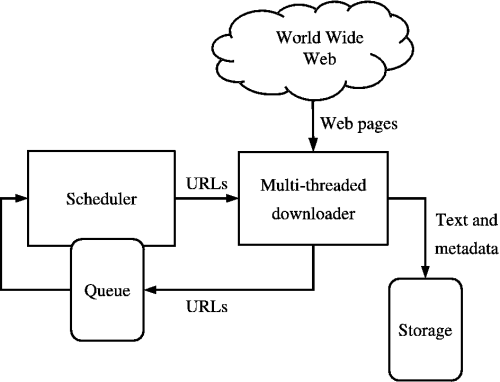
A Web crawler is a computer program that browses the World Wide Web in a methodical, automated manner or in an orderly fashion. Other terms for Web crawlers are ants, automatic indexers, bots, [1] or Web spiders, Web robots, or—especially in the FOAF community—Web scutters[2].

This process is called Web crawling or spidering. Many sites, in particular search engines, use spidering as a means of providing up-to-date data. Web crawlers are mainly used to create a copy of all the visited pages for later processing by a search engine that will index the downloaded pages to provide fast searches. Crawlers can also be used for automating maintenance tasks on a Web site, such as checking links or validating HTML code. Also, crawlers can be used to gather specific types of information from Web pages, such as harvesting e-mail addresses (usually for spam).

A Web crawler is one type of bot, or software agent. In general, it starts with a list of URLs to visit, called the seeds. As the crawler visits these URLs, it identifies all the hyperlinks in the page and adds them to the list of URLs to visit, called the crawl frontier. URLs from the frontier are recursively visited according to a set of policies.

Source: http://en.wikipedia.org/wiki/Web_crawler#Crawler_identification.


Thanks for the "lingo", M. Anon!
.

Wednesday, January 27, 2010

Media Execs Predict End Of Free Internet Content


Posted on: Sunday, 26 July 2009, 07:32 CDT

IAC/InteractiveCorp chairman and CEO Barry Diller said the era of free Internet content is coming to an end.

Speaking at the Fortune Brainstorm conference in Pasadena, California, Diller challenged traditional Internet business models in which consumers pay for Internet access while content is provided free of charge.

In the future, he said revenue will be generated from advertising, subscriptions and transactions.

“It is not free, and is not going to be,” said Diller, adding that Web users will have to pay for the content they watch and use.

The transition will not be smooth, he said, and the years ahead will not be easy for content providers.

"We are transitioning from an old form to a new form and those things are always bloody," said the media and technology executive, who also serves as chairman of Expedia Inc. and Ticketmaster Entertainment Inc.

The Internet is still in its infancy, and while content was initially provided at no charge to the user, the goal was always to find a way in time to generate revenue, he said.

Diller’s comments echo those of other media moguls, such as Liberty Media Corp.’s John Malone and Walt Disney Co. CEO Robert Iger, who say that Web users will have to pay for the content they watch and use.

Diller, 67, whose IAC/Interactive runs the Ask.com search engine and the Match.com dating service, called the view of the Internet as a system of free communications a “mythology”.

He said his own news Web site, “The Daily Beast”, has "done a very good early job" creating compelling content.

The site is not difficult to finance, but "it's going to have to earn its way,” he said.

Burbank, California-based Disney is working on a subscription-based Internet product that the company believes will expand its opportunities in Web sales, Iger said. The product will allow improvements in online advertising by allowing marketers to target consumers by tracking their activities and interests.

“We have ample evidence both in traditional and new media that people are willing to pay for quality, to pay for choice and to pay for convenience,” said Iger, speaking at the conference on July 22.

“And they are willing to pay for what they perceive as value.”

News Corp., publisher of the Wall Street Journal and owner of the Fox TV and film studios, is also looking to generate revenue through its Internet businesses by charging customers for news and entertainment, according to a Bloomberg report citing remarks from Jonathan Miller, chief executive officer of News Corp.’s Digital Media Group and News Corp.’s chief digital officer.

The Wall Street Journal already charges customers for online subscriptions.

In the future, some companies will offer content that users are willing to pay for, while others won’t, said Miller, and online journalism will increasingly transition to a “paid model”.

News Corp.’s interactive revenue fell 11 percent to $187 million during the first quarter of this year, led by a 16 percent drop in advertising at sites such as MySpace.

---


.

Saturday, November 28, 2009

Weather Channel Founder And 30,000 Other Scientists Wanting To Sue Al Gore For Global Warming Fraud

by Infidelesto on November 21, 2009

Long overdue…

http://www.youtube.com/watch?v=PIe2JCUc_pA&feature=player_embeddedhttp://


Stolen(?) classified emails and files were released yesterday that proved that the junk scientists behind the global warming movement knowingly perpetrated a fraud on the global community.


The Climategate scandal (and I do apologise for calling it that, but that’s how the internet works: you need obvious, instantly memorable, event-specific search terms) continues to set the Blogosphere ablaze.

For links to all the latest updates on this, I recommend Marc Morano’s invaluable Climate Depot site.

And if you want to read those potentially incriminating emails in full, go to An Elegant Chaos org where they have all been posted in searchable form.

Like the Telegraph’s MPs’ expenses scandal, this is the gift that goes on giving. It won’t, unfortunately, derail Copenhagen (too many vested interests involved) or cause any of our many political parties to start talking sense on “Climate change”. But what it does demonstrate is the growing level of public scepticism towards Al Gore’s Anthropogenic Global Warming theory. That’s why, for example, this story is the single most read item on today’s Telegraph website.

What it also demonstrates – as my dear chum Dan Hannan so frequently and rightly argues – is the growing power of the Blogosphere and the decreasing relevance of the Mainstream Media (MSM).

This is not altogether the MSM’s fault. Partly it is just the way of things that more and more readers prefer their news and opinion served up in snappier, less reverent, more digestible and instant for.

But in the case of “Climate Change”, the MSM has been caught with its trousers down.


hattip: ZIP, GWP

Related Posts

U.S. Senate Report: Over 400 Prominent Scientists Disputed Man-Made Global Warming Claims in 2007
Myth of Consensus Explodes: APS Opens Global Warming Debate
Goracle compares fighting global warming to fighting Nazis; compares himself to Winston Churchill
Goldberg: Gore uses fascist tactics to push Global Warming agenda
Al Gore urges civil disobedience to stop coal plants

-->


Source: http://infidelsarecool.com/2009/11/21/weather-channel-founder-and-30000-other-scientists-wanting-to-sue-al-gore-for-global-warming-fraud/

.

Monday, November 23, 2009

WCC website revamped

25.08.09


Visitors to the website of the World Council of Churches (WCC) are now being welcomed by a fresh, simplified look and a new homepage, designed to give an immediate feel of the identity and values of the organization.

The homepage was rebuilt around three aspects of the council's mission: the pursuit of unity, common witness and Christian service.

Visitors are invited to discover what the WCC says and does about these three keywords. Relevant news or feature stories and ideas for personal involvement in each thematic area are also proposed.

While the homepage is no longer centred on the latest news, all WCC press releases and other news items can be read and - another novelty - commented on the news page where users can also sign up to receive them by e-mail. To give more opportunities for interactivity, "friends of the WCC website" groups have been created on Facebook and LinkedIn.
Commenting on the work of the web team, Mark Beach, WCC director of communications said: "We are confident visitors to the site will find it easy to navigate and learn more about the council's key mission of unity, witness and service."

800,000 unique visitors from 227 countries came to the WCC website http://www.oikoumene.org/en/news/news-management/eng/a/browse/7/article/1634/en/home.html last year with an average of 2,500 per day. Most content is available in English, German, French and Spanish.

The WCC website


Learn more about the WCC web office
.
.

Sunday, November 22, 2009

Scientist's E-Mail Cites 'Trick' to 'Hide the Decline' on Climate Change


DAVID STRINGER, AP


LONDON (Nov. 21) -- Computer hackers have broken into a server at a well-respected climate change research center in Britain and posted hundreds of private e-mails and documents online — stoking debate over whether some scientists have overstated the case for man-made climate change.


The University of East Anglia, in eastern England, said in a statement Saturday that the hackers had entered the server and stolen data at its Climatic Research Unit, a leading global research center on climate change. The university said police are investigating the theft of the information, but could not confirm if all the materials posted online are genuine.

More than a decade of correspondence between leading British and U.S. scientists is included in about 1,000 e-mails and 3,000 documents posted on Web sites following the security breach last week.


Some climate change skeptics and bloggers claim the information shows scientists have overstated the case for global warming, and allege the documents contain proof that some researchers conspired to manipulate data.


The furor over the leaked data comes weeks before the U.N. climate conference in Copenhagen, when 192 nations will seek to reach a binding treaty to reduce emissions of carbon dioxide and other heat-trapping greenhouse gases worldwide. Many officials — including U.N. Secretary-General Ban Ki-moon — regard the prospects of a pact being sealed at the meeting as bleak.
In one leaked e-mail, the research center's director, Phil Jones, writes to colleagues about graphs showing climate statistics over the last millennium. He alludes to a technique used by a fellow scientist to "hide the decline" in recent global temperatures. Some evidence appears to show a halt in a rise of global temperatures from about 1960, but is contradicted by other evidence which appears to show a rise in temperatures is continuing.


Jones wrote that, in compiling new data, he had "just completed Mike's Nature trick of adding in the real temps to each series for the last 20 years (i.e., from 1981 onwards) and from 1961 for Keith's to hide the decline," according to a leaked e-mail, which the author confirmed was genuine.


One of the colleague referred to by Jones — Michael Mann, a professor of meteorology at Pennsylvania State University — did not immediately respond to requests for comment via telephone and e-mail.


The use of the word "trick" by Jones has been seized on by skeptics — who say his e-mail offers proof of collusion between scientists to distort evidence to support their assertion that human activity is influencing climate change.


"Words fail me," Stephen McIntyre — a blogger whose climateaudit.org Web site challenges popular thinking on climate change — wrote on the site following the leak of the messages.
However, Jones denied manipulating evidence and insisted his comment had been taken out of context. "The word 'trick' was used here colloquially, as in a clever thing to do. It is ludicrous to suggest that it refers to anything untoward," he said in a statement Saturday.


Jones did not indicate who "Keith" was in his e-mail.


Two other American scientists named in leaked e-mails — Gavin Schmidt of NASA's Goddard Institute for Space Studies in New York, and Kevin Trenberth, of the U.S. National Center for Atmospheric Research, in Colorado — did not immediately return requests for comment.


The University of East Anglica said that information published on the Internet had been selected deliberately to undermine "the strong consensus that human activity is affecting the world's climate in ways that are potentially dangerous."


"The selective publication of some stolen e-mails and other papers taken out of context is mischievous and cannot be considered a genuine attempt to engage with this issue in a responsible way," the university said in a statement.


Associated Press Writer Meera Selva in London contributed to this report.


.

Thursday, November 19, 2009

Why Web widgets will invade your TV

Web widgets bring Internet perks to the biggest screen in most people’s homes.

By Gregory M. Lamb Staff Writer for The Christian Science Monitor/ November 17, 2009 edition


Rob Dunlavey
Beware, the web widgets are coming.


The Internet revolution may finally be televised.

Innocuous little software applications, popularly known as “widgets,” may turn out to be the back door to your TV screen that Internet companies have been waiting for.

For more than a decade, businesses have been trying to make the Internet available on the largest screen in most homes. In 1996, Time Warner offered WebTV, which failed to find an audience and folded. Even today, projects like Hewlett Packard’s MediaSmart (2006) and Apple TV (2007) have yet to win over large numbers of viewers, hampered by complicated setups or limited programming choices.

Widgets promise to bring the perks of the Internet to TV screens, using a familiar remote control instead of a computer mouse.

All indications are that widgets are going to “move very quickly to a great many of the TVs being sold in the next few years – if not all of them,” says Kurt Scherf, vice president and principal analyst at Parks Associates, a market research firm in Dallas that specializes in emerging consumer technologies.

What’s changed? Unlike a decade ago, most households now have broadband Internet service, meaning people already have the ability to stream high-quality Internet data, including video, to their computers. In many cases, these broadband connections are provided by the same company that pipes cable television into homes.

At the same time, more and more consumers are becoming familiar with downloading and using “apps,” or widgets, on their cellphones or laptops. Apple’s iPhone alone offers thousands of apps that add useful or fun functions to that mobile phone.

TV widgets – small, useful programs and icons that appear along the bottom or side of a television screen – perform similar functions. They might give information about news, weather, sports, or stocks – or link to popular social-networking sites such as Twitter, Facebook, MySpace, or the photo-sharing website Flickr.

TV manufacturers seem bullish on the idea. Sony, Samsung, and LG already offer TV sets capable of displaying widgets and linking to the Internet. Vizio, a low-cost HDTV brand, will follow shortly, and set a new standard by offering a small pullout keyboard inside its remote. Vizio will also build in Wi-Fi capability, meaning no wiring will be needed to connect the TV to the Internet.

About 400,000 TVs sold in the US this year will be Web-enabled. But by 2013, about 13.8 million TV sets in US households will be Web-enabled, says a study from Parks Associates.

“We think it’s exciting. We think it’s real,” says Howard Bass, a partner at Ernst & Young’s Global Media & Entertainment Center. Last month, Ernst & Young released a report on TV widgets predicting that they “could be the catalyst to widespread adoption of Web-enabled TV.”

Widgets won’t try to duplicate a computer screen on TVs. That’s not what TV viewers are looking for, analysts say. Instead, widgets offer a simple point-and-click experience using the existing TV remote control.

“All they need to know is left, right, up, down, and OK,” says Russ Schafer, senior director for Connected TV at Yahoo. The company announced earlier this year that it had teamed with chipmaker Intel to promote development of widgets for TVs.

Yahoo has tested TV widgets with people from 18-year-olds to those in their 60s and universally found them easy to use, Mr. Schafer says.

The coming months should be “the big blowout year for connected TVs,” Schafer predicts about 2010.

Among the widget connections Yahoo is offering now, or will be shortly, are USA Today’s sports news; YouTube; and casual games, such as Sudoku. Yahoo provides about 20 widgets now but has potentially thousands more in the pipeline, Schafer says, some of which will show up by early 2010.

Another major player in TV widgets, Verizon FiOS, continues to expand its network of digital television and broadband Internet services over its US fiber-optic lines.

Verizon FiOS and Internet customers in the New York City area now can get video of local traffic conditions via a TV widget called “NYC 311.” Live cameras, operated by the City of New York, show conditions on roads in all five boroughs of the city. Viewers can zoom in for a closer look at a particular road and set “favorites” to go immediately to the routes they use to commute each day.

The ESPN Fantasy Football Widget, available to viewers who’ve signed up for ESPN’s fantasy football leagues, displays personalized football statistics, such as box scores, league rankings, and information on players.

In the Yahoo-Intel Widget Gallery, the eBay widget permits users to receive real-time updates on their accounts, place bids, and monitor favorite items. Users can view photos or search for and compare prices of items. A New York Times widget lets viewers see headlines, photos, and stories, and forward them to their mobile phone.

TV watchers are undergoing a significant shift, says Maitreyi Krishnaswami, director of interactive video services for Verizon. Many are no longer passive viewers. “Now it’s really about interactive TV and social TV,” she says. People are already checking on their fantasy sports teams or commenting on the reality TV show they’re watching using a mobile phone or computer.

Verizon’s “Widget Bazaar” is accessed through a “Widget” button provided on Verizon remote controls, Ms. Krishnaswami says. No special Web-enabled TV is needed, nor do viewers need a high-definition TV set or a digital video recorder (DVR). Right now, they’ll find 10 or 12 widgets, with many more coming in the months ahead, she says.

Last summer, Verizon introduced widgets that allow access to the viewer’s Twitter and Facebook accounts, using the TV remote and an onscreen keyboard. Viewers can watch a split-screen mode in which the TV program runs on one side and “tweets,” short comments about the program from people using Twitter, run next to it.

One of the most popular uses of Facebook on Verizon is to access people’s online photo albums and display them on the TV. “What you see are really high-quality images on the television that you can share with your family,” Krishnaswami says.

The Ernst & Young report on TV widgets does include some cautions. Who will pay for them, and how, isn’t clear. If widgets include advertising content, they might conflict with advertising being shown on the TV program itself. What if Car Company A is running an ad on TV while Car Company B’s ad is being displayed on a widget?

And unless Web-enabled TVs include Wi-Fi, viewers will have to link their TV to the Internet through a wired Ethernet connection. Getting that wire to the TV could be a home-networking hassle if the computer and TV are in different rooms.

What will really be interesting in the future, Mr. Scherf says, is if a content provider such as ESPN designs its own widgets to customize and enhance its TV programs. Viewers might be able to decide which sports scores or other information they want displayed in the widget, for example.

While Scherf doesn’t envision people reading e-mail on a TV, the kind of “snackable sharing” represented by Facebook or Twitter “seems to be a fit,” he says.

Today’s early widgets mostly offer a distraction from TV content, such as news or weather. Eventually, “smart widgets” may automatically enhance TV viewing, says James McQuivey, vice president and principal analyst at Forrester Research in Cambridge, Mass., in a paper from earlier this year. Smart widgets could “listen” to the audio track of the show being watched and offer more information about it – or even suggest a new widget you might like to download based on your interests. TV programs already carry hidden digital information identifying them.

“When all the dust settles, the entire landscape of how we watch TV will be altered,” Mr. McQuivey writes, referring to widgets. “Advertisers will have more active ways to engage TV viewers … [and] consumers will have more ways to watch the shows they love most.”
.
.

Monday, August 17, 2009

3 indicted over largest cyber-theft in US history

Tue, 18 Aug 2009 02:02:22 GMT


Albert Gonzalez


One American and two Russian nationals are indicted for supposedly stealing more than 130 million credit and debit card numbers.

A prosecutor said late on Sunday that the three carried out the largest computer hacking and identity-theft caper in US history.

He said the 28-year-old American, Albert Gonzalez, believed to be one of the nation's cybercrime kingpins has been in federal custody in New York since May 2008 over hacking cases across Florida.

The two Russians, whose names were not revealed -- and were only identified as Hacker 1 and Hacker 2 -- were indicted in the federal district court in New Jersey on charges related to five corporate data breaches from 2006 to 2008.

Prosecutors said the three stole card numbers in those breaches from credit-card processor Heartland Payment Systems and retail chains 7-Eleven Inc. and Hannaford Brothers Co. The US attorney's office in New Jersey said they also targeted two other corporations, but declined to name those companies.

The Russians also targeted large corporations by scanning the Fortune 500's list and exploring corporate websites before setting out to identify vulnerabilities.

Each defendant could face up to 35 years in prison and large fines if convicted.

FTP/SME/MMN
.
.
.
.

Monday, August 10, 2009

Air Force used Twitter to track NY flyover fallout


FILE -- In this photograph released by the White House, one of the president's official planes flies over the Statue of Liberty in New York in this undated photograph. (AP Photo/The White House)


Air Force used Twitter to track NY flyover fallout
By RICHARD LARDNER (AP) – 9 hours ago

WASHINGTON — As the Pentagon warns of the security risks posed by social networking sites, newly released government documents show the military also uses these Internet tools to monitor and react to coverage of high-profile events.

The Air Force tracked the instant messaging service Twitter, video carrier YouTube and various blogs to assess the huge public backlash to the Air Force One flyover of the Statue of Liberty this spring, according to the documents.

And while the attempts at damage control failed — "No positive spin is possible," one PowerPoint chart reads — the episode opens a window into the tactics for operating in a boundless digital news cycle.

This new terrain has slippery slopes, though, for the military. Facebook, MySpace and other social media sites are very popular among service members, including those in Iraq and Afghanistan who want to keep in touch with friends and family. The sites are also valued by military organizations for recruiting or communicating with other federal agencies.

But posting information on these interactive links makes it vulnerable to being lost or stolen by the enemy, according to Pentagon officials. On Thursday hackers shut down Twitter for several hours, while Facebook had intermittent access problems — an indication of the shortcomings of relying on these services.

The Marine Corps' computer network blocks users from accessing social media sites, which service officials say expose "information to adversaries" and provide "an easy conduit for information leakage."

The Marines recently made its ban official. And that prohibition might extend to other parts of the military pending a top-level review ordered in late July by Deputy Defense Secretary Bill Lynn.

In a widely distributed memo, Lynn said the so-called "Web 2.0" sites are important tools but more study is needed to understand their threats and benefits.

Air Force officials are already aware of the potential benefits.

According to the Air Force One documents released through the Freedom of Information Act, a unit called the Combat Information Cell at Tyndall Air Force Base in Florida monitored the public fallout from the April 27 flight and offered recommendations for dealing with the fast-breaking story.

Formed two years ago, the cell is made up of as many as nine people who analyze piles of data culled from the Internet and other sources to determine whether the Air Force's message is being heard.

The presidential plane took off for New York from Andrews Air Force in Maryland accompanied by two F-16 jet fighters. The purpose of the flight, which wasn't publicly announced, was to get new photos of the specially modified Boeing 747 with the statue in the background.

The mission quickly became a public relations disaster as panicked New Yorkers, fearing another 9/11-style attack, emptied office buildings. In the aftermath, Louis Caldera, director of the White House military office that authorized the flight, was fired.

The Combat Information Cell's first assessment of the event said "Web site blog comments 'furious' at best." Local reporting of the flyover was "very critical, highlighting scare factor," it added.

A Twitter search revealed a rate of one "tweet" per minute about a pair of F-16s chasing a commercial airliner. A tweet is a text message of up to 140 characters delivered to the author's subscribers, who are known as followers.

Media coverage over the next 24 hours "will focus on local hysteria and lack of public notification," the cell predicted. "Blogs will continue to be overwhelmingly negative."

"Damage control requires timely counter-information," but the opportunity for that had passed, the assessment said. The cell recommended acknowledging the mistake and ensuring it didn't happen again.

Another update on April 28 said the story was still "reverberating, surprisingly resilient." The tweet rate had grown to three per minute and the words "New York" had been pushed into Twitter's high-frequency topic category. Videos of the event posted on YouTube had been viewed more than 260,000 times, it said.

By April 30, the story had faded, the cell reported. The blogs were still very critical, but it was the White House, not the Air Force, that was taking the heat, the assessment for that day said.

The other dominant news story at the time was public concern over the spread of swine flu. According to the documents, the same Air Force cell suggested there may be an opportunity to turn the tide. "Government involvement in this incident could be used to frame expected handling of H1N1 outbreak," one of the PowerPoint charts reads.

A Utah Air National Guard unit, the 101st Information Warfare Flight in Salt Lake City, was also monitoring the social sites. "To say that this event is being beaten like a dead horse is an understatement," reads an April 28 e-mail from the unit to other Air Force offices. "Has really taken off in Web. 2.0."

Both the 101st and the Combat Information Cell are attached to the 1st Air Force, which is based at Tyndall and is in charge of guarding U.S. airspace.

1st Air Force spokesman Al Eakle explained that the command had no role in planning or coordinating the Air Force One flight. But the units tracked social networks and blog traffic "to obtain what lessons we might learn so as not to repeat them in the future." The assessments were sent to the command's leadership so they'd know how the public was reacting, he added.

John Verdi of the Electronic Privacy Information Center in Washington said gray zones can emerge while monitoring social networking sites because viewing and participating is based on trust.

"Lots of times individuals upload private or sensitive information that they expect to share with their friends or family and not the whole Internet world," Verdi said. "It would certainly be a major problem if the government were accessing that information under false pretenses."

Paul Bove, an Air Force digital media strategist, said service personnel are instructed not to do that. Nor are they to use aliases or represent a position that's beyond the scope of what they do.

"We always tell people, 'Stay in your lane and don't talk about something that you're not qualified to talk about,'" Bove said.

The issue of aliases is at the heart of a complaint stemming for the Army Corps of Engineers' performance in New Orleans before and after Hurricane Katrina.

On Tuesday, Sen. Mary Landrieu, D-La., asked the Pentagon inspector general to examine allegations that Corps employees posed as ordinary citizens and posted comments on a New Orleans web site defending the organization from criticism following the disaster.

Jon Donley, former editor of NOLA.com, said in a June 9 affidavit that there were as many as 20 registered users who developed a pattern of not only defending the Corps, but at times being "overtly abusive" to any critics. He said he was able to trace their posts to a Corps Internet address.

Ken Holder, a spokesman for Corps' New Orleans District, said it will cooperate with any investigation.

On the Net: 1st Air Force: http://www.1af.acc.af.mil/index.asp


.