Showing posts with label Hegelian Dialects. Show all posts

Friday, October 16, 2026

Something Is Going Very Wrong in Europe...

Something Is Going Very Wrong in Europe...

reallygraceful  

Oct 16, 2026 

What’s happening with the protests in Europe—and what gets left out of the headlines?

In this video, I examine the (on-going) French student protests, including the unrest in Belgium, Italy, Greece, and Albania...and the debate surrounding demonstrations in Britain (which I find suspicious). From media coverage and political responses to immigration policy and public frustration, there’s more to unpack than just the viral clips circulating online.

I also revisit reporting on the Arab Spring (and it's manipulators), explore the UN’s Agenda 2030 and its earlier United Nations “Replacement Migration” report, and discuss developments in Albania. We went from student protests to regime change in a blink of an eye. Along the way, I compare public statements, historical examples, and competing narratives—and share my perspective on the questions they raise.

Which comparisons hold up? Where does the reporting end and interpretation begin? Are nation states becoming extinct?

Subscribe to reallygraceful for weekly independent research, news analysis, and commentary.

Find my book, The Deep State Encyclopedia, and more:

https://www.reallygraceful.com

This video includes news footage and historical material for documentary discussion and commentary. Inclusion of a clip or quotation does not imply endorsement.


Chris Cuomo Just Made the Christa Pike Case About Race


Thursday, October 15, 2026

The Overton Window: How Ideas Become Acceptable Without Anyone Noticing

blac

Oct 8, 2026

There's an idea that, right now, would end a career if you said it out loud. 

Nobody proposes it. Nobody defends it. But ideas like this don't always stay 

that way.

The Overton Window is the range of ideas a society considers acceptable to 

say in public. It doesn't move because someone wins an argument. It moves 

because the furthest edge keeps shifting outward, and everything behind it 

gets pulled along, one small step at a time.

Part of an ongoing series on the psychology of belief, compliance, and 

manipulation.


Wednesday, October 14, 2026

House Democrat introduces bill seeking to cut ICE, CBP, replace DHS


House Democrat introduces bill seeking to cut ICE, CBP, replace DHS


by Ford McCracken 10/13/26 05:12 PM ET


Rep. Delia Ramirez (D-Ill.) introduced a bill Tuesday to overhaul U.S. immigration agencies, including replacing the Department of Homeland Security (DHS) with a new “community-centered” department.

The “Reimagining Safety Act” would abolish Immigration and Customs Enforcement (ICE) and Customs and Border Protection (CBP), as well as dismantle DHS, replacing it with a new agency called the “Department of Community Safety.” The bill would preserve non-immigration functions of DHS, including the Federal Emergency Management Agency and the Transportation Security Administration.

“Every person dead in detention, shot or killed by ICE and CBP, every neighbor deported to a third country, every family separated … is a reason DHS must be dismantled and something new must take its place,” Ramirez said in a statement.

Ramirez, a member of the House Homeland Security Committee and a frequent ICE critic, has repeatedly called to abolish ICE and dismantle DHS in the past. After federal agents fatally shot two U.S. citizens as part of an immigration operation in Minneapolis in January, Ramirez marched alongside protesters in the city.

President Trump’s immigration agenda has become unpopular with voters, despite it being one of his strongest issues in the 2024 campaign. An AP-NORC poll released Oct. 1 found that just 39 percent of Americans approve of the president’s handling of immigration.

Trump allies have suggested Trump’s efforts to end illegal immigration to the country were successful, and that voters are not giving him credit for those wins. His critics argue his strict policies going after legal and illegal immigrants in the U.S. have turned off voters.

Some Democrats have avoided calls to abolish ICE entirely, though the idea did gain traction following those fatal shootings. A January Economist/YouGov poll found that more Americans supported abolishing ICE than opposed it, 46 percent to 43 percent.


Monday, October 12, 2026

Haiti & Jesuit Refugee Service


 AI Overview

JRS in relation to Haiti most commonly refers to the Jesuit Refugee Service (known as Service jésuite aux réfugiés or through its close regional/partner network like SJM Haïti / Service Jésuite aux Réfugiés et Migrants).

Key Activities and Context

• Accompanying Migrants & Returnees: Operating in Haiti since 1999 (via partner networks like SJM Haïti), JRS and its partners defend the rights, safety, and dignity of migrants, displaced persons, and returnees facing violence, abuse, or forced repatriation.

• Education & Community Support: JRS has historically supported localized educational infrastructure and school construction projects in vulnerable or rural Haitian communities (such as in Thiotte) and aided children and stateless people of Haitian descent.

• Advocacy in North America: JRS/USA actively advocates for Haitian migrants abroad—including campaigning for the protection and extension of Temporary Protected Status (TPS) and humanitarian relief for hundreds of thousands of Haitians affected by ongoing domestic instability and violence.

(Note: "JRS" can also occasionally appear in sports contexts as an abbreviation or reference tied to Haitian football/athletes, such as player Jean-Ricner Bellegarde or Derrick Etienne Jr.).

Sunday, October 11, 2026

Can churches help make an alternative asylum system a reality?


Dr Torsten Moritz, general secretary of the Churches’ Commission for Migrants in Europe (CCME), reflects on a recent conference, “Protecting People More Than Borders,” and how churches can help make an alternative asylum system a reality.


Photo:
Joy Eva Bohol/CCME/UMCOR
08 October 2026

Churches' Commission for Migrants in Europe
Refugees and migration


What were your biggest takeaways from the conference?

Dr Moritz: We met 28-30 September with some 30 participants representing churches from all over Europe. Discussions were around a draft paper outlining what elements of an alternative, protection-oriented asylum system in Europe could look like – a system which protects people more than borders.

These were very earnest discussions. They showed how important it is in asylum policy and practice to put the human being first - and how often this is not the case in Europe these days. There is thus great support for the draft paper. At the same time, there is a fear that any policy reform might even more be influenced by the extreme right and those following their agenda. Last not least, the message protecting people more than borders is a good common message, but it needs to be translated and contextualised into the different languages and contexts of churches in Europe.

What is the most crucial information for churches to know right now?

Dr Moritz: We – that is the CCME office and a task force from among members – will be working with the input we received from churches in Europe.

In early 2027 we will make an updated version of the proposals for an alternative asylum system in Europe available. It will be mainly policy-oriented and will contain specific suggestions for organising recognition of people asking for protection in Europe, their reception and integration, how this can happen while social cohesion increases, and how it doesn’t have to cost more than the current policy of dissuasion. The proposals are informed by good practices, as we could for example find them in the protection of Ukrainians fleeing in and since 2022. We will present an outline which shows that protecting people is not an a lofty illusion, but a real option if we dare to be values-based and realistic at the same time.

We will also provide accompanying information templates – like an explanation of policy proposals in a less technical language, which non-expert church members and members of the public can relate to. Throughout 2027, we will spread this information—online but also through events across Europe – to a church audience and policymakers, but also a broader public.

What is your urgent call to churches?

Dr Moritz: First of all, continue your work around the principle of protecting people more than borders. With hardening of policy and practice towards the most vulnerable, damage control is essential. Churches in many places make a different for upholding the dignity of persons seeking protection in Europe, while working to uphold social cohesion for all.

And, secondly, work with us on making an alternative asylum system a reality. Let us know what will help you in making an argument for a policy which prioritises protecting people – what information do you need, do you want us to visit and explain, and whom would you like to reach with your arguments? We all know that times are difficult and our resource at different levels are limited, but if we work together, we can have impact!


How We Got Divided Over Immigration. A Soros Fellow Just Slipped.

Sunday, August 23, 2026

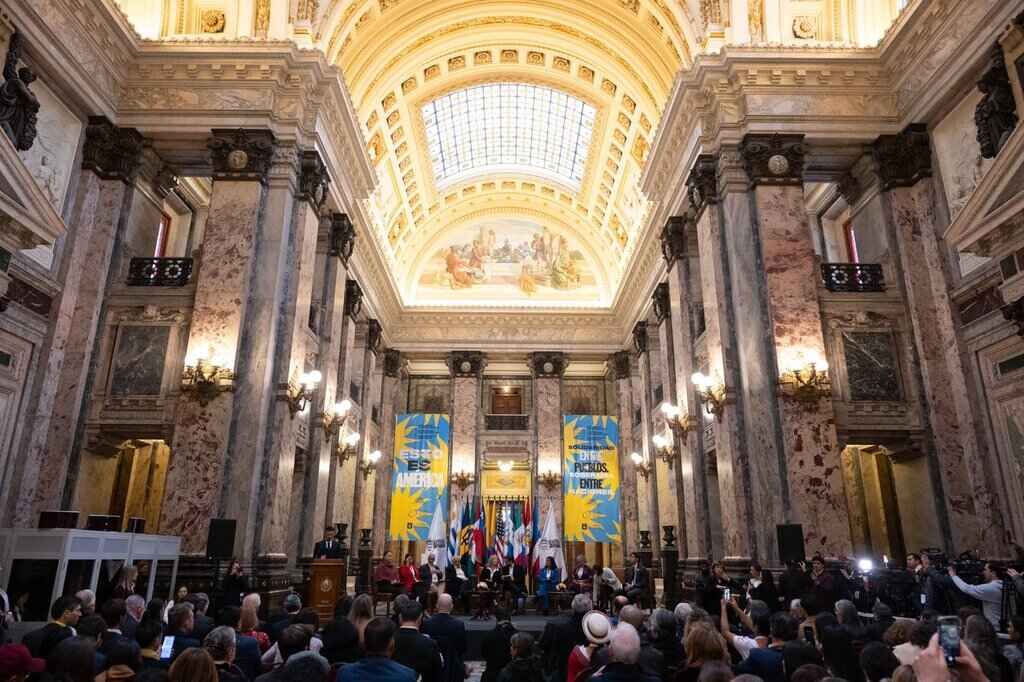
Progressive leaders gathered in Uruguay denounce US interference and acknowledge their own mistakes


Saturday, August 22nd 2026 - 08:28 UTC


Participants questioned Washington's conduct in the region, citing that intervention, strikes on vessels in the Caribbean and sanctions on Cuba, and called for greater regional autonomy

The opening session of the third Pan-American Congress, held on Friday at the Legislative Palace in Montevideo, combined criticism of United States policy towards Latin America with calls for self-criticism within progressive forces. More than 150 lawmakers, former presidents, ministers and political figures from fifteen countries are taking part, according to organisers.

Former Chilean president Gabriel Boric delivered the most widely noted speech, calling for consistency between political discourse and action. He criticised what he described as a “new imperialism” driven by Donald Trump and said the major powers “today do not speak of democracy, but directly of oil at the expense of a people.” He then turned a demand on his own allies: “We do not believe that violating international law is the way to intervene illegitimately in another people, but we also have to say very clearly that Maduro had stolen the elections and that his presidency at that time was also illegitimate.” He warned that if the left fails to acknowledge such distinctions, it will struggle to persuade its own electorates.

Nicolás Maduro was captured in Caracas on January 3 during a US military operation and remains in custody in the United States. Delcy Rodríguez has since served as Venezuela's acting president.

Participants questioned Washington's conduct in the region, citing that intervention, strikes on vessels in the Caribbean and sanctions on Cuba, and called for greater regional autonomy. Former Colombian president Ernesto Samper urged a revival of Latin American integration and closer ties with the Global South, arguing the region holds strategic water, food and mineral resources but lacks the political coordination to defend its interests.

US Representative Pramila Jayapal shifted the debate to her own country, saying opposition is growing to taxes being spent on military operations abroad rather than on health services and living standards. She defended a foreign policy based on dialogue and diplomacy as the only route to “a lasting peace.”

Uruguay's vice-president, Carolina Cosse, focused on disinformation and the contest for public attention. “Indifference to truth leads inexorably to totalitarianism,” she warned. Mexican Morena official Carolina Rangel proposed combining economic growth with social rights and called for an agenda covering care policies, energy transition, productive integration and digital sovereignty.

The forum, created in Bogotá in 2024 on the initiative of then Colombian president Gustavo Petro, is organised this year around four themes: peace, security and multilateralism; sustainable development and regional integration; digital sovereignty and artificial intelligence; and wellbeing and care. Sessions continue until Sunday and will conclude at the Parlasur headquarters.


Wednesday, August 19, 2026

The Unholy Alliance You Weren’t Supposed to Notice


Kelsey Reinhardt on August 12, 2026


Something unusual happened on October 8, 2023.

The morning after Hamas slaughtered 1,200 people in southern Israel, after women were raped, children were burned, and families were dragged into tunnels, demonstrators took to the streets and college campuses across the US, not in mourning, but in celebration.

Progressive activists marched alongside Islamist organizers. Transgender flags flew next to keffiyehs. Students at elite universities declared a sadistic massacre to be the opening act of a revolution.

It was, as one observer noted, Bolshevik demagoguery at its finest. The raped and murdered were recast as oppressors. The rapists and murderers became the oppressed.

What you were witnessing has a name.

Scholars and analysts call it “the red-green alliance”: a working coalition between the radical secular left and Islamist political movements. It is not a formal organization. It has no single headquarters. But it is real, it is growing, and its ambitions are not modest.

To understand it, you have to understand what holds it together: because on the surface, it makes no sense at all.

The radical left champions women’s autonomy, sexual liberation, and secular governance. Islamist political theology holds to the authority of Sharia, traditional gender roles, and the supremacy of religious law. These are not minor differences. They are irreconcilable visions of human life and social order.

And yet they march together. They fundraise together. They are reshaping Democratic primaries together.

What binds them is not a shared vision of the future. It is a shared enemy: the Judeo-Christian foundations of Western civilization, our natural law tradition, our ordered liberty and our understanding of the human person as made in the image of God and therefore possessed of an inherent dignity that no state can confer or revoke.

Both movements, in their activist forms, are united by what they oppose. And that opposition has proven sufficient to make them allies.

Saturday, August 01, 2026

Pope Leo says his ancestors were both ‘slaves and slave owners’


Pope Leo XIV has delved into his family history, revealing his ancestry included both enslaved people and slave owners.

“I come from a family that my grandparents were immigrants,” the first American pontiff told NBC news in the Vatican Gardens of Castel Gandolfo on Wednesday. “On my mother’s side, we have people who were both slaves and slave owners.”

Leo spoke about his family’s historical links to the transatlantic slave trade on Wednesday in response to a reporter’s question about his American heritage.

Asked what he loves about his homeland, the pope also said he highly values the United States’ “sense of freedom, the sense of opportunity” and “of having invited for generations people from around the world to be part of America.”

The importance of welcoming new arrivals is a message the Chicago-born pope has repeatedly sent to the US, as he has criticized the “inhuman” treatment of immigrants during the Trump administration’s crackdown.

Saturday, July 11, 2026

Inside Vatican 'Luciferian' Propaganda (Its Obvious When You Hear It!)


Blakeman accuses Hochul of anti-Catholic bigotry over LBGTQ law that would force hospice nuns to violate their beliefs


By Carl Campanile
Published July 8, 2026, 5:08 p.m. ET


Republican gubernatorial candidate Bruce Blakeman is accusing Democratic incumbent Kathy Hochul of religious bigotry for enforcing a transgender rights law she approved that is forcing Catholic nuns who run a hospice program to choose between their beliefs or caring for indigent, terminally ill patients.

The controversy concerns the Dominican Sisters of Hawthorne in Westchester County who run Rosary Hill Home — a Catholic hospice for the poor.

The order filed a federal lawsuit accusing the state of violating their constitutional rights with a 2024 law that requires the facility to affirm patients’ gender identity in regard to pronouns, room assignments and restroom usage.


Republican gubernatorial candidate Bruce Blakeman accused Gov. Kathy Hochul of anti-Catholic bigotry over a state law that forces Catholic nuns to affirm patients gender identity at their hospice pogram.Dennis A. Clark for NY Post


A nun with the Dominican Sisters of Hawthorne feeding a patient at Rosary Hill Home in Westchester County.Dominican Sisters of Hawthorne


The law bars nursing or long-term care facilities from discriminating against any resident based on the resident’s actual or perceived sexual orientation, gender identity or expression, or HIV status.

But the Trump Justice Department recently intervened in the case on behalf of the Dominican Sisters, claiming New York is engaged in religious discrimination at the 42-bed hospice care facility.

“What Kathy Hochul is doing to the Dominican Sisters of Hawthorne is an absolute disgrace. For over 120 years, these incredible women have done God’s work, providing unconditional love, comfort, and dignity to people in their final days,” Blakeman told The Post.

“They are saints walking among us, and they represent the absolute best of New York. Yet, Kathy Hochul is actually willing to shut them down, strip away their license, and throw terminal cancer patients out on the street—all to enforce her woke garbage.”

Monday, July 06, 2026

The Keys of This Blood


Píncaros da Glória Dec 31, 2025

Malachi Martin’s work explores the geopolitical competition between three primary forces—Western capitalism, Soviet communism, and the Roman Catholic Church—as they vie to establish a new world order. Central to this narrative is Pope John Paul II, whose unique background in Poland prepared him to engage as a sophisticated global competitor in this "millennium endgame." The text details how the Pontiff utilizes his moral authority and diplomatic reach to challenge both the materialism of the West and the totalitarianism of the East. Martin highlights the internal struggles within the Church, including the rise of Liberation Theology and a "superforce" of dissenters, which complicate the Pope’s mission. Ultimately, the source frames modern history as a transition from a world of sovereign nation-states to a unified, interdependent global structure. Through this lens, the author argues that the Pope’s actions are driven by a divine vision intended to steer humanity toward a spiritual rather than purely secular future.


Saturday, April 18, 2026

Bishop Burbidge calls for new immigration policy, criticizes Trump’s treatment of Pope Leo


By Hannah Hiester


Bishop Michael Burbidge (Photo by the Diocese of Arlington/X)


In a recent podcast episode, Bishop Michael Burbidge of the Diocese of Arlington, Virginia, decried President Donald Trump’s criticism of Pope Leo XIV as “unfortunate and disheartening” and offered his support to three cardinals who recently discussed immigration and politics with CBS News, saying he agreed with many of their points.

Bishop Burbidge began the episode of his podcast, “Walk Humbly,” by discussing the April 12 CBS News interview, which featured Cardinal Blase Cupich of Chicago, Cardinal Robert McElroy of Washington, D.C., and Cardinal Joseph Tobin of Newark, New Jersey. As Zeale News previously reported, the cardinals addressed the Trump administration's war in Iran and immigration enforcement and the relationship between Catholicism and politics.

Bishop Burbidge emphasized that the cardinals’ views do not represent those of all U.S. bishops, but he said that he agreed with several of the points made during the interview, especially the cardinals’ comment that the U.S. should adopt “a comprehensive approach to immigration.”

“It’s not good, it’s really quite wrong, that American immigration policy changes so dramatically with elections,” he said. “As the Church teaches, and we say this often on the podcast, every nation has the right to regulate its borders and enforce just immigration policy. At the same time, every migrant has a duty and obligation to respect the laws of the nation and always contribute positively to society. And for many, many years American immigration policy has been inconsistent.”

Bishop Burbidge said that the Church calls political leaders to shape immigration policy around human dignity and the common good, which he said “includes upholding justice and a rule of law.” Human dignity and the common good are not opposed to each other, he said, adding that he believes America, as a great nation, can discover a way to enforce immigration law that harmonizes both aspects.

The bishop also addressed Pope Leo’s calls for peace amid the U.S.-Iran conflict, saying that while Church doctrine recognizes “the right and duty of nations” to fight just wars, the Church “always promotes and pursues justice and peace.”

“Conflict should always be avoided wherever and whenever possible through tireless and relentless dialogue and negotiations,” he later added. “So Pope Leo has been an incredible witness to the Gospel, promoting peace since the war broke out.”

Finally, Bishop Burbidge discussed Trump’s social media posts and comments that criticized Pope Leo, saying that there was “no doubt” that the posts “crossed a line.”

“The Pope is not a politician. He was not speaking as a politician. He’s not a political rival,” the bishop said. “The Holy Father is the Vicar of Christ, called by his office to preach the Gospel and to speak moral truth to the entire world. So just like every father — every father strives for peace in his family and for his children — the Holy Father wants peace in the world. He wants peace for all of us and the glory of God.”

Bishop Burbidge emphasized that the Church seeks to inspire and influence political life since “politics involves applying principles and moral law … to the issues of our day.”

“So we will always, as the Holy Father has done so beautifully, call civil leaders to recognize what scripture tells us, that the ultimate authority comes from God,” he continued, later adding, “We’re not here to obey man; we’re here to obey God.”


Monday, April 13, 2026

Trump Lambasts ‘Weak’ Leo XIV, Urges Him To ‘Focus On Being A Great Pope, Not A Politician’


Screenshot/X/@RapidResponse47

Thomas Wong
Weekend editor

April 13, 202612:42 AM ET


President Donald Trump fired off his most public and intense criticism of Pope Leo XIV in a lengthy Sunday night post to Truth Social and also in remarks to journalists, calling the spiritual head of the Catholic Church “weak” and “terrible” on key issues.

“Pope Leo is WEAK on Crime, and terrible for Foreign Policy. He talks about ‘fear’ of the Trump Administration, but doesn’t mention the FEAR that the Catholic Church, and all other Christian Organizations, had during COVID when they were arresting priests, ministers, and everybody else, for holding Church Services, even when going outside, and being ten and even twenty feet apart,” Trump began his criticism on social media.

“I like his brother Louis much better than I like him, because Louis is all MAGA. He gets it, and Leo doesn’t!” the president continued, referring to the pontiff’s older brother Louis Prevost, a Trump supporter living in Florida. “I don’t want a Pope who thinks it’s OK for Iran to have a Nuclear Weapon. I don’t want a Pope who thinks it’s terrible that America attacked Venezuela, a Country that was sending massive amounts of Drugs into the United States and, even worse, emptying their prisons, including murderers, drug dealers, and killers, into our Country.”

“And I don’t want a Pope who criticizes the President of the United States because I’m doing exactly what I was elected, IN A LANDSLIDE, to do, setting Record Low Numbers in Crime, and creating the Greatest Stock Market in History,” he added.