Showing posts with label big brother. Show all posts
Showing posts with label big brother. Show all posts
Tuesday, July 05, 2016


Saturday, April 23, 2016
How a Cashless Society Could Embolden Big Brother
The Atlantic
When money becomes information, it can inform on you.

APR 8, 2016
TECHNOLOGY
In 2014, Cass Sunstein—one-time “regulatory czar” for the Obama administration—wrote an op-edadvocating for a cashless society, on the grounds that it would reduce street crime. His reasoning? A new study had found an apparent causal relationship between the implementation of the Electronic Benefit Transfer system for welfare benefits, and a drop in crime.

Security, privacy, commerce, and code
Under the new EBT system, welfare recipients could now use debit cards, rather than being forced to cash checks in their entirety—meaning there was less cash circulating in poor neighborhoods. And the less cash there was on the streets, the study’s authors concluded, the less crime there was.
Perhaps burglaries, larcenies, and assaults had gone down because there was simply less to readily steal. Perhaps, also, the debit cards deterred people from spending money on drugs and other black market goods. While nothing was really stopping them from withdrawing cash and then spending it illegally, the famous Sunsteinian Nudge was in effect—the very slightest friction in the environment pushed people away from committing crime.
Monday, February 23, 2015
Feds Hold Hearing On Whether They Should ‘Regulate’ Sites Like Drudge, Infowars And The Economic Collapse Blog
 By Michael Snyder, on February 11th, 2015

The control freaks that run our government always seem to want to “regulate” things that they do not like. And so it should be no surprise that there is a renewed push to regulate independent news websites. Sites like the Drudge Report, Infowars.com and The Economic Collapse Blog have been a thorn in the side of the establishment for years. You see, the truth is that approximately 90 percent of all news and entertainment in this country is controlled by just six giant media corporations. That is why the news seems to be so similar no matter where you turn. But in recent years the alternative media has exploded in popularity. People are hungry for the truth, and an increasing number of Americans are waking up to the fact that they are not getting the truth from the corporate-controlled media. But as the alternative media has grown, it was only going to be a matter of time before the establishment started cracking down on it. At the moment it is just the FEC and the FCC, but surely this is just the beginning. Our “Big Brother” government ultimately wants to control every area of our lives – and this especially applies to our ability to communicate freely with one another.
The Federal Election Commission is an example of a federal rule making body that has gotten wildly out of control. Since just about anything that anyone says or does could potentially “influence an election”, it is not difficult for them to come up with excuses to regulate things that they do not like.
And on Wednesday, the FEC held a hearing on whether or not they should regulate political speech on blogs, websites and YouTube videos…
The Federal Election Commission (FEC) is holding a hearing today to receive public feedback on whether it should create new rules regulating political speech, including political speech on the Internet that one commissioner warned could affect blogs, YouTube videos and even websites like the Drudge Report.
If you do not think that this could ever happen, you should consider what almost happened at the FEC last October…
In October, then FEC Vice Chairwoman Ann M. Ravel promised that she would renew a push to regulate online political speechfollowing a deadlocked commission vote that would have subjected political videos and blog posts to the reporting and disclosure requirements placed on political advertisers who broadcast on television. On Wednesday, she will begin to make good on that promise.
“Some of my colleagues seem to believe that the same political message that would require disclosure if run on television should be categorically exempt from the same requirements when placed in the Internet alone,” Ravel said in an October statement. “As a matter of policy, this simply does not make sense.”
“In the past, the Commission has specifically exempted certain types of Internet communications from campaign finance regulations,” she lamented. “In doing so, the Commission turned a blind eye to the Internet’s growing force in the political arena.”
As our nation continues to drift toward totalitarianism, it is only a matter of time before political speech on the Internet is regulated. It is already happening in other countries all around the globe, and control freak politicians such as Ravel will just keep pushing until they get what they want.
The way that they are spinning it this time around is that they desperately need to do something “about money in politics”…
Noting the 32,000 public comments that came into the FEC in advance of the hearing, Democratic Commissioner Ellen L. Weintraub said, “75 percent thought that we need to do more about money in politics, particularly in the area of disclosure. And I think that’s something that we can’t ignore.”
And it isn’t just a few control freak Democrats that want these changes.
The Brennan Center for Justice, the Campaign Legal Center, the League of Women Voters and Public Citizen were all expected to testify in favor of more government regulation on the Internet at the hearing.
Fortunately, other organizations are doing what they can to warn the general population. For example, the following comes from the Electronic Frontier Foundation…
Increased regulation of online speech is not only likely to chill participation in the public debate, but it may also threaten individual speakers’ privacy and right to post anonymously. In so doing, it may undermine two goals of campaign finance reform: protecting freedom of political speech and expanding political participation.
As we stated in our joint comments to the FEC back in 2005[pdf], “the Internet provides a counter-balance to the undue dominance that ‘big money’ has increasingly wielded over the political process in the past half-century.” We believe that heightened regulation of online political speech will hamper the Internet’s ability to level the playing field.
Meanwhile, Barack Obama and the FCC are using net neutrality as an excuse to impose lots of new regulations on Internet activity.
Ajit Pai is an FCC commissioner who is opposed to this plan. He recently sent out a tweet holding what he calls “President Obama’s 332-page plan to regulate the Internet“…
Ajit Pai’s description of “President Obama’s 332-page plan to regulate the Internet” sounds Orwellian. He tweeted a picture of himself holding the 332-page plan just below a picture of a smiling Barack Obama with a comment, “I wish the public could see what’s inside.” The implication depicted Obama as George Orwell’s “Big Brother.”
Pai also released a statement: “President Obama’s plan marks a monumental shift toward government control of the Internet. It gives the FCC the power to micromanage virtually every aspect of how the Internet works,” he said. “The plan explicitly opens the door to billions of dollars in new taxes on broadband… These new taxes will mean higher prices for consumers and more hidden fees that they have to pay.”
Here is the photo that he posted with his tweet…

After what we went through with Obamacare, one can only imagine what is inside that monstrosity of a document.
Regulation of the Internet is here, and it is only going to get worse.
But at least we are not like Saudi Arabia just yet. Recently, a Saudi blogger was sentenced to 1,000 lashes for “insulting Islam“.
So we should be thankful for the freedoms that we still have. But without a doubt, governments all over the world are slowly but surely cracking down on Internet freedom.
If we do not stand up for our rights now, one day we may wake up and find that our freedom to communicate with one another over the Internet is totally gone.
The Federal Election Commission is an example of a federal rule making body that has gotten wildly out of control. Since just about anything that anyone says or does could potentially “influence an election”, it is not difficult for them to come up with excuses to regulate things that they do not like.
And on Wednesday, the FEC held a hearing on whether or not they should regulate political speech on blogs, websites and YouTube videos…
The Federal Election Commission (FEC) is holding a hearing today to receive public feedback on whether it should create new rules regulating political speech, including political speech on the Internet that one commissioner warned could affect blogs, YouTube videos and even websites like the Drudge Report.
If you do not think that this could ever happen, you should consider what almost happened at the FEC last October…
In October, then FEC Vice Chairwoman Ann M. Ravel promised that she would renew a push to regulate online political speechfollowing a deadlocked commission vote that would have subjected political videos and blog posts to the reporting and disclosure requirements placed on political advertisers who broadcast on television. On Wednesday, she will begin to make good on that promise.
“Some of my colleagues seem to believe that the same political message that would require disclosure if run on television should be categorically exempt from the same requirements when placed in the Internet alone,” Ravel said in an October statement. “As a matter of policy, this simply does not make sense.”
“In the past, the Commission has specifically exempted certain types of Internet communications from campaign finance regulations,” she lamented. “In doing so, the Commission turned a blind eye to the Internet’s growing force in the political arena.”
As our nation continues to drift toward totalitarianism, it is only a matter of time before political speech on the Internet is regulated. It is already happening in other countries all around the globe, and control freak politicians such as Ravel will just keep pushing until they get what they want.
The way that they are spinning it this time around is that they desperately need to do something “about money in politics”…
Noting the 32,000 public comments that came into the FEC in advance of the hearing, Democratic Commissioner Ellen L. Weintraub said, “75 percent thought that we need to do more about money in politics, particularly in the area of disclosure. And I think that’s something that we can’t ignore.”
And it isn’t just a few control freak Democrats that want these changes.
The Brennan Center for Justice, the Campaign Legal Center, the League of Women Voters and Public Citizen were all expected to testify in favor of more government regulation on the Internet at the hearing.
Fortunately, other organizations are doing what they can to warn the general population. For example, the following comes from the Electronic Frontier Foundation…
Increased regulation of online speech is not only likely to chill participation in the public debate, but it may also threaten individual speakers’ privacy and right to post anonymously. In so doing, it may undermine two goals of campaign finance reform: protecting freedom of political speech and expanding political participation.
As we stated in our joint comments to the FEC back in 2005[pdf], “the Internet provides a counter-balance to the undue dominance that ‘big money’ has increasingly wielded over the political process in the past half-century.” We believe that heightened regulation of online political speech will hamper the Internet’s ability to level the playing field.
Meanwhile, Barack Obama and the FCC are using net neutrality as an excuse to impose lots of new regulations on Internet activity.
Ajit Pai is an FCC commissioner who is opposed to this plan. He recently sent out a tweet holding what he calls “President Obama’s 332-page plan to regulate the Internet“…
Ajit Pai’s description of “President Obama’s 332-page plan to regulate the Internet” sounds Orwellian. He tweeted a picture of himself holding the 332-page plan just below a picture of a smiling Barack Obama with a comment, “I wish the public could see what’s inside.” The implication depicted Obama as George Orwell’s “Big Brother.”
Pai also released a statement: “President Obama’s plan marks a monumental shift toward government control of the Internet. It gives the FCC the power to micromanage virtually every aspect of how the Internet works,” he said. “The plan explicitly opens the door to billions of dollars in new taxes on broadband… These new taxes will mean higher prices for consumers and more hidden fees that they have to pay.”
Here is the photo that he posted with his tweet…
After what we went through with Obamacare, one can only imagine what is inside that monstrosity of a document.
Regulation of the Internet is here, and it is only going to get worse.
But at least we are not like Saudi Arabia just yet. Recently, a Saudi blogger was sentenced to 1,000 lashes for “insulting Islam“.
So we should be thankful for the freedoms that we still have. But without a doubt, governments all over the world are slowly but surely cracking down on Internet freedom.
If we do not stand up for our rights now, one day we may wake up and find that our freedom to communicate with one another over the Internet is totally gone.
,
.
Wednesday, November 20, 2013
The U.S. Secret State and the Internet: “Dirty Secrets” and “Crypto Wars” from “Clipper Chip” and ECHELON to PRISM
By Tom Burghardt
Global Research, November 10, 2013

Back in the 1990s, security researchers and privacy watchdogs were alarmed by government demands that hardware and software firms build “backdoors” into their products, the millions of personal computers and cell phones propelling communication flows along the now-quaint “information superhighway.”
Never mind that the same factory-installed kit that allowed secret state agencies to troll through private communications also served as a discrete portal for criminal gangs to loot your bank account or steal your identity.
To make matters worse, instead of the accountability promised the American people by Congress in the wake of the Watergate scandal, successive US administrations have worked assiduously to erect an impenetrable secrecy regime backstopped by secret laws overseen by secret courts which operate on the basis of secret administrative subpoenas, latter day lettres de cachet.
But now that all their dirty secrets are popping out of Edward Snowden’s “bottomless briefcase,” we also know the “Crypto Wars” of the 1990s never ended.
Documents published by The Guardian and The New York Times revealed that the National Security Agency “actively engages the US and IT industries” and has “broadly compromised the guarantees that internet companies have given consumers to reassure them that their communications, online banking and medical records would be indecipherable to criminals or governments.”
“Those methods include covert measures to ensure NSA control over setting of international encryption standards,” The Guardian disclosed, along with “the use of supercomputers to break encryption with ‘brute force’, and–the most closely guarded secret of all–collaboration with technology companies and internet service providers themselves.”
According to The New York Times, NSA “had found ways inside some of the encryption chips that scramble information for businesses and governments, either by working with chipmakers to insert back doors or by surreptitiously exploiting existing security flaws, according to the documents.”
In fact, “vulnerabilities” inserted “into commercial encryption systems” would be known to NSA alone. Everyone else, including commercial customers, are referred to in the documents as “adversaries.”
The cover name for this program is Project BULLRUN. An agency classification guide asserts that “Project BULLRUN deals with NSA’s abilities to defeat the encryption used in specific network communication technologies. BULLRUN involves multiple sources, all of which are extremely sensitive. They include CNE [computer network exploitation], interdiction, industry relationships, collaboration with other IC entities, and advanced mathematical techniques.”
In furtherance of those goals, the agency created a “Commercial Solutions Center (NCSC) to leverage sensitive, cooperative relationships with industry partners” that will “further NSA/CSS capabilities against encryption used in network communications technologies,” and already “has some capabilities against the encryption used in TLS/SSL. HTTPS, SSH, VPNs, VoIP, WEBMAIL, and other network communications technologies.”
Time and again, beginning in the 1970s with the publication of perhaps the earliest NSA exposé by Ramparts Magazine, we learned that when agency schemes came to light, if they couldn’t convince they resorted to threats, bribery or the outright subversion of the standard setting process itself, which destroyed trust and rendered all our electronic interactions far less safe.
Tunneling underground, NSA, telcos and corporate tech giants worked hand-in-glove to sabotage what could have been a free and open system of global communications, creating instead the Frankenstein monster which AT&T whistleblower Mark Klein denounced as a “Big Brother machine.”
The Secret State and the Internet
Five years after British engineer Tim Berners-Lee, Belgian computer scientist Robert Cailliau and their team at CERN developed a system for assembling, and sharing, hypertext documents via the internet, which they dubbed the World Wide Web, in 1994 the Clinton administration announced it would compel software and hardware developers to install what came to known as the “Clipper Chip” into their products.
The veritable explosion of networked communication systems spawned by the mass marketing of easy-to-use personal computers equipped with newly-invented internet browsers, set off a panic amongst political elites.
How to control these seemingly anarchic information flows operating outside “normal” channels?
In theory at least, those doing the communicating–academics, dissidents, journalists, economic rivals, even other spies, hackers or “terrorists” (a fungible term generally meaning outsider groups not on board with America’s imperial goals)–were the least amenable users of the new technology and would not look kindly on state efforts to corral them.
As new communication systems spread like wildfire, especially among the great unwashed mass of “little people,” so too came a stream of dire pronouncements that the internet was now a “critical national asset” which required close attention and guidance.
President Clinton’s Commission on Critical Infrastructure Protection released a report that called for a vast increase in funding to protect US infrastructure along with one of the first of many “cyberwar” tropes that would come to dominate the media landscape.
“In the cyber dimension,” the report breathlessly averred, “there are no boundaries. Our infrastructures are exposed to new vulnerabilities–cyber vulnerabilities–and new threats–cyber threats. And perhaps most difficult of all, the defenses that served us so well in the past offer little protection from the cyber threat. Our infrastructures can now be struck directly by a variety of malicious tools.”
And when a commercial market for cheap, accessible encryption software was added to the mix, security mandarins at Ft. Meade and Cheltenham realized the genie would soon be out of the bottle.
After all they reasoned, NSA and GCHQ were the undisputed masters of military-grade cryptography who had cracked secret Soviet codes which helped “win” the Cold War. Were they to be out maneuvered by some geeks in a garage who did not share or were perhaps even hostile to the “post-communist” triumphalism which had decreed America was now the world’s “indispensable nation”?
Technological advances were leveling the playing field, creating new democratic space in the realm of knowledge creation accessible to everyone; a new mode for communicating which threatened to bypass entrenched power centers, especially in government and media circles accustomed to a monopoly over the Official Story.
US spies faced a dilemma. The same technology which created a new business model worth hundreds of billions of dollars for US tech corporations also offered the public and pesky political outliers across the political spectrum, the means to do the same.
How to stay ahead of the curve? Why not control the tempo of product development by crafting regulations, along with steep penalties for noncompliance, that all communications be accessible to our guardians, strictly for “law enforcement” purposes mind you, by including backdoors into commercially available encryption products.
Total Information Awareness 1.0
Who to turn to? Certainly such hush-hush work needed to be in safe hands.
The Clinton administration, in keeping with their goal to “reinvent government” by privatizing everything, turned to Mykotronx, Inc., a California-based company founded in 1983 by former NSA engineers, Robert E. Gottfried and Kikuo Ogawa, mining gold in the emerging information security market.
Indeed, one of the firm’s top players was Ralph O’Connell, was described in a 1993 document published by Computer Professionals for Social Responsibility (CPSR) as “the father of COMSEC” and the “Principle NSA Technical Contact” on Clipper and related cryptography projects.
A 1993 Business Wire release quoted the firm’s president, Leonard J. Baker, as saying that Clipper was “a good example of the transfer of military technology to the commercial and general government fields with handsome cost benefits. This technology should now pay big dividends to US taxpayers.”
It would certainly pay “big dividends” to Mykotronx’s owners.
Acquired by Rainbow Technologies in 1995, and eventually by Military-Industrial-Surveillance Complex powerhouse Raytheon in 2012, at the time the Los Angeles Times reported that “Mykotronx had been privately held, and its owners will receive 1.82 million shares of Rainbow stock–making the deal worth $37.9 million.”
The Clipper chip was touted by the administration as a simple device that would protect the private communications of users while also allowing government agents to obtain the keys that unlocked those communications, an early manifestation of what has since become know as law enforcement’s alleged “going dark” problem.
Under color of a vague “legal authorization” that flew in the face of the 1987 Computer Security Act (CSA), which sought to limit the role of the National Security Agency in developing standards for civilian communications systems, the administration tried an end-run around the law through an export ban on Clipper-free encryption devices overseen by the Commerce Department.
This wasn’t the first time that NSA was mired in controversy over the watering down of encryption standards. During the development of the Data Encryption Standard (DES) by IBM in the 1970s, the agency was accused of forcing developers to implement changes in the design of its basic cipher. There were strong suspicions these changes had weakened the algorithm to such a degree that one critical component, the S-box, had been altered and that a backdoor was inserted by NSA.
Early on, the agency grasped CSA’s significance and sought to limit damage to global surveillance and economic espionage programs such as ECHELON, exposed by British and New Zealand investigative journalists Duncan Campbell and Nicky Hager.
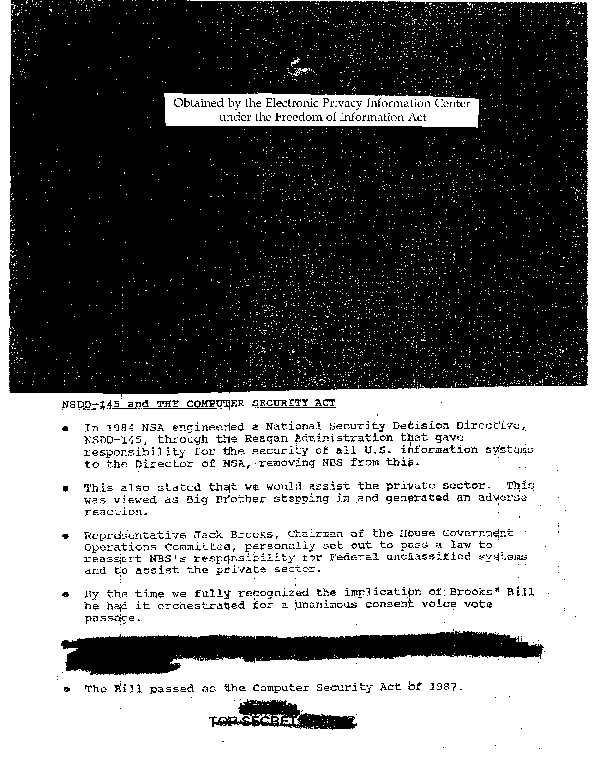
Before the 1987 law was passed however, Clinton Brooks, a Special Assistant to NSA Director Lieutenant General William Odom, wrote a Top Secret Memorandum which stated: “In 1984 NSA engineered a National Security Decision Directive, NSDD-145, through the Reagan Administration that gave responsibility for the security of all US information systems to the Director of NSA, removing NBS [National Bureau of Standards] from this.”
Conceived as a follow-on to the Reagan administration’s infamous 1981 Executive Order 12333, which trashed anemic congressional efforts to rein-in America’s out-of-control spy agencies, NSDD-145 handed power back to the National Security Agency and did so to the detriment of civilian communication networks.
Scarcely a decade after Senator Frank Church warned during post-Watergate hearings into government surveillance abuses, that NSA’s “capability at any time could be turned around on the American people, and no American would have any privacy left, such is the capability to monitor everything: telephone conversations, telegrams, it doesn’t matter . . . there would be no place to hide,” the agency was at it with a vengeance.
“This [NSDD-145] also stated,” Brooks wrote, “that we would assist the private sector. This was viewed as Big Brother stepping in and generated an adverse reaction” in Congress that helped facilitate passage of the Act.
Engineered by future Iran-Contra felon, Admiral John Poindexter, President Reagan’s National Security Adviser who would later serve as President George W. Bush’s Director of DARPA’s Information Awareness Office, the Pentagon satrapy that brought us the Total Information Awareness program, NSDD-145 stated that the “Director, National Security Agency is designated the National Manager for Telecommunications and Automated Information Systems Security.”
NSA’s new mandate meant that the agency would “act as the government focal point for cryptography, telecommunications systems security, and automated information systems security.”
Additionally, NSA would “conduct, approve, or endorse research and development of techniques and equipment for telecommunications and automated information systems security for national security information.”
But it also authorized the agency to do more than that, granting it exclusive authority to “review and approve all standards, techniques, systems and equipments for telecommunications and automated information systems security.” As well, NSA was directed to “enter into agreements for the procurement of technical security material and other equipment, and their provision to government agencies, where appropriate, to private organizations, including government contractors, and foreign governments.”
In other words, NSA was the final arbiter when it came to setting standards for all government and private information systems; quite a coup for the agency responsible for standing-up Project MINARET, the Cold War-era program that spied on thousands of antiwar protesters, civil rights leaders, journalists and members of Congress, as recently declassified documents published by the National Security Archive disclosed.
NSA Games the System
Although the Computer Security Act passed unanimously by voice vote in both Houses of Congress, NSA immediately set-out to undercut the law and did so by suborning the National Bureau of Standards, now the National Institute of Standards and Technology (NIST).
The battle over the Clipper Chip would be the template for future incursions by the agency for the control, through covert infiltration, of regulatory bodies overseeing civilian communications.
According to the Clinton White House, Clipper “would provide Americans with secure telecommunications without compromising the ability of law enforcement agencies to carry out legally authorized wiretaps.”
Neither safe nor secure, Clipper instead would have handed government security agencies the means to monitor all communications while giving criminal networks a leg up to do the same.
In fact, as the Electronic Privacy Information Center (EPIC) discovered in documents unearthed through the Freedom of Information Act, the underlying algorithm deployed in Clipper, Skipjack, had been developed by NSA.
Cryptography expert Matt Blaze wrote a now famous 1994 paper on the subject before the algorithm was declassified, Protocol Failure in the Escrowed Encryption Standard: “The EES cipher algorithm, called ‘Skipjack’, is itself classified, and implementations of the cipher are available to the private sector only within tamper-resistant modules supplied by government-approved vendors. Software implementations of the cipher will not be possible. Although Skipjack, which was designed by the US National Security Agency (NSA), was reviewed by a small panel of civilian experts who were granted access to the algorithm, the cipher cannot be subjected to the degree of civilian scrutiny ordinarily given to new encryption systems.”
This was precisely as NSA and the Clinton administration intended.
A partially declassified 1993 NSA memo noted that “there will be vocal public doubts expressed about having a classified algorithm in the device we propose for the US law enforcement problem, the CLIPPER chip, we recommend the following to address this.” We don’t know what those agency recommendations were, however; more than 20 years after the memo was written they remain secret.
The memo continued: “If such people agree to this clearance and non disclosure process, we could go over the algorithm with them to let them develop confidence in its security, and we could also let them examine the detail design of the CLIPPER chip made for the US law enforcement problem to assure themselves that there were no trapdoors or other techniques built in. This would likely require crypto-mathematicians for the algorithm examination and microelectronics chip design engineers for the chip examination.”
But the extreme secrecy surrounding Skipjack’s proposed deployment in commercial products was the problem. Even if researchers learned that Clipper was indeed the government-mandated backdoor they feared, non-disclosure of these facts, backed-up by the threat of steep fines or imprisonment would hardly assure anyone of the integrity of this so-called review process.
“By far, the most controversial aspect of the EES system,” Blaze wrote, “is key escrow.”
“As part of the crypto-synchronization process,” Blaze noted, “EES devices generate and exchange a ‘Law Enforcement Access Field’ (LEAF). This field contains a copy of the current session key and is intended to enable a government eavesdropper to recover the cleartext.”
“The LEAF copy of the session key is encrypted with a device-unique key called the ‘unit key,’ assigned at the time the EES device is manufactured. Copies of the unit keys for all EES devices are to be held in ‘escrow’ jointly by two federal agencies that will be charged with releasing the keys to law enforcement under certain conditions.”
What those conditions were however, was far from clear. In fact, as we’ve since learned from Snowden’s cache of secret documents, even when the government seeks surveillance authorization from the FISA court, the court must rely on government assurances that dragnet spying is critical to the nation’s security. Such assurances, FISA court judge Reggie B. Walton noted, were systematically “misrepresented” by secret state agencies.
That’s rather rich considering that Walton presided over the farcical “trial” that upheld Bush administration demands to silence FBI whistleblower Sibel Edmonds under the state secrets privilege. Edmonds, a former contract linguist with the Bureau charged that top FBI officials had systematically covered-up wrongdoing at its language division and had obstructed agents’ attempts to roll-up terrorist networks before and after the 9/11 provocation, facts attested to by FBI whistleblower Coleen Rowley in her 2002 Memo to then-FBI Director Robert Mueller.
In 2009, Walton wrote that “The minimization procedures proposed by the government in each successive application and approved and adopted as binding by the orders of the FISC have been so frequently and systemically violated that it can fairly be said that this critical element of the overall BR regime has never functioned effectively.”
“The Court,” Walton averred, “must have every confidence that the government is doing its utmost to ensure that those responsible for implementation fully comply with the Court’s orders. The Court no longer has such confidence.”
Predating those critical remarks, a heavily-redacted 1993 Memo to then-Special Assistant to the President and future CIA chief, George Tenet, from FBI Director William Sessions noted that NSA “has developed a new encryption methodology and computer chip which affords encryption strength vastly superior to DES [Digital Encryption Standard], yet which allows for real time decryption by law enforcement, acting pursuant to legal process. It is referred to as ‘Clipper’.”
[Two redacted paragraphs] “if the devices are modified to include the ‘Clipper’ chip, they would be of great value to the Federal, state and local law enforcement community, especially in the area of counter narcotics, investigations, where there is a requirement to routinely communicate in a secure fashion.”
But even at the time Sessions’ memo was written, we now know that AT&T provided the Drug Enforcement Administration “routine access” to “an enormous AT&T database that contains the records of decades of Americans’ phone calls,” The New York Times reported, and had done so since 1987 under the auspices of DEA’s Hemisphere Project.
Furthermore, in the wake of Snowden revelations we also learned that listening in on the conversations of drug capos is low on NSA’s list of priorities. However, programs like X-KEYSCORE and TEMPORA, which copies all data flowing along fiber optic cables, encrypted and unencrypted alike, at petabyte scales, is supremely useful when it comes to building profiles of internet users by intelligence agencies.
This was an implicit goal of Clinton administration maneuvers to compel developers to insert Clipper into their product designs.
According to Sessions, “the ‘Clipper’ methodology envisions the participation of three distinct types of parties.” [Redacted] It is proposed that the second party, the two custodians of the ‘split’ key infostructure [sic], be comprised of two disinterested and trustworthy non law enforcement Government agencies or entities. Although, such decision and selection are left for the Administration, a list of reccommended [sic] agencies and entities has been prepared (and included in the text), [redacted]. This party would administer and oversee all facets of the ‘Clipper’ program and methodology.”
Based on NSDD-145′s mandate, one can assume “this party” would be NSA, the agency that designed the underlying algorithm that powered Clipper.
The Sessions memo averred: “The Clipper chip provides law enforcement access by using a special chip key, unique to each device. In the AT&T TSD 3600, a unique session key is generated, external to the Clipper chip for each call.”
“This session key,” the memo explained, “is given to the chip to control the encryption algorithm. A device unique ‘chip key’ is programmed into each Clipper at the time of manufacture. When two TSD 3600s go to secure operation, the device gives out its identification (ID) number and the session key encrypted in its chip key.”
Underlining a key problem with Clipper technology Sessions noted, “Anyone with access to the chip key for that identified device will be able to recover the session key and listen to the transmission simultaneously with the intended receiver. This design means that the list of chip keys associated with the chip ID number provides access to all Clipper secured devices, and thus the list must be carefully generated and protected. Loss of the list would preclude legitmate [sic] access to the encrypted information and compromise of the list could allow unauthorized access.”
In fact, that “anyone” could include fabulously wealthy drug gangs or bent corporations with the wherewithal to buy chip keys from suborned government key escrow agents!
Its ubiquity would be a key selling-point for universal deployment. The memo explained, “the NSA developed chip based ‘Clipper’ solution works with hardware encryption applications, such as those which might be used with regard to certain telecommunications and computers devices,” which of course would allow unlimited spying by “law enforcement.”
Such vulnerabilities built into EES chip keys by design not only enabled widespread government monitoring of internet and voice traffic, but with a few tweaks by encryption-savvy “rogues” could be exploited by criminal organizations.
In his 1994 paper Blaze wrote that “a rogue system can be constructed with little more than a software modification to a legal system. Furthermore, while some expertise may be required to install and operate a rogue version of an existing system, it is likely that little or no special skill would be required to install and operate the modified software.”
“In particular,” Blaze noted, “one can imagine ‘patches’ to defeat key escrow in EES-based systems being distributed over networks such as the Internet in much the same way that other software is distributed today.”
In the intervening years since Blaze observed how easy it would be to compromise key escrow systems by various bad actors, governments or criminals take your pick, the proliferation of malware powered botnets that infect hundreds of thousands of computers and smart phones every day–for blanket surveillance, fraud, or both–is a fact of life.
It didn’t help matters when it emerged that “escrow agents” empowered to unlock encrypted communications would be drawn from the National Institute of Standards and Technology and the Automated Services Division of the Treasury Department, government outposts riddled with “No Such Agency” moles.
As EPIC pointed out, “Since the enactment of the Computer Security Act, the NSA has sought to undercut NIST’s authority. In 1989, NSA signed a Memorandum of Understanding (MOU) which purported to transfer back to NSA the authority given to NIST.”
The MOU required that NIST request NSA’s “assistance” on all matters related to civilian cryptography. In fact, were NIST and NSA representatives on the Technical Working Group to disagree on standards, the ultimate authority for resolving disputes would rest solely with the Executive Branch acting through the President, the Secretary of Defense and the National Security Council, thus undercutting the clear intent of Congress when they passed the 1987 Computer Security Act.
EPIC noted:
“The memorandum effectively returned to NSA many of the powers rejected by the Computer Security Act. The MOU contained several key goals that were to NSA’s benefit, including: NSA providing NIST with ‘technical security guidelines in trusted technology, telecommunications security, and personal identification that may be used in cost-effective systems for protecting sensitive computer data;’ NSA ‘initiating research and development programs in trusted technology, telecommunications security, cryptographic techniques and personal identification methods’; and NSA being responsive to NIST ‘in all matters related to cryptographic algorithms and cryptographic techniques including but not limited to research, development, evaluation, or endorsement’.”
A critique of the Memorandum in 1989 congressional testimony by the General Accounting Office (GAO) emphasized: “At issue is the degree to which responsibilities vested in NIST under the act are being subverted by the role assigned to NSA under the memorandum. The Congress, as a fundamental purpose in passing the act, sought to clearly place responsibility for the computer security of sensitive, unclassified information in a civil agency rather than in the Department of Defense. As we read the MOU, it would appear that NIST has granted NSA more than the consultative role envisioned in the act.”
Five years after the GAO’s critical appraisal, NSA’s coup was complete.
“In 1994,” EPIC noted,
“President Clinton issued Presidential Decision Directive (PDD-29). This directive created the Security Policy Board, which has recommended that all computer security functions for the government be merged under NSA control.”
Since PDD-29 was issued matters have only gotten worse. In fact, NIST is the same outfit exposed in Snowden documents published by The Guardian and The New York Times that allowed NSA to water down encryption and build backdoors into the Dual EC DRBG standard adopted by the Institute in 2006.
“Eventually, NSA became the sole editor.”
Besieged by widespread opposition, the Clinton administration was out maneuvered in the court of public opinion and by 1996 had abandoned Clipper. However, this proved to be a pyrrhic victory for security-minded researchers and civil libertarians as we have since learned from Edward Snowden’s revelations.
Befitting a military-intelligence agency, the dark core of America’s deep state, NSA was fighting a long war–and they were playing for keeps.
.
Monday, August 19, 2013
Bloomberg Proposes Fingerprinting at Public Housing
Bloomberg Proposes Fingerprinting at Public Housing — Democratic Mayoral Hopefuls Pounce

Richard French
Published on Aug 16, 2013
Richard French and the RFL panel discuss New York City Mayor Michael Bloomberg's proposal to install fingerprint keypads in public housing.
.
Wednesday, August 14, 2013
The New, Improved 1984

(August 12, 2013)
The new, improved version of 1984 is based on complicity.
George Orwell's prescient book 1984 envisioned a technologically enabled authoritarian state of ubiquitous surveillance, propaganda and fear that constantly rewrote history to suit the needs of the present regime. Published in 1949, 1984 took the totalitarian templates of Nazi Germany and the Soviet Union and extended them into a future where the state employed technology to perfect not only control of the populace via police state repression but control of their minds via propaganda extolling the state and revising "facts" to support the current party line.
Welcome to the new, improved 1984, America 2013.
Ubiquitous surveillance: check.
Ubiquitous propaganda extolling the state and central bank: check
Perpetual fear-mongering: check
Perpetual war against an unseen enemy who can never be defeated: check
Police state with essentially unlimited powers to suppress "enemies of the state": check
Continual revision of history to support the current party line: check.
Have you noticed that every key metric of the economy is constantly being revised, rewriting history and installing a shiny new set of "facts"? In a recent podcast I recorded with Chris Martenson of Peak Prosperity, Chris pointed out that downward revisions in economic data are made only when the data point is safely over the horizon of history; that the U.S. GDP dipped into negative numbers in 2011 was masked at the time with the usual ginned-up positive numbers, and revised down to an approximation of reality years later when the reality has zero impact on the public perception of the state-managed "recovery."
The "headline number" is always positive, and its downward revision buried in an avalanche of new data. The revisions are so constant and so extreme that the recognition of this constant revision of history to suit the political needs of the current regime has been numbed; everyone knows the numbers are intended to paint a positive picture of a devolving, fragile economy and society, but we prefer this propaganda illusion to the harsh reality.
Why? Because half of us are getting a direct check, benefit or payment from the state. Over 61 million people get a check from Social Security, over 50 million draw Medicare benefits, another 50 million get Medicaid benefits, 47 million receive SNAP food stamp benefits, 22 million people work directly for the state on all levels, millions more work for government contractors that are effectively proxies of the state, millions more receive Federally funded extended unemployment, retirement checks, Section 8 housing benefits, and so on.
Orwell underestimated the power of complicity. Once a citizen receives a direct payment from the state, the state has purchased their complicity, for no matter how much that citizen may complain privately about the state, he or she will never risk the payment/benefit by resisting the state in a politically meaningful way.
Once you get a check from the state, you begin loving your servitude. The collusion of the state and its central bank is truly a thing of authoritarian beauty: the central bank (the Federal Reserve) creates money out of thin air and buys government bonds with the new money. The state can thus borrow unlimited sums at low rates of interest, and continue to send tens of millions of individual payments out to buy the passivity and complicity of its citizens.
The state is great when it sends you money, never mind where or how it gets the money or the incalculable costs of subservience and complicity.
We don't hate Big Brother; we don't care about Big Brother or the fear-mongering or the rewriting of history or any of the rest of it, as long as the state's money flows to our individual account. Our complaints are as hollow as the state's financial "facts."
.
Wednesday, June 26, 2013
14 Incredibly Creepy Surveillance Technologies That Big Brother Will Be Using To Spy On You
 By Michael, on July 9th, 2012

Most of us don’t think much about it, but the truth is that people are being watched, tracked and monitored more today than at any other time in human history. The explosive growth of technology in recent years has given governments, spy agencies and big corporations monitoring tools that the despots and dictators of the past could only dream of. Previous generations never had to deal with “pre-crime” surveillance cameras that use body language to spot criminals or unmanned drones watching them from far above. Previous generations would have never even dreamed that street lights and refrigerators might be spying on them. Many of the incredibly creepy surveillance technologies that you are about to read about are likely to absolutely astound you. We are rapidly heading toward a world where there will be no such thing as privacy anymore. Big Brother is becoming all-pervasive, and thousands of new technologies are currently being developed that will make it even easier to spy on you. The world is changing at a breathtaking pace, and a lot of the changes are definitely not for the better.
The following are 14 incredibly creepy surveillance technologies that Big Brother will be using to watch you….
#1 “Pre-Crime” Surveillance Cameras
A company known as BRS Labs has developed “pre-crime” surveillance cameras that can supposedly determine if you are a terrorist or a criminal even before you commit a crime.
Does that sound insane?
Well, authorities are taking this technology quite seriously. In fact, dozens of these cameras are being installed at major transportation hubs in San Francisco….
In its latest project BRS Labs is to install its devices on the transport system in San Francisco, which includes buses, trams and subways.
The company says will put them in 12 stations with up to 22 cameras in each, bringing the total number to 288.
The cameras will be able to track up to 150 people at a time in real time and will gradually build up a ‘memory’ of suspicious behaviour to work out what is suspicious.
#2 Capturing Fingerprints From 20 Feet Away
Can you imagine someone reading your fingerprints from 20 feet away without you ever knowing it?
This kind of technology is actually already here according to POPSCI….
Gaining access to your gym or office building could soon be as simple as waving a hand at the front door. A Hunsville, Ala.-based company called IDair is developing a system that can scan and identify a fingerprint from nearly 20 feet away. Coupled with other biometrics, it could soon allow security systems to grant or deny access from a distance, without requiring users to stop and scan a fingerprint, swipe an ID card, or otherwise lose a moment dealing with technology.
Currently IDair’s primary customer is the military, but the startup wants to open up commercially to any business or enterprise that wants to put a layer of security between its facilities and the larger world. A gym chain is already beta testing the system (no more using your roommate’s gym ID to get in a free workout), and IDair’s founder says that at some point his technology could enable purchases to be made biometrically, using fingerprints and irises as unique identifiers rather than credit card numbers and data embedded in magnetic strips or RFID chips.
.
Friday, June 07, 2013
Documents: U.S. mining data from 9 leading Internet firms; companies deny knowledge

Video: Members of Congress and The White House are defending a top secret NSA program that continues to collect data from millions of phone records, but civil liberties supporters remain skeptical. The Post’s Ellen Nakashima explains.
By Barton Gellman and Laura Poitras, Updated: Thursday, June 6, 9:09 PM
The National Security Agency and the FBI are tapping directly into the central servers of nine leading U.S. Internet companies, extracting audio and video chats, photographs, e-mails, documents, and connection logs that enable analysts to track one target or trace a whole network of associates, according to a top-secret document obtained by The Washington Post.
The program, code-named PRISM, has not been made public until now. It may be the first of its kind. The NSA prides itself on stealing secrets and breaking codes, and it is accustomed to corporate partnerships that help it divert data traffic or sidestep barriers. But there has never been a Google or Facebook before, and it is unlikely that there are richer troves of valuable intelligence than the ones in Silicon Valley.
Equally unusual is the way the NSA extracts what it wants, according to the document: “Collection directly from the servers of these U.S. Service Providers: Microsoft, Yahoo, Google, Facebook, PalTalk, AOL, Skype, YouTube, Apple.”
PRISM was launched from the ashes of President George W. Bush’s secret program of warrantless domestic surveillance in 2007, after news media disclosures, lawsuits and the Foreign Intelligence Surveillance Court forced the president to look for new authority.
Congress obliged with the Protect America Act in 2007 and the FISA Amendments Act of 2008, which immunized private companies that cooperated voluntarily with U.S. intelligence collection. PRISM recruited its first partner, Microsoft, and began six years of rapidly growing data collection beneath the surface of a roiling national debate on surveillance and privacy. Late last year, when critics in Congress sought changes in the FISA Amendments Act, the only lawmakers who knew about PRISM were bound by oaths of office to hold their tongues.
The court-approved program is focused on foreign communications traffic, which often flows through U.S. servers even when sent from one overseas location to another. Between 2004 and 2007, Bush administration lawyers persuaded federal FISA judges to issue surveillance orders in a fundamentally new form. Until then the government had to show probable cause that a particular “target” and “facility” were both connected to terrorism or espionage.
In four new orders, which remain classified, the court defined massive data sets as “facilities” and agreed to occasionally certify that the government had reasonable procedures in place to minimize collection of “U.S. persons” data without a warrant.
Several companies contacted by The Post said they had no knowledge of the program and responded only to individual requests for information.
“We do not provide any government organization with direct access to Facebook servers,” said Joe Sullivan, chief security officer for Facebook. “When Facebook is asked for data or information about specific individuals, we carefully scrutinize any such request for compliance with all applicable laws, and provide information only to the extent required by law.”
.
Sunday, February 24, 2013
Big Brother Wears Google Glasses

Photo (Courtesy: http://bestandroidlookout.blogspot.com/2012/11/google-glass-project-glass-from-google.html)
An Orwellian Looking Glass
by ALYSSA ROHRICHT
In 2014, for a mere $1,500, you can literally have Big Brother strapped to your retinas. It isn’t marketed that way, of course. Instead, Google Glass is marketed as making “augmented reality” a part of our every day lives. And while Google’s mantra may be “Don’t Be Evil” (though the company’s own morality is questionable at best), you can be assured that the government, the Secret Service, and corporations are chomping at the bit to get ahold of this veritable gold mine of information.
“Imagine your brain being augmented by Google,” Google CEO and co-founder Larry Page said in a 2004 interview. And that’s now something we no longer have to imagine. In a teaser-video for Google Glass, we’re shown the viewer flying an airplane, playing sports, ice sculpting, and playing with a dog, all the while the glasses display the time, the temperature, and incoming phone calls in the upper right view frame of the glasses-wearer. The glasses take instant photos, videos, and even display information from the internet, including translating text and an instant GPS feature.
It is hard not to make the connection between Google Glass and George Orwell‘s Big Brother lurking around every corner of the dystopian novel. In Orwell’s nightmarish future world, Big Brother – via telescreens that can never be turned off – can literally see into every space of the city. He is in your bed room, at work, on the street, and peering down every hallway. With Google Glass, Big Brother won’t need a telescreen and he won’t need to spy on citizens. Instead, citizens will do the spying for him. Google Glass will constantly be gathering real-time information about your every single movement. What you see, what you hear, where you go and how you get there, who you speak with and what about, what you eat, drink, purchase, what you research, what you read on the street and in books and even what you do in the privacy of your home.
Gold mine is an understatement. Advertisers and corporations have been data mining for years, and we already give them most of this information through what we type on search engines, the websites we visit, and even through our smart phones and GPS devices. And they’ve been using that information to target us with tailored advertisements expertly based on our patterns of interests ripped directly from that information. Google Glass doesn’t necessarily do anything new, but it is the ease with which we are offering up our data on a silver platter that is transforming the data mining world. We aren’t just inviting these companies – and furthermore, the government – to view our thoughts, patterns, and consumer habits when we access the web. Now we’re inviting them into our private lives even further and literally placing them at the forefront of everything we do by affixing them directly in front of our faces 24/7.
Obviously, I’m not the first to criticize this new gadget, nor am I the first to see the glaring connection to our impending Orwellian future. Mic Wright writes in The Kernel that “Project Glass is the telescreen made real, strapped directly onto your face, pumping adverts into your retina, encouraging you to perpetually jones for more information in a way that will make today’s Twitter addicts seem slothful and non-reactive.” And it is true. We are not only giving up our last semblances of privacy, we are also succumbing even further to our ever-growing need to be “tapped-in” to the interweb and the endless stream of useless information it offers us.
The ramifications of the ease of accessibility for government and security agencies is even more frightening, especially in the face of the recent Justice Department “white paper” obtained by NBC earlier this month detailing the legal justifications that the Obama Administration has claimed for the targeting and killing of American citizens without trial. The paper was written in an attempt to legitimize the 2011 drone killings of three U.S. citizens in Yemen, including Samir Khan and Anwar al-Awlaki, and later Abdulrahman, al-Awlaki’s 16-year-old son. The paper argues that the targeted killings of U.S. citizens are justified and legal under U.S. law if a threat is “imminent” (though for a specific attack to be imminent does not mean that it must currently be under way at the time), a high-level official has provided evidence that the person in question may be a threat, and if capture is difficult. The incredibly vague memo leaves much room for interpretation, and of course, this is intentional. When questioned about the right to due process under the Constitution, General Eric Holder responded in March of 2012 saying,
“Some have argued that the President is required to get permission from a federal court before taking action against a United States citizen who is a senior operational leader of al Qaeda or associated forces. This is simply not accurate. “Due process” and “judicial process” are not one and the same, particularly when it comes to national security. The Constitution guarantees due process, not judicial process.”
Basically, if the Executive Branch says you’re guilty, that’s all the due process you need. Never mind a court, a trial by jury, or the notion that you’re innocent until proven guilty. The word of our government should be all that we require for any legal justifications.
The prospects for the information that Google Glass can provide to our government, which now reserves the right to detain us without charge (under the National Defense Authorization Act) and even immediately and covertly put an order out for our deaths, are terrifying, to say the least.
“In the past no government had the power to keep its citizens under constant surveillance. The invention of print, however, made it easier to manipulate public opinion, and the film and the radio carried the process further. With the development of television, and the technical advance which made it possible to receive and transmit simultaneously on the same instrument, private life came to an end.”
This dire prophecy is from Orwell’s 1984 and never before has this statement rang so true as today. As Wright wrote in his piece, in a way, Google Glasses are something “grimly inevitable.” It is not surprising that technology and access to the web has finally made the push not just to the tips of our fingertips but literally to right before our eyes at every moment. Not surprising, but worthy of resistance nonetheless. Wright notes,
“What will be lost with the proliferation of Google glasses, and what will be gained? Project Glass will not materially improve our lives. It will improve Google’s databases and make it easier to sell, sell, sell us more products and services. Ultimately, whatever the utopian rhetoric of Google’s cash-rich, sense-light engineering team, Project Glass will make you the easiest piece of meat to market to in history”
“BIG BROTHER IS WATCHING YOU,” Orwell wrote in 1984. For years, we’ve carried Big Brother around in our pockets, willingly giving up our information on the web and through our phones. Now, as those in the tech world clamor to be one of the lucky “bold, creative individuals” to get to try out Google Glass for free and before the wide-release, we will lose our last vestiges of privacy. Facecrime is no longer just a term in a book to describe an illegal act given away by a facial expression. Now, it has become our reality – our “augmented” reality.
Alyssa Rohricht maintains Crash Culture and can be reached at aprohricht@msn.com.
.
Thursday, July 12, 2012
Gadgets work under your skin --- but are you ready?

By Jim Giles
New Scientist Magazine
Why the the cyborg future will come to be
JewishWorldReview.com | Left your cell phone at home again? A solution is at hand: Make sure it's with you at all times by having it implanted in your arm.
But given the opportunity, would you want your gadget to be a permanent part of you? The question may need answering sooner than you think.
Researchers at Autodesk, a software company in Toronto, Canada, checked to see whether the methods we currently use to interface with our gadgets work when the device is implanted in human tissue. The answer was a resounding "yes."
A button, an LED and a touch sensor all functioned appropriately when embedded under the skin of a cadaver's arm. The team was even able to communicate transcutaneously using a Bluetooth connection and charge the electronics wirelessly.
"That's the bottom line," says Christian Holz of the Autodesk team, who presented the work in May at the Conference on Human Factors in Computing Systems in Austin, Texas. "Traditional user interfaces work through the skin."
Would anyone want a piece of consumer electronics inside their body? There is something intrinsically creepy about the idea. Plus there's a risk that the device could malfunction and need to be removed, or that it could infect the surrounding tissue, not to mention the dystopian vision of a society in which our phones become tracking devices that we can never be free of.
Yet there are reasons for thinking that the cyborg future will come to be. The research team, who worked with University of Toronto anatomist Anne Agur, says that medical risks, such as infection, need to be better understood before a device can be implanted into a living person. But it's a problem that manufacturers of existing implants, such as stents and replacement hips, have successfully tackled.
There are also clear benefits to implanted electronics.
"The device is always there," says Holz. "You cannot lose it." And implants provide new interface methods. A gadget similar to a smartphone could provide a calendar alert by means of a gentle sub-skin vibration, for example.
And that creepy feeling? It is a common reaction now, but may lessen as people become familiar with the technology. The idea of using a machine to assist a human heart was once deemed unnatural, for example, but the insertion of a pacemaker is now a routine procedure.
"In general, the trend has been that people are more and more willing to incorporate bits of the machine world into themselves," says Sherry Turkle, a sociologist at the Massachusetts Institute of Technology.
"The perception (of this technology) 10 years ago would differ from today and from what we would get in 10 years' time," agrees Holz.
Turkle wants society to think seriously about the potential downsides of implanted electronics, including tracking. But she has also studied how people relate to their cellphones and notes that some talk about them as if they were cyborgs.
"People literally cannot be without this device," Turkle says. "They don't feel the same when they are not connected. We live with our phones as if they are part of our body."
If we feel that way, perhaps having a phone implanted isn't unnatural at all. It may just be the obvious thing to do with a device that we already feel highly attached to.
Thursday, May 24, 2012
FBI asking Internet Companies for Wiretap-Friendly Back Door
By VC | May 8th, 2012

The push to make the internet a controlled space used to spy on citizens, where supposedly “private” information is automatically shared with authorities, might soon reach another threshold. A new report suggests that the FBI is currently discussing with major internet companies such as Microsoft, Facebook, Yahoo and Google to build backdoor accesses to their services to facilitate government surveillance. The FBI is also attempting to convince these companies to support an upcoming law that would allow the outright spying of social networks, VoIP, and Web e-mail providers. The law, like many other similar ones that are being proposed and adopted, is in direct violation with the 4th Amendment, which states: “The right of the people to be secure in their persons, houses, papers, and effects, against unreasonable searches and seizures, shall not be violated, and no warrants shall issue, but upon probable cause, supported by oath or affirmation, and particularly describing the place to be searched, and the persons or things to be seized.”
Of course, those who wrote the Bill of Rights were not expecting the advent of the internet and the storing of information on remote servers. The application of its principles is however nebulous today. However, if those in power truly wished (and if citizens somewhat cared) to preserve the spirit of the Amendment (which was created to protect citizens from government oppression and tyranny) they would have extended the principles of the Fourth Amendment to cyberspace. We are however witnessing the exact opposite: The advent of the internet, of social networks and other technologies appears to be the perfect opportunity for state authorities to deny these historic rights to citizens and to move towards a high tech police state.
Here’s an article on these FBI discussions with internet companies.
FBI: We need wiretap-ready Web sites – now
CNET learns the FBI is quietly pushing its plan to force surveillance backdoors on social networks, VoIP, and Web e-mail providers, and that the bureau is asking Internet companies not to oppose a law making those backdoors mandatory.
The FBI is asking Internet companies not to oppose a controversial proposal that would require firms, including Microsoft, Facebook, Yahoo, and Google, to build in backdoors for government surveillance.
In meetings with industry representatives, the White House, and U.S. senators, senior FBI officials argue the dramatic shift in communication from the telephone system to the Internet has made it far more difficult for agents to wiretap Americans suspected of illegal activities, CNET has learned.
The FBI general counsel’s office has drafted a proposed law that the bureau claims is the best solution: requiring that social-networking Web sites and providers of VoIP, instant messaging, and Web e-mail alter their code to ensure their products are wiretap-friendly.
“If you create a service, product, or app that allows a user to communicate, you get the privilege of adding that extra coding,” an industry representative who has reviewed the FBI’s draft legislation told CNET. The requirements apply only if a threshold of a certain number of users is exceeded, according to a second industry representative briefed on it.
The FBI’s proposal would amend a 1994 law, called the Communications Assistance for Law Enforcement Act, or CALEA, that currently applies only to telecommunications providers, not Web companies. The Federal Communications Commission extended CALEA in 2004 to apply to broadband networks.
FBI Director Robert Mueller is not asking companies to support the bureau’s CALEA expansion, but instead is “asking what can go in it to minimize impacts,” one participant in the discussions says. That included a scheduled trip this month to the West Coast — which was subsequently postponed — to meet with Internet companies’ CEOs and top lawyers.
A further expansion of CALEA is unlikely to be applauded by tech companies, their customers, or privacy groups. Apple (which distributes iChat and FaceTime) is currently lobbying on the topic, according to disclosure documents filed with Congress two weeks ago. Microsoft (which owns Skype and Hotmail) says its lobbyists are following the topic because it’s “an area of ongoing interest to us.” Google, Yahoo, and Facebook declined to comment.
In February 2011, CNET was the first to report that then-FBI general counsel Valerie Caproni was planning to warn Congress of what the bureau calls its “Going Dark” problem, meaning that its surveillance capabilities may diminish as technology advances. Caproni singled out “Web-based e-mail, social-networking sites, and peer-to-peer communications” as problems that have left the FBI “increasingly unable” to conduct the same kind of wiretapping it could in the past.
In addition to the FBI’s legislative proposal, there are indications that the Federal Communications Commission is considering reinterpreting CALEA to demand that products that allow video or voice chat over the Internet — from Skype to Google Hangouts to Xbox Live — include surveillance backdoors to help the FBI with its “Going Dark” program. CALEA applies to technologies that are a “substantial replacement” for the telephone system.
“We have noticed a massive uptick in the amount of FCC CALEA inquiries and enforcement proceedings within the last year, most of which are intended to address ‘Going Dark’ issues,” says Christopher Canter, lead compliance counsel at the Marashlian and Donahue law firm, which specializes in CALEA. “This generally means that the FCC is laying the groundwork for regulatory action.”
Subsentio, a Colorado-based company that sells CALEA compliance products and worked with the Justice Department when it asked the FCC to extend CALEA seven years ago, says the FBI’s draft legislation was prepared with the compliance costs of Internet companies in mind.
In a statement to CNET, Subsentio President Steve Bock said that the measure provides a “safe harbor” for Internet companies as long as the interception techniques are “‘good enough’ solutions approved by the attorney general.”
Another option that would be permitted, Bock said, is if companies “supply the government with proprietary information to decode information” obtained through a wiretap or other type of lawful interception, rather than “provide a complex system for converting the information into an industry standard format.”
A representative for the FBI told CNET today that: “(There are) significant challenges posed to the FBI in the accomplishment of our diverse mission. These include those that result from the advent of rapidly changing technology. A growing gap exists between the statutory authority of law enforcement to intercept electronic communications pursuant to court order and our practical ability to intercept those communications. The FBI believes that if this gap continues to grow, there is a very real risk of the government ‘going dark,’ resulting in an increased risk to national security and public safety.”
Next steps
The FBI’s legislation, which has been approved by the Department of Justice, is one component of what the bureau has internally called the “National Electronic Surveillance Strategy.” Documents obtained by the Electronic Frontier Foundation show that since 2006, Going Dark has been a worry inside the bureau, which employed 107 full-time equivalent people on the project as of 2009, commissioned a RAND study, and sought extensive technical input from the bureau’s secretive Operational Technology Division in Quantico, Va. The division boasts of developing the “latest and greatest investigative technologies to catch terrorists and criminals.”But the White House, perhaps less inclined than the bureau to initiate what would likely be a bruising privacy battle, has not sent the FBI’s CALEA amendments to Capitol Hill, even though they were expected last year. (A representative for Sen. Patrick Leahy, head of the Judiciary committee and original author of CALEA, said today that “we have not seen any proposals from the administration.”)
Mueller said in December that the CALEA amendments will be “coordinated through the interagency process,” meaning they would need to receive administration-wide approval.
Stewart Baker, a partner at Steptoe and Johnson who is the former assistant secretary for policy at Homeland Security, said the FBI has “faced difficulty getting its legislative proposals through an administration staffed in large part by people who lived through the CALEA and crypto fights of the Clinton administration, and who are jaundiced about law enforcement regulation of technology — overly jaundiced, in my view.”
On the other hand, as a senator in the 1990s, Vice President Joe Biden introduced a bill at the FBI’s behest that echoes the bureau’s proposal today. Biden’s bill said companies should “ensure that communications systems permit the government to obtain the plain text contents of voice, data, and other communications when appropriately authorized by law.” (Biden’s legislation spurred the public release of PGP, one of the first easy-to-use encryption utilities.)
The Justice Department did not respond to a request for comment. An FCC representative referred questions to the Public Safety and Homeland Security Bureau, which declined to comment.
From the FBI’s perspective, expanding CALEA to cover VoIP, Web e-mail, and social networks isn’t expanding wiretapping law: If a court order is required today, one will be required tomorrow as well. Rather, it’s making sure that a wiretap is guaranteed to produce results.
But that nuanced argument could prove radioactive among an Internet community already skeptical of government efforts in the wake of protests over the Stop Online Piracy Act, or SOPA, in January, and the CISPA data-sharing bill last month. And even if startups or hobbyist projects are exempted if they stay below the user threshold, it’s hardly clear how open-source or free software projects such as Linphone, KPhone, and Zfone — or Nicholas Merrill’s proposal for a privacy-protective Internet provider — will comply.
The FBI’s CALEA amendments could be particularly troublesome for Zfone. Phil Zimmermann, the creator of PGP who became a privacy icon two decades ago after being threatened with criminal prosecution, announced Zfone in 2005 as a way to protect the privacy of VoIP users. Zfone scrambles the entire conversation from end to end.
“I worry about the government mandating backdoors into these kinds of communications,” says Jennifer Lynch, an attorney at the San Francisco-based Electronic Frontier Foundation, which has obtained documents from the FBI relating to its proposed expansion of CALEA.
As CNET was the first to report in 2003, representatives of the FBI’s Electronic Surveillance Technology Section in Chantilly, Va., began quietly lobbying the FCC to force broadband providers to provide more-efficient, standardized surveillance facilities. The FCC approved that requirement a year later, sweeping in Internet phone companies that tie into the existing telecommunications system. It was upheld in 2006 by a federal appeals court.
But the FCC never granted the FBI’s request to rewrite CALEA to cover instant messaging and VoIP programs that are not “managed”–meaning peer-to-peer programs like Apple’s Facetime, iChat/AIM, Gmail’s video chat, and Xbox Live’s in-game chat that do not use the public telephone network.
If there is going to be a CALEA rewrite, “industry would like to see any new legislation include some protections against disclosure of any trade secrets or other confidential information that might be shared with law enforcement, so that they are not released, for example, during open court proceedings,” says Roszel Thomsen, a partner at Thomsen and Burke who represents technology companies and is a member of an FBI study group. He suggests that such language would make it “somewhat easier” for both industry and the police to respond to new technologies.
But industry groups aren’t necessarily going to roll over without a fight. TechAmerica, a trade association that includes representatives of HP, eBay, IBM, Qualcomm, and other tech companies on its board of directors, has been lobbying against a CALEA expansion. Such a law would “represent a sea change in government surveillance law, imposing significant compliance costs on both traditional (think local exchange carriers) and nontraditional (think social media) communications companies,” TechAmerica said in e-mail today.
Ross Schulman, public policy and regulatory counsel at the Computer and Communications Industry Association, adds: “New methods of communication should not be subject to a government green light before they can be used.”
- Source: CNet
Tuesday, February 07, 2012
FBI Enlists Internet Café Owners to Spy on Customers
Monday, 6. February 2012
The Government’s Pretexts for Arresting Virtually Anyone

The CAT program, funded by the State and Local Anti-Terrorism Training program (SLATT) is described as a “tool to engage members of the local community in the fight against terrorism.” The program interprets “local community” to mean businesses, and only registered businesses may access the program’s flyers listing “potential indicators” of terrorist activity.
Each flyer is designed for a particular kind of business. For example, this list was prepared for owners of internet cafes. Unquestionably, someone planning a terrorist attack has engaged in one or more of the “suspicious” activities on that list. But so, too, have most of the estimated 289 million computer users in this country.
The government’s flyer designates people as suspicious if they “always pay cash” at an internet café. That’s a jaw-dropping assumption considering that we’re talking about businesses that sell $2 cups of joe, not $600 airline tickets. Good luck paying with a credit card for a purchase under $10.
Evidence that one has a “residential based internet provider” (such as Comcast or AOL) is another pretext for government snooping. If your home internet connection is unreliable, if you are on travel, or if you simply relish a good cup of coffee with your internet browsing, you run the risk of acquiring an FBI file. Trying to shield personal information on your computer screen from the prying eyes of others will mark you as a potential terrorist, also.
It is officially creepy to use a café hotspot to download “photos, maps or diagrams” of a stadium, metro rail stop, or any “populated locations.” To be safe, confine your travel plans to the Alaskan tundra. And, should there be another terrorist attack, do not demonstrate any “preoccupation with press coverage” of the attack. Just move along–nothing to see here.
If you engage in these or any other “suspicious” activities listed on CAT flyers, businesses are encouraged to “gather information” about you, including “license plates, vehicle description, names used, languages spoken, ethnicity, etc.” At least 25 CAT flyers, collected by Public Intelligence, are known to exist.
The CAT list of “suspicious” internet café activities suggests appalling ignorance of the ways ordinary Americans use computers. Those who are computerless can become surveillance targets, too, if they own guns or precious metals, store a seven-day supply of food, buy a flashlight, believe in conspiracies or participate in peaceful demonstrations.
The government’s paranoia would be laughable were it not for the potential consequences for citizens who find themselves in its crosshairs. Under the 2012 National Defense Authorization Act, the government may detain indefinitely any terrorism suspects–including U.S. citizens. And, since the government has created pretexts for arresting virtually anyone, no one is safe.
The consequences for public safety are no less grim. If the FBI cannot distinguish between legitimate computer use and credible evidence of terrorist activities, it cannot zero in on genuine threats. So, what is the purpose of Big Brother and his business partners spying on millions of Americans if it doesn’t make us any safer? Bueller? Bueller? Anyone?
Linda Lewis is a policy analyst with degrees in emergency management and geosciences. Her experience includes 13 years as a policy analyst and planner for the U.S. government. During that time, she brought attention to serious deficiencies in government preparedness prior to the disasters that confirmed her analyses. Those included emergency communications (9/11 terrorist attacks), federal assistance (hurricane Katrina) and decision making (Columbia shuttle disaster).
Source
.
Subscribe to:
Posts (Atom)