AND THE THIRD ANGEL FOLLOWED THEM, SAYING WITH A LOUD VOICE, IF ANY MAN WORSHIP THE BEAST AND HIS IMAGE, AND RECEIVE HIS MARK IN HIS FOREHEAD, OR IN HIS HAND.
*** REVELATION 14:9
Showing posts with label European Bishops’ Conferences. Show all posts
Showing posts with label European Bishops’ Conferences. Show all posts
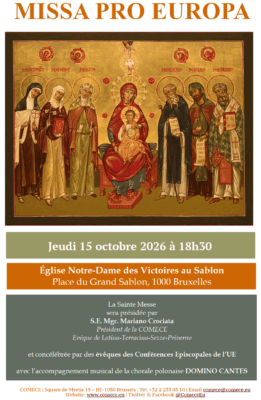
EVENT | ‘Mass for Europe’ to be celebrated in Brussels on 15 October
The public is warmly invited to join the bishops of the European Union for the Mass for Europe, to be celebrated on Thursday, 15 October 2026, at 18:30 at the Église Notre-Dame des Victoires au Sablon, Place du Grand Sablon, 1000 Brussels. The celebration is open to everyone and no registration is required. Download Poster
The Mass will take place in the context of the autumn 2026 Assembly of the Commission of the Bishops’ Conferences of the European Union (COMECE), to be held in Brussels from 14 to 16 October. The Assembly will bring together the bishops who compose COMECE and represent the episcopal conferences of the EU Member States.
The Mass will be presided over by H.E. Mgr Mariano Crociata, President of COMECE, and concelebrated by the bishops participating in the Assembly. Musical accompaniment will be provided by the Polish choir Domino Cantus.
Annual Article 17 TFEU EU-Churches meeting: COMECE urges stronger action to tackle religious discrimination and protect freedom of religion in the EU
COMECE participated in the Article 17 TFEU Annual High-Level Meeting between the European Commission and religious leaders on the theme “Living together in increasingly polarised societies” on Monday, 17 November 2024. During the meeting, COMECE Vice-President, Mgr Czeslaw Kozon, called for stronger institutional action, including “the appointment of an EU Coordinator on combating anti-Christian hatred and the urgent need for improved religious literacy”. Read the COMECE contribution | Photo Gallery
The meeting was hosted by Magnus Brunner, EU Commissioner for Home Affairs and Migration and the Commissioner responsible for the implementation of the Article 17 TFEU Dialogue. COMECE was represented by its Vice-President, Mgr Czeslaw Kozon, Bishop of Copenhagen.
COMECE-CCEE Presidencies: "let’s work all together for a recovery that leaves no one behind"
The annual COMECE-CCEE Presidencies meeting was held on Wednesday, 3 June 2020 with a special focus on the impact of the Covid-19 pandemic on the day-to-day life in the Church and European societies, as well as on the Catholic Church's contribution to "a just recovery that leaves no-one behind".
At the centre of the debate was the situation of the Church in Europe, together with future prospects in the critical context of the pandemic caused by the SARS-CoV-19 virus.
The COMECE and CCEE Presidencies analysed the effects of the pandemic on our civil and ecclesial communities, and identified possibilities for cooperation for the future Church life in Europe.
Renewing the Catholic Church's closeness to all those struggling against the pandemic - the victims, their families and all health workers, volunteers and the faithful who have been and are in the front line, caring for those affected and bringing them relief - the prelates expressed their concern "about the economic crisis and the consequent loss of a large number of jobs", and the hope that in Europe "we will all work together for a recovery that leaves no one behind".
In this time of crisis, which showed the great limits of individualism, the two Presidencies stressed the central role played by the family, "the true cell of solidarity and sharing, but also a place to pray together. Investing in the family - they continued - is the first step towards a just social, economic and ecclesial recovery".
Thanking the many priests for their crucial and generous service during this period, some also sacrificing their own lives, the participants of the meeting analysed the role played by social media in prayer and streaming celebrations.
These new forms of religious practice, relationships, presence and sharing of faith invite us not only to evaluate the possibility of giving a new meaning to faith and the Church, but also to work to make many faithful rediscover the element of full sacramentality of religious celebrations in places of worship, which the use of new technologies cannot ensure.
The two Presidencies also dwelt on the strong limitation imposed on freedom of religion in the context of the closure of places of worship and the prohibition of liturgies, calling for the re-establishment of normal State-Church relations based on dialogue and respect for fundamental rights.
In the follow up of the Future of Work Reflection, on 27-28 January 2020 COMECE hosted a 2-day capacity-building seminar gathering Catholic-inspired organisations to discuss possible ways to improve people’s working conditions in the global value chain.
The event comes after two years of work in which Catholic grassroot organisations and Christian social movements collected cases of human rights violations in the globalized economy.
Based on their experience, these organisations, active at the international and EU levels, contributed to the COMECE Reflection on the Future of Work, published in November 2018 and calling the EU “to play a constructive role in the ongoing negotiations for a binding UN treaty on business and human rights”.
During the meeting, COMECE and Catholic inspired organisations engaged in a dialogue with representatives of the EU Commission, of the International Labour Organisations (ILO) and of the International Trade Union Confederation (ITUC), highlighting the importance of promoting an international legal framework that protects workers, families and communities across the value chain in light of the challenges posed by the new forms of work on online platforms.
In the context of the ongoing review of the EU Action Plan on Human Rights and Democracy, the COMECE Assembly called the EU to take ambitious steps to ensure policy coherence between its trade, development, climate and human rights policies in line with the Sustainable Development Goals (DDGs). In particular they highlighted the importance of adopting binding and effective human rights legislation for EU-based transnational companies to ensure compliance of their actions throughout the entire supply chain with legal, social and environmental standards.
COMECE will continue supporting the initiatives of Catholic inspired NGOs, facilitating their exchange with the EU institutions.
Military Bishops in dialogue with the EU on human security
In the context of an increased attention to security concerns of European citizens, COMECE organised on Monday 8 April 2019 a first meeting between Military Bishops from across the European Union and EU military officials to enhance the cooperation towards a shared strategic culture across Europe.
This meeting allowed them to exchange on their respective military realities and on the EU’s response to current geopolitical and security challenges.
Witnessing a loss of trust in multilateral mechanisms and an expansion of conflict environments, accompanied by an omnipresence of digital technologies, Church representatives encourage the EU to strategically focus its policies on longstanding human security and sustainable peace.
In dialogue with General Claudio Graziano, Chairman of the EU Military Committee, EU Military Bishops highlighted the need for pursuing an integrated approach by better articulating military measures with civilian peace-building instruments promoting human, socio-economic and ecological development. As worldwide networks deeply rooted in local realities, religious actors can provide an important contribution in this regard.
In the Church’s understanding, security is essential because it protects human life and dignity. True security can only exist through sustainable peace. As stated in the COMECE reflection “Whose security? Whose defence?”, if not focusing on the security of persons, families and communities - including the respect for human rights and the rule of law - merely technical security measures may allow or even lead to a new conflict.
In the context of a recent UN report on the urgent need to develop policies that limit global warming to 1.5 degrees, Mgr. Jean-Claude Hollerich SJ, President of COMECE, together with all the other presidents of continental Bishops’ Conferences, calls politicians to work towards an ambitious implementation of the Paris Agreement. They ask for COP24 to prove a milestone in the path set out in 2015 in Paris.
Promoting the messages carried out by the Encyclical Letter Laudato Si’, Church leaders from all around the world call for ambitious and immediate actions to be taken to tackle and overcome the devastating effects of the climate crisis.
In their statement, Bishops’ Conferences from all continents urge world leaders to resist the temptation to look for short-term solutions without addressing the root causes and the long-term consequences.
The call is based on the principles of urgency, intergenerational justice, human dignity and human rights, ands demands policies that include the following elements:
keeping global warming below 1.5°C;
shifting towards sustainable lifestyles;
respecting the knowledge of indigenous communities;
implementing a financial paradigm shift in line with global climate accords;
transforming the energy sector by putting an end to the fossil fuel era and transitioning to renewable energy;
and rethinking the agriculture sector to ensure it provides healthy and accessible food for everyone, with a special emphasis on promoting agroecology.
The appeal was presented today in Rome and signed by Mgr. Jean-Claude Hollerich (President, COMECE), Card. Angelo Cardinal Bagnasco (President of CCEE), Card. Oswald Gracias (President of FABC), Mgr. Peter Loy Chong (President of FCBCO), Mgr. Gabriel Mbilingi (President of SECAM), and Card. Rubén Salazar Gómez (President of CELAM).
Participants debated the ways to address the root causes of migration through the European development cooperation, which, emphasised COMECE, “should neither be based on ideological approaches, nor instrumentalising peoples and countries but benefitting persons in all their aspects, including spiritual and moral welfare”.
COMECE also highlighted the importance of a greater access to education to enhance the human integral development of persons, families and peoples in their home countries.
COMECE also reaffirmed that the asylum legislation grants international protection in case of religious persecution as discussed in a recent joint COMECE-CEC meeting on religious conversion in asylum procedures. Migration current developments will be at the agenda of the next COMECE Working Group on Migration and Asylum next 22 November 2018.
COMECE organised a conference on 31 of January in Brussels on the theme of “Promoting the Christian Heritage of Europe” as a contribution to the European Year of Cultural Heritage 2018.
“The Church has a spiritual dimension but it is also a key actor in developing culture – said Fr. Poquillon op, COMECE General Secretary. It is the oldest structure still existing in Europe based on a faith expressing itself in different ways. It is a clear example of unity in diversity, like the EU wishes to be, and exactly like all of you arrived here from every corner of Europe in order to reflect about EU’s cultural diversities”.
He particularly referred to Pope Francis addressing the participants of the (Re)Thinking Europe Dialogue in Rome last October, when he diagnosed that “Europe has a kind of memory deficit” and that “to become once more a solidary community means rediscovering the value of our own past, in order to enrich the present and to pass on a future of hope to future generations.”
In his address, H.E. Mons Paul Tighe, Secretary of the Pontifical Council for Culture, exposed the challenges of developing culture in a context of religious illiteracy, highlighting the risk to lose keys of interpretation of our own culture. He praised the European Year as an opportunity for encounter and invited Catholic bishops in Europe to promote it as a tool for Evangelisation.
In a time of digitalisation, robotisation and climate change, the world of work is facing incredible changes. Inspired by Pope Francis’ encyclical Laudato si’ and its call to protect employment and nature, COMECE took part in a seminar with the ILO, researchers and Church-based actors in Geneva.
The conference was a first stepping-stone towards a COMECE reflection on the future of work.
Together with Catholic actors from five different continents and the International Labour Organisations (ILO), COMECE discussed the negative and positive impacts of digitalisation, robotisation and the globalisation on the labour market.
Participants stressed the need for a more social and sustainable economy, based not only on the goal of profit-maximisation but able to take into account its effect on human dignity and the natural environment. They also agreed that a new perception of work and labour is demanded by the climate change and by the need for an ecological transition.
COMECE will contribute to this debate by providing a reflection paper formulated with other European Catholic-based organisations within the framework of COMECE Social Affairs Commission. The paper will be addressed with specific recommendations to the European institutions.
COMECE will also continue to assess the impacts of digitalisation on decent working hours and work-life balance in its European Sunday Alliance.
Churches to the EU: Our future depends on common values
On 27 June, the European Parliament, under the patronage of President Antonio Tajani, convened a dialogue with representatives of Jewish, Muslim, and Christian communities on the future of Europe.
The high-level dialogue was inspired in part by recent European Parliament resolutions on improving its various treaties and on the 2017 European Commission White Paper on the future of Europe.
Churches are equally invested in these conversations, notably through the COMECE’s upcoming Vatican gathering (Re)thinking Europe and CEC’s open letter and consultation What future for Europe?
EU officials responsible for dialogue with religious and non-confessional organisations opened the afternoon’s proceedings. Mairead McGuiness, First Vice-President of the European Parliament, offered remarks on the EU’s approach to its own future in uncertain times. She stressed the importance of religious communities in contributing to developing an ever-closer union among the people of Europe.
Frans Timmermans, First Vice-President of the European Commission, underscored the identity of the EU as more than a common market. The EU, he noted, is about strengthening understanding through listening to people with whom you agree and also disagree.
Two panel discussions brought together religious contributions on the potential and future of the EU treaty system. Archbishop Jean-Claude Hollerich SJ, Primate of Luxembourg, advocated for a fresh vision for Europe, and that the full potential of the treaties could help develop this new European dream. CEC President Rt Rev. Christopher Hill KCVO, DD called for deeper engagement with the principles of solidarity, subsidiarity, and sovereignty to counter disenchantment about Europe, even among the churches.
Among the diversity of religions, Christian traditions, scholars, and EU representatives gathered, all agreed that faith-based contributions are essential in building up a “soul for Europe” and a European Union bonded by much more than politics and economics.
Bishop Irja Askola
Bishop of Helsinki, Evangelical Lutheran Church of Finland
Prof Pantelis Kalaitzidis
Director of the Orthodox Academy of Volos
Albert Guigui
Chief Rabbi of Brussels, representative of the Conference of European Rabbis
Rt. Rev. Christopher Hill KCVO, DD
President of the Conference of European Churches, Church of England
Mr Khalid Hajji
Secretary-General of the European Council of Moroccan Ulema, President of Brussels Forum of Wisdom and World Peace
Bishop Tamas Fabiny
Evangelical Lutheran Church in Hungary
(Moderator) Ms Mercedes Bresso
Co-rapporteur on the Future of Europe, European Parliament Committee on Constitutional Affairs
(Moderator) Ms Danuta Hübner
Chair of the European Parliament Committee on Constitutional Affairs
Dialogue seminars take place under Article 17 of the Treaty of the Functioning of the European Union, which guarantees open, regular, and transparent dialogue between the churches and the European Union.
For a complete programme of speakers and panellists, please click here.
COMECE, the Commission of the Bishops' Conferences of the European Union, is made up of Bishops delegated by the Catholic Bishops’ Conferences of the 28 Member States of the European Union. In accordance with its Mission as defined in its Statutes, COMECE monitors the political process of the European Union in all areas of interest to the Church.
The Conference of European Churches (CEC) is a fellowship of 115 Orthodox, Protestant, Anglican and Old Catholic Churches from across Europe, plus more than 40 National Council of Churches and Organisations in Partnership. CEC was founded in 1959. It has offices in Brussels and Strasbourg.
Malta’s Presidency of the Council of the European Union offers the Church the opportunity to revitalize faith in the European project, says the Archbishop of Malta Charles J. Scicluna.
The Maltese Presidency of the Council of the European Union takes place in very challenging times for the Union. Unfolding events could possibly change the Presidency’s planned tempo and dynamics.
EU leaders meeting in Bratislava on 16 September 2016 agreed to reconvene in Malta in the beginning of this year and to use the March 2017 celebrations of the 60th anniversary of the Rome Treaties, when the Heads of Government meet again in Rome, to set out orientations for the EU’s common future. Malta should take the opportunity to give a strong impetus to revitalise faith in the European Project.
The Catholic Church and European Christian Churches (CEC) urge the EU to return to the values of the EU founding fathers by solving common problems together building on their shared history, and to consider the European project as more than just a common market.
The single market is essential for economic growth. However, social inclusion should remain central to economic growth.
Many children in Europe live in poverty and young people are affected by high unemployment rates. There are also issues with long-term unemployment and workers who suffer deprivation from in-work poverty and precarious working conditions. The EU needs to act quickly to rescue the poor and the weak.
All efforts should include family-friendly measures. The family is the heart of the “culture of life”.
Energy security and climate change are closely related issues and concern the rights of present and future generations. Meeting the objectives of the Paris Agreement on Climate Change provides a strong opportunity for integrating security of energy supply and accessibility, and sustainability.
The Maltese Presidency needs to urge all EU Member States to maintain the course towards achieving the post-2020 national climate action plans (INDCs) and to keep up the momentum of COP 21 and COP 22. The EU needs to maintain global leadership on climate change.
Malta should also consider promoting the proposal put forward by the European Group of Ethics in Science and New Technologies (EGE) to the European Commission for setting up within its institutions an ‘ombudsperson’ structure to protect the interests of future generations.
The proposed reforms to the European Union’s Common Asylum System fall short of ensuring a fair, transparent and efficient asylum system based on high protection standards. Burden-sharing, or “responsibility sharing”, and reform to the Dublin Regulation are the two most important issues which have divided the EU and which exert most pressure on the Maltese presidency.
The Church in Malta hopes that the Maltese EU Presidency will continue to consolidate and implement the values of human dignity, democracy, human rights, justice, solidarity and the rule of law, cherished by the founding fathers of the European Union, in the areas of the six priorities adopted for its Presidency: migration, security, the single market, social inclusion, neighbourhood policy and the maritime sector.
The EU is among the major players in the global climate negotiations. Nevertheless, great discrepancies between different components of eco-justice can be witnessed in Europe - there is pollution, extreme poverty, injustice and isolation. Sustainability is not yet at an affordable price for many Europeans. What can young Europeans do about it?
Evening debate
Tuesday, 9 September 2014, 18h30
at the premises of the Secretariat of COMECE, Square de Meeûs 19, 1050 Brussels
Interpretation will be provided in English & German
The Conference is co-organised by : the Secretariat of COMECE | The Church and Society Commission of CEC | Don Bosco International | Ecumenical Youth Council in Europe | Evangelical Church in Germany, Brussels office | The Federation of Protestant Youth in Germany | Rete Juventutis
The official website for the second series of European Catholic Social Days is online
Today has seen the launch of the official bi-lingual (English-Spanish) website www.catholicdays.eu for the second series of European Catholic Social Days (Madrid, Spain, 18-21 September 2014) on the theme “The Christian faith and the future of Europe’. 150 delegates from the Bishops’ Conferences and church bodies throughout the continent will gather in Madrid to reflect on the Church’s mission in contemporary society and link the debate on Europe to the Church’s social teaching.
The meeting, promoted by two European episcopal organisations, ComECE (the Commission of the Bishops’ Conferences of the European Community) and CCEE (the Council of European Episcopal Conferences), together with the Archdiocese of Madrid, is being held in collaboration with the Spanish Bishops’ Conference. The meeting will be divided into plenary sessions, with interventions from well-known speakers, and working groups.
A message published on the website and signed by the two General Secretaries of ComECE and CCEE, respectively Fr Patrick Daly (ComECE) and Mgr Duarte da Cunha (CCEE), states that the Madrid meeting “aims to be an opportunity to deepen understanding of the relationship between the Christian faith we share and the future of Europe”. The General Secretaries of the two European episcopal bodies go on to express the hope that “the results of our study and our reflection may help us as Christians to have a greater awareness of the values on which a just and healthy society is built, and to commit ourselves to drawing upa Christian vision of a better world, based on the ideas and experiences arising during the three days of prayer, work, debate and reflection. They will be important reference points so that we can build a Europe which reflects the Church’s social teaching and is open to the values of the Kingdom of God in the multi-coloured mosaic which is contemporary Europe”.
The website, which during the meeting will also provide live streaming of some sessions, contains a great deal of information about the programme of this initiative, the speakers and organisers, as well as documents on social issues resulting from meetings or statements of the two organisations which demonstrate that the Church in Europe is engaged in European society. It is possible to subscribe online to the newsletter in order to receive further information about the meeting.
Contact: Johanna Touzel, COMECE Spokesperson and Press Officer
With the European elections on the horizon the Secretariat of COMECE and the Team of the Chapel for Europe cordially invite you to the Series of Conferences
EUROPE - POLITICS – AND BEYOND
to be held in the
Chapel of the Resurrection – Chapel for Europe
4th Conference: "The Family in the 21st Century"
Tuesday 7 January 2014 19:00
There is a wide consensus within Europe that the nuclear family is the basic building block of a healthy and prosperous society. A wide range of social change has challenged this view.
In the light of the changing profile of the family in Europe, Breda O’Brien, Columnist at The Irish Times, will explore the constitutive elements of the family and its relationship to society at large.
On Tuesday 7 January 2014 at 19:00,
“The Family in the 21st Century” at the Chapel for Europe
A fundamental aim of the European project has been the pursuit of and protection of the common good. Nation states have willingly and knowingly sacrificed some of their sovereignty with a view to attaining the greater good of the whole European family.
The discussion as to what constitutes the common good remains at the heart of the European political discourse. Father Patrick Riordan will explore for us Catholic thinking on this concept, as relevant today as it was seventy years ago.
Joint Irish Council of Churches-CEC-COMECE Press release
European economic governance needs to be balanced by a social dimension, according to Churches in Europe. At a meeting with the Irish EU Presidency in Dublin this morning (Friday March 8), they questioned the sense in discussing economic austerity without including measures for social cohesion. Efforts aimed at the eradication of structural poverty and inequality should all be considered when measuring economic progress, they maintained.
This was the main focus of a delegation of church representatives from across Ireland and Europe who met with the Taoiseach Enda Kenny (the Irish Prime Minister) in Government Buildings. The meeting carried on the tradition of regular encounters between churches and EU Presidencies.
In a cordial and open meeting, the delegation, representing the broad spectrum of Christian traditions in Ireland, raised a number of issues for consideration by the Irish EU Presidency including the social and economic crisis in Europe and development aid policy. The group was pleased with the sensitivity to their concerns shown by the Taoiseach and the other members of his delegation.
The meeting was organised by the Irish Council of Churches on behalf of the Conference of European Churches (CEC) and the Commission of the Bishops' Conferences of the European Community (COMECE).
Social Crisis in Europe
The delegation highlighted the social consequences of the severe economic crisis in the European Union and stated that those consequences were evident in the parishes of all of the churches and were a key concern for churches at local, regional and national level. The Irish churches were particularly concerned about the impact of austerity on present and future generations and on the most vulnerable in Society.
While acknowledging that employment and the creation of jobs in Europe was one of the main requirements to overcome the crisis, the churches highlighted the increased numbers of working poor. They urged that a common weekly day of rest, which they described as being a clear and visible sign for the reconciliation of personal, family and professional life, be included in the revision of the working time directive.
They also called for greater participation of civil society, social partners and social actors in shaping the National Reform Programs, the National Social Reports and the Country Specific Recommendations.
Development Aid Policy
The delegation stressed that Development aid continues to transform lives and highlighted the importance of EU member states recommitting to meeting overseas development aid targets by 2015. However, the churches spoke of the need to use aid to work towards a situation where countries no longer need aid. To reach that point revenue authorities in developing countries need to be able to collect the correct amount of tax from multinational companies operating in their jurisdiction. Strengthening the capacity of revenue authorities in these countries is important, but tackling the accounting rules and financial regulations that enable this to happen is crucial, the group said.
Highlighting recent successful negotiations on banking regulation in Europe completed under the Irish Presidency, the church representatives called for strengthened negotiations on:
· Defending the agreement reached on banking reform (CRD) between the Council, Parliament and Commission
· Including a robust review clause in the Accounting and Transparency Directives that allows for the inclusion of additional sectors, and more detailed information similar in scope to that agreed in the banking reform agreement · Working towards tackling the insidious impact of tax havens
· Implementing the recommendation to OECD countries contained in the 2011 OECD/IMF/UN/World bank report Supporting the Development of More Effective Tax Systems, to conduct a spill over analysis of domestic tax policy to ensure there are no negative consequences for developing countries.
Delegation Members
Archbishop Michael Jackson, Church of Ireland (Anglican) Archbishop of Dublin and Primate of Ireland.
Rev Fr Godfrey O'Donnell, President of the Irish Council of Churches and Chair of Orthodox Network of Churches.
Bishop William Crean, Bishop of Cloyne.
Ms Gillian Kingston, Lay Leader of the Methodist Church in Ireland.
Dr Nicola Rooney, Council for Justice and Peace of the Irish Episcopal Conference.
Dr Kenneth Milne, Coordinator of European Engagement group, Irish Council of Churches/Irish Inter Church Meeting..
Mervyn McCullagh, Executive Officer, Irish Council of Churches/Irish Inter Church Meeting.
Rev Frank-Dieter Fischbach, Executive Secretary of CEC-Church and Society Commission.
Fr Patrick Daly, General Secretary of COMECE.
Michael Kuhn, Vice General Secretary of COMECE.
The meeting took place within the framework of Article 17 of the EU Treaty establishing a regular dialogue between churches and the EU.
‘We have united for the better’. This sentence from the Berlin Declaration of March 2007 was recalled by Cardinal Marx, COMECE President, on the occasion of the opening event of the Autumn Plenary Assembly of the COMECE bishops, which took place from 21 to 23 November in Brussels.
In his Speech dedicated to the ‘Current Challenges for the EU and the Contribution of Christians’, Cardinal Marx called for the reinvention of the European project: ‘We Europeans are united in peace, to pursue happiness and prosperity for ourselves and for the whole world. It is necessary, not only to assert this but to win over the people of Europe to it and to venture and seek a new start.’
In the current crisis, the COMECE bishops are aware that the reforms that have been undertaken in many Eurozone States should be considered as a way for Europe to maintain its role in the 21st century. Sacrifices imposed by governments on the population must not however go against social justice. The bishops also call on all citizens to stay united and in solidarity in facing the current crisis.
In order to make their mark, the COMECE bishops wish to send a strong signal of European solidarity, especially towards men and women of the countries who are particularly hit by the current economic crisis. They have therefore decided to reflect in the coming months, in partnership with Caritas Europe, on reinforcing the intra-European aid provided by the Church.
Furthermore, in order mark these bonds of solidarity at the spiritual level, the Austrian delegate Mgr Egon Kapellari has been asked by his COMECE peers to develop an initiative on Prayer for Europe which could be introduced Europe wide by involving Christians from all countries as well as the religious communities.
In order to overcome the many national und cultural divergences and in working towards greater unity in their own work as well, the COMECE delegates of the Bishops’ Conferences from the EU Member States are committed to promote - by means of their exchanges and collaboration - the conscience of belonging to one Church in Europe : the Ecclesia in Europa to which Pope John-Paul II referred. On the occasion of the 10th anniversary of the Apostolic Exhortation of the same name, COMECE will organise a series of events in Brussels next year.
This Plenary Assembly was also concerned with reforming the internal functioning of COMECE. Through renewed and more efficient working methods, COMECE will become better equipped to address the new challenges which emerge from a Europe in crisis, and will also be better able to be a partner - adding its socio ethical reflections - in the process of European integration.
Finally, the COMECE bishops during their Plenary Assembly nominated a new General Secretary for a 3-year mandate. Fr Patrick H. Daly, 61, a priest from the diocese of Birmingham (UK) who will take up his new post in January 2013. On this occasion, a reception[1] will be organised to honour both the outgoing and the new General Secretaries. In this way, the Bishops wish to thank Fr Piotr Mazurkiewicz for the work he has accomplished during his 4 years. The Austrian Deacon, Dr Michael Kuhn is tasked with heading the Secretariat in the interim period.
COMECE and CEC-KEK both look for a profound reflection of the European Integration process based on a search for the common good and the human dignity. We are also convinced that the roots of the financial and economical crisis are not purely to be found in the economical sphere but also ethics and spirituality have their say in this crisis.
To deepen this reflection we are glad to invite you for an evening debate on this topic.
Wednesday 23 May 2012, 20:00
Secretariat of COMECE, 19 Square de Meeûs – 1050 Bruxelles
The Contribution of Spirituality and Ethics: “Towards a Sustainable Economic Order”
Interpretation ENGLISH-FRENCH
Evening debate between
H.E. Mgr André-Joseph Léonard
Archbishop of the diocese of Bruxelles-Malines (Belgium)
&
Edy Korthals Altes
Ambassador Emeritus of the Kingdom of the Netherlands
Chaired by H.E. Mgr Adrianus van Luyn
Bishop Emeritus of the diocese of Rotterdam (The Netherlands)
Former President of COMECE
The debate will be followed by questions from 2 young people:
Ms Kristine Jansone (EWCE) and Ms Marie-Caroline Leroux (WYA)
In every country where the people’s rights of freedom of religion has been violated -and even threatened -, the society itself is at risk. Freedom of Religion is actually an important indicator for assessing the implementation of Fundamental Rights as a whole. The EU should therefore more clearly monitor violations of Freedom of Religion both within the EU and throughout the world. This was the main request put forward by the Church and Society Commission of CEC and COMECE to the European Commission and the European External Action Service on the occasion of the Dialogue Seminar held in Brussels on 30 March.
During a day-long session, the Churches presented their assessment of the recent violations of Religious Freedom. Mgr Coutts, the Archbishop of Karachi and Paul Bhatti, the brother of the assassinated Minister, presented a vibrant report on the situation of Christians and other minorities in Pakistan. Like in a number of other countries, although Religious Freedom is officially granted in Pakistan, the facts show that religious minorities suffer from violence and the exercise of pressure.
Christians and other religious minorities do not claim a special status or protection, but simply access to ‘common citizenship’, the Bishop emphasized: “they are full citizens of their countries and should simply be granted their legitimate rights as citizens”.
The representatives from the European External Action Service shared their intention to enhance the monitoring of Religious Freedom violations through a more systematic and coordinated strategy at the EU level. The Churches fully supported the increase of the EEAS potential in this regard and encouraged the EEAS to develop a ‘Toolkit’ containing measures and instruments to counter Religious Freedom violations in the world and offered their expertise in the field. To this effect, Canon Dr Gary Wilton from the Church of England offered several best practices such as ranging from human rights education inside and outside the churches to common seminars with police, judiciary and religious representatives from specific conflict zones. He also added that in Trade agreements concluded by the EU with third-countries, the insertion of conditionality clauses relating to respect for human rights are a good tool but that these clauses need to be made more effective, especially with regard to religious freedom.
Concerning countries which intend to join the EU, the European Commission should scrutinise with particular attention the respect for the fundamental right to freedom of religion and its related aspects (property rights, implementation of the rule of law). Clear and unequivocal steps towards the implementation of freedom of religion shall be present before a country is allowed to join the EU.
When it comes to the internal dimension, the main reference point for EU policies on human rights is Article 2 TEU. The right to religious freedom within the EU is based on Article 10 of the Charter of Fundamental Rights. The EU institutions should ensure that it is not simply an individualistic interpretation of this fundamental right which is promoted but that this is also broadened out so as to fully include its social and institutional dimension. Dr Peter Krömer, from the Protestant Church AB in Austria, and of Rev Anthony Peck, Secretary General of the European Baptist Federation, emphasized in their presentations the need to pay special attention to the implementation of the rights of minority Churches and religious communities under the anti-discrimination provisions.
The Churches asked the Fundamental Rights Agency to produce a survey on discrimination based on the grounds of freedom of religion in EU Member States and in applicant countries. To this end, the EU should also encourage the Member States to collect this kind of data at national level and provide the FRA with the relevant information on a yearly basis.
Recent attacks based on religious hatred make it clear that respect for freedom of religion is at the very heart of our living together in Europe and allows the promotion of ‘Unity in Diversity’. The role of religion in the public square must be protected from attacks, which constitute a violation of religious freedom. It is important, in this regard, to acknowledge the positive role that religion plays in public life and in society.
Contributions to Download:
Speech of Prof. Feliciani in FR
Contribution by Canon Dr Gary Wilton FROB
Power point presentation by Canon Dr Gary Wilton FROB