Showing posts with label Conclave. Show all posts
Showing posts with label Conclave. Show all posts
Saturday, May 09, 2026


Friday, May 09, 2025
Monday, May 05, 2025
Saturday, May 03, 2025
Wednesday, April 30, 2025
DEATH OF POPE FRANCIS & THE NEXT POPE - 4.30.2025
NOISE OF THUNDER RADIO - 4.30.2025
Today's Show: DEATH OF POPE FRANCIS & THE NEXT POPE
Chris discusses the controversies surrounding the death of the first Jesuit pope, the prophecy of the Catholic "Saint Malachy" and who might be the next pontiff in Rome.

Wednesday, April 30, 2025 at 8:56AM
Today's Show: DEATH OF POPE FRANCIS & THE NEXT POPE - 4.30.2025
Chris discusses the stories surrounding the death of Pope Francis, the first official Jesuit pope in Rome. We consider his influence and legacy for the Catholic church in the next generation. Also discussed is the so-called prophecy of "St. Malachy" who is said to have predicted the number of popes all the way to the end of the world. Supposedly, the now-deceased pontiff was to be the final pope. Will there be a successor? And if so, will he take the name of Petrus Romanus? We review the history of the controversial prophecy of the popes and show what most modern historians and critics believe concerning it. We also consider whether the movie "Conclave" was somehow a foreshadowing of who or what the next pope might be.
Thursday, April 24, 2025
Conclave Viewership Shot Up 283 Percent Following Pope Francis’ Death
Angela Watercutter
Apr 22,2025 12:24 PM
Since Monday, viewers have watched nearly 7 million minutes of Conclave, a film about the process of choosing a new pope. The Two Popes saw its numbers go up 417 percent.
Since Monday, viewers have watched nearly 7 million minutes of Conclave, a film about the process of choosing a new pope. The Two Popes saw its numbers go up 417 percent.

Courtesy of Philippe Antonello/Focus Features
In the Roman Catholic Church, it was called the “Francis effect,” a feeling that the arrival of the more inclusive Pope Francis in 2013 would invigorate the faith and get people back in the pews.
On Monday, Francis’ passing at the age of 88 led to an effect of a different kind: a surge in viewership for Conclave, director Edward Berger’s Oscar-winning film about what happens in the Vatican when church leaders are locked in a room—or, well, the Sistine Chapel—to decide who will be the next pope.
Streaming viewership for Conclave increased 283 percent after Pope Francis’ death, jumping from 1.8 million minutes watched on April 20 to 6.9 million minutes watched on Monday, according to data from analytics firm Luminate. Netflix’s The Two Popes, meanwhile, saw a 417 percent increase in viewership over that same period, jumping from 290,000 minutes to 1.5 million minutes.
In some ways, these numbers are to be expected. Conclave’s arrival last year and eight Oscar nominations (it won for Best Adapted Screenplay) had already made it a popular film. The fact that the Vatican is about to start a real-life conclave in just a few days only increases the attention on the film. The Two Popes, meanwhile, is about Pope Francis himself, and the relationship he had with his predecessor, Pope Benedict XVI.
While the numbers are impressive, Luminate has seen similar boosts after other significant news events, according to spokesperson Jimmy Harney. When presidential candidate Donald Trump announced JD Vance as his running mate during the Republican National Convention last year, viewership for Netflix’s Hillbilly Elegy, based on Vance’s memoir, jumped 1,180 percent, according to Luminate. When news came out that Vice President Kamala Harris would likely be the Democrats’ candidate for president, US viewership for HBO’s Veep increased 353 percent.
Theoretically, Conclave’s viewership numbers could climb even higher in the coming days. On Monday, thanks to one of the many cumbersome deals that dictate the modern streaming landscape, viewers needed to rent or buy the movie in order to watch it. It cost between $6 and $20 on Amazon Prime Video. Early Tuesday, the movie became available to stream for Prime members.
Following Pope Francis’ death—an announcement that sent Catholics around the world into mourning—several news outlets (including this one) pointed to Conclave’s timeliness. The film, about a series of high-profile cardinals and their efforts to become the next pontiff, is a highly dramatized, and drama-filled, version of what the secretive conclave process looks like.
Francis’ funeral will be held in front of St. Peter’s Basilica in Rome on Saturday. Cardinals from around the world are headed to Italy to attend. After which, they will take part in the conclave, a name that’s derived from the Latin “with key,” meaning they will be locked in the historic church while they deliberate. No outside contact is permitted during the process; no phones, televisions, newspapers, or messages are allowed. Members of the College of Cardinals, the church’s most senior clergy, under the age of 80 get a vote, so about 135 of the 250-member body will be involved in the choosing.
According to Luminate data, other pope-centric films like Netflix’s Pope Francis biographic series Call Me Francis, haven’t seen the same huge spikes—yet. Maybe viewers just need to get back in the habit of watching Catholic content.
Monday, February 24, 2025
The rise and fall of Catholic wins at the Oscars
February 21, 2025
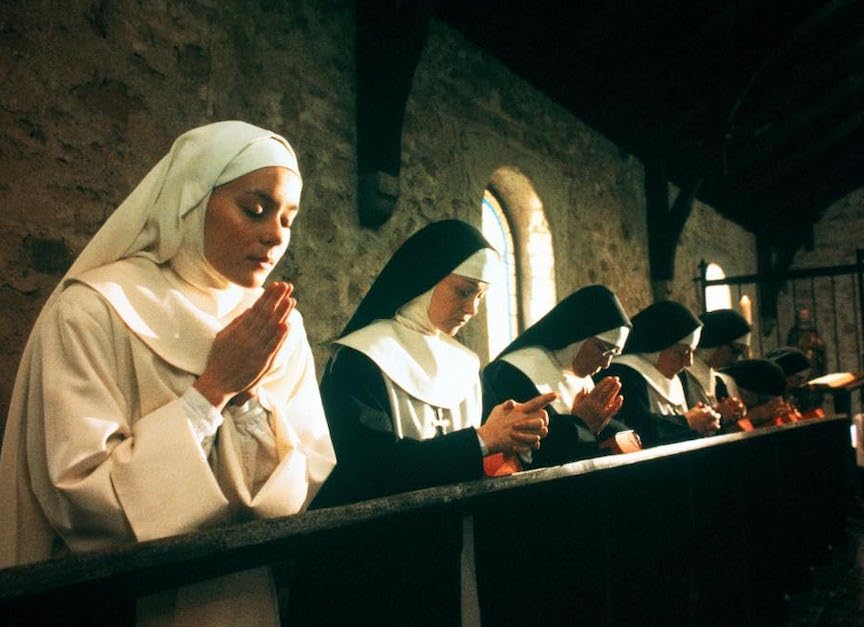
Meg Tilly in “Agnes of God” (IMDB)

John Dougherty
At this year’s Academy Awards, Edward Berger’s twisty Vatican drama “Conclave” has eight nominations including Best Picture, Best Director and Best Supporting Actor for Barry Fitzgerald, who played Father Fitzgibbon. (He was also nominated for Best Actor; the only time an actor has been nominated twice for playing the same character in the same film.)
That same year, Ingrid Bergman was nominated for playing Sister Mary Benedict in “The Bells of St. Mary’s” and Gregory Peck for playing a priest in “The Keys of the Kingdom” (1944). A few years later, Bergman would marry Italian director Roberto Rossellini (following a brief and scandalous affair), and they had three children—including Isabella Rossellini.
In these films and others of the time, priests were portrayed as “virile, athletic, compassionate, wise,” according to Charles R. Morris in American Catholic. The fact that they were celibate didn’t prevent them from being inspirational figures, played by some of the most famous (and desirable) men in Hollywood. The films portrayed religious life as one of immense sacrifice and meaning. “These are talented, attractive people who have made big sacrifices for the love of God,” Morris writes, “and they are better than the rest of us for it.”
This mid-century popularity of Catholic films in Hollywood occurred thanks to several factors, including the still-exotic nature of Catholicism to majority-non-Catholic audiences and the dynamically cinematic elements of Catholic religious practice. It is also meaningful that this period coincided with the heyday of the Production Code, a censorship document that determined what got made in Hollywood. In American Catholic, Morris (in line with other scholars) suggests that the deluge of positive Catholic films may have been an attempt by the studios to stay in the good graces of the Production Code Administration’s vigilant and pugnacious director: devout Catholic Joseph Ignatius Breen.
Tuesday, February 18, 2025
Hierarchical Considerations for the 2025 Conclave
For the 2025 Conclave, the Hierarchy will be in deep deliberation and planning for the next stages of evolutionary changes for Humanity. It is viewed as a pivotal moment that could significantly shape the spiritual trajectory of humanity and the planet in the coming decades. The Conclave is expected to have profound spiritual effects on human consciousness and a provide new spiritual techniques and methods that could strengthen the “Christ principle” in humanity, and the establishment of the mystery schools on the physical plane.
But is Humanity ready for these new evolutionary changes?
The period leading up to 2025 is seen as preparatory, testing humanity’s receptivity. Hierarchy has been closely observing and considering how, with the increased spiritual stimulation, what has been humanity’s readiness and response to the various impacts and impressions. At the coming Conclave, Hierarchy will be considering and assessing:
- Overall evolutionary progress across the human, animal, vegetable, and mineral kingdoms.
- Evaluate crisis points and blockages around environmental issues and international conflicts. For this, Hierarchy would determine the flow of spiritual energy and formulate plans for the coming century based on this assessment. For this, there is an emphasis on the role of the service workers to act as a bridge for grounding new stimulations of educational and spiritual related initiatives.
- Determine Humanity’s readiness for the Christ’s return and how His energies and presence can be most effectively manifested.
- Setting a date for the initial phases of the Hierarchy’s externalization and specifying a potential timeframe for the Christ’s reappearance. How humanity handles increased spiritual stimulation will influence the timing of further externalization.
Powerful energies from the Conclave are expected to stimulate new patterns of thinking and cause individuals within society to act with more inclusivity, such as related to global issues and fostering interconnectedness between groups.
Who could be the next pope? How U.S. cardinals, including Boston's Cardinal O'Malley, rank

USA TODAY NETWORK - New England
Published 2:55 p.m. ET Feb. 17, 2025
Published 2:55 p.m. ET Feb. 17, 2025
Key Points
- Pope Francis is hospitalized as he recovers from a sinus infection.
- If the pope were to resign over health concerns, a new pope would be selected through a process called the conclave, which consists of a vote by members of the College of Cardinals.
- Two U.S. archbishops are considered papabile, or frontrunners for pope. One of them is Boston's former archbishop Cardinal Sean Patrick O'Malley.
As Pope Francis continues to recover from a respiratory infection, some have questioned whether he would consider stepping down from his role due to health concerns like his predecessor, Pope Benedict XVI.
If the pope were to resign, a new pope would be selected through a process called the conclave, which consists of a vote by members of the College of Cardinals.
Subscribe to:
Posts (Atom)