Showing posts with label South America. Show all posts

Sunday, October 18, 2026

Faithful gather to welcome Pope Leo back for Sunday blessing after cancer surgery


Pope Leo XIV has returned to the Vatican after undergoing surgery to remove a lung tumor

By COLLEEN BARRY Associated Press and TRISHA THOMPSON Associated Press

October 18, 2026, 5:41 AM


VATICAN CITY -- Catholic faithful converged on St. Peter’s Square on Sunday to welcome Pope Leo XIV back to the Vatican after surgery to remove a tumor from his lung.

Leo is delivering the traditional Angelus blessing, his first official appointment since being released from the hospital on Saturday, four days after cancer surgery.

The 71-year-old pontiff had the lower lobe of his right lung removed on Tuesday in the first major health event of his 17-month pontificate. The surgery confirmed he had adenocarcinoma, the most common type of lung cancer.

He told a reporter in English that he was doing ‘’much better’’ as he drove away from Rome’s Gemelli hospital to return to the Vatican, well ahead of the weeklong hospital stay than had been initially anticipated.

“I don’t believe it, because he was just operated on the other day,” Cosimo Mastrocinque, a retired factory worker visiting the Vatican from the southern region of Puglia, said. “It is a miracle that he recovered already.”

American tourists were especially eager to pray alongside the first pope born in the United States. Marla Marsala of Michigan was supposed to attend a Mass with the pope last week that was canceled due to his hospitalization.

‘’I am just happy that we are praying with him today instead of for him, like we were before,’’ Marsala said. "It was a tough week for all of the people who love him, which are many. He seems like a very strong soul. So I think he will pull through and fight it, and succeed and keep doing the wonderful work he is doing.''

Claire Holland from Jacksonville, Florida, said she felt “very blessed” to be present for the pope’s return to his flock.

“I’m so happy that he has recovered so quickly. I think there have been millions and millions of prayers. And he is a strong determined man, and I am so happy that he is feeling well enough to do this,” Holland said.

Leo's next major engagement is an ambitious Nov. 6-17 trip to Uruguay, Argentina and Peru, including a dozen flights and two helicopter rides to high altitudes. His surgeon, Dr. Stefano Margaritora, told Vatican News on Saturday that there are “no clinical reasons” to preclude the trip.


“The Holy Father has put his heart and soul into his recovery,” Margaritora told Vatican News, adding that he expected the pope to recover fully from surgery “in another 10 days or so.”

“As for a long trip involving air travel in about three weeks, I would say there are no clinical reasons why it should not take place,” Margaritora said.

Histological testing of the tumor and related lymph nodes was underway. The results, along with details of the tumor’s molecular and genetic makeup, will help doctors determine whether the pope needs additional treatment. Options include chemotherapy, a combination of chemotherapy and immunotherapy, or targeted oral therapy based on the tumor’s genetic characteristics.

_____


Sunday, August 24, 2025

Fuerzas Comando 2025


News | Aug. 18, 2025
Fuerzas Comando 2025

By Maj. Trevor Wild,
ILOPANGO, El Salvador –

Sixteen special operations teams from across Central and South America and the Caribbean will gather in Ilopango, El Salvador, Aug. 18–29, for Fuerzas Comando 2025, the 19th iteration of the premier special operations skills competition and senior leadership seminar.

Established in 2004, Fuerzas Comando is a 10-day event designed to test participants’ skills through a friendly competition among special operations forces. The event promotes interoperability and military-to-military relationships through cordial contests, enhances training knowledge, and strengthens regional cooperation.

Concurrently, a senior leadership seminar will convene, uniting top multinational special operations leaders to address transnational threats impacting defense and stability across the region.

Participating nations include Argentina, Belize, Chile, Colombia, Costa Rica, Dominican Republic, Ecuador, El Salvador, Guatemala, Honduras, Jamaica, Mexico, Panama, Paraguay, Peru, and the United States.

Fuerzas Comando 2025 is sponsored by U.S. Southern Command and executed by Special Operations Command South in partnership with the Fuerza Armada de El Salvador.

The competition will feature a series of evaluated events:
Day 1: Weapons zero (non-graded)
Day 2: Physical training event (100 points) and opening ceremony
Day 3: Assaulter stages 1 and 2 / Sniper stage 1 (300 points)
Day 4: Assaulter stages 3 and 4 / Sniper stages 2 and 3 (300 points)
Day 5: Assaulter stage 5 / Sniper stages 4 and 5 (400 points)
Day 6: Assaulter stages 6 and 7 / Sniper stage 7 (400 points)
Day 7: Assaulter and sniper stage 8 / Combined assault (300 points)
Day 8: Ruck event (200 points)
Day 9: Obstacle course (200 points)
Day 10: Water event (200 points)
Day 11: No evaluation
Day 12: Closing ceremony

For updates and standings, follow @SOCSOUTH and @FUERZARMADASV on Instagram, Facebook, and X.

“Juntos somos Fuerzas Comando.”


Wednesday, January 17, 2018

International Court Pushes Gay Marriage on 20 Latin American Nations


Michelle Riestra / January 17, 2018


The autonomous Inter-American Court of Human Rights has faced growing resistance from Latin American countries in recent months. (Photo: iStock Photos)


Commentary By


Michelle Riestra


Michelle Riestra serves as legal counsel for ADF International in Washington, D.C., where she engages in legal advocacy at the Organization of American States.


The Inter-American Court of Human Rights called last week for the recognition of same-sex marriage and of proclaimed “gender identity” as a protected category for nondiscrimination under the American Convention on Human Rights.

Although the decision is not binding, 20 countries throughout the Americas have accepted the jurisdiction of the court, and will now be pressured to implement its decision.

The 20 countries are Argentina, Barbados, Bolivia, Brazil, Chile, Colombia, Costa Rica, the Dominican Republic, Ecuador, El Salvador, Guatemala, Haiti, Honduras, Mexico, Nicaragua, Panama, Paraguay, Peru, Suriname, and Uruguay.

Same-sex marriage is already legal in some of those countries, including Argentina, Brazil, Colombia, and Uruguay, and others recognize civil unions, but still others do not recognize either and will be expected to change their laws.

Americans need an alternative to the mainstream media. But this can't be done alone. Find out more >>

The case originated from Costa Rica, which requested an advisory opinion from the court on whether its domestic law violated international law, as it does not facilitate name changes based on gender identity, nor recognize patrimonial rights of same-sex partnerships.

Advisory opinions are not even binding on the country that asked the question, let alone the other 19 nations that have accepted the court’s jurisdiction. However, the court ignored this legal reality and called upon the countries to issue temporary decrees recognizing same-sex marriage until new legislation can be enacted by those countries.

The court has no authority to order such a thing, and the decision goes against the clear wording of the American Convention on Human Rights, as well as several national constitutions. However, the court’s decision is just the latest example of judicial activism, which stretches back more than a decade.

The court is tasked with interpreting the American Convention on Human Rights and operates within the broader Organization of American States framework.

Faced with stubbornly conservative member nations that are slow to follow the legal and cultural liberalism flowing out of Canada, the U.S., and much of Western Europe, the court has taken it upon itself to force its own liberal agenda on a reluctant region.


Wednesday, October 18, 2017

Pope announces Synod of Bishops for Pan-Amazon region


October 15, 2017 VATICAN CORRESPONDENT


Pope Francis's pastoral staff is hit by a ray of the sun during the canonization mass for 35 new saints in St. Peter's Square at the Vatican, Sunday, Oct.15, 2017. (Credit: AP Photo/Andrew Medichini.)


Pope Francis on Sunday announced that he's calling a special Synod of Bishops in October 2019 for the Pan-Amazon region in Latin America, meaning the countries of the Amazon -- Bolivia, Brazil, Colombia, Ecuador, French Guyana, Guyana, Perú, Venezuela and Surinam. It's the first time Francis has called a synod for a specific region, something that St. John Paul II used to do to signal a special concern.


ROME - Pope Francis on Sunday announced a special assembly of the Synod of Bishops, scheduled for October 2019, to involve prelates from Latin America’s Pan-Amazon region, meaning Bolivia, Brazil, Colombia, Ecuador, French Guyana, Guyana, Perú, Venezuela and Surinam.

“Accepting the desire of some Catholic Bishops’ Conferences in Latin America, as well as the voice of various pastors and faithful from other parts of the world, I have decided to convene a Special Assembly of the Synod of Bishops for the Pan-Amazon region, which will take place in Rome in the month of October 2019,” Francis said at the end of the weekly Angelus prayer.

There’s already a Synod of Bishops on youth, faith and vocational discernment scheduled for Oct. 2018.

This is the first time Francis has called a Synod of Bishops for a specific region, although St. Pope John Paul II did so on different occasions to signal a special concern. John Paul called a special synod for the Netherlands in 1980 and for Lebanon in 1995, in addition to special synods for each of the continents of the world.

The main purpose of the Amazon gathering, Francis said, will be to identify new paths for the evangelization in the region. Particular attention, he added, will be paid to the indigenous people, “often forgotten and without the prospect of a serene future,” and to the crisis of the Amazonian rain forest, considered one of the world’s “lungs” because of the amount of oxygen produced by its abundant vegetation.


Saturday, May 28, 2016

A look at the Operation Condor conspiracy in South America


US

Published May 27, 2016

 Associated Press


 FILE - In this Sept. 1988 file photo, Chile's dictator Augusto Pinochet is flanked by subordinates at a ceremony in Santiago, Chile. With a world divided by the Cold War, South America’s dictatorships in 1975 agreed to start exchanging information on political dissidents, trade unionists, students and any individual suspected of being leftist. The goal was to hunt down and eliminate the enemies of the dictatorships across the continent and beyond. According to declassified documents, various agencies of the U.S. government were aware of the plan. (AP Photo/Santiago Llanquin, File) (The Associated Press)


 FILE - In this March 24, 1976 file photo, Argentina's dictator Gen. Jorge Rafael Videla, center, is sworn-in as president at the Government House in Buenos Aires, Argentina. With a world divided by the Cold War, South America's dictatorships in 1975 agreed to start exchanging information on political dissidents, trade unionists, students and any individual suspected of being leftist. The goal was to hunt down and eliminate the enemies of the dictatorships across the continent and beyond. According to declassified documents, various agencies of the U.S. government were aware of the plan. (AP Photo/Eduardo Di Baia, File) (The Associated Press)


 FILE - In this July 9, 1982 file photo, Argentina's last dictator, General Reynaldo Bignone, arrives for a religious ceremony at the Cathedral in Buenos Aires. A court in Argentina has sentenced the former junta leader to 20 years in prison for Operation Condor crimes. The secret conspiracy was launched by six South American dictators in the 1970s in a combined effort to track down their enemies and eliminate them. The federal court ruled Friday, May 27, 2016. Bignone is already serving life sentences for multiple human rights violations during the 1976-1983 dictatorship. (AP Photo/Eduardo Di Baia, File) (The Associated Press)


BUENOS AIRES, Argentina – Argentina's last dictator and 14 other former military officials were sentenced Friday to prison for human rights crimes committed during the Operation Condor conspiracy. Here is a look at the clandestine program's main features:

WHAT WAS OPERATION CONDOR?

It was a coordinated effort by the military dictatorships in Argentina, Chile, Paraguay, Bolivia, Uruguay and Brazil to hunt down and eliminate opponents and leftists across the continent and beyond. It operated from the mid-1970s to the early 1980s.

HOW DID IT WORK?

Operation Condor officially began in 1975, when South America's dictatorships agreed to start exchanging information on political dissidents, trade unionists, students and anyone suspected of being leftist, especially those who had sought refuge in other countries. According to declassified documents, various U.S. government agencies were aware of the plan.

The covert operation involved the deployment of special transnational teams to kidnap subversive "targets," who were then interrogated and tortured in seven clandestine prisons located on military or police bases in Argentina, Paraguay, Uruguay and Chile. The dissidents were sometimes returned to their country of origin and disappeared.

Condor's agents also assassinated political leaders seen as influencing public opinion against the military regimes. Some of their targets were in the United States and Europe. The September 1976 assassination of Orlando Letelier, the ex-foreign minister of Chile's socialist President Salvador Allende, was the best-known case. Letelier, and his U.S. aide Ronni Moffitt, were killed by a bomb placed in his car in Washington D.C. Investigators found that the Chilean dictatorship's spy agency, known as DINA, and an anti-Castro group, many of whose members had been trained by the CIA, were behind the assassination.

WHO WERE CONDOR'S MASTERMINDS?

Chilean dictator Augusto Pinochet, Paraguay's Alfredo Stroessner, Bolivia's Hugo Banzer, Argentine dictator Jorge Videla and Juan Maria Bordaberry of Uruguay. While no representative of Brazil signed the operation's charter, its government cooperated with the program and dissidents were killed and kidnapped in its territory.

HOW MANY VICTIMS?

According to a 2015 report by UNESCO's International Center for the Promotion of Human Rights, Operation Condor had 376 victims: 177 Uruguayans, 72 Argentines, 64 Chileans, 25 Paraguayans, 15 Peruvians, 12 Bolivians, five Brazilians, three Cubans, two Americans and a Spaniard.


Source

.

Monday, May 05, 2014

Lavrov's Peru Visit Very Much In Line With Past Russian Foreign Policy

2 May, 17:37


RIA/NOVOSTI
Russian Foreign Minister Sergei Lavrov, left, and Peruvian President Ollanta Humala during a meeting in Lima.


By Rustem Safronov and Kells Hetherington

WASHINGTON (VR) — The West and the United States and Europe perceived Russian Foreign Minister Sergei Lavrov’s current tour of Cuba, Nicaragua, Peru and Chile as a response to the large American presence in eastern Europe and U.S. meddling in Ukraine, which has always been regarded as part of Russia's sphere of influence, according to Alex Sanchez, a Research Fellow at the Council on Hemispheric Affairs based in Washington. Sanchez added, Lavrov’s trip to Latin America was regarded as a way for Moscow to demonstrate now Russia can be aggressive and expand its foreign policy and its sphere of influence historically regarded as in Washington's backyard.

"And I have to just point out,” Sanchez said that “Russia has been paying attention to Latin America and the Caribbean more and more in recent years. For example, Defense Minister Sergei Shoigu, he was in Peru actually in October or November. He went to Brazil as well and also to Peru. So Peru, I will say, in the past couple of years, Peru has had quite a bit of attention from Russia."

According to Sanchez, Cuba and Nicaragua, the latter country, now under the [Daniel] Ortega presidency, have had a history of tensions with the US, but countries such as Peru and Chile have always been more neutral, although their foreign policies have tended toward U.S. appeasement. And he added, this is a big part of the reason Lavrov’s visit to Chile specially was unsettling to Washington.

Radio VR's Rustem Safronov emphasized, in trips such as the recent one by Lavrov Russia has worked to achieve a “multipolar world” as opposed to a U.S. centric one. Russia has a longstanding relationship with the Peruvians, and may be in talks with the Lima government to supply military equipment, including Russian tanks. Peru needs the equipment to fight a war on drugs in the country.

Source
.

Father General's Journey

Black Pope Adolfo Nicolás Pachón (left) and  Peter Hans Kolvenbach (right) his "predecessor".


Father General's Journey. On 25 April, Father General left Rome for South America. He will return on 12 May. The first stop of the visit was British Guyana, Venezuela and Cuba. During the second half of this visit, Father General took part in the 28th Meeting of Latin America Provincials (CPAL). On Friday, 25 April, Father General began his journey in British Guyana. After a night in Barbados, he arrived in Georgetown at noon on 26 April. Visits to apostolic works of the Society, and a meeting with Jesuits and their collaborators followed. Father General left for Venezuela on Monday, 28 April, where his stay centered on Caracas and Maracaibo. In Caracas, he visited the Catholic Andrés Bello University, the La Vega barrio, the Educational and Pedagogical Reflection Center, the San Ignacio College, and the Jesús Obrero center of collaboration, where he met Jesuits and their collaborators. The visit in Maracaibo on 30 April, allowed him to familiarize himself with the Ignatian Apostolic Network of Zulia. On the evening of 2 May, he left for Cuba, where he remained until the afternoon of 4 May. In Havana, he met the country's religious congregations, as well as Jesuits and their collaborators. He participated in the Festival de Jóvenes Ignacianos. On the Sunday evening he travelled to Guadalajara, Mexico, to take part in the Latin American Provincials meeting.

The 28th Assembly of CPAL begins on 6 May and continues until Saturday, 10 May. It will be held in the Retreat and Conference Center at Puente Grande. Father General will personally meet with each Provincial during the Assembly. He will familiarize himself with the common projects of CPAL's Provinces and Regions. These include the project centered on the Panama Canal Zone, and the international centers of formation. Core issues on the Assembly's agenda will be the re-configuration of Provinces, and the establishment of common centers of philosophical formation. On Friday, 9 May, still in Puente Grande, Father General will meet the Mexican Jesuits in formation. On Sunday, 11 May, before his departure for Rome, Father General will launch an exhibition whose theme is the Society of Jesus during the colonial era. This will be held in the Society's former novitiate and missionary center in Tepotzotlán, near Mexico City.


Source
.

Wednesday, April 02, 2014

Chile Lifts Tsunami Warning After 8.2 Quake


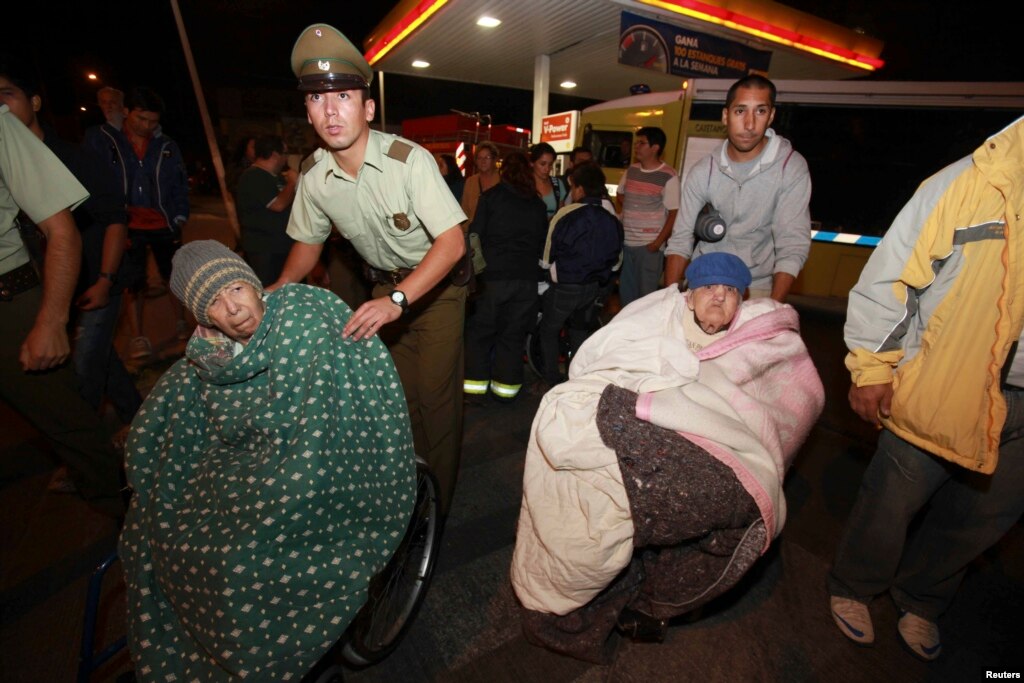
People are evacuated from their shelter after a tsunami alarm at Antofagasta city, north of Santiago on the southern Pacific coast, April 1, 2014.

VOA News

April 02, 2014

Tsunami warnings have been lifted for Chile's coastline, hours after a strong 8.2-magnitude earthquake killed at least six people in Chile and set off a small tsunami that prompted evacuations along the country's Pacific coast.

The earthquake late Tuesday was centered about 100 kilometers off Chile's northwestern coast. It caused landslides that blocked highways and widespread power outages.

President Michelle Bachelet has declared a state of emergency in the region. In a late-night address, she urged citizens to stay calm.


"Appropriate measures have been taken to protect their lives and their belongings. And the government will continue to work all the time that is necessary to confront this emergency and protect our citizens," she said.

Waves measuring about two meters hit the Chilean coast in the hours following the quake. No damage from the waves has been reported.

At least six people were reported dead after being crushed by collapsing walls or experiencing heart attacks.

Interior Minister Rodrigo Penailillo said about 300 inmates escaped a woman's prison in Iquique. He said troops have been deployed to prevent looting and round up the escapees.

Chile is one of the world's most earthquake prone countries. In 2010, a 8.8-magnitude quake rocked central Chile, killing more than 500 people and destroying 220,000 homes.

The region hit by Tuesday's quake had also experienced several smaller temblors in recent days, including a 6.0-magnitude earthquake on Sunday.


Residents take their belongings to higher ground after a tsunami alarm at Talcahuano city, south of Santiago, April 1, 2014.


Source
.
.

Friday, June 28, 2013

Liberation Theology and Its Role in Latin America


Colombian Catholic Priest Camilo Restrepo 


Liberation Theology and Socialism

Probably the greatest criticism of liberation theology is its association with socialism. There is a uniform conviction among liberation theologians that some form of socialism offers the best hope for Latin America.[26] However, liberation theologians acknowledge the failure of Marxist-socialist regimes as well as the failure of capitalism. Capitalism favors the privileged, but socialism, in practice, has involved repression and state-control. However, liberation theologians, such as Gutiérrez, see their theory of socialism as something uniquely Latin American and not simply an imitation of old models of any particular philosophy, including Marxism.[27] And the connections between socialism and liberation theology have weakened considerably since its inception to allow liberation theology to appeal to the middle-class. Today, to liberation theologians, socialism offers three advantages: people's basic needs will be met, ordinary people will be active in building a new society, and what is created will be a new Latin America, not a copy of old socialist ideals.[28] Base Ecclesial Communities are one of the only practices that combine both liberation theology and socialism, but even the Communities do not endorse Marxist socialism as much as a system of fairness and equality. The connections between liberation theology and socialism are far more apparent in theory than in practice.


.
.

The History of the Catholic Church in Latin America and Liberation Theology


The Jesuit Order was founded in 1540 and came to Spanish America during the term of Thomas de Souza as governor between 1549 and 1553. At that time the Franciscan and Dominican monks were already established in the New World, but these orders were not destined to have the significant impact that the Company of Jesus or the Jesuit Order was to have on the indigenous peoples of Brazil, Ecuador, Colombia, Paraguay, Chile, Mexico, Peru, Guatemala and Haiti. Through their successes with the Indians taken into their care and the resulting conflicts, the Jesuits were finally expelled from South America in 1767.

The Jesuits were inspired to establish their own social order by St. Thomas More who published his Utopia in 1516. The fundamental idea of Utopia was to “restore society to its Christian bases, adopting as supreme guide the norms of natural rights.” The Jesuits saw themselves as fulfilling Thomas More’s prophesy, and to carry out this work they chose the impenetrable jungles of the New World as their home and workshop. Here they felt that they could do their work undisturbed, armed with a self government grant from the king which protected them from other Spaniards.

Land was granted to the Jesuit priests as well as to other religious orders. What mattered, really, was not so much the land itself, but rather the number of Indians, or souls, that lived upon it. Agriculture was important in 1650, and the Jesuits eventually counted themselves among the wealthiest landowners.

Mariano Picon-Salas wrote that the Jesuits formed a link between the baroque age and the prerevolutionary period, indicating their pre-eminence among several religious communities active in the Spanish holdings in the New World at that time. By the Seventeenth Century the Jesuit Order was the foremost cultural organization and one of the strongest economic and political forces in the entire colonial wor1d.

The Jesuits were international in character and brought clergymen into South America from many foreign nations. Father Kino organized Hungarians, Poles and Germans into Jesuit missions in Paraguay. These foreign priests brought new currents of thought to the Spanish Company of Jesus.

The Jesuits were students of the geography and natural history of the areas in which they worked. Father Jose Gumilla’s The Enlightened Orinoco, published in 1791, was “an excellent monograph on the Guianas that describes climatic phenomena flora, fauna and the ethnography of the interior.”

By the eighteenth century the intellectual standards, economic power and social influence of the Jesuits was unmatched. Their economic power derived from enormous plantaions in the central valley of Chile, ranches in the River Plate region and large city and rural estates in Peru and Mexico. There were Jesuit owned workshops in Paraguay, Peru and Ecuador, and mining interests in the Chaco area of New Granada, now Colombia, Ecuador, Venezuela and Panama.

These vast holdings comprised the material aspect of what German Arciniegas calls the “largest Utopian experiment ever attempted.” The Jesuits established this “utopian empire” under adverse conditions. The first step was to pacify the local Indians. Father Gonzalez de Santa Cruz and Rodriguez y del Castillo were martyred in 1628 and were beatified by Pius XI. After the Indians were pacified the missions were often attacked by groups who were searching for Indians to use as slaves.

All Indians on the reductions received pots and pans, needles, clothing and other necessities. The quantity of these goods increased as the collective wealth of the community grew.

The government of the reduction was carried out by elected representatives. Again, this limited democracy did not stir admiration, but rather jealousy of the privileged Creoles. The Creole haciendas tended to be poorly managed, relying on slave labor. The reductions were perceived as political and economic threat and eventually were outlawed and the Jesuits were forced to leave New Granada.

Once the Jesuits gathered the Indians into the relative security and isolation of the reductions, the process of conversion and reinforcement of Christian Doctrine took place. Sometimes the Jesuits resorted to trickery and appealed to the Indians’ idolatry to reinforce Christianity. In Paraguay, the priests exploited the Indian’s idolatry by standing inside of a wooden statue and shouting orders to them.

The Jesuits also used the theater, already developed by Franciscan and Dominican monks. At that time the theater was an integral part of European religious festivals. It was used to attract and amuse the Indians. Dances of Indian and African origins were blended into the mysteries of the new religion. The purely African communities instantly accepted the school of the Jesuit theater and learned from it.

Another device which the Jesuit Fathers used to make religion more believable to the Guaranis was to use yerba-mate, a tea brewed from the leaves of the yerba tree. The Guarani believed that the yerba had magical powers since the yerba is actually a stimulant. Since the Jesuits could not persuade the Guaranis that yerba-mate did not have magical powers, they fabricated the story that St. Thomas had conveyed supernatural powers to the yerba and brewed it as a tea for his converts. The Jesuits eventually exported the yerba cultivated by the Guarani.

The Jesuits used their wealth, amassed from the workings of the reductions, by investing it in land, tools and draft animals. They were free with technical and scientific advice and allowed the Indians a voice in decision making. Jesuits used their wealth to direct and control seminaries and missions of great importance to the economic life of the colonies. They provided intellectual centers in small, provincial towns, providing banking facilities and forums for the resolution of local political problems.

In Paraguay the Jesuit press printed books in the Guarani language. These were printed from wooden fonts carved by the Indians, themselves. Although Guarani was the spoken language, prayers and hymns were written down in Latin.

In the seventeenth and eighteenth centuries the Jesuits began to defend their Indian charges and their rights against the authority of Spain. This authority was present in the new elite and the landlords and the Jesuits were forced out of one city after another. Finally, after a last stand at Ilano, the Jesuits were forced out of New Granad altogether when Pope Clement XIV dissolved the order in 1773.

Once in exile the Jesuits turned to writing. They wrote truthfully and objectively since writing was all that was left to them. The Catholic monarchy which had been effectively administered by the Jesuits then began to disintegrate. By the early eighteenth century the Jesuits’ Paraguayan community was the most peaceful and prosperous unit of government in Latin America.

From the point of view of the royal government, this was most beneficial. The Crown had allowed the missionaries to convert and pacify the Indians. After this was accomplished, royal officers and members of the secular ecclesiastical hier archy replaced them. This was economical for imperial territory was expanded with a minimum of risk. The Crown government was ready to assume control after Indian hostility was past and before the missionaries could assume positions of power. The equilibrium between diminishing Indian strife and expanding missionary organization was carefully watched by royal and ecclesiastical authorities. The time designated between pacification and conversion and the time when the secular clergy would take charge was ten years. The period, however, was usually more than a decade and on the frontier lasted until the end of colonial times.

The removal of the Jesuit influence brought on a series of local uprisings. The revolt at Asuncion grew into the Antequera revolution. Antequera wanted local control of local institutions in Buenos Aires and Peru. The execution of Antequera became the rallying point for both the upper classes and commoners and their new South American political conciousness which began an attitude of belligerence toward the Spanish monarchy. Without the Jesuits, dissatisfaction over military recruitment, ever-increasing taxes and the Indians’ hatred for their Spanish magistrates came to the surface. In 1749 Juan francisco Leon led a revolt of small cocao planters in Venezuela and in 1752 rebellions at LaRioja and Catamarca in North Argentina protested arbitrary military conscription of peasants. These were followed by large scale uprisings between 1749 and 1782.

Francis Xavier Clavijero and other exiled Jesuits saw miscegenation as the only answer to the problem of the races. Other members of the order, however, disagreed strongly. Clavijero wrote in his Storia Anitca del Mexico. “There is no doubt at all that the policy of the Spaniards would have been wiser if, instead of fetching wives from Europe and slaves from Africa...they had insisted on making a single people out of themselves and the Mexican Indians.” Clavijero attempted to remove erroneous concepts of the Europeans regarding the Indians and bestow a universal character upon them. For example, he compared the Mexican word “Teotl” to the “Theos” of the Greeks. He then used “Teotl” to express a Christian-like monotheism, reflecting a widespread eighteenth century interest in creating a universal cu1ture.

Herbert Wendt believed that the Jesuits actually wanted to prevent the mingling of blood of the whites and the Indians. Their motivation was not racial, but rather they wanted to prevent “the uprooting and debasement that were taking place in Latin America.”

Before the expulsion of the Jesuits, many of them were beginning to take a “benevolent attitude toward the ideas of separation and independence from Spain, which began to be bruited about in the eighteenth century. The interests of the order began to coincide “with those of the regional burgeois that considered its rise in the economic scale as handicapped by Spanish monopolistic practices and by the excessive, French style centralization that the Bourbon dynasty was imposing.”

John Gunther states that the Catholic Church grew rich and decadent in America. In fact, Paraguay became practically a Jesuit colony. “Nowhere did the clergy, secular or regular, bestow upon the people anything like proper recompense for their inordinate position, though an effort was made in education.”

In agreement with Gunther is Mariano Picon-Salas who wrote that even long before the expulsion the generally bad relations between Spain and the order were at their worst in Paraguay “where they held a virtual fiefdom.”

In 1754 the Paraguayan Fathers led their Indians in a revolt against a Spanish-Portuguese boundary treaty, and in Peru, Jesuits were accused of terrorizing Indians and depriving them of land, wages, women, children and personal freedom. The Bourbons also cited widespread smuggling, graft, cheating of Indians and a general tendency to ignore orders from Spain. This weakening of the bonds between the Old World and the new invited intervention by rival powers and this, too, became a factor in the expulsion of the Jesuits.

The expulsion of the Jesuits in 1767 was part of a whole pattern of administrative reform both foreign and domestic under the Bourbons. As an official explanation, the monarchy cited the need to “bring local Jesuit power to an end and assert royal power in their stead.” This explanation was related to the Bourbon attack upon the Jesuit society in Europe and the result of Enlightenment ideas, religious nationalism and resistance to papal authority.


.

Tuesday, November 06, 2012

JESUIT CHIEF DEFENDS LIBERATION THEOLOGY AND SOCIAL ACTIVISM


By KENNETH A. BRIGGS (The New York Times); Foreign Desk
October 28, 1984, Sunday
Late City Final Edition, Section 1, Page 1, Column 4, 882 words


[ DISPLAYING ABSTRACT ]

The head of the Jesuit order says he strongly supports Latin American theologians and church workers who seek to promote social justice. And he says the teachings known as the theology of liberation must be ''recognized as possible and necessary.'' The Vatican recently criticized some elements of liberation theology as relying too heavily on Marxist analysis, but it affirmed the church's fight against oppression in Central and South America. The Rev. Peter-Hans Kolvenbach, chosen as Superior General of the Jesuits a year ago, said in an interview in New York last week that the order would continue to aid efforts for social justice in Latin America.

.

Tuesday, October 25, 2011

Vatican note on economy the first ripple of a southern wave

Oct. 25, 2011
By John L Allen Jr


A woman carries bananas to market in Nyei, South Sudan, in this 2009 file photo. (CNS photo/Paul Jeffrey)


Commentary


Whenever the Vatican appears to lurch in a given direction, there's a tendency in Catholic circles to become obsessed with how much ecclesiastical authority the gesture or text in question carries. For the most part, it's a legitimate question; when Benedict XVI uses kneelers during Communion, for instance, people have good reasons for wondering if it's a harbinger of a policy move or simply a matter of personal taste.


Sometimes, however, fussing about the authority behind something misses the bigger picture. Reaction to Monday's note from the Pontifical Council for Justice and Peace, titled "Towards Reforming the International Financial and Monetary Systems in the Context of Global Political Authority," offers a classic case in point. (Read the document.)


To recap, the note expressed a clear rejection of "neo-liberal" economic policies (in American argot, "neo-conservative") and an equally clear endorsement of a "true world political authority" to regulate a globalized economy, one not dominated by major powers such as the United States. As a preliminary step, the document called for the creation of an institution, or several institutions, that would play the role of a "central world bank." It also offered a plug for the "Tobin Tax" on financial transactions, public recapitalization of banks and greater regulation of "shadow markets."


"The primacy of the spiritual and of ethics needs to be restored, and, with them, the primacy of politics -- which is responsible for the common good -- over the economy and finance," the note reads. "We should not be afraid to try new ideas, even if they might destabilize pre-existing balances of power that prevail over the weakest."


Critics, dismayed by the note's content, rather predictably have challenged its Vatican standing. George Weigel dismissed it as the product of a "rather small office in the Roman Curia" while Bill Donohue said it contains "neologisms" not found in the thought of Pope Benedict XVI. To be fair, there's merit to these points. The note is hardly a dogmatic definition, and on matters outside the Catechism, the Vatican rarely speaks with one voice.


Focusing on how much papal muscle the note can flex, however, risks ignoring what is at least an equally revealing question: Whatever you make of it, does the note seem to reflect important currents in Catholic social and political thought anywhere in the world?


The answer is yes, and it happens to be where two-thirds of the Catholics on the planet today live: the southern hemisphere, also known as the developing world.


It's fitting that the Vatican official responsible for the document is an African, Cardinal Peter Turkson of Ghana, because it articulates key elements of what almost might be called a "southern consensus." One way of sizing up the note's significance, therefore, is as an indication that the demographic transition long under way in Catholicism, with the center of gravity shifting from north to south, is being felt in Rome.


There are almost 750 million Catholics scattered across Africa, Asia and Latin America, and generalizations about such a vast pool of people are always hazardous. Nonetheless, on matters of sexual morality and the "culture wars," Catholics in the south generally strike Europeans and Americans as remarkably conservative -- opposed to gay marriage, anti-abortion, devoted to the traditional family. When the conversation shifts to economic policy and geopolitics, however, Catholic opinion in the developing world often comes off in the West as strikingly progressive.


To be specific, Southern bishops, priests, religious and laity often are:


  • Skeptical of free-market capitalism and unregulated globalization;

  • Wary about the global influence of the United States;

  • Pro-United Nations and pro-global governance;

  • In favor of a robust role for the state in the economy.

A few examples flesh out that picture.


In a 2002 issue of Theological Studies, the late Dean Brackley and Thomas Schubeck outlined a "Latin consensus" on the economy, expressed not just by avant-garde theologians in Latin America but in official church documents. They described it this way: "The market is a useful, even necessary means for stimulating production and allocating resources. However, in the 'new economy,' overreliance on the market has aggravated social inequality, further concentrated wealth and income, and left millions mired in misery."


Catholic leaders in other parts of the global south hold similar views. For instance, in a 127-page report issued in 2004, the Catholic bishops of Asia declared that "neoliberal economic globalization" destroys Asian families and is the primary cause of poverty on the continent.


In June 2005, a group of Catholic bishops from Eritrea, Ethiopia, Kenya, Malawi, Tanzania, Sudan, Uganda, Zambia, Somalia and Djibouti declared, "We are particularly horrified by the ravages of unbridled capitalism, which has taken away and stifled local ownership of economic initiatives and is leading to a dangerous gap between the rich few and the poor majority."


Now consider the language of the Vatican note, which breathes much the same air: "What has driven the world in such a problematic direction for its economy and also for peace? First and foremost, an economic liberalism that spurns rules and controls ... an economic system of thought that sets down a priori the laws of market functioning and economic development, without measuring them against reality, runs the risk of becoming an instrument subordinated to the interests of the countries that effectively enjoy a position of economic and financial advantage."


One can certainly debate the merits of those perceptions, or the policy moves that might flow from them. Yet to dismiss all this as nothing more than the rogue perceptions of an isolated Vatican department ignores the demographic and cultural realities of the church in the 21st century.


This is not the dying echo of warmed-over European socialism. For better or worse, it's the first ripple of a southern wave.


[John L. Allen Jr. is NCR's senior correspondent.]


Source


Monday, November 08, 2010

Father General in Paraguay, Argentina, Uruguay and Chile


Father General in Paraguay, Argentina, Uruguay and Chile


(05-Nov-2010) From October 31st to November 13th Father General is in Latin America to participate in the XXI Assembly of CPAL, the Conference of Latin American Provincials. The Assembly is taking place in Asunción, Paraguay, from the 2nd to the 6th of November.


Source
.