Showing posts with label J.G. Roberts. Show all posts

Thursday, July 16, 2015

Chief Justice Roberts broke his word

 
Matthew's Cathedral after attending the Red Mass in Washington October 2, 2011.


July 14, 2015, 12:00 pm


By Matt Schlapp, founder and chairman of the American Conservative Union


Chief Justice John Roberts put himself forward for the wrong job. He now acts more like a senator than a judge.

At a time when President Obama is trying to change the very idea of what is considered reasonable in American politics, it is imperative for conservatives to stand up and bring some sense to this progressive chaos being war-roomed out of the oval office.

The need for principled conservatives to stand up is especially true on the federal bench, where judges get the fair bargain of lifetime tenure, which protects them from the ill effects of being politically unpopular, in exchange for taking an oath which asks them to do the hard thing. This tough calling is especially true for originalist conservatives on the Supreme Court, who often have to write or concur with judicial opinions that do not necessarily match the political outcome they would prefer. Conservatives of character on the nation’s highest court are our constitutional chaperones, reminding us that in the end no matter how much we want to lead society into a better place, the role of the Court is to simply rule on the constitutionality of a given government policy. For some reason “conservatives” who are appointed by Republican presidents too often forget this very simple job description, as they forget the answers they give under oath in the Senate during their confirmation hearings.

The Supreme Court’s decision upholding Obamacare in the King v. Burwell decision shows why it is so dangerous and destructive for Justices to act outside the Constitutional framework and to act as politicians rather than jurists. While most Americans continue to dislike Obamacare and wish the Supreme Court had taken appropriate action against the unauthorized conduct of the Obama administration, our nation should be even more concerned about the Court’s power grab and its creation of a brand new judicial standard which is abhorrent to our system of checks and balances.

It was once unimaginable to most people to think that Chief Justice John Roberts would contradict so sharply the image he portrayed at his confirmation hearing. For example, under oath he explained, “You don’t look to legislative history to create ambiguity. If the text is clear, that is what you follow, and that’s binding. And you don’t look beyond it to say, well, if you look here, though, maybe this clear word should be interpreted a different way.”

It was that John Roberts whom most Americans trusted to preserve the integrity of the U.S. Constitution. Instead, like President Obama’s unprecedented “executive actions,” Chief Justice Roberts has usurped the power of the Legislative Branch by creating a new authority for the Court to rewrite—rather than to interpret—statutory laws to achieve particular policy outcomes. Whether out of hubris or contempt for the American people, Justice Roberts and the majority of the Court have articulated a new role for the judiciary; it can now function as judge, legislature and king.

Obamacare’s architects (Professor Jonathan Gruber, Obama, then-Majority Leader Harry Reid and then-Speaker Nancy Pelosi) thought they could force reluctant Republican governors to create state-based insurance exchanges, but the law’s rollout proved otherwise. Over two-thirds of governors found the overwhelming mandates of Obama’s healthcare overhaul too much to handle, and 33 governors thumbed their noses at Professor Gruber and chose unsubsidized federal insurance exchanges.

In King v. Burwell, Justice Roberts made it clear that he believes it is the Court’s responsibility to re-write the Affordable Care Act to ensure its survival. Even though the law’s wording was clear on the distinction between state and federal exchanges, Justice Roberts and the five justices who joined him disgraced their office, sprayed graffiti on the Constitution, and pushed America toward a constitutional crisis. For the notorious liberals on the Court, last week’s decision is not a surprise.

But Justice Roberts swore under oath that he would not “create ambiguity.” He swore that he would honor the clear text of a statute and find it binding. Additionally, when Justice Roberts was appointed by President George W. Bush, he promised to stand by the Constitution and strictly adherence to the letter of the law. He promised the same to the U.S. Senate and to the American people. He did not tell the truth and instead betrayed his oath to uphold the Constitution. He has lost the trust of the American people, done serious damage to the integrity of the Court, and harmed the separation of powers that has protected our liberty for over two centuries. Justice Roberts ultimately ended up acting like a corrupt politician, using the power of his office to achieve a political outcome as if they were negotiating a backroom deal in a smoke-filled room.

At a minimum, the Senate should haul him into a hearing room to give an account of his actions. Any other person is forbidden from committing perjury while testifying before Congress, why should our Chief Justice be held to a different standard? Certainly the 15 federal court judges — including a Supreme Court Justice -- have been impeached by Congress were required to do more than merely explain themselves.

On the highest court in the land, the bench that is tasked with defending our Constitution and ensuring our laws are faithfully protected, we are left with just three honest justices: Samuel Alito, Clarence Thomas, and Antonin Scalia. The other justices have brought shame to the Court and defied the American people who placed their trust in them. Each would have probably made lousy politicians, thank God, and I mean that literally, each of them realized that they had a different role to play. It was not to win a popularity contest, nor be the latest conservative slouching forward to listen to the siren song from the Georgetown set. Instead they simply live by their oath and the Constitution, which is made up of words -- words that have meaning -- no matter how badly Roberts and Kennedy try to bend them.

Schlapp is chairman of the American Conservative Union.


Source

. 

Thursday, January 02, 2014

2014 Begins With A Roar

Ball drops in NYC's Times Square, ushering in 2014


Photo (Courtesy) http://www.sfgate.com/news/us/article/Ball-drops-in-NYC-s-Times-Square-ushering-in-2014-5105982.php
[http://ww4.hdnux.com/photos/25/47/44/5667099/3/628x471.jpg]

In freezing New York City's Times Square, a sea of horn-tooting, hat-wearing revelers cheered and some smooched as the famed crystal ball dropped at midnight.
Bronx-born U.S. Supreme Court Justice Sonia Sotomayor led the 60-second countdown and pushed the button that unleashed the shimmering orb with 2,688 crystals, a role usually filled by the New York City mayor.
Mayor Michael Bloomberg, on his last day in office, sat out the celebration after 12 years on the job, while newly elected Mayor Bill de Blasio took the oath of office just after midnight at his Brooklyn home.


Read more
.
.
---Somewhat related---
.
[Wow, on the same day she makes the BIG HEADLINES once again!]


Justice Sotomayor grants temporary Obamacare exemption to nuns 

The Catholic nuns would have faced 'draconian fines' if they failed to provide contraceptive coverage, as the healthcare law requires.


By David G. Savage and Maeve Reston December 31, 2013, 10:33 p.m.

WASHINGTON — Supreme Court Justice Sonia Sotomayor granted a temporary exemption late Tuesday to a small group of Catholic nuns that shields it from having to comply with a part of President Obama's healthcare law that requires it to provide contraceptive coverage in its insurance plans. 

She acted on an emergency appeal from lawyers for the group who said the nuns faced "draconian fines" beginning on New Year's Day if they failed to comply with the law widely known as Obamacare.

Sotomayor gave the government until Friday to file a response in the case. Her order extends only to the group of nuns and does not apply more broadly to the Affordable Care Act and its requirements.

The Supreme Court is facing a series of appeals from religious organizations and private corporations whose owners object to paying for contraceptives. In March, the court will hear two cases involving corporations and the contraceptive mandate.

The Obama administration has exempted churches and other religious groups from providing contraceptive coverage. However, it has granted a more limited exemption for religiously affiliated charities. Although they need not pay for this coverage directly, their insurers are required to include the coverage in their policies.

Nonetheless, several religious charities have continued to press for exemptions to the law. And on Tuesday evening, hours before the mandate was to take effect, they sent several emergency appeals to the court seeking an emergency exemption.

It was unclear how the Obama administration would proceed after Sotomayor's order. Obama is vacationing with his family in Hawaii this week, and the White House is not expected to make any comment before the Justice Department files a response to Sotomayor's ruling on Friday.

A number of religious groups with similar objections have vigorously challenged the Affordable Care Act in court. The Colorado order of nuns, the Little Sisters of the Poor, asked for the last-minute ruling Tuesday because the healthcare law's provisions go into effect Jan. 1.

In late November, the Supreme Court agreed to hear several cases that could settle the dispute between the Obama administration and businesses run by Christian conservatives over whether those companies must pay for birth control if providing that coverage is in conflict with the religious beliefs of the business owner.

The November announcement that the Supreme Court would hear the constitutional challenge to the birth control mandate in Sebelius vs. Hobby Lobby Stores Inc., as well as another case, signaled a new phase of the political battle over the healthcare law.

David Green, founder of Oklahoma-based Hobby Lobby Stores, has argued that business owners "should not have to choose between violating their beliefs and violating the law."

david.savage@latimes.com

maeve.reston@latimes.com

Savage reported from Washington and Reston from Honolulu.


---Related indeed---

Roberts calls for more money for courts


Roberts spoke out about sequestration's affect on the courts. | AP Photo
By TAL KOPAN | 1/1/14 8:28 AM EST


Supreme Court Chief Justice John Roberts used his year-end report for 2013 to call for more funding for federal courts and lambaste sequestration’s effect on the judiciary.

In the New Year’s Eve missive, Roberts referenced the seasonally appropriate “A Christmas Carol” by Charles Dickens to guide a “look at what has made our federal court system work in the past, what we are doing in the present to preserve it in an era of fiscal constraint, and what the future holds if the judiciary does not receive the funding it needs.”

Roberts wrote that while the judiciary recognizes the need for frugality, its operating costs are only 0.2 percent of the federal budget and it has been making austerity moves for years, even before the sequester went into effect. Because courts cannot manage their caseload, however, Roberts said the effects of sequestration hit them harder.

“The impact of the sequester was more significant on the courts than elsewhere in the government, because virtually all of their core functions are constitutionally and statutorily required,” Roberts wrote. “Unlike most Executive Branch agencies, the courts do not have discretionary programs they can eliminate or postpone in response to budget cuts.”

The chief justice also went through the appropriations request submitted by the judiciary to Congress, saying it was conservative and the minimum needed for the courts to operate properly.

“In the coming weeks, and into the future, I encourage the president and Congress to be attentive to the needs of the Judicial Branch and avert the adverse consequences that would result from funding the judiciary below its minimal needs,” Roberts wrote. “It takes no imagination to see that failing to meet the judiciary’s essential requirements undermines the public’s confidence in all three branches of government. Both ‘A Christmas Carol’ and ‘It’s a Wonderful Life’ have happy endings. We are encouraged that the story of funding for the federal judiciary — though perhaps not as gripping a tale — will too.”

The Supreme Court justices and federal judges have not been shy in advocating for court funding under sequestration. The chief judges of 87 district courts wrote to Congress last August pleading for more money and Justices Anthony Kennedy and Stephen Breyer made a rare appearance before a congressional hearing last March to make the case, as well.

Source 

The best for last


The Current U.S. Supreme Court
Six are Roman Catholics and Three Jewish!

Service Birth
Name, stateAssoc. JusticeChief JusticeYrs Place Date Died Religion
Antonin Scalia, DC 1986–— N.J. 1936 — Roman Catholic
Anthony M. Kennedy, Calif. 1988–— Calif. 1936 — Roman Catholic
Clarence Thomas, DC 1991–— Ga. 1948 — Roman Catholic
Ruth Bader Ginsburg, DC 1993–— N.Y. 1933 — Jewish
Stephen G. Breyer, Mass. 1994–— Calif. 1938 — Jewish
John G. Roberts, DC2005–—N.Y.1955—Roman Catholic
Samuel A. Alito, Jr., N.J.2006–—N.J.1950—Roman Catholic
Sonia Sotomayor N.Y.2009–—N.Y.1954—Roman Catholic
Elena Kagan N.Y.2010–—N.Y.1960—Jewish
.
http://www.factmonster.com/us/supreme-court/supreme-court-members.html
.
.

Saturday, February 23, 2013

The Offshore Outsourcing of American Jobs: A Greater Threat Than Terrorism


By Dr. Paul Craig Roberts

Global Research, February 17, 2013

Creators Syndicate and Global Research 18 April 2010


Is offshore outsourcing good or harmful for America? To convince Americans of outsourcing’s benefits, corporate outsourcers sponsor misleading one-sided “studies.”

Only a small handful of people have looked objectively at the issue. These few and the large number of Americans whose careers have been destroyed by outsourcing have a different view of outsourcing’s impact. But so far there has been no debate, just a shouting down of skeptics as “protectionists.”

Now comes an important new book, Outsourcing America, published by the American Management Association. The authors, two brothers, Ron and Anil Hira, are experts on the subject. One is a professor at the Rochester Institute of Technology, and the other is professor at Simon Fraser University.

The authors note that despite the enormity of the stakes for all Americans, a state of denial exists among policymakers and outsourcing’s corporate champions about the adverse effects on the US. The Hira brothers succeed in their task of interjecting harsh reality where delusion has ruled.

In what might be an underestimate, a University of California study concludes that 14 million white-collar jobs are vulnerable to being outsourced offshore. These are not only call-center operators, customer service and back-office jobs, but also information technology, accounting, architecture, advanced engineering design, news reporting, stock analysis, and medical and legal services. The authors note that these are the jobs of the American Dream, the jobs of upward mobility that generate the bulk of the tax revenues that fund our education, health, infrastructure, and social security systems.

The loss of these jobs “is fool’s gold for companies.” Corporate America’s short-term mentality, stemming from bonuses tied to quarterly results, is causing US companies to lose not only their best employees-their human capital-but also the consumers who buy their products. Employees displaced by foreigners and left unemployed or in lower paid work have a reduced presence in the consumer market. They provide fewer retirement savings for new investment.

Nothink economists assume that new, better jobs are on the way for displaced Americans, but no economists can identify these jobs. The authors point out that “the track record for the re-employment of displaced US workers is abysmal: “The Department of Labor reports that more than one in three workers who are displaced remains unemployed, and many of those who are lucky enough to find jobs take major pay cuts. Many former manufacturing workers who were displaced a decade ago because of manufacturing that went offshore took training courses and found jobs in the information technology sector. They are now facing the unenviable situation of having their second career disappear overseas.”

American economists are so inattentive to outsourcing’s perils that they fail to realize that the same incentive that leads to the outsourcing of one tradable good or service holds for all tradable goods and services. In the 21st century the US economy has only been able to create jobs in nontradable domestic services-the hallmark of a third world labor force.

Prior to the advent of offshore outsourcing, US employees were shielded against low wage foreign labor. Americans worked with more capital and better technology, and their higher productivity protected their higher wages.

Outsourcing forces Americans to “compete head-to-head with foreign workers” by “undermining US workers’ primary competitive advantage over foreign workers: their physical presence in the US” and “by providing those overseas workers with the same technologies.”

The result is a lose-lose situation for American employees, American businesses, and the American government. Outsourcing has brought about record unemployment in engineering fields and a major drop in university enrollments in technical and scientific disciplines. Even many of the remaining jobs are being filled by lower paid foreigners brought in on H-1b and L-1 visas. American employees are discharged after being forced to train their foreign replacements.

US corporations justify their offshore operations as essential to gain a foothold in emerging Asian markets. The Hira brothers believe this is self-delusion. “There is no evidence that they will be able to outcompete local Chinese and Indian companies, who are very rapidly assimilating the technology and know-how from the local US plants. In fact, studies show that Indian IT companies have been consistently outcompeting their US counterparts, even in US markets. Thus, it is time for CEOs to start thinking about whether they are fine with their own jobs being outsourced as well.”

The authors note that the national security implications of outsourcing “have been largely ignored.”

Outsourcing is rapidly eroding America’s superpower status. Beginning in 2002 the US began running trade deficits in advanced technology products with Asia, Mexico and Ireland. As these countries are not leaders in advanced technology, the deficits obviously stem from US offshore manufacturing. In effect, the US is giving away its technology, which is rapidly being captured, while US firms reduce themselves to a brand name with a sales force.

In an appendix, the authors provide a devastating expose of the three “studies” that have been used to silence doubts about offshore outsourcing-the Global Insight study (March 2004) for the Information Technology Association of America, the Catherine Mann study (December 2003) for the Institute for International Economics, and the McKinsey Global Institute study (August 2003).

The ITAA is a lobbying group for outsourcing. The ITAA spun the results of the study by releasing only the executive summary to reporters who agreed not to seek outside opinion prior to writing their stories.

Mann’s study is “an unreasonably optimistic forecast based on faulty logic and a poor understanding of technology and strategy.”

The McKinsey report “should be viewed as a self-interested lobbying document that presents an unrealistically optimistic estimate of the impact of offshore outsourcing and an undeveloped and politically unviable solution to the problems they identify.”

Outsourcing America is a powerful work. Only fools will continue clinging to the premise that outsourcing is good for America.

Dr. Paul Craig Roberts was Assistant Secretary of the Treasury in the Reagan administration. His latest book, “How The Economy Was Lost,” has just been published by CounterPunch/AK Press.

To find out more about Paul Craig Roberts, and read features by other Creators Syndicate writers and cartoonists, visit the Creators Syndicate web page at www.creators.com .


.

Monday, July 02, 2012

Chief Justice Roberts: A more nuanced view after healthcare ruling

Had Roberts gone the other way, the court would have wiped away the entire health care overhaul, which is the outcome embraced by dissenting Justices Samuel Alito, Antonin Scalia, Clarence Thomas and Kennedy.

By Mark Sherman, Associated Press / July 2, 2012


In this 2008 photo, Chief Justice John G. Roberts, Jr., is seen in Providence, R.I.
Stephan Savoia/AP/File


WASHINGTON

Chief Justice John Roberts could have taken down the entire, massive health care law that his fellow Republicans deride as "Obamacare." He could have prevented the Supreme Court decision that largely disabled the most disputed aspects of Arizona's crackdown on illegal immigrants.

He didn't do either, and in the process surprised (or dismayed) longtime court observers of every political stripe.

Those two outcomes in the finals days of his seventh year on the court offer some clues for reassessing what kind of chief justice Roberts is and intends to be. Is he no longer the rock-ribbed conservative loved by supporters and jeered by opponents? Has he become a pragmatic leader mindful of the court's place in history? Is he more canny, but still solidly conservative?


The measure of a justice is best taken after decades of service, rather than a few years. At age 57, Roberts could lead the court for another quarter-century.

But at the very least, the end of the Roberts Court's most consequential term already is leading to revised, and in some cases more nuanced, appraisals of his leadership.

Erwin Chemerinsky, a liberal scholar who is dean of the law school at the University of California at Irvine, announced that the era of the Roberts Court had begun. "He authored the opinion in the most important case in his seven years on the court, and did so against what was expected," Chemerinsky said.

In truth, Roberts' vote to uphold President Barack Obama's health care law was not so much a surprise.

He long had been counted among the possible votes to uphold the law. But it was widely assumed that ifRoberts ultimately voted for it, so too would Anthony Kennedy, most often the decisive vote in closely fought cases. It was only the second time in his tenure that Roberts provided the deciding vote for the side favored by the court's liberals.

Up until now, it had been the Kennedy Court, Chemerinsky said, "This year, it was the Roberts Court."

Had Roberts gone the other way, the court would have wiped away the entire health care overhaul, which is the outcome embraced by dissenting Justices Samuel Alito, Antonin Scalia, Clarence Thomas and Kennedy.

Instead, he said the individual insurance requirement at the heart of the law could be upheld as a tax. At the same time, he rejected administration arguments that the mandate was justified by the Constitution's clause giving Congress power over interstate commerce, which has been the authority for most federal programs since the New Deal.

Some legal scholars suggest Roberts produced an essentially conservative opinion with a liberal outcome.

Neal Katyal, the former acting solicitor general who argued the Obama administration's side in the health care cases in several appeals courts, said that Roberts' majority opinion opened the door to potentially important changes in the law that could restrict federal power as it has been understood since the New Deal.

Ilya Somin, a George Mason University law professor, said on the Volokh Conspiracy legal blog that the health care case "gives supporters of limits on federal power some useful ammunition, despite also dealing us a painful defeat."

In addition, Roberts' ruling has helped refocus the public debate over the law and gave Republican opponents ammunition for calling it a big tax increase they would try to repeal.

Just three days earlier, Roberts, joined by Kennedy this time, sided with three liberal justices in the Arizona immigration case. Justice Elena Kagan, one of the court's liberals, did not take part because of her previous involvement as solicitor general, when she was the Obama administration's top Supreme Court lawyer.

Roberts joined in every word of Kennedy's majority opinion that struck down three contentious provisions of the law, but allowed one to go forward — the requirement that police check the immigration status of people they stop for other reasons.

Roberts could have sided with the conservatives who favored allowing other provisions to take effect, but that would have left the court divided 4-4, a distasteful outcome because it amounts to a waste of the justices' time.

What's more, Roberts might have reasoned that Kagan probably would side with

the other liberal justices and Kennedy in some future immigration case over similar state laws that she could take part in. Such a case down the road probably would produce an outcome similar to what the court achieved last week in the Arizona case. But if Roberts stuck with the conservative justices, that scenario would have deprived him of a chance to try to influence the majority opinion.

Yet as the court followed its usual practice of issuing a torrent of opinions just days before the justices scatter for the summer, Roberts did not exactly abandon his frequent allies on the right.

He wrote a sharp dissent from Kagan's majority opinion barring mandatory sentences of life without possibility of parole for people younger than 18. The chief justice and the other conservatives rebuffed pleas from supporters of campaign spending limits and from liberal justices to take a fresh look at the 2-year-old Citizens United decision, perhaps the most politically unpopular decision of Roberts' tenure.

The court struck down Montana's limits on corporate campaign spending because the majority, includingRoberts, said the state law conflicted with the Citizens United decision.

Montana Attorney General Steve Bullock called the court just "another political body." Liberal groups bemoaned the loss of a chance to carve out state exceptions to the Citizens United ruling that unleashed a tidal wave of big money contributions during this election year.

Roberts has called for consensus in judicial decisions since he arrived at the court in September 2005. He has advocated judicial modesty, though his critics insist he himself cast that aspiration aside in Citizens United and other high-profile cases involving abortion rights, race and gun rights.

Other predictions of furious discord among the ideologically divided justices in big cases were sometimes proved wrong. The justices avoided a major confrontation over the landmark civil-rights-era Voting Rights Act in an 8-1 decision that resolved the case without reaching disputed constitutional issues.

When the court heard a dispute over congressional redistricting maps in Texas that essentially pitted Republicans against Latinos and African-Americans who argued for greater representation, the court seemed headed for its typical conservative-liberal split. Instead, 11 days after hearing arguments, the court returned a consensus, unsigned opinion that gave both sides some of what they wanted.

Paul Clement, who argued the health care, immigration and redistricting cases, said the Texas case was a remarkable accomplishment for Roberts. "It was not foreordained as a unanimous decision. One has to assume it was largely due to the leadership of the chief justice," Clement said.

So what does the future hold?

The court already has agreed to hear a challenge to the University of Texas' affirmative action program. A new case involving the Voting Rights Act and challenges to restrictions on gay marriage are close behind.

Roberts has voiced serious reservations about racial preferences in government programs. In 2007, he declared in ruling against public school system programs to promote integration that "the way to stop discrimination on the basis of race is to stop discriminating on the basis of race."

Ben Wittes, a legal scholar at the Brookings Institution think tank in Washington, cautioned against grand re-evaluations of Roberts because of the health care case.

"Roberts is, to be sure, no shrinking violet about ideologically divided opinions when, in his view, the law compels them, but he apparently has a more flexible view than do his conservative colleagues concerning the difference for constitutional purposes between a penalty and a tax," Wittes said. "In other words, don't be too surprised if Roberts next terms looks like a conservative again. He actually did not stray very far from where the other four conservatives ended up in this case — just over a consequential line."

Roberts repeated his desire to have the court adhere to judicial modesty Thursday at the start of his health care opinion.

"We do not consider whether the act embodies sound policies. That judgment is entrusted to the nation's elected leaders. We ask only whether Congress has the power under the Constitution to enact the challenged provisions," he wrote.

Thursday's dissenters accused Roberts of "vast judicial overreaching." Several years ago, Justice Stephen Breyer said of Roberts and the other conservatives at the end of an especially contentious term with an unusually high number of 5-4 decisions that "never have so few done so much" in so little time.

Roberts has been mocked for comparing a justice to a baseball umpire calling balls and strikes.

But umpires often take it as a compliment when both teams are griping about their rulings.


Tuesday, March 02, 2010

The United States of Corporate America: From Democracy to Plutocracy


Friday, January 22, 2010

The United States of Corporate America: From Democracy to Plutocracy

"The price of apathy towards public affairs is to be ruled by evil men."
Plato, ancient Greek philosopher


...“The 20th century has been characterized by three developments of great political importance: The growth of democracy, the growth of corporate power, and the growth of corporate propaganda as a means of protecting corporate power against democracy.”
Alex Carey, Australian social scientist


“The most effective way to restrict democracy is to transfer decision-making from the public arena to unaccountable institutions: kings and princes, priestly castes, military juntas, party dictatorships, or modern corporations.”
Noam Chomsky, M.I.T. emeritus Professor of Linguistics


On Tuesday, January 19 (2010), the Obama administration got a kick in the pants from the Massachusetts voters when they filled former Senator Ted Kennedy's seat by electing a conservative Republican candidate. The essence of their message was: stop dithering and start governing; stop trying to satisfy the bankers and please the anonymous editors of Rupert Murdoch's Wall Street Journal, and start caring for the ordinary people.

Two days later, President Barack Obama seemed to have understood the people's message when he announced a “Volcker rule” that will forbid large banks from owning hedge funds that make money by placing large bets against their own clients, using information that these same clients gave them. It was about time. Such a policy should have been announced months ago, if not years ago.

On the same day, however, a nonelected body, the U.S. Supreme Court, threw a different challenge to the Obama administration. Indeed, on Thursday January 21 (2010), a Republican-appointed majority on the U.S. Supreme Court took it upon itself to profoundly change the U.S. Constitution and American democracy. Indeed, in what can be labeled a most reactionary decision, the Roberts U.S. Supreme Court, ruled that legal entities, such as corporations and labor unions, have the same purely personal rights to free speech as living individuals. Indeed, the First Amendment of the U.S. Constitution says “Congress shall make no law ... abridging the freedom of speech.

The only problem with such a wide interpretation of the U.S. Bills of Rights (N.B.: The first ten amendments to the United States Constitution are known as the Bill of Rights) is that this runs contrary to its letter and its spirit, since it clearly states later on that "the enumeration in the Constitution, of certain rights, shall not be construed to deny or disparage others retained by the people, and reserves all powers not granted to the federal government to the citizenry or States.” The words “people” and “citizenry” clearly refer here to living human beings, not to legal or artificial entities such as business corporations, labor unions, financial organizations or political lobbies.

Such entities, for example, cannot vote in an election. Indeed, laws governing voting rights in the United States clearly establish that only “Adult citizens of the United States who are residents of one of the 50 states have the right to participate fully in the political system of the United States”. No mention is made of corporations or other legal entities.

However, with its January 21 (2010) decision, the majority on the Roberts U.S. Supreme Court is saying in effect that even if artificial entities cannot vote in an election, they can spend as much money as they like to influence the outcome of an election. Money is speech for them, and the more a legal entity has of it, the more it has a right to become powerful politically and control the political agenda.

In fact, what Chief Justice Roberts and his conservative Supreme Court majority have done is to overcome a century-old democratic tradition in the United States in granting a constitutional right to business corporations and to banks, (because they are really the ones with a lot of money), to use their enormous resources to not only participate in debates about public issues, but also, and above all, to de facto dictate the election of candidates of their choice to public office.

That's plutocracy, not democracy!

Plutocracy is defined as a political system characterized by “the rule by the wealthy, or power provided by wealth.” Democracy, on the other hand, is defined as a political system where political power belongs to the people. This means “a political government either carried out directly by the people (direct democracy) or by means of elected representatives of the people (representative democracy). The terms "the power to the people" are derived from the words "people" and "power" in Greek.

This fundamental idea of democracy was well summarized by President Abraham Lincoln, in his 1863 Gettysburg Address, when he said that it is “a government of the people, by the people and for the people.” This is a definition that is based on the basic democratic principle of equality among human beings.

But now, the Roberts Court's decision must have made President Lincoln turn in his grave, because that decision, in effect, transfers political power from the living “people” to artificial corporate entities, with tons of money to spend. If Congress does not act quickly to reverse this decision, legal entities will be able to spend freely in the media to support or oppose political candidates for president and Congress, and this, as far as the last moment of a political campaign. This is quite something!

By a stroke of the pen, the Roberts Court has thus abolished the laws governing American electoral financing and removed limits to how much special money interests can spend to have the elected officials they want. The government they want will largely be “a government of the corporations, by the corporations, for the corporations.” Truly amazing!

To reflect the new political philosophy of the five-member majority of the Roberts Court, the Preambule of the U.S. Constitution that says “We the People of the United States, in order to form a more perfect Union...” should, maybe, more appropriately be changed for “We, the business corporations of America...”

It is that much more ironic that the word “corporation” appears nowhere in the U.S. Constitution or in the Bill of Rights. It is scarcely conceivable that the drafters of the Constitution had anything resembling corporate entities in mind when they drafted the Bill of Rights. But the Roberts Court majority does not seem to agree with Washington, Jefferson, Franklin, Madison, Mason...etc. Because of their decision, the five conservative members of the U. S. Supreme Court of today have become the new Fathers of the U. S. Constitution.

For nearly a century, it has been assumed that the U.S. Bill of Rights protected persons, not corporations. Even if sometimes the courts have extended the rights of the 14th Amendment banning the deprivation of property without due process or equal protection of the law to the property of corporations, it was never thought that the purely personal rights of the first Amendment of the Bill of Rights applied to corporate entities as well as to human beings. This is understandable. Business corporations are created through legislation that gives them potentially perpetual life and limited liability to enhance their efficiency as economic entities. While such characteristics can be beneficial in the economic sphere, they represent special dangers in the political sphere. That is the rationale for not extending constitutional rights to purely legal entities.

But now, the five-member majority of the Roberts Court have said that such legalized artificial entities have the same constitutionally protected rights to engage in political activities as living individuals.

In conclusion, let us reiterate that in a democracy—and as it is clearly established also in the U.S. Bill of Rights and in all democratic constitutions—the citizens are the only legitimate source of law. It follows inexorably that corporations, not being citizens, cannot be legitimate political actors. Chief Justice Roberts and his conservative Supreme Court majority have thus badly erred in their anti-democratic judgment.

Their judgment is clearly revolutionary or, more precisely, counter-revolutionary.


Rodrigue Tremblay
[http://www.thenewamericanempire.com/author.htm] is professor emeritus of economics at the University of Montreal and can be reached at rodrigue.tremblay@yahoo.com. He is the author of the coming book "The Code for Global Ethics" at: http://www.TheCodeForGlobalEthics.com/

You may reserve a copy of the book on Amazon


*****The French version of the book is now available. See:

http://www.lecodepouruneethiqueglobale.com/

or on Amazon Canada

Register to be alerted when the English version is available by sending the word “Code” to bigpictureworld@yahoo.com

Please visit the book site at:

http://www.TheCodeForGlobalEthics.com/


Posted, Friday, January 22, 2010, at 5:30 am
.

Thursday, January 22, 2009

For the New Administration, No Delay in Feather Ruffling


By RICHARD PÉREZ-PEÑA
Published: January 22, 2009

President Obama may or may not get a honeymoon with the news media, but it only took one day for the new relationship to have its first spat.


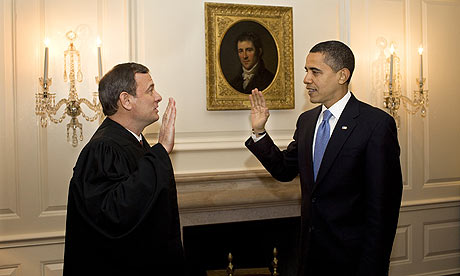
On Wednesday, as the president spent his first full day at work in the White House, and had a just-in-case second swearing-in ceremony — after he and Chief Justice John G. Roberts Jr. fumbled some of the words in the official oath of office on Tuesday — the White House denied news cameras the access they have traditionally had to capture such moments.

Instead, Mr. Obama’s staff provided official White House photographs of the event.

But the three news services that would ordinarily send those images to news organizations around the world — The Associated Press, Reuters and Agence France-Presse — refused to distribute the White House photographs. Michael Oreskes, managing editor of The Associated Press for United States News, dismissed them as a “visual press release.”

Robert Gibbs, the new White House press secretary, tried to patch things up on Thursday afternoon, chatting with the three news services on a conference call. But accounts of the meeting left it unclear whether the Obama administration would grant the traditional access of previous presidencies.

“We’re pleased that the White House press team takes this issue seriously, and they seem open to continuing this practice going forward,” said Howard Goller, United States editor for political and general news at Reuters. But he declined to specify what was actually said.

A person briefed on the meeting, who insisted on anonymity because he was not authorized to discuss it, said the White House had made no promises and had not explained its reasoning for the omission, but had left the impression that it was simply feeling its way, and had not adopted a new stance.

At Mr. Obama’s second swearing-in on Wednesday, a pool of four reporters from the print news media was present, but no pool still photographer or television camera. The photo released by the White House had been taken by its own photographer.

Mr. Oreskes said it was important that the news media produce their own images, and then choose which ones to use.

“There is a time-honored tradition going back many administrations of providing routine access to news photographers to regular, working areas of the White House,” he said, with the exception of closed areas like the Situation Room.

At a briefing on Thursday, Mr. Gibbs was asked about the exclusion of photographers. But he shed no light on either the reason it happened or on what the practice would be going forward.

“I encourage you to speak to any of the four journalists that were in there,” he said. “I think the pool report accurately reflects the event and the time it was in there.”