Showing posts with label Feminist Theology. Show all posts

Wednesday, September 09, 2026

Talarico('s) Pastor: ‘People in This Church’ Wish Would-Be Trump Assassin ‘Had Been More Successful’


Kyle Olson

September 08, 2026 5:00 PM


Townhall Media

Much has been made about Texas U.S. Senate candidate James Talarico’s version, or perversion, of “Christianity.”

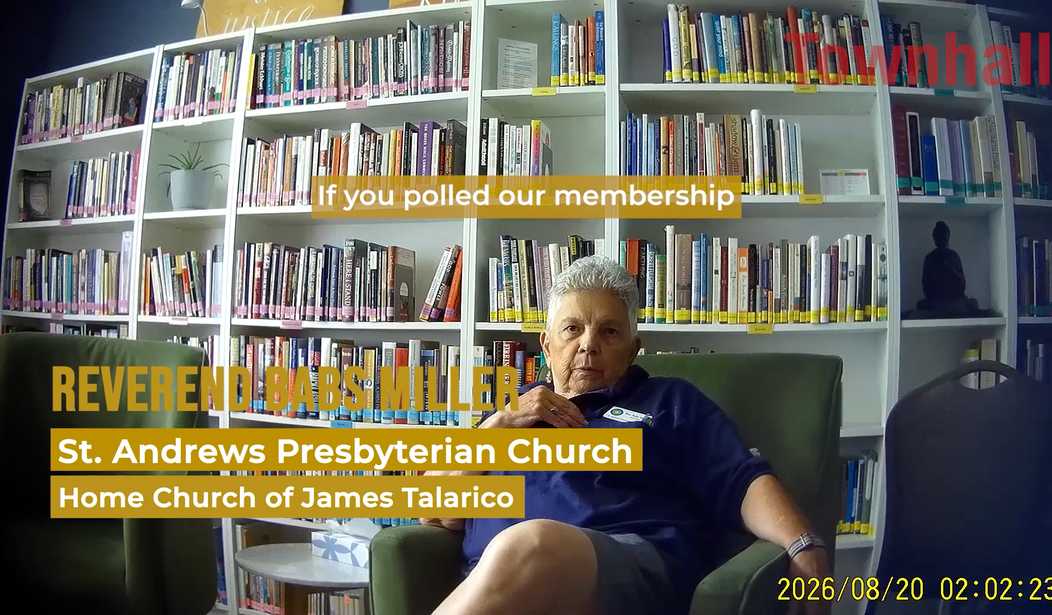
The Democrat nominee has called St. Andrews Presbyterian Church in Austin home since he was two years old, he says. It has been led for 35 years by Rev. Jim Rigby, whom Talarico calls a “mentor.” Rev. Babs Miller is “Minister to the Parish,” according to the progressive church’s website. So, one might conclude Miller knows a thing or two about St. Andrews’ congregants and their beliefs.

“We still have people in this church who wish that the young man had not just nicked his ear, but had been more successful,” Miller said, according to a video obtained by Townhall Media.


She, of course, seems to be referring to Thomas Matthew Crooks, a 20-year-old man who attempted to assassinate President Donald Trump as he rallied supporters in a Butler, Pennsylvania, field in 2024. Miller didn’t get more specific about which church members feel that way, so it’s unclear if they include Talarico.

Sources tell Townhall Media a trove of other videos that feature Miller and Rigby are forthcoming and indicate the true nature of Talarico’s religious beliefs.

“If you polled our members, and asked them if they were Christian, agnostic, or atheist, the vast majority would say agnostic or atheist because they don’t buy the religion that we got from the Puritans,” Miller said, according to another video reviewed by Townhall.

The inside look at Talarico’s church’s beliefs gives an unvarnished version of the “Christianity” he is offering to Texas voters.

He has sought to tone down his bizarre values as Election Day approaches, including the idea that God is “non-binary” and that “faith traditions all over the world” are “all equal pathways to truth.”


P.S.


Sunday, December 30, 2018

Female theologians publish 'women's bible'


Female theologians publish 'women's bible' to counter claims the Holy Book is sexist in the age of #MeToo


'Feminist values and reading the Bible are not incompatible,' said Lauriane Savoy, right, who produced the book with fellow Geneva theology professor Elisabeth Parmentier 
CREDIT: FABRICE COFFRINI/AFP


Henry Samuel, paris 30 DECEMBER 2018 • 8:00AM


A group of Protestant and Catholic feminist theologians have released A Woman’s Bible arguing that the Holy Book is not misogynistic but a tool for female emancipation.

Sparked by the Harvey Weinstein scandal, the #MeToo movement has sent shockwaves around the world about sexual abuse around the world at home and in the workplace.

Many feminists have accused The Bible, Christianity and religion in general of bolstering a sexist view of society that casts women as subservient. They argue that the female figures in translations and interpretations of Bible texts are all prostitutes servants or saints, whose most positive roles are seducing a monarch or kissing Jesus' feet.

But authors of Une bible des femmes ("A women's bible"), published in October, say that view is often down to a misinterpretation of the Holy Book by patriarchs and sexists.

The book, they write in the introduction, aims to "scrutinise shifts in the Christiantradition, things that have remained concealed, tendentious translations, partial interpretations."

In particular, they sought to counter "the lingering patriarchal readings that have justified numerous restrictions and bans on women”.

"Feminist values and reading the Bible are not incompatible," said Lauriane Savoy, one of two Geneva theology professors behind the book.

Saturday, January 09, 2016

Repenting of Our Patriarchy & Heterosexism Trisha Famisaran


Repenting of Our Patriarchy & Heterosexism Trisha Famisaran — Feb 23 2013 HD (Mirror)


Published on Sep 28, 2013

On February 22, 2013, Trisha Famisaran, who is assistant professor of philosophy and theological studies and director of the honors program at La Sierra University, preached a sermon at the Hollywood SDA Church, California.

For some reason or other the original video disappeared from YT. Where or not you agree with the presentation it is important enough that I believe it should remain on the public record as an indicator as to where some Adventist congregations are currently headed.

More commentary can be found at http://advindicate.com/articles/3029

,

Monday, July 06, 2015

Seventh-day Adventists to decide whether women can become clergy

Acts of Faith


By Michelle Boorstein July 5

Tens of thousands of Seventh-day Adventists are meeting this week to face an issue as divisive as any in the Protestant group’s 152-year history: Does the Bible allow women to be ordained as clergy?

The question has special complexity for Adventists, who to this day revere one of their founders who saw visions — a writer named Ellen White — a woman described in documents from her lifetime as “ordained.”

Discussions about what it means to be ordained, what the Bible says about women’s leadership, what to do with women’s spiritual gifts and whether different regions of the 18-million-member faith can disagree culminate in a vote Wednesday. The vote is considered not only the main event of the July 2-11 General Conference, a meeting Adventists have only once every five years, but to some potentially schismatic.

Western Adventists say the ban on female leaders is holding back their ability to function in this culture, while proponents of the status quo say they read scripture as banning women from overseeing men.

Adventists also are expected to reaffirm two of their fundamental beliefs: that the world was created in literally six days, before God rested, and that marriage is between a man and a woman. These votes, which are not expected to be seriously contested, reflect a recent push by Adventist leadership to keep the faith firmly on orthodox grounds, experts said.

The Silver Spring, Md.-based denomination has been resisting efforts to ordain women for decades, a period in which the Adventist center of gravity has shifted from its American roots to a booming, developing and more theologically conservative world.

In 1950, just a third of Adventists were in Africa and Latin American, whereas today it’s more like 80 percent, said Monte Sahlin, a recently retired regional vice president. Just more than 1 million of the 18 million worldwide live in the United States.

The issue is being pushed in the last couple years since North American Adventists have voted for women to be ordained, and the largest U.S. conference, in Southern California, in 2013 elected Sandra E. Roberts to be its president. The faith’s top executive body doesn’t recognize her leadership, and the space for Southeastern Conference “president” is left blank in the official Seventh-day Adventist directory, or yearbook.

Now the Adventists, a group that has long resisted creating extensive doctrine and rules, are looking at whether they can agree to disagree. Adventists have never allowed for diverse practices on a topic as fundamental as this.

Some say the Adventists could be headed for a split, while others believe most members value the faith’s large size and don’t want to start breaking off chunks. The church is largest in Africa, Central America, the Caribbean and in the northern part of South America.

The debate and shifting demographics are hardly unique to Adventists. As denominations including Anglicanism and Methodism have shrunk in the U.S. and Europe and exploded in the global South, values have changed.

In North America, Adventists are dramatically graying, and the ban on female clergy is a barrier for young people. In many other parts of the world, equalizing gender roles is viewed very negatively, Sahlin said. New Adventists in the Southern Hemisphere are attracted, often from Catholicism, because they like the concept of sectarian separation. They perceive the ordination debate as dangerous, secular feminism, he said.

“All of a sudden the denomination is becoming worldly and part of the culture … people want something more separated from the world,” he said.

On Wednesday, Adventist delegates from 190 countries will be asked whether it is all right for regional bodies “as they may deem it appropriate in their territories, to make provision for the ordination of women to the gospel ministry?”

The conference is drawing 60,000 to 70,000 people, said Garrett Caldwell, spokesman for the global church.

Also being voted on — and expected to pass — is an edit to Adventist doctrine that refers in places to a commitment between “partners.” The new language will make clear that same-sex marriage is against Adventist practice and that marriage is between one man and one woman.

There are of course LGBT Adventists, including unofficial supporting organizations. However, Sahlin said, many have left the faith.

Also expected to pass is a revision to another of the 28 “fundamental beliefs,” reaffirming a belief that God created the world in a week.

The issue has come up in some Adventist colleges and universities, as it has at other conservative Christian schools that are trying to balance a commitment to orthodox practice with a desire for an open academic environment.


“The need for clarification comes because some might look at the seven-day account in the Bible and say, ‘Scientifically, this is impossible.’ Or that the word ‘day’ is symbolic,” Caldwell said. “We’re saying, ‘No, we believe that.’ ”

Christians who say women can’t be clergy come at it from different perspectives. Catholics, for example, focus on the story of Jesus and his male apostles. Traditional Protestant groups, including the Southern Baptists and the Lutheran Church — Missouri Synod, cite scripture calling for women to be students, not teachers or authority figures over men. Many Christian groups that accept women’s leadership either cite sociological reasons or say women who were given spiritual gifts by God should be allowed to use them.

Which is where White comes in. Perhaps the most revered of Adventist founders, White is believed to have had many spiritual visions, and her writings are pored over. While documents say she was “ordained,” there is disagreement about what specifically that meant in her lifetime. A full day at the convention is set aside, Caldwell said, to discuss this issue.

“She was never ordained,” said David Neff, longtime editor of Christianity Today and a former Adventist pastor, “but did all the things ordained people do.”

Clinton Wahlen, associate director of the Adventist Biblical Research Institute, said there is no question White was an “inspired messenger of God” and had credentials as a public speaker and church representative that were as high as any man. But, he said, she never performed a wedding or conducted a baptism — functions clearly reserved for clergy. Wahlen is among those who sees no Biblical basis for women to be ordained clergy.

“There is a clear gender specification that we cannot ignore as a Bible-based church.”


Want more stories about faith? Follow Acts of Faith on Twitter or sign up for our newsletter.


Michelle Boorstein is the Post’s religion reporter, where she reports on the busy marketplace of American religion.


Source
.

Thursday, December 26, 2013

Pastor Leads A New Brand Of Church For 'Sinners And Saints'


by
December 24, 2013 3:35 AM


from

Morning Edition
Listen to the Story

7 min 20 sec


Pastor Nadia Bolz-Weber, shown here officiating civil union ceremonies in Denver in May, wrote a book on faith that recently landed on the New York Times best-seller list. 
Anna Hanel/Colorado Public Radio 


It's Sunday evening, and services are just getting underway at the House for All Sinners and Saints in Denver. Nearly 200 worshipers sit in circles of plastic chairs around a simple altar table. Together they follow traditional Christian rites. They sit. They stand. They sing.

The congregation here resembles the crowd at a downtown bookshop — hipsters and college professors, gay couples and Democratic grandmas. But even in this crowd, the congregation's pastor, with her short, moussed hair and armloads of religious tattoos, stands out as she launches into a sermon about Jesus on the cross.

"In our win-lose way of understanding things, it would have made a lot more sense for Jesus to have come and been a superhero — kicking ass and taking names, showing everyone how strong God is by winning at our game," she tells the congregation.

Pastor Nadia Bolz-Weber is a bit of a Lutheran rock star at the moment, although the term makes her cringe. Her new book, Pastrix: The Cranky, Beautiful Faith of a Sinner & Saint, recently hit the New York Times best-seller list.

What she and her church are trying to do, she says, is simple and radical: create an authentic Christian experience without the pretension that can come with church.

"I think people's tolerance for bullshit is at an all-time low," she says.


Members of the church meet at Denver coffeehouses during the week for what they call "office hours" —€” informal and often highly irreverent chats. Jim Smelser/House for All Sinners and Saints 


What people want, she says, is a spiritual community that's beautiful and transformative and maybe even transgressive — and that's not what you find in most churches, conservative or liberal.

"We've been given social conventions, we've been given basically the Elks Club with Eucharist, or we've been given a place to gather on Sundays where basically what we hear is the same as the platform of the Democratic Party," she says. "I don't think the early Christians martyred themselves for either of these things."

Bolz-Weber's path to becoming an increasingly public theologian was rocky, to say the least. Early in adulthood she drifted away from her parents' conservative Church of Christ and into a lost period of drugs and alcohol, only to find God again as she was struggling to get sober. That checkered history is something she talks about openly, trying to help others feel comfortable with their own failings.

"There was a young woman, I took her confession — and it was for real, it was something really heavy — and she was super tense at the beginning, and then she relaxed," Bolz-Weber says. "Then we were kind of laughing, and she goes, 'Oh, my gosh, I'm so glad you're my pastor, because I know you've done much worse than that.' So that's also a service I offer."

The faith that the congregation practices is, for lack of a better word, orthodox Lutheran. Even the congregation's name — House for All Sinners and Saints — comes from Martin Luther's belief that everyone is simultaneously all sinner and all saint.

But "House," as it's often called, does practice its faith differently from most congregations. It offers communion to everyone, regardless of whether they've been baptized, and it opens the liturgy to all who want to participate. That really struck parishioner Stephen Ludwig when he first attended a service after a decade away from the church.

"Everyone that shows up has the opportunity to read scripture, serve communion, participate in the service," he says. "Liturgy is supposed to be 'of the people,' and this really brings it back to that."


Welcoming all is the animating idea behind House, but it can be a challenging one. As Bolz-Weber's popularity has grown, so many people have started visiting that there often aren't enough chairs for the regulars.

Longtime worshiper Stuart Sanks admits that having so many new people stopping in can be difficult.

"Sometimes it feels like House is losing that idea of what made it different. But that's just something we're trying to figure out and work through and make the best of stewarding the responsibility, I guess, that we've been given."

For Bolz-Weber, that responsibility is exciting — rethinking the way the church exists in the world today. She says she's more interested in her congregation having a dynamic, faithful relationship with God than getting hung up on the specifics of what they believe.

And while no single common belief holds the congregation together, Bolz-Weber says certain values are universal: to welcome everyone and take that message out into the world.


Source
.
Wednesday, November 21, 2012

The Church of England can no longer continue as an arm of the state

By voting against women bishops, it has shown itself to be a discriminatory organisation that seeks to be above the law


Suzanne Moore


The Guardian, Wednesday 21 November 2012 15.00 EST


Vicar Rose Hudson-Wilkin was widely expected to become the CofE’s first woman bishop until the vote. Photograph: Carl Court


Up until now I cannot say I have been overly concerned with female vicars. That one in Dibley seems fun but mostly I am with Bill Hicks: "Women priests. Great, great. Now there's priests of both sexes I don't listen to." I don't believe or even pretend to believe in order to get my kids into the right schools.

Nor am I under illusion that the Church of England is some hippy-dippy hirsute cerebral force for good. Bits of it may well be. When I lived in London's King's Cross, the local vicar – "Trev the Rev", as he was known – let the prostitutes sleep in the church when they were under assault from vicious punters and the police. This seemed to me a fine Christian thing to do. But for every Trev the Rev there is some reactionary gittish vicar determined to keep up the fine traditions of homophobia and misogyny.

Unity in the church is a joke. When I asked my local vicar if I could use his church for a blessing ceremony using a female Baptist minister, he made clear his feelings about women vicars. But half a mile up the road the clergy were in the middle of a big gay picnic and had no problem with anyone using their building. For a donation. Which is fair enough.

One encounters these inner-city vicars who don't seem to mind what you believe – some will even say that the resurrection is but a metaphor – but don't be fooled. At the heart of the church is a steely core of evangelicals who have far more say than they should. The provisional wing of the CofE is as fundamentalist as they come: the one thing that all fundamentalisms share is the need to keep women in their place.

Thus we had the farce of the vote against women bishops when there have been women priests for 20 years, which the majority of the congregation accepts. To ban those women from promotion is discrimination that would not be acceptable in any other walk of life. The church, with its mystifying voting process, looks not only archaic but also impotent as the vast majority of the synod did not want this result. They are praying for resolution. Sometimes prayers are not enough.

As the conservative MP who speaks for the synod in parliament said: "I think the great danger for the church following the vote is that it will be seen increasingly as just like any other sect." Indeed, this is how many of us already regard it. The question then becomes how can the church continue to function as an arm of the state when it endorses such out-and-out prejudice?

Remember there are already 3,600 women priests in the church and 37 women Anglican bishops worldwide. Africa has just got its first woman bishop. So now we lag behind Swaziland.

The issue is not belief – people can believe in fairies as far as I am concerned – it is the relationship between church and state. In this crazy chess game, the head of the Church of England, the Queen, could not be a bishop. David Cameron has urged them to "get on with it" – ie, vote the right way for the church – but not conforming to equality legislation is untenable.

It is worth understanding what the objection to women as bishops is based on. Evangelicals believe that women cannot exercise authority over men. They use scripture (St Paul's letters) to justify this: "I do not permit a woman to teach or have authority over a man." Thus a man could never swear a canonical oath to a woman bishop. Other objections rest on the fact that Jesus chose only male disciples. Was Jesus sexist? And that before The Fall, when it all went wrong, women existed to act only as helpers to men. I venture that the people, many of them women, who believe such things are unlikely to be swayed by new-fangled notions of equality. But why should they hold such sway in the church and why should the church hold such sway in our land?

Away from theological debate, other issues are at stake. Money, for instance. Reform, the group that represents the evangelicals, holds the rest of the church to ransom by constantly reminding the House of Bishops of its financial clout. In 2010 Reform wrote a letter mentioning the £38m that it had added to the CofE central coffers. The threat that these people withdraw completely from the CofE appears to paralyse the church – but surely the situation has become ridiculous.

The church, in seeking to be above the law, is now a discriminatory organisation, though it holds 26 seats in the House in Lords, from which women are barred. This effective debarring of women from the legislative process is more than an "embarrassment", it is profoundly undemocratic.

A secular country – and that is largely what we are – should have no truck with this. Why on earth should we respect this bizarre sect any longer? The separation of church and state is long overdue. An institution that allows the maintenance of a stained glass ceiling for its female clergy to bang their heads against should not only lose its moral authority. Let it also lose its unearned privileges.


Source
.

Friday, August 10, 2012

North German Union Conference Constituency Session Votes to Ordain Women


09.05.2012:


Berne, May 9, 2012. [CD-EUDnew]. What happened in Germany during the North German Union Constituency Session last April 23, will doubtlessly push the Seventh-day Adventist Headquarters to consider reopening the discussion on women’s ordination.


During the session, an individual's motion to ordain women passed through the administrative levels in order to qualify for the agenda. Opening the discussion, the debate animated the floor, and more than 40 interventions rose up to participate in the discussion. There was not one speaker on the microphone who spoke against the ordination of women. Some obviously tended towards rating global unity over equality as everyone knew a positive vote would lead to a clash with the General Conference's Working Policy. Finally, after all the interventions, the delegates voted (160 to 47 votes taken electronically for the first time) ‘… to ordain female pastors in the North German Union [in the same way] as their male colleagues.’
What drove this Constituency session to take such a decision despite the position of the World Adventist Church, after freezing the discussion for the past 10 years?


Pastor Klaus van Treeck, Union Conference president, said: “We didn’t want to open the way or to encourage others to oppose the guidelines of the World Church or to join us in civil disobedience. We discussed the matter in the context of our culture and ask the World Church to understand our situation and decision. We are respectful towards our brothers and sisters in any area of our World Church. We feel deeply associated with them in the love of Jesus and in the unity and mission of the church.” In Germany both the law and social values strongly condemn discrimination against women in the selection of leaders in any organization, including the church.


How to deal with this issue confronting guidelines and cultural exigencies?
According to this moral background, the delegates wanted to express to the worldwide Adventist Church leadership that the issue of the equality of female and male pastors is no more an option, and invite them not to consider this vote as an act of disloyalty towards the World Church. They want to launch a signal that they are tired of waiting for a solution for such a sensitive question. They hope to have made a contribution so that in 2015, in San Antonio (USA), a regionally different regulation will be approved giving end to an unbiblical and discriminatory estimation of women’s ordination. There are no theological, but only cultural arguments that speak against it.

The most recent support for this pioneering process was given by the former president of the World Church Council,
Dr Jan Paulsen, when he addressed the audience of the Spring Session of the General Conference in April 17, 2012, (available in ANN) saying : “The Spirit is the minister of this unity among Christ’s followers (Eph. 4: 3). It is appropriate that we should remind ourselves that while uniformity is no Biblical requirement, unity is!
“Our unity as a global family is these days being tested with respect to the role of women in ministry and leadership in our church. Some insist that those who advocate the ordination of women in our church will split the church. Maybe. The other side answers that those who deny women ordination will be the ones who split this church. Maybe. If the church cannot find a way forward in this matter without compromising the unity God wants us to hold and preserve, we shall all have to answer for how we contributed or failed to contribute to overcome our impasse, and I suspect that those who said “No” will be held as responsible in the eyes of God as those who said “Yes”. Make no mistake about it: God’s love for his people, whom he wants to remain united, is greater than we can understand.


“If there were clear inspired mandates, in the Scriptures or in the Writings of Ellen White, giving us directions in this matter (women’s ordination), we would not be having this discussion as a global church. We have in the past concluded, through the work of several commissions and reported back to this council, that we find no such mandate on which there is broad agreement”
Dr. Paulsen concluded.

According to this evidence, the delegates voted to charge the union executive committee with implementing additional study of the topic of ordination, including research to be conducted by Friedensau University, the Adventist higher education institution in Germany. The findings from this study are to be presented to the Euro-Africa Division and the General Conference.


During the session, there was a motion to amend the Union Conference constitution to delete the language that requires that the president and secretary be ordained ministers. This motion was not passed by the require two-third majority.
 
The North German Union Conference covers 11 states in the northern region of the German Federal Republic, including Berlin and other major urban areas. It is made up of four local conferences with a total of about 20,000 church members among a population of more than 47 million. There are 346 local churches and 149 ministers, including two women.

The EUD Administrative Committee in its last session reflected on the vote, and has made a recommendation to the Executive Committee that will be published after its meeting later this month.


By: CD-EUDnews. Picture CD-EUD


Source

.

Saturday, January 23, 2010

Wicca's Invitation


Posted by David Virtue on 2010/1/20 8:10:00


Pagan practices are meeting with an increasingly receptive audience in the Episcopal Church. Is it the consequence of an unmet need?

by Jeff Walton
January 14, 2010

The monthly meditation had a playful air about it.

"A crone is an old woman. A crone is a witch. A crone is a wise woman. Which one will you be, my friend? Which one I?"

Wrapped around a rite for "croning", the meditation embraced a history of mystical women and offered prayers to "Mothering God" and "Eternal Wisdom." But the article was not in a new age publication or Wiccan blog: it was on the pages of the September newsletter of the Episcopal Diocese of Washington.

Entitled "Crone Power", the meditation innocuously sat opposite a story about choosing a children's Bible and next to a column on St. Jerome. The newsletter quickly drew the attention of Anglican bloggers, many of whom found the placement of what appeared to be a Wiccan ritual to be jarring in an official church publication. But intentionally or not, the publication and placement of the rite were reflective of a new reality: one in which practices drawn from or inspired by pagan belief, including witchcraft, are increasingly finding acceptance within the ranks of the Episcopal Church.

"Croning rituals have been a part of modern day witchcraft since [English occultist] Gerald Gardner invented it in the 1950s," explains Catherine Sanders, author of Wicca's Charm: Understanding the Spiritual Hunger Behind the Rise of Modern Witchcraft and Pagan Spirituality. Sanders, an evangelical Christian, spent several years researching pagan practices and witnessed their incorporation into the church during the writing of her book. Sanders said that croning, the practice of honoring a woman who has gone through menopause, became more popular in the 1970s with the women's movement.

"Most of the mainline denominations had people within them experimenting with pagan rituals," Sanders said. "A lot of these people were searching for a way to affirm what they were going through in their lives."

While the croning ritual was notable for its prominence in a diocesan newsletter, such pagan-inspired practices are not new in the Episcopal Church. In 2005, Pennsylvania Episcopal priest Bill Melnyk was outed as a Druid (he belonged to the Order of Bards, Ovates, and Druids) after posting a druid ritual to an Episcopal Church Women's website. Melnyk, who had taken the name "Oakwyse," was forced to resign by his bishop.

Pagan influences in women's spirituality were also a prominent part of the "Reimagining" movement that appeared among some mainline Protestant feminists in the early 1990s. The Reimagining movement encouraged worshippers to refer to God as a feminine deity known as "Sophia," loosely based on the Greek concept of the wisdom of God. Controversy eventually subsided after denominational leaders, responding to pressure from traditionalists, distanced themselves from the Reimagining liturgies.

The diocese of Washington itself has a track record of embracing mystical rites, most recently hosting a Native American "smudging" ceremony at the National Cathedral. During an interfaith conference,Sacred Circles: a Celebration of Women's Spirituality, smoking tobacco was offered to the spirits of the four cardinal directions.

Crone Power

The author of the rite that appeared in the Washington Window was herself far from the traditional images of covens and witchcraft. An older parishioner at St. Alban's Church, Helma Lanyi arrived from the Roman Catholic Church ten years ago after taking issue with Catholicism's hierarchy and patriarchy.

Situated near the highest point in Washington, D.C., next to the prestigious school of the same name that educates many of Washington's elite, St. Alban's is more reflective of the reserved and upper-class mainstream of the Episcopal Church, rather than the fringe congregations that have previously entertained pagan ideas and practices. Its rector was recently elected to become the new bishop of the Episcopal Diocese of Georgia.

"I had become aware for a while that it's really not cool in our society to be an older woman," Lanyi said. "At one point I picked up a book on crones. That describes very much the whole pagan point of view about being an older woman."

Lanyi, a first generation immigrant from Germany, found the topic interesting. Nevertheless, it did not appeal to her as a Christian.

"I'm really not into Earth mother thinking," the St. Alban's parishioner explained. Among other concerns that she had with pagan practices, Lanyi did not like the portrayal of female power as superior to male power. But the idea of croning seemed to resonate along with a book she had read by liberal Catholic nun Joan Chittister. Lanyi saw being older as a gift, and she had grown tired of what she saw as a cultural expectation to hide one's age.

"Why is the joy of life considered to be something that it isn't part of [life] for women when they are older?" Lanyi asked. "I felt that God hasn't taken his concern away from me now that I am older. Why should that only be between me and God?"

In her words, Lanyi wanted to be "properly an old lady without being out of the picture." So she investigated croning further. Normally engaged with her work as co-chair of the Episcopal Peace Fellowship at St. Alban's, Lanyi visited Wiccan websites that her daughter had found, complete with a variety of croning rituals.

"It blended perfectly with my nonviolence training and interest," Lanyi said of some of her folk religion readings. Lanyi found in folk religion an element which "emphasized the more female elements of being non-judgmental." The St. Alban's parishioner saw those elements as being compatible with Christianity as she understood it.

"That's what Jesus came for, working together and everyone is equal," Lanyi claimed. "Jesus came not to go against all of that [folk religion], the same way he didn't go against the Jewish religion, Jesus came to affirm our nature."

But whereas Lanyi found value in folk religion, some of the Wiccan croning rituals themselves were wild and over the top.

"I couldn't see asking people to do that in my living room," the elderly German laughed. She decided that authoring her own rite was the best way to proceed.

"I pretty much made it up, that ritual doesn't exist anywhere as I know it," Lanyi explained. "I thought it was a little like baptism rituals, this idea of asking questions: what are you seeking, what do you want?"

She wrote her ritual a little bit tongue in cheek, she admitted. Then, last year, Lanyi gathered seven friends and performed the rite. They stood in a circle, one lighting a candle and placing it on a center table. They took turns reading the poem "Woman's Work," by Maya Angelou, as a sign of solidarity with all women. Then they invited the newest crone-to-be into the circle.

"What we read in these Wiccan rituals that my daughter shared with me, they used dirt or soil, and that didn't make sense, so we used a hand-woven stole," Lanyi added. She recalled the rite in her article:

She [the new crone] tells us of the phases of her life up until now. The others ask her: "What is it you are seeking for this phase of your life as a crone?"

She answers: "I seek wisdom." We say in unison: "Mothering God, grant her Crone Wisdom."

We ask: "Beside wisdom, what is it you are seeking?" She answers: "I seek judgment." We reply: "Mothering God, grant her Crone Judgment."

Finally we ask: "Besides wisdom and judgment, what is it you are seeking?" She says: "I seek Joy." We respond: "Mothering God, grant her Crone Joy."

We take turns anointing her forehead with special oil and present her with a stole, or wreath, inviting her to go forth into the world and share her Crone power.

We pray: Eternal Wisdom, source of our being and center of all our longing, In you our sister has lived to a strong age: A woman of dignity and wit, in loving insight now a blessed crone. May the phase into which she has entered bear the marks of your spirit. May she ever be borne up by the fierce and tender love of friends and by You, most intimate friend; and clothed in your light, grow in grace as she advances in years, For your love's sake.

"I wanted to indicate that this was now a passage, now a part of life," Lanyi said. "It meant a lot to us, most of us were of that age."

An Unmet Need

After years of researching Wicca, Sanders has empathy for women like Lanyi that have looked to pagan ritual.

"There definitely is a hunger," Sanders explained. The author observed that croning rituals tend to draw older women, while younger women seek rituals involving nature. Many times, the rituals grew out of desire to be recognized or acknowledged.

"Older women have a lot of wisdom, and they do have a special place in our society," Sanders said. "But the fact that our society has this view that women need to make themselves better (through things like plastic surgery), that's the result of sin and the fall."

"A lot of these women are looking to affirm something that they don't think is being met," Saunders said. Quoting author Arthur Lindsley of the C.S. Lewis Institute, Sanders surmises that sometimes "people are interested in neopaganism because of the unpaid bills of the church."
One example that Sanders cites is the church's lack of a response to miscarriage or stillbirth. While the Episcopal Church has historically offered no rite acknowledging these traumas, Wicca does.

"The problem that exists with a lot of these pagan rituals is that they don't bring the redeeming life of Jesus into them," Sanders said. "They're all about the participants, and that is where the problem lies."

For such needs to be properly addressed within the Christian Church, rites made for them have to be about what Christians believe, Sanders says. "It has to focus on Jesus and what he did for humankind."

The evangelical author notes that many of the pagan rituals do not focus on a personal God, since they presuppose a god revealed or contained only in natural forces.

"As Christians, we just go so much further than that," Sanders says. "It's perfectly fine to have a service of worship to praise Him for His creation. There can be a certain need for churches to do more of this thing, but not pagan rituals that stop short of praising God and that step outside of Christian theology."

Additionally, Sanders has concerns about feminized language that can be found in such rituals, including Lanyi's croning rite.

Lanyi said that the Washington Window editor "did come back to me to ask if I could make it more Christian." In her published meditation, Lanyi backed the feminized wording with references to Christian women in the Celtic tradition such as Hild, Ita, and Brigid. She also cited the 14th century writer Julian of Norwich, who described God as a Mother. Lanyi labels all these Christian women crones, along with Catholic school pioneer Mother Seton and Mother Theresa of Calcutta.

"In calling God Mother, the thing that is confusing for pagans or Wiccans is that we are 'part of that' but in Christianity, we are not part of God, he is wholly separate," Sanders explained. She noted that mothers give birth, a trait ascribed to the goddess in the mainline Reimagining movement. In contrast, Scripture does not describe God as possessing reproductive organs or giving birth, traits common in depictions of pagan deities.

"Obviously God is not human, he is wholly other," Sanders said. "In calling God father, that's what Jesus did. He didn't call God his mother or she, he called him he."

Sanders says that the draw toward such feminized depictions of God sometimes comes from the personal history of the practitioner.

"You have these women that are very hurt, upset because of a relationship with their father, but Christianity says God can heal you of past hurts through the redeeming love of Christ," Sanders said. During the course of her research, Sanders also found that difficult marriages or encounters with a pastor that were unsatisfactory could also leave a woman wounded and drawn to Wicca.

A Service of Remembrance

Some churches are taking notice of the need for spiritual acknowledgement of events like miscarriage. At the Falls Church, an Anglican parish in suburban Washington, D.C., the pastoral care staff worked on a liturgy of remembrance for a special All Saints' Day service. Sensing a need for women who had experienced losses through miscarriage, abortion, stillbirth, or early childhood death, the 275-year-old parish began the service in 2008.

"It wasn't about us, it was all about the redeeming work of Christ," Sanders said. "The subject of the ceremony was to remember the children and what happened to the parents there, but it was all focused on God and deeply rooted in Scripture."

"It was very much about glorifying God," the author said. "It marked the loss, but it pointed to Jesus Christ." The special All Saints' Day service proved extremely popular, with the sanctuary reaching full capacity. The pastoral care staff plans to repeat the service this year.

Rev. Nicholas Lubelfeld, an Episcopal Priest on staff at the Falls Church, explained a distinction between the church's All Saints' service and pagan rituals.

"It's one thing to try to conform our lives to God's will; it's another thing to try to shoehorn God into our goals and aspirations," Lubelfeld said. The priest said that the difference was between prayer through Jesus Christ and bringing God "into play into our plans."

"Who's agenda is it?" Lubelfeld asked. "My need is what I bring to God, but I don't try to shoehorn him into my plan -- magic has as its aim the securing of a particular end; prayer has the end of bringing our hopes and fears to God."

"It would be good for churches to consider ways to honor who God created us to be, the things we are experiencing," Sanders said. But Sanders added that if rituals do not point to Jesus, they don't have a place in the church.

"The Gospel is the best answer for those people," Sanders said. "As a result of sin, we don't honor women the way we should, and therefore they are reaching out. These are people that are in our midst that are hurting, and if it means reading up on these rituals, that will help us understand where they are coming from."

"In modern 21st century America, we think we know what we need, and that's a dangerous place to be in," Sanders said. "We need to constantly glorify him."

Since publication of her croning rite, Lanyi has received a subdued response.

"I'm aware that this may be not entirely what people are used to," Lanyi said. "Women my age have come to me and said, 'I loved your article'-- but not a lot. I'm not sure if they know what to think of it."


----Jeff Walton is Communications Manager and Anglican Staffer for the Institute on Religion & Democracy.The following article originally appeared in Forward in Christ Magazine, and is reproduced with permission.
..

.

Monday, December 14, 2009

Ecofeminism, ecology key topics for women’s conference


“Adventist Women and the Earth: A Response to Ecofeminism” will take place at the La Sierra University Church. The conference will feature talks, workshops, panels, a film screening, prayer labyrinth and community outreach activities. Keynote speaker and theologian Rosemary Radford Ruether will deliver an address April 25 titled “Ecofeminism and Theology: A Comparative Perspective.”


April 21, 2009
By Darla Martin Tucker

RIVERSIDE, Calif. – ( http://www.lasierra.edu/ ) What responsibilities do women, particularly Seventh-day Adventist women, have toward safeguarding planet Earth? What connection do religious beliefs have with stewardship of the earth? And how can women and men show respect for God’s creation through conservation?

These and other issues will be addressed this weekend during the conference, “Adventist Women and the Earth: A Response to Ecofeminism.” The series of talks, workshops and outreach activities will take place April 24 – 26 at La Sierra University Church, 4937 Sierra Vista Ave., Riverside.

The conference is open to all who wish to attend. Admission is free. For more information call 951-785-2470 or visit http://adventistwomenearth.wordpress.com/ . The “Adventist Women and the Earth” weekend event serves as the annual Young Women and the Word Conference organized by La Sierra University’s Women’s Resource Center. La Sierra University is an institution of the Seventh-day Adventist Church.

The weekend kicks off with a 7:45 p.m. program on April 24 titled “Where Does the Accent Go?” presented by LSU Master’s of Divinity student Jared Wright. The following day’s lineup includes talks by educators Maritza Duran and Somer Penington. They will speak respectively at 8:30 a.m. and at 9:30 a.m. with talks titled “Resurrection and New Life” and “I Came For the Wildflowers, and All I Got was a Snake.” At 11 a.m., Chris Oberg, La Sierra University Church senior pastor will give a talk titled “Going Green is Going Home,” a presentation that addresses reasons to care for the earth despite certain religious views predicting Earth’s demise.

At 2 p.m., conference keynote speaker Rosemary Radford Ruether will give an address titled “Ecofeminism and Theology: A Comparative Perspective.” “The talk defines different meanings of the term ecofeminism and discusses why I choose the third view and compares ecofeminist views of Vandana Shiva of India and Ivone Gebara of Brazil,” Ruether said.

Ruether is a Claremont Graduate University visiting professor of feminist theology and a noted theologian whose books include “Sexism and God-Talk” and “Integrating Ecofeminism, Globalization, and World Religions.” She has held a long career as a scholar, teacher and activist in the Roman Catholic Church and is known as a groundbreaking figure in Christian feminist theology.

The afternoon’s offerings will include workshops and panel discussions on ecology and its relation to art, religion, gender and spirituality. Students will give presentations on the earth and feminism and on ‘bright green’ environmentalism.

“Adventist Women and the Earth” aims to address our responsibility to the earth, to explore connections with gender justice, and to examine religious beliefs as they underpin individual and collective stewardship,” said Trisha Famisaran, an LSU alumna, Claremont Graduate University doctoral student and Women’s Resource Center board member. She will lead the conference’s paper presentations by La Sierra students Felisa Samarin-Meier and Ana Cristina Lee Escudero. The students’ presentations are respectively titled “Differentiating Feminine and Feminist,” and “The Earth is My Mother.”

“We hope to lead out and show how young Adventist women care about the earth and women and challenge others not only to recognize this problem but to actively create and practice solutions that respect the dignity and value of God’s creations,” Famisaran said.

Conference attendees will have the opportunity to walk a 45-foot-by-24-foot prayer labyrinth in Sierra Vista Chapel, watch the natural history feature film “Earth” at 7:30 p.m. at Edwards Corona Crossings Stadium theater on Saturday evening, and participate in beautification and cleanup outreach projects on Sunday morning. The latter outreach activities will include cleaning, plant trimming and landscaping at a homeless shelter. Conference organizers are seeking donations of cleaning supplies, flowerpots, gardening supplies, plants and flowers for this project.

“The conference is including community projects because we feel that it is important to engage in practices beyond discussion and theory,” Famisaran said. “Conservation is a very important aspect of ecofeminism because it calls us to recognize a different relationship between humans and the environment, a relationship of interconnection and recognizing the intrinsic value of all things. The particular community projects that we have organized offer a small glimpse of what conservation is and gives participants the opportunity to provide a service to the community.”


Following is a schedule of events, speakers and participants.


Fri., April 24
7:45 p.m. – Vesper program, “Where Does the Accent Go?” presented by Jared Wright, LSU graduate divinity student.

Sat., April 25
- 8:30 a.m. - Maritza Duran, Orangewood Adventist Academy vice principal, will speak on “Resurrection and New Life.”
- 9:30 a.m. - Somer Penington, Redlands Adventist Academy chaplain will discuss the Global Issues Experience prayer labyrinth and give a talk titled “I Came For the Wildflowers, and All I Got was a Snake.”
- 11 a.m. – Chris Oberg, La Sierra University Church senior pastor will give a talk titled “Going Green is Going Home.”

- Lunch break - Attendees will provide their own lunch.

- 2 p.m. – Keynote speaker and Claremont Graduate University theologian Rosemary Radford Ruether will give a talk titled “Ecofeminism and Theology: A Comparative Perspective.”

Afternoon Workshops and Panels

3 p.m. - Ecology, Religion and Gender Panel, with Ruether; John B. Cobb Jr., professor, award-winning author and co-director of The Center for Process Studies at the Claremont School of Theology; Sheryll Prinz-McMillan, executive director of the Christian Counseling Center in Redlands and a pioneer of Adventist women’s writings on ecofeminism; and Warren Trenchard, La Sierra University provost and professor of New Testament and Early Christian Literature. La Sierra Associate Professor of Religious and Theological Studies Ginger Hanks-Harwood will moderate the panel.

4:15 and 5:15 p.m., Breakout Sessions
- Conservation, led by Wendy Walters, LSU alumna and senior biologist at environmental and land use planning firm, LSA Associates Inc.
- Art and Ecology workshop, led by Beatriz Mejia-Krumbiein, LSU art department chair, with Ann Isolde, visual artist and feminist art movement participant; and France White, Roman Catholic nun, artist, teacher and peace educator.
- Spirituality and Ecology: Fostering Awareness, led by Hanks-Harwood.
- Presentation of Student Papers, led by Famisaran.
- Eco-Dome: Building a Bright Green Future, led by John Razzouk, former La Sierra Students In Free Enterprise president and members of SIFE’s Environmental Sustainability Team. They will discuss the SIFE team’s environmentally friendly projects including construction of demonstration eco-domes on La Sierra’s campus. The structures are made primarily of earth and mixed with such elements as cement, barbed wire and polyurethane tubing. The team will also talk about simple solutions to a brighter, greener future.

7:30 p.m. – Film screening: “Earth” (Rated: G), Edwards Corona Crossings Stadium 18, 2650 Tuscany St., Corona. Tickets available for purchase at the theater.

Sun., April 26
- 9 a.m. – 12 p.m. Outreach projects.


PR Contact: Larry Becker
Executive Director of University Relations
La Sierra University
Riverside, California
951.785.2460 (voice)
.
.
.
.
*P.S. This is a conference University where your SDA daughters or sisters can get a New Age Ecologically viable ecumenical/feminist education.....
Arsenio.
.