Showing posts with label S. Africa. Show all posts

Thursday, October 01, 2026

Protesters against illegal immigration in South Africa call for more deportations


Hundreds of people have held a demonstration against illegal immigration in the South African city of Durban

ByKAYLEEN MORGAN Associated Press and MOGOMOTSI MAGOME Associated Press
September 30, 2026, 3:58 PM

DURBAN, South Africa -- Hundreds of people held a demonstration against illegal immigration in the South African city of Durban on Wednesday, vowing to intensify their actions against what they say is the government's failure to deal with the issue.

The crowds, led by the March by March group, had set a Sept. 30 deadline for those living illegally in South Africa to leave the country. The deadline wasn't recognized by the government and authorities.

With some brandishing traditional Zulu weapons and singing cultural songs, they marched through Durban’s streets. Police didn’t report any incidents of violence against foreigners during the protest.

A similar deadline set for June 30 sparked a mass repatriation of foreigners to their various African countries after attacks on immigrants. The governments of those nations arranged for the evacuation of their citizens.

Wednesday's demonstration was the latest protest in South Africa over the last few months. There have been reported attacks against some foreign nationals that have led to diplomatic tensions between the South African government and some African nations.

South African authorities also have reported the deportations of thousands of foreigners who were in the country illegally in recent months.

Earlier this month, Nigeria’s parliament indefinitely suspended official visits and engagements with South Africa over the immigration tensions.

For years, South Africa has attracted foreign nationals seeking economic opportunities from across the continent, including from nearby countries Zimbabwe, Lesotho, Mozambique and Malawi, and as far away as Nigeria, Ghana and Ethiopia.

Many blame migrants for the country’s high levels of unemployment, crime and pressure on public services.

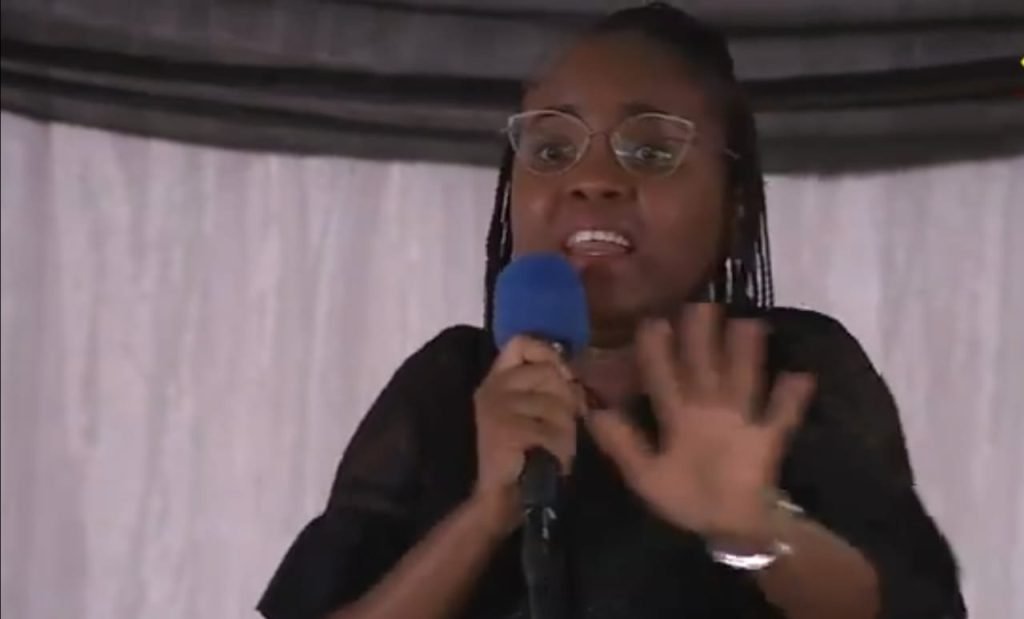
“We were raising another concern about our porous borders and the fact that we have overstretched resources that are not enough to take care of us,” said Jacinta Ngobese-Zuma, the leader of March and March.

The protests were meant to put more pressure on the government and called for more deportations of those who are in the country illegally, she said.

“The message we are sending today is that people are getting really, really fed up," she said. "We also hope that our government will take the cries of the people seriously, instead of trying to look good to the international world."

Protesters said that the demonstration was also meant to express outrage over the issue of femicide and gender-based violence in the country, which has recently been highlighted by the killing of at least 11 women in Ekurhuleni, east of Johannesburg.

___

Mogomotsi Magome reported from Johannesburg.


Sunday, November 23, 2025

G20 grapples with a splintering world order

Leaders of world's biggest economies gather in South Africa, despite US boycott
WorldPoliticsDiplomacy

AFP 


Some of the G20 representatives and leaderspose for a family picture during the summit. Photo: AFP

G20 leaders gathered Sunday in South Africa hailed multilateralism -- even as they struggled to adapt to a changing world order beset by go-it-alone US policies, wars and deepening geopolitical rivalries.

The final day of their weekend summit -- boycotted by the United States -- kicked off with a searching discussion on how the G20 can survive in a fragmenting world.

"We are not experiencing a transition, but a rupture," acknowledged Canadian Prime Minister Mark Carney to journalists just before the summit session.

"Too many countries are retreating into geopolitical blocs or the battlegrounds of protectionism," he said, but added: "In every rupture resides the responsibility to build -- nostalgia is not a strategy."

Dozens of leaders from key economies around the world -- including Europe, China, India, Japan, Turkey, Brazil and Australia -- attended the summit, the first to be held in Africa.

US President Donald Trump's government snubbed the event, saying South Africa's priorities -- including cooperation on trade and climate -- ran counter to its policies.

The United States is retreating from multilateral forums as it stokes trade volatility with sweeping tariffs and reverses commitments to fight global warming.

Trump's officials have also made unfounded accusations of a "white genocide" in South Africa.

Wednesday, November 05, 2025

All About Zohran Mamdani’s Parents, Dad Mahmood Mamdani and Mom Mira Nair

Zohran Mamdani’s parents took him to rallies and marches as a child
By
Makena Gera

Published on November 4, 2025 07:00AM EST


Zohran Mamdani, Mira Nair and Mahmood Mamdani on September 23, 2017.Credit :
Alberto E. Rodriguez/Getty

NEED TO KNOW
  • Zohran Mamdani was born in 1991 to dad Mahmood Mamdani, a professor, and Mira Nair, a filmmaker
  • Zohran's parents raised him in Uganda and South Africa before their family relocated to New York City in 1999
  • Zohran is now the Democratic nominee for New York mayor, and Mahmood and Mira have spoken out in support of their son
Zohran Mamdani’s parents, Mahmood Mamdani and Mira Nair, influenced his political beliefs.

Mahmood is a professor of government and anthropology at Columbia University, and Mira is an Oscar-nominated filmmaker who focuses largely on South Asian and Indian stories. The couple met in the late 1980s in Uganda and welcomed their son in 1991. The family lived in Africa for nearly a decade before moving to New York when Zohran was 7 years old.

The New York City mayoral candidate's views have been shaped by his upbringing, from witnessing his father’s career in academia and watching his mother’s movies, which often showcase overlooked perspectives.

Zohran told City & State in April 2023 that he spent time as a child attending rallies and marches with his parents, including protests over the Iraq war and Marxist lectures.

“When you’re the kid of two parents who are very involved in social justice, a lot of times what you remember as a playdate was you being at some rally or some march,” he said.

Here's everything to know about Zohran Mamdani’s parents, Mahmood Mamdani and Mira Nair.

They raised Zohran in Uganda, South Africa and New York

Sunday, May 25, 2025

TRUMP, SOUTH AFRICAN FARMERS & RHODESIA_05.22.2025 Chris Pinto


NOISE OF THUNDER RADIO - 5.22.2025

Today's Show: TRUMP, SOUTH AFRICAN FARMERS & RHODESIA

Chris discusses the recent controversy over President Trump extending refugee status and citizenship to the white South African farmers who have been persecuted through incessant farm attacks and murders along with land confiscation under the ANC government. We hear the notorious "Kill the Boer" song from the political leader, Julius Malema who has openly called for the killing of whites. Now the SA government has developed a new law which allows them to confiscate land from the white farmers without any financial compensation whatsoever. We also review the history of what happened leading to the fall of Rhodesia, which was given over to the Jesuit trained Robert Mugabe. Many researchers believe the same playbook used in Rhodesia and South Africa is what the global elites are also planning for America.

Image Credit: By Johnnyhurst - Own work, CC BY-SA 3.0, commons.wikimedia.org/w/index.php?curid=33357596


Tuesday, May 13, 2025

Episcopal Church refuses to resettle white Afrikaners, citing moral opposition

May 12, 20252:45 PM ET

By
Jack Jenkins


White South Africans demonstrate in support of President Trump in front of the U.S. Embassy in Pretoria, South Africa, on Feb. 15.Jerome Delay/AP

In a striking move that ends a nearly four-decades-old relationship between the federal government and the Episcopal Church, the denomination announced on Monday that it is terminating its partnership with the government to resettle refugees, citing moral opposition to resettling white Afrikaners from South Africa who have been classified as refugees by President Trump's administration.


Africa
White South African Afrikaner refugees arrive in U.S. on a government-chartered plane

In a letter sent to members of the church, the Most Rev. Sean W. Rowe — the presiding bishop of the Episcopal Church — said that two weeks ago, the government "informed Episcopal Migration Ministries that under the terms of our federal grant, we are expected to resettle white Afrikaners from South Africa whom the U.S. government has classified as refugees."

The request, Rowe said, crossed a moral line for the Episcopal Church, which is part of the global Anglican Communion, which boasts among its leaders the late Archbishop Desmond Tutu, a celebrated and vocal opponent of apartheid in South Africa.

"In light of our church's steadfast commitment to racial justice and reconciliation and our historic ties with the Anglican Church of Southern Africa, we are not able to take this step," Rowe wrote. "Accordingly, we have determined that, by the end of the federal fiscal year, we will conclude our refugee resettlement grant agreements with the U.S. federal government."

Monday, May 05, 2025

Female 'Pastor' Wins Court Case Against Adventist Conference

April 8, 2025 Gerry Wagoner


In 2024, Lerato Makombe filed a suit against the Cape Conference of Seventh-day Adventists, claiming that the Conference failed to address her numerous grievances over a period of years, including congregants who refused to accept a female pastor due to their religious beliefs.

Court Document

She says she was transferred to several districts and diagnosed with a mental illness as a consequence and successfully treated but subsequently resigned to avoid a relapse. She claims gender discrimination in her case against the Conference.

Makombe started work with the Cape Conference of the Seventh Day Adventists Church in January 2014 as an intern. She later became a pastor. From 2014 to 2020 she was transferred from post to post, often without any consultation, and was met with what she calls ‘hostile reception’ from congregants who do not believe that the Bible supports female pastors.

Makombe has a history of taking her Employer to court, filing another grievance in 2017. Since 2017, she has been treated repeatedly for psychological and psychiatric issues, including major depressive disorder. She blames her employer for her mental conditions, citing the unwillingness of some Seventh-day Adventist church members to accept a female pastor and the Conference’s unwillingness to demonstrate proper care and compassion. The conference claims that Makombe’s complaints were without substance.

Monday, August 20, 2018

South Africa begins seizing white-owned farms


SOUTH Africa has targeted the first two farms for unilateral seizure after the owners refused an offer of one-tenth of the land’s value.


Frank Chung@franks_chung

August 21, 20187:36am


Video
Image


Silent slaughter - Farm attacks in South Africa


A record 400 farmers attacked in 2017, between one or two murdered a week.

March 10th 2018
5 months ago


South African president Cyril Ramaphosa. Picture: Rodger Bosch/AFPSource:AFP

Ads by Kiosked


THE South African government has begun the process of seizing land from white farmers.


Local newspaper City Press reports two game farms in the northern province of Limpopo are the first to be targeted for unilateral seizure after negotiations with the owners to purchase the properties stalled.

While the government says it intends to pay, owners Akkerland Boerdery wanted 200 million rand ($18.7 million) for the land — they’re being offered just 20 million rand ($1.87 million).

“Notice is hereby given that a terrain inspection will be held on the farms on April 5, 2018 at 10am in order to conduct an audit of the assets and a handover of the farm’s keys to the state,” a letter sent to the owners earlier this year said.

Akkerland Boerdery obtained an urgent injunction to prevent eviction until a court had ruled on the issue, but the Department of Rural Development and Land Affairs is opposing the application.

Sunday, July 27, 2014

Putin and BRICS form Seed Crystal of a New International Monetary Pole


WILLIAM ENGDAHL | JULY 25, 20142 COMMENTS


The Creation of an historic alternative to an Anglo-American monetary & financial system


Future historians will mark the July 16-17 heads of state meeting of the five BRICS nations in Fortaleza Brazil as one of the major turning points in world history since the 1815 defeat of Napoleon at Waterloo and the rise of the British and then the American imperial domination of the world. Russian President Vladimir Putin is taking what is clearly the leading role in the creation of an historic alternative to an Anglo-American monetary and financial system through BRICS. The next months will be decisive in this history.

By far the most significant agreement of the meeting was an agreement to create what has been named the New Development Bank, with initial capital of $50 billion that could later reach $100 billion. As well BRICS agreed to a new $100 billion reserve pooling arrangement that will make a repeat of the 1997 Wall Street US financial attacks on Asian “Tiger” countries very difficult and costly.

The development bank would provide financing to BRICS and other emerging market and developing countries for infrastructure, industrialization and productive development. The reserve pool would allow BRICS and other nations to draw on pooled reserves in the event of balance of payments crises or threats to their currencies.[1]

The $100 billion crisis lending fund, called the Contingent Reserve Arrangement (CRA), was established. China, with the world’s largest currency reserves, will contribute the lion’s share, about $41 billion, Russia, Brazil and India will chip in $18 billion, and South Africa, the newest member of the economic bloc, will contribute $5 billion.[2]

In a shrewd move to defuse the idea that China or any one BRICS state garner too much power, the new bank will be based in Shanghai, China, and India will preside over its operations for the first six years, followed by five-year terms for Brazil and then Russia. That is a dramatic change from the iron rules of the US-dominated International Monetary Fund (IMF), where Washington has de facto held a controlling veto minority vote since 1944 despite the relative decline of the economic weight of the USA since. Through the veto Washington has until now managed to sabotage any efforts by developing nations to make the IMF and its sister the World Bank more representative of the needs of the rest of the world.

Ironically, BRICS was originally a created acronym by a Wall Street investment banker, Jim O’Niell, who wanted to encourage investors to invest in the fastest-growing large emerging economies. Despite that peculiar beginning, today BRICS includes Brazil, Russia, India, China and South Africa. It is significant geo-graphically as it encompasses the vast potential of Eurasia while including two crucial economies from Africa and South America. Thus it sets a frame to incorporate other suitable nations in the future as it develops.

Putin’s vision

In an extensive interview with Itar-Tass news service, President Putin laid out major aspects of what is developing strategy for the big five BRICS: “The modern world is indeed multipolar, complex, and dynamic – this is objective reality. Any attempts to create a model of international relations where all decisions are made within a single ‘pole’ are ineffective, malfunction regularly, and are ultimately set to fail,” the Russian leader declared.

Putin went on to indicate that the then-forthcoming BRICS meeting would take major steps, as it in fact did: “I believe it is time to raise the BRICS’ role to a new level and to make our association an unalienable part of the global management system for sustainable development.” [3]

Political alternative

In his remarks, Putin, who is clearly the driving force behind the enhanced international role of the BRICS, stated that the five nations, who together comprise two UN Security Council veto members and a combined population of almost 3 billion people, would move to speak with a single voice on principled issues of international affairs and of the UN Charter, a document that people in Washington and Brussels today seem to have forgotten even exists.

Putin called for BRICS to, “develop cooperation in the UN in every possible way, persistently counteract individual states’ attempts to impose on the international community the policy of displacing unwanted regimes and promoting unilateral solutions to crisis situations. We propose to create a mechanism of regular high level consultations between our foreign ministries on different regional conflicts to agree, where possible, on common positions and joint efforts to ensure their political and diplomatic settlement.” [4]

For anyone needing it, he was referring, diplomatically, to Washington and the EU.

The “Rio Consensus”

But the heart of the major expansion of the role of the five nation BRICS will be in the area of global monetary coordination and creation of an infrastructure development bank to finance major projects in the BRICS and even beyond. These are projects that the World Bank and IMF refuse to finance because they do not serve the agenda of US or EU multinationals like ExxonMobil or Monsanto.

Although he did not say so explicitly, Putin’s entire remarks were an assault on the de facto neo-colonial role of the IMF and World Bank with their “Washington Consensus” of imposing austerity, selloff of state companies and currency devaluation—policies which, conveniently, uniquely favor the financial and industrial interests of the advanced countries.

De facto, by creating a new BRICS’ New Development Bank with $50 billion capital, with its own control, its own rules, completely independent of IMF dictates, BRICS have done, for the first time in the postwar era, a revolution against the dollar system, a system that exercises until now a lock-grip on world development and directs it in a lopsided way to the benefit of the so-called rich nations. The unwritten rule there was that the head of the IMF is always a European and the World Bank chief is to be an American with both based in Washington D.C.

Every one of the BRICS countries with the sole exception of China has been the recipient of IMF conditionalities and brutal demands and, more importantly, bitterly opposes them. After the US-fostered breakup of the Soviet Union in 1991 Washington forced all economic investment into Russia to be conditional on IMF approval. The US Treasury controlled the IMF. That enabled US multinationals and Wall Street to loot the wealth of Russia during the Yeltsin era. Similarly during the Third World debt crisis of the 1980’s Brazil and later South Africa were under the bloody thumb of the IMF dictates.

Now with these two new institutions as the “seed crystal” of a new just world economic system, the BRICS have the chance to formulate a “peoples’ consensus” or as some are already calling it, the “Rio Consensus” that would value rational national economic development, raising of the living standards of all, reduction of the power of corrupt oligarchs. All indications are that the Rio Consensus is already in draft preparation.

The New Development Bank will decide to fund infrastructure projects where members show a consensus, opposite IMF rules.

At its core is a commitment to financial stability and productive development in a manner that is inclusive, honors human rights and is environmentally sustainable. Organizations carrying out such a mission should also have a more equitable organizational structure with open and transparent rules. This crucially includes the mechanism for picking leaders and a more equal voting system for existing and new members. [5]

As Asia Times respected analyst, Pepe Escobar, himself a person with deep roots in the BRICS world, described the developments,

[T]he key member of Putin’s traveling party is Elvira Nabiulin, president of Russia’s Central Bank; she is pressing in South America the concept that all negotiations with the BRICS should bypass the US dollar.

Putin’s extremely powerful, symbolic meeting with Fidel Castro in Havana, as well as writing off $36 billion in Cuban debt could not have had a more meaningful impact all across Latin America. Compare it with the perennial embargo imposed by a vengeful Empire of Chaos.

In South America, Putin is meeting not only with Uruguay’s President Pepe Mujica – discussing, among other items, the construction of a deepwater port – but also with Venezuela’s Nicolas Maduro and Bolivia’s Evo Morales.

Xi Jinping is also on tour, visiting, apart from Brazil, Argentina, Cuba and Venezuela. What Beijing is saying (and doing) complements Moscow; Latin America is viewed as highly strategic. That should translate into more Chinese investment and increased South-South integration. [6]

Though Vladimir Putin indicated that admission of new members to BRICS must wait the consolidation of these new institutions, already Indonesia, Turkey and a number of other fast-growing developing countries are lining up at the BRICS door to be considered. That in turn is building a major counter-weight to Washington’s Sole Superpower world.

BRICS Energy Association

Russia is also pushing for creation of a BRICS energy association. The idea would be to create a fuel reserve, as well as an Institute for Energy Policy, according to Russian presidential aide Yuri Ushakov.

“Russia will propose a number of specific issues for consideration, including establishing a BRICS energy association aimed at ensuring the energy security of its member states, and to conduct integrated research and analysis of global hydrocarbon markets. It is suggested that a fuel reserve and an energy policy institute for the BRICS will be created within this association,” Ushakov told journalists in Brazil.

In addition, Russia suggested a network to link the leading universities of Russia, China, Brazil, India and South Africa that will specialize in economics and technology, TASS reports. [7]

Conclusion

Putin and leading Russians have often said all Russia seeks is to be accepted as a member of the family of leading nations, with a place at the table of leading nations. The problem with that particular family, as Putin and much of the world are learning, is that the parents are genuine psychopaths.

Now, Russia with Brazil, India, China with South Africa are forming a new family, one where reason and at least a modicum of feeling or empathy for the plight of others exists. BRICS states are not responsible for the fact that the leading circles in the US and G7 are psychopaths. The G7 is today a Club of Failed Economies—USA, Britain, Italy, France, Canada, Japan. The only member with a halfway functioning economy is Germany. It makes sense for Putin and the BRICS to look for a better family, their own.

Vladimir Putin and his BRICS colleagues now can move to create an alternative that will benefit the entire world family. Such is my personal hope and dream since decades.

# # # #


F. William Engdahl, BFP contributing Author & Analyst
William Engdahl is author of A Century of War: Anglo-American Oil Politics in the New World Order. He is a contributing author at BFP and may be contacted through his website at www.engdahl.oilgeopolitics.net where this article was originally published.


Source
.